Two-dimensional Si spin qubit arrays with multilevel interconnects
Pith reviewed 2026-05-23 03:47 UTC · model grok-4.3
The pith
A three-layer interconnect process builds two-dimensional silicon spin qubit arrays while preserving gate fidelities above 99.9 percent.
A machine-rendered reading of the paper's core claim, the machinery that carries it, and where it could break.
Core claim
In a device using three interconnect layers, exchange-only qubits are encoded and achieve average single-qubit gate fidelities consistent with single-layer devices, including fidelities greater than 99.9 percent as measured by blind randomized benchmarking; the two-dimensional spin connectivity further enables both linear and right-angle exchange-only qubits with high performance.
What carries the argument
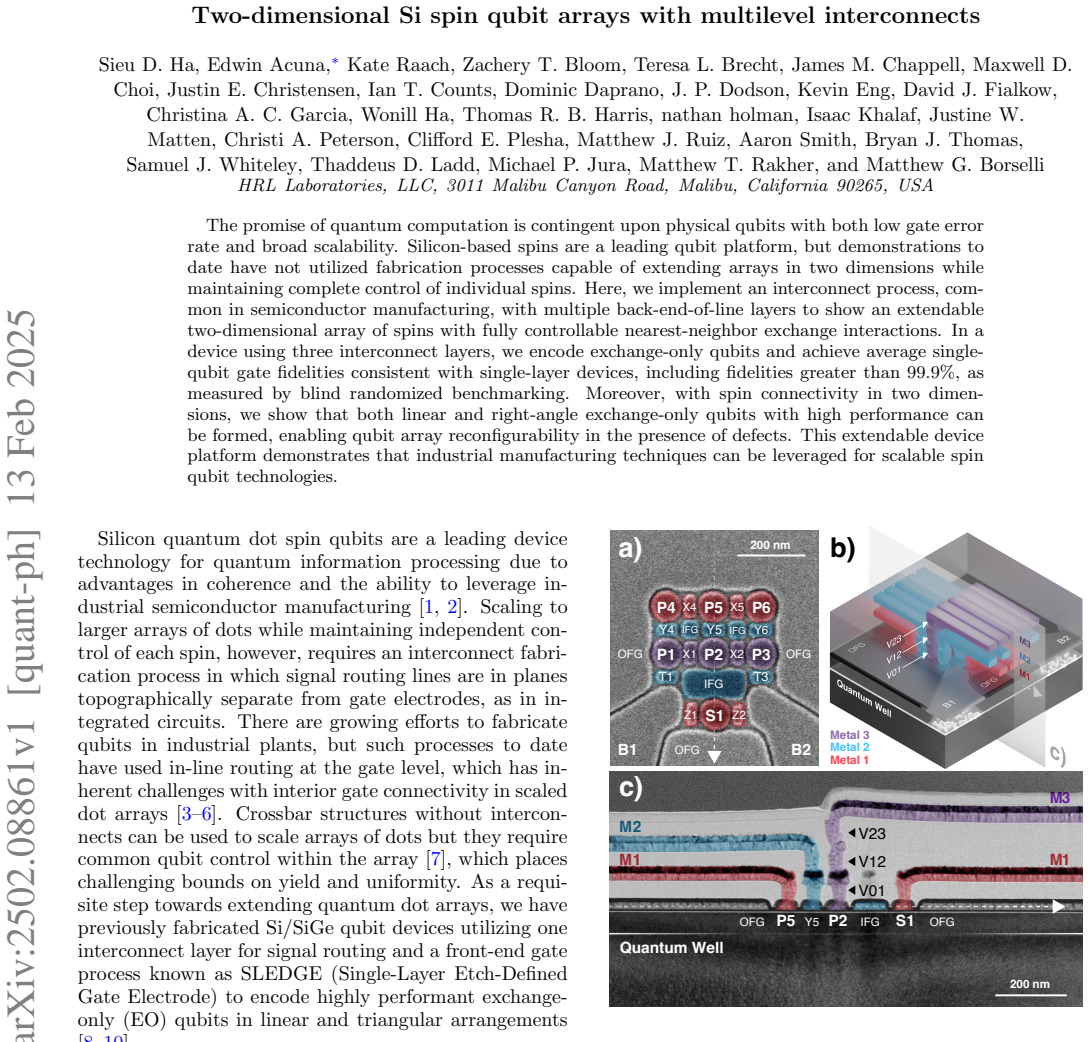
The three-layer back-end-of-line interconnect stack that supplies independent control lines to every nearest-neighbor pair while preserving exchange tunability across the plane.
If this is right
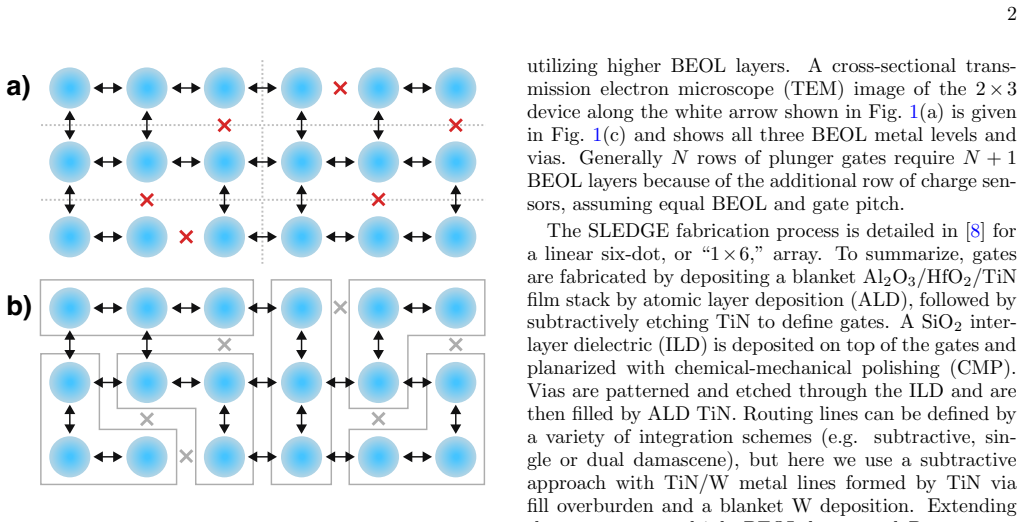
- Both linear and right-angle exchange-only qubits can be formed and operated at high fidelity in the same array.
- Defective qubits can be bypassed by switching between linear and right-angle encodings.
- The same interconnect architecture can be extended to larger arrays without redesign of the qubit layer itself.
- Standard industrial semiconductor processes become directly applicable to spin-qubit scaling.
Where Pith is reading between the lines
- The approach may allow classical control electronics to be integrated on additional metal layers above the qubit plane.
- Similar multilayer wiring could be tested on other spin-qubit variants or on superconducting circuits that also require dense nearest-neighbor coupling.
- If the noise floor remains unchanged with added layers, the platform could support error-corrected logical qubits whose physical density exceeds current one-dimensional limits.
Load-bearing premise
Adding the extra interconnect layers does not introduce new charge noise, strain, or defects that would lower spin coherence or exchange control beyond the levels already present in single-layer devices.
What would settle it
A direct comparison showing that average single-qubit gate fidelity in the three-layer device falls measurably below the fidelity obtained on an otherwise identical single-layer device would falsify the consistency claim.
Figures


read the original abstract
The promise of quantum computation is contingent upon physical qubits with both low gate error rate and broad scalability. Silicon-based spins are a leading qubit platform, but demonstrations to date have not utilized fabrication processes capable of extending arrays in two dimensions while maintaining complete control of individual spins. Here, we implement an interconnect process, common in semiconductor manufacturing, with multiple back-end-of-line layers to show an extendable two-dimensional array of spins with fully controllable nearest-neighbor exchange interactions. In a device using three interconnect layers, we encode exchange-only qubits and achieve average single-qubit gate fidelities consistent with single-layer devices, including fidelities greater than 99.9%, as measured by blind randomized benchmarking. Moreover, with spin connectivity in two dimensions, we show that both linear and right-angle exchange-only qubits with high performance can be formed, enabling qubit array reconfigurability in the presence of defects. This extendable device platform demonstrates that industrial manufacturing techniques can be leveraged for scalable spin qubit technologies.
Editorial analysis
A structured set of objections, weighed in public.
Referee Report
Summary. The manuscript reports the implementation of a three-layer back-end-of-line interconnect process for creating two-dimensional arrays of silicon spin qubits with fully controllable nearest-neighbor exchange. Exchange-only qubits are encoded, achieving average single-qubit gate fidelities consistent with single-layer devices and exceeding 99.9% as measured by blind randomized benchmarking. The platform also enables both linear and right-angle qubit configurations for array reconfigurability around defects.
Significance. This work is significant for demonstrating that standard semiconductor manufacturing interconnects can be integrated into spin qubit devices without apparent degradation of performance, addressing a major hurdle in scaling silicon spin qubits to two dimensions. The blind benchmarking and reconfigurability demonstrations are notable strengths if the consistency claim is substantiated.
major comments (1)
- [Abstract and Results] The assertion that fidelities are consistent with single-layer devices (Abstract) lacks supporting quantitative data such as direct comparisons of fidelity distributions, T2* coherence times, or exchange coupling histograms between the multilevel interconnect device and single-layer controls; this is load-bearing for the claim that the interconnect process introduces no additional noise or defects.
minor comments (1)
- [Abstract] The abstract could more precisely specify the number of qubits or devices tested to support the yield and consistency claims.
Simulated Author's Rebuttal
We thank the referee for their thorough review and valuable comments. We address the single major comment below.
read point-by-point responses
-
Referee: [Abstract and Results] The assertion that fidelities are consistent with single-layer devices (Abstract) lacks supporting quantitative data such as direct comparisons of fidelity distributions, T2* coherence times, or exchange coupling histograms between the multilevel interconnect device and single-layer controls; this is load-bearing for the claim that the interconnect process introduces no additional noise or defects.
Authors: We agree that direct quantitative comparisons are needed to fully substantiate the consistency claim. In the revised manuscript we will add a new supplementary figure (or main-text panel) that directly compares the multilevel-interconnect device against single-layer control devices fabricated in the same process flow. The comparison will include (i) histograms of single-qubit gate fidelities obtained from blind randomized benchmarking, (ii) T2* coherence-time distributions, and (iii) exchange-coupling histograms measured on nearest-neighbor pairs. These data will be accompanied by a brief statistical test (e.g., Kolmogorov-Smirnov) to quantify consistency. We believe this addition will address the referee’s concern without altering the central conclusions of the work. revision: yes
Circularity Check
No circularity: experimental device demonstration with direct measurements
full rationale
This is an experimental fabrication and characterization paper reporting measured single-qubit gate fidelities via blind randomized benchmarking in a multilevel-interconnect Si spin qubit array. No equations, derivations, or fitted parameters are presented that reduce the reported fidelities (>99.9% or consistency with single-layer devices) to inputs defined by the same data. The central claim rests on empirical RB results rather than any self-definitional, fitted-prediction, or self-citation chain. The assumption that the interconnect stack adds no extra noise is an empirical premise tested by the measurements themselves, not a circular reduction. No load-bearing steps match the enumerated circularity patterns.
Axiom & Free-Parameter Ledger
Lean theorems connected to this paper
-
IndisputableMonolith/Foundation/RealityFromDistinction.leanreality_from_one_distinction unclear?
unclearRelation between the paper passage and the cited Recognition theorem.
In a device using three interconnect layers, we encode exchange-only qubits and achieve average single-qubit gate fidelities consistent with single-layer devices, including fidelities greater than 99.9%, as measured by blind randomized benchmarking.
-
IndisputableMonolith/Cost/FunctionalEquation.leanwashburn_uniqueness_aczel unclear?
unclearRelation between the paper passage and the cited Recognition theorem.
Exchange-only qubits are instantiated using a triple-quantum-dot (TQD) decoherence-free subsystem (DFS) encoding
What do these tags mean?
- matches
- The paper's claim is directly supported by a theorem in the formal canon.
- supports
- The theorem supports part of the paper's argument, but the paper may add assumptions or extra steps.
- extends
- The paper goes beyond the formal theorem; the theorem is a base layer rather than the whole result.
- uses
- The paper appears to rely on the theorem as machinery.
- contradicts
- The paper's claim conflicts with a theorem or certificate in the canon.
- unclear
- Pith found a possible connection, but the passage is too broad, indirect, or ambiguous to say the theorem truly supports the claim.
Forward citations
Cited by 1 Pith paper
-
CAbLECAR: efficiently scheduling QLDPC codes on a tileable spin qubit chip with shuttling
CAbLECAR provides a robotics-inspired shuttle scheduler that enables QLDPC codes on tileable spin-qubit hardware, yielding up to 86% faster schedules and orders-of-magnitude gains in encoding efficiency and logical er...
Reference graph
Works this paper leans on
-
[1]
G. Burkard, T. D. Ladd, J. M. Nichol, A. Pan, and J. R. Petta, Semiconductor spin qubits, Rev. Mod. Phys. 95, 025003 (2023)
work page 2023
-
[2]
N. D. Stuyck, A. Saraiva, W. Gilbert, J. C. Pardo, R. Li, C. C. Escott, K. D. Greve, S. Voinigescu, D. J. Reilly, and A. S. Dzurak, CMOS compatibility of semiconductor spin qubits (2024), arXiv:2409.03993 [cond-mat.mes-hall]
work page internal anchor Pith review Pith/arXiv arXiv 2024
-
[3]
B. Bertrand, B. Martinez, J. Li, B. C. Paz, V. Mil- lory, V. Labracherie, L. Br´ evard, H. Sahin, G. Rous- sely, A. Sarrazin, T. Meunier, M. Vinet, Y.-M. Niquet, B. Brun, R. Maurand, S. De Franceschi, and H. Niebo- jewski, Tunnel and capacitive coupling optimization in FDSOI spin-qubit devices, in 2023 International Electron Devices Meeting (IEDM) (2023) pp. 1–4
work page 2023
-
[4]
A. M. J. Zwerver, T. Kr¨ ahenmann, T. F. Watson, L. Lampert, H. C. George, R. Pillarisetty, S. A. Bojarski, P. Amin, S. V. Amitonov, J. M. Boter, R. Caudillo, D. Correas-Serrano, J. P. Dehollain, G. Droulers, E. M. Henry, R. Kotlyar, M. Lodari, F. L¨ uthi, D. J. Michalak, B. K. Mueller, S. Neyens, J. Roberts, N. Samkharadze, G. Zheng, O. K. Zietz, G. Scap...
work page 2022
-
[5]
A. Elsayed, M. M. K. Shehata, C. Godfrin, S. Kubicek, S. Massar, Y. Canvel, J. Jussot, G. Simion, M. Mongillo, D. Wan, B. Govoreanu, I. P. Radu, R. Li, P. Van Dorpe, and K. De Greve, Low charge noise quantum dots with industrial CMOS manufacturing, npj Quantum Informa- tion 10, 70 (2024)
work page 2024
-
[6]
S. G. J. Philips, M. T. Madzik, S. V. Amitonov, S. L. de Snnoo, M. Russ, N. Kalhor, C. Volk, D. Lawrie, William I. L. anf Brousse, L. Tryputen, B. P. Wuetz, A. Sammak, M. Veldhorst, G. Scappucci, and L. M. K. Vandersypen, Universal control of a six-qubit quantum processor in silicon, Nature 609, 919 (2022)
work page 2022
- [7]
-
[8]
W. Ha, S. D. Ha, M. D. Choi, Y. Tang, A. E. Schmitz, M. P. Levendorf, K. Lee, J. M. Chappell, T. S. Adams, D. R. Hulbert, E. Acuna, R. S. Noah, J. W. Matten, M. P. Jura, J. A. Wright, M. T. Rakher, and M. G. Borselli, A Flexible Design Platform for Si/SiGe Exchange-Only Qubits with Low Disorder, Nano Lett. 22, 1443 (2022)
work page 2022
-
[9]
A. J. Weinstein, M. D. Reed, A. M. Jones, R. W. An- drews, D. Barnes, J. Z. Blumoff, L. E. Euliss, K. Eng, B. Fong, S. D. Ha, R. R. Hulbert, C. Jackson, M. Jura, T. E. Keating, J. Kerckhoff, A. A. Kiselev, J. Matten, G. Sabbir, A. Smith, J. Wright, M. T. Rakher, T. D. Ladd, and M. G. Borselli, Universal logic with encoded spin qubits in silicon, Nature 61...
work page 2023
-
[10]
E. Acuna, J. D. Broz, K. Shyamsundar, A. B. Mei, C. P. Feeney, V. Smetanka, T. Davis, K. Lee, M. D. Choi, B. Boyd, J. Suh, W. Ha, C. Jennings, A. S. Pan, D. S. Sanchez, M. D. Reed, and J. R. Petta, Coherent con- trol of a triangular exchange-only spin qubit, Phys. Rev. Appl. 22, 044057 (2024)
work page 2024
-
[11]
J. Z. Blumoff, A. S. Pan, T. E. Keating, R. W. Andrews, D. W. Barnes, T. L. Brecht, E. T. Croke, L. E. Euliss, J. A. Fast, C. A. Jackson, A. M. Jones, J. Kerckhoff, R. K. Lanza, K. Raach, B. J. Thomas, R. Velunta, A. J. Weinstein, T. D. Ladd, K. Eng, M. G. Borselli, A. T. Hunter, and M. T. Rakher, Fast and high-fidelity state preparation and measurement i...
work page 2022
-
[12]
D. P. DiVincenzo, D. Bacon, J. Kempe, G. Burkard, and 6 K. B. Whaley, Universal quantum computation with the exchange interaction, Nature 408, 339 (2000)
work page 2000
-
[13]
R. W. Andrews, C. Jones, M. D. Reed, A. M. Jones, S. D. Ha, M. P. Jura, J. Kerckhoff, M. Levendorf, S. Meenehan, S. T. Merkel, A. Smith, B. Sun, A. J. Weinstein, M. T. Rakher, T. D. Ladd, and M. G. Borselli, Quantifying error and leakage in an encoded Si/SiGe triple-dot qubit, Nat. Nanotechnol. 14, 747 (2019)
work page 2019
-
[14]
A. M. Jones, E. J. Pritchett, E. H. Chen, T. E. Keating, R. W. Andrews, J. Z. Blumoff, L. A. De Lorenzo, K. Eng, S. D. Ha, A. A. Kiselev, S. M. Meenehan, S. T. Merkel, J. A. Wright, L. F. Edge, R. S. Ross, M. T. Rakher, M. G. Borselli, and A. T. Hunter, Spin-blockade spectroscopy of Si/Si-Ge quantum dots, Phys. Rev. Appl. 12, 014026 (2019)
work page 2019
-
[15]
Y. P. Kandel, H. Qiao, S. Fallahi, G. C. Gardner, M. J. Manfra, and J. M. Nichol, Coherent spin-state transfer via Heisenberg exchange, Nature 573, 553 (2019)
work page 2019
-
[16]
M. D. Reed, B. M. Maune, R. W. Andrews, M. G. Borselli, K. Eng, M. P. Jura, A. A. Kiselev, T. D. Ladd, S. T. Merkel, I. Milosavljevic, E. J. Pritchett, M. T. Rakher, R. S. Ross, A. E. Schmitz, A. Smith, J. A. Wright, M. F. Gyure, and A. T. Hunter, Reduced sensitivity to charge noise in semiconductor spin qubits via symmetric operation, Phys. Rev. Lett. 11...
work page 2016
-
[17]
F. Martins, F. K. Malinowski, P. D. Nissen, E. Barnes, S. Fallahi, G. C. Gardner, M. J. Manfra, C. M. Mar- cus, and F. Kuemmeth, Noise suppression using symmet- ric exchange gates in spin qubits, Phys. Rev. Lett. 116, 116801 (2016)
work page 2016
-
[18]
A. Pirati, R. Peeters, D. Smith, S. Lok, M. van Noorden- burg, R. van Es, E. Verhoeven, H. Meijer, A. Minnaert, J.-W. van der Horst, H. Meiling, J. Mallmann, C. Wag- ner, J. Stoeldraijer, G. Fisser, J. Finders, C. Zoldesi, U. Stamm, H. Boom, D. Brandt, D. Brown, I. Fomenkov, and M. Purvis, EUV lithography performance for man- ufacturing: status and outloo...
work page 2016
-
[19]
D. M. Zajac, T. M. Hazard, X. Mi, E. Nielsen, and J. R. Petta, Scalable gate architecture for a one-dimensional array of semiconductor spin qubits, Phys. Rev. Appl. 6, 054013 (2016)
work page 2016
-
[20]
J. I. Colless, A. C. Mahoney, J. M. Hornibrook, A. C. Doherty, H. Lu, A. C. Gossard, and D. J. Reilly, Disper- sive readout of a few-electron double quantum dot with fast rf gate sensors, Phys. Rev. Lett. 110, 046805 (2013)
work page 2013
-
[21]
A. West, B. Hensen, A. Jouan, T. Tanttu, C.-H. Yang, A. Rossi, M. F. Gonzalez-Zalba, F. Hudson, A. Morello, D. J. Reilly, and A. S. Dzurak, Gate-based single-shot readout of spins in silicon, Nature Nanotechnology 14, 437 (2019)
work page 2019
-
[22]
B. Sun, T. Brecht, B. H. Fong, M. Akmal, J. Z. Blumoff, T. A. Cain, F. W. Carter, D. H. Finestone, M. N. Fire- man, W. Ha, A. T. Hatke, R. M. Hickey, C. A. C. Jack- son, I. Jenkins, A. M. Jones, A. Pan, D. R. Ward, A. J. Weinstein, S. J. Whiteley, P. Williams, M. G. Borselli, M. T. Rakher, and T. D. Ladd, Full-Permutation Dy- namical Decoupling in Triple-...
work page 2024
-
[23]
F. Setiawan, H.-Y. Hui, J. P. Kestner, X. Wang, and S. D. Sarma, Robust two-qubit gates for exchange-coupled qubits, Phys. Rev. B 89, 085314 (2014)
work page 2014
discussion (0)
Sign in with ORCID, Apple, or X to comment. Anyone can read and Pith papers without signing in.