REVIEW 5 major objections 5 minor 17 references
Biologically Plausible Brain Graph Transformer
T0 review · 5 major / 5 minor · reviewed 2026-08-07 · deepseek-v4-flash
Pith's one-line read A graph transformer that explicitly encodes hubs and functional modules of brain graphs outperforms prior models on autism, ADHD, and Alzheimer's/MCI detection benchmarks.
desk verdict Useful engineering combination, but the 'biologically plausible' claim rests on an unvalidated Louvain-to-modules mapping and should be tempered or backed by quantitative atlas agreement. read the letter →
The pith
A machine-rendered reading of the paper's core claim, the machinery that carries it, and where it could break.
The reading
What carries the argument
The central machinery is twofold. First, network entanglement-based node importance encoding: the brain graph is treated as a density matrix $\rho_G = e^{-\gamma L}/Z$ built from the Laplacian $L$, and node importance is defined as $NE(i) = \|S(G_i) - S(G)\|$, the change in spectral entropy after perturbing node $i$; the paper proves an approximation formula (Theorem 1) and embeds a learnable vector per importance level into each node's input representation. Second, functional module-aware self-attention: Louvain community detection partitions the graph into functional modules, two augmented views are passed through a GNN view encoder, an InfoNCE contrastive loss treats same-module nodes as positives and cross-module nodes as negatives (the functional module extractor), and the resulting module-aware representations feed an exponential-kernel self-attention; Theorem 2 shows this attention is Lipschitz, so distances between same-module nodes remain small.
What would settle it
Take the ADHD-200 graphs, run Louvain as the paper does, and compare the resulting communities against the Dosenbach et al. (2010) functional module labels using a partition-overlap measure such as normalized mutual information. If the overlap is low (say NMI near zero or at chance), the functional module extractor is enforcing spurious structure, and the model's attention patterns would not be aligning with genuine functional modules; that would directly falsify the biological-plausibility claim for FM-Attn.
Extended reading notes
Core claim
The paper's central claim is that the small-world architecture of brain graphs can be converted into inductive biases that improve both performance and plausibility. Specifically, node importance computed as network entanglement (NE), the change in density-matrix spectral entropy before and after perturbing a node's local connections, captures hub-like roles in global information propagation; and a functional module-aware self-attention (FM-Attn), trained with a contrastive loss on Louvain-derived communities, keeps node representations within a module close and across modules distant. With these two components, BioBGT achieves 74.00% accuracy on ABIDE, 52.08% on ADNI, and 71.06% on ADHD-200, outperforming the compared state-of-the-art graph transformers and brain graph GNNs; ablation studies attribute the gains to both components. The paper also argues that the model's attention heatmaps reflect known functional modules and disease-related differences, e.g., weakened hub properties in autism and blurred module structure in Alzheimer's.
Load-bearing premise
The result rests on Louvain community detection finding the brain's true functional modules; if Louvain's communities do not match real functional systems, the contrastive loss will enforce arbitrary groupings and the claimed preservation of functional segregation and integration collapses.
Editorial extensions
If this is right
- Brain disorder detection on fMRI connectomes improves with biologically grounded encodings: BioBGT reports top accuracy on autism (ABIDE), ADHD (ADHD-200), and Alzheimer's/MCI (ADNI) classification.
- Learned attention weights become interpretable: they separate normal controls from patient groups along known axes, such as weakened hub properties in ASD and reduced modularity in AD, offering a potentially inspectable biomarker.
- The two components transfer beyond brain graphs: the paper shows BioBGT also works on citation networks (Citeseer, Cora), suggesting the hub-and-module encoding is a general graph prior.
- The network-entanglement encoding provides a global, perturbation-based alternative to degree, betweenness, closeness, and eigenvector centrality, which the paper argues are fragile for brain communication networks.
Reading between the lines
- The paper never validates Louvain's partitions against a functional atlas; a direct test on ADHD-200, which has Dosenbach et al. labels, would turn the weakest assumption into a quantitative check.
- Because Theorem 1's NE approximation uses a mean-field step assuming the number of connected components is unchanged by node perturbation, graphs where node deletion splits components may violate the assumption; robustness to such graphs is left open.
- When functional module labels are available (e.g., from atlases), the community contrastive extractor could be replaced by a supervised module encoder, potentially removing the Louvain dependence entirely.
- Disease-specific heatmap differences (NC vs ADHD vs ASD vs AD/MCI) suggest a quantifiable biomarker: module-level attention strength could be tested as a diagnostic or progression metric on larger cohorts.
Editorial analysis
A structured set of objections, weighed in public.
Referee Report
Summary. The paper proposes BioBGT, a graph transformer for brain-graph classification that aims to encode the small-world architecture of brain networks through two components: a network-entanglement-based node importance encoding (Section 3.1) and a functional-module-aware self-attention mechanism (Section 3.2) built on a Louvain-based community contrastive module extractor. The model is evaluated on ABIDE, ADNI, and ADHD-200 for disease classification, with ablations, node-importance comparisons, attention-heatmap analyses, and two theoretical statements (Theorems 1 and 2). The paper reports accuracy gains over a broad set of baselines on the three datasets and claims enhanced biological plausibility of the learned representations.
Significance. If the biological-plausibility claims are properly supported, the paper would make a useful contribution by injecting explicit small-world structure—hubs and functional modules—into graph transformers for connectomics. The manuscript has notable strengths: the code is publicly released, the experimental comparison spans three standard fMRI datasets and many baselines, results are averaged over 10 runs, and the ablation studies isolate the two proposed components. The authors also include explicit discussion of limitations and provide visual comparisons of node-importance values with node efficiency and functional-connectivity strength. However, the biological validation is mostly qualitative, the key assumption in Theorem 1 is not checked, and Theorem 2 does not establish the module-preservation property it is claimed to guarantee. The central claims are defensible in principle, but they need additional quantitative validation and a more careful framing of the theoretical results.
major comments (5)
- [Section 3.1, Theorem 1] Theorem 1 approximates the node-entanglement value under the assumption that the number of connected components in the i-control graph equals that of the original graph, i.e., α_i = α. This assumption is likely to fail precisely for hub nodes, which are the nodes the method is designed to highlight: removing or perturbing a hub can disconnect the graph and increase the number of connected components. The paper does not check this condition empirically or justify it for brain graphs. Since node importance encoding is one of the two core contributions, the approximation in Eq. (6) needs either a derivation that handles α_i ≠ α or an empirical verification that the assumption holds on the datasets used.
- [Section 3.2.1, Appendix D.5] The functional module extractor treats Louvain communities as if they were the brain's functional modules and trains a contrastive loss that pulls same-community nodes together and pushes different-community nodes apart. The paper never validates Louvain partitions against known functional atlases, such as the Dosenbach labels that are available for ADHD-200. The only evidence provided in Section 4.5 and Figure 5 is a visual comparison of attention heatmaps, and Appendix D.5 explicitly states that no functional-module labels are available for ABIDE and ADNI. If the Louvain communities do not correspond to true functional modules, the contrastive objective enforces spurious groupings and the claimed preservation of functional segregation and integration is not established. I recommend reporting a quantitative agreement measure (e.g., NMI or ARI) between Louvain partitions and Dosenbach labels on ADHD-200, and either obtaining labels for the other datasets or substantially softening the biological-claim language for ABIDE and ADNI.
- [Section 3.2.2, Theorem 2] Theorem 2 assumes that the functional module extractor ψ is bounded by a constant Cψ, but no such bound is proved or even discussed; ψ includes Louvain community detection, a GNN view encoder, and a contrastively trained representation, so this is not an innocuous assumption. More importantly, the theorem's conclusion is a Lipschitz bound on the attention output, which only says that relative distances do not grow without control. It does not state or prove that nodes from the same functional module remain close while nodes from different modules remain far, nor does it relate the output representation to any ground-truth or Louvain module partition. The phrase 'controllably preserve functional modules' in the text therefore goes beyond what the theorem establishes. I recommend reframing Theorem 2 as a stability or Lipschitz-continuity result and supporting the module-preservation claim empirically instead.
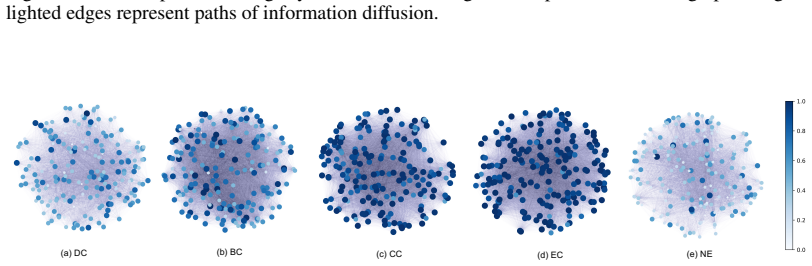
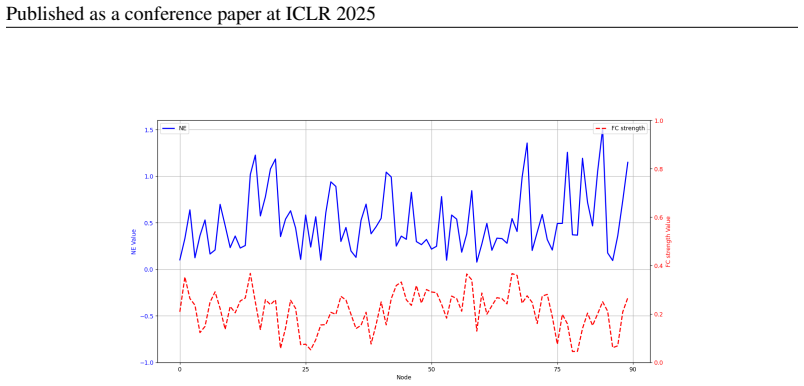
- [Section 4.5, Appendices D.3 and D.4] The biological validation of the NE component is based on visual inspection of NE curves against node-efficiency (NEff) and functional-connectivity-strength curves for one randomly selected graph per dataset. No correlation coefficient, rank correlation, or subject-level aggregation is reported. Since this is the only direct evidence that NE captures biologically meaningful node importance, the claim that 'NE aligns with biological plausibility' needs a quantitative summary, such as Spearman correlation between NE and NEff across subjects, along with confidence intervals.
- [Abstract, Tables 1 and 7] The abstract states that BioBGT 'outperforms state-of-the-art models' without qualification. On ADNI, however, BioBGT's F1 score (32.29±2.31) is lower than MCST-GCN (37.44±3.12) and GroupBNA (35.85±1.38) in Table 7, even though BioBGT achieves the best ACC and AUC in Table 1. The claim should be made metric-specific or per-dataset, and the main text should acknowledge that the advantage is not uniform across all evaluation metrics.
minor comments (5)
- [Table 2] The ADNI AUC for BioBGT is listed as 61.33±5.98 in Table 2 but 62.33±5.98 in Table 1; these values should be reconciled.
- [Table 2] In the +BC row of Table 2, the ADHD-200 AUC is written as '70.09±1,05' with a comma as the decimal separator; this should be '70.09±1.05' for consistency.
- [Equation (8)] The InfoNCE loss in Eq. (8) sums only nNeg negative samples in the denominator and does not include the positive term in the denominator; with multiple positive samples per anchor, the loss form is ambiguous. Please specify how positives are selected, how many there are, and whether the denominator follows the standard InfoNCE form.
- [Section 3.2.1 and Appendix C] The edge-dropping augmentation is described qualitatively, but the main text and hyperparameter table do not state the edge-dropping ratio or the number of negative samples nNeg. These are needed for reproducibility.
- [Table 10] The generalizability analysis on citation networks is summarized as showing 'superiority' of BioBGT, but on Cora the AUC of BioBGT (94.58) is lower than GAT (97.38), and on Citeseer the gains over SAT+PE are small. The conclusion should be softened to indicate competitive rather than uniformly superior performance.
Circularity Check
No significant circularity: the model is trained on external disease labels and evaluated on held-out test splits; the Louvain-based contrastive loss is a design mechanism, and the unquantified Louvain-to-Dosenbach mapping is a validation gap, not a circular derivation.
full rationale
The paper's derivation chain is self-contained. The node importance encoding (Eq. 7) is built on network entanglement as defined by Huang et al. (2024), an external published method, and the agreement with NEff is a post-hoc analysis rather than a fitted parameter used in training. The functional module extractor (Sec. 3.2.1) assigns module memberships via Louvain and trains a contrastive loss (Eq. 8) that pulls same-module representations together; the functional module-aware self-attention (Eq. 9) then computes similarity on those representations. Thus high intra-Louvain-community attention similarity is a direct consequence of the training objective, but the paper presents this as a design goal, not as an empirical prediction. The biological plausibility validation against Dosenbach labels (Sec. 4.5, Fig. 5) is qualitative, and Appendix D.5 explicitly states that no functional-module labels are available for ABIDE and ADNI; this is a genuine evidence gap about whether Louvain communities match functional modules, but it is not a circularity because the disease-classification accuracy is measured against held-out external labels and the ablations isolate the components. The theorems are proved from stated assumptions using standard Lipschitz properties of softmax (Gao & Pavel, 2017), not from self-citations. Self-citations (e.g., GroupBNA, quantum graph learning survey) appear only as baselines or background and are not load-bearing. No circular step is identified.
Assumptions & free parameters
free parameters (5)
- Gamma (gamma) =
not specified
- Edge weight threshold =
0.3 (ABIDE), 0 (ADNI, ADHD-200)
- Louvain resolution parameter =
not specified
- Edge dropping ratio =
not specified
- Number of negative samples (nNeg) =
not specified
assumptions (4)
- standard math Mean-field approximation: <lambda_j(L) lambda_j(rho_G)> is approximated by <lambda_j(L)> <lambda_j(rho_G)>
- domain assumption The i-control graph has the same number of connected components as the original graph (alpha_i = alpha)
- domain assumption Louvain-detected communities correspond to functional modules of the brain
- ad hoc to paper The functional module extractor psi is bounded by a constant C_psi
Cite this review
Pith. "Pith review of Biologically Plausible Brain Graph Transformer." pith.science (2026). https://pith.science/paper/FZB7X7YZ
@misc{pith2026250208958,
  author       = {Pith},
  title        = {Pith review of: Biologically Plausible Brain Graph Transformer},
  year         = {2026},
  howpublished = {\url{https://pith.science/paper/FZB7X7YZ}},
  note         = {Machine review of arXiv:2502.08958}
}
read the original abstract
State-of-the-art brain graph analysis methods fail to fully encode the small-world architecture of brain graphs (accompanied by the presence of hubs and functional modules), and therefore lack biological plausibility to some extent. This limitation hinders their ability to accurately represent the brain's structural and functional properties, thereby restricting the effectiveness of machine learning models in tasks such as brain disorder detection. In this work, we propose a novel Biologically Plausible Brain Graph Transformer (BioBGT) that encodes the small-world architecture inherent in brain graphs. Specifically, we present a network entanglement-based node importance encoding technique that captures the structural importance of nodes in global information propagation during brain graph communication, highlighting the biological properties of the brain structure. Furthermore, we introduce a functional module-aware self-attention to preserve the functional segregation and integration characteristics of brain graphs in the learned representations. Experimental results on three benchmark datasets demonstrate that BioBGT outperforms state-of-the-art models, enhancing biologically plausible brain graph representations for various brain graph analytical tasks
Figures


Figures from the paper (13 more)






Reference graph
Works this paper leans on
-
[2]
∥FM-Attn(a) − FM-Attn(b)∥ ≤CM∥ha − hb∥. B R ELIABILITY OF NE FOR NODE IMPORTANCE MEASURING Given a node i, its importance degree in the information propagation across the graph is defined as its NE value, which is obtained by measuring the disparity between the density matrix-based spectral entropy of the original graph and that of thei-control graph. The...
work page 2023
-
[3]
Table 3: Hyperparameters for training BioBGT on three different datasets. Hyperparameter ABIDE ADNI ADHD-200 #Layers 3 3 3 #Attention heads 8 8 8 Threshold of edge weight 0.3 0 0 Hidden dimensions 128 128 128 FFN hidden dimensions 256 256 256 Dropout 0.5 0.1 0.1 Readout method mean mean mean Learning rate 3e-4 3e-4 3e-4 Batch size 128 128 128 #Epochs 200 ...
work page 2025
-
[6]
On the properties of the softmax function with application in game theory and reinforcement learning
Bolin Gao and Lacra Pavel. On the properties of the softmax function with application in game theory and reinforcement learning. arXiv preprint arXiv:1704.00805,
-
[11]
13 Published as a conference paper at ICLR 2025 Caio Seguin, Olaf Sporns, Andrew Zalesky, Fernando Calamante, et al. Network communication models narrow the gap between the modular organization of structural and functional brain networks. NeuroImage, 257:119323,
work page 2025
-
[13]
NAR-Former V2: Rethinking transformer for universal neural network representation learning
14 Published as a conference paper at ICLR 2025 Yun Yi, Haokui Zhang, Rong Xiao, Nannan Wang, and Xiaoyu Wang. NAR-Former V2: Rethinking transformer for universal neural network representation learning. Advances in Neural Information Processing Systems, 36,
work page 2025
-
[14]
Quantum graph learning: Frontiers and outlook
Shuo Yu, Ciyuan Peng, Yingbo Wang, Ahsan Shehzad, Feng Xia, and Edwin R Hancock. Quantum graph learning: Frontiers and outlook. arXiv preprint arXiv:2302.00892,
-
[15]
15 Published as a conference paper at ICLR 2025 A P ROOFS A.1 P ROOF OF PROPOSITION 1 Proposition 1 (Density matrix as structural information.) The structural information of a brain graph G, including the connection strength between nodes and the degree distribution of nodes, is encoded by its density matrix, which stands as a normalized information diffu...
work page 2024
-
[2000]
Graphit: Encoding graph structure in transformers
Grégoire Mialon, Dexiong Chen, Margot Selosse, and Julien Mairal. Graphit: Encoding graph structure in transformers. arXiv preprint arXiv:2106.05667,
Show all 17 references
-
[2007]
Prediction of individual brain maturity using fMRI
11 Published as a conference paper at ICLR 2025 Nico UF Dosenbach, Binyam Nardos, Alexander L Cohen, Damien A Fair, Jonathan D Power, Jessica A Church, Steven M Nelson, Gagan S Wig, Alecia C V ogel, Christina N Lessov-Schlaggar, et al. Prediction of individual brain maturity u...
2025
-
[2009]
A whole brain fMRI atlas generated via spatially constrained spectral clustering
R Cameron Craddock, G Andrew James, Paul E Holtzheimer III, Xiaoping P Hu, and Helen S Mayberg. A whole brain fMRI atlas generated via spatially constrained spectral clustering. Human Brain Mapping, 33(8):1914–1928,
1914
-
[2010]
A generalization of transformer networks to graphs
Vijay Prakash Dwivedi and Xavier Bresson. A generalization of transformer networks to graphs. arXiv preprint arXiv:2012.09699,
2012 arXiv
-
[2017]
Gradformer: Graph transformer with exponential decay
12 Published as a conference paper at ICLR 2025 Chuang Liu, Zelin Yao, Yibing Zhan, Xueqi Ma, Shirui Pan, and Wenbin Hu. Gradformer: Graph transformer with exponential decay. In Proceedings of the Thirty-Third International Joint Confer- ence on Artificial Intelligence, Jeju, ...
2025
-
[2018]
Adaptive brain network aug- mentation based on group-aware graph learning
Ciyuan Peng, Mujie Liu, Chenxuan Meng, Shuo Yu, and Feng Xia. Adaptive brain network aug- mentation based on group-aware graph learning. In The Second Tiny Papers Track at ICLR 2024,
2024
-
[2021]
Representation learning with contrastive predictive coding
Aaron van den Oord, Yazhe Li, and Oriol Vinyals. Representation learning with contrastive predictive coding. arXiv preprint arXiv:1807.03748,
-
[2022]
CSGCL: community- strength-enhanced graph contrastive learning
Han Chen, Ziwen Zhao, Yuhua Li, Yixiong Zou, Ruixuan Li, and Rui Zhang. CSGCL: community- strength-enhanced graph contrastive learning. In Proceedings of the Thirty-Second International Joint Conference on Artificial Intelligence, IJCAI, pp. 2059–2067,
-
[2023]
Graph transformers: A survey
Ahsan Shehzad, Feng Xia, Shagufta Abid, Ciyuan Peng, Shuo Yu, Dongyu Zhang, and Karin Verspoor. Graph transformers: A survey. arXiv preprint arXiv:2407.09777,
-
[2024]
Fast unfolding of communities in large networks
Vincent D Blondel, Jean-Loup Guillaume, Renaud Lambiotte, and Etienne Lefebvre. Fast unfolding of communities in large networks. Journal of Statistical Mechanics: Theory and Experiment, 2008 (10):P10008,
2008
Reviewed August 7, 2026 · model on record in the stance chip above.
Discussion (0). Sign in to comment.