REVIEW 3 major objections 6 minor 2 cited by
Designing a Conditional Prior Distribution for Flow-Based Generative Models
T0 review · 3 major / 6 minor · reviewed 2026-08-07 · deepseek-v4-flash
Pith's one-line read The paper claims that placing a condition-specific Gaussian prior at each condition's average data point shortens the flow and cuts the sampling steps needed for high-quality conditional generation.
desk verdict A genuinely useful conditional prior for flow matching, with a solid empirical story and one acknowledged assumption that could use a robustness check. read the letter →
The pith
A machine-rendered reading of the paper's core claim, the machinery that carries it, and where it could break.
The reading
What carries the argument
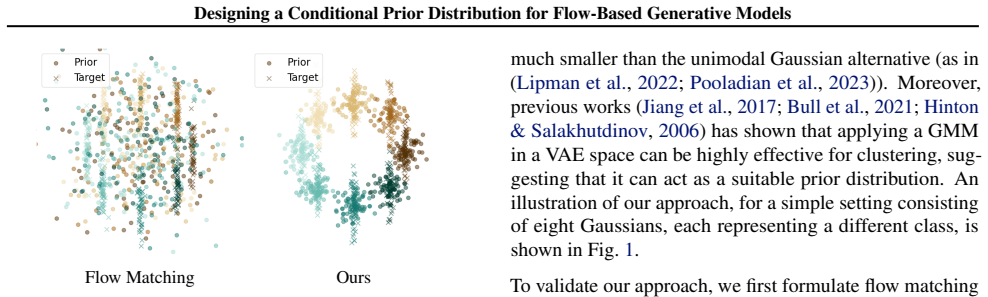
The load-bearing object is the conditional prior distribution (CPD), a Gaussian mixture model with one component per condition, placed in a latent space. Each component's mean is the condition's average data point, so the condition information enters before the flow starts; for discrete classes the mean and covariance are estimated from training samples, and for text prompts a learned mapper sends the prompt embedding to that mean. The matching training objective is Conditional Generation Joint Flow Matching (CGJFM), which generalizes flow matching to an arbitrary joint distribution $q(x_0, x_1, c)$ and uses the linear interpolant $\psi_t(x|x_1,c) = \sigma_t x + \mu_t$ with $\sigma_t = t\sigma_{\min}I + (1-t)\Sigma_c^{1/2}$ and $\mu_t = t x_1 + (1-t)\mu_c$. The network regresses the velocity field this interpolant induces, and the efficiency argument runs through the reduction in average path length $\Delta = |x_1 - x_0|$ that the condition-centered prior achieves.
What would settle it
Take a condition whose latent training examples split into two well-separated clusters and measure the average straight-line distance from the proposed Gaussian prior to the targets; if that distance is not smaller than the distance from a standard Gaussian prior, or if sampling at five to ten function evaluations shows no FID improvement, the central claim fails.
Extended reading notes
Core claim
Flow matching trains a neural network to reproduce a vector field that carries samples along interpolated paths between a source distribution and a target data distribution. The paper's discovery is that, in the conditional setting, the source should not be a fixed unimodal noise distribution shared by all conditions. It defines a conditional prior distribution $p_0 = \mathrm{GMM}(\mathcal{N}(\mu_i, \Sigma_i)_{i=1}^n, \pi)$, with $\mu_i = \mathbb{E}[x_1|c_i]$ and $\Sigma_i = \mathrm{cov}[x_1|c_i]$ in the latent space of a pretrained autoencoder; for text conditions, a trained mapper $P_\theta$ approximates $\mathbb{E}[x_1|c]$ from the condition embedding, and the covariance is a scalar hyperparameter. The model then learns the conditional vector field $\dot{x}_t = (\sigma_{\min}I - \Sigma_c^{1/2})x + x_1 - \mu_c$ that interpolates from that condition-specific Gaussian to the target. Because the prior is centered near the target mode, the average source-target distance drops, the velocity field has smaller Lipschitz constant, and the global truncation error bound permits larger step sizes. The paper claims this construction improves FID, KID, and CLIP scores at low numbers of function evaluations on ImageNet-64 and MS-COCO, and reaches convergence at roughly half the sampling steps of the strongest baselines.
Load-bearing premise
The argument assumes that, in the latent space, the training images belonging to a single condition form roughly one blob, so a single Gaussian centered at their average is a faithful starting distribution.
Editorial extensions
If this is right
- At low sampling budgets the gain is largest: on ImageNet-64 the method reaches FID 13.62 at 15 function evaluations, while the flow baselines are still above 16 at the same budget.
- Shorter average paths also speed up training, since the regression target is easier to fit when each source sample starts near its target; the paper shows a lower FID per epoch throughout training on MS-COCO.
- For text prompts, an unseen condition still receives a sensible prior center by passing its embedding through the trained mapper, so the benefit carries over to new prompts without retraining.
- The change is confined to the prior and the interpolant, leaving the network architecture untouched, so existing conditional flow-matching pipelines can adopt it as a drop-in replacement.
Reading between the lines
- A natural stress test the paper does not run: for conditions whose latent examples form several separated modes, a multi-component prior per condition should preserve the short-path benefit, while the single-Gaussian-per-condition version will see its advantage shrink; the toy experiment with intersecting classes already hints at this limit.
- The reported transport-cost numbers (570 and 510 versus 630 and 632 for the main baselines) could be used as a cheap, training-free diagnostic for whether a condition-aware prior will help on a new dataset.
- Because the prior center is produced by a deterministic mapping from text embedding to latent space, improving the text-image embedding itself should directly improve the prior centers and further reduce the required number of sampling steps.
Editorial analysis
A structured set of objections, weighed in public.
Referee Report
Summary. The paper proposes to replace the unimodal Gaussian prior used in conditional flow matching with a condition-specific Gaussian prior. For discrete conditions, the prior mean and covariance are estimated from per-class training data; for text conditions, a learned mapper regresses CLIP embeddings to the conditional mean in a pretrained latent space, and the covariance is fixed to an isotropic hyperparameter. The authors introduce a joint conditional flow matching objective (Eq. 16), define an affine interpolant between the condition-specific Gaussian and target samples (Eqs. 21-23), and evaluate the method on toy problems, ImageNet-64, and MS-COCO, reporting improved FID/KID/CLIP scores at low NFE as well as faster training convergence.
Significance. If the empirical results hold, the proposed idea is a simple and potentially useful drop-in modification for conditional flow matching, especially in compute-limited regimes. The paper contains a clean generalization of flow matching to arbitrary conditional joint distributions in Sec. 4.1, and it demonstrates consistent gains over CondOT and BatchOT at low NFE on two real datasets, with ablations isolating the role of sigma and the CLIP mapper. The contribution is incremental but practically relevant. The main concerns are formal precision of the flow construction and the unvalidated unimodality assumption for text conditions; both need to be addressed before the central claims can be considered fully supported.
major comments (3)
- [Sec. 4.1, Eq. (15)] The equality as written, ∫ p(x0|x1,c) dx1 dc = p(x0), is false under the definition p(x0|x1,c)=ρ(x0,x1,c)/q(x1,c). The integral over x1,c of p(x0|x1,c) weights by 1/q(x1,c), not by 1. The correct boundary condition is ∫ p(x0|x1,c) q(x1,c) dx1 dc = p(x0). Please correct the displayed equation and the surrounding derivation.
- [Secs. 4.2-4.3, Eqs. (21)-(24)] The role of the variable x in the interpolant is not consistent with the definition of x0 in Eqs. (13)-(16). In Sec. 4.2 x0 is a sample from p(x0|c)=N(μc,Σc), but Eq. (21) with σ0=Σc^{1/2} and μ0=μc gives ψ0(x0)=Σc^{1/2}x0+μc, which does not equal x0. If x in Eq. (21) is a standard Gaussian auxiliary variable, then x0 should be defined as σ0 x+μ0 and Eqs. (16) and (24) should be restated in terms of that variable. This is not a cosmetic issue: the objective in Eq. (16) and the ODE in Eq. (24) are only well-defined once the relationship between x0 and x is fixed.
- [Sec. 4.2 and Fig. 4] The claimed efficiency benefit depends on the assumption that each conditional distribution is approximately unimodal in the chosen latent space. The paper explicitly acknowledges this ('If the latter are close to being unimodal...'), but the assumption is not tested on real data. For MS-COCO, prompts describing multiple objects or attributes correspond to multimodal latent distributions, and the conditional mean may fall in low-density regions. The toy example in Fig. 4 shows only a small MMD gap (0.072 vs 0.084) in an intersecting case. All real-world results are reported as aggregate FID/KID/CLIP values without error bars or stratification by prompt complexity. Please provide per-condition or stratified results, or an explicit quantification of when the assumption fails.
minor comments (6)
- [Sec. 4.1, after Eq. (16)] Typo: 'we thus purpose' should be 'we thus propose'.
- [Sec. 4.2.1] Typo: 'represntation' should be 'representation'.
- [Fig. 5 caption] The caption notes that DDPM converges to a superior result given more steps, but the main text states that the method obtains superior results across all scores. Please clarify the NFE regime and qualify the claim accordingly.
- [Fig. 6 caption] The phrase 'NFE per training epoch' is unclear. Please specify how the NFE is computed (e.g., adaptive solver on a fixed validation batch at each epoch) and why it is reported on the training curve.
- [Table 1] Please specify the protocol used to compute the transport cost for the MS-COCO row, including how prior samples are drawn when the mapper is trained on the same data, and the number of pairs used.
- [Eq. (24)] The notation ψ0(x)=x0 is nonstandard; it should be ψ0(x0)=x0 or an explicit flow map from the initial condition.
Circularity Check
No circularity: the conditional prior is a data-driven construction and all reported gains are measured by external metrics.
full rationale
The paper's derivation chain is self-contained. The conditional prior p0 is defined in Eqs. 17-18 as a GMM whose per-class mean and covariance are the empirical statistics E[x1|ci] and cov[x1|ci]; for text, Eq. 20 trains a mapper Pθ to approximate E[x1|c] from CLIP embeddings. These are legitimate uses of training data to define a starting distribution, not fitted parameters that are then renamed as predictions. The flow-matching objective in Eq. 16 is the standard conditional flow-matching loss, regressing the velocity field to x1 - x0 for x0 drawn from the condition-specific prior; the target x1 is independent of the prior parameters, so no quantity is predicted from itself. The headline results (FID, KID, CLIP) are computed on held-out ImageNet-64 and MS-COCO validation sets and are external to the fitted prior and mapper. The lower transport cost reported in Table 1 is a mathematical consequence of centering the prior at the conditional mean, and the paper presents it as motivation rather than as an independent prediction; this is a design property, not circularity. The cited prior work on OT couplings and flow matching is external, and no load-bearing claim rests on a self-citation. The unimodality assumption in Sec. 4.2 is a substantive correctness risk for multimodal prompts, but it is an assumption about the data, not a circular derivation.
Assumptions & free parameters
free parameters (1)
- sigma (text-condition prior spread) =
0.7
assumptions (3)
- domain assumption Conditional data in the chosen latent space is approximately unimodal per condition
- domain assumption Shorter average source-target distance reduces global truncation error of the learned vector field
- standard math The interpolant in Eqs. 21-23 is a valid flow (affine, invertible for t in [0,1) with sigma_t > 0)
Cite this review
Pith. "Pith review of Designing a Conditional Prior Distribution for Flow-Based Generative Models." pith.science (2026). https://pith.science/paper/35RS6SZM
@misc{pith2026250209611,
  author       = {Pith},
  title        = {Pith review of: Designing a Conditional Prior Distribution for Flow-Based Generative Models},
  year         = {2026},
  howpublished = {\url{https://pith.science/paper/35RS6SZM}},
  note         = {Machine review of arXiv:2502.09611}
}
read the original abstract
Flow-based generative models have recently shown impressive performance for conditional generation tasks, such as text-to-image generation. However, current methods transform a general unimodal noise distribution to a specific mode of the target data distribution. As such, every point in the initial source distribution can be mapped to every point in the target distribution, resulting in long average paths. To this end, in this work, we tap into a non-utilized property of conditional flow-based models: the ability to design a non-trivial prior distribution. Given an input condition, such as a text prompt, we first map it to a point lying in data space, representing an ``average" data point with the minimal average distance to all data points of the same conditional mode (e.g., class). We then utilize the flow matching formulation to map samples from a parametric distribution centered around this point to the conditional target distribution. Experimentally, our method significantly improves training times and generation efficiency (FID, KID and CLIP alignment scores) compared to baselines, producing high quality samples using fewer sampling steps.
Figures


Figures from the paper (6 more)


Forward citations
Cited by 2 Pith papers
-
Source-Lifted Flow Matching for Intervenable Multimodal Imitation
Orthogonal Source Lifting makes flow-matching imitation intervenable by selecting only the source endpoint, changing future routes in 91.1% of matched-prefix tests while keeping free-deployment performance strong.
-
CaloTrilogy: Toward a Breakthrough in One-Step, End-to-End, Physics-Guided Shower Generation for Modern Calorimeters
Presents CaloTrilogy, a unified one-step generative model for high-granularity calorimeter showers that combines velocity field integration, learned priors, and physics losses to match SOTA quality.
Reference graph
Works this paper leans on
-
[1]
write newline
" write newline "" before.all 'output.state := FUNCTION n.dashify 't := "" t empty not t #1 #1 substring "-" = t #1 #2 substring "--" = not "--" * t #2 global.max substring 't := t #1 #1 substring "-" = "-" * t #2 global.max substring 't := while if t #1 #1 substring * t #2 global.max substring 't := if while FUNCTION format.date year duplicate empty "emp...
-
[2]
write newline
" write newline "" before.all 'output.state := FUNCTION n.dashify 't := "" t empty not t #1 #1 substring "-" = t #1 #2 substring "--" = not "--" * t #2 global.max substring 't := t #1 #1 substring "-" = "-" * t #2 global.max substring 't := while if t #1 #1 substring * t #2 global.max substring 't := if while FUNCTION format.date year duplicate empty "emp...
-
[3]
Albergo, M. S. and Vanden-Eijnden, E. Building normalizing flows with stochastic interpolants. arXiv preprint arXiv:2209.15571, 2022
arXiv 2022
-
[4]
J., Bengio, Y., Tong, A., and Neklyudov, K
Atanackovic, L., Zhang, X., Amos, B., Blanchette, M., Lee, L. J., Bengio, Y., Tong, A., and Neklyudov, K. Meta flow matching: Integrating vector fields on the wasserstein manifold, 2024. URL https://arxiv.org/abs/2408.14608
arXiv 2024
-
[5]
Bińkowski, M., Sutherland, D. J., Arbel, M., and Gretton, A. Demystifying mmd gans, 2021. URL https://arxiv.org/abs/1801.01401
arXiv 2021
-
[6]
Bull, L. A., Gardner, P., Rogers, T. J., Cross, E. J., Dervilis, N., and Worden, K. Probabilistic inference for structural health monitoring: New modes of learning from data. ASCE-ASME Journal of Risk and Uncertainty in Engineering Systems, Part A: Civil Engineering, 7 0 (1), March 2021. ISSN 2376-7642. doi:10.1061/ajrua6.0001106. URL http://dx.doi.org/10...
-
[7]
Chen, R. T. Q. torchdiffeq, 2018. URL https://github.com/rtqichen/torchdiffeq
work page 2018
-
[8]
Chen, R. T. Q., Rubanova, Y., Bettencourt, J., and Duvenaud, D. Neural ordinary differential equations, 2019
work page 2019
Show all 46 references
-
[9]
Flow matching in latent space, 2023
Dao, Q., Phung, H., Nguyen, B., and Tran, A. Flow matching in latent space, 2023. URL https://arxiv.org/abs/2307.08698
2023 arXiv
-
[10]
Imagenet: A large-scale hierarchical image database
Deng, J., Dong, W., Socher, R., Li, L.-J., Li, K., and Fei-Fei, L. Imagenet: A large-scale hierarchical image database. In 2009 IEEE conference on computer vision and pattern recognition, pp.\ 248--255. Ieee, 2009
2009
-
[11]
and Nichol, A
Dhariwal, P. and Nichol, A. Diffusion models beat gans on image synthesis. Advances in neural information processing systems, 34: 0 8780--8794, 2021
2021
-
[12]
A., Garnelo, M., Lee, M
Dilokthanakul, N., Mediano, P. A., Garnelo, M., Lee, M. C., Salimbeni, H., Arulkumaran, K., and Shanahan, M. Deep unsupervised clustering with gaussian mixture variational autoencoders. arXiv preprint arXiv:1611.02648, 2016
2016 arXiv
-
[13]
Scaling rectified flow transformers for high-resolution image synthesis
Esser, P., Kulal, S., Blattmann, A., Entezari, R., M \"u ller, J., Saini, H., Levi, Y., Lorenz, D., Sauer, A., Boesel, F., et al. Scaling rectified flow transformers for high-resolution image synthesis. In Forty-first International Conference on Machine Learning, 2024
2024
-
[14]
datasauRus: Datasets from the Datasaurus Dozen, 2025
Gillespie, C., Locke, S., Davies, R., and D'Agostino McGowan , L. datasauRus: Datasets from the Datasaurus Dozen, 2025. URL https://github.com/jumpingrivers/datasauRus. R package version 0.1.9, https://jumpingrivers.github.io/datasauRus/
2025
-
[15]
L., and Choi, Y
Hessel, J., Holtzman, A., Forbes, M., Bras, R. L., and Choi, Y. Clipscore: A reference-free evaluation metric for image captioning, 2022. URL https://arxiv.org/abs/2104.08718
2022 arXiv
-
[16]
Gans trained by a two time-scale update rule converge to a local nash equilibrium, 2018
Heusel, M., Ramsauer, H., Unterthiner, T., Nessler, B., and Hochreiter, S. Gans trained by a two time-scale update rule converge to a local nash equilibrium, 2018. URL https://arxiv.org/abs/1706.08500
2018 arXiv
-
[17]
Hinton, G. E. and Salakhutdinov, R. R. Reducing the dimensionality of data with neural networks. science, 313 0 (5786): 0 504--507, 2006
2006
-
[18]
and Salimans, T
Ho, J. and Salimans, T. Classifier-free diffusion guidance. arXiv preprint arXiv:2207.12598, 2022
2022 arXiv
-
[19]
Denoising diffusion probabilistic models
Ho, J., Jain, A., and Abbeel, P. Denoising diffusion probabilistic models. In Larochelle, H., Ranzato, M., Hadsell, R., Balcan, M., and Lin, H. (eds.), Advances in Neural Information Processing Systems, volume 33, pp.\ 6840--6851. Curran Associates, Inc., 2020 a . URL https://...
2020
-
[20]
Denoising diffusion probabilistic models
Ho, J., Jain, A., and Abbeel, P. Denoising diffusion probabilistic models. Advances in neural information processing systems, 33: 0 6840--6851, 2020 b
2020
-
[21]
Extended flow matching: a method of conditional generation with generalized continuity equation, 2024
Isobe, N., Koyama, M., Zhang, J., Hayashi, K., and Fukumizu, K. Extended flow matching: a method of conditional generation with generalized continuity equation, 2024. URL https://arxiv.org/abs/2402.18839
2024 arXiv
-
[22]
Izmailov, P., Kirichenko, P., Finzi, M., and Wilson, A. G. Semi-supervised learning with normalizing flows. In International conference on machine learning, pp.\ 4615--4630. PMLR, 2020
2020
-
[23]
Variational deep embedding: An unsupervised and generative approach to clustering, 2017
Jiang, Z., Zheng, Y., Tan, H., Tang, B., and Zhou, H. Variational deep embedding: An unsupervised and generative approach to clustering, 2017. URL https://arxiv.org/abs/1611.05148
2017 arXiv
-
[24]
Kingma, D. P. and Ba, J. Adam: A method for stochastic optimization, 2017. URL https://arxiv.org/abs/1412.6980
2017 arXiv
-
[25]
J., and Brubaker, M
Kobyzev, I., Prince, S. J., and Brubaker, M. A. Normalizing flows: An introduction and review of current methods. IEEE transactions on pattern analysis and machine intelligence, 43 0 (11): 0 3964--3979, 2020
2020
-
[26]
Priorgrad: Improving conditional denoising diffusion models with data-dependent adaptive prior
Lee, S.-g., Kim, H., Shin, C., Tan, X., Liu, C., Meng, Q., Qin, T., Chen, W., Yoon, S., and Liu, T.-Y. Priorgrad: Improving conditional denoising diffusion models with data-dependent adaptive prior. arXiv preprint arXiv:2106.06406, 2021
2021 arXiv
-
[27]
Lin, T.-Y., Maire, M., Belongie, S., Hays, J., Perona, P., Ramanan, D., Doll \'a r, P., and Zitnick, C. L. Microsoft coco: Common objects in context. European conference on computer vision, pp.\ 740--755, 2014
2014
-
[29]
H., Le, M., Vyas, A., Shi, B., Tjandra, A., and Hsu, W.-N
Liu, A. H., Le, M., Vyas, A., Shi, B., Tjandra, A., and Hsu, W.-N. Generative pre-training for speech with flow matching. In The Twelfth International Conference on Learning Representations, 2024. URL https://openreview.net/forum?id=KpoQSgxbKH
2024
-
[30]
Flow straight and fast: Learning to generate and transfer data with rectified flow
Liu, X., Gong, C., and Liu, Q. Flow straight and fast: Learning to generate and transfer data with rectified flow. arXiv preprint arXiv:2209.03003, 2022
2022 arXiv
-
[31]
McCann, R. J. A convexity principle for interacting gases. Advances in Mathematics, 128: 0 153--179, 1997. URL https://api.semanticscholar.org/CorpusID:123005604
1997
-
[32]
J., Mohamed, S., and Lakshminarayanan, B
Papamakarios, G., Nalisnick, E., Rezende, D. J., Mohamed, S., and Lakshminarayanan, B. Normalizing flows for probabilistic modeling and inference. Journal of Machine Learning Research, 22 0 (57): 0 1--64, 2021
2021
-
[33]
Pooladian, A.-A., Ben-Hamu, H., Domingo-Enrich, C., Amos, B., Lipman, Y., and Chen, R. T. Multisample flow matching: Straightening flows with minibatch couplings. arXiv preprint arXiv:2304.14772, 2023
2023 arXiv
-
[34]
W., Hallacy, C., Ramesh, A., Goh, G., Agarwal, S., Sastry, G., Askell, A., Mishkin, P., Clark, J., et al
Radford, A., Kim, J. W., Hallacy, C., Ramesh, A., Goh, G., Agarwal, S., Sastry, G., Askell, A., Mishkin, P., Clark, J., et al. Learning transferable visual models from natural language supervision. In International conference on machine learning, pp.\ 8748--8763. PMLR, 2021
2021
-
[35]
High-resolution image synthesis with latent diffusion models
Rombach, R., Blattmann, A., Lorenz, D., Esser, P., and Ommer, B. High-resolution image synthesis with latent diffusion models. In Proceedings of the IEEE/CVF Conference on Computer Vision and Pattern Recognition, pp.\ 10684--10695, 2022
2022
-
[36]
U-net: Convolutional networks for biomedical image segmentation, 2015
Ronneberger, O., Fischer, P., and Brox, T. U-net: Convolutional networks for biomedical image segmentation, 2015. URL https://arxiv.org/abs/1505.04597
2015 arXiv
-
[37]
Deep unsupervised learning using nonequilibrium thermodynamics
Sohl-Dickstein, J., Weiss, E., Maheswaranathan, N., and Ganguli, S. Deep unsupervised learning using nonequilibrium thermodynamics. In International conference on machine learning, pp.\ 2256--2265. PMLR, 2015
2015
-
[38]
P., Kumar, A., Ermon, S., and Poole, B
Song, Y., Sohl-Dickstein, J., Kingma, D. P., Kumar, A., Ermon, S., and Poole, B. Score-based generative modeling through stochastic differential equations. arXiv preprint arXiv:2011.13456, 2020
2011 arXiv
-
[39]
and Mayers, D
S \"u li, E. and Mayers, D. F. An introduction to numerical analysis. Cambridge university press, 2003
2003
-
[40]
Improving and generalizing flow-based generative models with minibatch optimal transport
Tong, A., Malkin, N., Huguet, G., Zhang, Y., Rector-Brooks, J., Fatras, K., Wolf, G., and Bengio, Y. Improving and generalizing flow-based generative models with minibatch optimal transport. arXiv preprint arXiv:2302.00482, 2023
2023 arXiv
-
[41]
Neural discrete representation learning, 2018
van den Oord, A., Vinyals, O., and Kavukcuoglu, K. Neural discrete representation learning, 2018. URL https://arxiv.org/abs/1711.00937
2018 arXiv
-
[42]
N., Kaiser, L., and Polosukhin, I
Vaswani, A., Shazeer, N., Parmar, N., Uszkoreit, J., Jones, L., Gomez, A. N., Kaiser, L., and Polosukhin, I. Attention is all you need, 2023. URL https://arxiv.org/abs/1706.03762
2023 arXiv
-
[43]
Diffusers: State-of-the-art diffusion models
von Platen, P., Patil, S., Lozhkov, A., Cuenca, P., Lambert, N., Rasul, K., Davaadorj, M., Nair, D., Paul, S., Berman, W., Xu, Y., Liu, S., and Wolf, T. Diffusers: State-of-the-art diffusion models. https://github.com/huggingface/diffusers, 2022
2022
-
[44]
Zheng, Q., Le, M., Shaul, N., Lipman, Y., Grover, A., and Chen, R. T. Q. Guided flows for generative modeling and decision making, 2023. URL https://arxiv.org/abs/2311.13443
2023 arXiv
-
[45]
@esa (Ref
\@ifxundefined[1] #1\@undefined \@firstoftwo \@secondoftwo \@ifnum[1] #1 \@firstoftwo \@secondoftwo \@ifx[1] #1 \@firstoftwo \@secondoftwo [2] @ #1 \@temptokena #2 #1 @ \@temptokena \@ifclassloaded agu2001 natbib The agu2001 class already includes natbib coding, so you should ...
-
[46]
\@lbibitem[] @bibitem@first@sw\@secondoftwo \@lbibitem[#1]#2 \@extra@b@citeb \@ifundefined br@#2\@extra@b@citeb \@namedef br@#2 \@nameuse br@#2\@extra@b@citeb \@ifundefined b@#2\@extra@b@citeb @num @parse #2 @tmp #1 NAT@b@open@#2 NAT@b@shut@#2 \@ifnum @merge>\@ne @bibitem@firs...
-
[47]
Johnson, Justin and Alahi, Alexandre and Fei-Fei, Li
@open @close @open @close and [1] URL: #1 \@ifundefined chapter * \@mkboth \@ifxundefined @sectionbib * \@mkboth * \@mkboth\@gobbletwo \@ifclassloaded amsart * \@ifclassloaded amsbook * \@ifxundefined @heading @heading NAT@ctr thebibliography [1] @ \@biblabel @NAT@ctr \@bibset...
2025 arXiv
Reviewed August 7, 2026 · model on record in the stance chip above.
Discussion (0). Continue with ORCID to comment.