REVIEW 3 major objections 5 minor 33 references
A Hybrid Edge Classifier: Combining TinyML-Optimised CNN with RRAM-CMOS ACAM for Energy-Efficient Inference
T0 review · 3 major / 5 minor · reviewed 2026-08-07 · deepseek-v4-flash
Pith's one-line read By replacing a deep network's dense classifier with an RRAM-CMOS analogue content-addressable memory, a tiny CNN can classify greyscale CIFAR-10 at 70.91% accuracy with an estimated 792-fold reduction in inference energy versus a…
desk verdict The paper's 792x energy claim is really the front-end compression's achievement; the ACAM back-end saves negligible energy while costing 11 accuracy points, so the central trade-off does not hold, though the thresholding and ablation studies are useful. read the letter →
The pith
A machine-rendered reading of the paper's core claim, the machinery that carries it, and where it could break.
The reading
What carries the argument
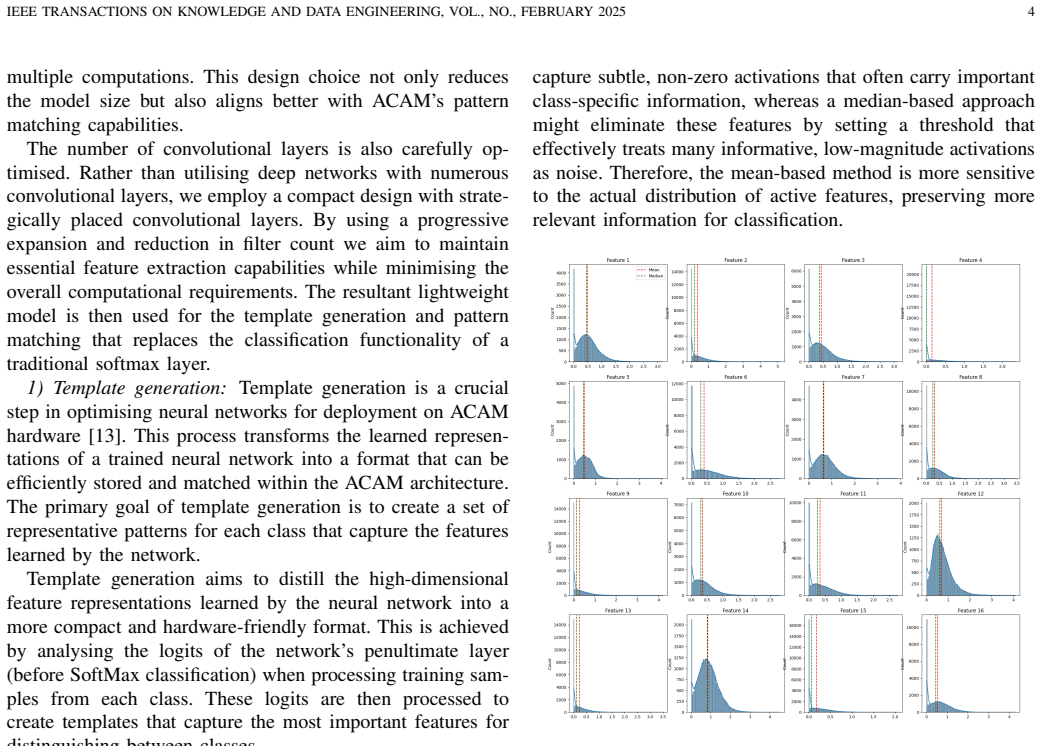
The central object is the RRAM-CMOS TXL-ACAM back-end, an analogue content-addressable memory that stores each class template as programmed RRAM conductances and computes, in parallel, a similarity score between the input feature map and every stored template. The paper models that hardware with a feature-count score $S_{fc}(Q,T)=\sum_i \mathbb{I}(Q_i=T_i)$ and a similarity score $S_{sim}=H/(1+\alpha D)$ with a distance penalty for features outside template bounds; both reduce to the same bit-counting operation at 1-bit precision. The front-end that feeds this matcher is a three-convolutional-layer student network trained by knowledge distillation, pruned to 80% sparsity, quantised to 8-bit weights, and intentionally built without fully connected layers so that classification is entirely template matching. The energy argument uses a fixed 185 fJ per cell per search for the ACAM and 0.23 pJ compute plus 20 pJ memory access per MAC for the digital part.
What would settle it
Build or simulate a full TXL-ACAM classifier with 10 templates of 784 cells, including matchline sense amplifiers, winner-take-all output, RRAM programming, and any conversion between the front-end's digital feature map and the analogue query; measure total back-end energy per inference. If that measured energy is materially above 1.45 nJ or if the measured system energy is not about 790 times below the measured teacher energy, the central energy claim is falsified.
Extended reading notes
Core claim
The paper's central claim is that the final dense classification layers of a deep network can be replaced by template matching in an RRAM-CMOS analogue content-addressable memory without sacrificing the viability of edge classification. A ResNet-50 teacher trained on greyscale CIFAR-10 reaches 91.04% accuracy; knowledge distillation, pruning to 80% sparsity, and 8-bit quantisation produce a 380,314-parameter convolutional student that reaches 82.22% accuracy with a softmax layer. When the student's feature maps are binarised by mean-based thresholding and compared against one binary template per class in the ACAM, the hybrid reaches 70.91% accuracy, and two templates per class raise this to 71.64%. The paper estimates front-end energy at 96.07 nJ and back-end energy at 1.45 nJ per classification operation, against 78.06 µJ for the teacher, a 792-fold reduction. It also reports that feature-count and similarity-based matching become equivalent at 1-bit template precision, so the simpler feature-count approach suffices.
Load-bearing premise
The energy conclusion depends on the ACAM behaving like the software equations (8)-(12) with a flat 185 fJ per cell and no extra cost for sensing, winner-take-all logic, programming, or analog-to-digital conversion, while the same per-MAC memory-access cost applies to both teacher and student.
Editorial extensions
If this is right
- At 70.91% accuracy with one binary template per class, the hybrid is a candidate for extreme-edge sensing applications where an 11-point drop from the softmax student is an acceptable exchange for removing dense floating-point layers.
- The front-end dominates the reported total energy, so further system-level energy reductions would have to come mainly from shrinking the convolutional feature extractor rather than from the matcher.
- Feature-count and similarity-based matching give identical accuracy at 1-bit template precision, so the simpler feature-count approach is sufficient at this quantisation level.
- Two templates per class improve accuracy to 71.64%, while a third template gives 71.60%, indicating diminishing returns for additional templates under binary quantisation.
- The claimed 792-fold energy reduction is measured against the unmodified ResNet-50 teacher, not against the already compressed softmax student, so the incremental energy benefit attributable to the ACAM alone is not quantified by the paper.
Reading between the lines
- The paper's absolute energy units appear to be scaled by a factor of 1000: using the cited 20 pJ per memory access, the front-end's 4.75M MACs cost about 96 µJ (not 96 nJ) and the teacher's 3.8G MACs cost about 78 mJ (not 78 µJ), so the 792x ratio survives but the absolute figures should be rescaled.
- A fabricated TXL-ACAM will add overheads absent from the software model, including matchline charging, sense amplifiers, winner-take-all circuitry, RRAM programming, and potential analog-to-digital conversion; a few nanojoules per inference would not change the system-level conclusion, but a few hundred nanojoules would erode the reported advantage.
- Because the evaluation uses greyscale CIFAR-10, the accuracy and energy results do not automatically transfer to colour images, which triple the front-end input channels and change activation statistics.
- A comparison against a binarized or otherwise compressed pure-digital classifier at the same 70-72% accuracy would isolate what the ACAM back-end contributes over conventional digital inference.
Editorial analysis
A structured set of objections, weighed in public.
Referee Report
Summary. The manuscript proposes a hybrid edge classifier for greyscale CIFAR-10 that combines a knowledge-distilled, pruned, and quantised CNN student (82.22% accuracy with softmax, 4.76M MACs) with an RRAM-CMOS ACAM back-end that performs binary template matching on the CNN's feature maps (70.91% accuracy with one template per class). The authors report front-end energy of 96.23 nJ and back-end energy of 1.45 nJ per inference versus 78.06 µJ for a ResNet-50 teacher, claiming a 792-fold reduction. The paper also presents ablations of knowledge distillation, pruning, quantisation, mean/median thresholding, feature-count versus similarity-based matching, and the number of templates per class.
Significance. If the reported energy and accuracy figures held, the paper would provide a useful data point for digital-analogue co-design at the edge. The compression pipeline (knowledge distillation, pruning, quantisation) is standard but carefully evaluated, and the template-generation ablations—particularly the comparison of mean-based versus median-based thresholding and the multi-template clustering—are clearly described and informative. However, the central energy-efficiency claim is compromised by two load-bearing problems: the absolute energy numbers are mislabelled by a factor of 1000, and the hybrid is never compared against the student with softmax. When that comparison is made using the paper's own cost model, the ACAM back-end saves less than 0.2% of total energy while reducing accuracy by more than 11 percentage points, meaning the hybrid is Pareto-dominated by the software-only student. The paper's value is therefore mainly as a feasibility study of ACAM-based template matching, not as a demonstration of a competitive accuracy-versus-energy trade-off.
major comments (3)
- [Section V-D and Abstract] The energy values are mislabelled by a factor of 1000. Using the paper's own figures, 4,749,174 MACs × 20.23 pJ = 96.08 µJ (not 96.07 nJ), and the teacher's 3,858,551,808 MACs × 20.23 pJ = 78.06 mJ (not 78.06 µJ). The Abstract's E_front-end = 96.23 nJ does not match Section V-D's 96.07 nJ and appears to be the softmax student's energy (4,757,024 × 20.23 pJ = 96.23 µJ). All absolute energy claims in the Abstract, Section V-D, and Section VI must be corrected to µJ/mJ and made internally consistent.
- [Section V-D and Table I] The central claim of a 'competitive trade-off' is not supported because the paper never compares the hybrid to the student with softmax. With the paper's own cost model, the softmax student uses 4,757,024 × 20.23 pJ ≈ 96.23 µJ and achieves 82.22% accuracy (Table I), while the hybrid uses 4,749,174 × 20.23 pJ + 1.45 nJ ≈ 96.08 µJ and achieves 70.91% accuracy (Section V-D and Table II). The ACAM back-end therefore saves about 0.15 µJ (0.17% of total energy) while decreasing accuracy by 11.3 percentage points. Under the paper's assumptions, the hybrid is Pareto-dominated by the software-only student, so the 792-fold reduction relative to the teacher is attributable to the front-end compression, not to the ACAM. The authors need to report the softmax baseline and demonstrate an advantage of the hybrid over it, or substantially revise the central claim.
- [Section III-B and Section V-D] The energy model rests on unvalidated hardware assumptions. The 185 fJ/cell figure and the TXL-ACAM behavioural model are taken from prior work (Refs. [19], [27]) with no measured power breakdown in this paper, and the estimate omits sense-amplifier, winner-take-all, programming, and any analogue-to-digital conversion overheads. The front-end estimate applies a flat 20 pJ per MAC from Horowitz without specifying the memory hierarchy or dataflow. Because all energy conclusions depend on these assumptions, the paper should provide either hardware measurements or a sensitivity analysis showing that the qualitative conclusions are robust to realistic overheads.
minor comments (5)
- [Section II-D-2, Eq. (8)] Equation (8) defines S_fc(Q,T) but refers to an undefined matching threshold epsilon; either remove the mention or include epsilon in the formula.
- [Abstract and Section V-D] The Abstract reports E_front-end = 96.23 nJ while Section V-D computes 96.07 nJ; these should be reconciled and both expressed in the correct units (µJ).
- [Section V-D and Table I] The teacher energy comparison uses the colour-teacher MAC count (3,858,551,808), but the experiments are on greyscale CIFAR-10; using the greyscale teacher row of Table I (3,808,375,808 MACs) gives 77.06 mJ, which is the more appropriate baseline for the ratio.
- [Section II-D-2 and Section V-D] There are typos in the text: 'classifcation' should be 'classification', and 'an addition 7,850 operations' should be 'an additional 7,850 operations'.
- [Section III-B and Figure 4(b)] The text describing the 3T1R cell refers to transistors 'MA', 'MM LO', and 'MM HI' that are not labelled in the schematic; please align the text with the figure labels.
Circularity Check
No significant circularity: the derivation is grounded in external CIFAR-10 benchmarks and Horowitz energy costs; the self-cited ACAM cell energy enters as an input parameter, not as a predicted result.
full rationale
The central accuracy and energy claims are not circular. The 82.22% student accuracy, the 70.91% hybrid accuracy, and the template-matching results are obtained by training and evaluating models on the external CIFAR-10 benchmark, not by fitting the claimed conclusions. The energy estimates use an external Horowitz per-MAC cost (0.2 pJ multiply, 0.03 pJ add, 20 pJ memory access) applied uniformly to both teacher and student, and the ACAM back-end energy is computed by simple multiplication (Eq. 14) from a stated 185 fJ per cell figure. That cell figure comes from the authors' prior TXL-ACAM work and is an externally falsifiable hardware parameter, not a quantity derived in this paper or fitted to this paper's results. The 792x reduction is arithmetic from reported MAC counts and per-MAC energy costs, and the accuracy-versus-energy comparison is an evaluation rather than a definitional equivalence. The only self-citation is the ACAM circuit description and cell energy from prior papers by overlapping authors, but it is not used to forbid alternatives, is not the conclusion itself, and does not make any Eq. X = Eq. Y by construction. The apparent mislabelling of absolute energy units in the abstract and Section V-D is a units/correctness issue, not a circularity issue. Therefore no circular step rises to the standard required by the review rules.
Assumptions & free parameters
free parameters (4)
- KD temperature T =
not reported
- KD balancing weight alpha =
not reported
- Similarity penalty scale alpha =
not reported
- Pruning sparsity endpoints =
si=0.50, sf=0.80
assumptions (4)
- domain assumption Horowitz energy figures apply uniformly to teacher and student models
- domain assumption The TXL-ACAM can be modeled by the feature count and similarity equations with a flat 185 fJ per cell and no extra overhead
- domain assumption Grayscale CIFAR-10 is a suitable benchmark for extreme edge classification
- standard math Standard knowledge distillation and pruning results are valid
Cite this review
Pith. "Pith review of A Hybrid Edge Classifier: Combining TinyML-Optimised CNN with RRAM-CMOS ACAM for Energy-Efficient Inference." pith.science (2026). https://pith.science/paper/SUEQATST
@misc{pith2026250210089,
  author       = {Pith},
  title        = {Pith review of: A Hybrid Edge Classifier: Combining TinyML-Optimised CNN with RRAM-CMOS ACAM for Energy-Efficient Inference},
  year         = {2026},
  howpublished = {\url{https://pith.science/paper/SUEQATST}},
  note         = {Machine review of arXiv:2502.10089}
}
abstract
In recent years, the development of smart edge computing systems to process information locally is on the rise. Many near-sensor machine learning (ML) approaches have been implemented to introduce accurate and energy efficient template matching operations in resource-constrained edge sensing systems, such as wearables. To introduce novel solutions that can be viable for extreme edge cases, hybrid solutions combining conventional and emerging technologies have started to be proposed. Deep Neural Networks (DNN) optimised for edge application alongside new approaches of computing (both device and architecture -wise) could be a strong candidate in implementing edge ML solutions that aim at competitive accuracy classification while using a fraction of the power of conventional ML solutions. In this work, we are proposing a hybrid software-hardware edge classifier aimed at the extreme edge near-sensor systems. The classifier consists of two parts: (i) an optimised digital tinyML network, working as a front-end feature extractor, and (ii) a back-end RRAM-CMOS analogue content addressable memory (ACAM), working as a final stage template matching system. The combined hybrid system exhibits a competitive trade-off in accuracy versus energy metric with $E_{front-end}$ = $96.23 nJ$ and $E_{back-end}$ = $1.45 nJ$ for each classification operation compared with 78.06$\mu$J for the original teacher model, representing a 792-fold reduction, making it a viable solution for extreme edge applications.
Figures


Figures from the paper (4 more)


Reference graph
Works this paper leans on
-
[19]
A 9t4r rram-based acam for analogue template matching at the edge,
G. Papandroulidakis, S. Agwa, A. Cirakoglu, and T. Prodromakis, “A 9t4r rram-based acam for analogue template matching at the edge,”
-
[27]
A 1T1R+2T Ana- log Content-Addressable Memory Pixel for Online Template Matching,
S. Agwa, G. Papandroulidakis, and T. Prodromakis, “A 1T1R+2T Ana- log Content-Addressable Memory Pixel for Online Template Matching,” 2023 IEEE International Symposium on Circuits and Systems (ISCAS) , 2023
work page 2023
-
[1]
Deep convolutional neural networks for image classification: A comprehensive review,
W. Rawat and Z. Wang, “Deep convolutional neural networks for image classification: A comprehensive review,” Neural Computation, vol. 29, no. 9, pp. 2352–2449, sep 2017
work page 2017
-
[2]
A Survey of the Usages of Deep Learning for Natural Language Processing,
D. W. Otter, J. R. Medina, and J. K. Kalita, “A Survey of the Usages of Deep Learning for Natural Language Processing,” IEEE Transactions on Neural Networks and Learning Systems , vol. 32, no. 2, pp. 604–624, feb 2021
work page 2021
-
[3]
A review of deep learning techniques for speech processing,
A. Mehrish, N. Majumder, R. Bharadwaj, R. Mihalcea, and S. Poria, “A review of deep learning techniques for speech processing,” Information Fusion, vol. 99, p. 101869, nov 2023
work page 2023
-
[4]
Compressing fully connected layers of deep neural networks using permuted features,
D. Nagaraju and N. Chandrachoodan, “Compressing fully connected layers of deep neural networks using permuted features,” IET Computers and Digital Techniques, vol. 17, no. 3-4, pp. 149–161, jul 2023
work page 2023
-
[5]
Towards Optimal Compression: Joint Pruning and Quantization,
B. Zandonati, G. Bucagu, A. A. Pol, M. Pierini, O. Sirkin, and T. Kopetz, “Towards Optimal Compression: Joint Pruning and Quantization,” feb
-
[6]
Hardware-aware approach to deep neural network optimization,
H. Li and L. Meng, “Hardware-aware approach to deep neural network optimization,” Neurocomputing, vol. 559, p. 126808, nov 2023
work page 2023
Show all 33 references
-
[7]
Pruning and quantization for deep neural network acceleration: A survey,
T. Liang, J. Glossner, L. Wang, S. Shi, and X. Zhang, “Pruning and quantization for deep neural network acceleration: A survey,” Neuro- computing, vol. 461, pp. 370–403, oct 2021
2021
-
[8]
Knowledge Distillation: A Survey,
J. Gou, B. Yu, S. J. Maybank, and D. Tao, “Knowledge Distillation: A Survey,” International Journal of Computer Vision , vol. 129, no. 6, pp. 1789–1819, jun 2021
2021
-
[9]
Optimizing Off- Chip Memory Access for Deep Neural Network Accelerator,
Y . Zheng, H. Yang, Y . Shu, Y . Jia, and Z. Huang, “Optimizing Off- Chip Memory Access for Deep Neural Network Accelerator,” IEEE Transactions on Circuits and Systems II: Express Briefs , vol. 69, no. 4, pp. 2316–2320, apr 2022
2022
-
[10]
Adaptation in Edge Computing: A review on design principles and research challenges,
F. Golpayegani, N. Chen, N. Afraz, E. Gyamfi, A. Malekjafarian, D. Sch¨afer, and C. Krupitzer, “Adaptation in Edge Computing: A review on design principles and research challenges,” ACM Transactions on Autonomous and Adaptive Systems , sep 2024
2024
-
[11]
Distilling the Knowledge in a Neural Network,
G. Hinton, O. Vinyals, and J. Dean, “Distilling the Knowledge in a Neural Network,” 3 2015. [Online]. Available: https://arxiv.org/abs/ 1503.02531v1
2015 arXiv
-
[12]
An Attentive Pruning Method for Edge Computing,
G. Yang, G. Hao, L. Weijia, W. Qinghua, S. Chen, and N. Zhang, “An Attentive Pruning Method for Edge Computing,” ACM International Conference Proceeding Series, pp. 6–10, feb 2020
2020
-
[13]
Hardware implementation of memristor-based artificial neural networks,
F. Aguirre, A. Sebastian, M. Le Gallo, W. Song, T. Wang, J. J. Yang, W. Lu, M. F. Chang, D. Ielmini, Y . Yang, A. Mehonic, A. Kenyon, M. A. Villena, J. B. Rold ´an, Y . Wu, H. H. Hsu, N. Raghavan, J. Su ˜n´e, E. Miranda, A. Eltawil, G. Setti, K. Smagulova, K. N. Salama, O. Kre...
2024
-
[14]
Effi- cient Parallel Median Filter for Image Denoising: Implementation and Performance Evaluation,
M. Kantharimuthu, P. Selvaraj, H. Sankar, and G. Brindavanam, “Effi- cient Parallel Median Filter for Image Denoising: Implementation and Performance Evaluation,” Traitement du Signal , vol. 41, no. 05, pp. 2403–2414, oct 2024
2024
-
[15]
Robust and memory-less median estimation for real-time spike detection,
A. Burman, J. Sol ´e-Casals, and S. E. Lew, “Robust and memory-less median estimation for real-time spike detection,” PLOS ONE , vol. 19, no. 11, p. e0308125, nov 2024
2024
-
[16]
An efficient switching median filter based on local outlier factor,
W. Wang and P. Lu, “An efficient switching median filter based on local outlier factor,” IEEE Signal Processing Letters , vol. 18, no. 10, pp. 551–554, 2011
2011
-
[17]
In-Memory Computing with Memristor Content Addressable Memories for Pattern Matching,
C. E. Graves, C. Li, X. Sheng, D. Miller, J. Ignowski, L. Kiyama, and J. P. Strachan, “In-Memory Computing with Memristor Content Addressable Memories for Pattern Matching,” Advanced Materials , vol. 32, no. 37, 2020
2020
-
[18]
Analog content-addressable memories with memristors,
C. Li, C. E. Graves, X. Sheng, D. Miller, M. Foltin, G. Pedretti, and J. P. Strachan, “Analog content-addressable memories with memristors,” Nature Communications, vol. 11, no. 1638, 2020
2020
-
[20]
In-memory computing with resistive switching devices,
D. Ielmini and H.-S. P. Wong, “In-memory computing with resistive switching devices,” Nature Electronics, vol. 1, no. 6, pp. 333–343, 2018. [Online]. Available: http://www.nature.com/articles/s41928-018-0092-2
2018
-
[21]
Memory devices and applications for in-memory computing,
A. Sebastian, M. Le Gallo, R. Khaddam-aljameh, E. Eleftheriou, M. L. Gallo, R. Khaddam-aljameh, and E. Eleftheriou, “Memory devices and applications for in-memory computing,” Nature Nanotechnology , vol. 15, no. 7, pp. 529–544, 2020. [Online]. Available: http: //dx.doi.org/10....
2020 doi
-
[22]
A neuromorphic systems approach to in-memory computing with non-ideal memristive devices: From mitigation to exploitation,
M. Payvand, M. V . Nair, L. K. Muller, and G. Indiveri, “A neuromorphic systems approach to in-memory computing with non-ideal memristive devices: From mitigation to exploitation,” Faraday Discussions Royal Society of Chemistry , 2018. [Online]. Available: http://arxiv.org/abs...
2018 arXiv
-
[23]
Tree-based machine learning performed in-memory with memristive analog CAM,
G. Pedretti, C. E. Graves, S. Serebryakov, R. Mao, X. Sheng, M. Foltin, C. Li, and J. P. Strachan, “Tree-based machine learning performed in-memory with memristive analog CAM,” Nature Communications , vol. 12, no. 5806, 2021
2021
-
[24]
Differentiable Content Addressable Memory with Memristors,
G. Pedretti, C. E. Graves, T. Van Vaerenbergh, S. Serebryakov, M. Foltin, X. Sheng, R. Mao, C. Li, and J. P. Strachan, “Differentiable Content Addressable Memory with Memristors,” Advanced Electronic Materials, vol. 8-8, no. 2101198, 2022
2022
-
[25]
Combining Multiple tinyML Models for Multimodal Context-Aware Stress Recognition on Con- strained Microcontrollers,
M. Gibbs, K. Woodward, and E. Kanjo, “Combining Multiple tinyML Models for Multimodal Context-Aware Stress Recognition on Con- strained Microcontrollers,” IEEE Micro, pp. 1–9, nov 2023
2023
-
[26]
A comprehensive technology agnostic RRAM characterisation protocol,
S. Stathopoulos, L. Michalas, A. Khiat, A. Serb, and T. Prodromakis, “A comprehensive technology agnostic RRAM characterisation protocol,” 2018
2018
-
[28]
Learning multiple layers of features from tiny images,
A. Krizhevsky, G. Hinton et al. , “Learning multiple layers of features from tiny images,” 2009
2009
-
[29]
Deep residual learning for image recognition,
K. He, X. Zhang, S. Ren, and J. Sun, “Deep residual learning for image recognition,” in Proceedings of the IEEE Computer Society Conference on Computer Vision and Pattern Recognition , 2016
2016
-
[30]
Enhancing ob- ject recognition with resnet-50: an investigation of the cifar-10 dataset,
P. Kaushik, Z. Khan, A. Kajla, A. Verma, and A. Khan, “Enhancing ob- ject recognition with resnet-50: an investigation of the cifar-10 dataset,” 2024 International Conference on Smart Devices, ICSD 2024 , 2024
2024
-
[31]
1.1 Computing’s energy problem (and what we can do about it),
M. Horowitz, “1.1 Computing’s energy problem (and what we can do about it),” Digest of Technical Papers - IEEE International Solid-State Circuits Conference, vol. 57, pp. 10–14, 2014
2014
-
[2023]
Available: https://arxiv.org/abs/2302.07612v2
[Online]. Available: https://arxiv.org/abs/2302.07612v2
-
[2024]
Available: https://arxiv.org/abs/2410.03414 IEEE TRANSACTIONS ON KNOWLEDGE AND DATA ENGINEERING, VOL., NO., FEBRUARY 2025 12
[Online]. Available: https://arxiv.org/abs/2410.03414 IEEE TRANSACTIONS ON KNOWLEDGE AND DATA ENGINEERING, VOL., NO., FEBRUARY 2025 12
2025 arXiv
Reviewed August 7, 2026 · model on record in the stance chip above.
Discussion (0). Continue with ORCID to comment.