Superballistic paradox in electron fluids: Evidence of tomographic transport
Pith reviewed 2026-05-23 03:04 UTC · model grok-4.3
The pith
Tomographic dynamics with head-on-only collisions resolves the superballistic conduction paradox in electron fluids.
A machine-rendered reading of the paper's core claim, the machinery that carries it, and where it could break.
Core claim
Replacing the classical dynamics with tomographic dynamics, where only head-on collisions are allowed between electrons, solves the dilemma of superballistic conduction starting at close-to-zero temperatures. This strengthens superballistic conduction, with potential applications in low-dissipation devices, and explains its differences with the Molenkamp effect and conventional fluids dynamics. The study reveals that the superballistic paradox is resolved by considering the electrons not as classical particles but as fermions.
What carries the argument
Tomographic dynamics where only head-on collisions are allowed between electrons, replacing classical particle dynamics in hydrodynamic flow models.
If this is right
- Superballistic conduction strengthens and begins at close-to-zero temperatures.
- The Gurzhi effect shows clear differences from the Molenkamp effect.
- Electron fluids behave differently from conventional fluids due to the fermionic restriction.
- Low-dissipation devices become feasible using this transport at accessible temperatures.
Where Pith is reading between the lines
- Similar tomographic restrictions could appear in other fermionic systems such as certain quantum wires or topological materials.
- Angle-resolved scattering measurements in graphene devices might directly test the head-on dominance at low temperatures.
- The approach suggests re-examining viscous flow models in other 2D electron systems for fermionic signatures.
Load-bearing premise
Electrons in the studied 2D materials obey tomographic dynamics restricted to head-on collisions rather than classical particle dynamics.
What would settle it
An experiment in which superballistic conduction fails to appear at low temperatures under conditions enforcing only head-on collisions, or persists when such collisions are suppressed, would falsify the resolution.
Figures


read the original abstract
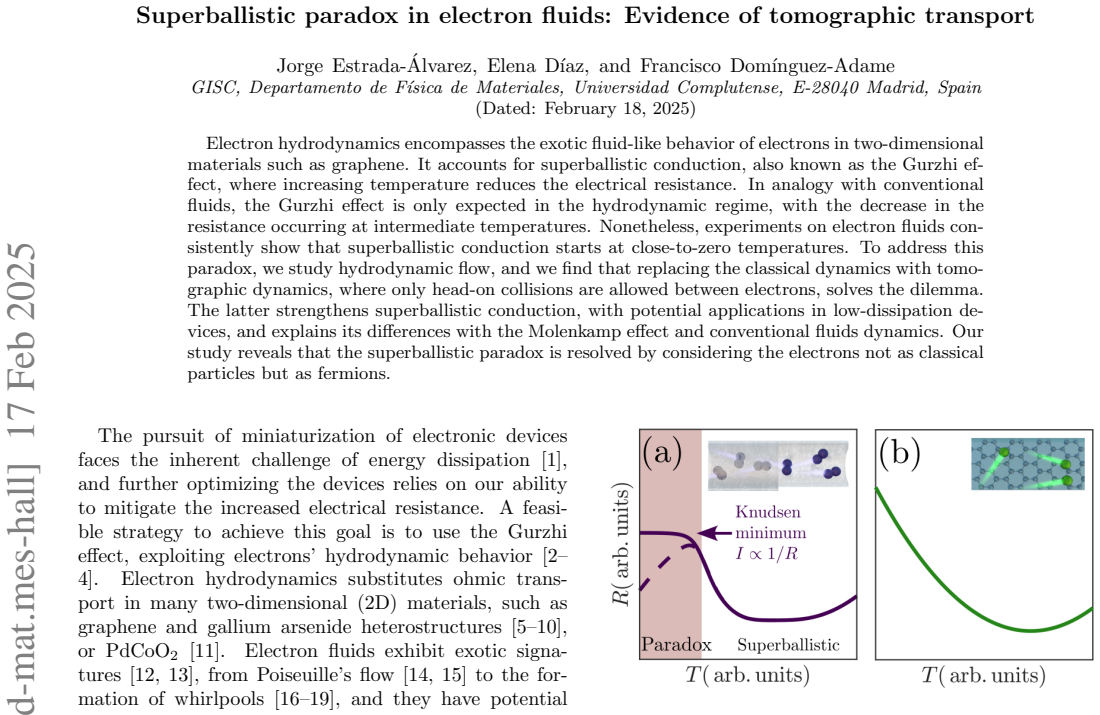
Electron hydrodynamics encompasses the exotic fluid-like behavior of electrons in two-dimensional materials such as graphene. It accounts for superballistic conduction, also known as the Gurzhi effect, where increasing temperature reduces the electrical resistance. In analogy with conventional fluids, the Gurzhi effect is only expected in the hydrodynamic regime, with the decrease in the resistance occurring at intermediate temperatures. Nonetheless, experiments on electron fluids consistently show that superballistic conduction starts at close-to-zero temperatures. To address this paradox, we study hydrodynamic flow, and we find that replacing the classical dynamics with tomographic dynamics, where only head-on collisions are allowed between electrons, solves the dilemma. The latter strengthens superballistic conduction, with potential applications in low-dissipation devices, and explains its differences with the Molenkamp effect and conventional fluids dynamics. Our study reveals that the superballistic paradox is resolved by considering the electrons not as classical particles but as fermions.
Editorial analysis
A structured set of objections, weighed in public.
Referee Report
Summary. The manuscript claims that the superballistic (Gurzhi) paradox—superballistic conduction appearing at near-zero temperatures in 2D electron fluids, contrary to standard hydrodynamic expectations—is resolved by replacing classical particle dynamics with tomographic dynamics in which electron-electron collisions are restricted to head-on (180°) scattering. This fermionic restriction is asserted to strengthen the effect at arbitrarily low T, distinguish it from the Molenkamp effect and classical fluids, and explain experimental observations in materials such as graphene.
Significance. If the central claim holds, the work would supply a microscopic rationale for the unexpectedly low onset temperature of superballistic flow and underscore the necessity of treating electrons as fermions rather than classical particles in hydrodynamic models. It could guide design of low-dissipation devices and clarify distinctions among electron-fluid phenomena.
major comments (2)
- [Abstract] Abstract: The assertion that a collision operator limited to head-on scattering produces dR/dT < 0 already at T→0 is introduced without an explicit reduction of the full Pauli-blocked fermionic Boltzmann collision integral (including its angular dependence on the Fermi surface) to the claimed 180°-only form; the low-T onset therefore remains an assumption rather than a derived result.
- [Abstract] The hydrodynamic equations with the tomographic operator are stated to resolve the paradox, yet no derivation or explicit form of the modified collision integral is supplied that would allow verification that the operator indeed yields the reported temperature dependence without additional fitting parameters.
minor comments (1)
- [Abstract] The abstract refers to 'the studied 2D materials' without naming them or citing the relevant experiments; a brief specification would improve clarity.
Simulated Author's Rebuttal
We thank the referee for their careful reading and constructive comments. Below we respond point-by-point to the major comments, indicating revisions that will be incorporated to strengthen the presentation of the derivation.
read point-by-point responses
-
Referee: [Abstract] Abstract: The assertion that a collision operator limited to head-on scattering produces dR/dT < 0 already at T→0 is introduced without an explicit reduction of the full Pauli-blocked fermionic Boltzmann collision integral (including its angular dependence on the Fermi surface) to the claimed 180°-only form; the low-T onset therefore remains an assumption rather than a derived result.
Authors: We agree that the abstract is concise and does not contain the full reduction. The main text starts from the Pauli-blocked fermionic Boltzmann integral on the 2D Fermi surface and shows that energy-momentum conservation together with the exclusion principle restricts the contributing processes to 180° scattering; the resulting effective operator then produces dR/dT < 0 at arbitrarily low T. To make this explicit and verifiable, we will add a dedicated paragraph or subsection that performs the angular reduction step by step. revision: yes
-
Referee: [Abstract] The hydrodynamic equations with the tomographic operator are stated to resolve the paradox, yet no derivation or explicit form of the modified collision integral is supplied that would allow verification that the operator indeed yields the reported temperature dependence without additional fitting parameters.
Authors: The referee is correct that an explicit mathematical expression for the tomographic collision integral would facilitate independent verification. In the manuscript the operator is obtained by projecting the full fermionic integral onto the head-on channel, yielding a form whose only temperature dependence enters through the standard T² Fermi-liquid scattering rate and contains no adjustable parameters. We will include the explicit integral expression and the resulting hydrodynamic equations in the revised main text. revision: yes
Circularity Check
No circularity; central claim is an explicit modeling assumption, not a derived reduction.
full rationale
The paper asserts that replacing classical particle dynamics with tomographic dynamics (head-on collisions only) resolves the low-T superballistic paradox. This replacement is presented directly as the solution without any internal derivation chain that reduces a claimed prediction back to fitted parameters, self-citations, or definitional inputs. No equations or load-bearing steps are visible that would trigger the enumerated circularity patterns; the outcome follows tautologically from the stated ansatz rather than from any hidden self-referential construction. The derivation is therefore self-contained as a proposed model choice.
Axiom & Free-Parameter Ledger
axioms (1)
- domain assumption Electrons in 2D materials obey tomographic dynamics restricted to head-on collisions (as opposed to classical particle dynamics).
Reference graph
Works this paper leans on
-
[1]
G. Varnavides, A. Yacoby, C. Felser, and P. Narang, Charge transport and hydrodynamics in materials, Nat. Rev. Mater. 8, 726 (2023)
work page 2023
-
[2]
B. N. Narozhny, Hydrodynamic approach to two- dimensional electron systems, Riv. Nuovo Cimento 45, 661 (2022)
work page 2022
-
[3]
M. Polini and A. K. Geim, Viscous electron fluids, Phys. Today 73, 28 (2020)
work page 2020
- [4]
-
[5]
Y. A. Pusep, M. Teodoro, V. Laurindo Jr, E. C. de Oliveira, G. Gusev, and A. Bakarov, Diffusion of pho- toexcited holes in a viscous electron fluid, Phys. Rev. Lett. 128, 136801 (2022)
work page 2022
-
[6]
Alekseev, Negative magnetoresistance in viscous flow of two-dimensional electrons, Phys
P. Alekseev, Negative magnetoresistance in viscous flow of two-dimensional electrons, Phys. Rev. Lett. 117, 166601 (2016)
work page 2016
-
[7]
D. I. Sarypov, D. A. Pokhabov, A. G. Pogosov, E. Y. Zhdanov, A. A. Shevyrin, A. K. Bakarov, and A. A. Shklyaev, Temperature dependence of electron viscosity in superballistic GaAs point contacts, Phys. Rev. Lett. 134, 026302 (2025)
work page 2025
-
[8]
A. C. Keser, D. Q. Wang, O. Klochan, D. Y. Ho, O. A. Tkachenko, V. A. Tkachenko, D. Culcer, S. Adam, I. Far- rer, D. A. Ritchie, et al., Geometric control of universal hydrodynamic flow in a two-dimensional electron fluid, Phys. Rev. X 11, 031030 (2021)
work page 2021
-
[9]
Z. T. Wang, M. Hilke, N. Fong, D. G. Austing, S. A. Studenikin, K. W. West, and L. N. Pfeiffer, Nonlinear transport phenomena and current-induced hydrodynam- ics in ultrahigh mobility two-dimensional electron gas, Phys. Rev. B 107, 195406 (2023)
work page 2023
- [10]
-
[11]
P. J. Moll, P. Kushwaha, N. Nandi, B. Schmidt, and A. P. Mackenzie, Evidence for hydrodynamic electron flow in PdCoO2, Science 351, 1061 (2016)
work page 2016
-
[12]
A. Talanov, J. Waissman, A. Hui, B. Skinner, K. Watan- abe, T. Taniguchi, and P. Kim, Observation of electronic viscous dissipation in graphene magneto-thermal trans- port, arXiv preprint arXiv:2406.13799 (2024)
-
[13]
R. Sano and M. Matsuo, Breaking down the magnonic Wiedemann-Franz law in the hydrodynamic regime, Phys. Rev. Lett. 130, 166201 (2023)
work page 2023
-
[14]
J. A. Sulpizio, L. Ella, A. Rozen, J. Birkbeck, D. J. Perello, D. Dutta, M. Ben-Shalom, T. Taniguchi, K. Watanabe, T. Holder, et al. , Visualizing Poiseuille flow of hydrodynamic electrons, Nature 576, 75 (2019)
work page 2019
-
[15]
A. Jenkins, S. Baumann, H. Zhou, S. A. Meynell, Y. Daipeng, K. Watanabe, T. Taniguchi, A. Lucas, A. F. Young, and A. C. B. Jayich, Imaging the breakdown of ohmic transport in graphene, Phys. Rev. Lett. 129, 087701 (2022)
work page 2022
-
[16]
A. Aharon-Steinberg, T. V¨ olkl, A. Kaplan, A. K. Pariari, I. Roy, T. Holder, Y. Wolf, A. Y. Meltzer, Y. Myasoedov, M. E. Huber, et al., Direct observation of vortices in an electron fluid, Nature 607, 74 (2022)
work page 2022
-
[17]
M. L. Palm, C. Ding, W. S. Huxter, T. Taniguchi, K. Watanabe, and C. L. Degen, Observation of current whirlpools in graphene at room temperature, Science 384, 465 (2024)
work page 2024
-
[18]
D. Bandurin, I. Torre, R. K. Kumar, M. Ben Shalom, A. Tomadin, A. Principi, G. Auton, E. Khestanova, K. Novoselov, I. Grigorieva, et al. , Negative local resis- tance caused by viscous electron backflow in graphene, Science 351, 1055 (2016)
work page 2016
-
[19]
G. Falkovich and L. Levitov, Linking spatial distributions of potential and current in viscous electronics, Phys. Rev. Lett. 119, 066601 (2017)
work page 2017
-
[20]
M. Kravtsov, A. L. Shilov, Y. Yang, T. Pryadilin, M. A. Kashchenko, O. Popova, M. Titova, D. Voropaev, Y. Wang, K. Shein, et al. , Viscous terahertz photocon- ductivity of hydrodynamic electrons in graphene, Nat. Nanotech. 20, 51 (2024)
work page 2024
-
[21]
J. Estrada- ´Alvarez, E. D´ ıaz Garc´ ıa, and F. Dominguez- Adame, Negative differential resistance of viscous elec- tron flow in graphene, 2D Mater. 12, 015012 (2024)
work page 2024
-
[22]
R. N. Gurzhi, Minimum of resistance in impurity-free conductors, Sov. Phys. JETP 17, 521 (1963)
work page 1963
-
[23]
R. N. Gurzhi, Hydrodynamic effects in solids at low tem- perature, Sov. Phys. Uspekhi 11, 255 (1968)
work page 1968
- [24]
- [25]
-
[26]
R. Krishna Kumar, D. Bandurin, F. Pellegrino, Y. Cao, A. Principi, H. Guo, G. Auton, M. Ben Shalom, L. A. Ponomarenko, G. Falkovich, et al. , Superballistic flow of viscous electron fluid through graphene constrictions, Nat. Phys. 13, 1182 (2017)
work page 2017
-
[27]
H. Guo, E. Ilseven, G. Falkovich, and L. S. Levi- tov, Higher-than-ballistic conduction of viscous electron flows, PNAS USA 114, 3068 (2017)
work page 2017
-
[28]
J. Estrada- ´Alvarez, F. Berm´ udez-Mendoza, F. Dom´ ınguez-Adame, and E. D´ ıaz, Optimal ge- ometries for low-resistance viscous electron flow, Phys. Rev. B 111, 075401 (2025)
work page 2025
-
[29]
R. N. Gurzhi, A. N. Kalinenko, and A. I. Kopeliovich, Electron-electron collisions and a new hydrodynamic ef- fect in two-dimensional electron gas, Phys. Rev. Lett.74, 3872 (1995)
work page 1995
-
[30]
V. T. Renard, O. A. Tkachenko, V. A. Tkachenko, 6 T. Ota, N. Kumada, J.-C. Portal, and Y. Hi- rayama, Boundary-mediated electron-electron interac- tions in quantum point contacts, Phys. Rev. Lett. 100, 186801 (2008)
work page 2008
-
[31]
L. V. Ginzburg, C. Gold, M. P. R¨ o¨ osli, C. Reichl, M. Berl, W. Wegscheider, T. Ihn, and K. Ensslin, Superballistic electron flow through a point contact in a Ga[Al]As het- erostructure, Phys. Rev. Res. 3, 023033 (2021)
work page 2021
-
[32]
J. Estrada- ´Alvarez, J. Salvador-S´ anchez, A. P´ erez- Rodr´ ıguez, C. S´ anchez-S´ anchez, V. Cleric` o, D. Vaquero, K. Watanabe, T. Taniguchi, E. Diez, F. Dom´ ınguez- Adame, M. Amado, and E. D´ ıaz, Superballistic con- duction in hydrodynamic antidot graphene superlattices, arXiv preprint arXiv:2407.04527 (2024)
-
[33]
K. E. Nagaev and O. S. Ayvazyan, Effects of electron- electron scattering in wide ballistic microcontacts, Phys. Rev. Lett. 101, 216807 (2008)
work page 2008
-
[34]
L. V. Ginzburg, Y. Wu, M. P. R¨ o¨ osli, P. R. Gomez, R. Garreis, C. Tong, V. Star´ a, C. Gold, K. Nazaryan, S. Kryhin, et al. , Long distance electron-electron scat- tering detected with point contacts, Phys. Rev. Res. 5, 043088 (2023)
work page 2023
- [35]
-
[36]
M. Knudsen, Die gesetze der molekularstr¨ omung und der inneren reibungsstr¨ omung der gase durch r¨ ohren, Ann. Phys. 333, 75 (1909)
work page 1909
-
[37]
G. Tatsios, S. K. Stefanov, and D. Valougeorgis, Predict- ing the Knudsen paradox in long capillaries by decom- posing the flow into ballistic and collision parts, Phys. Rev. E 91, 061001 (2015)
work page 2015
-
[38]
P. Ledwith, H. Guo, A. Shytov, and L. Levitov, Tomo- graphic dynamics and scale-dependent viscosity in 2D electron systems, Phys. Rev. Lett. 123, 116601 (2019)
work page 2019
-
[39]
A. Afanasiev, P. Alekseev, A. Greshnov, and M. Semina, Ballistic-hydrodynamic phase transition in flow of two- dimensional electrons, Phys. Rev. B 104, 195415 (2021)
work page 2021
-
[40]
H. Rostami, N. Ben-Shachar, S. Moroz, and J. Hofmann, Magnetic-field suppression of tomographic electron trans- port, arXiv preprint arXiv:2411.08102 (2024)
- [41]
-
[42]
J. Estrada- ´Alvarez, F. Dom´ ınguez-Adame, and E. D´ ıaz, Alternative routes to electron hydrodynamics, Commun. Phys. 7, 138 (2024)
work page 2024
-
[43]
P. S. Alekseev and A. P. Dmitriev, Hydrodynamic mag- netotransport in two-dimensional electron systems with macroscopic obstacles, Phys. Rev. B 108, 205413 (2023)
work page 2023
-
[44]
P. S. Alekseev and M. A. Semina, Ballistic flow of two-dimensional interacting electrons, Phys. Rev. B 98, 165412 (2018)
work page 2018
-
[45]
See Supplemental Material for more details
-
[46]
A. Tomadin, G. Vignale, and M. Polini, Corbino disk viscometer for 2D quantum electron liquids, Phys. Rev. Lett. 113, 235901 (2014)
work page 2014
-
[47]
P. S. Alekseev and A. P. Alekseeva, Transverse mag- netosonic waves and viscoelastic resonance in a two- dimensional highly viscous electron fluid, Phys. Rev. Lett. 123, 236801 (2019)
work page 2019
-
[48]
A. Principi, G. Vignale, M. Carrega, and M. Polini, Bulk and shear viscosities of the two-dimensional electron liq- uid in a doped graphene sheet, Phys. Rev. B 93, 125410 (2016)
work page 2016
- [49]
-
[50]
P. G. Ciarlet, The finite element method for elliptic prob- lems (SIAM, 2002)
work page 2002
-
[51]
D. Engwirda and D. Ivers, Off-centre Steiner points for Delaunay-refinement on curved surfaces, Comput. Aided Des. 72, 157 (2016)
work page 2016
-
[52]
Callaway, Model for lattice thermal conductivity at low temperatures, Phys
J. Callaway, Model for lattice thermal conductivity at low temperatures, Phys. Rev. 113, 1046 (1959)
work page 1959
-
[53]
M. M¨ uller, J. Schmalian, and L. Fritz, Graphene: A nearly perfect fluid, Phys. Rev. Lett. 103, 025301 (2009)
work page 2009
-
[54]
E. I. Kiselev and J. Schmalian, Boundary conditions of viscous electron flow, Phys. Rev. B 99, 035430 (2019)
work page 2019
- [55]
-
[56]
E. Nilsson, U. Gran, and J. Hofmann, Nonequilibrium relaxation and odd-even effect in finite-temperature elec- tron gases, arXiv preprint arXiv:2405.03635 (2024)
-
[57]
J. Hofmann and S. D. Sarma, Collective modes in inter- acting two-dimensional tomographic fermi liquids, Phys. Rev. B 106, 205412 (2022)
work page 2022
-
[58]
J. Hofmann and U. Gran, Anomalously long lifetimes in two-dimensional Fermi liquids, Phys. Rev. B 108, L121401 (2023)
work page 2023
-
[59]
Q. Hong, M. Davydova, P. J. Ledwith, and L. Levitov, Superscreening by a retroreflected hole backflow in tomo- graphic electron fluids, Phys. Rev. B 109, 085126 (2024)
work page 2024
-
[60]
P. S. Alekseev and A. P. Dmitriev, Viscosity of two- dimensional electrons, Phys. Rev. B 102, 241409 (2020)
work page 2020
-
[61]
P. J. Ledwith, H. Guo, and L. Levitov, The hierarchy of excitation lifetimes in two-dimensional Fermi gases, Ann. Phys. 411, 167913 (2019)
work page 2019
-
[62]
S. Kryhin and L. Levitov, Two-dimensional electron gases as non-Newtonian fluids, Low Temp. Phys.49, 1402 (2023)
work page 2023
- [63]
-
[64]
R. N. Gurzhi, A. N. Kalinenko, and A. I. Kope- liovich, Electron-electron momentum relaxation in a two- dimensional electron gas, Phys. Rev. B 52, 4744 (1995)
work page 1995
-
[65]
J. Hofmann and H. Rostami, Nonlinear thermoelectric probes of anomalous electron lifetimes in topological Fermi liquids, Phys. Rev. Res. 6, L042042 (2024)
work page 2024
-
[66]
I. Moiseenko, E. M¨ onch, K. Kapralov, D. Bandurin, S. Ganichev, and D. Svintsov, Testing the tomographic Fermi liquid hypothesis with high-order cyclotron reso- nance, arXiv preprint arXiv:2409.05147 (2024)
- [67]
-
[68]
N. Dongari, A. Sharma, and F. Durst, Pressure-driven diffusive gas flows in micro-channels: from the Knudsen to the continuum regimes, Microfluid. Nanofluidics6, 679 (2009)
work page 2009
- [69]
-
[70]
M. J. M. de Jong and L. W. Molenkamp, Hydrodynamic electron flow in high-mobility wires, Phys. Rev. B 51, 13389 (1995)
work page 1995
-
[71]
L. W. Molenkamp and M. J. M. de Jong, Electron- electron-scattering-induced size effects in a two- dimensional wire, Phys. Rev. B 49, 5038 (1994). Supplemental Materials Superballistic paradox in electron fluids: Evidence of tomographic transport BOL TZMANN TRANSPOR T EQUA TION We solve the Boltzmann transport equation to describe ballistic, tomographic, ...
work page 1994
discussion (0)
Sign in with ORCID, Apple, or X to comment. Anyone can read and Pith papers without signing in.