REVIEW 4 major objections 5 minor 77 references
AffinityFlow: Guided Flows for Antibody Affinity Maturation
T0 review · 4 major / 5 minor · reviewed 2026-08-07 · deepseek-v4-flash
Pith's one-line read AffinityFlow reports state-of-the-art affinity maturation by alternating guided flow sampling with inverse folding and co-taught predictors.
desk verdict The pipeline is real and clearly presented, but the SOTA affinity-maturation claim is circular: Rosetta ΔG serves as both the training signal and the evaluation metric. read the letter →
The pith
A machine-rendered reading of the paper's core claim, the machinery that carries it, and where it could break.
The reading
What carries the argument
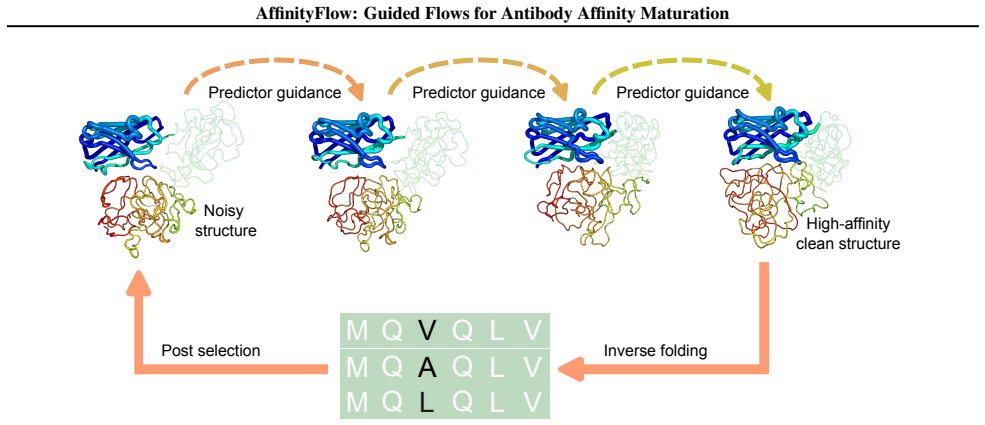
The central object is the guided flow-matching sampler. AlphaFlow is a pretrained sequence-conditioned generative model that maps noisy protein backbone coordinates to clean coordinates, and AffinityFlow steers that process with the velocity field $$\tilde{v}(x_t,t,\$\Delta$ G;\$\theta$)=\hat{v}(x_t,t;\$\theta$)-\gamma\frac{1-t}{t}\nabla_{x_t}\hat{f}_\$\beta$(\hat{x}_1(x_t)),$$ where $\hat{f}_\beta$ is the structure-based affinity predictor. The gradient term directs denoising toward lower predicted binding energy, and the guidance is applied mainly to CDR coordinates in the later sampling steps. The second load-bearing mechanism is the co-teaching module: pairwise labels are formed from Rosetta $\Delta\Delta G$ values on GeoDock-docked complexes, and the sequence-based and structure-based predictors each select consensus samples to fine-tune the other, filtering noisy labels. The loop is closed by ProteinMPNN inverse folding, Amber relaxation as a predictor-corrector step, and an ESM-2/MLP sequence-based predictor for post-selection.
What would settle it
Measure the actual binding affinities of a sample of the paper's designed mutants (for example by surface plasmon resonance or biolayer interferometry) and compare the measured ordering with the ordering predicted by Rosetta on the IgFold/GeoDock structures; if the measured mutants do not bind tighter than the wild-type or do not correlate with predicted $\Delta\Delta G$, the central claim collapses.
Extended reading notes
Core claim
The paper's central claim is that antibody affinity maturation can be formulated as an alternating optimization between structure and sequence, and that this beats mutating directly in sequence space. Starting from an antibody-antigen pair joined as one sequence, AffinityFlow freezes the sequence while a structure-based affinity predictor guides AlphaFlow's flow-matching sampler to low-energy backbone conformations; it then applies ProteinMPNN inverse folding to generate one-, two-, and three-point CDR mutations, and a sequence-based affinity predictor selects the promising variants. The two predictors are refined by a co-teaching module: Rosetta binding free energies computed on GeoDock-docked complexes are turned into pairwise discrete labels ($\Delta\Delta G$), and each predictor selects samples on which it agrees to fine-tune the other. The paper reports that this loop, run for three iterations, achieves the best Improvement Percentage (IMP) and the lowest cross-antigen sequence similarity (Sim) in Table 1 across CDR-H1, CDR-H2, CDR-H3, and all CDRs, and, among non-language-model methods, the best naturalness score.
Load-bearing premise
The load-bearing premise is that Rosetta binding free energy computed on GeoDock-docked antibody-antigen complexes is a valid proxy for true binding affinity; if these energies do not track real binding, both the guidance signal and the benchmark are measuring the wrong quantity.
Editorial extensions
If this is right
- Antibody maturation no longer needs an experimentally solved antibody-antigen complex structure: a pair of sequences is sufficient to enter the design loop.
- The alternating recipe can be lifted onto any sequence-conditioned structure generator: guide the structure with a differentiable affinity surrogate, inverse-fold, and filter with a sequence-ranked surrogate.
- The co-teaching module gives a template for training affinity predictors from noisy physics-based labels when supervised affinity data are scarce.
- Because the method generates antigen-specific mutants (low Sim), it is positioned for target-specific therapeutic design rather than generic antibody mutation.
- The case-study mutations such as Ala105Pro and Lys99Trp against the SARS-CoV-2 RBD are concrete, testable predictions.
Reading between the lines
- The reported benchmark is self-consistent: the same Rosetta energy oracle that creates the co-teaching labels also scores the final designs, so the numbers demonstrate optimization within a physics-based surrogate rather than validated wet-lab improvement.
- The framework can be read as a model-based optimizer with two coupled surrogates—a differentiable structure predictor for coordinates and a ranking sequence predictor for mutations—so the co-teaching scheme may transfer to other design problems with noisy biophysical labels.
- A natural next experiment is to run the same pipeline on antibodies with published experimental affinities and check whether the top Rosetta-ranked variants are also the top binders in the lab; that would separate design quality from surrogate bias.
- The use of pairwise relative labels ($\Delta\Delta G$) rather than absolute energies matches the intuition that ranking is easier than scoring, a choice likely worth reusing even when some experimental labels exist.
Editorial analysis
A structured set of objections, weighed in public.
Referee Report
Summary. The paper presents AffinityFlow, a sequence-only antibody affinity maturation method that combines AlphaFlow flow matching with a structure-based affinity predictor for guided structure generation, followed by ProteinMPNN inverse folding and a sequence-based predictor for post-selection. The predictors are trained with a co-teaching scheme over pairwise Rosetta ΔΔG labels computed from GeoDock-docked sdAb-antigen complexes. Experiments on a SAbDab sdAb benchmark report IMP, Sim, and Nat metrics across CDR-H1, CDR-H2, CDR-H3, and all CDR positions, claiming state-of-the-art performance against ESM, AbLang, nanoBERT, dWJS, DiffAb, AbDPO, and GearBind.
Significance. The proposed alternating optimization and co-teaching pipeline is creative and builds sensibly on AlphaFlow and ProteinMPNN; the ablation study and the Spearman-rank analysis are useful sanity checks, and the SARS-CoV-2 RBD case study is a nice qualitative illustration. However, the manuscript's central claim is not currently established: the evaluation is based entirely on Rosetta binding energies computed on computationally predicted and docked structures, and the same energy function is used to train the selection predictor. Without an independent anchor to experimental affinity data, the reported 'state-of-the-art affinity maturation' numbers cannot be distinguished from optimization of a Rosetta proxy. The contribution is therefore best viewed as a computational study of an in silico proxy, and the claims need to be scaled back or externally validated.
major comments (4)
- [§3.2, §4.1, Table 1] The central SOTA claim is undermined by a circular evaluation: the sequence-based predictor used to select the top three designs is fine-tuned on Rosetta pairwise ΔΔG labels (§3.2), and the reported IMP is computed with Rosetta ΔG on IgFold-predicted and GeoDock-docked complexes (§4.1). Because the same energy function is both the selection oracle and the ground-truth metric, the high IMP values in Table 1 may simply reflect overfitting to Rosetta's scoring function rather than genuine affinity maturation. The manuscript provides no correlation between Rosetta ΔG and experimentally measured binding affinity and no wet-lab validation. I ask for either an external anchor, such as a Spearman correlation against measured KD or IC50 values on a held-out set, or an explicit reframing of the claim as optimization of the Rosetta proxy, with the 'state-of-the-art affinity maturation' claim removed.
- [§4.1, Table 1] Table 1 reports point estimates on only 60 antigens with 3 designs per antigen, and no confidence intervals or significance tests are given. Several headline differences are small (e.g., CDR-H1 IMP: AffinityFlow 88.9% vs AbDPO 88.3%; All-region IMP: 91.2% vs 90.0%), so the claim that AffinityFlow 'consistently achieves the best performance' is not statistically supported. Please report per-antigen variance, bootstrap confidence intervals, or paired significance tests, and state explicitly how many designs are used for each CDR setting.
- [§3.1, Eq. (6), §4.3, Appendix C] The guidance relies on the approximation pβ(ΔG|x_t,t) ≈ pβ(ΔG|\hat{x}_1(x_t),1), which the paper itself says is effective only when t is close to 1, and on the additional approximation ∂\hat{x}_1/∂x_t ≈ I in Appendix C. However, the sampling schedule is [1.0, 0.6, 0.3, 0.0], so guidance is applied at t=0.6 and t=0.3 where these approximations are questionable. Please specify at which time steps guidance is actually active, quantify the approximation error, or justify the schedule with an ablation.
- [§4.1] The description of the data split is ambiguous with respect to possible leakage. The manuscript says 120 labeled sdAb-antigen pairs are used to initially train predictors, then 77 sdAbs and 54 antigens are extracted to generate 4,158 docked complexes, and the 60 test files have antigens and antibodies not included in the training set. It is not clear whether the 77 sdAbs and 54 antigens used for co-teaching labels are disjoint from the 60 test antibodies and antigens. Please clarify the exact split and confirm that no test antibody or antigen appears in the 4,158 co-teaching complexes.
minor comments (5)
- [Table 1, §4.4] The direction of the arrows in the column headers (IMP ↓, Sim ↓, Nat ↓) is confusing because higher IMP and higher Nat are better, while lower Sim is better. Please use explicit arrows or state the orientation in the caption.
- [§4.3] The statement 'AlphaFlow sampling steps T to 3 per iteration with a schedule of [1.0, 0.6, 0.3, 0.0]' is ambiguous: with T=3 there should be three intervals, yet four time points are listed. Please clarify the discretization.
- [§4.1] The phrase 'resulting in a total of 180 sequence designs' is ambiguous, since 60 antigens × 3 designs equals 180, but the evaluation covers four separate CDR settings; please state whether 180 designs are produced per setting or in total.
- [§2.3] The 32-repeat GGGGS linker introduces 160 residues between the antibody and antigen; please discuss whether AlphaFlow, trained on single proteins, can faithfully model such a linked complex and whether this artificial chain affects the validity of the generated structures.
- [§4.5] The Spearman correlation analysis is reported on 10 antigens paired with 77 sdAbs, but it is unclear whether these are the same 10 antigens used for the ablation and whether they are held out from co-teaching training; please specify the split and the predictor version used for each reported coefficient.
Circularity Check
The SOTA affinity-maturation claim is scored by the same Rosetta ΔG energy function used to train both predictors and guide sampling, so the reported IMP is largely an optimization of the evaluation metric rather than an independent measurement.
-
fitted input called prediction
[Section 3.2 (Co-teaching) and Section 4.1 (Benchmark/Evaluation)]
"IMP reflects the proportion of mutated sdAbs with reduced binding energy compared to the original. Structures are predicted using IgFold (Ruffolo et al., 2023), docked with GeoDock (Chu et al., 2023), and binding energies are analyzed via Rosetta (Alford et al., 2017). ... we use Rosetta (Alford et al., 2017) to compute the binding free energy ∆G and then calculate the change in binding free energy ∆∆Gijk = ∆Gij − ∆Gik to form pairwise discrete labels."
The Rosetta ∆G pipeline is both the source of the labels used to train and refine the sequence- and structure-based predictors and the score that defines the IMP evaluation metric. The paper then 'predicts' affinity maturation by selecting designs with those predictors and evaluating them with the same Rosetta ∆G. A design is counted as improved exactly when its Rosetta ∆G decreases, which is the quantity the predictors were trained to estimate and the guidance was trained to minimize. There is no independent, experiment-derived affinity measurement in the loop; if the Rosetta/GeoDock energies are wrong, the training signal and the benchmark fail together, so the SOTA claim is not independently supported.
-
fitted input called prediction
[Section 3.1, Eq. (8) and Section 4.4 (Results and Analysis)]
"˜v(xt, t,∆G; θ) = ˆv(xt, t; θ) − γ (1 − t)/t ∇xt ˆfβ(ˆx1(xt)). This vector field guides the ODE sampling process towards lower binding energy. ... The notable IMP is mainly due to our effective predictor guidance, which directs the structure sample generation towards low binding energy."
Eq. (8) explicitly steers AlphaFlow sampling along the negative gradient of ˆfβ, the structure-based predictor. That predictor is fine-tuned on Rosetta pairwise ∆∆G labels (Section 3.2), and the final sequences are post-selected by the sequence predictor trained on the same labels. The evaluation then reports IMP as the fraction of designs whose Rosetta ∆G is lower than wild type. Thus the generation procedure is constructed to decrease the exact energy function used as the benchmark; the high IMP is a consequence of optimizing the evaluation metric, not evidence of improved binding affinity measured independently.
full rationale
The central circularity is benchmark construction, not formal equation identity. The paper is explicit that Rosetta provides the training labels ('we use Rosetta ... to compute the binding free energy ∆G') and that evaluation is performed with the same tool ('binding energies are analyzed via Rosetta'). Because the structure predictor in Eq. (8) is fine-tuned on those Rosetta labels and the sequence predictor used for post-selection is trained on the same pairwise labels, the method is effectively optimizing the Rosetta score that defines IMP. The paper even attributes the high IMP to 'our effective predictor guidance' that 'directs the structure sample generation towards low binding energy.' This is a fitted-input/called-prediction pattern: the label source and the metric are not independent. No load-bearing self-citation chain was found; AlphaFlow, ProteinMPNN, predictor guidance, and baselines come from external work, so the self-citation patterns do not apply. The score is high because the paper's central state-of-the-art claim rests entirely on this Rosetta-internal loop, with no wet-lab validation or correlation to experimentally measured affinity. The finding is not that the equations are formally tautological; it is that the reported 'prediction' is forced by the choice to train and evaluate on the same computational energy function.
Assumptions & free parameters
free parameters (5)
- Guidance scaling factor gamma =
5.0
- Number of AlphaFlow sampling steps T =
3
- Number of alternating optimization iterations =
3
- Mutation multiplicity schedule =
single, double, and triple point mutations per iteration
- Linker length =
32 GGGGS repeats
assumptions (6)
- domain assumption Rosetta binding free energy Delta G is an adequate proxy for true binding affinity for both training the predictors and evaluating maturation success.
- domain assumption AlphaFlow, trained on single protein chains, can faithfully model the structural ensemble of an antibody-antigen pair concatenated with a 32x GGGGS linker.
- domain assumption GeoDock docking of all 77 sdAbs against all 54 antigens produces physically meaningful complexes with meaningful Rosetta energies.
- ad hoc to paper The approximation p_beta(Delta G | x_t, t) approximately equals p_beta(Delta G | x_hat_1(x_t), 1) is valid for predictor guidance.
- domain assumption ESM2-GVP structure-based predictor and ESM-2 sequence-based predictor can be trained to rank antibody-antigen pairs by Delta G with enough accuracy to guide maturation.
- domain assumption ProteinMPNN inverse folding preserves the structure while introducing mutations that are then scored by the sequence predictor.
Cite this review
Pith. "Pith review of AffinityFlow: Guided Flows for Antibody Affinity Maturation." pith.science (2026). https://pith.science/paper/F4PA45T7
@misc{pith2026250210365,
  author       = {Pith},
  title        = {Pith review of: AffinityFlow: Guided Flows for Antibody Affinity Maturation},
  year         = {2026},
  howpublished = {\url{https://pith.science/paper/F4PA45T7}},
  note         = {Machine review of arXiv:2502.10365}
}
read the original abstract
Antibodies are widely used as therapeutics, but their development requires costly affinity maturation, involving iterative mutations to enhance binding affinity.This paper explores a sequence-only scenario for affinity maturation, using solely antibody and antigen sequences. Recently AlphaFlow wraps AlphaFold within flow matching to generate diverse protein structures, enabling a sequence-conditioned generative model of structure. Building on this, we propose an alternating optimization framework that (1) fixes the sequence to guide structure generation toward high binding affinity using a structure-based affinity predictor, then (2) applies inverse folding to create sequence mutations, refined by a sequence-based affinity predictor for post selection. A key challenge is the lack of labeled data for training both predictors. To address this, we develop a co-teaching module that incorporates valuable information from noisy biophysical energies into predictor refinement. The sequence-based predictor selects consensus samples to teach the structure-based predictor, and vice versa. Our method, AffinityFlow, achieves state-of-the-art performance in affinity maturation experiments. We plan to open-source our code after acceptance.
Figures


Figures from the paper (1 more)

Reference graph
Works this paper leans on
-
[1]
write newline
" write newline "" before.all 'output.state := FUNCTION n.dashify 't := "" t empty not t #1 #1 substring "-" = t #1 #2 substring "--" = not "--" * t #2 global.max substring 't := t #1 #1 substring "-" = "-" * t #2 global.max substring 't := while if t #1 #1 substring * t #2 global.max substring 't := if while FUNCTION format.date year duplicate empty "emp...
-
[2]
Abramson, J., Adler, J., Dunger, J., Evans, R., Green, T., Pritzel, A., Ronneberger, O., Willmore, L., Ballard, A. J., Bambrick, J., et al. Accurate structure prediction of biomolecular interactions with alphafold 3. Nature, 2024
work page 2024
-
[3]
D., Hu, X., Adachi, Y., Schief, W
Adolf-Bryfogle, J., Kalyuzhniy, O., Kubitz, M., Weitzner, B. D., Hu, X., Adachi, Y., Schief, W. R., and Dunbrack Jr, R. L. Rosettaantibodydesign (rabd): A general framework for computational antibody design. PLoS computational biology, 2018
work page 2018
-
[4]
A., Smorodina, E., Cotet, T.-S., Flem-Karlsen, K., Frank, R., Mehta, B
Akbar, R., Bashour, H., Rawat, P., Robert, P. A., Smorodina, E., Cotet, T.-S., Flem-Karlsen, K., Frank, R., Mehta, B. B., Vu, M. H., et al. Progress and challenges for the machine learning-based design of fit-for-purpose monoclonal antibodies. In MAbs. Taylor & Francis, 2022
work page 2022
-
[5]
F., Leaver-Fay, A., Jeliazkov, J
Alford, R. F., Leaver-Fay, A., Jeliazkov, J. R., OMeara, M. J., DiMaio, F. P., Park, H., Shapovalov, M. V., Renfrew, P. D., Mulligan, V. K., Kappel, K., et al. The rosetta all-atom energy function for macromolecular modeling and design. Journal of chemical theory and computation, 2017
work page 2017
-
[6]
Allgower, E. L. and Georg, K. Numerical continuation methods: an introduction, volume 13. Springer Science & Business Media, 2012
work page 2012
-
[7]
R., Watson, J
Bennett, N. R., Watson, J. L., Ragotte, R. J., Borst, A. J., See, D. L., Weidle, C., Biswas, R., Shrock, E. L., Leung, P. J., Huang, B., et al. Atomically accurate de novo design of single-domain antibodies. bioRxiv, 2024
2024
-
[8]
Blum, A. and Mitchell, T. Combining labeled and unlabeled data with co-training. In Proceedings of the eleventh annual conference on Computational learning theory, 1998
work page 1998
Show all 77 references
-
[9]
Pretrainable geometric graph neural network for antibody affinity maturation
Cai, H., Zhang, Z., Wang, M., Zhong, B., Li, Q., Zhong, Y., Wu, Y., Ying, T., and Tang, J. Pretrainable geometric graph neural network for antibody affinity maturation. Nature Communications, 2024
2024
-
[10]
Generative flows on discrete state-spaces: Enabling multimodal flows with applications to protein co-design
Campbell, A., Yim, J., Barzilay, R., Rainforth, T., and Jaakkola, T. Generative flows on discrete state-spaces: Enabling multimodal flows with applications to protein co-design. arXiv preprint arXiv:2402.04997, 2024
2024 arXiv
-
[11]
Deep extrapolation for attribute-enhanced generation
Chan, A., Madani, A., Krause, B., and Naik, N. Deep extrapolation for attribute-enhanced generation. Advances in Neural Information Processing Systems, 34: 0 14084--14096, 2021
2021
-
[12]
S., Liu, H., and Dou, D
Chen, C., Zheng, S., Chen, X., Dong, E., Liu, X. S., Liu, H., and Dou, D. Generalized dataweighting via class-level gradient manipulation. Advances in Neural Information Processing Systems, 34: 0 14097--14109, 2021
2021
-
[13]
Gradient-based bi-level optimization for deep learning: A survey
Chen, C., Chen, X., Ma, C., Liu, Z., and Liu, X. Gradient-based bi-level optimization for deep learning: A survey. arXiv preprint arXiv:2207.11719, 2022
2022 arXiv
-
[14]
Bidirectional learning for offline model-based biological sequence design
Chen, C., Zhang, Y., Liu, X., and Coates, M. Bidirectional learning for offline model-based biological sequence design. In International Conference on Machine Learning. PMLR, 2023 a
2023
-
[15]
Structure-aware protein self-supervised learning
Chen, C., Zhou, J., Wang, F., Liu, X., and Dou, D. Structure-aware protein self-supervised learning. Bioinformatics, 39 0 (4): 0 btad189, 2023 b
2023
-
[16]
Robust guided diffusion for offline black-box optimization
Chen, C., Beckham, C., Liu, Z., Liu, X., and Pal, C. Robust guided diffusion for offline black-box optimization. Transactions on Machine Learning Research, 2024 a . ISSN 2835-8856. URL https://openreview.net/forum?id=4JcqmEZ5zt
2024
-
[17]
S., Beckham, C., Liu, Z., Liu, X
Chen, C. S., Beckham, C., Liu, Z., Liu, X. S., and Pal, C. Parallel-mentoring for offline model-based optimization. Advances in Neural Information Processing Systems, 36, 2024 b
2024
-
[18]
Chiu, M. L. and Gilliland, G. L. Engineering antibody therapeutics. Current opinion in structural biology, 38: 0 163--173, 2016
2016
-
[19]
A., Harmalkar, A., and Gray, J
Chu, L.-S., Ruffolo, J. A., Harmalkar, A., and Gray, J. J. Flexible protein-protein docking with a multi-track iterative transformer. Protein Science, pp.\ e4862, 2023
2023
-
[20]
J., Milles, L
Dauparas, J., Anishchenko, I., Bennett, N., Bai, H., Ragotte, R. J., Milles, L. F., Wicky, B. I., Courbet, A., de Haas, R. J., Bethel, N., et al. Robust deep learning--based protein sequence design using proteinmpnn. Science, 2022
2022
-
[21]
and Nichol, A
Dhariwal, P. and Nichol, A. Diffusion models beat gans on image synthesis. Advances in neural information processing systems, 2021
2021
-
[22]
Dunbar, J., Krawczyk, K., Leem, J., Baker, T., Fuchs, A., Georges, G., Shi, J., and Deane, C. M. Sabdab: the structural antibody database. Nucleic acids research, 2014
2014
-
[23]
Protgpt2 is a deep unsupervised language model for protein design
Ferruz, N., Schmidt, S., and H \"o cker, B. Protgpt2 is a deep unsupervised language model for protein design. Nature communications, 13 0 (1): 0 4348, 2022
2022
-
[24]
C., Berenberg, D., Zadorozhny, K., Kleinhenz, J., Lafrance-Vanasse, J., Hotzel, I., Wu, Y., Ra, S., Bonneau, R., Cho, K., et al
Frey, N. C., Berenberg, D., Zadorozhny, K., Kleinhenz, J., Lafrance-Vanasse, J., Hotzel, I., Wu, Y., Ra, S., Bonneau, R., Cho, K., et al. Protein discovery with discrete walk-jump sampling. arXiv preprint arXiv:2306.12360, 2023
2023 arXiv
-
[25]
D., Kosciolek, T., Leman, J
Gligorijevi \'c , V., Renfrew, P. D., Kosciolek, T., Leman, J. K., Berenberg, D., Vatanen, T., Chandler, C., Taylor, B. C., Fisk, I. M., Vlamakis, H., et al. Structure-based protein function prediction using graph convolutional networks. Nature communications, 2021
2021
-
[26]
T., Sat awa, T., Janusz, B., Shan, L., Zhou, L., R \"o ttger, R., and Krawczyk, K
Hadsund, J. T., Sat awa, T., Janusz, B., Shan, L., Zhou, L., R \"o ttger, R., and Krawczyk, K. nanobert: a deep learning model for gene agnostic navigation of the nanobody mutational space. Bioinformatics Advances, 2024
2024
-
[27]
Co-teaching: Robust training of deep neural networks with extremely noisy labels
Han, B., Yao, Q., Yu, X., Niu, G., Xu, M., Hu, W., Tsang, I., and Sugiyama, M. Co-teaching: Robust training of deep neural networks with extremely noisy labels. Advances in neural information processing systems, 31, 2018
2018
-
[28]
J., Oktay, D., Lin, Z., Verkuil, R., Tran, V
Hayes, T., Rao, R., Akin, H., Sofroniew, N. J., Oktay, D., Lin, Z., Verkuil, R., Tran, V. Q., Deaton, J., Wiggert, M., et al. Simulating 500 million years of evolution with a language model. bioRxiv, pp.\ 2024--07, 2024
2024
-
[29]
L., Shanker, V
Hie, B. L., Shanker, V. R., Xu, D., Bruun, T. U., Weidenbacher, P. A., Tang, S., Wu, W., Pak, J. E., and Kim, P. S. Efficient evolution of human antibodies from general protein language models. Nature Biotechnology, 2024
2024
-
[30]
Sequence-augmented se (3)-flow matching for conditional protein backbone generation
Huguet, G., Vuckovic, J., Fatras, K., Thibodeau-Laufer, E., Lemos, P., Islam, R., Liu, C.-H., Rector-Brooks, J., Akhound-Sadegh, T., Bronstein, M., et al. Sequence-augmented se (3)-flow matching for conditional protein backbone generation. arXiv preprint arXiv:2405.20313, 2024
2024 arXiv
-
[31]
Ikram, Z., Liu, D., and Rahman, M. S. Antibody sequence optimization with gradient-guided discrete walk-jump sampling. In ICLR 2024 Workshop on Generative and Experimental Perspectives for Biomolecular Design, 2024
2024
-
[32]
B., Baranov, M., Costello, Z., Barber, K
Ingraham, J. B., Baranov, M., Costello, Z., Barber, K. W., Wang, W., Ismail, A., Frappier, V., Lord, D. M., Ng-Thow-Hing, C., Van Vlack, E. R., et al. Illuminating protein space with a programmable generative model. Nature, 623, 2023
2023
-
[33]
Jing, B., Eismann, S., Suriana, P., Townshend, R. J. L., and Dror, R. Learning from protein structure with geometric vector perceptrons. In International Conference on Learning Representations, 2021. URL https://openreview.net/forum?id=1YLJDvSx6J4
2021
-
[34]
Eigenfold: Generative protein structure prediction with diffusion models, 2023
Jing, B., Erives, E., Pao-Huang, P., Corso, G., Berger, B., and Jaakkola, T. Eigenfold: Generative protein structure prediction with diffusion models, 2023
2023
-
[35]
Alphafold meets flow matching for generating protein ensembles, 2024
Jing, B., Berger, B., and Jaakkola, T. Alphafold meets flow matching for generating protein ensembles, 2024
2024
-
[36]
Highly accurate protein structure prediction with alphafold
Jumper, J., Evans, R., Pritzel, A., Green, T., Figurnov, M., Ronneberger, O., Tunyasuvunakool, K., Bates, R., Z \' dek, A., Potapenko, A., et al. Highly accurate protein structure prediction with alphafold. nature, 2021
2021
-
[37]
Kingma, D. P. Adam: A method for stochastic optimization. arXiv preprint arXiv:1412.6980, 2014
2014 arXiv
-
[38]
R., Morey-Burrows, F
Krishna, R., Wang, J., Ahern, W., Sturmfels, P., Venkatesh, P., Kalvet, I., Lee, G. R., Morey-Burrows, F. S., Anishchenko, I., Humphreys, I. R., et al. Generalized biomolecular modeling and design with rosettafold all-atom. Science, 2024
2024
-
[39]
M., and Grover, A
Krishnamoorthy, S., Mashkaria, S. M., and Grover, A. Diffusion models for black-box optimization. In International Conference on Machine Learning, pp.\ 17842--17857. PMLR, 2023
2023
-
[40]
V., Wang, Y
Kulyt \.e , P., Vargas, F., Mathis, S. V., Wang, Y. G., Hern \'a ndez-Lobato, J. M., and Li \`o , P. Improving antibody design with force-guided sampling in diffusion models. arXiv preprint arXiv:2406.05832, 2024
2024 arXiv
-
[41]
Voicebox: Text-guided multilingual universal speech generation at scale
Le, M., Vyas, A., Shi, B., Karrer, B., Sari, L., Moritz, R., Williamson, M., Manohar, V., Adi, Y., Mahadeokar, J., et al. Voicebox: Text-guided multilingual universal speech generation at scale. Advances in neural information processing systems, 2024
2024
-
[42]
Lee, S., Jo, J., and Hwang, S. J. Exploring chemical space with score-based out-of-distribution generation. In International Conference on Machine Learning. PMLR, 2023
2023
-
[43]
S., Farmery, J
Leem, J., Mitchell, L. S., Farmery, J. H., Barton, J., and Galson, J. D. Deciphering the language of antibodies using self-supervised learning. Patterns, 2022
2022
-
[44]
Full-atom peptide design based on multi-modal flow matching
Li, J., Cheng, C., Wu, Z., Guo, R., Luo, S., Ren, Z., Peng, J., and Ma, J. Full-atom peptide design based on multi-modal flow matching. arXiv preprint arXiv:2406.00735, 2024
2024 arXiv
-
[45]
A., Lai, Y., Kuo, S.-M., Bao, J., Lan, J., Seeger, M
Li, T., Cai, H., Yao, H., Zhou, B., Zhang, N., Gong, Y., Zhao, Y., Shen, Q., Qin, W., Hutter, C. A., Lai, Y., Kuo, S.-M., Bao, J., Lan, J., Seeger, M. A., Wong, G., Bi, Y., Lavillette, D., and Li, D. A potent synthetic nanobody targets rbd and protects mice from sars-cov-2 inf...
2020 doi
-
[46]
Lin, H., Wu, L., Huang, Y., Liu, Y., Zhang, O., Zhou, Y., Sun, R., and Li, S. Z. Geoab: Towards realistic antibody design and reliable affinity maturation. bioRxiv, 2024
2024
-
[47]
Language models of protein sequences at the scale of evolution enable accurate structure prediction
Lin, Z., Akin, H., Rao, R., Hie, B., Zhu, Z., Lu, W., dos Santos Costa, A., Fazel-Zarandi, M., Sercu, T., Candido, S., et al. Language models of protein sequences at the scale of evolution enable accurate structure prediction. BioRxiv, 2022
2022
-
[48]
Evolutionary-scale prediction of atomic-level protein structure with a language model
Lin, Z., Akin, H., Rao, R., Hie, B., Zhu, Z., Lu, W., Smetanin, N., Verkuil, R., Kabeli, O., Shmueli, Y., et al. Evolutionary-scale prediction of atomic-level protein structure with a language model. Science, 379, 2023
2023
-
[49]
L., Dror, R
Lindorff-Larsen, K., Piana, S., Palmo, K., Maragakis, P., Klepeis, J. L., Dror, R. O., and Shaw, D. E. Improved side-chain torsion potentials for the amber ff99sb protein force field. Proteins: Structure, Function, and Bioinformatics, 2010
2010
-
[50]
T., Ben-Hamu, H., Nickel, M., and Le, M
Lipman, Y., Chen, R. T., Ben-Hamu, H., Nickel, M., and Le, M. Flow matching for generative modeling. arXiv preprint arXiv:2210.02747, 2022
2022 arXiv
-
[51]
Deep geometric representations for modeling effects of mutations on protein-protein binding affinity
Liu, X., Luo, Y., Li, P., Song, S., and Peng, J. Deep geometric representations for modeling effects of mutations on protein-protein binding affinity. PLoS computational biology, 2021
2021
-
[52]
Antigen-specific antibody design and optimization with diffusion-based generative models for protein structures
Luo, S., Su, Y., Peng, X., Wang, S., Peng, J., and Ma, J. Antigen-specific antibody design and optimization with diffusion-based generative models for protein structures. Advances in Neural Information Processing Systems, 35: 0 9754--9767, 2022
2022
-
[53]
when to update
Malach, E. and Shalev-Shwartz, S. Decoupling" when to update" from" how to update". Proc. Adv. Neur. Inf. Proc. Syst (NeurIPS), 2017
2017
-
[54]
and Weaver, C
Murphy, K. and Weaver, C. Janeway's immunobiology. Garland science, 2016
2016
-
[55]
Learning to reweight examples for robust deep learning
Ren, M., Zeng, W., Yang, B., and Urtasun, R. Learning to reweight examples for robust deep learning. In International conference on machine learning, pp.\ 4334--4343. PMLR, 2018
2018
-
[56]
L., Ma, J., and Fergus, R
Rives, A., Meier, J., Sercu, T., Goyal, S., Lin, Z., Liu, J., Guo, D., Ott, M., Zitnick, C. L., Ma, J., and Fergus, R. Biological structure and function emerge from scaling unsupervised learning to 250 million protein sequences. PNAS, 2019. doi:10.1101/622803. URL https://www....
2019 doi
-
[57]
A., Gray, J
Ruffolo, J. A., Gray, J. J., and Sulam, J. Deciphering antibody affinity maturation with language models and weakly supervised learning. arXiv preprint arXiv:2112.07782, 2021
2021 arXiv
-
[58]
A., Chu, L.-S., Mahajan, S
Ruffolo, J. A., Chu, L.-S., Mahajan, S. P., and Gray, J. J. Fast, accurate antibody structure prediction from deep learning on massive set of natural antibodies. Nature communications, 2023
2023
-
[59]
Deep learning guided optimization of human antibody against sars-cov-2 variants with broad neutralization
Shan, S., Luo, S., Yang, Z., Hong, J., Su, Y., Ding, F., Fu, L., Li, C., Chen, P., Ma, J., et al. Deep learning guided optimization of human antibody against sars-cov-2 variants with broad neutralization. Proceedings of the National Academy of Sciences, 2022
2022
-
[60]
W., Ruffolo, J
Shuai, R. W., Ruffolo, J. A., and Gray, J. J. Generative language modeling for antibody design. bioRxiv, pp.\ 2021--12, 2021
2021
-
[61]
W., Ruffolo, J
Shuai, R. W., Ruffolo, J. A., and Gray, J. J. Iglm: Infilling language modeling for antibody sequence design. Cell Systems, 2023
2023
-
[62]
P., Kumar, A., Ermon, S., and Poole, B
Song, Y., Sohl-Dickstein, J., Kingma, D. P., Kumar, A., Ermon, S., and Poole, B. Score-based generative modeling through stochastic differential equations. arXiv preprint arXiv:2011.13456, 2020
2011 arXiv
-
[63]
Saprot: Protein language modeling with structure-aware vocabulary
Su, J., Han, C., Zhou, Y., Shan, J., Zhou, X., and Yuan, F. Saprot: Protein language modeling with structure-aware vocabulary. bioRxiv, pp.\ 2023--10, 2023
2023
-
[64]
Trends in therapeutic antibody affinity maturation: From in-vitro towards next-generation sequencing approaches
Tabasinezhad, M., Talebkhan, Y., Wenzel, W., Rahimi, H., Omidinia, E., and Mahboudi, F. Trends in therapeutic antibody affinity maturation: From in-vitro towards next-generation sequencing approaches. Immunology letters, 2019
2019
-
[65]
Olsen, I
Tobias H. Olsen, I. H. M. and Deane, C. M. Ablang: An antibody language model for completing antibody sequences. bioRxiv, 2022. doi:https://doi.org/10.1101/2022.01.20.477061
2022 doi
-
[66]
Victora, G. D. and Nussenzweig, M. C. Germinal centers. Annual review of immunology, 2022
2022
-
[67]
A., Brand, R., Calvo, M
Wang, Z., Combs, S. A., Brand, R., Calvo, M. R., Xu, P., Price, G., Golovach, N., Salawu, E. O., Wise, C. J., Ponnapalli, S. P., et al. Lm-gvp: an extensible sequence and structure informed deep learning framework for protein property prediction. Scientific reports, 2022
2022
-
[68]
Single domain antibodies: promising experimental and therapeutic tools in infection and immunity
Wesolowski, J., Alzogaray, V., Reyelt, J., Unger, M., Juarez, K., Urrutia, M., Cauerhff, A., Danquah, W., Rissiek, B., Scheuplein, F., et al. Single domain antibodies: promising experimental and therapeutic tools in infection and immunity. Medical microbiology and immunology, 2009
2009
-
[69]
Bindprofx: assessing mutation-induced binding affinity change by protein interface profiles with pseudo-counts
Xiong, P., Zhang, C., Zheng, W., and Zhang, Y. Bindprofx: assessing mutation-induced binding affinity change by protein interface profiles with pseudo-counts. Journal of molecular biology, 2017
2017
-
[70]
Peer: a comprehensive and multi-task benchmark for protein sequence understanding
Xu, M., Zhang, Z., Lu, J., Zhu, Z., Zhang, Y., Chang, M., Liu, R., and Tang, J. Peer: a comprehensive and multi-task benchmark for protein sequence understanding. Advances in Neural Information Processing Systems, 2022
2022
-
[71]
A high-affinity RBD-targeting nanobody improves fusion partner’s potency against SARS-CoV-2
Yao, H., Cai, H., Li, T., Zhou, B., Qin, W., Lavillette, D., and Li, D. A high-affinity RBD-targeting nanobody improves fusion partner’s potency against SARS-CoV-2 . PLOS Pathogens, 17 0 (3): 0 1--18, 2021. doi:10.1371/journal.ppat.1009328. URL https://doi.org/10.1371/journal....
2021 doi
-
[72]
Proteinbench: A holistic evaluation of protein foundation models
Ye, F., Zheng, Z., Xue, D., Shen, Y., Wang, L., Ma, Y., Wang, Y., Wang, X., Zhou, X., and Gu, Q. Proteinbench: A holistic evaluation of protein foundation models. arXiv preprint arXiv:2409.06744, 2024
2024 arXiv
-
[73]
S., Liu, Z., Neiswanger, W., and Liu, X
Yuan, Y., Chen, C. S., Liu, Z., Neiswanger, W., and Liu, X. S. Importance-aware co-teaching for offline model-based optimization. Advances in Neural Information Processing Systems, 36, 2024 a
2024
-
[74]
J., and Liu, X
Yuan, Y., Zhang, Y., Chen, C., Wu, H., Li, Z., Li, J., Clark, J. J., and Liu, X. Design editing for offline model-based optimization. arXiv preprint arXiv:2405.13964, 2024 b
2024 arXiv
-
[75]
Paretoflow: Guided flows in multi-objective optimization
Yuan, Y., Chen, C., Pal, C., and Liu, X. Paretoflow: Guided flows in multi-objective optimization. In The Thirteenth International Conference on Learning Representations, 2025. URL https://openreview.net/forum?id=mLyyB4le5u
2025
-
[76]
Zheng, Q., Le, M., Shaul, N., Lipman, Y., Grover, A., and Chen, R. T. Guided flows for generative modeling and decision making. arXiv preprint arXiv:2311.13443, 2023
2023 arXiv
-
[77]
Antigen-specific antibody design via direct energy-based preference optimization
Zhou, X., Xue, D., Chen, R., Zheng, Z., Wang, L., and Gu, Q. Antigen-specific antibody design via direct energy-based preference optimization. arXiv preprint arXiv:2403.16576, 2024
2024 arXiv
Reviewed August 7, 2026 · model on record in the stance chip above.
Discussion (0). Sign in to comment.