REVIEW 3 major objections 5 minor 3 cited by
(How) Can Transformers Predict Pseudo-Random Numbers?
T0 review · 3 major / 5 minor · reviewed 2026-08-07 · deepseek-v4-flash
Pith's one-line read With enough capacity and training variety, GPT-style transformers predict LCG sequences with unseen parameters and moduli by learning the modulus's prime factorization and predicting each digit according to its period.
desk verdict Real capability result for full-period LCGs with a clean mechanistic story, but the title's 'pseudo-random numbers' overstates the tested regime. read the letter →
The pith
A machine-rendered reading of the paper's core claim, the machinery that carries it, and where it could break.
The reading
What carries the argument
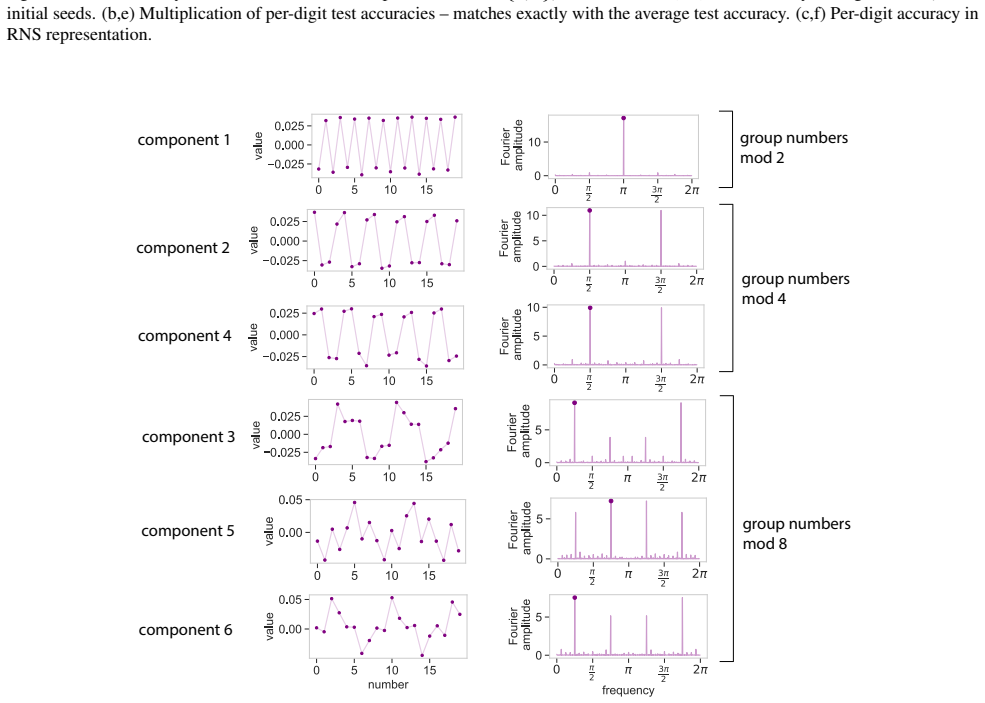
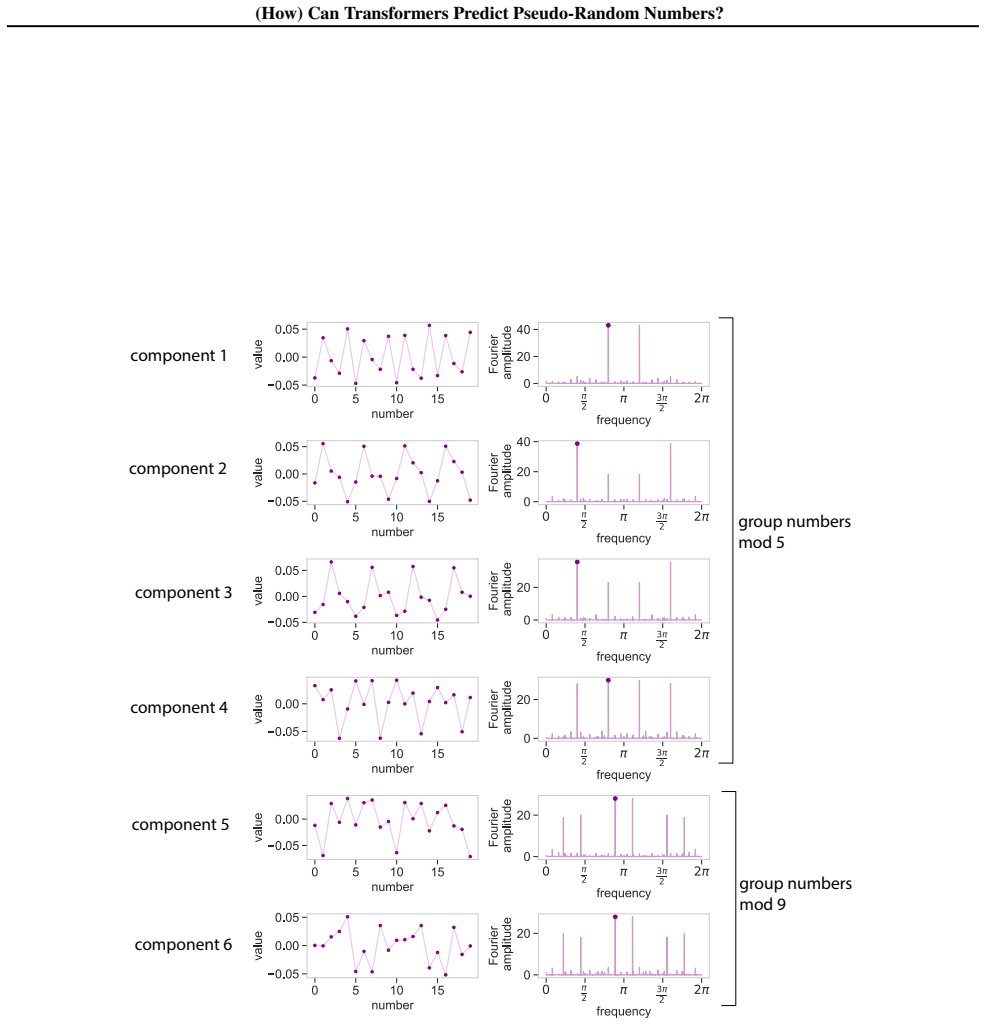
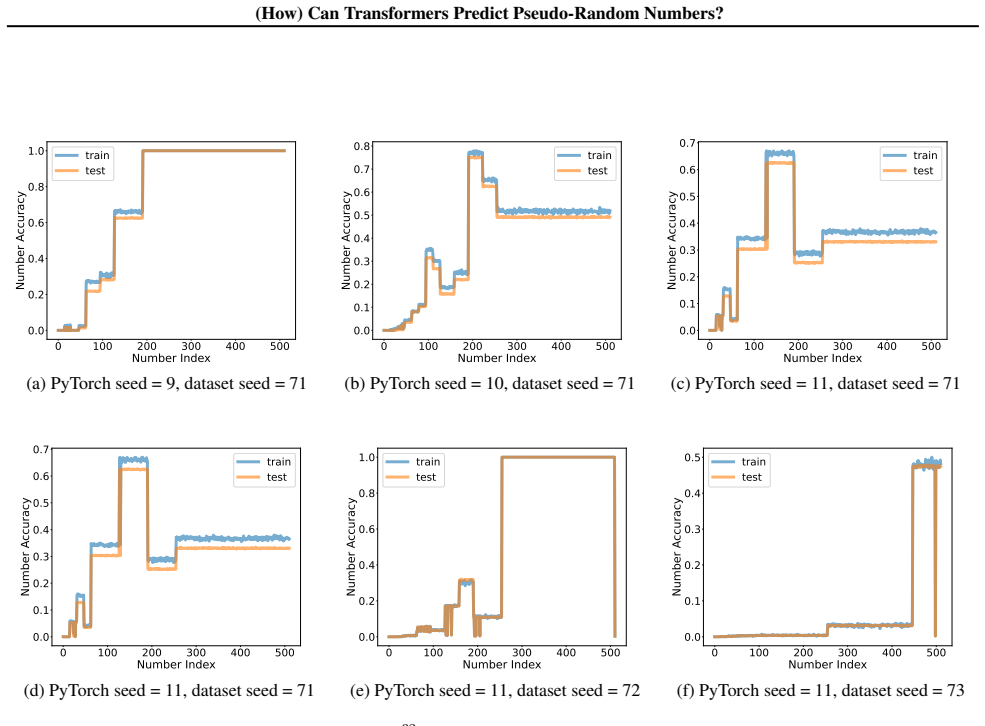
The load-bearing object is the residue number system representation of LCG outputs together with the digit-period theorem that comes from the Hull-Dobell maximum-period condition. When the sequence has full period $m$, the $w$-th lowest base-$p_j$ digit of $x_t$ has period $p_j^w$, and skipping $r$ steps in the sequence shortens that period to $p_j^w / \gcd(r, p_j^w)$. This makes the prediction task progressively easier as the context grows: the model can look back $2^k$ steps, copy the lowest $k$ bits, and read the higher bits from the simplified sequence, which explains the ladder-shaped accuracy curve with jumps at the $2^k$-th positions. The same construction, generalized to arbitrary prime-power factors of $m$, is the algorithm that the interpretability analysis attributes to the trained transformer.
What would settle it
Evaluate the unseen-modulus model on a held-out modulus with a large prime factor, for example $m_{\text{test}} = 2^{11} \cdot 101$, using the same six-layer recipe; if test accuracy does not reach the same 60-percent threshold with sublinear context scaling, then the demonstrated generalization is confined to smooth moduli, confirming that the mechanism's reliance on short-period prime-power digits is the reason. This is a measurement the paper does not report, and its outcome would delimit the central claim.
Extended reading notes
Core claim
The central claim is that transformers trained on LCG sequences do not memorize the training data but learn the underlying arithmetic structure, and that this structure is exactly the digit-wise periodicity of maximum-period LCGs. For a modulus $m = p_1^{w_1} \cdots p_q^{w_q}$, each number can be written in the residue number system as its tuple of residuals modulo $p_j^{w_j}$, and each base-$p_j$ digit has period $p_j^w$. The trained model's embedding layer groups numbers by their residues modulo prime powers, its attention heads look back $2^k$ (or $p_j^k$) steps in the context to exploit the $r$-step recurrence, and its MLP neurons fire with periodic patterns that constructively interfere at the correct next number. In the unseen-modulus setting the model first estimates $m$ greedily from the largest number in context, then applies the same digit-wise mechanism; a patching experiment that swaps in features from a sequence with a different modulus steers the model's predictions accordingly. The paper claims this mechanism generalizes to moduli up to $2^{32}$ in the fixed-modulus case, with the required context length scaling sublinearly as roughly $m^{1/4}$.
Load-bearing premise
The entire test regime is restricted to maximum-period LCGs whose parameters satisfy the Hull-Dobell theorem, and the unseen-modulus scaling results use only smooth moduli (powers of 2 and 3); a claim that transformers predict 'pseudo-random numbers' in general would go beyond the evidence.
Editorial extensions
If this is right
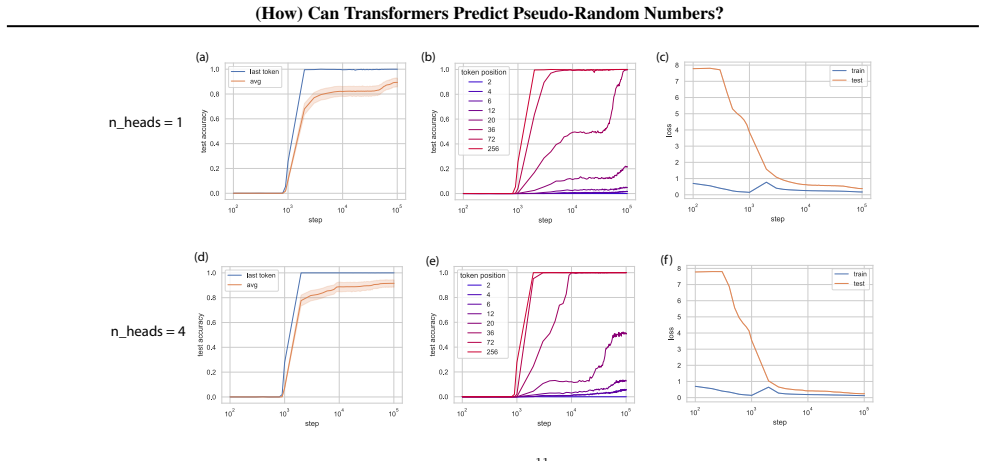
- One attention head in a single transformer layer already solves the fixed-modulus task for composite $m$, so the digit-period shortcut is a low-complexity algorithm once the modulus is known.
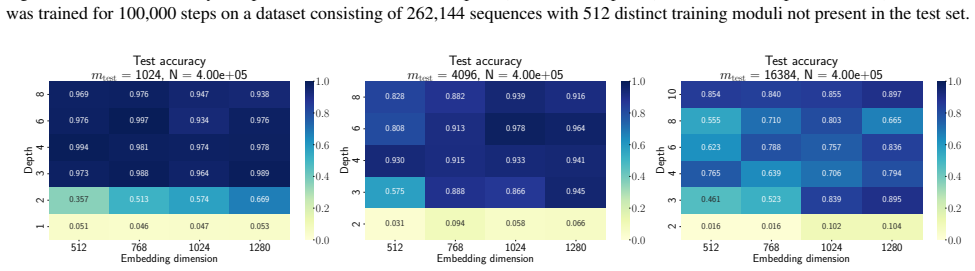
- Generalizing to an unseen modulus requires a sharp minimum of three layers, and accuracy collapses below that depth; the modulus-estimating head and the prime-factor-specialized heads are both necessary components.
- The context length needed for perfect or near-perfect prediction grows sublinearly with the modulus, roughly $m^{1/4}$ in the fixed-modulus case and $m^{0.24}$ to $m^{0.33}$ for unseen moduli, so larger numbers do not demand proportionally more examples.
- The tokenization base matters: a base aligned with the modulus's prime factors, such as $256 = 2^8$ versus $243 = 3^5$, makes the periodic structure visible to the model and improves scaling.
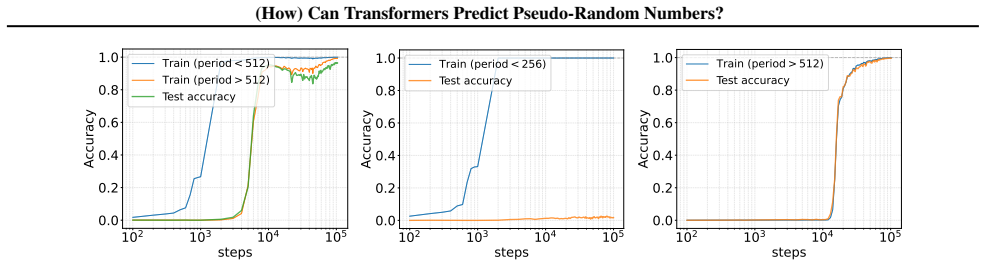
- Training on long-period sequences alone is sufficient for generalization; training on short-period sequences teaches only copying and does not transfer.
Reading between the lines
- The digit-period mechanism predicts that transformers trained this way will fail on moduli that admit no small prime-power factor structure, such as primes or products of two large primes, in the fixed-modulus regime; the paper already observes this failure for a single prime in Appendix C, and generalizing that test would delineate the method's boundary sharply.
- Because low-order digits carry the strongest periodic signal, small errors in the estimated modulus are tolerable; this suggests a testable robustness property and, conversely, an adversarial weakness, namely that generators which truncate or mask low-order bits, such as the PCG family, should be substantially harder to predict with this mechanism.
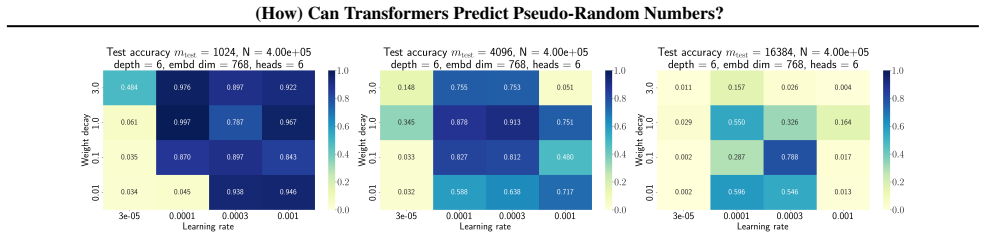
- The reported shrinking of the usable hyperparameter range as $m$ grows suggests that the 'sufficient capacity and training variety' premise hides a real engineering cost: each modulus scale may need its own learning-rate and weight-decay re-tuning, which the paper does not quantify as a scaling law.
- The sublinear context scaling invites a natural extrapolation test: predict the required context length for $m$ beyond $2^{32}$ from the power law, then check whether a model trained on the same family reaches 100 percent accuracy there; a deviation would reveal where the digit-copying shortcut stops being learned.
Editorial analysis
A structured set of objections, weighed in public.
Referee Report
Summary. This paper studies whether GPT-style transformers can learn to predict the next output of linear congruential generators (LCGs) from in-context examples. It considers two settings: a fixed modulus (FM), with held-out (a,c) pairs, and an unseen-modulus (UM) setting, where test moduli are excluded from training. The authors report that a one-layer, single-head transformer solves FM for composite moduli up to m=2^32 using base-b tokenization, while UM requires at least three layers and generalizes to unseen moduli up to m_test=2^16. Through PCA, attention-masking, head-pruning, and patching experiments, they argue that the model factorizes the modulus into prime powers, represents numbers in an RNS, copies low digits using r-step recurrences, and, in the UM case, estimates the modulus from the largest context value. They also report that the number of in-context elements needed for high accuracy scales as m^gamma with gamma around 1/4 (FM) or 0.24-0.33 (UM). The test distribution is restricted to Hull-Dobell-valid parameters, and the large-scale UM experiments use only m_test = 2^k, 3^k.
Significance. If the results hold, the paper provides one of the more complete mechanistic accounts of a nontrivial in-context learning algorithm in transformers, with correct digit-period derivations in Appendix F, held-out parameter evaluation, excluded test moduli, and causal interventions (attention masking, head pruning, and activation patching) that support the proposed algorithm. The authors also open-source their code, which supports reproducibility. The sublinear context-scaling finding for smooth moduli is interesting and may inform studies of algorithmic reasoning. However, the demonstrated capability is narrower than the title suggests: the experiments cover only maximum-period LCGs, and the scaled-up unseen-modulus results cover only powers of 2 and 3. The paper is therefore a strong case study of a structured subclass of LCG sequences rather than a general statement about pseudo-random number prediction.
major comments (3)
- [§1.2, §5.2, App. C] The results support a narrower claim than the title and abstract. Section 1.2 explicitly limits all evaluation to sequences obeying the Hull-Dobell conditions, so test LCGs have maximal period T_m = m; Section 5.2 restricts the unseen-modulus scaling experiments to m_test = 2^k, 3^k; and Appendix C shows that in the fixed-modulus setting the model fails on the prime modulus m = 2039 within the same budget. The algorithmic story in Section 4.1 and Appendix F also relies on the maximum-period property to obtain digit periods p^w. The abstract's statement that transformers 'can perform in-context prediction of LCG sequences with unseen moduli and parameters' should therefore be qualified to full-period LCGs, with scaled-up evidence only for moduli that are powers of 2 and 3, or the experiments need to be extended to non-Hull-Dobell parameters and moduli with large prime factors.
- [§5.1, §5.2, Fig. 12-13] The sublinear context-scaling law is claimed for 'the modulus' in general but is fit only on m = 2^k in the FM setting and on m_test = 2^k, 3^k in the UM setting. These are exactly the moduli where the RNS digit-period mechanism provides many low-period digits. For a modulus with a large prime factor, the highest digit has period comparable to m and the copying shortcut is unavailable, so there is no reason to expect the same exponent; the fixed-modulus prime result in Appendix C is a concrete indication that the behavior differs. The scaling claims should be explicitly restricted to smooth moduli, or supported by experiments on mixed-prime and prime moduli at scale.
- [§4.2, Qualitative Algorithm; §1.2] The claim that the fixed-modulus algorithm 'works for arbitrary a, c, x0 for a given m' is stronger than what is tested and stronger than the derivation supports. The r-step copying of low digits is derived under the Hull-Dobell/full-period assumption; for a generic LCG with shorter period, the w-th digit need not have period p^w, and Appendix C shows the model does not learn such sequences within the same budget. The sentence should be restricted to Hull-Dobell-valid (a,c), or supported by experiments on non-maximum-period LCGs.
minor comments (5)
- [§2.1, App. A.1] The number of sampled moduli is denoted n_m in Section 2.1 but appears as n_p in Appendix A.1; please harmonize the notation.
- [§4.2, Eq. (5)] Equation (5) is described as an 'empirical proof'; since the identity is only verified numerically in Figure 23(b), the wording should be 'empirically verified relation' rather than 'proof'.
- [Fig. 13] The figure captions should render the tokenization bases as 2^8 and 3^5, not '28' and '35'; the superscripts appear to have been lost in the text.
- [§6, Limitations] The Limitations paragraph mentions the scale m ≤ 2^32 but omits the two more important restrictions: all tests use Hull-Dobell-valid parameters, and the scaled-up unseen-modulus experiments use only powers of 2 and 3.
- [Throughout] There are several typographical errors ('exlude', 'hyperpamraters', 'Futhermore', 'accoverall') that should be corrected in a final pass.
Circularity Check
No substantive circularity: the central generalization claims are evaluated against held-out (a,c) pairs and unseen moduli excluded from training, and the interpretability claims are supported by causal ablations and independent mathematical derivations.
full rationale
The paper's core claims are benchmarked externally rather than by construction. In the fixed-modulus setting, Section 2.1 states that test (a,c) pairs are 'not considered while generating the training dataset' (64 held-out values), and in the unseen-modulus setting the test moduli Mtest are 'reserved exclusively for evaluation' and excluded from training, so the model is tested on moduli it never saw during training. The interpretability mechanism (RNS digit periods and r-step copying) is derived from the Hull-Dobell theorem and standard LCG period facts in Appendix F, not from a self-citation chain; the attention-masking, head-pruning, and patching experiments provide causal evidence for the claimed circuit roles rather than merely renaming observed patterns. The base-3 tokenization crossover in Section 5.2 is a falsifiable prediction that succeeded as predicted. The self-citations (Doshi et al. 2024a,b; He et al. 2024) appear only as related-work context and are not load-bearing evidence for any central claim. The main caveat is a scope restriction, not circularity: testing is limited to full-period Hull-Dobell-valid LCGs (Section 1.2) and, for the unseen-modulus scaling experiments, smooth moduli mtest = 2^k, 3^k (Section 5.2); this narrows the headline claim about 'pseudo-random numbers' and is a scope/correctness risk, but it does not make any derivation equivalent to its inputs. The circularity burden is therefore essentially absent beyond minor, non-load-bearing self-citation, matching a low score of 2.
Assumptions & free parameters
free parameters (3)
- Scaling exponent gamma (fixed modulus) =
gamma near 1/4 (Figure 12b)
- Scaling exponent gamma (unseen modulus) =
0.24 to 0.33 (Figure 13)
- Training diversity rule nm at least mtest/4 =
nm at least mtest/4
assumptions (5)
- standard math Hull-Dobell theorem: for coprime (c, m), with prime-divisor and mod-4 conditions on a - 1, the LCG has maximal period T_m = m.
- standard math Digit-period lemma: for maximum-period LCGs, the w-th lowest base-p digit has period p^w along the sequence.
- standard math Residue Number System representation is unique for pairwise-coprime prime-power factors of m.
- domain assumption The reverse-engineered algorithm is the mechanism of the trained checkpoints, not merely a post hoc description.
- domain assumption Evaluation is restricted to the Hull-Dobell maximum-period family and, in Section 5.2, to smooth moduli (2^k, 3^k).
Cite this review
Pith. "Pith review of (How) Can Transformers Predict Pseudo-Random Numbers?." pith.science (2026). https://pith.science/paper/QTWYAME4
@misc{pith2026250210390,
  author       = {Pith},
  title        = {Pith review of: (How) Can Transformers Predict Pseudo-Random Numbers?},
  year         = {2026},
  howpublished = {\url{https://pith.science/paper/QTWYAME4}},
  note         = {Machine review of arXiv:2502.10390}
}
abstract
Transformers excel at discovering patterns in sequential data, yet their fundamental limitations and learning mechanisms remain crucial topics of investigation. In this paper, we study the ability of Transformers to learn pseudo-random number sequences from linear congruential generators (LCGs), defined by the recurrence relation $x_{t+1} = a x_t + c \;\mathrm{mod}\; m$. We find that with sufficient architectural capacity and training data variety, Transformers can perform in-context prediction of LCG sequences with unseen moduli ($m$) and parameters ($a,c$). By analyzing the embedding layers and attention patterns, we uncover how Transformers develop algorithmic structures to learn these sequences in two scenarios of increasing complexity. First, we investigate how Transformers learn LCG sequences with unseen ($a, c$) but fixed modulus; and demonstrate successful learning up to $m = 2^{32}$. We find that models learn to factorize $m$ and utilize digit-wise number representations to make sequential predictions. In the second, more challenging scenario of unseen moduli, we show that Transformers can generalize to unseen moduli up to $m_{\text{test}} = 2^{16}$. In this case, the model employs a two-step strategy: first estimating the unknown modulus from the context, then utilizing prime factorizations to generate predictions. For this task, we observe a sharp transition in the accuracy at a critical depth $d= 3$. We also find that the number of in-context sequence elements needed to reach high accuracy scales sublinearly with the modulus.
Figures


Figures from the paper (30 more)











Forward citations
Cited by 3 Pith papers
-
Learning Pseudorandom Numbers with Transformers: Permuted Congruential Generators, Curricula, and Interpretability
Transformers can in-context predict PCG outputs on unseen parameters; required context length scales as sqrt(m), and curriculum training with smaller moduli is necessary for large moduli.
-
Pseudorandom Streams within Diffusion Models Act as Learnable Inputs That Affect Generation Quality
A diffusion model's training loss and output quality depend measurably on which pseudorandom orbit supplies its randomness, even after marginal-statistics control.
-
Sequential Correlations Change In-Context Learning: Effective Context Length and Architectural Mismatch
Within-context token correlations reduce ICL to an effective shorter i.i.d. context length, while query–context correlations lower error and favor softmax over linear attention.
Reference graph
Works this paper leans on
-
[1]
Transformers learn to implement preconditioned gradient descent for in-context learning
Ahn, K., Cheng, X., Daneshmand, H., and Sra, S. Transformers learn to implement preconditioned gradient descent for in-context learning. In Oh, A., Neumann, T., Globerson, A., Saenko, K., Hardt, M., and Levine, S. (eds.), Advances in Neural Information Processing Systems, volume 36, pp.\ 45614--45650. Curran Associates, Inc., 2023. URL https://openreview....
work page 2023
-
[2]
What learning algorithm is in-context learning? investigations with linearmodels, 2023
Aky \"u rek, E., Schuurmans, D., Andreas, J., Ma, T., and Zhou, D. What learning algorithm is in-context learning? investigations with linearmodels, 2023. URL https://openreview.net/forum?id=0g0X4H8yN4I
work page 2023
- [3]
- [4]
-
[5]
Cagnetta, F. and Wyart, M. Towards a theory of how the structure of language is acquired by deep neural networks. arXiv preprint arXiv:2406.00048, 2024
arXiv 2024
-
[6]
Cagnetta, F., Petrini, L., Tomasini, U. M., Favero, A., and Wyart, M. How deep neural networks learn compositional data: The random hierarchy model. Physical Review X, 14 0 (3): 0 031001, 2024
work page 2024
-
[7]
Chen, X. and Zou, D. What can transformer learn with varying depth? case studies on sequence learning tasks. In Forty-first International Conference on Machine Learning, 2024. URL https://openreview.net/forum?id=YNbCbcGyXE
work page 2024
-
[8]
Three models for the description of language
Chomsky, N. Three models for the description of language. IRE Transactions on information theory, 2 0 (3): 0 113--124, 1956
1956
Show all 38 references
-
[9]
K., Catt, E., Cundy, C., Hutter, M., Legg, S., Veness, J., and Ortega, P
Delétang, G., Ruoss, A., Grau-Moya, J., Genewein, T., Wenliang, L. K., Catt, E., Cundy, C., Hutter, M., Legg, S., Veness, J., and Ortega, P. A. Neural networks and the chomsky hierarchy, 2023. URL https://arxiv.org/abs/2207.02098
2023 arXiv
-
[10]
To grok or not to grok: Disentangling generalization and memorization on corrupted algorithmic datasets
Doshi, D., Das, A., He, T., and Gromov, A. To grok or not to grok: Disentangling generalization and memorization on corrupted algorithmic datasets. In The Twelfth International Conference on Learning Representations, 2024 a . URL https://openreview.net/forum?id=UHjE5v5MB7
2024
-
[11]
Grokking modular polynomials, 2024 b
Doshi, D., He, T., Das, A., and Gromov, A. Grokking modular polynomials, 2024 b . URL https://arxiv.org/abs/2406.03495
2024 arXiv
-
[12]
An image is worth 16x16 words: Transformers for image recognition at scale
Dosovitskiy, A., Beyer, L., Kolesnikov, A., Weissenborn, D., Zhai, X., Unterthiner, T., Dehghani, M., Minderer, M., Heigold, G., Gelly, S., Uszkoreit, J., and Houlsby, N. An image is worth 16x16 words: Transformers for image recognition at scale. In International Conference on...
2021
-
[13]
Garner, H. L. The residue number system. In Papers Presented at the the March 3-5, 1959, Western Joint Computer Conference, IRE-AIEE-ACM '59 (Western), pp.\ 146–153, New York, NY, USA, 1959. Association for Computing Machinery. ISBN 9781450378659. doi:10.1145/1457838.1457864. ...
1959
-
[14]
Grokking modular arithmetic, 2023
Gromov, A. Grokking modular arithmetic, 2023. URL https://arxiv.org/abs/2301.02679
2023 arXiv
-
[15]
Learning to grok: Emergence of in-context learning and skill composition in modular arithmetic tasks
He, T., Doshi, D., Das, A., and Gromov, A. Learning to grok: Emergence of in-context learning and skill composition in modular arithmetic tasks. In The Thirty-eighth Annual Conference on Neural Information Processing Systems, 2024. URL https://openreview.net/forum?id=aVh9KRZdRk
2024
-
[16]
In-context learning creates task vectors, 2023
Hendel, R., Geva, M., and Globerson, A. In-context learning creates task vectors, 2023
2023
-
[17]
Hull, T. E. and Dobell, A. R. Random number generators. SIAM Review, 4 0 (3): 0 230--254, 1962. doi:10.1137/1004061. URL https://doi.org/10.1137/1004061
1962 doi
-
[18]
Knuth, D. E. The art of computer programming, volume 2 (3rd ed.): seminumerical algorithms. Addison-Wesley Longman Publishing Co., Inc., USA, 1997. ISBN 0201896842
1997
-
[19]
Learning skillful medium-range global weather forecasting
Lam, R., Sanchez-Gonzalez, A., Willson, M., Wirnsberger, P., Fortunato, M., Alet, F., Ravuri, S., Ewalds, T., Eaton-Rosen, Z., Hu, W., et al. Learning skillful medium-range global weather forecasting. Science, 382 0 (6677): 0 1416--1421, 2023
2023
-
[20]
In-context vectors: Making in context learning more effective and controllable through latent space steering, 2024
Liu, S., Ye, H., Xing, L., and Zou, J. In-context vectors: Making in context learning more effective and controllable through latent space steering, 2024
2024
-
[21]
and Hutter, F
Loshchilov, I. and Hutter, F. Decoupled weight decay regularization. In International Conference on Learning Representations, 2019. URL https://openreview.net/forum?id=Bkg6RiCqY7
2019
-
[22]
Uncovering a universal abstract algorithm for modular addition in neural networks, 2025
McCracken, G., Moisescu-Pareja, G., Letourneau, V., Precup, D., and Love, J. Uncovering a universal abstract algorithm for modular addition in neural networks, 2025. URL https://arxiv.org/abs/2505.18266
2025 arXiv
-
[23]
R., Kailkhura, B., Bhatele, A., Geiping, J., Schwarzschild, A., and Goldstein, T
McLeish, S., Bansal, A., Stein, A., Jain, N., Kirchenbauer, J., Bartoldson, B. R., Kailkhura, B., Bhatele, A., Geiping, J., Schwarzschild, A., and Goldstein, T. Transformers can do arithmetic with the right embeddings, 2024. URL https://arxiv.org/abs/2405.17399
2024 arXiv
-
[24]
Progress measures for grokking via mechanistic interpretability
Nanda, N., Chan, L., Lieberum, T., Smith, J., and Steinhardt, J. Progress measures for grokking via mechanistic interpretability. In The Eleventh International Conference on Learning Representations, 2023. URL https://openreview.net/forum?id=9XFSbDPmdW
2023
-
[25]
In-context learning and induction heads
Olsson, C., Elhage, N., Nanda, N., Joseph, N., DasSarma, N., Henighan, T., Mann, B., Askell, A., Bai, Y., Chen, A., et al. In-context learning and induction heads. arXiv preprint arXiv:2209.11895, 2022
2022 arXiv
-
[26]
O'Neill, M. E. Pcg : A family of simple fast space-efficient statistically good algorithms for random number generation. 2014. URL https://api.semanticscholar.org/CorpusID:3489282
2014
-
[27]
Grokking: Generalization beyond overfitting on small algorithmic datasets
Power, A., Burda, Y., Edwards, H., Babuschkin, I., and Misra, V. Grokking: Generalization beyond overfitting on small algorithmic datasets. arXiv preprint arXiv:2201.02177, 2022
2022 arXiv
-
[28]
and Wolf, L
Press, O. and Wolf, L. Using the output embedding to improve language models. In Proceedings of the 15th Conference of the European Chapter of the Association for Computational Linguistics: Volume 2, Short Papers, pp.\ 157--163, 2017
2017
-
[29]
Language models are unsupervised multitask learners
Radford, A., Wu, J., Child, R., Luan, D., Amodei, D., and Sutskever, I. Language models are unsupervised multitask learners. 2019
2019
-
[30]
Rivest, R. L. Cryptography and machine learning. In International Conference on the Theory and Application of Cryptology, pp.\ 427--439. Springer, 1991
1991
-
[31]
J., Casper, S., Tegmark, M., Saunders, W., Bau, D., Todd, E., Geiger, A., Geva, M., Hoogland, J., Murfet, D., and McGrath, T
Sharkey, L., Chughtai, B., Batson, J., Lindsey, J., Wu, J., Bushnaq, L., Goldowsky-Dill, N., Heimersheim, S., Ortega, A., Bloom, J., Biderman, S., Garriga-Alonso, A., Conmy, A., Nanda, N., Rumbelow, J., Wattenberg, M., Schoots, N., Miller, J., Michaud, E. J., Casper, S., Tegma...
2025 arXiv
-
[32]
and Vigna, S
Steele, G. and Vigna, S. Computationally easy, spectrally good multipliers for congruential pseudorandom number generators, 2021. URL https://arxiv.org/abs/2001.05304
2021 arXiv
-
[33]
N., Kaiser, L., and Polosukhin, I
Vaswani, A., Shazeer, N., Parmar, N., Uszkoreit, J., Jones, L., Gomez, A. N., Kaiser, L., and Polosukhin, I. Attention is all you need. In Proceedings of the 31st International Conference on Neural Information Processing Systems, NIPS'17, pp.\ 6000–6010, Red Hook, NY, USA, 201...
2017
-
[34]
Transformers learn in-context by gradient descent, 2023
von Oswald, J., Niklasson, E., Randazzo, E., Sacramento, J., Mordvintsev, A., Zhmoginov, A., and Vladymyrov, M. Transformers learn in-context by gradient descent, 2023
2023
-
[35]
Chain-of-thought prompting elicits reasoning in large language models, 2023
Wei, J., Wang, X., Schuurmans, D., Bosma, M., Ichter, B., Xia, F., Chi, E., Le, Q., and Zhou, D. Chain-of-thought prompting elicits reasoning in large language models, 2023. URL https://arxiv.org/abs/2201.11903
2023 arXiv
-
[36]
and Nanda, N
Zhang, F. and Nanda, N. Towards best practices of activation patching in language models: Metrics and methods. In The Twelfth International Conference on Learning Representations, 2024. URL https://openreview.net/forum?id=Hf17y6u9BC
2024
-
[37]
The clock and the pizza: Two stories in mechanistic explanation of neural networks
Zhong, Z., Liu, Z., Tegmark, M., and Andreas, J. The clock and the pizza: Two stories in mechanistic explanation of neural networks. In Thirty-seventh Conference on Neural Information Processing Systems, 2023. URL https://openreview.net/forum?id=S5wmbQc1We
2023
-
[38]
write newline
" write newline "" before.all 'output.state := FUNCTION n.dashify 't := "" t empty not t #1 #1 substring "-" = t #1 #2 substring "--" = not "--" * t #2 global.max substring 't := t #1 #1 substring "-" = "-" * t #2 global.max substring 't := while if t #1 #1 substring * t #2 gl...
Reviewed August 7, 2026 · model on record in the stance chip above.
Discussion (0). Sign in to comment.