Two-dimensional higher-order Weyl semimetals
Pith reviewed 2026-05-23 02:46 UTC · model grok-4.3
The pith
Coupling a trilayer topological insulator to a d-wave altermagnet opens gaps in helical edge states while preserving two Weyl points, realizing two-dimensional higher-order Weyl semimetals with topological corner states.
A machine-rendered reading of the paper's core claim, the machinery that carries it, and where it could break.
Core claim
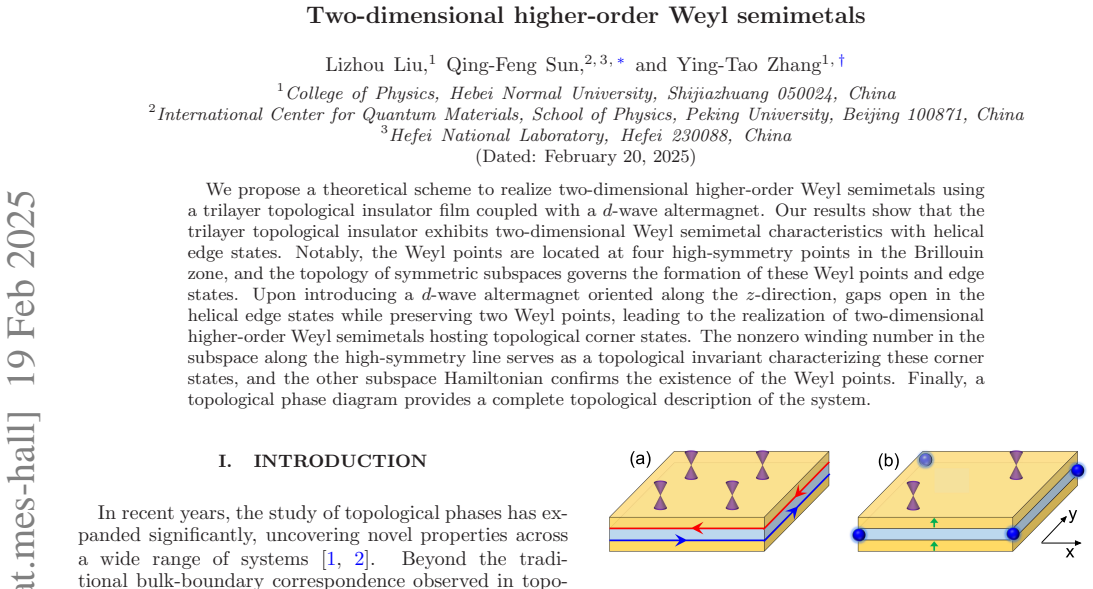
Upon introducing a d-wave altermagnet oriented along the z-direction, gaps open in the helical edge states while preserving two Weyl points, leading to the realization of two-dimensional higher-order Weyl semimetals hosting topological corner states. The nonzero winding number in the subspace along the high-symmetry line serves as a topological invariant characterizing these corner states, and the other subspace Hamiltonian confirms the existence of the Weyl points.
What carries the argument
Winding number in the symmetric subspace along the high-symmetry line, which acts as the topological invariant for the corner states after the altermagnet gaps the edges.
If this is right
- Helical edge states of the trilayer film become gapped while two Weyl points survive at high-symmetry points.
- Topological corner states appear and are protected by the nonzero winding number.
- The complementary subspace Hamiltonian continues to encode the preserved Weyl points.
- A complete topological phase diagram classifies all regimes of the heterostructure.
Where Pith is reading between the lines
- The selective gapping separates the protection of bulk Weyl points from the protection of boundary states, allowing higher-order topology to emerge in two dimensions.
- The same winding-number invariant could be used to diagnose corner states in other 2D systems where an external field gaps edges without eliminating all band crossings.
- Transport signatures of the corner states, such as localized conductance peaks at sample corners, would be a direct experimental test of the construction.
Load-bearing premise
The trilayer topological insulator film exhibits two-dimensional Weyl semimetal characteristics with helical edge states whose formation is governed by the topology of symmetric subspaces.
What would settle it
Numerical diagonalization or transport measurement of the coupled system that finds either a vanishing winding number in the relevant subspace or the absence of corner states when the edges are gapped and exactly two Weyl points remain would falsify the higher-order character.
Figures


read the original abstract
We propose a theoretical scheme to realize two-dimensional higher-order Weyl semimetals using a trilayer topological insulator film coupled with a d-wave altermagnet. Our results show that the trilayer topological insulator exhibits two-dimensional Weyl semimetal characteristics with helical edge states. Notably, the Weyl points are located at four high-symmetry points in the Brillouin zone, and the topology of symmetric subspaces governs the formation of these Weyl points and edge states. Upon introducing a d-wave altermagnet oriented along the z-direction, gaps open in the helical edge states while preserving two Weyl points, leading to the realization of two-dimensional higher-order Weyl semimetals hosting topological corner states. The nonzero winding number in the subspace along the high-symmetry line serves as a topological invariant characterizing these corner states, and the other subspace Hamiltonian confirms the existence of the Weyl points. Finally, a topological phase diagram provides a complete topological description of the system.
Editorial analysis
A structured set of objections, weighed in public.
Referee Report
Summary. The manuscript proposes a scheme to realize two-dimensional higher-order Weyl semimetals by coupling a trilayer topological insulator film to a z-oriented d-wave altermagnet. It claims that the trilayer TI exhibits 2D Weyl semimetal behavior with helical edge states at four high-symmetry Brillouin-zone points, whose formation is governed by the topology of symmetric subspaces. Adding the altermagnet opens gaps in the helical edge states while preserving exactly two Weyl points; the resulting phase hosts topological corner states protected by a nonzero winding number in one subspace, with the other subspace Hamiltonian confirming the Weyl points. A topological phase diagram is also presented.
Significance. If substantiated, the construction would supply a concrete materials platform combining topological-insulator and altermagnet physics to realize higher-order topological semimetals in two dimensions, with protected corner states. The use of subspace topology and winding-number invariants offers a potentially generalizable route beyond conventional higher-order insulators.
major comments (3)
- [Abstract] Abstract: The central claim that the d-wave altermagnet gaps the four helical edge states while leaving precisely two Weyl points gapless rests on the assumption that the altermagnet term respects the symmetric-subspace decomposition used to define both the winding number and the Weyl-point Hamiltonian. No explicit matrix elements, symmetry operators, or commutation relations are supplied to show that the perturbation does not mix the subspaces.
- [Abstract] Abstract: The statement that 'the nonzero winding number in the subspace along the high-symmetry line serves as a topological invariant characterizing these corner states' is asserted without any derivation, explicit computation of the winding number, or demonstration of corner-state localization (e.g., via wave-function plots or finite-size spectra).
- [Abstract] Abstract: The claim that 'the other subspace Hamiltonian confirms the existence of the Weyl points' is made without presenting the form of this Hamiltonian or showing how the altermagnet term acts within it, rendering the preservation of the two Weyl points unverified.
Simulated Author's Rebuttal
We thank the referee for the careful reading of our manuscript and the constructive comments. We address each major comment point by point below.
read point-by-point responses
-
Referee: [Abstract] Abstract: The central claim that the d-wave altermagnet gaps the four helical edge states while leaving precisely two Weyl points gapless rests on the assumption that the altermagnet term respects the symmetric-subspace decomposition used to define both the winding number and the Weyl-point Hamiltonian. No explicit matrix elements, symmetry operators, or commutation relations are supplied to show that the perturbation does not mix the subspaces.
Authors: We agree that the abstract does not contain these explicit verifications. The symmetric subspaces are defined by the mirror symmetries of the trilayer TI, and the z-oriented d-wave altermagnet term is constructed to be even under those symmetries. In the revised manuscript we will add the explicit matrix representation of the altermagnet term together with the commutation relations that confirm it preserves the subspace decomposition. revision: yes
-
Referee: [Abstract] Abstract: The statement that 'the nonzero winding number in the subspace along the high-symmetry line serves as a topological invariant characterizing these corner states' is asserted without any derivation, explicit computation of the winding number, or demonstration of corner-state localization (e.g., via wave-function plots or finite-size spectra).
Authors: The winding number is computed explicitly from the subspace Hamiltonian in the main text, and corner-state localization is demonstrated by finite-size spectra and wave-function plots. We will revise the manuscript to make these calculations and figures more prominently referenced from the abstract and introduction, and if needed add a short clarifying sentence. revision: partial
-
Referee: [Abstract] Abstract: The claim that 'the other subspace Hamiltonian confirms the existence of the Weyl points' is made without presenting the form of this Hamiltonian or showing how the altermagnet term acts within it, rendering the preservation of the two Weyl points unverified.
Authors: We acknowledge that the abstract omits the explicit form. The manuscript derives both subspace Hamiltonians and shows that the altermagnet term leaves the Weyl points gapless in one subspace. In the revision we will insert the explicit expressions for the second subspace Hamiltonian and the action of the altermagnet term to verify preservation of the Weyl points. revision: yes
Circularity Check
No significant circularity detected
full rationale
The provided abstract and description present the central claims as following from standard topological invariants (winding numbers in symmetric subspaces) and symmetry properties of the trilayer TI plus z-oriented d-wave altermagnet. No equations, fitted parameters, or self-citation chains are exhibited that reduce the gapping of helical edges while preserving two Weyl points, or the resulting corner states, to the inputs by construction. The subspace decomposition and nonzero winding number are invoked as governing features without evidence of self-definitional loops or renaming of known results. This is the normal case of a self-contained theoretical proposal resting on domain-standard assumptions.
Axiom & Free-Parameter Ledger
free parameters (1)
- TI-altermagnet coupling strength
axioms (1)
- domain assumption Topology of symmetric subspaces governs formation of Weyl points and edge states in the trilayer TI.
Reference graph
Works this paper leans on
-
[1]
C.-K. Chiu, J. C. Y. Teo, A. P. Schnyder, and S. Ryu, Classification of Topological Quantum Matter with Sym- metries, Rev. Mod. Phys. 88, 035005 (2016)
work page 2016
- [2]
-
[3]
M. Z. Hasan and C. L. Kane, Colloquium: Topological insulators, Rev. Mod. Phys. 82, 3045 (2010)
work page 2010
-
[4]
F. Liu, Two-dimensional topological insulators: past, present and future, Coshare Science 01, v3, 1-62 (2023)
work page 2023
-
[5]
X.-L. Qi and S.-C. Zhang, Topological insulators and su- perconductors, Rev. Mod. Phys. 83, 1057 (2011)
work page 2011
-
[6]
F. D. M. Haldane, Model for a Quantum Hall Effect with- out Landau Levels: Condensed-Matter Realization of the ”Parity Anomaly”, Phys. Rev. Lett. 61, 2015 (1988)
work page 2015
-
[7]
C. L. Kane and E. J. Mele, Z2 Topological Order and the Quantum Spin Hall Effect, Phys. Rev. Lett. 95, 146802 (2005)
work page 2005
-
[8]
C. L. Kane and E. J. Mele, Quantum Spin Hall Effect in Graphene, Phys. Rev. Lett. 95, 226801 (2005)
work page 2005
-
[9]
B. A. Bernevig, T. L. Hughes, and S.-C. Zhang, Quan- tum Spin Hall Effect and Topological Phase Transition in HgTe Quantum Wells, Science 314, 1757 (2006)
work page 2006
-
[10]
B. A. Bernevig and S.-C. Zhang, Quantum Spin Hall Ef- fect, Phys. Rev. Lett. 96, 106802 (2006)
work page 2006
-
[11]
N.P. Armitage, E. J. Mele, and A. Vishwanath, Weyl and Dirac semimetals in three-dimensional solids, Rev. Mod. Phys. 90, 015001 (2018)
work page 2018
-
[12]
B. Q. Lv, T. Qian, and H. Ding, Experimental perspec- tive on three-dimensional topological semimetals, Rev. Mod. Phys. 93, 025002 (2021)
work page 2021
-
[13]
A. A. Burkov, Topological semimetals, Nat. Mater. 15, 1145 (2016)
work page 2016
-
[14]
Dai, Weyl fermions go into orbit, Nat
X. Dai, Weyl fermions go into orbit, Nat. Phys. 12, 727 (2016)
work page 2016
-
[15]
W. A. Benalcazar, B. A. Bernevig, and T. L. Hughes, Quantized electric multipole insulators, Science 357, 61 (2017)
work page 2017
-
[16]
W. A. Benalcazar, B. A. Bernevig, and T. L. Hughes, Electric multipole moments, topological multipole mo- ment pumping, and chiral hinge states in crystalline in- sulators, Phys. Rev. B 96, 245115 (2017)
work page 2017
-
[17]
T. Li, P. Zhu, W. A. Benalcazar, and T. L. Hughes, Fractional disclination charge in two-dimensional Cn- symmetric topological crystalline insulators, Phys. Rev. B 101, 115115 (2020)
work page 2020
-
[18]
W. A. Benalcazar, T. Li, and T. L. Hughes, Quantiza- tion of fractional corner charge in Cn-symmetric higher- order topological crystalline insulators, Phys. Rev. B 99, 6 245151 (2019)
work page 2019
-
[19]
F. Schindler, A. M. Cook, M. G. Vergniory, Z. Wang, S. S. P. Parkin, B. A. Bernevig, and T. Neupert, Higher-order topological insulators, Sci. Adv. 4, eaat0346 (2018)
work page 2018
-
[20]
C. W. Peterson, W. A. Benalcazar, T. L. Hughes, and G. Bahl, A quantized microwave quadrupole insulator with topologically protected corner states, Nature 555, 346 (2018)
work page 2018
- [21]
-
[22]
S. Bhowmik, S. Banerjee, and A. Saha, Higher-order topological corner and bond-localized modes in magnonic insulators, Phys. Rev. B 109, 104417 (2024)
work page 2024
- [23]
-
[24]
Y.-C. Hung, B. Wang, C.-H. Hsu, A. Bansil, and H. Lin, Time-reversal soliton pairs in even spin Chern number higher-order topological insulators, Phys. Rev. B 110, 035125 (2024)
work page 2024
-
[25]
M. Mazanov, A. S. Kupriianov, R. S. Savelev, Z. He, and M. A. Gorlach, Multipole higher-order topology in a multimode lattice, Phys. Rev. B 109, L201122 (2024)
work page 2024
-
[26]
Y. Ren, Z. Qiao, and Q. Niu, Engineering Corner States from Two-Dimensional Topological Insulators, Phys. Rev. Lett. 124, 166804 (2020)
work page 2020
-
[27]
Z.-Y. Zhuang and Z. Yan, Topological Phase Transitions and Evolution of Boundary States Induced by Zeeman Fields in Second-Order Topological Insulators, Front. Phys. 10, 866347 (2022)
work page 2022
-
[28]
B. Han, J. Zeng, and Z. Qiao, In-Plane Magnetization- Induced Corner States in Bismuthene, Chinese Phys. Lett. 39, 017302 (2022)
work page 2022
-
[29]
C.-M. Miao, Q.-F. Sun, and Y.-T. Zhang, Second-order topological corner states in zigzag graphene nanoflake with different types of edge magnetic configurations, Phys. Rev. B 106, 165422 (2022)
work page 2022
-
[30]
C.-M. Miao, Y.-H. Wan, Q.-F. Sun, and Y.-T. Zhang, Engineering topologically protected zero-dimensional in - terface end states in antiferromagnetic heterojunction graphene nanoflakes, Phys. Rev. B 108, 075401 (2023)
work page 2023
-
[31]
C.-M. Miao, L. Liu, Y.-H. Wan, Q.-F. Sun, and Y.-T. Zhang, General principle behind magnetization-induced second-order topological corner states in the Kane-Mele model, Phys. Rev. B 109, 205417 (2024)
work page 2024
-
[32]
C. Chen, Z. Song, J.-Z. Zhao, Z. Chen, Z.-M. Yu, X.-L. Sheng, and S. A. Yang, Universal Approach to Magnetic Second-Order Topological Insulator, Phys. Rev. Lett. 125, 056402 (2020)
work page 2020
-
[33]
Y.-X. Li, Y. Liu, and C.-C. Liu, Creation and manipu- lation of higher-order topological states by altermagnets , Phys. Rev. B 109, L201109 (2024)
work page 2024
-
[34]
L. Liu, J. An, Y. Ren, Y.-T. Zhang, Z. Qiao, and Q. Niu, Engineering second-order topological insulators via coupling two first-order topological insulators, Phys. Rev . B 110, 115427 (2024)
work page 2024
- [35]
-
[36]
S. A. A. Ghorashi, T. Li, and T. L. Hughes, Higher-Order Weyl Semimetals, Phys. Rev. Lett. 125, 266804 (2020)
work page 2020
-
[37]
H.-X. Wang, Z.-K. Lin, B. Jiang, G.-Y. Guo, and J.-H. Jiang, Higher-Order Weyl Semimetals, Phys. Rev. Lett. 125, 146401 (2020)
work page 2020
-
[38]
Z. Xiong, Z.-K. Lin, H.-X. Wang, S. Liu, Y. Qian, and J.-H. Jiang, Valley higher-order Weyl semimetals, Phys. Rev. B 108, 085141 (2023)
work page 2023
-
[39]
Z. Pu, H. He, L. Luo, Q. Ma, L. Ye, M. Ke, and Z. Liu, Acoustic Higher-Order Weyl Semimetal with Bound Hinge States in the Continuum, Phys. Rev. Lett. 130, 116103 (2023)
work page 2023
-
[40]
S. A. A. Ghorashi, T. Li, M. Sato, and T. L. Hughes, Non-Hermitian higher-order Dirac semimetals, Phys. Rev. B 104, L161116 (2021)
work page 2021
-
[41]
Z. Wang, D. Liu, H. T. Teo, Q. Wang, H. Xue, and B. Zhang, Higher-order Dirac semimetal in a photonic crys- tal, Phys. Rev. B 105, L060101 (2022)
work page 2022
-
[42]
C. Chen, X.-T. Zeng, Z. Chen, Y. X. Zhao, X.-L. Sheng, and S. A. Yang, Second-Order Real Nodal- Line Semimetal in Three-Dimensional Graphdiyne, Phys. Rev. Lett. 128, 026405 (2022)
work page 2022
-
[43]
M.-J. Gao, H. Wu, and J.-H. An, Engineering second- order nodal-line semimetals by breaking PT symmetry and periodic driving, Phys. Rev. B 107, 035128 (2023)
work page 2023
-
[44]
X.-L. Du, R. Chen, R. Wang, and D.-H. Xu, Weyl nodes with higher-order topology in an optically driven nodal- line semimetal, Phys. Rev. B 105, L081102 (2022)
work page 2022
-
[45]
M. R. Hirsbrunner, A. D. Gray, and T. L. Hughes, Crys- talline electromagnetic responses of higher-order topolo g- ical semimetals, Phys. Rev. B 109, 075169 (2024)
work page 2024
-
[46]
B. Pan, Y. Hu, P. Zhou, H. Xiao, X. Yang, and L. Sun, Higher-order double-Weyl semimetal, Phys. Rev. B 109, 035148 (2024)
work page 2024
-
[47]
Y. Qi, Z. He, K. Deng, J. Li, and Y. Wang, Multipole higher-order topological semimetals, Phys. Rev. B 109, L060101 (2024)
work page 2024
-
[48]
Jackiw, Fractional charge and zeromodes for planar systems in a magnetic field, Phys
R. Jackiw, Fractional charge and zeromodes for planar systems in a magnetic field, Phys. Rev. D 29, 2375 (1984)
work page 1984
-
[49]
E. Fradkin, E. Dagotto, and D. Boyanovsky, Physical realization of the parity anomaly in condensed matter physics, Phys. Rev. Lett. 57, 2967 (1986)
work page 1986
-
[50]
G. W. Semenoff, Condensed-matter simulation of a three- dimensional anomaly, Phys. Rev. Lett. 53, 2449 (1984)
work page 1984
-
[51]
M. Mogi, Y. Okamura, M. Kawamura, R. Yoshimi, K. Yasuda, A. Tsukazaki, K. S. Takahashi, T. Mori- moto, N. Nagaosa, M. Kawasaki, Y. Takahashi, and Y. Tokura, Experimental signature of the parity anomaly in a semi-magnetic topological insulator, Nat. Phys. 18, 390 (2022)
work page 2022
-
[52]
I. Sodemann, and L. Fu, Quantum nonlinear hall effect induced by berry curvature dipole in time-reversal invari- ant materials, Phys. Rev. Lett. 115, 216806 (2015)
work page 2015
-
[53]
Z. Z. Du, H.-Z. Lu, and X. C. Xie, Nonlinear Hall effects, Nat. Rev. Phys. 3, 744 (2021)
work page 2021
-
[54]
Ezawa, Valley-polarized metals and quantum anoma- lous hall effect in silicene, Phys
M. Ezawa, Valley-polarized metals and quantum anoma- lous hall effect in silicene, Phys. Rev. Lett. 109, 055502 (2012)
work page 2012
-
[55]
Y. Han, C. Cui, X.-P. Li, T.-T. Zhang, Z. Zhang, Z.- M. Yu, and Y. Yao, Cornertronics in Two-Dimensional Second-Order Topological Insulators, Phys. Rev. Lett. 133, 176602 (2024)
work page 2024
-
[56]
L. ˇSmejkal, J. Sinova, and T. Jungwirth, Emerging Re- search Landscape of Altermagnetism, Phys. Rev. X 12, 040501 (2022)
work page 2022
-
[57]
L. ˇSmejkal, A. H. MacDonald, J. Sinova, S. Nakatsuji, and T. Jungwirth, Anomalous Hall antiferromagnets, Nat. Rev. Mater. 7, 482 (2022). 7
work page 2022
-
[58]
L. ˇSmejkal, J. Sinova, and T. Jungwirth, Beyond Con- ventional Ferromagnetism and Antiferromagnetism: A Phase with Nonrelativistic Spin and Crystal Rotation Symmetry, Phys. Rev. X 12, 031042 (2022)
work page 2022
- [59]
-
[60]
J. Wang, B. Lian, and S.-C. Zhang, Universal scaling of the quantum anomalous Hall plateau transition, Phys. Rev. B 89, 085106 (2014)
work page 2014
-
[61]
Q. Li, Y. Han, K. Zhang, Y.-T. Zhang, J.-J. Liu, and Z. Qiao, Multiple Majorana edge modes in magnetic topo- logical insulator-superconductor heterostructures, Phy s. Rev. B 102, 205402 (2020)
work page 2020
-
[62]
I. Vobornik, U. Manju, J. Fujii, F. Borgatti, P. Torelli , D. Krizmancic, Y. S. Hor, R. J. Cava, and G. Panaccione, Magnetic Proximity Effect as a Pathway to Spintronic Applications of Topological Insulators, Nano Lett. 11, 4079 (2011)
work page 2011
-
[63]
D. Xiao, M.-C. Chang, and Q. Niu, Berry phase effects on electronic properties, Rev. Mod. Phys. 82, 1959 (2010)
work page 1959
-
[64]
L. Matthes, S. K¨ ufner, J. Furthm¨ uller, and F. Bechstedt, Intrinsic spin Hall conductivity in one-, two-, and three- dimensional trivial and topological systems, Phys. Rev. B 94, 085410 (2016)
work page 2016
-
[65]
D. J. Thouless, M. Kohmoto, M. P. Nightingale, and M. den Nijs, Quantized Hall Conductance in a Two- Dimensional Periodic Potential, Phys. Rev. Lett. 49, 405 (1982)
work page 1982
-
[66]
J. Qiao, J. Zhou, Z. Yuan, and W. Zhao, Calculation of intrinsic spin Hall conductivity by Wannier interpolation , Phys. Rev. B 98, 214402 (2018)
work page 2018
-
[67]
Y. Yao, L. Kleinman, A. H. MacDonald, J. Sinova, T. Jungwirth, D.-S. Wang, E. Wang, and Q. Niu, First prin- ciples calculation of anomalous Hall conductivity in fer- romagnetic bcc Fe, Phys. Rev. Lett. 92, 037204 (2004)
work page 2004
-
[68]
M.-C. Chang and Q. Niu, Berry phase, hyperorbits, and the Hofstadter spectrum: Semiclassical dynamics in mag- netic Bloch bands, Phys. Rev. B 53, 7010 (1996)
work page 1996
-
[69]
L.-D. Yuan, Z. Wang, J.-W. Luo, E. I. Rashba, and A. Zunger, Giant momentum-dependent spin splitting in centrosymmetric low-Z antiferromagnets, Phys. Rev. B 102, 014422 (2020)
work page 2020
-
[70]
L. ˇSmejkal, R. Gonz´ alez-Hern´ andez, T. Jungwirth, and J. Sinova, Crystal time-reversal symmetry breaking and spontaneous Hall effect in collinear antiferromagnets, Sci . Adv. 6, eaaz8809 (2020)
work page 2020
-
[71]
J.-X. Yin, S. H. Pan, and M. Zahid Hasan, Probing topological quantum matter with scanning tunnelling mi- croscopy, Nat. Rev. Phys. 3, 249 (2021)
work page 2021
discussion (0)
Sign in with ORCID, Apple, or X to comment. Anyone can read and Pith papers without signing in.