Ensemble RL through Classifier Models: Enhancing Risk-Return Trade-offs in Trading Strategies
Pith reviewed 2026-05-23 02:36 UTC · model grok-4.3
The pith
Ensemble RL models paired with classifiers deliver better risk-adjusted trading performance than individual RL agents.
A machine-rendered reading of the paper's core claim, the machinery that carries it, and where it could break.
Core claim
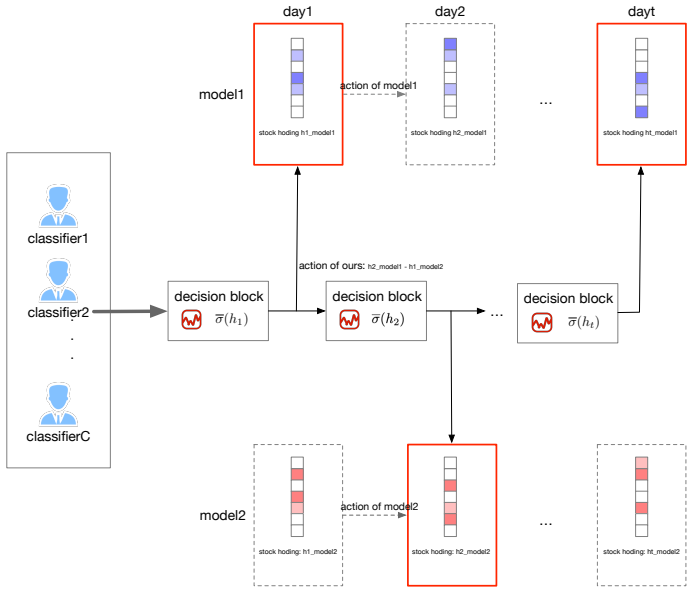
Integrating classifier predictions with RL policies through ensemble rules based on a variance threshold tau produces trading agents that outperform their base RL components on risk-return metrics, including higher Sharpe and Calmar ratios alongside reduced maximum drawdowns.
What carries the argument
The variance-thresholded ensemble rule that merges action distributions from multiple RL agents with classifier outputs to select or weight decisions.
Load-bearing premise
The chosen classifiers contribute information not already encoded in the RL policies' learned behaviors.
What would settle it
Running the same trading environments and finding that no ensemble variant exceeds the best base RL model on Sharpe ratio or drawdown metrics would contradict the reported outperformance.
Figures


read the original abstract
This paper presents a comprehensive study on the use of ensemble Reinforcement Learning (RL) models in financial trading strategies, leveraging classifier models to enhance performance. By combining RL algorithms such as A2C, PPO, and SAC with traditional classifiers like Support Vector Machines (SVM), Decision Trees, and Logistic Regression, we investigate how different classifier groups can be integrated to improve risk-return trade-offs. The study evaluates the effectiveness of various ensemble methods, comparing them with individual RL models across key financial metrics, including Cumulative Returns, Sharpe Ratios (SR), Calmar Ratios, and Maximum Drawdown (MDD). Our results demonstrate that ensemble methods consistently outperform base models in terms of risk-adjusted returns, providing better management of drawdowns and overall stability. However, we identify the sensitivity of ensemble performance to the choice of variance threshold {\tau}, highlighting the importance of dynamic {\tau} adjustment to achieve optimal performance. This study emphasizes the value of combining RL with classifiers for adaptive decision-making, with implications for financial trading, robotics, and other dynamic environments.
Editorial analysis
A structured set of objections, weighed in public.
Referee Report
Summary. The paper claims that ensembles combining RL algorithms (A2C, PPO, SAC) with classifiers (SVM, Decision Trees, Logistic Regression) outperform individual RL models on financial trading metrics including cumulative returns, Sharpe ratio, Calmar ratio, and maximum drawdown, while noting sensitivity of results to the variance threshold τ.
Significance. If validated with proper controls, the work could provide a practical template for hybrid RL-classical ML ensembles in sequential decision tasks with risk constraints. The explicit acknowledgment of τ sensitivity is a strength, but the absence of reproducibility details and independence checks limits the current impact.
major comments (3)
- [Abstract] Abstract and experimental section: no description of train/test splits, walk-forward validation, or statistical significance testing (e.g., Diebold-Mariano or bootstrap) is provided for the reported SR/Calmar/MDD improvements, making it impossible to assess whether gains exceed sampling variability.
- [Methods / Ensemble Construction] Ensemble integration (variance-threshold gating): τ is treated as a tunable hyperparameter whose optimal value must be selected per experiment; the paper itself flags performance sensitivity to τ, which directly undermines the claim that ensembles are inherently superior rather than the result of post-hoc fitting.
- [Results / Classifier Integration] Classifier-RL complementarity: no ablation, pairwise action-agreement rate, or mutual-information analysis is reported to test whether SVM/DT/LR outputs supply signal orthogonal to the A2C/PPO/SAC policies. Without this, the observed variance reduction is consistent with averaging correlated predictors rather than true ensemble benefit.
minor comments (1)
- [Methods] Notation: the symbol τ is introduced without an explicit equation defining how the variance threshold is computed from the classifier outputs.
Simulated Author's Rebuttal
We thank the referee for the constructive comments, which identify key areas for improving the manuscript's clarity, reproducibility, and analytical depth. We respond to each major comment below and indicate the revisions we will make.
read point-by-point responses
-
Referee: [Abstract] Abstract and experimental section: no description of train/test splits, walk-forward validation, or statistical significance testing (e.g., Diebold-Mariano or bootstrap) is provided for the reported SR/Calmar/MDD improvements, making it impossible to assess whether gains exceed sampling variability.
Authors: We agree that these details are necessary for proper evaluation. The revised manuscript will include an expanded Experimental Setup section describing the chronological train/test splits, walk-forward validation procedure to prevent data leakage, and statistical significance testing via bootstrap confidence intervals on the reported metrics. revision: yes
-
Referee: [Methods / Ensemble Construction] Ensemble integration (variance-threshold gating): τ is treated as a tunable hyperparameter whose optimal value must be selected per experiment; the paper itself flags performance sensitivity to τ, which directly undermines the claim that ensembles are inherently superior rather than the result of post-hoc fitting.
Authors: We present the sensitivity to τ as an explicit finding rather than a hidden caveat. Our central claim is that ensembles with suitable τ selection deliver improved risk-return profiles relative to base RL models; this is not claimed to be tuning-free. We will add further discussion and sensitivity plots across τ values to clarify the method's practical use. revision: partial
-
Referee: [Results / Classifier Integration] Classifier-RL complementarity: no ablation, pairwise action-agreement rate, or mutual-information analysis is reported to test whether SVM/DT/LR outputs supply signal orthogonal to the A2C/PPO/SAC policies. Without this, the observed variance reduction is consistent with averaging correlated predictors rather than true ensemble benefit.
Authors: This is a fair critique on the need for explicit complementarity analysis. We will add an ablation study together with pairwise action-agreement rates between the classifier outputs and RL policies in the revised Results section to better demonstrate the source of the observed gains. revision: yes
Circularity Check
Empirical comparison with acknowledged parameter sensitivity; no load-bearing derivation reduces to inputs
full rationale
The paper reports experimental results on ensembles of RL policies (A2C/PPO/SAC) with classifiers (SVM/DT/LR), evaluating financial metrics. The abstract explicitly flags sensitivity of results to the variance threshold τ and calls for dynamic adjustment, indicating performance is not presented as first-principles or independent of this choice. No equations, uniqueness theorems, or self-citations are shown that would make the outperformance claim reduce by construction to fitted inputs or prior author work. The central claim remains an empirical observation rather than a self-referential prediction.
Axiom & Free-Parameter Ledger
free parameters (1)
- variance threshold tau
Reference graph
Works this paper leans on
-
[1]
Constrained policy optimization
Joshua Achiam, David Held, Aviv Tamar, and Pieter Abbeel. Constrained policy optimization. In International conference on machine learning , pages 22–31. PMLR, 2017
work page 2017
-
[2]
Uncertainty-based offline rein- forcement learning with diversified q-ensemble
Gaon An, Seungyong Moon, Jang-Hyun Kim, and Hyun Oh Song. Uncertainty-based offline rein- forcement learning with diversified q-ensemble. Advances in neural information processing systems, 34:7436–7447, 2021
work page 2021
-
[3]
Neurosymbolic reinforcement learning with formally verified exploration
Greg Anderson, Abhinav Verma, Isil Dillig, and Swarat Chaudhuri. Neurosymbolic reinforcement learning with formally verified exploration. Advances in neural information processing systems , 33:6172–6183, 2020
work page 2020
-
[4]
Finite-time analysis of the multiarmed bandit problem, 2002
P Auer. Finite-time analysis of the multiarmed bandit problem, 2002
work page 2002
-
[5]
Multi-timescale ensemble q-learning for markov decision process policy optimization
Talha Bozkus and Urbashi Mitra. Multi-timescale ensemble q-learning for markov decision process policy optimization. IEEE Transactions on Signal Processing , 2024
work page 2024
-
[6]
Risk-sensitive safety analysis using conditional value-at-risk
Margaret P Chapman, Riccardo Bonalli, Kevin M Smith, Insoon Yang, Marco Pavone, and Claire J Tomlin. Risk-sensitive safety analysis using conditional value-at-risk. IEEE Transactions on Auto- matic Control, 67(12):6521–6536, 2021
work page 2021
-
[7]
Yinlam Chow, Mohammad Ghavamzadeh, Lucas Janson, and Marco Pavone. Risk-constrained rein- forcement learning with percentile risk criteria.Journal of Machine Learning Research, 18(167):1–51, 2018
work page 2018
-
[8]
A lyapunov- based approach to safe reinforcement learning
Yinlam Chow, Ofir Nachum, Edgar Duenez-Guzman, and Mohammad Ghavamzadeh. A lyapunov- based approach to safe reinforcement learning. Advances in neural information processing systems , 31, 2018
work page 2018
-
[9]
Count (and count-like) data in finance
Jonathan B Cohn, Zack Liu, and Malcolm I Wardlaw. Count (and count-like) data in finance. Journal of Financial Economics , 146(2):529–551, 2022
work page 2022
-
[10]
Kamyar Ghasemipour, Shixiang Shane Gu, and Ofir Nachum. Why so pessimistic? estimating uncertainties for offline rl through ensembles, and why their independence matters. Advances in Neural Information Processing Systems, 35:18267–18281, 2022
work page 2022
-
[11]
Towards sporadic demand stock manage- ment based on simulation with single reorder point estimation
Katerina Huskova, Petra Kasparova, and Jakub Dyntar. Towards sporadic demand stock manage- ment based on simulation with single reorder point estimation. 14
-
[12]
On the importance of exploration for general- ization in reinforcement learning
Yiding Jiang, J Zico Kolter, and Roberta Raileanu. On the importance of exploration for general- ization in reinforcement learning. Advances in Neural Information Processing Systems , 36, 2024
work page 2024
-
[13]
Accurate uncer- tainty estimation and decomposition in ensemble learning
Jeremiah Liu, John Paisley, Marianthi-Anna Kioumourtzoglou, and Brent Coull. Accurate uncer- tainty estimation and decomposition in ensemble learning. Advances in neural information process- ing systems, 32, 2019
work page 2019
-
[14]
Learning policies with zero or bounded constraint violation for constrained mdps
Tao Liu, Ruida Zhou, Dileep Kalathil, Panganamala Kumar, and Chao Tian. Learning policies with zero or bounded constraint violation for constrained mdps. Advances in Neural Information Processing Systems, 34:17183–17193, 2021
work page 2021
-
[15]
Model-based constrained reinforcement learning using generalized control barrier function
Haitong Ma, Jianyu Chen, Shengbo Eben, Ziyu Lin, Yang Guan, Yangang Ren, and Sifa Zheng. Model-based constrained reinforcement learning using generalized control barrier function. In 2021 IEEE/RSJ International Conference on Intelligent Robots and Systems (IROS) , pages 4552–4559. IEEE, 2021
work page 2021
-
[16]
Malik Magdon-Ismail and Amir F Atiya. Maximum drawdown. Risk Magazine, 17(10):99–102, 2004
work page 2004
-
[17]
Risk aversion in markov decision processes via near optimal chernoff bounds
Teodor Moldovan and Pieter Abbeel. Risk aversion in markov decision processes via near optimal chernoff bounds. Advances in neural information processing systems , 25, 2012
work page 2012
-
[18]
Deep exploration via bootstrapped dqn
Ian Osband, Charles Blundell, Alexander Pritzel, and Benjamin Van Roy. Deep exploration via bootstrapped dqn. Advances in neural information processing systems , 29, 2016
work page 2016
-
[19]
Lyapunov design for safe reinforcement learning
Theodore J Perkins and Andrew G Barto. Lyapunov design for safe reinforcement learning. Journal of Machine Learning Research, 3(Dec):803–832, 2002
work page 2002
-
[20]
Density constrained reinforcement learning
Zengyi Qin, Yuxiao Chen, and Chuchu Fan. Density constrained reinforcement learning. In Inter- national conference on machine learning , pages 8682–8692. PMLR, 2021
work page 2021
-
[21]
Marc Rigter, Bruno Lacerda, and Nick Hawes. One risk to rule them all: A risk-sensitive perspective on model-based offline reinforcement learning. Advances in Neural Information Processing Systems, 36, 2024
work page 2024
-
[22]
A comparative study on the sharpe ratio, sortino ratio, and calmar ratio in portfolio optimization
Jaydip Sen. A comparative study on the sharpe ratio, sortino ratio, and calmar ratio in portfolio optimization
-
[23]
The sharpe ratio, the journal of portfolio management
William F Sharpe. The sharpe ratio, the journal of portfolio management. Stanfold University, Fall, 1994
work page 1994
-
[24]
Safe exploration for optimization with gaussian processes
Yanan Sui, Alkis Gotovos, Joel Burdick, and Andreas Krause. Safe exploration for optimization with gaussian processes. In International conference on machine learning , pages 997–1005. PMLR, 2015
work page 2015
-
[25]
Reinforcement learning: An introduction
Richard S Sutton. Reinforcement learning: An introduction. A Bradford Book, 2018
work page 2018
-
[26]
Algorithmic trading using double deep q-networks and sentiment analysis
Leon Tabaro, Jean Marie Vianney Kinani, Alberto Jorge Rosales-Silva, Julio C´ esar Salgado-Ram´ ırez, Dante M´ ujica-Vargas, Ponciano Jorge Escamilla-Ambrosio, and Eduardo Ramos-D´ ıaz. Algorithmic trading using double deep q-networks and sentiment analysis. Information, 15(8):473, 2024
work page 2024
-
[27]
Yichuan Charlie Tang, Jian Zhang, and Ruslan Salakhutdinov. Worst cases policy gradients. arXiv preprint arXiv:1911.03618, 2019
-
[28]
High-confidence off-policy evaluation
Philip Thomas, Georgios Theocharous, and Mohammad Ghavamzadeh. High-confidence off-policy evaluation. In Proceedings of the AAAI Conference on Artificial Intelligence , volume 29, 2015
work page 2015
-
[29]
Aminu Umaru and Nuhu Ado. Monetary policy effectiveness under climate uncertainty: A bayesian dynamic stochastic general equilibrium approach. Available at SSRN 5092156 , 2025
work page 2025
-
[30]
Ocean-mbrl: Offline conservative exploration for model-based offline reinforcement learning
Fan Wu, Rui Zhang, Qi Yi, Yunkai Gao, Jiaming Guo, Shaohui Peng, Siming Lan, Husheng Han, Yansong Pan, Kaizhao Yuan, et al. Ocean-mbrl: Offline conservative exploration for model-based offline reinforcement learning. In Proceedings of the AAAI Conference on Artificial Intelligence , volume 38, pages 15897–15905, 2024. 15
work page 2024
-
[31]
Mario Zanon and S´ ebastien Gros. Safe reinforcement learning using robust mpc.IEEE Transactions on Automatic Control, 66(8):3638–3652, 2020
work page 2020
-
[32]
Ruoqi Zhang, Ziwei Luo, Jens Sj¨ olund, Thomas B Sch¨ on, and Per Mattsson. Entropy-regularized diffusion policy with q-ensembles for offline reinforcement learning.arXiv preprint arXiv:2402.04080, 2024. 16
discussion (0)
Sign in with ORCID, Apple, or X to comment. Anyone can read and Pith papers without signing in.