Fully AI-Generated Image Detection: Definition, Recent Advances and Challenges
Pith reviewed 2026-05-23 03:08 UTC · model grok-4.3
The pith
Fully AI-generated image detectors are organized by the inductive priors they use to extract generation artifacts, with dataset choices controlling generalization.
A machine-rendered reading of the paper's core claim, the machinery that carries it, and where it could break.
Core claim
The paper claims that detecting fully AI-generated images requires reliably extracting the inherent artifacts imprinted by generative architectures, and that existing methods can be categorized based on the primary inductive priors leveraged to isolate artifacts while dataset design influences generalization and robustness. It follows the standard detector design pipeline to survey works and identify open challenges.
What carries the argument
The categorization framework that groups artifact extraction methods by the primary inductive priors they leverage to isolate artifacts imprinted by generative architectures.
If this is right
- Dataset construction choices directly determine how well learned artifacts transfer to unseen generative models.
- Methods are reviewed and compared within a shared structure of inductive priors rather than isolated techniques.
- Gaps in current artifact extraction approaches become visible once all works are placed in the same framework.
- Future detectors can be designed by deliberately selecting priors and datasets that address identified robustness shortfalls.
Where Pith is reading between the lines
- The same inductive-prior lens could be applied to detection tasks in video or audio to reveal cross-media patterns.
- Hybrid detectors that combine multiple priors might achieve better robustness than single-prior methods.
- Standardized evaluation protocols built around this categorization could make progress across papers easier to compare.
Load-bearing premise
The body of existing literature on fully AI-generated image detection can be systematically and comprehensively categorized using the proposed framework of inductive priors for artifact extraction.
What would settle it
A detection method whose core mechanism cannot be assigned to any of the inductive-prior categories defined in the review, or empirical tests showing dataset design has little measurable effect on generalization performance.
Figures

read the original abstract
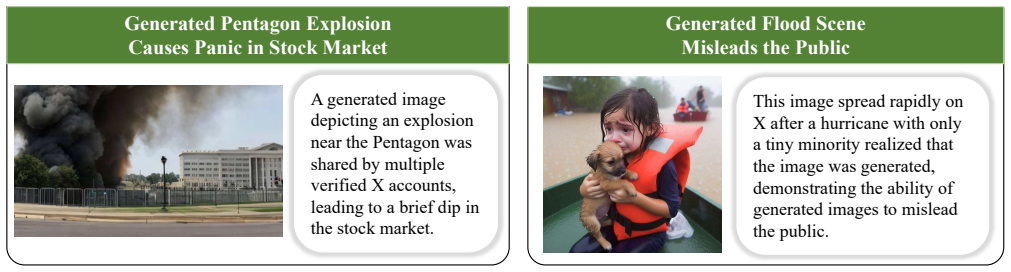
Recent advances in visual generative models have enabled the creation of highly realistic, fully AI-generated images without relying on real source content. While beneficial for many applications, these models also pose significant societal risks, as they can be easily exploited to produce convincing Deepfakes. Detecting them represents a foundational yet challenging problem in AI media forensics, requiring detectors to reliably extract the inherent artifacts imprinted by generative architectures. In this Review, we provide a systematic overview of fully AI-generated image detection. Following the standard detector design pipeline, we focus on two key components: dataset construction and artifact extraction. We analyze how dataset design influences the generalization and robustness of learned artifacts, and categorize existing artifact extraction methods based on the primary inductive priors leveraged to isolate artifacts. Within this framework, we systematically review existing works. Finally, we highlight open problems and envision several future directions for developing more robust and generalizable detectors. Reviewed works in this survey can be found at https://github.com/zju-pi/Awesome-Fully-AI-Generated-Image-Detection.
Editorial analysis
A structured set of objections, weighed in public.
Referee Report
Summary. The manuscript is a survey on fully AI-generated image detection. It follows the standard detector design pipeline and focuses on two components: dataset construction and artifact extraction. The authors claim that dataset design choices influence the generalization and robustness of learned artifacts, and they categorize existing artifact extraction methods according to the primary inductive priors used to isolate generative artifacts. Within this framework the paper systematically reviews prior works, identifies open problems, and outlines future directions. A GitHub repository listing the reviewed works is provided.
Significance. If the proposed organizational framework holds, the survey supplies a useful lens for navigating the rapidly growing literature on AI media forensics by linking inductive priors to artifact detection and by explicitly connecting dataset construction decisions to detector robustness. The inclusion of a public GitHub repository that enumerates the reviewed works is a concrete strength that supports reproducibility and follow-on research. As a review paper the contribution lies in synthesis and structuring rather than new empirical results.
minor comments (3)
- [Abstract] Abstract: the GitHub link is mentioned but the introduction does not describe its contents or update policy, reducing immediate utility for readers.
- [§3 (Artifact Extraction)] The categorization of inductive priors would be clearer if a summary table were added that lists each prior, representative papers, and the key artifact each prior targets.
- [§4 (Review of Existing Works)] Several citations to recent generative models (e.g., diffusion variants) appear without explicit discussion of how their architectural changes affect the artifact categories already defined.
Simulated Author's Rebuttal
We thank the referee for the constructive review and positive assessment of our survey. The recommendation for minor revision is noted, but the report contains no specific major comments to address point by point.
Circularity Check
No significant circularity: descriptive survey only
full rationale
The paper is a literature review that organizes prior work on fully AI-generated image detection into categories based on inductive priors for artifact extraction and the role of dataset design. It advances no derivations, equations, predictions, or fitted parameters of its own. The central framework is presented explicitly as a lens for reviewing existing methods rather than a testable claim or result derived from the paper's own content. No self-citation chains, self-definitional steps, or renamings of known results occur in a load-bearing manner. The analysis is therefore self-contained against external benchmarks with no reduction to inputs by construction.
Axiom & Free-Parameter Ledger
Reference graph
Works this paper leans on
-
[1]
An analysis of recent advances in deepfake image detection in an evolv- ing threat landscape
[Abdullah et al., 2024] Sifat Muhammad Abdullah, Aravind Cheruvu, Shravya Kanchi, Taejoong Chung, Peng Gao, Murtuza Jadliwala, and Bimal Viswanath. An analysis of recent advances in deepfake image detection in an evolv- ing threat landscape. In IEEE S&P,
work page 2024
-
[2]
Manifold induced biases for zero-shot and few-shot detection of generated images
[Brokman et al., 2025] Jonathan Brokman, Amit Giloni, Omer Hofman, Roman Vainshtein, Hisashi Kojima, and Guy Gilboa. Manifold induced biases for zero-shot and few-shot detection of generated images. In ICLR,
work page 2025
-
[3]
[Cazenavette et al., 2024] George Cazenavette, Avneesh Sud, Thomas Leung, and Ben Usman. Fakeinversion: Learning to detect images from unseen text-to-image models by inverting stable diffusion. In CVPR,
work page 2024
-
[4]
A single simple patch is all you need for ai-generated im- age detection
[Chen et al., 2024c] Jiaxuan Chen, Jieteng Yao, and Li Niu. A single simple patch is all you need for ai-generated im- age detection. arXiv preprint arXiv:2402.01123,
-
[5]
On the detection of synthetic images generated by diffusion models
[Corvi et al., 2023] Riccardo Corvi, Davide Cozzolino, Gi- ada Zingarini, Giovanni Poggi, Koki Nagano, and Luisa Verdoliva. On the detection of synthetic images generated by diffusion models. In ICASSP,
work page 2023
-
[6]
Zero-shot detec- tion of ai-generated images
[Cozzolino et al., 2024] Davide Cozzolino, Giovanni Poggi, Matthias Nießner, and Luisa Verdoliva. Zero-shot detec- tion of ai-generated images. In ECCV,
work page 2024
-
[7]
[Deng et al., 2024] Jingyi Deng, Chenhao Lin, Zhengyu Zhao, Shuai Liu, Qian Wang, and Chao Shen. A sur- vey of defenses against ai-generated visual media: De- tection, disruption, and authentication. arXiv preprint arXiv:2407.10575,
-
[8]
Frequency masking for universal deepfake detection
[Doloriel and Cheung, 2024] Chandler Timm Doloriel and Ngai-Man Cheung. Frequency masking for universal deepfake detection. In ICASSP,
work page 2024
-
[9]
An image is worth 16x16 words: Trans- formers for image recognition at scale
[Dosovitskiy et al., 2021] Alexey Dosovitskiy, Lucas Beyer, Alexander Kolesnikov, Dirk Weissenborn, Xiaohua Zhai, Thomas Unterthiner, Mostafa Dehghani, Matthias Min- derer, Georg Heigold, Sylvain Gelly, Jakob Uszkoreit, and Neil Houlsby. An image is worth 16x16 words: Trans- formers for image recognition at scale. In ICLR,
work page 2021
-
[10]
[Durall et al., 2020] Ricard Durall, Margret Keuper, and Ja- nis Keuper. Watch your up-convolution: Cnn based gener- ative deep neural networks are failing to reproduce spectral distributions. In CVPR,
work page 2020
-
[11]
Leveraging frequency analysis for deep fake image recognition
[Frank et al., 2020] Joel Frank, Thorsten Eisenhofer, Lea Sch¨onherr, Asja Fischer, Dorothea Kolossa, and Thorsten Holz. Leveraging frequency analysis for deep fake image recognition. In ICML,
work page 2020
-
[12]
Gen- erative adversarial networks
[Goodfellow et al., 2020] Ian Goodfellow, Jean Pouget- Abadie, Mehdi Mirza, Bing Xu, David Warde-Farley, Sherjil Ozair, Aaron Courville, and Yoshua Bengio. Gen- erative adversarial networks. Communications of the ACM,
work page 2020
-
[13]
Are gan generated images easy to detect? a critical analysis of the state-of-the-art
[Gragnaniello et al., 2021] Diego Gragnaniello, Davide Cozzolino, Francesco Marra, Giovanni Poggi, and Luisa Verdoliva. Are gan generated images easy to detect? a critical analysis of the state-of-the-art. In ICME,
work page 2021
-
[14]
Fake or jpeg? revealing common biases in generated image detection datasets
[Grommelt et al., 2024] Patrick Grommelt, Louis Weiss, Franz-Josef Pfreundt, and Janis Keuper. Fake or jpeg? revealing common biases in generated image detection datasets. arXiv preprint arXiv:2403.17608,
-
[15]
Beyond the spectrum: Detecting deepfakes via re-synthesis
[He et al., 2021] Yang He, Ning Yu, Margret Keuper, and Mario Fritz. Beyond the spectrum: Detecting deepfakes via re-synthesis. In IJCAI,
work page 2021
-
[16]
Denoising diffusion probabilistic models
[Ho et al., 2020] Jonathan Ho, Ajay Jain, and Pieter Abbeel. Denoising diffusion probabilistic models. In NeurIPS,
work page 2020
-
[17]
[Imanpour et al., 2024] Nasrin Imanpour, Shashwat Bajpai, Subhankar Ghosh, Sainath Reddy Sankepally, Abhilekh Borah, Hasnat Md Abdullah, Nishoak Kosaraju, Shreyas Dixit, Ashhar Aziz, Shwetangshu Biswas, et al. Visual counter turing test (vct 2): Discovering the challenges for ai-generated image detection and introducing visual ai in- dex (vAI). arXiv prep...
-
[18]
Clipping the deception: Adapt- ing vision-language models for universal deepfake detec- tion
[Khan and Dang-Nguyen, 2024] Sohail Ahmed Khan and Duc-Tien Dang-Nguyen. Clipping the deception: Adapt- ing vision-language models for universal deepfake detec- tion. In ICMR,
work page 2024
-
[19]
Leveraging representations from intermediate encoder-blocks for synthetic image detection
[Koutlis and Papadopoulos, 2024] Christos Koutlis and Symeon Papadopoulos. Leveraging representations from intermediate encoder-blocks for synthetic image detection. In ECCV,
work page 2024
-
[20]
[Li et al., 2022] Junnan Li, Dongxu Li, Caiming Xiong, and Steven Hoi. Blip: Bootstrapping language-image pre- training for unified vision-language understanding and generation. In ICML,
work page 2022
-
[21]
Improving synthetic image detection towards generalization: An image trans- formation perspective
[Li et al., 2024] Ouxiang Li, Jiayin Cai, Yanbin Hao, Xiao- long Jiang, Yao Hu, and Fuli Feng. Improving synthetic image detection towards generalization: An image trans- formation perspective. arXiv preprint arXiv:2408.06741 ,
-
[22]
Detecting multimedia gen- erated by large ai models: A survey
[Lin et al., 2024] Li Lin, Neeraj Gupta, Yue Zhang, Hainan Ren, Chun-Hao Liu, Feng Ding, Xin Wang, Xin Li, Luisa Verdoliva, and Shu Hu. Detecting multimedia gen- erated by large ai models: A survey. arXiv preprint arXiv:2402.00045,
-
[23]
Mixture of low-rank experts for trans- ferable ai-generated image detection
[Liu et al., 2024b] Zihan Liu, Hanyi Wang, Yaoyu Kang, and Shilin Wang. Mixture of low-rank experts for trans- ferable ai-generated image detection. arXiv preprint arXiv:2404.04883,
-
[24]
Lare 2: Latent reconstruction error based method for diffusion-generated image detection
[Luo et al., 2024] Yunpeng Luo, Junlong Du, Ke Yan, and Shouhong Ding. Lare 2: Latent reconstruction error based method for diffusion-generated image detection. InCVPR,
work page 2024
-
[25]
Deepfake detection: Current chal- lenges and next steps
[Lyu, 2020] Siwei Lyu. Deepfake detection: Current chal- lenges and next steps. In ICMEW,
work page 2020
-
[26]
Do gans leave ar- tificial fingerprints? In MIPR,
[Marra et al., 2019] Francesco Marra, Diego Gragnaniello, Luisa Verdoliva, and Giovanni Poggi. Do gans leave ar- tificial fingerprints? In MIPR,
work page 2019
-
[27]
Towards universal fake image detectors that general- ize across generative models
[Ojha et al., 2023] Utkarsh Ojha, Yuheng Li, and Yong Jae Lee. Towards universal fake image detectors that general- ize across generative models. In CVPR,
work page 2023
-
[28]
Deep- fake generation and detection: A benchmark and survey
[Pei et al., 2024] Gan Pei, Jiangning Zhang, Menghan Hu, Zhenyu Zhang, Chengjie Wang, Yunsheng Wu, Guangtao Zhai, Jian Yang, Chunhua Shen, and Dacheng Tao. Deep- fake generation and detection: A benchmark and survey. arXiv preprint arXiv:2403.17881,
-
[29]
Learning transferable visual models from nat- ural language supervision
[Radford et al., 2021] Alec Radford, Jong Wook Kim, Chris Hallacy, Aditya Ramesh, Gabriel Goh, Sandhini Agar- wal, Girish Sastry, Amanda Askell, Pamela Mishkin, Jack Clark, et al. Learning transferable visual models from nat- ural language supervision. In ICML,
work page 2021
-
[30]
On the effective- ness of dataset alignment for fake image detection
[Rajan et al., 2025] Anirudh Sundara Rajan, Utkarsh Ojha, Jedidiah Schloesser, and Yong Jae Lee. On the effective- ness of dataset alignment for fake image detection. In ICLR,
work page 2025
-
[31]
Aeroblade: Training-free detection of latent diffusion images using autoencoder reconstruction error
[Ricker et al., 2024] Jonas Ricker, Denis Lukovnikov, and Asja Fischer. Aeroblade: Training-free detection of latent diffusion images using autoencoder reconstruction error. In CVPR,
work page 2024
-
[32]
High-resolution image synthesis with latent diffusion models
[Rombach et al., 2022] Robin Rombach, Andreas Blattmann, Dominik Lorenz, Patrick Esser, and Bj ¨orn Ommer. High-resolution image synthesis with latent diffusion models. In CVPR,
work page 2022
-
[33]
Shadows don’t lie and lines can’t bend! generative models don’t know projective geometry
[Sarkar et al., 2024] Ayush Sarkar, Hanlin Mai, Amitabh Mahapatra, Svetlana Lazebnik, David A Forsyth, and Anand Bhattad. Shadows don’t lie and lines can’t bend! generative models don’t know projective geometry... for now. In CVPR,
work page 2024
-
[34]
De-fake: Detection and attribution of fake images generated by text-to-image generation models
[Sha et al., 2023] Zeyang Sha, Zheng Li, Ning Yu, and Yang Zhang. De-fake: Detection and attribution of fake images generated by text-to-image generation models. In ACM CCS,
work page 2023
-
[35]
[Sha et al., 2024] Zeyang Sha, Yicong Tan, Mingjie Li, Michael Backes, and Yang Zhang. Zerofake: Zero-shot detection of fake images generated and edited by text-to- image generation models. In ACM CCS,
work page 2024
-
[36]
Deep image fingerprint: Towards low budget synthetic im- age detection and model lineage analysis
[Sinitsa and Fried, 2024] Sergey Sinitsa and Ohad Fried. Deep image fingerprint: Towards low budget synthetic im- age detection and model lineage analysis. In WACV,
work page 2024
-
[37]
Deep unsupervised learning using nonequilibrium thermody- namics
[Sohl-Dickstein et al., 2015] Jascha Sohl-Dickstein, Eric Weiss, Niru Maheswaranathan, and Surya Ganguli. Deep unsupervised learning using nonequilibrium thermody- namics. In ICML,
work page 2015
-
[38]
Cnn- generated images are surprisingly easy to spot
[Wang et al., 2020] Sheng-Yu Wang, Oliver Wang, Richard Zhang, Andrew Owens, and Alexei A Efros. Cnn- generated images are surprisingly easy to spot... for now. In CVPR,
work page 2020
-
[39]
Dire for diffusion-generated image detec- tion
[Wang et al., 2023] Zhendong Wang, Jianmin Bao, Wen- gang Zhou, Weilun Wang, Hezhen Hu, Hong Chen, and Houqiang Li. Dire for diffusion-generated image detec- tion. In ICCV,
work page 2023
-
[40]
Security and privacy on generative data in aigc: A survey
[Wang et al., 2024] Tao Wang, Yushu Zhang, Shuren Qi, Ruoyu Zhao, Zhihua Xia, and Jian Weng. Security and privacy on generative data in aigc: A survey. ACM Com- puting Surveys, 57(4):1–34,
work page 2024
-
[41]
A sanity check for ai-generated image detection
[Yan et al., 2025] Shilin Yan, Ouxiang Li, Jiayin Cai, Yanbin Hao, Xiaolong Jiang, Yao Hu, and Weidi Xie. A sanity check for ai-generated image detection. In ICLR,
work page 2025
-
[42]
[Yu et al., 2024] Xiao Yu, Kejiang Chen, Kai Zeng, Han Fang, Zijin Yang, Xiuwei Shang, Yuang Qi, Weiming Zhang, and Nenghai Yu. Semgir: Semantic-guided image regeneration based method for ai-generated image detec- tion and attribution. In ACM Multimedia,
work page 2024
-
[43]
The unreasonable effectiveness of deep features as a perceptual metric
[Zhang et al., 2018] Richard Zhang, Phillip Isola, Alexei A Efros, Eli Shechtman, and Oliver Wang. The unreasonable effectiveness of deep features as a perceptual metric. In CVPR,
work page 2018
-
[44]
Detecting and simulating artifacts in gan fake images
[Zhang et al., 2019] Xu Zhang, Svebor Karaman, and Shih- Fu Chang. Detecting and simulating artifacts in gan fake images. In WIFS,
work page 2019
-
[45]
Leveraging natural frequency deviation for diffusion-generated image detection,
[Zhang et al., 2024] Daichi Zhang, Tong Zhang, Shiming Ge, and Sabine Susstrunk. Leveraging natural frequency deviation for diffusion-generated image detection,
work page 2024
-
[46]
Patchcraft: Exploring texture patch for efficient ai-generated image detection
[Zhong et al., 2023] Nan Zhong, Yiran Xu, Zhenxing Qian, and Xinpeng Zhang. Patchcraft: Exploring texture patch for efficient ai-generated image detection. arXiv preprint arXiv:2311.12397,
-
[47]
Gen- det: Towards good generalizations for ai-generated image detection
[Zhu et al., 2023] Mingjian Zhu, Hanting Chen, Mouxiao Huang, Wei Li, Hailin Hu, Jie Hu, and Yunhe Wang. Gen- det: Towards good generalizations for ai-generated image detection. arXiv preprint arXiv:2312.08880,
-
[48]
Genimage: A million-scale benchmark for detecting ai-generated image
[Zhu et al., 2024] Mingjian Zhu, Hanting Chen, Qiangyu Yan, Xudong Huang, Guanyu Lin, Wei Li, Zhijun Tu, Hailin Hu, Jie Hu, and Yunhe Wang. Genimage: A million-scale benchmark for detecting ai-generated image. In NeurIPS Datasets and Benchmarks Track, 2024
work page 2024
discussion (0)
Sign in with ORCID, Apple, or X to comment. Anyone can read and Pith papers without signing in.