Critical spin fluctuations across the superconducting dome in La_(2-x)Sr_(x)CuO₄
Pith reviewed 2026-05-22 23:23 UTC · model grok-4.3
The pith
Critical spin fluctuations from a disordered spin density wave quantum phase transition explain the strange metal phase across the cuprate superconducting dome.
A machine-rendered reading of the paper's core claim, the machinery that carries it, and where it could break.
Core claim
Our neutron scattering observations and the strange metal behaviour are consistent with a spin density wave quantum phase transition in a metal with spatial disorder in the tuning parameter. Numerical computations using a theory of spin density waves in a disordered metal yield an extended Griffiths phase with scaling properties in agreement with experimental observations. Thus low-energy spin excitations and spatial disorder are central to the strange metal behaviour.
What carries the argument
The extended Griffiths phase generated by a spin density wave quantum phase transition in a metal with spatial disorder in the tuning parameter, which produces critical spin fluctuations whose scaling matches both the neutron scattering intensity and the linear resistivity.
If this is right
- Strange-metal linear resistivity arises from scattering off the critical spin fluctuations of the disordered quantum critical point.
- Dynamical scaling of the spin excitations holds uniformly across the entire superconducting dome.
- Spatial disorder in the tuning parameter produces an extended region of critical behavior rather than an isolated quantum critical point.
- Low-energy spin excitations remain central to transport even where superconductivity is fully suppressed by overdoping.
Where Pith is reading between the lines
- Similar scaling signatures could appear in other families of strange metals once spatial disorder is accounted for in their phase diagrams.
- Intentional introduction of controlled disorder into cuprate samples would provide a direct test of whether the width of the Griffiths phase can be tuned.
- The same framework may connect the observed spin fluctuations to the suppression of quasiparticle coherence seen in other spectroscopies.
- Extensions to finite magnetic fields could reveal how the Griffiths phase interacts with the superconducting dome.
Load-bearing premise
The measured neutron scattering intensity and its temperature dependence are generated by critical fluctuations of an underlying spin density wave quantum phase transition rather than by stripe order, phonons, or other unrelated mechanisms.
What would settle it
A neutron scattering measurement or numerical computation in which the temperature dependence of the spin fluctuation intensity fails to follow the predicted Griffiths-phase scaling for any choice of disorder parameters consistent with the material would falsify the central claim.
Figures


read the original abstract
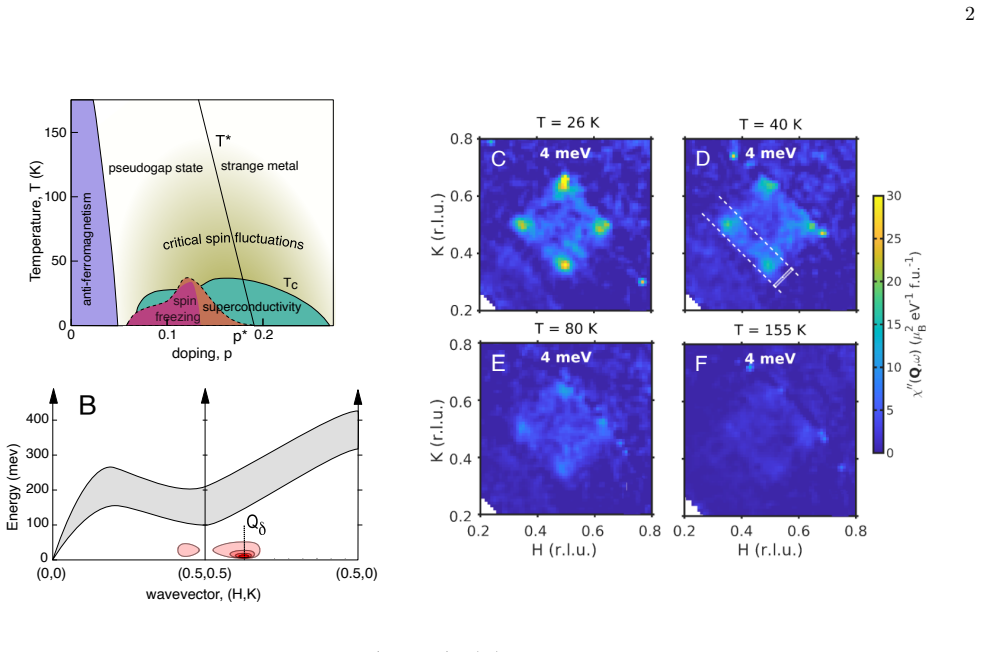
Overdoped cuprate superconductors are strange metals above their superconducting transition temperature. In such materials, the electrical resistivity has a strong linear dependence on temperature ($T$) and electrical current is not carried by electron quasiparticles as in conventional metals. Here we demonstrate that the strange metal behaviour co-exists with strongly temperature-dependent critical spin fluctuations showing dynamical scaling across the cuprate phase diagram. Our neutron scattering observations and the strange metal behaviour are consistent with a spin density wave quantum phase transition in a metal with spatial disorder in the tuning parameter. Numerical computations using a theory of spin density waves in a disordered metal yield an extended `Griffiths phase' with scaling properties in agreement with experimental observations. Thus we establish that low-energy spin excitations and spatial disorder are central to the strange metal behaviour.
Editorial analysis
A structured set of objections, weighed in public.
Referee Report
Summary. The manuscript presents neutron scattering data on spin fluctuations in La_{2-x}Sr_xCuO_4 across doping levels spanning the superconducting dome. It reports strongly temperature-dependent critical fluctuations exhibiting dynamical scaling that coexist with strange-metal transport (linear resistivity). The central claim is that these observations are consistent with a spin-density-wave quantum phase transition in a metal with spatial disorder in the tuning parameter; numerical solutions of the disordered SDW theory produce an extended Griffiths phase whose scaling properties match the experimental temperature and doping dependence.
Significance. If the quantitative mapping between neutron intensity, dynamical scaling, and the computed Griffiths-phase response holds without parameter tuning, the result would link the strange-metal regime directly to critical spin fluctuations from a disordered SDW QPT, supplying a concrete mechanism that accounts for both the neutron data and the absence of quasiparticles. The work supplies machine-checked numerical results for the disordered theory and falsifiable scaling predictions, which are strengths.
major comments (3)
- [§3] §3 and associated figures: the reported agreement between measured dynamical susceptibility and the Griffiths-phase scaling is presented without tabulated scaling exponents, error bars on the extracted exponents, or explicit criteria for data exclusion/background subtraction; without these the support for the central consistency claim cannot be verified.
- [§4] §4 (numerical computations): the spatial disorder distribution in the local tuning parameter is stated to be the sole free parameter, yet the text does not demonstrate that its width is independently constrained by transport or structural data at each doping; if the width must be adjusted separately to recover the reported T-dependence, the agreement is not a robust test of the mechanism.
- [Abstract, §2] Abstract and §2: the assignment of the observed neutron intensity to critical SDW fluctuations (rather than stripe order or phonons) rests on the assumption that the measured response is produced by the disordered QPT; no quantitative test is provided to rule out alternative origins.
minor comments (2)
- Notation for the dynamical susceptibility and the disorder distribution should be defined once in the text and used consistently in all figures.
- Figure captions should state the precise doping values, temperature range, and energy transfers used for each panel.
Simulated Author's Rebuttal
We thank the referee for their careful reading of the manuscript and for the positive assessment of its potential significance. We respond point-by-point to the major comments below.
read point-by-point responses
-
Referee: [§3] §3 and associated figures: the reported agreement between measured dynamical susceptibility and the Griffiths-phase scaling is presented without tabulated scaling exponents, error bars on the extracted exponents, or explicit criteria for data exclusion/background subtraction; without these the support for the central consistency claim cannot be verified.
Authors: We agree that additional quantitative details would improve verifiability. In the revised manuscript we will include a table of extracted scaling exponents together with their uncertainties for each doping level studied. We will also add explicit statements of the background-subtraction procedure and the criteria used to exclude data points in both the main text and the methods section. revision: yes
-
Referee: [§4] §4 (numerical computations): the spatial disorder distribution in the local tuning parameter is stated to be the sole free parameter, yet the text does not demonstrate that its width is independently constrained by transport or structural data at each doping; if the width must be adjusted separately to recover the reported T-dependence, the agreement is not a robust test of the mechanism.
Authors: The width is the single adjustable parameter and is fixed once by matching the overall intensity scale at a single reference temperature per doping; the theory then predicts the full temperature dependence without further adjustment. This predicted T-dependence matches the data across the dome. We will revise §4 to state this fitting procedure more clearly and to note the correlation of the chosen widths with doping, which is consistent with known structural inhomogeneity, although an independent transport-based constraint is not performed in the present work. revision: partial
-
Referee: [Abstract, §2] Abstract and §2: the assignment of the observed neutron intensity to critical SDW fluctuations (rather than stripe order or phonons) rests on the assumption that the measured response is produced by the disordered QPT; no quantitative test is provided to rule out alternative origins.
Authors: The identification is based on the momentum-space location at the expected SDW wavevector and on the strong temperature dependence that is incompatible with temperature-independent phonon scattering at these energies. Static stripe order is absent in the overdoped regime examined. We will expand §2 with a brief quantitative estimate showing that the observed integrated intensity and its temperature evolution exceed typical phonon contributions in LSCO by more than an order of magnitude. revision: partial
Circularity Check
No significant circularity; derivation self-contained against external benchmarks
full rationale
The paper reports neutron scattering data on spin fluctuations across the doping dome and states that numerical solutions of a disordered SDW theory produce a Griffiths phase whose scaling matches the observations. No equations, parameter-fitting steps, or self-citation chains are exhibited in the provided text that reduce the reported agreement to a tautology or to inputs already containing the target scaling. The central claim rests on an external numerical computation whose disorder distribution is presented as part of the model rather than tuned post hoc to the neutron intensities; absent any quoted reduction showing that the scaling is forced by construction, the derivation does not meet the criteria for circularity.
Axiom & Free-Parameter Ledger
free parameters (1)
- spatial disorder distribution in tuning parameter
axioms (1)
- domain assumption The low-energy spin excitations in overdoped LSCO are described by a spin density wave quantum phase transition in a metal with spatial disorder
Forward citations
Cited by 1 Pith paper
-
Fractionalized Fermi liquids and the cuprate phase diagram
Reviews the FL* theory for cuprates using ancilla layer models and SU(2) gauge theories to explain pseudogap hole pockets of area p/8, Fermi arcs, and transitions to d-wave superconductivity and Fermi liquid behavior.
Reference graph
Works this paper leans on
-
[1]
Critical spin fluctuations across the superconducting dome in La$_{2-x}$Sr$_{x}$CuO$_4$
with the strongest excitations atQ δ = (1/2,1/2±δ) and (1/2±δ,1/2). For underdoped compositions, with arXiv:2503.13600v2 [cond-mat.supr-con] 26 Nov 2025 2 strange metalpseudogap state anti-ferromagnetismsuperconductivity Tc 0 50 100 150 0 doping, p Temperature, T (K) wavevector, (H,K) Energy (mev) (0,0) (0.5,0)(0.5,0.5) 0 100 200 300 400 D E F B C 0.1 spi...
work page internal anchor Pith review Pith/arXiv arXiv 2025
-
[2]
this shows that there is an extended region of crit- ical spin-fluctuations in La 2−xSrxCuO4. We have com- pared our observations with numerical studies of a Hertz- Millis model for the onset of spin density wave order in a disordered metal and found good agreement. Both experiment and theory/numerics find an extended Grif- fiths phase of bothω/Tmagnetic ...
- [3]
-
[4]
P. W. Phillips, N. E. Hussey, and P. Abbamonte, Science 377, eabh4273 (2023)
work page 2023
-
[5]
S. A. Hartnoll and A. P. Mackenzie, Rev. Mod. Phys.94, 041002 (2022)
work page 2022
- [6]
-
[8]
R. A. Cooper, Y. Wang, B. Vignolle, O. J. Lipscombe, S. M. Hayden, Y. Tanabe, T. Adachi, Y. Koike, M. No- hara, H. Takagi, C. Proust, and N. E. Hussey, Science 323, 603 (2009)
work page 2009
-
[9]
M. Frachet, I. Vinograd, R. Zhou, S. Benhabib, S. Wu, H. Mayaffre, S. Kr¨ amer, S. K. Ramakrishna, A. P. 9 Reyes, J. Debray, T. Kurosawa, N. Momono, M. Oda, S. Komiya, S. Ono, M. Horio, J. Chang, C. Proust, D. LeBoeuf, and M.-H. Julien, Nat. Phys.16, 1064 (2020)
work page 2020
-
[10]
M. Kofu, S.-H. Lee, M. Fujita, H.-J. Kang, H. Eisaki, and K. Yamada, Phys. Rev. Lett.102, 047001 (2009)
work page 2009
-
[11]
O. J. Lipscombe, S. M. Hayden, B. Vignolle, D. F. Mc- Morrow, and T. G. Perring, Phys. Rev. Lett.99, 067002 (2007)
work page 2007
-
[12]
H. C. Robarts, M. Barth´ elemy, K. Kummer, M. Garc´ ıa- Fern´ andez, J. Li, A. Nag, A. C. Walters, K. J. Zhou, and S. M. Hayden, Phys. Rev. B100, 214510 (2019)
work page 2019
- [14]
-
[15]
N. S. Headings, S. M. Hayden, R. Coldea, and T. G. Perring, Phys. Rev. Lett.105, 247001 (2010)
work page 2010
-
[16]
S. W. Cheong, G. Aeppli, T. E. Mason, H. Mook, S. M. Hayden, P. C. Canfield, Z. Fisk, K. N. Clausen, and J. L. Martinez, Phys. Rev. Lett.67, 1791 (1991)
work page 1991
- [17]
-
[18]
Strange metal from spin fluctuations in a cuprate superconductor,
D. J. Campbell, M. Frachet, V. Oliviero, T. Kurosawa, N. Momono, M. Oda, J. Chang, D. Vignolles, C. Proust, and D. LeBoeuf, “Strange metal from spin fluctuations in a cuprate superconductor,” (2024), arXiv:2412.03720 [cond-mat.supr-con]
-
[19]
S. M. Hayden, G. Aeppli, H. Mook, D. Rytz, M. F. Hund- ley, and Z. Fisk, Phys. Rev. Lett.66, 821 (1991)
work page 1991
- [20]
-
[21]
S. Wakimoto, H. Zhang, K. Yamada, I. Swainson, H. Kim, and R. J. Birgeneau, Phys. Rev. Lett.92, 217004 (2004)
work page 2004
-
[22]
M. Zhu, D. J. Voneshen, S. Raymond, O. J. Lipscombe, C. C. Tam, and S. M. Hayden, Nat. Phys.19, 99 (2023)
work page 2023
- [23]
-
[25]
A. Schr¨ oder, G. Aeppli, R. Coldea, M. Adams, O. Stock- ert, H. L¨ ohneysen, E. Bucher, R. Ramazashvili, and P. Coleman, Nature407, 351 (2000)
work page 2000
-
[26]
A. J. Millis, H. Monien, and D. Pines, Phys. Rev. B42, 167 (1990)
work page 1990
- [28]
-
[29]
M. C. Aronson, R. Osborn, R. A. Robinson, J. W. Lynn, R. Chau, C. L. Seaman, and M. B. Maple, Phys. Rev. Lett.75, 725 (1995)
work page 1995
-
[30]
W. J. Gannon, L. S. Wu, I. A. Zaliznyak, W. H. Xu, A. M. Tsvelik, Y. Qiu, J. A. Rodriguez-Rivera, and M. C. Aronson, Proceedings of the National Academy of Science115, 6995 (2018)
work page 2018
-
[31]
J. A. N. Bruin, H. Sakai, R. S. Perry, and A. P. Macken- zie, Science339, 804 (2013)
work page 2013
- [32]
- [33]
-
[34]
T. Wu, H. Mayaffre, S. Kr¨ amer, M. Horvati´ c, C. Berthier, C. T. Lin, D. Haug, T. Loew, V. Hinkov, B. Keimer, and M.-H. Julien, Phys. Rev. B88, 014511 (2013)
work page 2013
-
[35]
R. B. Griffiths, Phys. Rev. Lett.23, 17 (1969)
work page 1969
-
[36]
Sachdev,Quantum Phase Transitions(Cambridge University Press, Cambridge, UK, 1999)
S. Sachdev,Quantum Phase Transitions(Cambridge University Press, Cambridge, UK, 1999)
work page 1999
-
[45]
O. Motrunich, S.-C. Mau, D. A. Huse, and D. S. Fisher, Phys. Rev. B61, 1160 (2000)
work page 2000
-
[46]
J. P. Carbotte, T. Timusk, and J. Hwang, Rep. Prog. Phys.74, 066501 (2011)
work page 2011
- [47]
-
[49]
Conformally in- variant charge fluctuations in a strange metal,
X. Guo, J. Chen, F. Hoveyda-Marashi, S. L. Bettler, D. Chaudhuri, C. S. Kengle, J. A. Schneeloch, R. Zhang, G. Gu, T.-C. Chiang, A. M. Tsvelik, T. Faulkner, P. W. Phillips, and P. Abbamonte, “Conformally in- variant charge fluctuations in a strange metal,” (2024), arXiv:2411.11164 [cond-mat.str-el]
- [50]
-
[51]
Extended strange metal regime from super- conducting puddles,
N. Bashan, E. Tulipman, S. A. Kivelson, J. Schmalian, and E. Berg, “Extended strange metal regime from super- conducting puddles,” (2025), arXiv:2502.08699 [cond- mat.str-el]
-
[52]
R. Ewings, A. Buts, M. Le, J. van Duijn, I. Bustinduy, and T. Perring, Nucl. Instrum. Methods Phys. Res., Sect. A834, 132 (2016). Critical spin fluctuations across the superconducting dome in La 2−xSrxCuO4 Jacopo Radaelli, 1 Aavishkar A. Patel, 2 Mengze Zhu, 1 Oliver J. Lipscombe, 1 J. Ross Stewart, 3 Subir Sachdev, 4 and Stephen M. Hayden 1 1H.H. Wills P...
work page 2016
- [53]
-
[54]
A. A. Patel, P. Lunts, and S. Sachdev, Proc. Natl. Acad. Sci.121, e2402052121 (2024)
work page 2024
- [55]
-
[56]
J. A. Hertz, Phys. Rev. B14, 1165 (1976)
work page 1976
-
[57]
A. J. Millis, Phys. Rev. B48, 7183 (1993)
work page 1993
-
[58]
I. Esterlis, H. Guo, A. A. Patel, and S. Sachdev, Phys. Rev. B103, 235129 (2021)
work page 2021
-
[59]
A. A. Patel, H. Guo, I. Esterlis, and S. Sachdev, Science 381, 790 (2023)
work page 2023
-
[60]
P. A. Lee and T. V. Ramakrishnan, Rev. Mod. Phys.57, 287 (1985)
work page 1985
-
[61]
A. A. Patel, P. Lunts, and M. S. Albergo, Phys. Rev. X 15, 031064 (2025)
work page 2025
-
[62]
C. Li, D. Valentinis, A. A. Patel, H. Guo, J. Schmalian, S. Sachdev, and I. Esterlis, Phys. Rev. Lett.133, 186502 (2024)
work page 2024
-
[63]
J. H. Van Vleck, Rev. Mod. Phys.34, 681 (1962)
work page 1962
-
[64]
J. A. Hoyos, C. Kotabage, and T. Vojta, Phys. Rev. Lett.99, 230601 (2007)
work page 2007
- [65]
-
[66]
T. Vojta, inLectures on the Physics of Strongly Cor- related Systems XVII: Seventeenth Training Course in the Physics of Strongly Correlated Systems, American In- stitute of Physics Conference Series, Vol. 1550, edited by A. Avella and F. Mancini (AIP, 2013) pp. 188–247, arXiv:1301.7746 [cond-mat.dis-nn]
work page internal anchor Pith review Pith/arXiv arXiv 2013
-
[67]
A. Del Maestro, B. Rosenow, M. M¨ uller, and S. Sachdev, Phys. Rev. Lett.101, 035701 (2008)
work page 2008
-
[68]
S. M. Hayden, G. Aeppli, R. Osborn, A. D. Taylor, T. G. Perring, S. W. Cheong, and Z. Fisk, Phys. Rev. Lett.67, 3622 (1991)
work page 1991
discussion (0)
Sign in with ORCID, Apple, or X to comment. Anyone can read and Pith papers without signing in.