Generalized spheroidal wave equation for real and complex valued parameters. An algorithm based on the analytic derivatives for the eigenvalues
Pith reviewed 2026-05-22 23:33 UTC · model grok-4.3
The pith
Analytic derivatives expressed as three-term recurrences compute eigenvalues of generalized spheroidal wave equations to high accuracy across real and complex parameters.
A machine-rendered reading of the paper's core claim, the machinery that carries it, and where it could break.
Core claim
Eigenvalues of the generalized spheroidal wave equation are obtained to high accuracy for wide ranges of real and complex parameters by constructing the analytic derivatives of the eigenvalues exactly as three-term recurrent relations within the associated continued-fraction method.
What carries the argument
Three-term recurrent relations that express the analytic derivatives of the eigenvalues inside the continued-fraction framework.
If this is right
- Electronic energies and separation constants are obtained for various states and geometries of H2+, HeH2+, and BH5+ quasimolecular systems.
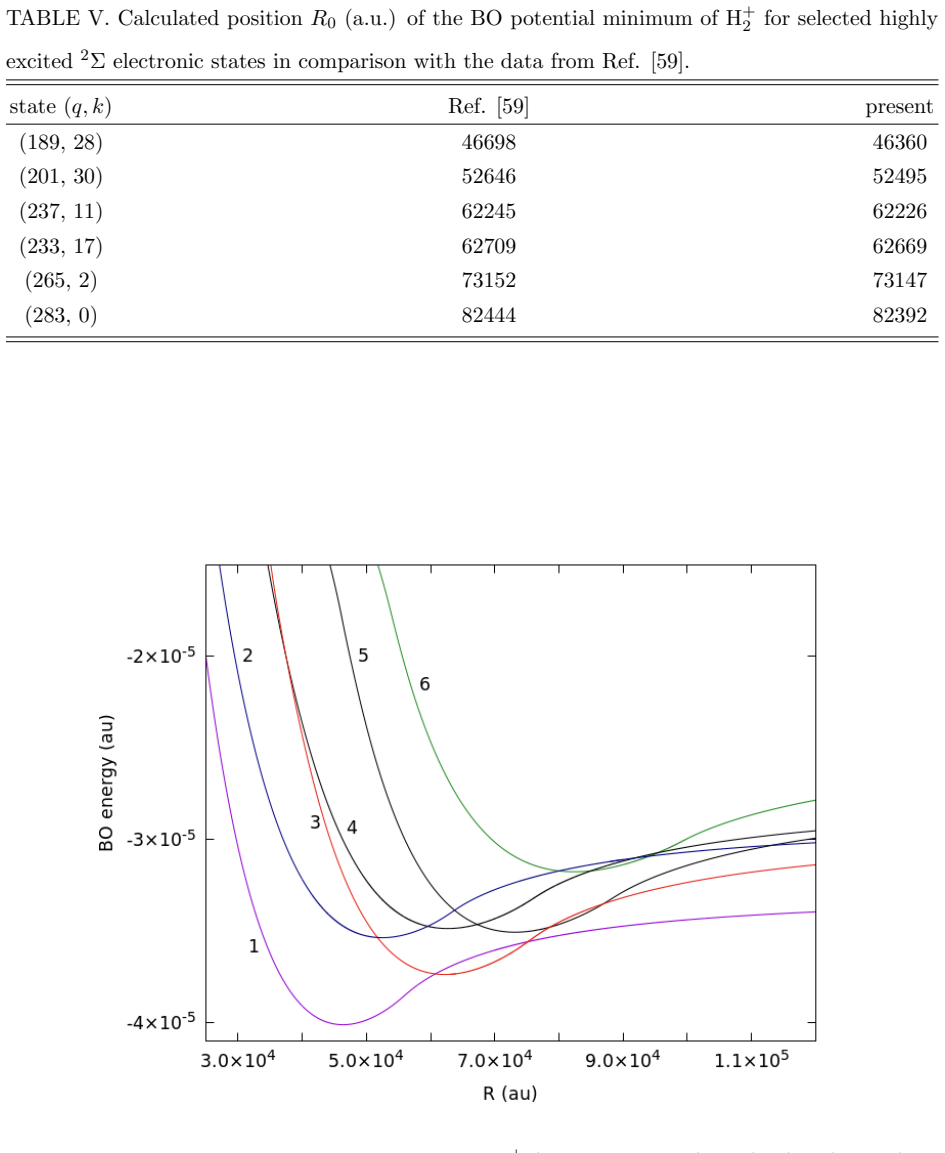
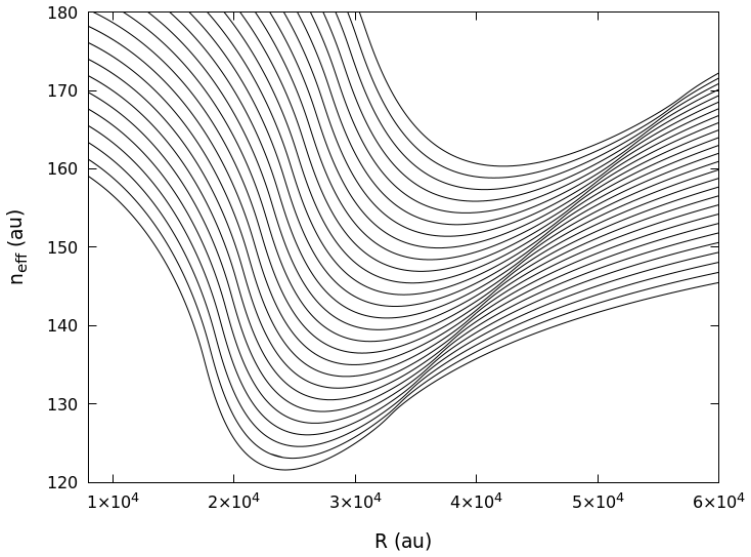
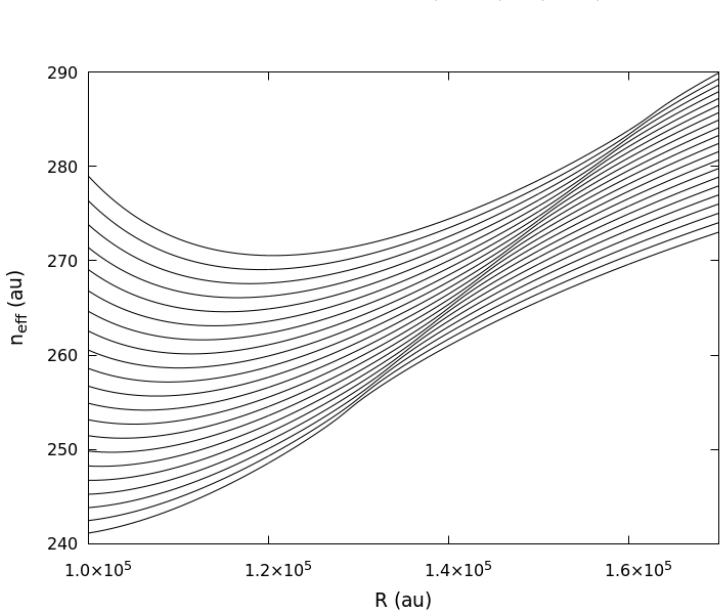
- High-lying 2Sigma states of H2+ are computed reliably up to internuclear separations of 1.7 times 10^5 atomic units.
- Eigenvalues are produced for the generalized spheroidal wave equation when parameters are complex-valued.
- Results match those of other authors for the tested cases.
Where Pith is reading between the lines
- The recurrence construction may be portable to other differential equations whose solutions are represented by continued fractions.
- Stability under complex parameters could support direct computation of resonance widths or scattering phase shifts without separate analytic continuation steps.
- The method supplies a route to parameter-free tabulation of separation constants over the full range of internuclear distances needed for molecular potential curves.
Load-bearing premise
The analytic derivatives of the eigenvalues can be expressed exactly as three-term recurrence relations inside the continued-fraction framework and remain numerically stable for both real and complex parameters without introducing additional truncation or convergence errors.
What would settle it
If high-precision independent calculations for a high-lying state of H2+ at internuclear distance 10^5 au or for a chosen complex parameter set differ from the reported eigenvalues by more than the claimed numerical tolerance, the accuracy claim is falsified.
Figures
read the original abstract
This paper presents a new approach for the computation of eigenvalues of the generalized spheroidal wave equations. The novelty of the present method is in the use of the analytical derivatives of the eigenvalues to minimize losses in accuracy. The derivatives are constructed in the form of three-term recurrent relations within the method of continued fractions associated with the corresponding spheroidal wave equation. Very accurate results for the eigenvalues are obtained for a wide range of the parameters of the problem. As an illustrative example, the electronic energies and the separation constants are computed for various electronic states and geometries of selected ($\rm{H}_2^{+}$, $\rm{HeH}^{2+}$, and $\rm{BH}^{5+}$) quasimolecular systems. The computations for high lying ${}^{2}\Sigma$ electronic states of $\rm{H}_2^{+}$ up to very large internuclear separations ($ \leq 1.7 \times 10^5$ au) are presented. Also presented the computations for the eigenvalues of the generalized spheroidal wave equations with complex valued parameters. The agreement between the obtained results and the results of other authors is discussed.
Editorial analysis
A structured set of objections, weighed in public.
Referee Report
Summary. The manuscript presents a computational method for the eigenvalues of the generalized spheroidal wave equation that constructs analytic derivatives of the eigenvalues as three-term recurrence relations inside the continued-fraction formalism. The approach is applied to real and complex parameter regimes, with numerical illustrations for the electronic energies and separation constants of H2+, HeH2+ and BH5+ quasimolecules, including high-lying 2Σ states of H2+ at internuclear distances up to 1.7×10^5 au and selected complex-valued cases; the authors report high accuracy and agreement with existing literature.
Significance. If the three-term recurrences for the derivatives are exact and remain stable for complex parameters, the method supplies a direct route to eigenvalue derivatives without finite-difference approximations, which can reduce truncation error in applications that require both eigenvalues and their parametric derivatives. The explicit large-separation and complex-parameter demonstrations add concrete utility for molecular and atomic physics calculations that employ spheroidal coordinates.
minor comments (3)
- The abstract and introduction state that the derivatives are 'constructed in the form of three-term recurrent relations,' but the manuscript should include an explicit derivation of the recurrence coefficients (including the starting index and termination conditions) to allow independent verification.
- Numerical tables or figures comparing the new results with prior literature should report both the eigenvalue and its derivative (or at least the convergence behavior of the continued fraction) so that the claimed accuracy gain from analytic derivatives can be assessed directly.
- For the complex-parameter examples, the manuscript should state the criterion used to decide when the continued fraction is truncated and how the stability of the recurrence is monitored when the parameters have nonzero imaginary parts.
Simulated Author's Rebuttal
We thank the referee for the positive summary of our manuscript, the assessment of its significance, and the recommendation for minor revision. No specific major comments were listed in the report.
Circularity Check
No significant circularity
full rationale
The paper's central contribution is the explicit construction of three-term recurrence relations for the analytic derivatives of eigenvalues inside the standard continued-fraction representation of the generalized spheroidal wave equation. This is presented as a direct algebraic derivation that extends the existing continued-fraction formalism without redefining any input quantity in terms of the output or invoking load-bearing self-citations. The numerical examples (energies and separation constants for H2+, HeH2+, BH5+ and complex-parameter cases) are applications of the derived recurrences rather than predictions that collapse back to fitted parameters. No step reduces by construction to its own inputs, and the method is described as numerically stable without additional truncation assumptions that would create circularity.
Axiom & Free-Parameter Ledger
axioms (1)
- domain assumption The method of continued fractions is applicable to the generalized spheroidal wave equation for both real and complex parameters.
Reference graph
Works this paper leans on
-
[1]
We obtained the equilibrium distances ofR e = 12.546 083 658 617 457 a.u
which, since our results on electronic energies are otherwise in excellent agreement with earlier computations from the same authors and of Ishikawa in [55], we suspect is due to a misprint. We obtained the equilibrium distances ofR e = 12.546 083 658 617 457 a.u. with the BO energy:−0.500 060 790 563 912 563 640 093 300 090 05 a.u. for the 2pσ u state, a...
work page 2004
-
[2]
The case of smallR It is well known that Jaffe’s expansion for the radial solution Π(ξ) converges slowly for very smallR(see, e.g., Ref. [62] and references therein). Therefore, calculation of the electronic energies of H2 + at the small internuclear separations is a good test for the accuracy of the present method. To verify our results we use an asympto...
-
[3]
We computed theE BO 1sσ(R) energy of H+ 2 at a sufficiently largeRand compared the 12 TABLE II
The case of largeR Calculation of the BO energies at large internuclear distances is also a good test for the accuracy. We computed theE BO 1sσ(R) energy of H+ 2 at a sufficiently largeRand compared the 12 TABLE II. Convergence with increasingN RK andN NR of the electronic energy for the ground 1sσg state of H + 2 atR= 0.005 a.u. The reference analytic as...
work page 2000
- [5]
-
[6]
2.19561 23696 53500 1 1 4 PW a 4.39959 30671 65506 10459 61890 349−2.90920 07591 46191 61848 25064
-
[7]
4.39959 97606 64940 1 1 10 PW 89.71223 12326 08531 82924 20083 558 37.88064 98956 19453 22628 71048
- [9]
-
[10]
131.56008 09183 03 a Result forλ(c) +c 2 21 TABLE VIII. Comparison of eigenvaluesλ 00(c, b= 0) for complex parameterccomputed in the present work (PW) and in publications [36, 44]. Notation:α= 1 +i. cRef. Re[λ 00(c)] Im[λ 00(c)] αPW 0.05947 27697 35031 26247 06156 230−1.33717 48778 05399 97103 72378 512
-
[11]
0.05947 27697 35031 26247 06156−1.33717 48778 05399 97103 72378 5αPW 4.23035 06988 78380 87794 25891−44.97310 67423 02780 62895 65852 10αPW 9.24076 62146 34603 35159 57442 763−189.98934 85956 57553 67515 08696 381
-
[12]
9.24076 62146 34603 35159 57442−189.98934 85956 57553 67515 08696 20αPW a 19.24532 81345 43127 94480 20.00499 41449 70279 83195
-
[13]
Comparisons of eigenvaluesλ lm(c)+c 2 for selected values ofbcomputed in the present work (PW), Ref
19.24532 81302 15245 20.00499 41471 04920 a Result forλ 00(c) +c 2 TABLE IX. Comparisons of eigenvaluesλ lm(c)+c 2 for selected values ofbcomputed in the present work (PW), Ref. [38], and Ref. [37] when available. (m, l)cRef.b= 0b= 2 (0,0) 1.0 PW 0.31900 00551 46892 73978 39819−0.15430 49702 80370 60175 78170
-
[14]
0.31900 00551 469−0.15430 49702 80
-
[15]
0.31900 00551 46893 25 PW 24.24209 35412 27324 02377 17920 24.24045 94381 87742 70543 68343
-
[16]
24.24209 35412 28 24.24045 94381 88 100 PW 99.24810 11089 83252 55045 78476 99.24800 06013 19520 62785 79264
-
[17]
99.24810 11089 91 99.24800 06013 07
-
[18]
99.24810 11089 832 (4,8) 1.0 PW 72.38941 89146 97508 96893 7413 72.39169 16942 19545 24437 8883
-
[19]
72.38941 89146 98 72.39169 16942 19 25 PW 233.57957 22097 14548 60892 011 233.57773 51174 30830 16340 670
-
[20]
233.57957 22097 1 233.57773 51174 3 22 TABLE X. The eigenvaluesλ lm(c, b) forc= 1 +iand selected values of the parameterbcomputed in the present work. m,l c bRe [λ lm] Im [λ lm] (0,0) 1 +i0.01 0.05945 80409 82913 62742 87308−1.33716 78162 85459 23808 81316 0.01i0.05948 74985 33125 82592 62801−1.33718 19395 18751 81975 40535 0.1+ 0.1i0.05805 95356 20813 93...
work page 2088
-
[21]
J. M. Brown and A. Carrington,Rotational Spectroscopy of Diatomic Molecules(Cambridge University Press, Cambridge, 2003)
work page 2003
- [22]
-
[23]
T. Kereselidze, I. Noselidze, and Z. Machavariani, Eur. Phys. J. D78, 59 (2024)
work page 2024
-
[24]
V. Y. Lazur, M. V. Khoma, and R. K. Janev, J. Phys. B: At. Mol. Phys.37, 1245 (2004)
work page 2004
-
[25]
D. I. Bondar, M. Hnatich, and V. Y. Lazur, J. Phys. A: Math. Gen.40, 1791 (2007)
work page 2007
-
[26]
M. L. Martiarena and V. H. Ponce, Nucl. Instr. Meth. Phys. Res. B125, 228 (1997)
work page 1997
-
[27]
A. Yanacopoulo, G. Hadinger, and M. Aubert-Frecon, J. Phys. B: At. Mol. Opt. Phys.22, 2427 (1989). 25
work page 1989
-
[28]
G. Hadinger, M. Aubert-Frecon, and G. Hadinger, J. Phys. B: At. Mol. Opt. Phys.22, 697 (1989)
work page 1989
-
[29]
B. C. Eu and M. L. Sink, J. Chem. Phys.78, 4896 (1983)
work page 1983
-
[30]
J. M. Rost, Hyperfine Interact.89, 343 (1994)
work page 1994
- [31]
- [32]
-
[33]
Deng, Journal of Electrostatics66, 549 (2008)
S. Deng, Journal of Electrostatics66, 549 (2008)
work page 2008
- [34]
-
[35]
S. Y. Slavyanov and W. Lay,Special functions(Oxford University Press, Oxford, 2000)
work page 2000
- [36]
-
[37]
S. A. Teukolsky, Class. Quantum Grav.32, 124006 (2015)
work page 2015
-
[38]
P. P. Fiziev, Class. Quantum Grav.27, 135001 (2010)
work page 2010
-
[39]
E. W. Leaver, J. Math. Phys.27, 1238 (1986)
work page 1986
-
[40]
J. M. Peek, J. Chem. Phys.43, 3004 (1965)
work page 1965
-
[41]
M. M. Madsen and J. M. Peek, Atomic Data2, 171 (1971)
work page 1971
- [42]
-
[43]
D. B. Hodge, J. Math. Phys.11, 2308 (1970)
work page 1970
-
[44]
J. D. Power, Phil. Trans. R. Soc. A274, 663 (1973)
work page 1973
- [45]
-
[46]
L. I. Ponomarev and L. N. Somov, J. Comput. Phys.20, 183 (1976)
work page 1976
-
[47]
I. V. Komarov, L. I. Ponomarev, and S. Y. Slavyanov,Spheroidal and Coulomb Spheroidal Functions(Nauka, Moscow, 1976)
work page 1976
-
[48]
S. Y. Ovchinnikov and J. H. Macek, Phys. Rev. A55, 3605 (1997)
work page 1997
-
[49]
A. A. Abramov and S. V. Kurochkin, Comput. Math. Math. Phys.46, 10 (2006)
work page 2006
-
[50]
L. J. El-Jaick and B. D. Figueiredo, Appl. Math. Comp.284, 234 (2016)
work page 2016
-
[51]
B. D. B. Figueiredo, J. Phys. A: Math. Gen.35, 2877–2906 (2002)
work page 2002
-
[52]
B. D. B. Figueiredo, J. Math. Phys.48, 013503 (2007)
work page 2007
-
[53]
L. J. El-Jaick and B. D. B. Figueiredo, J. Math. Phys.49, 083508 (2008)
work page 2008
-
[54]
T. C. Scott, M. Aubert-Fr´ econ, and J. Grotendorst, Chem. Phys.324, 323 (2006). 26
work page 2006
-
[55]
J. W. Liu, J. Math. Phys.33, 4026 (1992)
work page 1992
-
[56]
P. E. Falloon, P. C. Abbott, and J. B. Wang, J. Phys. A: Math. Gen.36, 5477 (2003)
work page 2003
-
[57]
P. E. Falloon,Theory and Computation of Spheroidal Harmonics with General Arguments (The University of Western Australia, Crawley, 2001) Master thesis
work page 2001
- [58]
- [59]
-
[60]
L. Li, M. Leong, T. Yeo, P. Kooi, and K. Tan, Phys. Rev. E58, 6792 (1998)
work page 1998
- [61]
-
[62]
D. M. Mitnik, F. A. L´ opez, and L. U. Ancarani, Mol. Phys.119, e1881179 (2021)
work page 2021
-
[63]
M. Seri, J. Math. Phys.56, 012902 (2015)
work page 2015
-
[64]
D. X. Ogburn, C. L. Waters, M. D. Sciffer, J. A. Hogan, and P. C. Abbot, Comp. Phys. Comm.185, 244 (2014)
work page 2014
-
[65]
G. B. Cook and M. Zalutskiy, Phys. Rev. D90, 124021 (2014)
work page 2014
- [66]
- [67]
-
[68]
R. K. Janev, L. P. Presnyakov, and V. P. Shevelko,Physics of Highly Charged Ions(Springer- Verlag, Berlin, 1985)
work page 1985
- [69]
-
[70]
L. I. Ponomarev and T. P. Puzynina, Zh. Vych. Mat. Mat. Fiz.8, 1256 (1968)
work page 1968
- [71]
-
[72]
H. S. Wall,Analytic Theory of Continued Fractions(Van Nostrand, New York, 1948)
work page 1948
- [73]
- [74]
-
[75]
A. Ishikawa, H. Nakashima, and H. Nakatsuji, J. Chem. Phys.128, 124103 (2008)
work page 2008
- [76]
-
[77]
M. C. Zammit, J. S. Savage, J. Colgan, D. V. Fursa, D. P. Kilcrease, I. Bray, C. J. Fontes, P. Hakel, and E. Timmermans, The Astrophys. Journ.851, 64 (2017)
work page 2017
-
[78]
H. Olivares-Pil´ on and A. V. Turbiner, Ann. Phys.373, 581 (2016)
work page 2016
-
[79]
T. J. Price and C. H. Greene, J. Phys. Chem. A122, 8565 (2018). 27
work page 2018
- [80]
-
[81]
L. Tao, C. W. McCurdy, and T. N. Rescigno, Phys. Rev. A79, 012719 (2009)
work page 2009
- [82]
discussion (0)
Sign in with ORCID, Apple, or X to comment. Anyone can read and Pith papers without signing in.