Beyond Answers: How LLMs Can Pursue Strategic Thinking in Education
Pith reviewed 2026-05-22 21:03 UTC · model grok-4.3
The pith
LLMs enhance education when they guide students to develop strategies rather than supplying direct answers.
A machine-rendered reading of the paper's core claim, the machinery that carries it, and where it could break.
Core claim
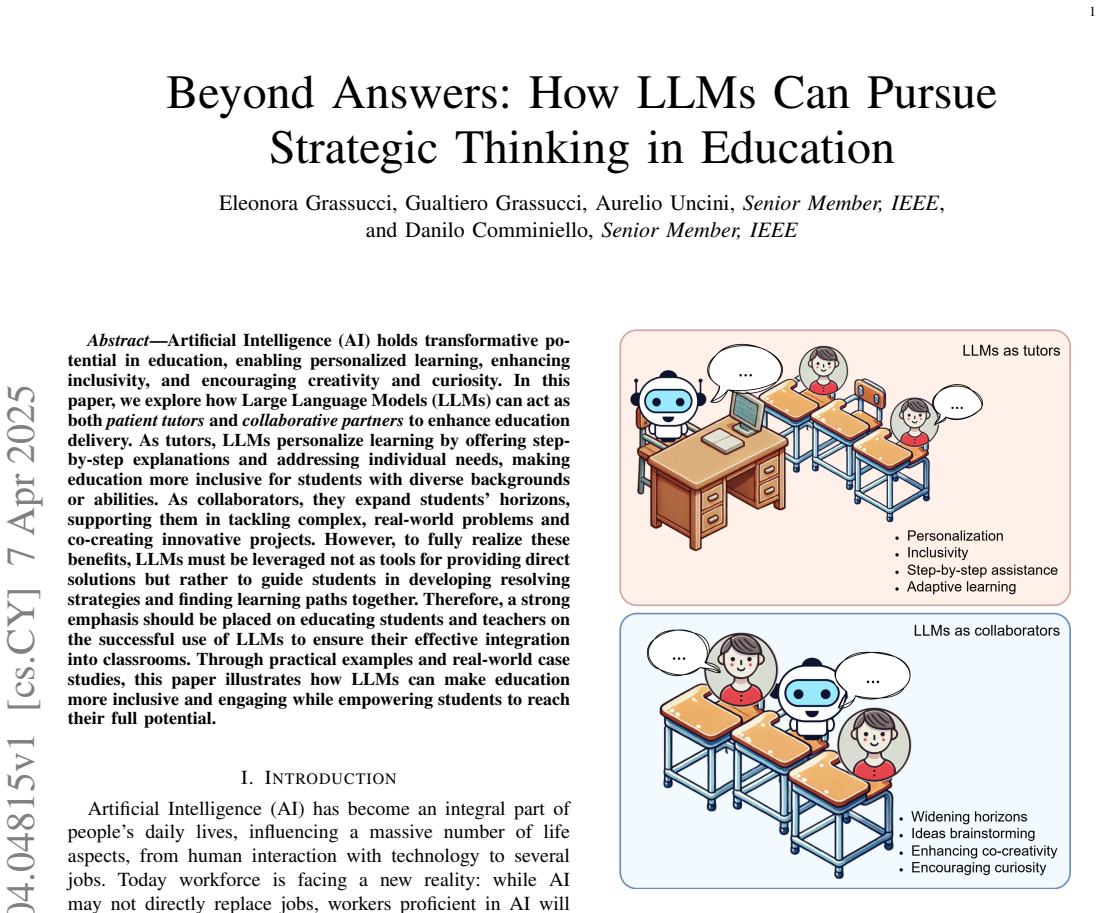
Large language models function effectively as tutors for individualized explanations and as collaborators for real-world projects, yet their benefit in education depends on using them to guide the development of resolving strategies and joint learning paths rather than to deliver direct solutions, as shown through practical examples and case studies.
What carries the argument
The dual role of LLMs as tutors and collaborators that prioritize guiding strategic development and learning paths over direct answers.
If this is right
- Personalized step-by-step guidance makes learning accessible to students with varied backgrounds and abilities.
- Students develop skills for addressing complex real-world problems through co-creation with the models.
- Effective classroom use requires dedicated training for both students and teachers on LLM interaction.
- Education becomes more engaging by encouraging curiosity and creative project work.
Where Pith is reading between the lines
- Curricula could incorporate explicit practice in prompting LLMs to reveal strategies rather than final outputs.
- Teacher training might include scenarios that demonstrate redirecting LLM responses toward student-led problem solving.
- Assessment could evolve to score the quality of the learning path explored with an LLM instead of only the end result.
- Under-resourced schools might use LLM guidance to reduce gaps in access to individualized tutoring.
Load-bearing premise
Placing a strong emphasis on educating students and teachers on the successful use of LLMs will ensure their effective integration into classrooms.
What would settle it
A controlled study in which trained students and teachers still rely on LLMs primarily for direct answers without evidence of increased strategic thinking or independent learning paths.
Figures


read the original abstract
Artificial Intelligence (AI) holds transformative potential in education, enabling personalized learning, enhancing inclusivity, and encouraging creativity and curiosity. In this paper, we explore how Large Language Models (LLMs) can act as both patient tutors and collaborative partners to enhance education delivery. As tutors, LLMs personalize learning by offering step-by-step explanations and addressing individual needs, making education more inclusive for students with diverse backgrounds or abilities. As collaborators, they expand students' horizons, supporting them in tackling complex, real-world problems and co-creating innovative projects. However, to fully realize these benefits, LLMs must be leveraged not as tools for providing direct solutions but rather to guide students in developing resolving strategies and finding learning paths together. Therefore, a strong emphasis should be placed on educating students and teachers on the successful use of LLMs to ensure their effective integration into classrooms. Through practical examples and real-world case studies, this paper illustrates how LLMs can make education more inclusive and engaging while empowering students to reach their full potential.
Editorial analysis
A structured set of objections, weighed in public.
Referee Report
Summary. The paper claims that LLMs can serve as patient tutors for personalized, step-by-step learning and as collaborators for tackling complex problems, but to realize these benefits they must guide students toward developing resolving strategies and learning paths rather than supplying direct solutions; it therefore recommends strong emphasis on educating students and teachers about effective LLM use, illustrated via practical examples and real-world case studies.
Significance. If the normative position holds, the paper could usefully shape policy and classroom practice around strategic rather than answer-oriented LLM integration, potentially supporting more inclusive and creative educational outcomes. As a position paper it contributes to the computers-and-society literature by articulating a clear pedagogical stance, though its influence will depend on the persuasiveness of the examples rather than new empirical results.
major comments (1)
- [Abstract] Abstract: the recommendation that 'a strong emphasis should be placed on educating students and teachers on the successful use of LLMs to ensure their effective integration' is load-bearing for the practical takeaway, yet the text supplies no argument, mechanism, or evidence showing why education alone would produce that outcome; this assumption therefore requires explicit justification or qualification.
minor comments (1)
- The abstract refers to 'practical examples and real-world case studies' whose details are not visible in the provided text; if they appear later, they should be cross-referenced so readers can evaluate how they support the central claim.
Simulated Author's Rebuttal
We thank the referee for the detailed and constructive feedback on our position paper. The comment highlights an important point about strengthening the justification for our practical recommendations, and we address it directly below.
read point-by-point responses
-
Referee: [Abstract] Abstract: the recommendation that 'a strong emphasis should be placed on educating students and teachers on the successful use of LLMs to ensure their effective integration' is load-bearing for the practical takeaway, yet the text supplies no argument, mechanism, or evidence showing why education alone would produce that outcome; this assumption therefore requires explicit justification or qualification.
Authors: We agree that the abstract states the recommendation concisely without an explicit mechanism or supporting argument in that section alone. The manuscript's core contribution rests on the practical examples and real-world case studies in the body, which demonstrate how unguided LLM use can shortcut strategic thinking while guided interactions foster resolving strategies, inclusivity, and creativity. To make this link explicit and address the concern, we will revise the abstract to qualify the recommendation and add a short explanatory clause referencing the illustrative cases. We will also ensure the introduction or conclusion briefly articulates the rationale—namely, that education equips users to prompt for paths rather than answers—drawing directly from the examples without overstating empirical claims. revision: yes
Circularity Check
No significant circularity
full rationale
The paper is a conceptual position paper with no equations, derivations, fitted parameters, or technical claims that could reduce to inputs by construction. Its recommendations rest on normative advocacy and illustrative examples rather than any self-referential chain or fitted prediction. No load-bearing self-citations or ansatzes are present in the provided text. This is a standard self-contained discussion without internal circularity.
Axiom & Free-Parameter Ledger
Reference graph
Works this paper leans on
-
[1]
How AI is shaping the future of education,
R. Schmelzer, “How AI is shaping the future of education,” Forbes, 2024
work page 2024
-
[2]
OpenAI and J. Achiam et al., “GPT-4 technical report,” ArXiv preprint: arXiv:2303.08774, 2023
work page internal anchor Pith review Pith/arXiv arXiv 2023
-
[3]
Gemini: A Family of Highly Capable Multimodal Models
Gemini Team, “Gemini: A family of highly capable multimodal models,” ArXiv preprint: arXiv:2312.11805 , 2024
work page internal anchor Pith review Pith/arXiv arXiv 2024
-
[4]
AI for Education (AI4EDU): Advancing personalized education with llm and adaptive learning,
Q. Wen, J. Liang, C. Sierra, R. Luckin, R. Tong, Z. Liu, P. Cui, and J. Tang, “AI for Education (AI4EDU): Advancing personalized education with llm and adaptive learning,” in ACM SIGKDD Conference on Knowledge Discovery and Data Mining (KDD) , 2024, p. 6743–6744
work page 2024
-
[5]
Bringing generative ai to adaptive learning in education
Hang Li, Tianlong Xu, Chaoli Zhang, Eason Chen, Jing Liang, Xing Fan, Haoyang Li, Jiliang Tang, and Qingsong Wen, “Bringing generative ai to adaptive learning in education,” ArXiv preprint: arXiv:2402.14601 , 2024
-
[6]
Foundation models for education: Promises and prospects,
T. Xu, R. Tong, J. Liang, X. Fan, H. Li, Q. Wen, and G. Pang, “Foundation models for education: Promises and prospects,” IEEE Intelligent Systems, vol. 39, pp. 20–24, 2024
work page 2024
-
[7]
Artificial intelligence-based stem education,
X. Zhai and J. Krajcik, “Artificial intelligence-based stem education,” Uses of Artificial Intelligence in STEM Education , 2024
work page 2024
-
[8]
PhysicsAssistant: An LLM- powered interactive learning robot for physics lab investigations,
E. Latif, R. Parasuraman, and X. Zhai, “PhysicsAssistant: An LLM- powered interactive learning robot for physics lab investigations,” ArXiv prerint: arXiv:2403.18721, 2024
-
[9]
Generative AI as a learning buddy and teaching assistant: Pre-service teachers’ uses and attitudes,
M. Nyaaba, L. Shi, M. Nabang, X. Zhai, P. Kyeremeh, S. A. Ayoberd, and B. N. Akanzire, “Generative AI as a learning buddy and teaching assistant: Pre-service teachers’ uses and attitudes,” ArXiv preprint: arXiv:2407.11983, 2024
-
[10]
Improving collaborative learning perfor- mance based on llm virtual assistant,
R. Wei, K. Li, and J. Lan, “Improving collaborative learning perfor- mance based on llm virtual assistant,” in Int. Conf. on Educational and Information Technology (ICEIT), 2024, pp. 1–6
work page 2024
-
[11]
A systematic assessment of openai o1-preview for higher order thinking in education,
Ehsan Latif, Yifan Zhou, Shuchen Guo, Yizhu Gao, Lehong Shi, Matthew Nayaaba, Gyeonggeon Lee, Liang Zhang, Arne Bewersdorff, Luyang Fang, Xiantong Yang, Huaqin Zhao, Hanqi Jiang, Haoran Lu, Jiaxi Li, Jichao Yu, Weihang You, Zhengliang Liu, Vincent Shung Liu, Hui Wang, Zihao Wu, Jin Lu, Fei Dou, Ping Ma, Ninghao Liu, Tianming Liu, and Xiaoming Zhai, “A sys...
-
[12]
Large language models for education: A survey and outlook
S. Wang, T. Xu, H. Li, C. Zhang, J. Liang, J. Tang, P. S. Yu, and Q. Wen, “Large language models for education: A survey and outlook,” ArXiv preprint: arXiv:2403.18105, 2024
-
[13]
A. Vaswani, N. M. Shazeer, N. Parmar, J. Uszkoreit, L. Jones, A. N. Gomez, L. Kaiser, and I. Polosukhin, “Attention is all you need,” in Neural Information Processing Systems , 2017
work page 2017
-
[14]
BERT: Pre- training of deep bidirectional transformers for language understanding,
J. Devlin, M.-W. Chang, K. Lee, and K. Toutanova, “BERT: Pre- training of deep bidirectional transformers for language understanding,” in Association for Computational Linguistics , 2019
work page 2019
-
[15]
Rohan Anil et al. , “PaLM 2 technical report,” ArXiv preprint: arXiv:2305.10403, 2023
work page internal anchor Pith review Pith/arXiv arXiv 2023
-
[16]
L. Huang, W. Yu, W. Ma, W. Zhong, Z. Feng, H. Wang, Q. Chen, W. Peng, X. Feng, B. Qin, and T. Liu, “A survey on hallucination in large language models: Principles, taxonomy, challenges, and open questions,” ArXiv preprint: arXiv:2311.05232 , 2023
work page internal anchor Pith review Pith/arXiv arXiv 2023
-
[17]
Realizing visual question answering for educa- tion: GPT-4V as a multimodal AI,
G.-G. Lee and X. Zhai, “Realizing visual question answering for educa- tion: GPT-4V as a multimodal AI,” ArXiv preprint: arXiv:2405.07163 , 2024
-
[18]
Leveraging language models for emotion and behavior analysis in education,
K. Tanaka, B. Tan, and B. Wong, “Leveraging language models for emotion and behavior analysis in education,” ArXiv preprint: arXiv:2408.06874, 2024
-
[19]
Large language models understand and can be enhanced by emotional stimuli,
C. Li, J. Wang, Y . Zhang, K. Zhu, W. Hou, J. Lian, F. Luo, Q. Yang, and X. Xie, “Large language models understand and can be enhanced by emotional stimuli,” 2023
work page 2023
-
[20]
ECG-based automated emotion recognition using temporal convolution neural networks,
T. C. Sweeney-Fanelli and M. H. Imtiaz, “ECG-based automated emotion recognition using temporal convolution neural networks,” IEEE Sensors Journal, vol. 24, no. 18, pp. 29039–29046, 2024
work page 2024
-
[21]
A novel exploitative and explorative GWO-SVM algorithm for smart emotion recognition,
X. Yan, Z. Lin, Z. Lin, and B. Vucetic, “A novel exploitative and explorative GWO-SVM algorithm for smart emotion recognition,” IEEE Internet of Things Journal , vol. 10, no. 11, pp. 9999–10011, 2023
work page 2023
-
[22]
L. Barack and N. Sago, “Beyond the geodesic approximation: conser- vative effects of the gravitational self-force in eccentric orbits around a schwarzschild black hole,” Physical Review D , vol. 83, pp. 084023, 2011. BIOGRAPHIES Eleonora Grassucci received the Ph.D. degree in Informa- tion and Communication Technologies in 2023 from Sapienza University of...
work page 2011
discussion (0)
Sign in with ORCID, Apple, or X to comment. Anyone can read and Pith papers without signing in.