Creating and Evaluating Personas Using Generative AI: A Scoping Review of 81 Articles
Pith reviewed 2026-05-22 20:51 UTC · model grok-4.3
The pith
A review of 81 studies finds generative AI for user personas often skips evaluation and risks the same model generating and judging its own outputs.
A machine-rendered reading of the paper's core claim, the machinery that carries it, and where it could break.
Core claim
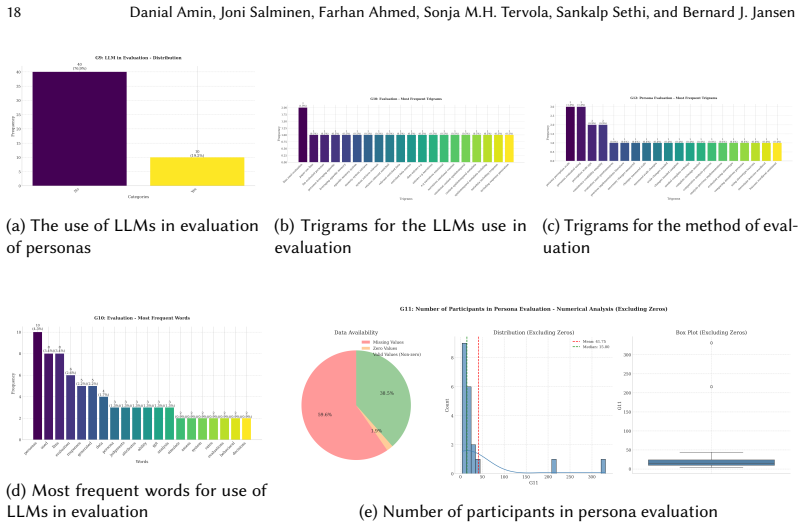
The scoping review finds that 61 percent of the articles share resources such as personas, code, or datasets, supporting reproducibility, while conversational persona interfaces appear more often alongside traditional profile formats. At the same time, 45 percent of articles include no evaluation step and 86 percent rely exclusively on GPT models. In several cases the same generative model both produces and assesses the personas, creating a circularity risk, and overall the approach appears to shrink the direct contribution of human developers during creation. The authors respond by outlining practical guidelines to support responsible use of the technology in persona work.
What carries the argument
Scoping review that sorts articles by generative AI application, evaluation presence, model choice, resource sharing, and interface style to surface patterns in persona development.
If this is right
- Persona studies that omit evaluation steps may deliver user representations whose fit to actual people remains unknown.
- Dominant use of a single model family limits the variety of outputs and may embed shared biases across many projects.
- Circular generation and evaluation loops can produce self-reinforcing results that appear consistent without external confirmation.
- Reduced human involvement shifts more responsibility for accuracy and relevance onto the generative model itself.
- Proposed guidelines offer a concrete route to restore checks and broaden model choices in future persona work.
Where Pith is reading between the lines
- Teams adopting these tools may need new quality benchmarks that avoid depending on the generating model for validation.
- Wider industry use could amplify any model-specific blind spots in how user groups are portrayed over time.
- The move toward conversational personas might require fresh testing methods focused on dialogue quality rather than static profiles.
- Maintaining some human checkpoints at key stages could be tested as a practical safeguard against over-reliance on generative outputs.
Load-bearing premise
The 81 articles located by the search strategy form a representative sample of current generative AI practices for personas, and the extraction accurately reflects evaluation methods, model use, and reproducibility without major selection or reading bias.
What would settle it
A follow-up search that turns up many additional articles using non-GPT models together with independent human evaluations of the generated personas would test whether the reported patterns hold.
Figures




read the original abstract
As generative AI (GenAI) is increasingly applied in persona development to represent real users, understanding the implications and limitations of this technology is essential for establishing robust practices. This scoping review analyzes how 81 articles (2022-2025) use GenAI techniques for the creation, evaluation, and application of personas. The articles exhibited good level of reproducibility, with 61% of articles sharing resources (personas, code, or datasets). Furthermore, conversational persona interfaces are increasingly provided alongside traditional profiles. However, nearly half (45%) of the articles lack evaluation, and the majority (86%) use only GPT models. In some articles, GenAI use creates a risk of circularity, in which the same GenAI model both generates and evaluates outputs. Our findings also suggest that GenAI seems to reduce the role of human developers in the persona-creation process. To mitigate the associated risks, we propose actionable guidelines for the responsible integration of GenAI into persona development.
Editorial analysis
A structured set of objections, weighed in public.
Referee Report
Summary. The manuscript presents a scoping review of 81 articles (2022-2025) examining the use of generative AI for persona creation, evaluation, and application. It reports that 61% of articles share resources, 45% lack evaluation, 86% rely exclusively on GPT models, identifies circularity risks where the same GenAI model generates and evaluates outputs, observes a reduction in human developer roles, and proposes guidelines for responsible integration.
Significance. If the sample is representative and extraction reliable, the review provides a timely synthesis of GenAI practices in persona development, with credit due for the scale of the review (81 articles), explicit quantification of reproducibility and evaluation gaps, and the identification of circularity as a distinct risk. These elements offer a useful reference point for HCI researchers adopting GenAI tools.
major comments (2)
- [Methods] Methods section: The description of the literature search lacks the exact search strings, list of databases, PRISMA flow diagram, and any inter-rater reliability metrics for article screening and data extraction. This directly affects confidence in the representativeness of the 81-article sample and the reliability of derived statistics (86% GPT-only, 45% no evaluation, circularity observations).
- [Results] Results section (circularity and human-role findings): The claims that GenAI creates circularity risks and reduces human developer involvement rest on interpretive categorization of the reviewed articles without a reported coding scheme or agreement statistics; this is load-bearing for the risk-assessment conclusions and the proposed guidelines.
minor comments (2)
- [Abstract] Abstract: The phrase 'good level of reproducibility' should be replaced with the specific figure (61%) for precision.
- [Tables/Figures] Tables/figures: Any summary tables of article characteristics would benefit from explicit column definitions for categories such as 'evaluation presence' to avoid ambiguity in interpretation.
Simulated Author's Rebuttal
We thank the referee for the constructive comments on our scoping review. The feedback highlights important areas for improving transparency in methods and supporting interpretive claims in results. We address each major comment below and indicate planned revisions.
read point-by-point responses
-
Referee: [Methods] Methods section: The description of the literature search lacks the exact search strings, list of databases, PRISMA flow diagram, and any inter-rater reliability metrics for article screening and data extraction. This directly affects confidence in the representativeness of the 81-article sample and the reliability of derived statistics (86% GPT-only, 45% no evaluation, circularity observations).
Authors: We agree that additional methodological detail is needed to strengthen confidence in the sample and statistics. In the revised manuscript we will add the exact search strings, the complete list of databases, and a PRISMA flow diagram. The screening and extraction process was led by one author with team oversight rather than independent dual coding; therefore formal inter-rater reliability metrics are not available. We will describe the exact procedure and any quality-control steps taken so readers can evaluate reliability. revision: partial
-
Referee: [Results] Results section (circularity and human-role findings): The claims that GenAI creates circularity risks and reduces human developer involvement rest on interpretive categorization of the reviewed articles without a reported coding scheme or agreement statistics; this is load-bearing for the risk-assessment conclusions and the proposed guidelines.
Authors: The circularity and human-role observations were derived from systematic reading of the 81 articles. To make the basis for these claims transparent, we will add a dedicated subsection in the methods (or an appendix) that details the categorization criteria, coding scheme, and decision rules used to identify circularity and changes in human involvement. This will allow readers to assess the interpretive steps supporting the risk discussion and guidelines. revision: yes
Circularity Check
No circularity in scoping review synthesis
full rationale
This paper performs a scoping review of 81 articles on GenAI for persona creation and evaluation. Its claims consist of observational tallies (e.g., 86% GPT-only usage, 45% lacking evaluation, occasional same-model generate-and-evaluate loops in reviewed works) drawn from the sampled literature rather than any derivation, equation, parameter fit, or prediction that reduces to the paper's own inputs by construction. No self-definitional loops, fitted-input predictions, or load-bearing self-citation chains appear; the synthesis is self-contained against the external corpus it reviews.
Axiom & Free-Parameter Ledger
axioms (2)
- domain assumption The search strategy and inclusion criteria applied to identify the 81 articles capture the relevant population of GenAI persona studies without material omission or bias.
- domain assumption Evaluation absence, model usage, and resource sharing can be reliably extracted and categorized from article texts using consistent definitions.
Lean theorems connected to this paper
-
IndisputableMonolith/Foundation/RealityFromDistinction.leanreality_from_one_distinction unclear?
unclearRelation between the paper passage and the cited Recognition theorem.
This scoping review analyzes how 81 articles (2022-2025) use GenAI techniques for the creation, evaluation, and application of personas... nearly half (45%) of the articles lack evaluation, and the majority (86%) use only GPT models.
-
IndisputableMonolith/Cost/FunctionalEquation.leanwashburn_uniqueness_aczel unclear?
unclearRelation between the paper passage and the cited Recognition theorem.
GenAI use creates a risk of circularity, in which the same GenAI model both generates and evaluates outputs
What do these tags mean?
- matches
- The paper's claim is directly supported by a theorem in the formal canon.
- supports
- The theorem supports part of the paper's argument, but the paper may add assumptions or extra steps.
- extends
- The paper goes beyond the formal theorem; the theorem is a base layer rather than the whole result.
- uses
- The paper appears to rely on the theorem as machinery.
- contradicts
- The paper's claim conflicts with a theorem or certificate in the canon.
- unclear
- Pith found a possible connection, but the passage is too broad, indirect, or ambiguous to say the theorem truly supports the claim.
Reference graph
Works this paper leans on
-
[1]
Fake people and sticky notes: Fostering communication for human-centered software design
Adlin, T., Jamesen, H., and Krebs, T. Fake people and sticky notes: Fostering communication for human-centered software design. Whitepaper, published under: http://www. jamesen. com/publications/FakePeople-G. pdf (2001)
work page 2001
-
[2]
Mutual character dialogue generation with semi-supervised multitask learners and awareness
Ahrari Khalaf, A., Hassan Abdalla Hashim, A., and Olowolayemo, A. Mutual character dialogue generation with semi-supervised multitask learners and awareness. International Journal of Information Technology 16 , 3 (Mar. 2024), 1357–1363
work page 2024
-
[3]
Aldous, K., Salminen, J., Farooq, A., Jung, S.-G., and Jansen, B. Using ChatGPT in Content Marketing: Enhancing Users’ Social Media Engagement in Cross-Platform Content Creation through Generative AI. InProceedings of the 35th ACM Conference on Hypertext and Social Media (New York, NY, USA, Sept. 2024), HT ’24, Association for Computing Machinery, pp. 376–383
work page 2024
-
[4]
Customer personas: A data-driven approach
An, S., et al. Customer personas: A data-driven approach. In Proceedings of the International Conference on Data Science (2018)
work page 2018
-
[5]
Imaginary personas: Automating the persona creation process with ai
An, S., et al. Imaginary personas: Automating the persona creation process with ai. In Proceedings of the ACM Conference on Human Factors in Computing Systems (2018)
work page 2018
-
[6]
Claude 3.5 sonnet model card addendum
Anthropic. Claude 3.5 sonnet model card addendum. Tech. rep., Anthropic, June 2024
work page 2024
-
[7]
Aoyama, M. Persona-and-scenario based requirements engineering for software embedded in digital consumer products. In 13th IEEE International Conference on Requirements Engineering (RE’05) (2005), IEEE, pp. 85–94
work page 2005
-
[8]
Agentic Society: Merging skeleton from real world and texture from Large Language Model, Sept
Bai, Y., Sun, K., and Yin, H. Agentic Society: Merging skeleton from real world and texture from Large Language Model, Sept. 2024. arXiv:2409.10550 [cs]
-
[9]
ChatGPT for Learning HCI Techniques: A Case Study on Interviews for Personas
Barambones, J., Moral, C., De Antonio, A., Imbert, R., Martínez-Normand, L., and Villalba-Mora, E. ChatGPT for Learning HCI Techniques: A Case Study on Interviews for Personas. IEEE Transactions on Learning Technologies 17 (2024), 1486–1501
work page 2024
-
[10]
Bartels, S. L., Taygar, A. S., Johnsson, S. I., Petersson, S., Flink, I., Boersma, K., McCracken, L. M., and Wicksell, R. K. Using personas in the development of ehealth interventions for chronic pain: A scoping review and narrative synthesis. Internet Interventions 32 (2023), 100619. 2URL TO GITHUB REPOSITORY MASKED DUE TO ANONYMITY , Vol. 1, No. 1, Arti...
work page 2023
-
[11]
M., Gebru, T., McMillan-Major, A., and Shmitchell, S
Bender, E. M., Gebru, T., McMillan-Major, A., and Shmitchell, S. On the dangers of stochastic parrots: Can language models be too big? In Proceedings of the 2021 ACM Conference on Fairness, Accountability, and Transparency (2021), ACM, pp. 610–623
work page 2021
-
[12]
Benharrak, K., Zindulka, T., Lehmann, F., Heuer, H., and Buschek, D.Writer-Defined AI Personas for On-Demand Feedback Generation. In Proceedings of the CHI Conference on Human Factors in Computing Systems (Honolulu HI USA, May 2024), ACM, pp. 1–18
work page 2024
-
[13]
Frontiers in Digital Health 6 (Oct
Blanchard, M., Venerito, V., Ming Azevedo, P., and Hügle, T.Generative AI-based knowledge graphs for the illustration and development of mHealth self-management content. Frontiers in Digital Health 6 (Oct. 2024). Publisher: Frontiers
work page 2024
-
[14]
Blanchet, J., and Han, S. Integrating a LLM into an Automatic Dance Practice Support System: Breathing Life Into The Virtual Coach. In Adjunct Proceedings of the 36th Annual ACM Symposium on User Interface Software and Technology (San Francisco CA USA, Oct. 2023), ACM, pp. 1–2
work page 2023
-
[15]
Personas in action: ethnography in an interaction design team
Blomqist, Å., and Arvola, M. Personas in action: ethnography in an interaction design team. In Proceedings of the second Nordic conference on Human-computer interaction (2002), pp. 197–200
work page 2002
-
[16]
Boyce, R. D., Ragueneau-Majlessi, I., Yu, J., Tay-Sontheimer, J., Kinsella, C., Chou, E., Brochhausen, M., Judkins, J., Gufford, B. T., Pinkleton, B. E., Cooney, R., Paine, M. F., and McCune, J. S. Developing User Personas to Aid in the Design of a User-Centered Natural Product-Drug Interaction Information Resource for Researchers. AMIA Annual Symposium P...
work page 2018
-
[17]
Chapman, C., and Milham, R. P. The Personas’ New Clothes: Methodological and Practical Arguments against a Popular Method. In Proceedings of the Human Factors and Ergonomics Society Annual Meeting (Oct. 2006), vol. 50, pp. 634–636
work page 2006
-
[18]
LLMs as Academic Reading Companions: Extending HCI Through Synthetic Personae, Mar
Chen, C., and Leitch, A. LLMs as Academic Reading Companions: Extending HCI Through Synthetic Personae, Mar. 2024. arXiv:2403.19506 [cs]
-
[19]
J.-j.Why am I seeing this: Democratizing End User Auditing for Online Content Recommendations, Oct
Chen, C., Li, L., Cao, L., Ye, Y., Li, T., Y ao, Y., and Li, T. J.-j.Why am I seeing this: Democratizing End User Auditing for Online Content Recommendations, Oct. 2024. arXiv:2410.04917 [cs]
-
[20]
Chen, C., Li, W., Song, W., Ye, Y., Y ao, Y., and Li, T. J.-J.An Empathy-Based Sandbox Approach to Bridge the Privacy Gap among Attitudes, Goals, Knowledge, and Behaviors. In Proceedings of the CHI Conference on Human Factors in Computing Systems (Honolulu HI USA, May 2024), ACM, pp. 1–28
work page 2024
-
[21]
Chen, R. C., Nivala, W. C.-Y., and Chen, C.-B.Modeling the role of empathic design engaged personas: an emotional design approach. In Universal Access in Human-Computer Interaction. Users Diversity: 6th International Conference, UAHCI 2011, Held as Part of HCI International 2011, Orlando, FL, USA, July 9-14, 2011, Proceedings, Part II 6 (2011), Springer, ...
work page 2011
-
[22]
Cheng, M., Durmus, E., and Jurafsky, D.Marked Personas: Using Natural Language Prompts to Measure Stereotypes in Language Models. In Proceedings of the 61st Annual Meeting of the Association for Computational Linguistics (Volume 1: Long Papers) (Toronto, Canada, July 2023), A. Rogers, J. Boyd-Graber, and N. Okazaki, Eds., Association for Computational Lin...
work page 2023
-
[23]
Choi, Y., Kang, E. J., Choi, S., Lee, M. K., and Kim, J.Proxona: Leveraging LLM-Driven Personas to Enhance Creators’ Understanding of Their Audience, Nov. 2024. arXiv:2408.10937 [cs]
-
[24]
Clements, D., Giannis, E., Crowe, F., Balapitiya, M., Marshall, J., Papadopoulos, P., and Kanij, T.An Innovative Approach to Develop Persona from Application Reviews:. In Proceedings of the 18th International Conference on Evaluation of Novel Approaches to Software Engineering (Prague, Czech Republic, 2023), SCITEPRESS - Science and Technology Publication...
work page 2023
-
[25]
Cooper, A. The Inmates Are Running the Asylum: Why High-Tech Products Drive Us Crazy and How to Restore the Sanity. Thomson Course Technology, 1999
work page 1999
-
[26]
C., Driessen, T., and Dodou, D
de Winter, J. C., Driessen, T., and Dodou, D. The use of ChatGPT for personality research: Administering questionnaires using generated personas. Personality and Individual Differences 228 (2024), 112729. Publisher: Elsevier
work page 2024
-
[27]
Dong, Y. R., Hu, T., and Collier, N. Can LLM be a Personalized Judge?, June 2024. arXiv:2406.11657 [cs]
-
[28]
Learning with conversational ai and personas: A systematic literature review
Drobnjak, A., BOTICKI, I., Peter, S., and Ken, K. Learning with conversational ai and personas: A systematic literature review. In International Conference on Computers in Education (2023)
work page 2023
-
[29]
Duda, S. Personas—who owns them. Omnichannel Branding: Digitalisierung als Basis erlebnis-und beziehungsorien- tierter Markenführung (2018), 173–191
work page 2018
-
[30]
Farooq, A., Alabed, A., Msefula, P. S., Tamime, R. A., Salminen, J., Jung, S.-g., and Jansen, B. J. Representing groups of students as personas: A systematic review of persona creation, application, and trends in the educational domain. Computers and Education Open (2025), 100242
work page 2025
-
[31]
SOMONITOR: Combining Explainable AI & Large Language Models for Marketing Analytics, Dec
Farseev, A., Yang, Q., Ongpin, M., Gossoudarev, I., Chu-Farseeva, Y.-Y., and Nikolenko, S. SOMONITOR: Combining Explainable AI & Large Language Models for Marketing Analytics, Dec. 2024. arXiv:2407.13117 [cs]
-
[32]
Preparing Future Designers for Human-AI Collaboration , Vol
Goel, T., Shaer, O., Delcourt, C., Gu, Q., and Cooper, A. Preparing Future Designers for Human-AI Collaboration , Vol. 1, No. 1, Article . Publication date: April 2025. 32 Danial Amin, Joni Salminen, Farhan Ahmed, Sonja M.H. Tervola, Sankalp Sethi, and Bernard J. Jansen in Persona Creation. In Proceedings of the 2nd Annual Meeting of the Symposium on Huma...
work page 2025
-
[33]
Gonzalez, R. A., and DiPaola, S. Exploring Augmentation and Cognitive Strategies for AI based Synthetic Personae, Apr. 2024. arXiv:2404.10890 [cs]
-
[34]
J., Justel, D., Iriarte, I., and Hernández, J
Gonzalez de Heredia, A., Goodman-Deane, J., W aller, S., Clarkson, P. J., Justel, D., Iriarte, I., and Hernández, J. Personas for policy-making and healthcare design
-
[35]
P.Evaluating Inclusivity using Quantitative Personas
Goodman-Deane, J., W aller, S., Demin, D., González-de Heredia, A., Bradley, M., and Clarkson, J. P.Evaluating Inclusivity using Quantitative Personas. In In the Proceedings of Design Research Society Conference 2018 (June 2018)
work page 2018
-
[36]
A.-L., Bradley, M., W aller, S., and Clarkson, P
Goodman-Deane, J. A.-L., Bradley, M., W aller, S., and Clarkson, P. J.Developing personas to help designers to understand digital exclusion. Proceedings of the Design Society 1 (Aug. 2021), 1203–1212
work page 2021
-
[37]
W., Salminen, J., Jung, S.-G., and Jansen, B
Guan, K. W., Salminen, J., Jung, S.-G., and Jansen, B. J. Leveraging Personas for Social Impact: A Review of Their Applications to Social Good in Design. International Journal of Human–Computer Interaction (Sept. 2023), 1–16
work page 2023
-
[38]
Evaluation of LLMs Biases Towards Elite Universities: A Persona-Based Exploration
Gupta, S., and Ranjan, R. Evaluation of LLMs Biases Towards Elite Universities: A Persona-Based Exploration. The Review of Contemporary Scientific and Academic Studies 4 , 7 (July 2024). arXiv:2407.12801 [cs]
-
[39]
Gupta, S., Shrivastava, V., Deshpande, A., Kalyan, A., Clark, P., Sabharwal, A., and Khot, T.Bias Runs Deep: Implicit Reasoning Biases in Persona-Assigned LLMs
-
[40]
Designing with dementia: Guidelines for participatory design together with persons with dementia
Hendriks, N., Truyen, F., and Duval, E. Designing with dementia: Guidelines for participatory design together with persons with dementia. In Human-Computer Interaction–INTERACT 2013: 14th IFIP TC 13 International Conference, Cape Town, South Africa, September 2-6, 2013, Proceedings, Part I 14 (2013), Springer, pp. 649–666
work page 2013
-
[41]
Representing the elderly in digital human modeling
Högberg, D., Hanson, L., Lundström, D., Jönsson, M., and Lämkull, D. Representing the elderly in digital human modeling. In Proceedings of the 40th Annual Nordic Ergonomic Society Conference, Reykjavik, Iceland (2008)
work page 2008
-
[42]
Huang, H. C., Lei, H., and Hsu, C.-C. Exploring Designer-Generative AI Collaborative Personas: A Case Study on ChatGPT. In Proceedings of the 17th International Symposium on Visual Information Communication and Interaction (Hsinchu Taiwan, Dec. 2024), ACM, pp. 1–5
work page 2024
-
[43]
Unlocking Adaptive User Experience with Generative AI
Huang, Y., Kanij, T., Madugalla, A., Mahajan, S., Arora, C., and Grundy, J. Unlocking Adaptive User Experience with Generative AI. pp. 760–768
-
[44]
Häyhänen, E., Salminen, J., and Jansen, B. J. Why Are Personas the Way They Are? Identifying Six Persona Creation Strategies. Persona Studies 11 (Mar. 2025)
work page 2025
-
[45]
The effect of hyperparameter selection on the personification of customer population data
Jansen, B., Jung, S.-g., and Salminen, J. The effect of hyperparameter selection on the personification of customer population data. International Journal of Electrical and Computer Engineering Research 1 , 2 (2021)
work page 2021
-
[46]
Jansen, B. J., Jung, S.-g., and Salminen, J.From flat file to interface: Synthesis of personas and analytics for enhanced user understanding. Proceedings of the Association for Information Science and Technology 57 , 1 (2020)
work page 2020
-
[47]
J., Jung, S.-g., Salminen, J., Guan, K., and Nielsen, L
Jansen, B. J., Jung, S.-g., Salminen, J., Guan, K., and Nielsen, L. Strengths and weaknesses of persona creation methods: Outlining guidelines for novice and experienced users and opportunities for digital innovations. In Proceedings of the 54th Hawaii International Conference on System Sciences (2021), pp. 4971–4980
work page 2021
-
[48]
J., Salminen, J., Jung, S.-g., and Guan, K
Jansen, B. J., Salminen, J., Jung, S.-g., and Guan, K. Evaluating Data-Driven Personas. In Data-Driven Personas. Springer International Publishing, Cham, 2021, pp. 209–237. Series Title: Synthesis Lectures on Human-Centered Informatics
work page 2021
-
[49]
Ji, Y., Tang, Z., and Kejriwal, M.Is persona enough for personality? Using ChatGPT to reconstruct an agent’s latent personality from simple descriptions, June 2024. arXiv:2406.12216 [cs]
-
[50]
Jung, S.-G., An, J., Kwak, H., Ahmad, M., Nielsen, L., and Jansen, B. J. Persona generation from aggregated social media data. In Proceedings of the 2017 CHI Conference Extended Abstracts on Human Factors in Computing Systems (New York, NY, USA, 2017), ACM, pp. 1748–1755
work page 2017
-
[51]
Jung, S.-G., Salminen, J., Aldous, K. K., and Jansen, B. J. Personacraft: Leveraging language models for data-driven persona development. International Journal of Human-Computer Studies 197 (2025), 103445
work page 2025
-
[52]
Jung, S.-g., Salminen, J., Kwak, H., An, J., and Jansen, B. J. Automatic persona generation (apg): A rationale and demonstration. In Proceedings of the 2018 Conference on Human Information Interaction & Retrieval (New York, NY, USA, 2018), CHIIR ’18, Association for Computing Machinery, p. 321–324
work page 2018
-
[53]
M., Häyhänen, E., Xuan, T., Azem, J., and Jansen, B
Kaate, I., Salminen, J., Jung, S.-G., Santos, J. M., Häyhänen, E., Xuan, T., Azem, J., and Jansen, B. J. Modeling the New Modalities of Personas: How Do Users’ Attributes Influence Their Perceptions and Use of Interactive Personas? In Adjunct Proceedings of the 32nd ACM Conference on User Modeling, Adaptation and Personalization (June 2024), UMAP Adjunct ...
work page 2024
-
[54]
CRAFTER: A Persona Generation Tool for Require- ments Engineering:
Karolita, D., Grundy, J., Kanij, T., Obie, H., and McIntosh, J. CRAFTER: A Persona Generation Tool for Require- ments Engineering:. In Proceedings of the 19th International Conference on Evaluation of Novel Approaches to Software Engineering (Angers, France, 2024), SCITEPRESS - Science and Technology Publications, pp. 674–683
work page 2024
-
[55]
EBSE Technical Report, TR/SE-0401 (2004)
Kitchenham, B., and Charters, S.Procedures for performing systematic reviews. EBSE Technical Report, TR/SE-0401 (2004). , Vol. 1, No. 1, Article . Publication date: April 2025. How Is Generative AI Used for Persona Development? 33
work page 2004
-
[56]
Risk or chance? large language models and reproducibility in hci research
Kosch, T., and Feger, S. Risk or chance? large language models and reproducibility in hci research. Interactions 31, 6 (2024), 44–49
work page 2024
-
[57]
Personær-transparency enhancing tool for llm-generated user personas from live website visits
Kronhardt, K., Hoffmann, S., Adelt, F., and Gerken, J. Personær-transparency enhancing tool for llm-generated user personas from live website visits. In Proceedings of the International Conference on Mobile and Ubiquitous Multimedia (2024), pp. 527–531
work page 2024
-
[58]
R.Designing with interactive example galleries
Lee, B., Srivastava, S., Kumar, R., Brafman, R., and Klemmer, S. R.Designing with interactive example galleries. In Proceedings of the SIGCHI conference on human factors in computing systems (2010), pp. 2257–2266
work page 2010
- [59]
- [60]
-
[61]
Li, V. R., Chen, Y., and Saphra, N. ChatGPT Doesn’t Trust Chargers Fans: Guardrail Sensitivity in Context, July
- [62]
-
[63]
Consumer segmentation with large language models
Li, Y., Liu, Y., and Yu, M. Consumer segmentation with large language models. Journal of Retailing and Consumer Services 82 (Jan. 2025), 104078
work page 2025
-
[64]
Effective methods for evaluating personas
Long, S., et al. Effective methods for evaluating personas. Journal of User Experience 4 , 2 (2009), 23–35
work page 2009
-
[65]
Luo, S., Kim, S. J., Duan, Z., and Chen, K. A Sociotechnical Lens for Evaluating Computer Vision Models: A Case Study on Detecting and Reasoning about Gender and Emotion, Nov. 2024. arXiv:2406.08222 [cs]
-
[66]
Evaluating Very Long-Term Conversational Memory of LLM Agents
Maharana, A., Lee, D.-H., Tulyakov, S., Bansal, M., Barbieri, F., and Fang, Y. Evaluating Very Long-Term Conversational Memory of LLM Agents, Feb. 2024. arXiv:2402.17753 [cs]
work page internal anchor Pith review Pith/arXiv arXiv 2024
-
[67]
The potential and issues in data-driven development of web personas
Mijač, T., Jadrić, M., and Ćukušić, M. The potential and issues in data-driven development of web personas. In 2018 41st International Convention on Information and Communication Technology, Electronics and Microelectronics (MIPRO) (2018), IEEE, pp. 1237–1242
work page 2018
-
[68]
Morandé, S., and Amini, M. Digital Persona: Reflection on the Power of Generative AI for Customer Profiling in Social Media Marketing
-
[69]
Nguyen, H., Nguyen, V., López-Fierro, S., Ludovise, S., and Santagata, R.Simulating Climate Change Discussion with Large Language Models: Considerations for Science Communication at Scale. In Proceedings of the Eleventh ACM Conference on Learning @ Scale (Atlanta GA USA, July 2024), ACM, pp. 28–38
work page 2024
-
[70]
S., Stage, J., and Billestrup, J
Nielsen, L., Hansen, K. S., Stage, J., and Billestrup, J. A Template for Design Personas: Analysis of 47 Persona Descriptions from Danish Industries and Organizations. International Journal of Sociotechnology and Knowledge Development 7, 1 (2015), 45–61
work page 2015
- [71]
-
[72]
Page, M. J., McKenzie, J. E., Bossuyt, P. M., Boutron, I., Hoffmann, T. C., Mulrow, C. D., Shamseer, L., Tetzlaff, J. M., Akl, E. A., Brennan, S. E., et al. The prisma 2020 statement: an updated guideline for reporting systematic reviews. bmj 372 (2021)
work page 2020
-
[73]
LLMs’ ways of seeing User Personas, Sept
Panda, S. LLMs’ ways of seeing User Personas, Sept. 2024. arXiv:2409.14858 [cs]
- [74]
- [75]
-
[76]
AudiLens: Configurable LLM-Generated Audiences for Public Speech Practice
Park, J., and Choi, D. AudiLens: Configurable LLM-Generated Audiences for Public Speech Practice. In Adjunct Proceedings of the 36th Annual ACM Symposium on User Interface Software and Technology (San Francisco CA USA, Oct. 2023), ACM, pp. 1–3
work page 2023
-
[77]
Generative Agents: Interactive Simulacra of Human Behavior
Park, J. S., O’Brien, J. C., Cai, C. J., Morris, M. R., Liang, P., and Bernstein, M. S.Generative agents: Interactive simulacra of human behavior. arXiv preprint arXiv:2304.03442 (2023)
work page internal anchor Pith review Pith/arXiv arXiv 2023
-
[78]
S., Popowski, L., Cai, C., Morris, M
Park, J. S., Popowski, L., Cai, C., Morris, M. R., Liang, P., and Bernstein, M. S.Social Simulacra: Creating Populated Prototypes for Social Computing Systems. In Proceedings of the 35th Annual ACM Symposium on User Interface Software and Technology (Bend OR USA, Oct. 2022), ACM, pp. 1–18
work page 2022
-
[79]
A Character-Centric Creative Story Generation via Imagination, Dec
Park, K., Kim, M., and Jung, K. A Character-Centric Creative Story Generation via Imagination, Dec. 2024. arXiv:2409.16667 [cs]
-
[80]
Prpa, M., Troiano, G., Y ao, B., Li, T. J.-J., W ang, D., and Gu, H.Challenges and Opportunities of LLM-Based Synthetic Personae and Data in HCI. In Companion Publication of the 2024 Conference on Computer-Supported Cooperative Work and Social Computing (San Jose Costa Rica, Nov. 2024), ACM, pp. 716–719
work page 2024
discussion (0)
Sign in with ORCID, Apple, or X to comment. Anyone can read and Pith papers without signing in.