Geometry-Driven Segregation in Periodically Textured Microfluidic Channels
Pith reviewed 2026-05-22 21:03 UTC · model grok-4.3
The pith
Periodically textured walls in microfluidic channels force elongated particles to align along the centerline.
A machine-rendered reading of the paper's core claim, the machinery that carries it, and where it could break.
Core claim
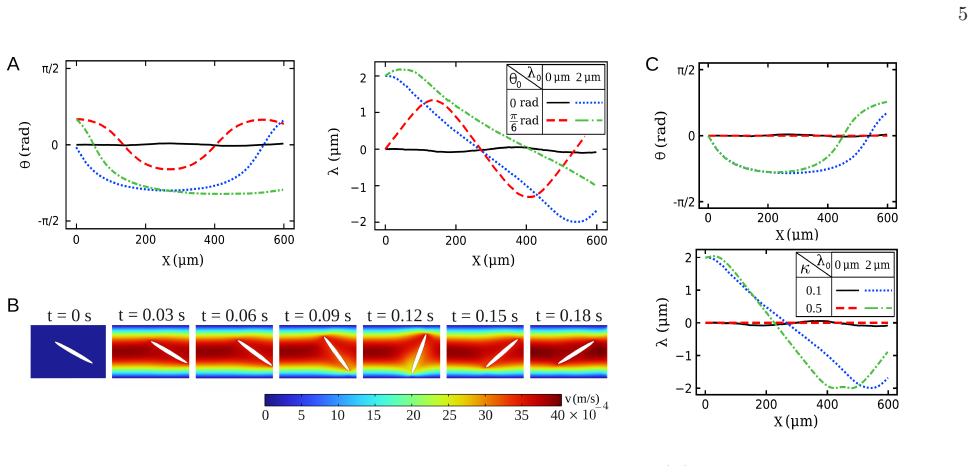
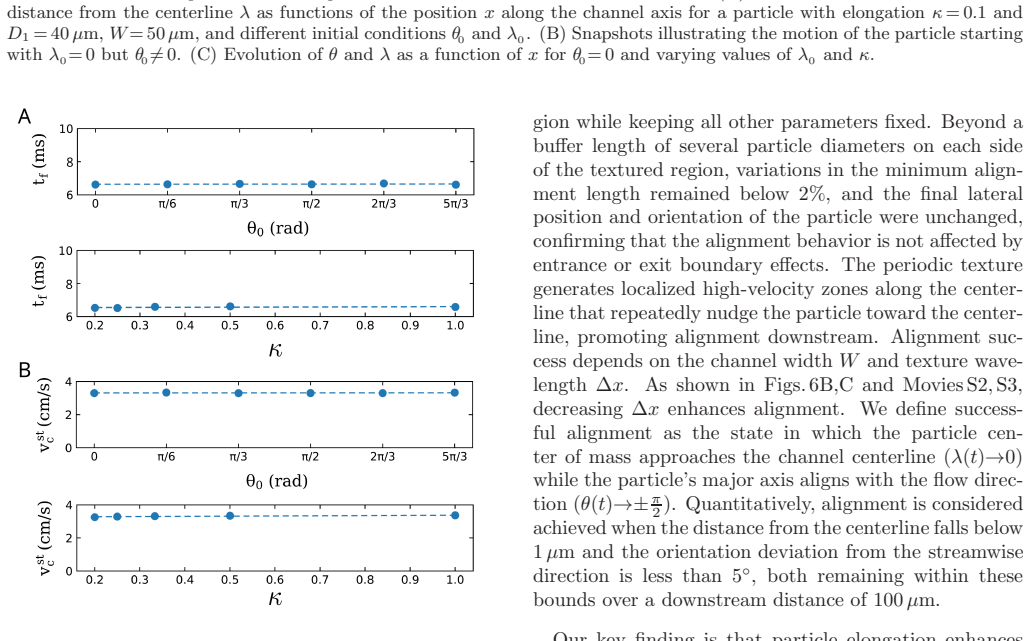
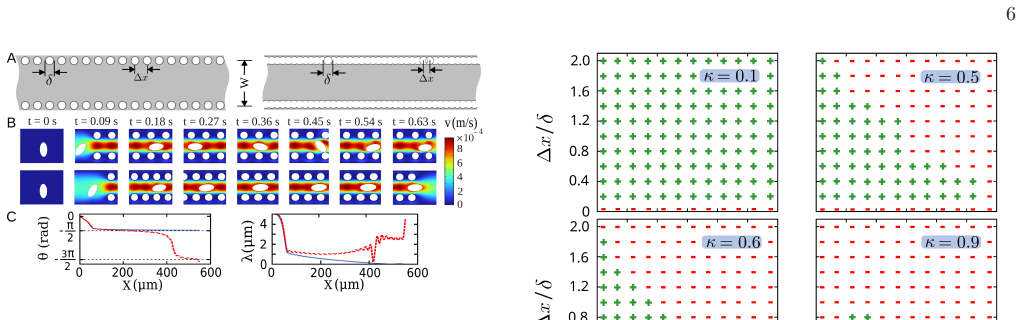
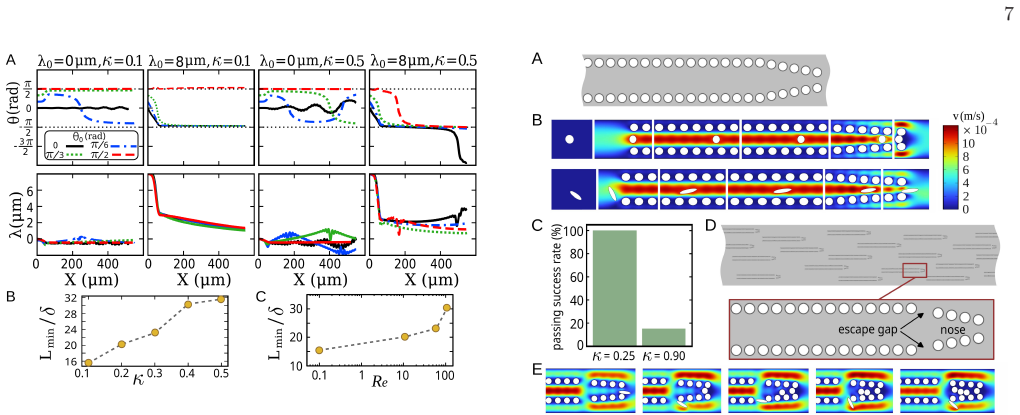
Introducing periodically textured walls triggers robust alignment of elongated microparticles along the microchannel centerline through repeated reorientations generated by spatially modulated shear gradients near the textured walls. Alignment efficiency depends on particle elongation and the relative texture wavelength with an optimal range for maximal effect. While the alignment behavior is not limited to low Reynolds numbers, the characteristic alignment length scale diverges as the Reynolds number increases toward the turbulent flow regime.
What carries the argument
Spatially modulated shear gradients near periodically textured walls that generate repeated particle reorientations.
If this is right
- Alignment becomes independent of starting orientation and lateral position once the periodic texture is introduced.
- Efficiency reaches a maximum within a specific range of particle elongations and texture wavelengths.
- The mechanism operates across Reynolds numbers but requires progressively longer distances as flow approaches turbulence.
- The texture pattern supplies a passive method to sort or focus anisotropic particles without external fields.
- The approach applies to soft matter transport, biophysical flows, and microfluidic device design.
Where Pith is reading between the lines
- Texture wavelength could be tuned to select particles of particular aspect ratios for separation in a single device.
- The same geometry principle might extend to non-periodic or three-dimensional wall patterns for more complex focusing tasks.
- At high Reynolds numbers the diverging alignment length sets a practical limit on channel length for effective passive control.
- Direct particle tracking experiments in microfabricated textured channels would test whether the predicted alignment length scales match observations.
Load-bearing premise
The alignment is produced solely by the periodic wall geometry and the modulated shear it creates, independent of particle-wall interactions or initial flow details.
What would settle it
Track orientation distributions of elongated particles in a smooth channel versus an otherwise identical periodically textured channel at fixed flow rate and Reynolds number; if the textured case shows no reduction in dependence on initial orientation, the claim is falsified.
Figures
read the original abstract
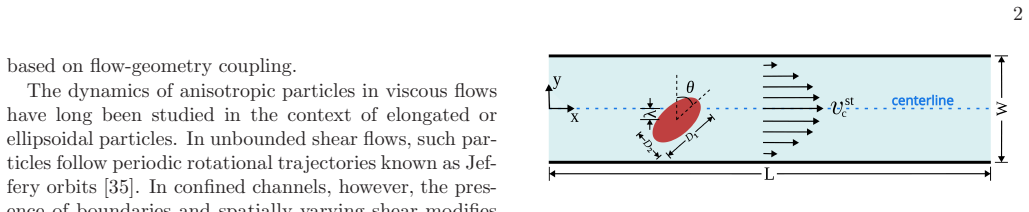
We investigate the transport dynamics of elongated microparticles in microchannel flows. While smooth-walled channels preserve the dependence of particle trajectories on initial orientation and lateral position, we show that introducing periodically textured walls can trigger robust alignment of the particle along the channel centerline. This geometry-driven alignment arises from repeated reorientations generated by spatially modulated shear gradients near the textured walls. The alignment efficiency depends on particle elongation and the relative texture wavelength, with an optimal range for maximal effect. While the observed alignment behavior is not limited to low Reynolds numbers, the characteristic alignment length scale diverges as the Reynolds number increases toward the turbulent flow regime. These findings offer a predictive framework for designing microfluidic devices that passively sort or focus anisotropic particles, with implications for soft matter transport, biophysical flows, and microfluidic engineering.
Editorial analysis
A structured set of objections, weighed in public.
Referee Report
Summary. The manuscript investigates transport of elongated microparticles in microchannel flows. It claims that periodically textured walls induce robust centerline alignment via repeated reorientations from spatially modulated shear gradients near the walls, in contrast to smooth walls where trajectories retain dependence on initial orientation and lateral position. Alignment efficiency depends on particle elongation and texture wavelength (with an optimal range), while the characteristic alignment length diverges as Reynolds number increases toward turbulence. The work positions this as a predictive framework for passive sorting or focusing of anisotropic particles in microfluidic devices.
Significance. If the central mechanism is confirmed, the result would be significant for microfluidic engineering by providing a purely geometric route to passive particle alignment and focusing that overrides initial-condition dependence. This has clear implications for soft-matter transport, biophysical flows, and device design where external forcing is undesirable. The reported dependence on elongation, wavelength, and Reynolds number supplies concrete design guidelines.
major comments (2)
- [Numerical Methods / particle equation of motion] The claim that alignment is driven purely by periodic wall geometry and modulated shear (independent of particle-wall interactions or initialization details) is load-bearing. The abstract supplies no information on the particle equation of motion, wall boundary treatment, or sampling of initial position/orientation phase space; any short-range hydrodynamic corrections or contact forces could introduce an alternative centering mechanism. Please add this specification and robustness tests in the numerical-methods section.
- [Results] Quantitative support for 'robust alignment' and the 'optimal range' is needed. The abstract is entirely qualitative; the results section should report metrics such as alignment fraction versus initial conditions, alignment length versus wavelength and aspect ratio, and any error bars or ensemble statistics.
minor comments (2)
- [Discussion] Clarify the Reynolds-number scaling of the alignment length (e.g., with a plot or asymptotic argument) rather than stating only that it diverges.
- [Figures] Add a schematic or trajectory plot illustrating the repeated reorientation events near the textured walls for a representative particle.
Simulated Author's Rebuttal
We thank the referee for their careful reading of the manuscript and for highlighting points that improve its clarity and rigor. We address each major comment below and have revised the manuscript accordingly.
read point-by-point responses
-
Referee: [Numerical Methods / particle equation of motion] The claim that alignment is driven purely by periodic wall geometry and modulated shear (independent of particle-wall interactions or initialization details) is load-bearing. The abstract supplies no information on the particle equation of motion, wall boundary treatment, or sampling of initial position/orientation phase space; any short-range hydrodynamic corrections or contact forces could introduce an alternative centering mechanism. Please add this specification and robustness tests in the numerical-methods section.
Authors: We agree that explicit specification of the particle dynamics and boundary treatment is necessary to support the geometry-driven claim. The revised Numerical Methods section now details the particle equation of motion (integration of hydrodynamic torques and forces from the resolved flow field, without short-range corrections or contact forces), the no-slip treatment of the periodically textured walls, and the sampling protocol over initial lateral positions and orientations. New robustness tests confirm that centerline alignment occurs consistently across the sampled phase space when the texture wavelength lies in the reported optimal range, with no evidence of alternative centering mechanisms. revision: yes
-
Referee: [Results] Quantitative support for 'robust alignment' and the 'optimal range' is needed. The abstract is entirely qualitative; the results section should report metrics such as alignment fraction versus initial conditions, alignment length versus wavelength and aspect ratio, and any error bars or ensemble statistics.
Authors: We have augmented the Results section with the requested quantitative metrics. New figures and text report the alignment fraction (fraction of trajectories reaching within 0.1 channel widths of the centerline) as a function of initial position and orientation, the characteristic alignment length versus texture wavelength and particle aspect ratio (with error bars from ensembles of several hundred trajectories), and statistical summaries confirming the existence and location of the optimal wavelength range. These additions provide direct, quantitative support for the claims of robust, geometry-driven alignment. revision: yes
Circularity Check
No circularity detected; derivation self-contained
full rationale
The paper presents a geometry-driven alignment mechanism based on modulated shear gradients in textured channels, grounded in standard fluid mechanics without any quoted self-definitional steps, fitted inputs renamed as predictions, or load-bearing self-citations that reduce the central claim to its inputs. The abstract describes the effect as arising from repeated reorientations due to spatially modulated shear, with dependence on elongation and wavelength, but supplies no equations or derivations that loop back to the result by construction. No evidence of ansatz smuggling, uniqueness theorems from prior self-work, or renaming of known results appears in the provided text. The derivation remains independent of the target outcome and relies on external hydrodynamic principles.
Axiom & Free-Parameter Ledger
Reference graph
Works this paper leans on
-
[1]
Alignment also depends on boundary roughness, captured by the dimensionless ratio ε1= ∆ x δ
5D1≲∆ x≲2D1. Alignment also depends on boundary roughness, captured by the dimensionless ratio ε1= ∆ x δ . For ε1≪ 1, strongly overlapping disks smooth the wall and reduce shear gradients; for ε1≫ 1, shear zones be- come widely separated and alignment degrades. Opti- mal alignment occurs for 0 . 1≲ε1≲2, with effects van- ishing beyond ε1>5. Another key par...
-
[2]
Fluid mechanics of microrheology,
T. M. Squires and T. G. Mason, “Fluid mechanics of microrheology,” Annu. Rev. Fluid Mech. 42, 413–438 (2010)
work page 2010
-
[3]
Microfluidics: Fluid physics at the nanoliter scale,
T. M. Squires and S. R. Quake, “Microfluidics: Fluid physics at the nanoliter scale,” Rev. Mod. Phys. 77, 977– 1026 (2005)
work page 2005
-
[4]
D. Stoecklein and D. Di Carlo, “Nonlinear microfluidics, ” Anal. Chem. 91, 296–314 (2019)
work page 2019
-
[5]
Computational models for active mat- ter,
R. Shaebani, A. Wysocki, R. G. Winkler, G. Gompper, and H. Rieger, “Computational models for active mat- ter,” Nat. Rev. Phys. 2, 181–199 (2020)
work page 2020
-
[6]
Microtubule polymeriza- tion generates microtentackles important in circulating tumor cell invasion,
L. Kainka, R. Shaebani, K. Kaiser, J. Bosche, L. San- ten, and F. Lautenschl¨ ager, “Microtubule polymeriza- tion generates microtentackles important in circulating tumor cell invasion,” Biophys. J. 124, 2161–2175 (2025)
work page 2025
-
[7]
Y. Rashidi, O. Aouane, A. Darras, T. John, J. Harting, C. Wagner, and S. M. Recktenwald, “Cell-free layer de- velopment and spatial organization of healthy and rigid red blood cells in a microfluidic bifurcation,” Soft Matter 19, 6255 (2023)
work page 2023
-
[8]
Red blood cell lingering modulates hematocrit dis- tribution in the microcirculation,
Y. Rashidi, G. Simionato, Q. Zhou, T. John, A. Kihm, M. Bendaoud, T. Kr¨ uger, M. O. Bernabeu, L. Kaestner, M. W. Laschke, M. D. Menger, C. Wagner, and A. Dar- ras, “Red blood cell lingering modulates hematocrit dis- tribution in the microcirculation,” Biophy. J. 122, 1526 (2023)
work page 2023
-
[9]
S. M. Recktenwald, K. Graessel, Y. Rashidi, J. N. Steuer, T. John, S. Gekle, and C. Wagner, “Cell-free layer of red blood cells in a constricted microfluidic channel under steady and time-dependent flow conditions,” Phys. Rev. Fluids 8, 074202 (2023)
work page 2023
-
[10]
Continuous particle separation through deterministic lateral displacement,
L. R. Huang, E. C. Cox, R. H. Austin, and J. C. Sturm, “Continuous particle separation through deterministic lateral displacement,” Science 304, 987–990 (2004)
work page 2004
-
[11]
Particle separati on using virtual deterministic lateral displacement (vdld),
D. J. Collins, T. Alan, and A. Neild, “Particle separati on using virtual deterministic lateral displacement (vdld), ” Lab Chip 14, 1595–1603 (2014)
work page 2014
-
[12]
Deterministic microfluidic ratchet,
K. Loutherback, J. Puchalla, R. H. Austin, and J. C. Sturm, “Deterministic microfluidic ratchet,” Phys. Rev. Lett. 102, 045301 (2009)
work page 2009
-
[13]
H. Tang, J. Niu, H. Jin, S. Lin, and D. Cui, “Geometric structure design of passive label-free microfluidic system s for biological micro-object separation,” Microsyst Nano- eng 8, 62 (2022)
work page 2022
-
[14]
Finite element simula- tions of hydrodynamic trapping in microfluidic particle- trap array systems,
X. Xu, Z. Li, and A. Nehorai, “Finite element simula- tions of hydrodynamic trapping in microfluidic particle- trap array systems,” Biomicrofluidics 7, 054108 (2013)
work page 2013
-
[15]
Particle separation and sorting in microfluidic devices: a review,
P. Sajeesh and A. K. Sen, “Particle separation and sorting in microfluidic devices: a review,” Microfluid. Nanofluidics 17, 1–52 (2014)
work page 2014
-
[16]
Continuous separation of cells and particles in microfluidic systems,
A. Lenshof and T. Laurell, “Continuous separation of cells and particles in microfluidic systems,” Chem. Soc. Rev. 39, 1203–1217 (2010)
work page 2010
-
[17]
Active mi- crofluidic systems for cell sorting and separation,
M. Sivaramakrishnan, R. Kothandan, D. K. Govindara- jan, Y. Meganathan, and K. Kandaswamy, “Active mi- crofluidic systems for cell sorting and separation,” Curr. Opin. Biomed. Eng. 13, 60–68 (2020)
work page 2020
-
[18]
Active par- ticle motion in poiseuille flow through rectangular chan- nels,
R. N. Valani, B. Harding, and Y. M. Stokes, “Active par- ticle motion in poiseuille flow through rectangular chan- nels,” Phys. Rev. E 110, 034603 (2024)
work page 2024
-
[19]
Acoustophoretic particle motion in a spherical microchamber,
B. Sailer, R. Barnkob, and O. Hayden, “Acoustophoretic particle motion in a spherical microchamber,” Phys. Rev. Appl. 22, 044034 (2024)
work page 2024
-
[20]
A review of acoustofluidic separation of bioparticles,
F. Hossein and P. Angeli, “A review of acoustofluidic separation of bioparticles,” Biophys. Rev. 15, 2005–2025 (2023)
work page 2005
-
[21]
J.-S. Park, S.-H. Song, and H.-I. Jung, “Continuous fo- cusing of microparticles using inertial lift force and vor- ticity via multi-orifice microfluidic channels,” Lab Chip 9, 939 (2009)
work page 2009
-
[22]
Enhanced size- dependent trapping of particles using microvortices,
J. Zhou, S. Kasper, and I. Papautsky, “Enhanced size- dependent trapping of particles using microvortices,” Mi- crofluid. Nanofluid. 15, 611 (2013)
work page 2013
-
[23]
J. Mandal, S. Sarkar, and S. Sen, “A deterministic model for bubble propagation through simple and cas- 9 caded loops of microchannels in power-law fluids,” Phys. Fluids 33, 072008 (2021)
work page 2021
-
[24]
Morphology and kinematics of a train of power-law droplets in a corrugated microchan- nel,
J. Mandal and S. Sarkar, “Morphology and kinematics of a train of power-law droplets in a corrugated microchan- nel,” Chem. Eng. Sci. 274, 118691 (2023)
work page 2023
-
[25]
Universal correlation for droplet fragmentation in a microfluidic t-junction,
J. Mandal and S. Sarkar, “Universal correlation for droplet fragmentation in a microfluidic t-junction,” Lang- muir 40, 17489 (2024)
work page 2024
-
[26]
Thermal marangoni stress induced droplet mobilization in a mi- crofluidic confinement,
J. Mandal, D. Sanyal, and S. Sarkar, “Thermal marangoni stress induced droplet mobilization in a mi- crofluidic confinement,” Phys. Fluids 37, 081704 (2025)
work page 2025
-
[27]
Modeling transport of soft particles in porous media,
S. Li, H.-h. Yu, and J. Fan, “Modeling transport of soft particles in porous media,” Phys. Rev. E 104, 025112 (2021)
work page 2021
-
[28]
Deterministic lateral displacement for particle separation: a review,
J. McGrath, M. Jimenez, and H. Bridle, “Deterministic lateral displacement for particle separation: a review,” Lab Chip 14, 4139–4158 (2014)
work page 2014
-
[29]
A. Zhbanov, Y. S. Lee, and S. Yang, “Current status and further development of deterministic lateral displacemen t for micro-particle separation,” Micro Nano Syst. Lett. 11, 11 (2023)
work page 2023
-
[30]
A review on deter- ministic lateral displacement for particle separation and detection,
T. Salafi, Y. Zhang, and Y. Zhang, “A review on deter- ministic lateral displacement for particle separation and detection,” Nano-Micro Lett. 11, 77 (2019)
work page 2019
-
[31]
Y. Li, H. Zhang, Y. Li, X. Li, J. Wu, S. Qian, and F. Li, “Dynamic control of particle separation in deterministic lateral displacement separator with viscoelastic fluids,” Sci. Rep. 8, 3618 (2018)
work page 2018
-
[32]
Particle focusing in a suspension flow through a corrugated tube,
G. F. Hewitt and J. S. Marshall, “Particle focusing in a suspension flow through a corrugated tube,” J. Fluid Mech. 660, 258 (2010)
work page 2010
-
[33]
T. Nizkaya, J. Angilella, and M. Bues, “Inertial focusi ng of small particles in wavy channels: Asymptotic analysis at weak particle inertia,” Physica D 268, 91 (2014)
work page 2014
-
[34]
Pore-scale modelling of particle transport in a porous bed,
R. Storm and J. S. Marshall, “Pore-scale modelling of particle transport in a porous bed,” J. Fluid Mech. 979, A9 (2024)
work page 2024
-
[35]
Particle focus - ing in a wavy channel,
X. Mao, I. Bischofberger, and A. Hosoi, “Particle focus - ing in a wavy channel,” J. Fluid Mech. 968, A25 (2023)
work page 2023
-
[36]
The motion of ellip- soidal particles immersed in a viscous fluid,
G. B. Jeffery and L. N. G. Filon, “The motion of ellip- soidal particles immersed in a viscous fluid,” Proc. R. Soc. Lond. 102, 161–179 (1922)
work page 1922
-
[37]
Par- ticle shape influences settling and sorting behavior in mi- crofluidic domains,
H. Basagaoglu, S. Succi, D. Wyrick, and J. Blount, “Par- ticle shape influences settling and sorting behavior in mi- crofluidic domains,” Sci. Rep. 8, 8583 (2018)
work page 2018
-
[38]
K. K. Zeming, S. Ranjan, and Y. Zhang, “Rotational separation of non-spherical bioparticles using i-shaped pillar arrays in a microfluidic device,” Nat. Commun. 4, 1625 (2013)
work page 2013
-
[39]
Engi- neering particle trajectories in microfluidic flows using particle shape,
W. E. Uspal, H. Burak Eral, and P. S. Doyle, “Engi- neering particle trajectories in microfluidic flows using particle shape,” Nat. Commun. 4, 2666 (2013)
work page 2013
-
[40]
Universal motion of mirror-symmetric microparticles in confined stokes flow,
R. N. Georgiev, S. O. Toscano, W. E. Uspal, B. Bet, S. Samin, R. van Roij, and H. B. Eral, “Universal motion of mirror-symmetric microparticles in confined stokes flow,” Proc. Natl. Acad. Sci. U.S.A. 117, 21865– 21872 (2020)
work page 2020
-
[41]
Small asymmetric brownian objects self-align in nanofluidic channels,
G. Fiorucci, J. T. Padding, and M. Dijkstra, “Small asymmetric brownian objects self-align in nanofluidic channels,” Soft Matter 15, 321–330 (2019)
work page 2019
-
[42]
Oscillations of confined fibres transported in microchannels,
M. Nagel, P.-T. Brun, H. Berthet, A. Lindner, F. Gal- laire, and C. Duprat, “Oscillations of confined fibres transported in microchannels,” J. Fluid Mech. 835, 444– 470 (2018)
work page 2018
-
[43]
Numerical simulations of a stick-slip spherical particle in poiseuil le flow,
M. Trofa, G. DAvino, and P. L. Maffettone, “Numerical simulations of a stick-slip spherical particle in poiseuil le flow,” Phys. Fluids 31, 083603 (2019)
work page 2019
-
[44]
Particle motion nearby rough surfaces,
C. Kurzthaler, L. Zhu, A. A. Pahlavan, and H. A. Stone, “Particle motion nearby rough surfaces,” Phys. Rev. Flu- ids 5, 082101 (2020)
work page 2020
-
[45]
An experimental study and modelling of roughness effects on laminar flow in microchannels,
G. Gamrat, M. Favre-Marinet, S. Le Person, R. Baviere, and F. Ayela, “An experimental study and modelling of roughness effects on laminar flow in microchannels,” J. Fluid Mech. 594, 399–423 (2008)
work page 2008
-
[46]
Effect of roughness on elongated particles in turbulent channel flow,
D. Saccone, C. Marchioli, and M. De Marchis, “Effect of roughness on elongated particles in turbulent channel flow,” Int. J. Multiphase Flow 152, 104065 (2022)
work page 2022
-
[47]
J. M. Acosta-Cuevas, M. A. Garcia-Ramirez, G. Hinojosa-Ventura, A. J. Martinez-Gomez, V. H. Perez-Luna, and O. Gonzalez-Reynoso, “Surface rough- ness analysis of microchannels featuring microfluidic devices fabricated by three different materials and methods,” Coatings 13, 1676 (2023)
work page 2023
-
[48]
S. M. Richardson, Fluid Mechanics (Hemisphere, New York, 1989)
work page 1989
-
[49]
Lagrangian-eulerian finite element formulation for in- compressible viscous flows,
T. J. Hughes, W. K. Liu, and T. K. Zimmermann, “Lagrangian-eulerian finite element formulation for in- compressible viscous flows,” Comput. Methods Appl. Mech. Eng. 29, 329–349 (1981)
work page 1981
-
[50]
Acoustic tweezing of microparticles in microchannels with sinusoidal cross sections,
E. A. Jannesar and H. Hamzehpour, “Acoustic tweezing of microparticles in microchannels with sinusoidal cross sections,” Sci. Rep. 11, 17902 (2021)
work page 2021
-
[51]
Acoustic interaction force between two particles immersed in a viscoelastic fluid,
F. Eslami, H. Hamzehpour, S. Derikvandi, and S. Amir Bahrani, “Acoustic interaction force between two particles immersed in a viscoelastic fluid,” Phys. Fluids 35, 031707 (2023)
work page 2023
-
[52]
Radial particle displace - ments in poiseuille flow of suspensions,
G. Segr´ e and A. Silberberg, “Radial particle displace - ments in poiseuille flow of suspensions,” Nature 189, 209–210 (1961)
work page 1961
discussion (0)
Sign in with ORCID, Apple, or X to comment. Anyone can read and Pith papers without signing in.