Advancing quantum simulations of nuclear shell model with noise-resilient protocols
Pith reviewed 2026-05-25 08:38 UTC · model grok-4.3
The pith
Noise-resilient quantum protocols compute nuclear shell-model energies for 38Ar and 6Li with improved accuracy on NISQ hardware.
A machine-rendered reading of the paper's core claim, the machinery that carries it, and where it could break.
Core claim
By employing Gray code encoding to reduce qubit requirements and generalizing transformations of fermionic operators, together with a Givens-rotation ansatz in VQE, qubit-ADAPT-VQE combined with VQD, and zero-noise extrapolation, the ground and excited state energy levels of 38Ar and 6Li are obtained with better accuracy under noisy conditions than with conventional encodings and methods.
What carries the argument
Gray code encoding of basis states combined with zero-noise extrapolation applied to VQE variants (including qubit-ADAPT-VQE and VQD) to achieve noise resilience while lowering qubit and gate counts.
If this is right
- Fewer qubits and gates become available for larger nuclei or more complex interactions.
- Ground and excited state energies can be extracted reliably enough to compare with experimental nuclear data.
- The same protocol stack applies to both Jordan-Wigner and Gray code mappings, allowing direct benchmarking.
- Noise mitigation extends the usable range of current NISQ devices for many-body fermionic problems.
Where Pith is reading between the lines
- If hardware noise continues to decrease, the same encoding and mitigation stack could handle nuclei beyond mass 38 without classical pre-processing.
- The approach may transfer to other fermionic many-body systems such as molecular Hamiltonians where Gray code locality helps.
- Testing the full pipeline on actual quantum hardware rather than simulators would reveal whether the reported accuracy gains survive real gate errors.
Load-bearing premise
The Gray code mapping of nuclear basis states to qubits and the generalized fermionic operator transformations correctly capture the many-body states without major approximation errors.
What would settle it
A direct comparison showing that the mitigated quantum energies for 38Ar and 6Li deviate from exact classical shell-model diagonalization by more than the accuracy gain reported after applying the protocols.
Figures






read the original abstract
Some of the computational limitations in solving the nuclear many-body problem could be overcome by utilizing quantum computers. The nuclear shell-model calculations providing deeper insights into the properties of atomic nuclei, is one such case with high demand for resources as the size of the Hilbert space grows exponentially with the number of particles involved. Quantum algorithms are being developed to overcome these challenges and advance such calculations. To develop quantum circuits for the nuclear shell-model, leveraging the capabilities of noisy intermediate-scale quantum (NISQ) devices. We aim to minimize resource requirements (specifically in terms of qubits and gates) and strive to reduce the impact of noise by employing relevant mitigation techniques. We achieve noise resilience by designing an optimized ansatz for the variational quantum eigensolver (VQE) based on Givens rotations and incorporating qubit-ADAPT-VQE in combination with variational quantum deflation (VQD) to compute ground and excited states incorporating the zero-noise extrapolation mitigation technique. Furthermore, the qubit requirements are significantly reduced by mapping the basis states to qubits using Gray code encoding and generalizing transformations of fermionic operators to efficiently represent manybody states. By employing the noise-resilient protocols, we achieve the ground and excited state energy levels of 38Ar and 6Li with better accuracy. These energy levels are presented for noiseless simulations, noisy conditions, and after applying noise mitigation techniques. Results are compared for Jordan Wigner and Gray code encoding using VQE, qubit-ADAPT-VQE, and VQD. Our work highlights the potential of noise-resilient protocols to leverage the full potential of NISQ devices in scaling the nuclear shell model calculations.
Editorial analysis
A structured set of objections, weighed in public.
Referee Report
Summary. The manuscript develops quantum circuits for nuclear shell-model calculations on NISQ devices by combining Gray-code encoding of many-body basis states with generalized fermionic operator transformations to reduce qubit count, an optimized Givens-rotation ansatz, qubit-ADAPT-VQE, VQD for excited states, and zero-noise extrapolation. It applies these protocols to compute ground- and excited-state energies of 38Ar and 6Li and asserts that the noise-resilient combination yields higher accuracy than standard Jordan-Wigner implementations under both noiseless and noisy conditions.
Significance. If the Gray-code mapping is shown to reproduce the exact shell-model Hamiltonian and the reported energy improvements are statistically robust, the work would provide a concrete route to lowering qubit and gate overhead for nuclear many-body problems, thereby extending the reach of variational algorithms on current hardware.
major comments (2)
- [qubit mapping and operator transformations section] The section on qubit mapping and operator transformations asserts that Gray-code encoding together with the generalized fermionic creation/annihilation transformations correctly represents the many-body states, yet supplies no explicit verification (e.g., a side-by-side comparison of two-body matrix elements or the full Hamiltonian matrix for the 6Li valence space against the standard second-quantized shell-model operator). Because all subsequent VQE/VQD/ZNE results rest on this equivalence, the absence of such a check is load-bearing for the central accuracy claim.
- [results section] Results section (tables/figures presenting energies for 38Ar and 6Li): the manuscript states that the noise-resilient protocols achieve “better accuracy,” but the abstract and the provided description contain no numerical values, error bars, or direct quantitative comparison between Gray-code and Jordan-Wigner runs under identical shot budgets and noise models. Without these data the improvement cannot be assessed.
minor comments (2)
- Figure captions and axis labels should explicitly state the number of shots, the noise model parameters, and whether the plotted energies are variational minima or extrapolated values.
- The manuscript would benefit from a short table listing the exact valence-space dimensions, the number of qubits required under each encoding, and the circuit depth for the ansatz used for each nucleus.
Simulated Author's Rebuttal
We thank the referee for the constructive comments. We address each major point below and will revise the manuscript to incorporate the requested clarifications and data.
read point-by-point responses
-
Referee: [qubit mapping and operator transformations section] The section on qubit mapping and operator transformations asserts that Gray-code encoding together with the generalized fermionic creation/annihilation transformations correctly represents the many-body states, yet supplies no explicit verification (e.g., a side-by-side comparison of two-body matrix elements or the full Hamiltonian matrix for the 6Li valence space against the standard second-quantized shell-model operator). Because all subsequent VQE/VQD/ZNE results rest on this equivalence, the absence of such a check is load-bearing for the central accuracy claim.
Authors: We agree that an explicit verification is necessary to substantiate the equivalence. In the revised manuscript we will add a side-by-side comparison of the two-body matrix elements (and, space permitting, the full Hamiltonian matrix) for the 6Li valence space between the Gray-code mapped operators and the standard second-quantized shell-model operators. revision: yes
-
Referee: [results section] Results section (tables/figures presenting energies for 38Ar and 6Li): the manuscript states that the noise-resilient protocols achieve “better accuracy,” but the abstract and the provided description contain no numerical values, error bars, or direct quantitative comparison between Gray-code and Jordan-Wigner runs under identical shot budgets and noise models. Without these data the improvement cannot be assessed.
Authors: The full manuscript contains tables and figures reporting the energies under noiseless, noisy, and mitigated conditions with comparisons between encodings. To make the claimed improvements quantitatively assessable, we will augment the results section with explicit numerical values, error bars obtained from repeated runs, and direct side-by-side error metrics (relative to exact diagonalization) for Gray-code versus Jordan-Wigner under matched shot budgets and noise models. We will also update the abstract to include representative numerical gains. revision: yes
Circularity Check
No circularity; computational demonstration on standard techniques
full rationale
The paper applies established methods (VQE, qubit-ADAPT-VQE, VQD, Gray-code encoding, ZNE) to compute nuclear shell-model energies for 38Ar and 6Li. No derivation chain, equation, or central claim reduces by construction to fitted inputs or self-citations. The work is a numerical demonstration whose results are externally falsifiable against known shell-model benchmarks; the encoding and operator mappings are presented as implementation choices rather than self-defining the target energies. This matches the default expectation of a self-contained application paper.
Axiom & Free-Parameter Ledger
Reference graph
Works this paper leans on
-
[1]
JW scheme The energy spectrum of 38Ar calculated with quan- tum simulations under one-hot encoding and JW trans- formation are shown in Table IV. We compare the ex- act energy values obtained from classical computation with the ones obtained from quantum simulations under noiseless and noisy conditions. The energies of lowest- lying states with spin 0 +, ...
-
[2]
GC scheme Results for 38Ar using GC encoding are given in Ta- ble VI. The reduced number of qubits and gates in GC encoding significantly improves the accuracy of computed energies compared to JW, which uses 6 qubits for all J π states. In contrast, GC encoding requires only 3 qubits for the 0+ state, 2 qubits for the 1+ state, and just 1 qubit for the 2 ...
work page 1965
-
[3]
9, 10, 11, 12, 13, 14, 15, 16, and 17
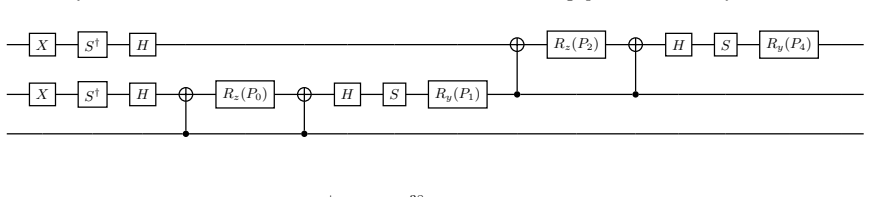
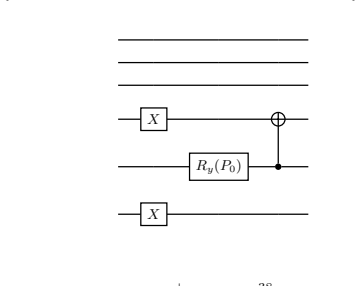
Qubit-ADAPT-VQE The final ans¨ atze obtained using the qubit-ADAPT- VQE (Section III B) for various spin-parity states of38Ar and 6Li are given Figs. 9, 10, 11, 12, 13, 14, 15, 16, and 17. These ans¨ atze are built iteratively using the pre- defined operator pool
-
[4]
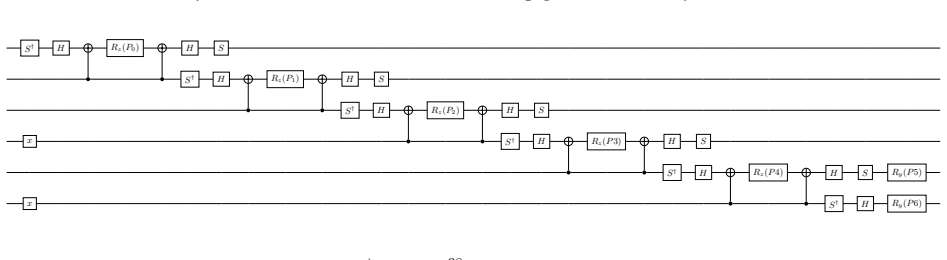
VQE Here we have given the ans¨ atze used for VQE. For JW scheme the given ans¨ atze are prepared using the par- ticle conserving ansatz technique given in appendix B. While for the GC encoding hardware efficient variational ans¨ atze are used. The corresponding figures are shown in Figs. 18, 19, 20, 21, 22, 23, and 24
-
[5]
E. F. Dumitrescu, A. J. McCaskey, G. Hagen, G. R. Jansen, T. D. Morris, T. Papenbrock, R. C. Pooser, D. J. Dean, and P. Lougovski, Phys. Rev. Lett. 120, 210501 (2018)
work page 2018
- [6]
-
[7]
A. Roggero, C. Gu, A. Baroni, and T. Papenbrock, Phys. Rev. C 102, 064624 (2020)
work page 2020
-
[8]
A. Roggero, A. C. Y. Li, J. Carlson, R. Gupta, and G. N. Perdue, Phys. Rev. D 101, 074038 (2020)
work page 2020
- [9]
- [10]
- [11]
-
[12]
D. Lacroix, E. A. R. Guzman, and P. Siwach, The Eu- ropean Physical Journal A 59 (2023)
work page 2023
-
[13]
A. P´ erez-Obiol, A. M. Romero, J. Men´ endez, A. Rios, A. Garc´ ıa-S´ aez, and A. Juli´ a-D´ ıaz, Sci. Rep.13, 12291 (2023)
work page 2023
- [14]
- [15]
-
[16]
A. Peruzzo, J. McClean, P. Shadbolt, M.-H. Yung, X.-Q. Zhou, P. J. Love, and A. Aspuru-Guzik, Nature Com- munications 5, 4213 (2014)
work page 2014
- [17]
- [18]
-
[19]
O. Kiss, M. Grossi, P. Lougovski, F. Sanchez, S. Val- lecorsa, and T. Papenbrock, Phys. Rev. C 106, 034325 (2022)
work page 2022
-
[20]
J. M. Arrazola, O. Di Matteo, N. Quesada, S. Jahangiri, A. Delgado, and N. Killoran, Quantum 6, 742 (2022)
work page 2022
-
[21]
H. L. Tang, V. Shkolnikov, G. S. Barron, H. R. Grimsley, N. J. Mayhall, E. Barnes, and S. E. Economou, PRX Quantum 2, 020310 (2021)
work page 2021
-
[22]
H. R. Grimsley, S. E. Economou, E. Barnes, and N. J. Mayhall, Nat Commun 10, 3007 (2019)
work page 2019
- [23]
- [24]
-
[25]
O. Di Matteo, A. McCoy, P. Gysbers, T. Miyagi, R. M. Woloshyn, and P. Navr´ atil, Phys. Rev. A 103, 042405 (2021)
work page 2021
-
[26]
E. Caurier, G. Mart´ ınez-Pinedo, F. Nowacki, A. Poves, and A. P. Zuker, Rev. Mod. Phys. 77, 427 (2005)
work page 2005
- [27]
-
[29]
J. Suhonen, From nucleons to nucleus: concepts of micro- scopic nuclear theory (Springer Science & Business Me- dia, 2007)
work page 2007
-
[30]
M. Hjorth-Jensen, T. T. Kuo, and E. Osnes, Physics Reports 261, 125 (1995)
work page 1995
-
[31]
S. R. Stroberg, H. Hergert, S. K. Bogner, and J. D. Holt, Annual Review of Nuclear and Particle Science 69, 307 (2019)
work page 2019
-
[32]
Talmi, Simple models of complex nuclei (Routledge, 2017)
I. Talmi, Simple models of complex nuclei (Routledge, 2017)
work page 2017
- [33]
-
[34]
J. T. Seeley, M. J. Richard, and P. J. Love, The Journal of Chemical Physics 137, 224109 (2012)
work page 2012
-
[35]
N. P. D. Sawaya, T. Menke, T. H. Kyaw, S. Johri, A. Aspuru-Guzik, and G. G. Guerreschi, npj Quantum Inf 6, 49 (2020)
work page 2020
- [36]
-
[37]
A. Kandala, A. Mezzacapo, K. Temme, M. Takita, M. Brink, J. M. Chow, and J. M. Gambetta, Nature 549, 242 (2017)
work page 2017
-
[38]
A. M. Romero, J. Engel, H. L. Tang, and S. E. Economou, Phys. Rev. C 105, 064317 (2022)
work page 2022
-
[39]
Y. Ibe, Y. O. Nakagawa, N. Earnest, T. Yamamoto, K. Mitarai, Q. Gao, and T. Kobayashi, Phys. Rev. Res. 15 X S† H Rz(P0) H S Rz(P2) H S Ry(P4) X S† H Rz(P1) Ry(P5) Ry(P3) FIG. 9. Quantum circuit for 0 + state of 6Li using qubit ADAPT-VQE in GC scheme. X S† H Rz(P1) H S Ry(P3) X S† H Rz(P0) H S Ry(P2) FIG. 10. Quantum circuit for 1 + state of 6Li using qubi...
work page 2022
-
[40]
B. A. Brown and W. A. Richter, Phys. Rev. C74, 034315 (2006)
work page 2006
- [41]
-
[42]
Spall, Johns Hopkins APL Technical Dig
J. Spall, Johns Hopkins APL Technical Dig. 19, 482 (1998)
work page 1998
- [43]
discussion (0)
Sign in with ORCID, Apple, or X to comment. Anyone can read and Pith papers without signing in.