REVIEW 4 major objections 4 minor 66 references
Software Engineering Principles for Fairer Systems: Experiments with GroupCART
T0 review · 4 major / 4 minor · reviewed 2026-08-16 · deepseek-v4-flash
Pith's one-line read GroupCART builds fairness into decision trees and keeps accuracy nearly intact.
desk verdict Plausible incremental ensemble method, but the headline 'optimal trade-off' leans on an inverted disparate-impact direction and an under-specified early-stopping rule. read the letter →
The pith
A machine-rendered reading of the paper's core claim, the machinery that carries it, and where it could break.
The reading
What carries the argument
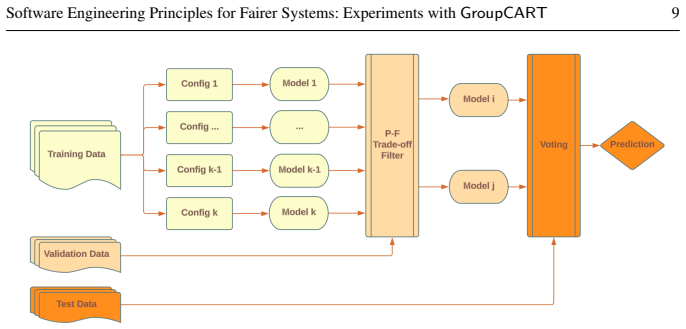
The central mechanism is the fairness-aware decision tree (FDT), which replaces the usual information-gain split criterion with a weighted sum of $IG_C$, the information gain on the class attribute, and $IG_S$, the information gain on the protected attribute. GroupCART instantiates $N$ such trees with weight ratios $i/N$ versus $1-i/N$, evaluates all candidates on validation data, and applies non-dominated sorting under continuous domination, a softened dominance rule that gives each candidate a scalar loss, to retain the Pareto frontier. Majority voting over those frontier models produces the final prediction. The weight ratio is the hyperparameter that moves the ensemble along the fairness-performance spectrum, and the voting step is what turns several trade-off-optimal configurations into one model.
What would settle it
Re-run GroupCART on the Adult dataset with protected attribute 'sex', computing the flip rate used for early stopping only on the validation split, and check whether the ensemble still stops at 20 members and whether the held-out test flip rate remains zero. If the test FR is nonzero or the ensemble sizes change, the reported perfect individual-fairness results are leakage artifacts.
Extended reading notes
Core claim
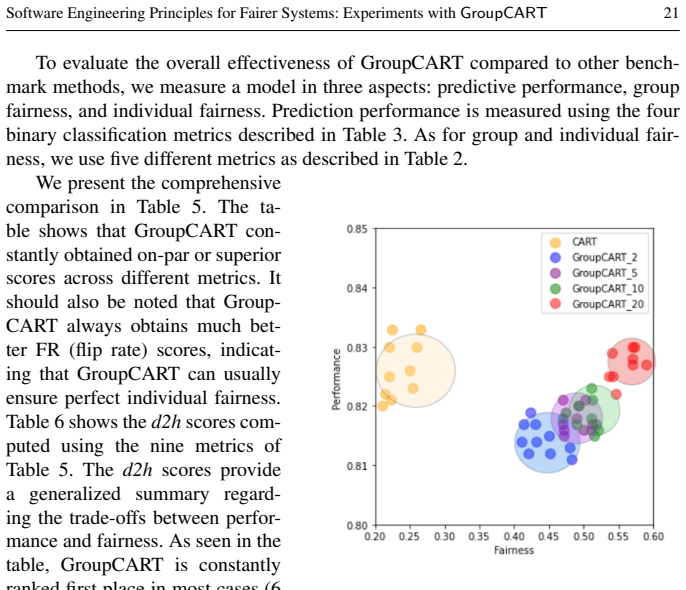
The paper's central claim is that optimizing tree splits for two objectives at once--decreasing entropy in the target label and increasing entropy in protected attributes--and then ensembling the resulting Pareto-optimal configurations produces models that sit on a better performance-fairness frontier than plain CART and than prior mitigation methods. GroupCART builds $N$ candidate trees with distinct $IG_C / IG_S$ weight ratios, keeps the non-dominated ones under continuous domination, and averages their predictions. In the reported experiments it matches or beats EGR, Fax-AI, MAAT, and FairMask on most datasets, reduces flip rate to zero in nearly all settings, and gives best distance-to-heaven scores in several cases while keeping performance close to the unconstrained baseline. The authors conclude from this that algorithmic bias within decision tree models can be mitigated through multi-task fairness-aware learning.
Load-bearing premise
The results assume that the early-stopping rule that fixes ensemble size at 5, 10, and 20--by stopping when flip rate reaches zero--uses only validation data; the paper never states which data split drives that rule, so the reported test flip rates may not be independent if the test set was involved.
Editorial extensions
If this is right
- Fairness can be treated as a configurable property of tree-based models, so bias mitigation becomes a search over weight ratios rather than a separate repair step.
- Ensembles with more than two members can improve the fairness-performance trade-off, suggesting that two-model ensembles leave room for improvement.
- Users can dial a continuous weight between performance and fairness, producing a family of deployable models rather than a single compromise.
- Multiple protected attributes can be handled at once, so a model can be tuned for fairness on sex and race simultaneously.
Reading between the lines
- If the early-stopping rule is validated as leakage-free, the reported flip rate of zero for nearly all settings would indicate that ensemble voting alone can enforce individual fairness without per-instance constraints; this could be tested by recording FR as a function of ensemble size on held-out data.
- The same weight-ratio construction should transfer to random forests and AdaBoost-style ensembles; the paper suggests it but does not evaluate it, so a direct experiment would show whether the Pareto-frontier mechanism, not the specific tree learner, is what delivers the trade-off.
- A natural stress test is to apply GroupCART to datasets with more than two protected-attribute values or to non-binary protected attributes, since the current experiments only cover binary protected attributes.
Signed reviews
Editorial analysis
A structured set of objections, weighed in public.
Referee Report
Summary. The paper proposes GroupCART, an ensemble of fairness-aware decision trees in which each tree is built with a different weight ratio between information gain on the protected attribute (IGS) and information gain on the class label (IGC). Candidate trees are filtered by Pareto-based non-dominated sorting on validation data, and the surviving models vote on test instances. The authors evaluate GroupCART on seven fairness datasets against CART, EGR, Fax-AI, MAAT, and FairMask, reporting accuracy, F1, group fairness metrics (AOD, EOD, SPD, DI), and an individual fairness flip rate (FR). They claim that GroupCART achieves on-par or better predictive performance while substantially improving fairness, and that the method can provide an 'optimal performance-fairness trade-off' based on distance-to-heaven (d2h) scores.
Significance. The central idea, treating fairness as a configurable property of tree-based learners and using multi-objective optimization plus ensemble voting to navigate the fairness-performance trade-off, is relevant to the empirical software engineering community. The paper has notable strengths: it uses seven datasets, repeats experiments 20 times, compares with four baselines, applies non-parametric significance and effect-size testing, and makes code and data publicly available. If the empirical claims are established after correcting the issues below, this would be a useful contribution to fairness-aware ML software. However, the headline evidence for 'optimal trade-off' currently rests on a d2h computation that reverses the semantics of disparate impact, and the individual-fairness result is weakened by an early-stopping rule that uses the reported outcome as its own stopping criterion. These are load-bearing problems in the current manuscript.
major comments (4)
- [§5.2, Eq. (4), Table 6] The d2h computation treats DI = 0 as the optimum, but Table 2 defines Disparate Impact as DI = P(Y=1|PA=0)/P(Y=1|PA=1), for which the fair value is 1.0 (100%). The reported values in Table 6 are only consistent with an optimum of 0 for DI: for example, the Adult:Sex CART row has d2h = 124, which requires a DI contribution of (90-0)^2 = 8100 rather than (90-100)^2 = 100. Under the paper's own definition, a lower DI means the unprivileged group receives a smaller fraction of favorable outcomes, i.e., more disparity, not less. Recomputing Adult:Sex and Adult:Race with |DI-100| reverses both GroupCART-versus-CART comparisons. Because Table 6's 'GroupCART ranked first in 6/8 cases' is the main support for the conclusion that GroupCART provides an optimal performance-fairness trade-off, this metric-direction error is load-bearing. Please correct the optimum vector for DI, re-run all d2h and ranking analyses, and revise the Table 5 caption so that it does not state 'for all fairness metrics, smaller is better.'
- [§6.3 and Table 5] The early-stopping rule described in §6.3 grows the ensemble until the flip rate FR reaches zero, and the paper then reports FR = 0 as a favorable outcome for GroupCART in Table 5. The manuscript never states whether the FR used for stopping is computed on the validation set or the test set. If the test set is used, the reported perfect individual fairness is a leakage artifact and the selected ensemble sizes (5, 10, 20) are tuned to the reported outcome. If the validation set is used, the test FR = 0 is still not independent evidence, because the ensemble size was selected to drive FR to zero. Please specify exactly which data split feeds the stopping rule, and, if necessary, re-evaluate with a fixed ensemble size chosen before observing test FR.
- [§4.3 and §5.2] The domination definitions in Eq. (1)-(3) state that lower objective values y are preferred, but the objectives listed in §5.2 include accuracy and F1, for which higher values are better. The paper does not state that these metrics are negated or converted to error rates before NDSorting is applied in Algorithm 2. If raw accuracy and F1 are passed to a lower-is-better domination rule, the Pareto filter could rank poor-performance models as dominant, which would undermine the selection of candidate trees. Please specify the exact objective transformation used in the implementation of NDSorting.
- [Table 4 and §6.1] The row 'Default: Sex' in Table 4 refers to a dataset that is not listed in Table 1 and is not described in §6.1. In addition, the d2h values in Table 4 (0.46-1.14) are on a completely different scale from those in Table 6 (46-124), and the manuscript does not explain whether the two tables use different objective vectors, different normalizations, or different subsets of metrics. This makes the RQ1 result ('up to 51% improvement from optimization') difficult to interpret and reproduce. Please document the datasets and the exact metric vectors used for each d2h calculation.
minor comments (4)
- [Table 2] The DI formula has a typo: it reads 'P(Y=1|PA=0]' with a closing bracket instead of a division slash; it should be 'P(Y=1|PA=0)/P(Y=1|PA=1)'.
- [Figure 2 caption] The caption contains a grammatical error: 'Presented in the paper be Cruz et al.' should read 'Presented in the paper by Cruz et al.'.
- [Tables 5 and 6] The text says Table 5 reports median values over 20 runs, while Table 6 is described as reporting mean d2h scores; the paper should state clearly which statistic is used in each table and why.
- [Algorithm 2 and §6.3] The term 'ensemble size N' is used ambiguously: it sometimes refers to the number of initialized candidate trees and sometimes to the size of the final voting ensemble after Pareto filtering. Please define both quantities explicitly.
Circularity Check
FR=0 is used both as the ensemble-size stopping criterion and as the reported individual-fairness outcome, and the d2h rankings treat disparate impact as lower-is-better, contradicting the paper's own ratio definition.
-
fitted input called prediction
[Section 6.3 'Experimental Rig'; RQ2/RQ3, Section 7 (Tables 4-6, Fig. 4)]
"Hence, in this paper, we keep doubling the size of the ensembles, stopping after the point where FR= 0. In practice, this means that we will generate ensembles of sizes 5,10, and 20 (as the FR decreases to 0 at the size of 20). ... GroupCART always obtains much better FR (flip rate) scores, indicating that GroupCART can usually ensure perfect individual fairness."
The stopping rule selects the reported ensemble sizes by growing the ensemble until FR=0, and Table 5 then reports GroupCART with FR=0 on every dataset as evidence of 'perfect individual fairness'. The measured outcome is therefore the target used in model selection, not an independent prediction. Section 6.3 does not state that the stopping FR is computed on a validation split distinct from the test FR reported in Table 5; as written, the same metric is used both to fit the ensemble size and to report the headline fairness result, so the FR=0 row is forced by construction.
-
other
[Table 2; Section 5.2 Eq. 4; Table 5 caption; Table 6/RQ3]
"Disparate Impact (DI) DI=P (Y=1|PA=0]/P [Y=1|PA=1) Similar to SPD but measuring ratio rather than the probability ... For all performance metrics, greater is better; for all fairness metrics, smaller is better."
Table 2 defines DI as a ratio whose fair value is 1.0, but Table 5 tells readers that all fairness metrics are 'smaller is better', and the d2h values in Table 6 are computed with DI's optimum at 0: CART on Adult:Sex has d2h=124, which matches a DI contribution of (90-0)^2=8100 rather than (90-100)^2=100. By construction, the d2h evaluation rewards lower DI, so the Table 6 ranking that supports the claim that GroupCART 'can provide an optimal performance-fairness trade-off' is generated under an objective opposite to the paper's own DI definition. This is a definitional/construction error in the main evidence, not merely a stylistic choice.
full rationale
The paper is an empirical study, and most of its machinery is not circular: the weighted IGS/IGC tree construction, Pareto-frontier filtering, and ensemble voting are independent algorithmic choices, and the self-citations (e.g., FairMask) are used as baselines rather than as load-bearing support. No imported uniqueness theorem is invoked. However, the central fairness claims contain two construction-level problems. First, the FR early-stopping rule controls the ensemble size until FR=0 and the same FR=0 is then presented as GroupCART's individual-fairness achievement; that 'prediction' reduces to the selection criterion unless a held-out validation/test separation is explicitly stated, which the paper does not do. Second, the d2h objective used to rank methods treats lower DI as better even though the paper defines DI as a ratio where 1.0 is fair; the reported Table 6 distances are only consistent with a 'heaven' of DI=0. Both issues affect the headline conclusion of an optimal performance-fairness trade-off, making the fairness-axis results partially self-fulfilling, while the predictive-performance comparisons and several other fairness metrics remain potentially informative.
Assumptions & free parameters
free parameters (3)
- Ensemble size N =
20 (also 5 and 10 explored)
- IGS/IGC weight ratio for selected models =
Selected subset of the grid {i/N} using continuous domination on validation
- Objective metric set for Pareto filtering =
accuracy, F1, AOD, DI
assumptions (6)
- domain assumption Protected attributes are available in the training data and may be used as split criteria.
- domain assumption The fairness metrics AOD, EOD, SPD, DI, and FR as defined in Table 2 are valid measures of bias.
- ad hoc to paper The validation set provides an unbiased guide for selecting the Pareto front and early stopping, with no leakage from the test set.
- domain assumption The test data are unbiased and correctly labeled.
- ad hoc to paper The d2h Euclidean distance with equal weights is a meaningful aggregate of performance and fairness.
- ad hoc to paper Continuous domination as defined in Equations 2 and 3 ranks configurations consistently with user preferences.
Cite this review
Pith. "Pith review of Software Engineering Principles for Fairer Systems: Experiments with GroupCART." pith.science (2026). https://pith.science/paper/DHNTZNI4
@misc{pith2026250412587,
  author       = {Pith},
  title        = {Pith review of: Software Engineering Principles for Fairer Systems: Experiments with GroupCART},
  year         = {2026},
  howpublished = {\url{https://pith.science/paper/DHNTZNI4}},
  note         = {Machine review of arXiv:2504.12587}
}
read the original abstract
Discrimination-aware classification aims to make accurate predictions while satisfying fairness constraints. Traditional decision tree learners typically optimize for information gain in the target attribute alone, which can result in models that unfairly discriminate against protected social groups (e.g., gender, ethnicity). Motivated by these shortcomings, we propose GroupCART, a tree-based ensemble optimizer that avoids bias during model construction by optimizing not only for decreased entropy in the target attribute but also for increased entropy in protected attributes. Our experiments show that GroupCART achieves fairer models without data transformation and with minimal performance degradation. Furthermore, the method supports customizable weighting, offering a smooth and flexible trade-off between predictive performance and fairness based on user requirements. These results demonstrate that algorithmic bias in decision tree models can be mitigated through multi-task, fairness-aware learning. All code and datasets used in this study are available at: https://github.com/anonymous12138/groupCART.
Figures


Figures from the paper (2 more)

Reference graph
Works this paper leans on
-
[1]
URL http://mlr.cs.umass.edu/ml/datasets/ Adult
(1994) Uci:adult data set. URL http://mlr.cs.umass.edu/ml/datasets/ Adult
work page 1994
-
[2]
(2000) Uci:statlog (german credit data) data set. URL https://archive.ics. uci.edu/ml/datasets/Statlog+(German+Credit+Data)
work page 2000
-
[3]
URL https://archive.ics.uci.edu/ml/ datasets/Heart+Disease
(2001) Uci:heart disease data set. URL https://archive.ics.uci.edu/ml/ datasets/Heart+Disease
work page 2001
-
[4]
URL https://meps.ahrq.gov/ mepsweb/
(2015) Medical expenditure panel survey. URL https://meps.ahrq.gov/ mepsweb/
work page 2015
-
[5]
URL https://github.com/ propublica/compas-analysis
(2015) propublica/compas-analysis. URL https://github.com/ propublica/compas-analysis
work page 2015
-
[6]
URL https://www.kaggle.com/c/ bank-marketing-uci
(2017) Bank marketing uci. URL https://www.kaggle.com/c/ bank-marketing-uci
work page 2017
-
[7]
(2018) Facebook says it has a tool to detect bias in its artificial intelligence. URL http://tiny.cc/5v6nzz
work page 2018
-
[8]
URLhttps: //www.microsoft.com/en-us/research/group/fate/
(2018) Fate: Fairness, accountability, transparency, and ethics in ai. URLhttps: //www.microsoft.com/en-us/research/group/fate/
work page 2018
Show all 66 references
-
[9]
URL https://2019.ase-conferences.org/home/ explain-2019
(2019) Explain 2019. URL https://2019.ase-conferences.org/home/ explain-2019
2019
-
[10]
URL https://fatconference.org/
(2024) Acm conference on fairness, accountability, and transparency (acm fat*). URL https://fatconference.org/
2024
-
[11]
In: International conference on machine learning, PMLR, pp 60–69
Agarwal A, Beygelzimer A, Dudík M, Langford J, Wallach H (2018) A reduc- tions approach to fair classification. In: International conference on machine learning, PMLR, pp 60–69
2018
-
[12]
In: Proceedings of the AAAI confer- ence on artificial intelligence, vol 33, pp 1418–1426
Aghaei S, Azizi MJ, Vayanos P (2019) Learning optimal and fair decision trees for non-discriminative decision-making. In: Proceedings of the AAAI confer- ence on artificial intelligence, vol 33, pp 1418–1426
2019
-
[13]
Agrawal A, Fu W, Chen D, Shen X, Menzies T (2019) How to "dodge" complex software analytics? arXiv preprint arXiv:190201838
2019
-
[14]
(2018) Ai fairness 360: An extensible toolkit for detecting, understanding, and mitigating unwanted algorithmic bias
Bellamy RK, Dey K, Hind M, Hoffman SC, Houde S, Kannan K, Lohia P, Mar- tino J, Mehta S, Mojsilovic A, et al. (2018) Ai fairness 360: An extensible toolkit for detecting, understanding, and mitigating unwanted algorithmic bias. arXiv preprint arXiv:181001943
2018
-
[15]
In: 2019 IEEE 31st International conference on tools with artificial intelligence (ICTAI), IEEE, pp 1810–1814
Bhaskaruni D, Hu H, Lan C (2019) Improving prediction fairness via model ensemble. In: 2019 IEEE 31st International conference on tools with artificial intelligence (ICTAI), IEEE, pp 1810–1814
2019
-
[16]
Proceedings of the 28th ACM Joint Meeting on European Software Engineering Conference and Symposium on the Foundations of Software Engineering DOI 10.1145/3368089
Biswas S, Rajan H (2020) Do the machine learning models on a crowd sourced platform exhibit bias? an empirical study on model fairness. Proceedings of the 28th ACM Joint Meeting on European Software Engineering Conference and Symposium on the Foundations of Software Engineerin...
2020
-
[17]
Calmon F, Wei D, Vinzamuri B, Natesan Ramamurthy K, Varshney KR (2017) Optimized pre-processing for discrimination prevention. In: Guyon I, Luxburg UV , Bengio S, Wallach H, Fergus R, Vishwanathan S, Garnett R (eds) Advances in Neural Information Processing Systems 30, Curran ...
2017
-
[18]
1905.05786
Chakraborty J, Xia T, Fahid FM, Menzies T (2019) Software engineering for fairness: A case study with hyperparameter optimization. 1905.05786
2019 arXiv
-
[19]
Chakraborty J, Majumder S, Yu Z, Menzies T (2020) Fairway: A way to build fair ml software. In: Proceedings of the 28th ACM Joint Meeting on Euro- pean Software Engineering Conference and Symposium on the Foundations of Software Engineering, Association for Computing Machinery...
2020
-
[20]
Chakraborty J, Peng K, Menzies T (2020) Making fair ml software using trust- worthy explanation. In: Proceedings of the 35th IEEE/ACM International Con- ference on Automated Software Engineering, Association for Computing Ma- chinery, New York, NY , USA, ASE ’20, p 1229–1233, ...
2020
-
[21]
Chakraborty J, Majumder S, Menzies T (2021) Bias in machine learning soft- ware: Why? how? what to do? In: Proceedings of the 29th ACM Joint Meeting on European Software Engineering Conference and Symposium on the Foun- dations of Software Engineering, Association for Computin...
2021
-
[22]
In: Proceedings of the 30th ACM Joint European Software Engineering Conference and Symposium on the Foundations of Software Engineering, pp 1122–1134
Chen Z, Zhang JM, Sarro F, Harman M (2022) Maat: a novel ensemble approach to addressing fairness and performance bugs for machine learning software. In: Proceedings of the 30th ACM Joint European Software Engineering Conference and Symposium on the Foundations of Software Eng...
2022
-
[23]
ACM Trans Softw Eng Methodol 32(4), DOI 10.1145/3583561, URL https://doi.org/ 10.1145/3583561
Chen Z, Zhang JM, Sarro F, Harman M (2023) A comprehensive empirical study of bias mitigation methods for machine learning classifiers. ACM Trans Softw Eng Methodol 32(4), DOI 10.1145/3583561, URL https://doi.org/ 10.1145/3583561
2023 doi
-
[24]
ACM Trans Softw Eng Methodol 33(5), DOI 10.1145/3652155, URL https://doi.org/10.1145/3652155
Chen Z, Zhang JM, Hort M, Harman M, Sarro F (2024) Fairness testing: A com- prehensive survey and analysis of trends. ACM Trans Softw Eng Methodol 33(5), DOI 10.1145/3652155, URL https://doi.org/10.1145/3652155
2024 doi
-
[25]
Publications Office, DOI doi/10.2759/177365
Commission E, Directorate-General for Communications Networks C, Tech- nology (2019) Ethics guidelines for trustworthy AI. Publications Office, DOI doi/10.2759/177365
2019 doi
-
[26]
In: 2021 IEEE International Conference on Data Mining (ICDM), IEEE, pp 1036–1041
Cruz AF, Saleiro P, Belém C, Soares C, Bizarro P (2021) Promoting fairness through hyperparameter optimization. In: 2021 IEEE International Conference on Data Mining (ICDM), IEEE, pp 1036–1041
2021
-
[27]
IEEE transactions on evolutionary computation 6(2):182–197
Deb K, Pratap A, Agarwal S, Meyarivan T (2002) A fast and elitist multiobjec- tive genetic algorithm: Nsga-ii. IEEE transactions on evolutionary computation 6(2):182–197
2002
-
[28]
In: proceedings of the 21th ACM SIGKDD international conference on knowledge discovery and data min- ing, pp 259–268 26 Kewen Peng et al
Feldman M, Friedler SA, Moeller J, Scheidegger C, Venkatasubramanian S (2015) Certifying and removing disparate impact. In: proceedings of the 21th ACM SIGKDD international conference on knowledge discovery and data min- ing, pp 259–268 26 Kewen Peng et al
2015
-
[29]
it’s actually not that clear
Feller A, Pierson E, Corbett-Davies S, Goel S (2016) A computer program used for bail and sentencing decisions was labeled biased against blacks. it’s actually not that clear. The Washington Post 17
2016
-
[30]
Proceedings of the 2017 11th Joint Meeting on Foundations of Software Engineering - ESEC/FSE 2017 DOI 10.1145/3106237.3106277, URL http://dx.doi.org/10.1145/3106237.3106277
Galhotra S, Brun Y , Meliou A (2017) Fairness testing: testing software for dis- crimination. Proceedings of the 2017 11th Joint Meeting on Foundations of Software Engineering - ESEC/FSE 2017 DOI 10.1145/3106237.3106277, URL http://dx.doi.org/10.1145/3106237.3106277
2017
-
[31]
In: 2023 IEEE/ACM 45th Inter- national Conference on Software Engineering (ICSE), pp 1533–1545, DOI 10.1109/ICSE48619.2023.00133
Gohar U, Biswas S, Rajan H (2023) Towards understanding fairness and its composition in ensemble machine learning. In: 2023 IEEE/ACM 45th Inter- national Conference on Software Engineering (ICSE), pp 1533–1545, DOI 10.1109/ICSE48619.2023.00133
2023
-
[32]
In: Proceedings of the 2022 ACM Conference on Fair- ness, Accountability, and Transparency, pp 1905–1916
Grabowicz PA, Perello N, Mishra A (2022) Marrying fairness and explainability in supervised learning. In: Proceedings of the 2022 ACM Conference on Fair- ness, Accountability, and Transparency, pp 1905–1916
2022
-
[33]
arXiv preprint arXiv:170610208
Grgi ´c-Hlaˇca N, Zafar MB, Gummadi KP, Weller A (2017) On fairness, diversity and randomness in algorithmic decision making. arXiv preprint arXiv:170610208
2017
-
[34]
1610.02413
Hardt M, Price E, Srebro N (2016) Equality of opportunity in supervised learn- ing. 1610.02413
2016 arXiv
-
[35]
In: annual meeting of the American Educational Research Association, pp 1–30
Hess MR, Kromrey JD (2004) Robust confidence intervals for effect sizes: A comparative study of cohen’sd and cliff’s delta under non-normality and hetero- geneous variances. In: annual meeting of the American Educational Research Association, pp 1–30
2004
-
[36]
Scientific american 267(1):66–73
Holland JH (1992) Genetic algorithms. Scientific american 267(1):66–73
1992
-
[37]
Empirical Software En- gineering 29(1):36
Hort M, Zhang JM, Sarro F, Harman M (2024) Search-based automatic repair for fairness and accuracy in decision-making software. Empirical Software En- gineering 29(1):36
2024
-
[38]
Knowledge and Information Systems 33(1):1–33
Kamiran F, Calders T (2012) Data preprocessing techniques for classification without discrimination. Knowledge and Information Systems 33(1):1–33
2012
-
[39]
In: 2010 IEEE international conference on data mining, IEEE, pp 869– 874
Kamiran F, Calders T, Pechenizkiy M (2010) Discrimination aware decision tree learning. In: 2010 IEEE international conference on data mining, IEEE, pp 869– 874
2010
-
[40]
Inf Sci DOI 10.1016/j.ins.2017
Kamiran F, Mansha S, Karim A, Zhang X (2018) Exploiting reject option in classification for social discrimination control. Inf Sci DOI 10.1016/j.ins.2017. 09.064
2018 doi
-
[41]
In: Flach PA, De Bie T, Cristianini N (eds) Ma- chine Learning and Knowledge Discovery in Databases, Springer Berlin Heidel- berg, Berlin, Heidelberg, pp 35–50
Kamishima T, Akaho S, Asoh H, Sakuma J (2012) Fairness-aware classifier with prejudice remover regularizer. In: Flach PA, De Bie T, Cristianini N (eds) Ma- chine Learning and Knowledge Discovery in Databases, Springer Berlin Heidel- berg, Berlin, Heidelberg, pp 35–50
2012
-
[42]
Evolutionary computation
Laumanns M, Thiele L, Deb K, Zitzler E (2002) Combining convergence and diversity in evolutionary multiobjective optimization. Evolutionary computation
2002
-
[43]
Li Y , Meng L, Chen L, Yu L, Wu D, Zhou Y , Xu B (2022) Training data de- bugging for the fairness of machine learning software. In: Proceedings of the 44th International Conference on Software Engineering, Association for Com- puting Machinery, New York, NY , USA, ICSE ’22, p...
2022
-
[44]
Universitas Psychologica 10(2):545–555
Macbeth G, Razumiejczyk E, Ledesma RD (2011) Cliff’s delta calculator: A non-parametric effect size program for two groups of observations. Universitas Psychologica 10(2):545–555
2011
-
[45]
IEEE Transactions on software engineering 39(6):822–834
Menzies T, Butcher A, Marcus A, Cok D, Shull F, Turhan B, Zimmermann T (2013) Local versus global lessons for defect prediction and effort estimation. IEEE Transactions on software engineering 39(6):822–834
2013
-
[46]
Morgan Kaufmann
Menzies T, Kocaguneli E, Turhan B, Minku L, Peters F (2014) Sharing data and models in software engineering. Morgan Kaufmann
2014
-
[47]
IEEE Transactions on soft- ware engineering 39(4):537–551
Mittas N, Angelis L (2012) Ranking and clustering software cost estimation models through a multiple comparisons algorithm. IEEE Transactions on soft- ware engineering 39(4):537–551
2012
-
[48]
IEEE Transactions on Software Engineering 46(7):794–811
Nair V , Yu Z, Menzies T, Siegmund N, Apel S (2018) Finding faster configura- tions using flash. IEEE Transactions on Software Engineering 46(7):794–811
2018
-
[49]
Narayanan A (2019) Tl;ds - 21 fairness definition and their politics by arvind narayanan
2019
-
[50]
IEEE Transactions on Software Engi- neering
Peng K, Chakraborty J, Menzies T (2022) Fairmask: Better fairness via model- based rebalancing of protected attributes. IEEE Transactions on Software Engi- neering
2022
-
[51]
Empirical Software Engineer- ing 28(3):61
Peng K, Kaltenecker C, Siegmund N, Apel S, Menzies T (2023) Veer: enhancing the interpretability of model-based optimizations. Empirical Software Engineer- ing 28(3):61
2023
-
[52]
arXiv preprint arXiv:170902012
Pleiss G, Raghavan M, Wu F, Kleinberg J, Weinberger KQ (2017) On fairness and calibration. arXiv preprint arXiv:170902012
2017
-
[53]
In: Proceedings of the 30th ACM International Con- ference on Information & Knowledge Management, pp 1508–1517
Ranzato F, Urban C, Zanella M (2021) Fairness-aware training of decision trees by abstract interpretation. In: Proceedings of the 30th ACM International Con- ference on Information & Knowledge Management, pp 1508–1517
2021
-
[54]
In: 2017 IEEE Canada International Humanitarian Tech- nology Conference (IHTC), IEEE, pp 197–201
Shahriari K, Shahriari M (2017) Ieee standard review—ethically aligned de- sign: A vision for prioritizing human wellbeing with artificial intelligence and autonomous systems. In: 2017 IEEE Canada International Humanitarian Tech- nology Conference (IHTC), IEEE, pp 197–201
2017
-
[55]
Ars Technica 29
Simonite T (2020) Google offers to help others with the tricky ethics of ai. Ars Technica 29
2020
-
[56]
In: Proceedings of the 44th International Confer- ence on Software Engineering, pp 909–920
Tizpaz-Niari S, Kumar A, Tan G, Trivedi A (2022) Fairness-aware configuration of machine learning libraries. In: Proceedings of the 44th International Confer- ence on Software Engineering, pp 909–920
2022
-
[57]
(2019) Unlocking fairness: a trade-off revisited
Wick M, Tristan JB, et al. (2019) Unlocking fairness: a trade-off revisited. Ad- vances in neural information processing systems 32
2019
-
[58]
arXiv preprint arXiv:180500336
Xia T, Krishna R, Chen J, Mathew G, Shen X, Menzies T (2018) Hyperparameter optimization for effort estimation. arXiv preprint arXiv:180500336
2018
-
[59]
Proc ACM Softw Eng 1(FSE), DOI 10.1145/3660801, URL https://doi.org/10
Xiao Y , Zhang JM, Liu Y , Mousavi MR, Liu S, Xue D (2024) Mirrorfair: Fixing fairness bugs in machine learning software via counterfactual predictions. Proc ACM Softw Eng 1(FSE), DOI 10.1145/3660801, URL https://doi.org/10. 1145/3660801
2024 doi
-
[60]
Expert Systems with Applications 36(2):2473–2480 28 Kewen Peng et al
Yeh IC, Lien Ch (2009) The comparisons of data mining techniques for the pre- dictive accuracy of probability of default of credit card clients. Expert Systems with Applications 36(2):2473–2480 28 Kewen Peng et al
2009
-
[61]
1801.07593
Zhang BH, Lemoine B, Mitchell M (2018) Mitigating unwanted biases with ad- versarial learning. 1801.07593
2018 arXiv
-
[62]
ignorance and prejudice
Zhang JM, Harman M (2021) "ignorance and prejudice" in software fairness. In: 2021 IEEE/ACM 43rd International Conference on Software Engineering (ICSE), pp 1436–1447, DOI 10.1109/ICSE43902.2021.00129
2021
-
[63]
In: Proceedings of the ACM/IEEE 42nd International Conference on Software Engineering, pp 949– 960
Zhang P, Wang J, Sun J, Dong G, Wang X, Wang X, Dong JS, Dai T (2020) White-box fairness testing through adversarial sampling. In: Proceedings of the ACM/IEEE 42nd International Conference on Software Engineering, pp 949– 960
2020
-
[64]
arXiv preprint arXiv:190707237
Zhang W, Ntoutsi E (2019) Faht: an adaptive fairness-aware decision tree classi- fier. arXiv preprint arXiv:190707237
2019
-
[65]
IEEE transactions on Evolutionary Computation 3(4):257–271
Zitzler E, Thiele L (1999) Multiobjective evolutionary algorithms: a comparative case study and the strength pareto approach. IEEE transactions on Evolutionary Computation 3(4):257–271
1999
-
[66]
TIK-report 103
Zitzler E, Laumanns M, Thiele L (2001) Spea2: Improving the strength pareto evolutionary algorithm. TIK-report 103
2001
Reviewed August 16, 2026 · model on record in the stance chip above.
Discussion (0). Continue with ORCID to comment.