REVIEW 5 major objections 5 minor 56 references
SFL-LEO: Asynchronous Split-Federated Learning Design for LEO Satellite-Ground Network Framework
T0 review · 5 major / 5 minor · reviewed 2026-08-16 · deepseek-v4-flash
Pith's one-line read This paper claims that an asynchronous split-federated framework with an auxiliary network lets LEO satellites train during disconnection periods, improving accuracy over split learning and federated learning while cutting…
desk verdict A plausible design for split-federated training over intermittent LEO links, but the paper's own numbers contradict each other and the headline accuracy gain is not isolated from the proposed mechanism. read the letter →
The pith
A machine-rendered reading of the paper's core claim, the machinery that carries it, and where it could break.
The reading
What carries the argument
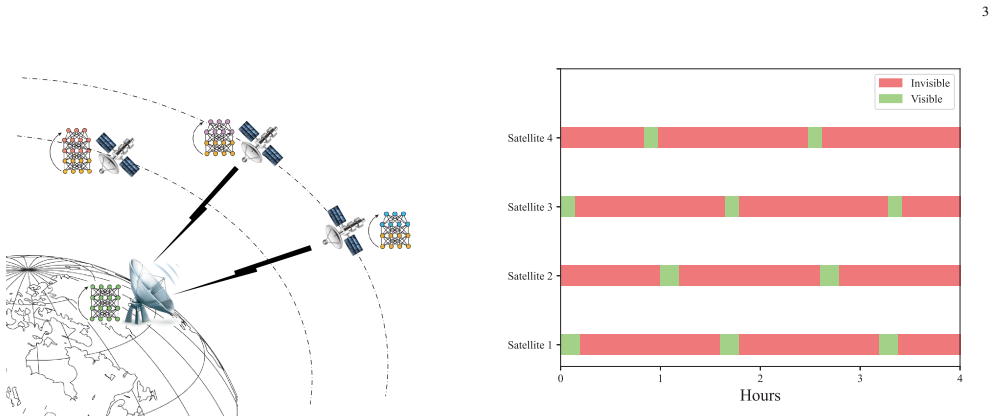
The auxiliary network is the load-bearing mechanism: a small network appended to each satellite's client-side model whose output is used to compute a local loss, allowing backpropagation and parameter updates entirely on the satellite while it is disconnected from the ground station. Around it, the design uses an asynchronous round structure in which the ground station aggregates after every $K$ visible satellites, a staleness penalty $p_n = (1+\tau_{r_n(j)}^{n})^{z}$ (with $z=-4$ in experiments) that downweights outdated updates, and a layer alignment strategy that keeps the cut layer identical across heterogeneous satellites by removing intermediate layers. Together these pieces turn orbital invisibility into training time while keeping different-sized models mergeable at the server.
What would settle it
Measure, on a held-out batch, the cosine similarity between the satellite-side gradients computed with the auxiliary network during disconnection and the true gradients the server would produce if it had the smashed data. If the average similarity is near zero or negative across satellites and rounds, the auxiliary proxy is not tracking the global objective. A direct test: run the same experiment but disable local updates during disconnection (pure split learning); if accuracy stays at the SFL-LEO level, the claimed benefit of offline training is not coming from the auxiliary network.
Extended reading notes
Core claim
The central claim is that SFL-LEO, an asynchronous split-federated framework with an auxiliary network and a layer-aligned personalized split, lets LEO satellites contribute useful gradient updates during disconnection periods, so the global model can be trained despite scarce connectivity. Satellites download the current client-side parameters, run U local updates using the auxiliary network's loss, and upload the most recent smashed data plus updated parameters when visible; the ground station updates the server-side model and aggregates client-side models with a staleness penalty. An adaptive split keeps the cut layer identical across satellites while removing middle layers, so satellites with different compute capacities remain aggregatable. The paper argues this combines the communication efficiency of split learning with the generalization of federated aggregation, and its experiments show higher accuracy than pure split or federated learning at a fraction of the transmission cost.
Load-bearing premise
The load-bearing premise is that the auxiliary network's locally computed loss is a good enough stand-in for the true server-side training signal during disconnection, so that offline local updates push the global model in the right direction.
Editorial extensions
If this is right
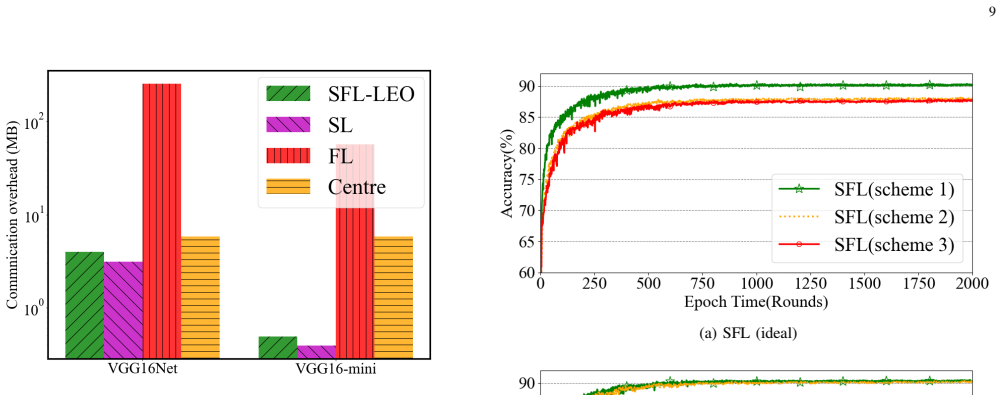
- Satellite constellations can turn the roughly 90 percent of orbit time spent out of contact into useful training, raising IID CIFAR-10 accuracy to 84.4 percent versus 73.2 percent for split learning and 83.2 percent for federated learning.
- The amount of data sent from satellites to the ground drops by 6x versus centralized training, 15x versus split learning, and 60x versus federated learning, which eases the satellite-ground bandwidth bottleneck.
- Heterogeneous satellites with different compute capabilities can still be aggregated because the cut layer is kept aligned by removing intermediate layers; accuracy stays similar even when multiple split structures coexist.
- Increasing asynchrony (smaller $K$, down to $K=1$) improves accuracy in the reported experiments, suggesting that waiting for synchronization costs performance in this setting.
- Performance remains relatively stable under 25 percent link loss and across mixed orbital altitudes, indicating the design tolerates realistic connection instability.
Reading between the lines
- The auxiliary network's local loss is the part to test first: if a gradient-alignment or convergence study shows the proxy drifts from the server-side objective, the accuracy gains could shrink on harder or more non-IID data than CIFAR-10.
- The same asynchronous local-update pattern should extend to any intermittently connected edge setting (airborne platforms, maritime nodes, ground vehicles in tunnels) whenever the server-side head is small enough to fit in the link budget, since the mechanism does not depend on satellite-specific physics beyond periodic visibility.
- A natural extension is to correct for staleness with server-side variance reduction or momentum rather than a fixed power-law penalty; the paper does not explore whether more aggressive weighting would recover some of the remaining gap to centralized training.
Signed reviews
Editorial analysis
A structured set of objections, weighed in public.
Referee Report
Summary. The paper proposes SFL-LEO, an asynchronous split-federated learning framework for LEO satellite-ground networks. Satellites train local sub-models during disconnection periods using an auxiliary network, upload smashed data and parameters to a ground station upon visibility, and the ground station aggregates client-side models with a staleness penalty. The paper also proposes an adaptive split strategy that keeps the cut layer consistent across heterogeneous satellites by removing intermediate layers. Experiments on CIFAR-10 with IID and non-IID data compare SFL-LEO with split learning (SL), federated learning (FL), and centralized training, and the paper claims accuracy improvements over SL and FL as well as communication reductions relative to centralized, SL, and FL baselines.
Significance. If the central claim were established, the paper would address a genuinely important problem: enabling on-board model updates under intermittent satellite-ground connectivity. The strengths are the self-contained experimental comparison against three baselines, the realistic motivation from LEO orbital dynamics, and the concrete layer-alignment idea for heterogeneous satellites. However, the significance is heavily undermined by internal contradictions in the headline accuracy and communication numbers, by an inconsistent staleness aggregation rule, and most importantly by the absence of any validation that the auxiliary-network local loss is an adequate proxy for the global training objective. The reported IID accuracy gain over SL may simply reflect that the SL baseline is starved of training time, not that the proposed mechanism is sound.
major comments (5)
- [Abstract, Section V-B] The headline performance claim is internally inconsistent. The abstract states that SFL-LEO 'provides a similar accuracy performance with the conventional SL scheme,' while the introduction states that accuracy is 'around 15% and 16% higher' than SL and FL, and Section V-B reports IID CIFAR-10 accuracies of 84.4% for SFL-LEO, 73.2% for SL, 83.2% for FL, and 91.2% for the centre scheme. These statements cannot all describe the same experiment; the paper should state one consistent set of claims and reconcile the abstract with the reported numbers.
- [Introduction, Section V-B, Fig. 8] The communication-overhead claims contradict the reported experiment. The introduction claims data reduction of 6x, 15x, and 60x versus centre, SL, and FL, respectively, but Section V-B and Fig. 8 state that SFL-LEO 'entails a similar information transmission size' compared to SL and only claims a significant reduction versus the centre scheme. The 15x and 60x factors are not supported by the described results; please provide the per-scheme transmission sizes and reconcile the numbers.
- [Section IV-B, Eqs. (10)-(11), Section V-A] The staleness handling rule is inconsistent and appears to invert the intended behavior. Equation (11) defines p_n = (1 + tau)^z if tau > tau_max and 0 otherwise; with z = -4 as set in Section V-A, a satellite with staleness above the threshold receives a positive (though small) aggregation weight, while a satellite with staleness below the threshold receives zero weight. This contradicts the text's statement that a satellite with tau > tau_max 'refrains from transmitting over outdated data,' and it makes the aggregation in Eq. (10) undefined for fresh models. The threshold condition, the penalty exponent, and the normalization of p_n need to be corrected and justified.
- [Section IV-B, Eqs. (6)-(8), Section V-A] The load-bearing claim that local updates via the auxiliary network improve the global model is not validated. Steps 2 and 3 minimize a local loss F_{s,n}(w_s, a_s) on the satellite, whereas the server head is trained separately on stale smashed data and aggregation in Eq. (10) contains no correction toward the server-side objective. No convergence analysis is given, no comparison between the local gradient and the true server-side gradient is reported, and no ablation isolates the auxiliary-network mechanism. Because the SL baseline is connected only about 5% of the time (Section V-A), the IID accuracy gap (84.4% vs 73.2%) could simply reflect that SFL-LEO performs many more effective gradient steps; the experiments as presented do not establish that the auxiliary loss is a sound training signal.
- [Section I, Section VI, References [3], [7], [16], [20]] The 'first' claims are contradicted by the paper's own references. The introduction and conclusion claim 'for the first time' a combination of FL and SL and 'the pioneering research efforts to bring distributed training to LEO satellite systems,' yet SplitFed [20] already combines FL and SL, and the cited prior work [3], [7], [16] applies split learning and federated split learning to LEO satellite networks. The novelty statement should be revised to a precise differentiation from these existing schemes.
minor comments (5)
- [Section V-A] The introduction states that experiments use a remote sensing image dataset, but Section V-A says the evaluation is on CIFAR-10; please clarify which dataset was actually used.
- [Section IV-C] Section IV-C ends with an unfinished question ('...can we drop the straggler one?'); complete this algorithmic discussion or remove it, as it currently reads as a leftover note.
- [Section II] The roadmap in Section II says Section IV contains experiments and Section V concludes, but experiments are in Section V and the conclusion is in Section VIII; update the roadmap.
- [Section IV-B, Eq. (10)] Equation (10) should specify how p_n is normalized; as written the aggregation weights do not sum to one when some p_n vanish.
- [Throughout] There are numerous typos: 'poineering', 'taht', 'pf processing', 'Split stragety', and the conclusion refers to 'SL-LEO' instead of SFL-LEO; a careful proofreading pass is needed.
Circularity Check
No circularity: the auxiliary-network local loss and the empirical accuracy claims are self-contained, not by-construction reductions; self-citations affect novelty, not the derivation.
full rationale
The paper's derivation chain consists of the global objective (Eq. 2), the satellite-side objective with an auxiliary network (Eq. 3), the GS-side objective (Eq. 4), and the four-step asynchronous algorithm (Eqs. 5-15), followed by measured comparisons. I inspected each step for the circularity patterns. The local update rules (Eqs. 6-7) minimize F_s,n(w_s,a_s), and Eq. 8 trains the GS head on smashed data; the paper does not claim these are algebraically identical to minimizing the global F(w), so the well-founded concern that the auxiliary loss is an unvalidated proxy for the server-side gradient is a correctness risk, not a by-construction circularity. No fitted parameter is renamed as a prediction: the accuracy, communication, and latency results are self-contained experimental measurements with stated hyperparameters (learning rates, z=-4, 2 Gbps bandwidth). The numerous self-citations (e.g., Refs. [3], [7], [13], [15], [16], [21], [23]) appear as related work and motivation; they are not invoked as machine-checked or otherwise as proof of SFL-LEO's correctness, so they are not load-bearing in the derivation. The 'for the first time' novelty claim is contradicted by the paper's own references to prior split-learning-over-LEO works by the same group, but a false priority claim is not a circular derivation. The missing citation placeholder in Section II-B, the unfinished straggler question in Section IV-C, and the inconsistency between Eq. 11 and its surrounding text are completeness and correctness defects, not circular steps. I find no equation that reduces to its input by construction and no benchmark comparison that is forced by a fitted parameter, so the appropriate circularity score is 0.
Assumptions & free parameters
free parameters (5)
- staleness penalty exponent z =
-4
- satellite learning rate ratio =
1/40 of ground station LR
- staleness threshold tau_max =
not specified
- local update steps U =
not specified
- link bandwidth =
2 Gbps
assumptions (3)
- domain assumption The auxiliary network loss is an adequate proxy for the server-side loss during local updates.
- ad hoc to paper Removing intermediate layers while adjusting channel counts preserves the cut-layer representation enough for aggregation.
- domain assumption Connectivity follows deterministic visibility condition Eq (1) with a single GS and known pass schedule.
Cite this review
Pith. "Pith review of SFL-LEO: Asynchronous Split-Federated Learning Design for LEO Satellite-Ground Network Framework." pith.science (2026). https://pith.science/paper/KNKW5KXO
@misc{pith2026250413479,
  author       = {Pith},
  title        = {Pith review of: SFL-LEO: Asynchronous Split-Federated Learning Design for LEO Satellite-Ground Network Framework},
  year         = {2026},
  howpublished = {\url{https://pith.science/paper/KNKW5KXO}},
  note         = {Machine review of arXiv:2504.13479}
}
read the original abstract
Recently, the rapid development of LEO satellite networks spurs another widespread concern-data processing at satellites. However, achieving efficient computation at LEO satellites in highly dynamic satellite networks is challenging and remains an open problem when considering the constrained computation capability of LEO satellites. For the first time, we propose a novel distributed learning framework named SFL-LEO by combining Federated Learning (FL) with Split Learning (SL) to accommodate the high dynamics of LEO satellite networks and the constrained computation capability of LEO satellites by leveraging the periodical orbit traveling feature. The proposed scheme allows training locally by introducing an asynchronous training strategy, i.e., achieving local update when LEO satellites disconnect with the ground station, to provide much more training space and thus increase the training performance. Meanwhile, it aggregates client-side sub-models at the ground station and then distributes them to LEO satellites by borrowing the idea from the federated learning scheme. Experiment results driven by satellite-ground bandwidth measured in Starlink demonstrate that SFL-LEO provides a similar accuracy performance with the conventional SL scheme because it can perform local training even within the disconnection duration.
Figures


Figures from the paper (8 more)




Reference graph
Works this paper leans on
-
[20]
Splitfed: When federated learning meets split learning,
C. Thapa, P. C. M. Arachchige, S. Camtepe, and L. Sun, “Splitfed: When federated learning meets split learning,” in Proceedings of the AAAI conference on artificial intelligence , vol. 36, no. 8, 2022, pp. 8485– 8493
2022
-
[3]
Esl-leo: An efficient split learning framework over leo satellite networks,
Z. Lin, Y . Zhang, C. Zhe, Z. Fang, Y . Yang, G. Zhang, H. Yang, C. Wu, X. Chen, and Y . Gao, “Esl-leo: An efficient split learning framework over leo satellite networks,” Authorea Preprints, 2025
work page 2025
-
[7]
Leo-split: A semi-supervised split learning framework over leo satellite networks,
Z. Lin, Y . Zhang, Z. Chen, Z. Fang, C. Wu, X. Chen, Y . Gao, and J. Luo, “Leo-split: A semi-supervised split learning framework over leo satellite networks,” arXiv preprint arXiv:2501.01293 , 2025
arXiv 2025
-
[16]
S-leon: An efficient split learning framework over heterogeneous leo satellite networks,
Y . Zhang, Z. Chen, X. Hu, J. Zhao, and Y . Gao, “S-leon: An efficient split learning framework over heterogeneous leo satellite networks,” Authorea Preprints, 2025
work page 2025
-
[1]
“Oneweb,” 2023, https://oneweb.net/
work page 2023
- [2]
-
[4]
Constructing 4d radio map in leo satellite networks with limited samples,
H. Yuan, Z. Chen, Z. Lin, J. Peng, Y . Zhong, X. Hu, S. Xue, W. Li, and Y . Gao, “Constructing 4d radio map in leo satellite networks with limited samples,” arXiv preprint arXiv:2501.02775 , 2025
arXiv 2025
-
[5]
LEO satellites in 5G and beyond networks: A review from a standardization perspective,
T. Darwish, G. K. Kurt, H. Yanikomeroglu, M. Bellemare, and G. Lam- ontagne, “LEO satellites in 5G and beyond networks: A review from a standardization perspective,” IEEE Access , vol. 10, pp. 35 040–35 060, 2022
work page 2022
Show all 56 references
-
[6]
The road towards 6G: A comprehensive survey,
W. Jiang, B. Han, M. A. Habibi, and H. D. Schotten, “The road towards 6G: A comprehensive survey,” IEEE Open Journal of the Communications Society, vol. 2, pp. 334–366, 2021
2021
-
[8]
Satsense: Multi-satellite collaborative framework for spectrum sensing,
H. Yuan, Z. Chen, Z. Lin, J. Peng, Z. Fang, Y . Zhong, Z. Song, and Y . Gao, “Satsense: Multi-satellite collaborative framework for spectrum sensing,” IEEE Transactions on Cognitive Communications and Net- working, 2024
2024
-
[9]
Efficient satellite-ground interconnection design for low-orbit mega- constellation topology,
W. Liu, J. Wu, Q. Lin, H. Luo, Q. Zhang, K. Qiu, Z. Chen, and Y . Gao, “Efficient satellite-ground interconnection design for low-orbit mega- constellation topology,” IEEE Transactions on Mobile Computing, 2024
2024
-
[10]
Sums: Sniffing unknown multiband signals under low sampling rates,
J. Peng, Z. Chen, Z. Lin, H. Yuan, Z. Fang, L. Bao, Z. Song, Y . Li, J. Ren, and Y . Gao, “Sums: Sniffing unknown multiband signals under low sampling rates,” IEEE Transactions on Mobile Computing , 2024
2024
-
[11]
Graph learning for multi-satellite based spectrum sensing,
H. Yuan, Z. Chen, Z. Lin, J. Peng, Z. Fang, Y . Zhong, Z. Song, X. Wang, and Y . Gao, “Graph learning for multi-satellite based spectrum sensing,” in Proc. ICCT, 2023, pp. 1112–1116
2023
-
[12]
Leo satellite networks assisted geo-distributed data processing,
Z. Zhao, Z. Chen, Z. Lin, W. Zhu, K. Qiu, C. You, and Y . Gao, “Leo satellite networks assisted geo-distributed data processing,” arXiv preprint arXiv:2406.10856, 2024
2024 arXiv
-
[13]
Satfed: A resource-efficient leo satellite-assisted heterogeneous federated learning framework,
Y . Zhang, Z. Lin, Z. Chen, Z. Fang, W. Zhu, X. Chen, J. Zhao, and Y . Gao, “Satfed: A resource-efficient leo satellite-assisted heterogeneous federated learning framework,” arXiv preprint arXiv:2409.13503, 2024
2024 arXiv
-
[14]
Sigchord: Sniffing wide non-sparse multiband signals for terrestrial and non- terrestrial wireless networks,
J. Peng, J. Duan, Z. Lin, H. Yuan, Y . Gao, and Z. Chen, “Sigchord: Sniffing wide non-sparse multiband signals for terrestrial and non- terrestrial wireless networks,” arXiv preprint arXiv:2504.06587 , 2025
2025 arXiv
-
[15]
Fedsn: A federated learning framework over heterogeneous leo satellite networks,
Z. Lin, Z. Chen, Z. Fang, X. Chen, X. Wang, and Y . Gao, “Fedsn: A federated learning framework over heterogeneous leo satellite networks,” IEEE Transactions on Mobile Computing , 2024
2024
-
[17]
Optimizing the communication capacity of a ground station network,
R. A. d. Carvalho, “Optimizing the communication capacity of a ground station network,” Journal of Aerospace Technology and Management , vol. 11, p. e2319, 2019
2019
-
[18]
Scheduling downloads for multi-satellite, multi-ground station missions,
J. Castaing, “Scheduling downloads for multi-satellite, multi-ground station missions,” 2014
2014
-
[19]
Orbital edge computing: Nanosatellite constellations as a new class of computer system,
B. Denby and B. Lucia, “Orbital edge computing: Nanosatellite constellations as a new class of computer system,” in Proceedings of the Twenty-Fifth International Conference on Architectural Support for Programming Languages and Operating Systems , ser. ASPLOS ’20. New York, NY...
2020
-
[21]
Adaptsfl: Adaptive split federated learning in resource-constrained edge networks,
Z. Lin, G. Qu, W. Wei, X. Chen, and K. K. Leung, “Adaptsfl: Adaptive split federated learning in resource-constrained edge networks,” arXiv preprint arXiv:2403.13101, 2024
2024 arXiv
-
[22]
Optimal resource allocation for u-shaped parallel split learning,
S. Lyu, Z. Lin, G. Qu, X. Chen, X. Huang, and P. Li, “Optimal resource allocation for u-shaped parallel split learning,” in 2023 IEEE Globecom Workshops (GC Wkshps), 2023, pp. 197–202
2023
-
[23]
Efficient parallel split learning over resource-constrained wireless edge networks,
Z. Lin, G. Zhu, Y . Deng, X. Chen, Y . Gao, K. Huang, and Y . Fang, “Efficient parallel split learning over resource-constrained wireless edge networks,” IEEE Transactions on Mobile Computing , 2024
2024
-
[24]
Investing in Space: Is SpaceX’s Starlink growing satellite internet market share, or taking it?
CNBC, “Investing in Space: Is SpaceX’s Starlink growing satellite internet market share, or taking it?” https://cnb.cx/42Pa8jd, 2023
2023
-
[25]
Satellite constellations,
J. G. Walker, “Satellite constellations,” Journal of the British Interplan- etary Society, vol. 37, p. 559, 1984
1984
-
[26]
A technical comparison of three low earth orbit satellite constellation systems to provide global broadband,
I. Del Portillo, B. G. Cameron, and E. F. Crawley, “A technical comparison of three low earth orbit satellite constellation systems to provide global broadband,” Acta astronautica , vol. 159, pp. 123–135, 2019
2019
-
[27]
Very deep convolutional networks for large-scale image recognition,
K. Simonyan and A. Zisserman, “Very deep convolutional networks for large-scale image recognition,” in 3rd International Conference on Learning Representations, ICLR 2015, San Diego, CA, USA, May 7-9, 2015, Conference Track Proceedings , Y . Bengio and Y . LeCun, Eds., 2015
2015
-
[28]
Anatel libera equipamentos da starlink, internet via satélite de elon musk,
“Anatel libera equipamentos da starlink, internet via satélite de elon musk,” 2021, https://tecnoblog.net/noticias/ 2021/05/25/anatel-libera-equipamentos-da-starlink-inter-net. -via-satelite-de-elon-musk/
2021
-
[29]
L2d2: Low latency distributed downlink for leo satellites,
D. Vasisht, J. Shenoy, and R. Chandra, “L2d2: Low latency distributed downlink for leo satellites,” in Proceedings of the 2021 ACM SIGCOMM 2021 Conference , ser. SIGCOMM ’21. New York, NY , USA: Association for Computing Machinery, 2021, p. 151–164. [Online]. Available: https:...
2021
-
[30]
Ground-assisted federated learning in LEO satellite constellations,
N. Razmi, B. Matthiesen, A. Dekorsy, and P. Popovski, “Ground-assisted federated learning in LEO satellite constellations,” IEEE Wireless Com- munications Letters, vol. 11, no. 4, pp. 717–721, 2022
2022
-
[31]
Federated learning in satellite constellations,
B. Matthiesen, N. Razmi, I. Leyva-Mayorga, A. Dekorsy, and P. Popovski, “Federated learning in satellite constellations,” IEEE Net- work, 2023
2023
-
[32]
Satellite-based computing networks with federated learning,
H. Chen, M. Xiao, and Z. Pang, “Satellite-based computing networks with federated learning,” IEEE Wireless Communications, vol. 29, no. 1, pp. 78–84, 2022
2022
-
[33]
Asyncfleo: Asynchronous federated learn- ing for leo satellite constellations with high-altitude platforms,
M. Elmahallawy and T. Luo, “Asyncfleo: Asynchronous federated learn- ing for leo satellite constellations with high-altitude platforms,” in 2022 IEEE International Conference on Big Data (Big Data), 2022, pp. 5478– 5487
2022
-
[34]
Split learning in 6g edge networks,
Z. Lin, G. Qu, X. Chen, and K. Huang, “Split learning in 6g edge networks,” arXiv preprint arXiv:2306.12194 , 2023
2023 arXiv
-
[35]
Efficient parallel split learning over resource-constrained wireless edge networks,
Z. Lin, G. Zhu, Y . Deng, X. Chen, Y . Gao, K. Huang, and Y . Fang, “Efficient parallel split learning over resource-constrained wireless edge networks,” arXiv preprint arXiv:2303.15991 , 2023. 13
2023 arXiv
-
[36]
Locfedmix-sl: Localize, federate, and mix for improved scalability, convergence, and latency in split learning,
S. Oh, J. Park, P. Vepakomma, S. Baek, R. Raskar, M. Bennis, and S.-L. Kim, “Locfedmix-sl: Localize, federate, and mix for improved scalability, convergence, and latency in split learning,” in Proceedings of the ACM Web Conference , 2022, pp. 3347–3357
2022
-
[37]
Communication and computation reduction for split learning using asynchronous training,
X. Chen, J. Li, and C. Chakrabarti, “Communication and computation reduction for split learning using asynchronous training,” in IEEE Workshop on Signal Processing Systems (SiPS). IEEE, 2021, pp. 76–81
2021
-
[38]
Communication and storage efficient federated split learning,
Y . Mu and C. Shen, “Communication and storage efficient federated split learning,” arXiv preprint arXiv:2302.05599 , 2023
2023 arXiv
-
[39]
Efficient split-mix feder- ated learning for on-demand and in-situ customization,
J. Hong, H. Wang, Z. Wang, and J. Zhou, “Efficient split-mix feder- ated learning for on-demand and in-situ customization,” arXiv preprint arXiv:2203.09747, 2022
2022 arXiv
-
[40]
Hsfl: Efficient and privacy-preserving offloading for split and federated learning in iot services,
R. Deng, X. Du, Z. Lu, Q. Duan, S.-C. Huang, and J. Wu, “Hsfl: Efficient and privacy-preserving offloading for split and federated learning in iot services,” in 2023 IEEE International Conference on W Services (ICWS), 2023
2023
-
[41]
Lcfed: An efficient clustered federated learning framework for heterogeneous data,
Y . Zhang, H. Chen, Z. Lin, Z. Chen, and J. Zhao, “Lcfed: An efficient clustered federated learning framework for heterogeneous data,” arXiv preprint arXiv:2501.01850, 2025
2025 arXiv
-
[42]
Hierarchical split federated learning: Convergence analysis and system optimization,
Z. Lin, W. Wei, Z. Chen, C.-T. Lam, X. Chen, Y . Gao, and J. Luo, “Hierarchical split federated learning: Convergence analysis and system optimization,” arXiv preprint arXiv:2412.07197 , 2024
2024 arXiv
-
[43]
Accelerating federated learning with model segmentation for edge networks,
M. Hu, J. Zhang, X. Wang, S. Liu, and Z. Lin, “Accelerating federated learning with model segmentation for edge networks,” IEEE Transac- tions on Green Communications and Networking , 2024
2024
-
[44]
Splitlora: A split parameter-efficient fine-tuning framework for large language models,
Z. Lin, X. Hu, Y . Zhang, Z. Chen, Z. Fang, X. Chen, A. Li, P. Vepakomma, and Y . Gao, “Splitlora: A split parameter-efficient fine-tuning framework for large language models,” arXiv preprint arXiv:2407.00952, 2024
2024 arXiv
-
[45]
Automated federated pipeline for parameter-efficient fine-tuning of large language models,
Z. Fang, Z. Lin, Z. Chen, X. Chen, Y . Gao, and Y . Fang, “Automated federated pipeline for parameter-efficient fine-tuning of large language models,” arXiv preprint arXiv:2404.06448 , 2024
2024 arXiv
-
[46]
A contemporary survey of large language model assisted program analysis,
J. Wang, T. Ni, W.-B. Lee, and Q. Zhao, “A contemporary survey of large language model assisted program analysis,” arXiv preprint arXiv:2502.18474, 2025
2025 arXiv
-
[47]
Agentsco- driver: Large language model empowered collaborative driving with lifelong learning,
S. Hu, Z. Fang, Z. Fang, Y . Deng, X. Chen, and Y . Fang, “Agentsco- driver: Large language model empowered collaborative driving with lifelong learning,” arXiv preprint arXiv:2404.06345 , 2024
2024 arXiv
-
[48]
Ifvit: Interpretable fixed-length representation for fingerprint matching via vision transformer,
Y . Qiu, H. Chen, X. Dong, Z. Lin, I. Y . Liao, M. Tistarelli, and Z. Jin, “Ifvit: Interpretable fixed-length representation for fingerprint matching via vision transformer,” IEEE Transactions on Information Forensics and Security, 2024
2024
-
[49]
Agentscomerge: Large language model empowered collaborative deci- sion making for ramp merging,
S. Hu, Z. Fang, Z. Fang, Y . Deng, X. Chen, Y . Fang, and S. Kwong, “Agentscomerge: Large language model empowered collaborative deci- sion making for ramp merging,” arXiv preprint arXiv:2408.03624, 2024
2024 arXiv
-
[50]
A survey on backdoor threats in large language models (llms): Attacks, defenses, and evaluations,
Y . Zhou, T. Ni, W.-B. Lee, and Q. Zhao, “A survey on backdoor threats in large language models (llms): Attacks, defenses, and evaluations,” arXiv preprint arXiv:2502.05224 , 2025
2025 arXiv
-
[51]
Pushing large language models to the 6g edge: Vision, challenges, and opportunities,
Z. Lin, G. Qu, Q. Chen, X. Chen, Z. Chen, and K. Huang, “Pushing large language models to the 6g edge: Vision, challenges, and opportunities,” arXiv preprint arXiv:2309.16739 , 2023
2023 arXiv
-
[52]
Robust deep reinforcement learning in robotics via adaptive gradient-masked adversarial attacks,
Z. Zhang, T. Duan, Z. Lin, D. Huang, Z. Fang, Z. Sun, L. Xiong, H. Liang, H. Cui, Y . Cui et al. , “Robust deep reinforcement learning in robotics via adaptive gradient-masked adversarial attacks,” arXiv preprint arXiv:2503.20844, 2025
2025 arXiv
-
[53]
Rethinking adversarial attacks in rein- forcement learning from policy distribution perspective,
T. Duan, Z. Zhang, Z. Lin, Y . Gao, L. Xiong, Y . Cui, H. Liang, X. Chen, H. Cui, and D. Huang, “Rethinking adversarial attacks in rein- forcement learning from policy distribution perspective,” arXiv preprint arXiv:2501.03562, 2025
2025 arXiv
-
[54]
State-aware perturbation optimization for robust deep reinforcement learning,
Z. Zhang, T. Duan, Z. Lin, D. Huang, Z. Fang, Z. Sun, L. Xiong, H. Liang, H. Cui, and Y . Cui, “State-aware perturbation optimization for robust deep reinforcement learning,” arXiv preprint arXiv:2503.20613 , 2025
2025 arXiv
-
[55]
Merit: Multimodal wearable vital sign waveform monitoring,
Y . Tang, Z. Chen, A. Li, T. Zheng, Z. Lin, J. Xu, P. Lv, Z. Sun, and Y . Gao, “Merit: Multimodal wearable vital sign waveform monitoring,” arXiv preprint arXiv:2410.00392 , 2024
2024 arXiv
-
[56]
Ic3m: In-car multimodal multi-object monitoring for abnormal status of both driver and passengers,
Z. Fang, Z. Lin, S. Hu, H. Cao, Y . Deng, X. Chen, and Y . Fang, “Ic3m: In-car multimodal multi-object monitoring for abnormal status of both driver and passengers,” arXiv preprint arXiv:2410.02592 , 2024
2024 arXiv
Reviewed August 16, 2026 · model on record in the stance chip above.
Discussion (0). Continue with ORCID to comment.