REVIEW 4 major objections 6 minor 50 references
The Future of Internet of Things and Multimodal Language Models in 6G Networks: Opportunities and Challenges
T0 review · 4 major / 6 minor · reviewed 2026-08-16 · deepseek-v4-flash
Pith's one-line read A survey argues that merging IoT, multimodal language models, and 6G can take IoT beyond its current limits.
desk verdict A serviceable but flawed survey that recombines existing work; the roadmap is plausible but leans on unverified 6G numbers. read the letter →
The pith
A machine-rendered reading of the paper's core claim, the machinery that carries it, and where it could break.
The reading
What carries the argument
The organizing mechanism is the MLLM treated as a universal semantic interpreter: multimodal encoders project heterogeneous sensor data into a shared embedding space, alignment layers fuse those modalities, and decoders produce text or actions. The paper runs this mechanism through four pillars of IoT integration, and over a hierarchical architecture in which tiny edge MLLMs perform semantic analysis, filtration, and caching while advanced cloud MLLMs handle deep reasoning. It is the shared embedding space and the semantic communication enabled by MLLMs that carry the argument that raw sensor streams can be replaced by meaning-level exchanges.
What would settle it
Run a representative multimodal IoT application, such as a smart-factory robot arm loop or a remote patient monitoring system, on a 5G-class link with roughly 10 ms latency and on a testbed that approaches 6G targets of under 1 ms latency and much higher bandwidth, then measure end-to-end task accuracy and response quality; the paper's central claim that 6G is the enabling condition stands or falls on whether the stricter link materially changes outcomes.
Extended reading notes
Core claim
The paper's central claim is that the convergence of IoT, MLLMs, and 6G is more than the sum of its parts: MLLMs provide state-of-the-art multimodal perception and inference, and 6G provides the communication conditions, such as terabit data rates and sub-millisecond latency, to make that perception available to billions of sensors. The authors argue that this synergy can overcome current IoT constraints by letting MLLMs act as intelligent orchestrators of sensors, as semantic encoders and decoders that replace raw data transmission, and as interpreters between humans and devices. They ground the claim in a review of existing systems, including edge-cloud MLLM architectures, multimodal health monitoring, agricultural analytics, autonomous driving assistance, and security tools, while acknowledging that hardware limits, storage scalability, privacy, and real-time processing remain unresolved.
Load-bearing premise
The roadmap assumes 6G will deliver its projected terabit data rates, sub-millisecond latency, and terahertz-scale frequency bands by around 2030, since those capabilities are what make streaming rich multimodal data from massive IoT deployments feasible.
Editorial extensions
If this is right
- Edge-deployed MLLMs would allow real-time IoT control with lower latency and reduced backhaul bandwidth, especially for video- and image-heavy applications.
- MLLM-driven semantic communication could transmit only the essential meaning of sensor data instead of raw streams, reducing network load.
- MLLMs could dynamically control sensor power and sampling rates, improving energy efficiency across IoT deployments.
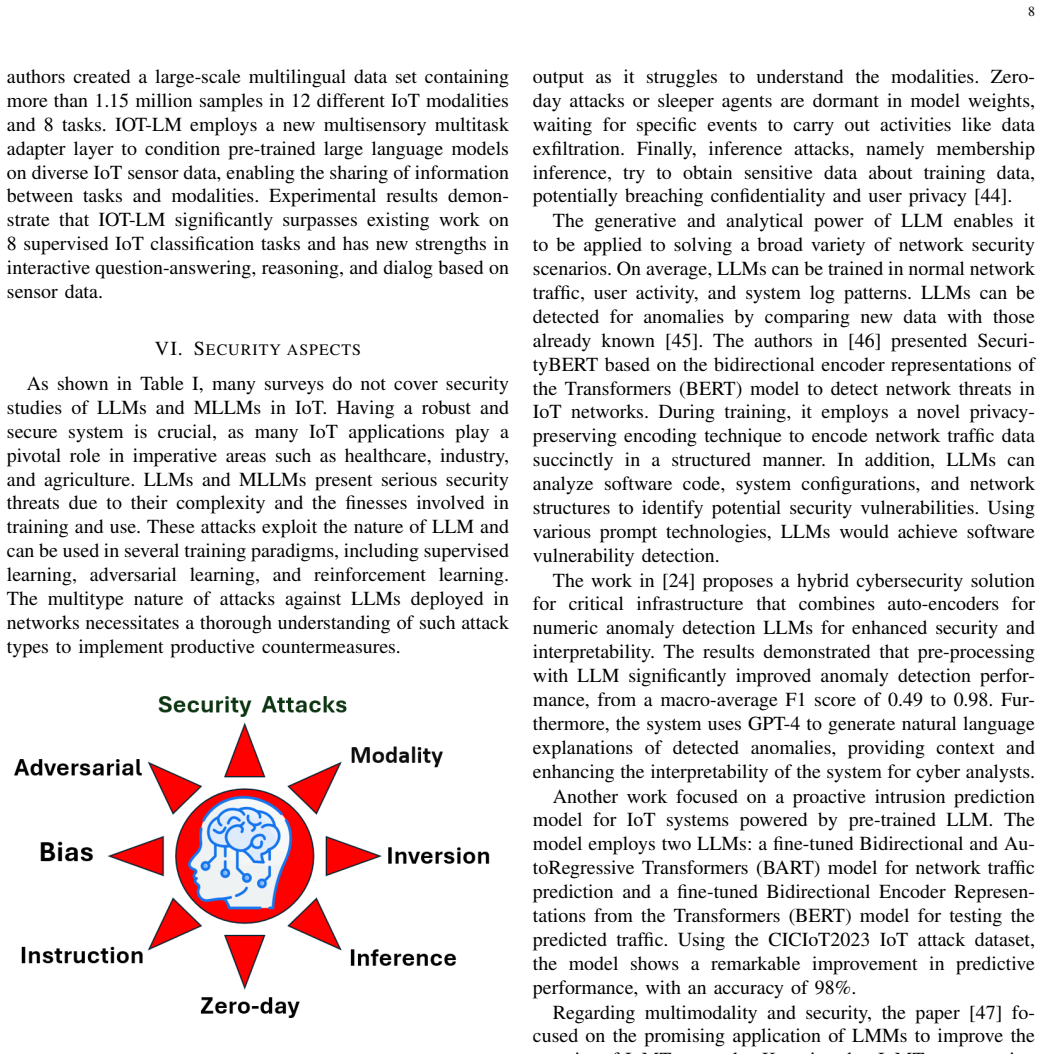
- Security concerns would expand from data-level attacks to model-level attacks, including prompt injection, backdoors, and modality-conflict attacks.
- New application domains, such as adaptive education and immersive entertainment, would emerge from the same multimodal convergence.
Reading between the lines
- The four-pillar taxonomy suggests a missing benchmark: currently no standard evaluation measures an MLLM's joint performance across sensing, communication, processing, and security on the same IoT platform; building one would test the survey's integration thesis directly.
- If semantic communication proves effective, it may partially decouple the argument from the most extreme 6G targets, since transmitting meaning rather than raw data could work on less powerful links than 1 Tbps.
- The security section implies a concrete vulnerability class: cross-modal contradictions in IoT data could be used to trigger hallucinations or incorrect actions, and a test suite of conflicting image, audio, and text inputs would quantify that risk.
- The paper's dependence on 6G projections could be stress-tested by comparing a representative multimodal IoT application on a 5G-class link and a 6G-like low-latency link; if outcomes do not materially differ, the 6G-driven case weakens.
Signed reviews
Editorial analysis
A structured set of objections, weighed in public.
Referee Report
Summary. This survey paper examines the potential integration of the Internet of Things (IoT) and Multimodal Language Models (MLLMs) in future 6G networks. It reviews application domains (healthcare, agriculture, smart cities, industry, education) and organizes the discussion around four pillars: sensors, communication, data processing, and security. The paper argues that synergistic bundling of IoT, MLLMs, and 6G will overcome current IoT limitations, and it lists open challenges and future research directions, including hardware constraints, scalability, privacy, and quantum-enhanced models. The survey positions itself as the first to integrate these three topics, comparing itself with 15 existing surveys.
Significance. If the roadmap's qualitative claims hold, the survey provides a useful organizing framework for a rapidly expanding interdisciplinary area, and its coverage of security aspects and application taxonomy is a genuine service to newcomers. The paper is a secondary source and offers no new experimental evidence or quantitative analysis, but that is typical for surveys. Its main value lies in the breadth of references and the structuring of open problems. However, the paper's central argument that 6G will remove communication bottlenecks relies on factual claims about 6G performance that are partly inaccurate and, in any case, are not substantiated by a quantitative requirement analysis. The survey also contains internal tensions between its proposed edge-cloud architecture and its acknowledgment of latency limitations. These issues must be resolved before the paper can serve as a reliable roadmap.
major comments (4)
- [Section I-B2, Table II] The paper presents 6G targets as settled facts: Table II lists a data rate of 1 Tbps, frequency of 1000 GHz, and latency of <1 ms. The frequency entry of '1000 GHz' is not an established IMT-2030 requirement; it conflates sub-THz research bands (e.g., 92-114 GHz or up to 300 GHz) with a single exaggerated figure. Similarly, the claim in Section I that 'an estimated 100 billion IoT connections will be established by 2025' is outdated and not supported by current industry data. Since Section IV-A relies on 6G capabilities to justify the paper's central claim, these factual inaccuracies in a core table undermine the survey's credibility. The authors should correct the table, present 6G targets as projections from specific sources, and avoid treating aspirational research goals as established requirements.
- [Section IV-A] The paper never quantifies the communication requirements of the proposed MLLM-IoT workloads. It lists qualitative factors (processing location, data modality, application requirements) but does not provide bandwidth or latency budgets for the flagship applications discussed in Section II, such as remote health monitoring or autonomous driving. At the same time, Section IV-A states that edge computing reduces bandwidth consumption 'to a large extent' and that on-device processing can 'limit communication to simple commands, the absolute minimum.' This directly undercuts the paper's implicit premise that 6G's headline data rates are necessary. The central argument should be reframed: the paper could argue that 6G is beneficial for scenarios where edge/on-device processing is insufficient, but as written it does not establish that 1 Tbps or <1 ms is either necessary or sufficient for the proposed applications. A rough quantitative analysis or at least a clear statement of which scenarios require which capabilities is needed.
- [Section VII-A1 and Section V] The paper proposes a hierarchical edge-cloud MLLM architecture in Section V (Tiny Edge MLLMs and Advanced Cloud MLLMs), but Section VII-A1 later concedes that 'edge-cloud collaborative systems and hierarchical LLM chains, often bring in latency problems that detract from real-time performance.' These two claims are in direct tension. The authors should reconcile them, for example by discussing the trade-offs of model compression, split inference, or caching strategies, and explain under what conditions the proposed architecture meets real-time constraints. Without this, the feasibility of the central roadmap is questioned by the paper's own challenge analysis.
- [Section I-A, Table I] The novelty claim that 'we did not find any survey articles that addressed the collective potential of multimodal language models in the 6G-enabled IoT paradigm' is a strong negative assertion. Table I compares only 15 surveys, and the criteria used to mark X/check marks appear to be applied without explicit definitions. This makes the uniqueness claim difficult to verify. The authors should state their search methodology (databases, keywords, time range) and phrase the claim more cautiously (e.g., 'to the best of our knowledge'). This is particularly important because the survey's contribution is primarily as a position statement rather than a novel technical result.
minor comments (6)
- [Abstract] The first sentence, 'Based on recent trends in artificial intelligence and IoT research,' is a sentence fragment. It should be combined with the second sentence or rewritten as a complete sentence.
- [Section IV-B (reference [41])] 'ChatGPT-40' should be 'ChatGPT-4o' (the model name is '4o', not '40').
- [Section VI] The phrase 'the finesses involved in training and use' is awkward; consider 'the subtle complexities involved in training and use'.
- [List of Acronyms] The acronym 'LLM' is listed twice with the same definition. Remove the duplicate.
- [Section VII-C2] The phrase 'the paragraph recognizes' is unclear; it refers to the cited work [15], so it should be 'the authors of [15] note' or similar.
- [Section I-B1] The phrase 'unbearable pressure on networking' is informal; consider 'significant strain' or 'severe load'.
Circularity Check
No circularity found: the paper is a survey with no derivations, fitted parameters, or self-citation chain to reduce.
full rationale
This manuscript is a narrative survey rather than a derivation or empirical study. It contains no equations, no fitted parameters, and no quantitative claim that is constructed from its own inputs. The central thesis, that synergistically bundling IoT, MLLMs, and 6G can go beyond current IoT limits, is supported by citing external prior work (e.g., [5], [6], [30], [43]) and by qualitative discussion of applications, challenges, and future directions; it is not derived from the paper's own definitions or results. Table I's comparison with related surveys is a scope-positioning statement, not a circularity: claiming that no prior survey covers the same combination of topics is a factual survey claim, and even if it were debatable, it does not make the survey's substantive content equivalent to its inputs. The paper does not invoke a uniqueness theorem from its own authors, and there are no self-citations that carry load-bearing weight. Reliance on Table II's 6G targets (1 Tbps, <1 ms, 1000 GHz) is an external-evidence concern about unverified industry projections, not circular reasoning, because those targets are not derived from the paper's own model or fitted to its conclusions. No step in the paper reduces by construction to its inputs, so the appropriate finding is no significant circularity.
Assumptions & free parameters
assumptions (2)
- domain assumption 6G will deliver the capabilities listed in Table II (1 Tbps data rate, <1 ms latency, 1000 GHz frequency, global coverage, intelligent connections) within the projected timeline.
- domain assumption MLLM inference can be made lightweight enough for resource-constrained IoT devices (via compression, partitioning, edge-cloud collaboration) without unacceptable accuracy loss.
Cite this review
Pith. "Pith review of The Future of Internet of Things and Multimodal Language Models in 6G Networks: Opportunities and Challenges." pith.science (2026). https://pith.science/paper/S2EEDWTQ
@misc{pith2026250413971,
  author       = {Pith},
  title        = {Pith review of: The Future of Internet of Things and Multimodal Language Models in 6G Networks: Opportunities and Challenges},
  year         = {2026},
  howpublished = {\url{https://pith.science/paper/S2EEDWTQ}},
  note         = {Machine review of arXiv:2504.13971}
}
read the original abstract
Based on recent trends in artificial intelligence and IoT research. The cooperative potential of integrating the Internet of Things (IoT) and Multimodal Language Models (MLLMs) is presented in this survey paper for future 6G systems. It focuses on the applications of this integration in different fields, such as healthcare, agriculture, and smart cities, and investigates the four pillars of IoT integration, such as sensors, communication, processing, and security. The paper provides a comprehensive description of IoT and MLLM technologies and applications, addresses the role of multimodality in each pillar, and concludes with an overview of the most significant challenges and directions for future research. The general survey is a roadmap for researchers interested in tracing the application areas of MLLMs and IoT, highlighting the potential and challenges in this rapidly growing field. The survey recognizes the need to deal with data availability, computational expense, privacy, and real-time processing to harness the complete potential of IoT, MLLM, and 6G technology
Figures


Figures from the paper (5 more)


Reference graph
Works this paper leans on
-
[1]
R. A. R. A. Mouha et al. , “Internet of things (iot),” Journal of Data Analysis and Information Processing , vol. 9, no. 02, p. 77, 2021
work page 2021
-
[2]
The internet of things: Mapping the value beyond the hype,
J. Manyika, M. Chui, P. Bisson, J. Woetzel, R. Dobbs, J. Bughin, and D. Aharon, “The internet of things: Mapping the value beyond the hype,” 2015
work page 2015
-
[3]
Future applications and research challenges of iot,
H. U. Rehman, M. Asif, and M. Ahmad, “Future applications and research challenges of iot,” in 2017 International conference on infor- mation and communication technologies (ICICT) . IEEE, 2017, pp. 68–74
work page 2017
-
[4]
6g comprehensive intelligence: network operations and optimization based on large language models,
S. Long, F. Tang, Y . Li, T. Tan, Z. Jin, M. Zhao, and N. Kato, “6g comprehensive intelligence: network operations and optimization based on large language models,” IEEE Network , 2024
work page 2024
-
[5]
Pushing large language models to the 6g edge: Vision, challenges, and opportunities,
Z. Lin, G. Qu, Q. Chen, X. Chen, Z. Chen, and K. Huang, “Pushing large language models to the 6g edge: Vision, challenges, and opportunities,” arXiv preprint arXiv:2309.16739 , 2023
arXiv 2023
-
[6]
T. C. Ho, F. Kharrat, A. Abid, F. Karray, and A. Koubaa, “Remoni: An autonomous system integrating wearables and multimodal large language models for enhanced remote health monitoring,” in 2024 IEEE International Symposium on Medical Measurements and Applications (MeMeA). IEEE, 2024, pp. 1–6
work page 2024
-
[7]
Llms and iot: A comprehensive survey on large language models and the internet of things,
F. Sarhaddi, N. T. Nguyen, A. Zuniga, P. Hui, S. Tarkoma, H. Flores, and P. Nurmi, “Llms and iot: A comprehensive survey on large language models and the internet of things,” TechRxiv, 2025
work page 2025
-
[8]
Lgvlm-miot: A lightweight generative visual-language model for multilingual iot ap- plications,
Y . Weng, K. Yang, Z. Liu, W. He, and X. Tang, “Lgvlm-miot: A lightweight generative visual-language model for multilingual iot ap- plications,” IEEE Internet of Things Journal , 2025
work page 2025
Show all 50 references
-
[9]
Interfacing multi-modal ai with iot: Unlocking new frontiers,
S. Delsi Robinsha and B. Amutha, “Interfacing multi-modal ai with iot: Unlocking new frontiers,” in Multimodal Generative AI. Springer, 2025, pp. 323–346
2025
-
[10]
A survey on large language models for communication, network, and service management: Application insights, challenges, and future directions,
G. O. Boateng, H. Sami, A. Alagha, H. Elmekki, A. Hammoud, R. Mi- zouni, A. Mourad, H. Otrok, J. Bentahar, S. Muhaidat et al. , “A survey on large language models for communication, network, and service management: Application insights, challenges, and future directions,” arXi...
2024 arXiv
-
[11]
A review of iot convergence in healthcare and smart cities: Challenges, innovations, and future perspectives,
A. U. Nabi, T. SNOUSSI, and Z. A. Abdalkareem, “A review of iot convergence in healthcare and smart cities: Challenges, innovations, and future perspectives,” Babylonian Journal of Internet of Things , vol. 2023, pp. 23–30, 2023
2023
-
[12]
Mm-llms: Recent advances in multimodal large language models,
D. Zhang, Y . Yu, J. Dong, C. Li, D. Su, C. Chu, and D. Yu, “Mm-llms: Recent advances in multimodal large language models,” arXiv preprint arXiv:2401.13601, 2024
2024 arXiv
-
[13]
Mobile edge intelligence for large language models: A contemporary survey,
G. Qu, Q. Chen, W. Wei, Z. Lin, X. Chen, and K. Huang, “Mobile edge intelligence for large language models: A contemporary survey,” IEEE Communications Surveys & Tutorials , 2025. Acronym Description LLM Large language model IoT Internet of Things MLLM Multimodal Language Mode...
2025
-
[14]
The revolution of multimodal large language models: a survey,
D. Caffagni, F. Cocchi, L. Barsellotti, N. Moratelli, S. Sarto, L. Baraldi, M. Cornia, and R. Cucchiara, “The revolution of multimodal large language models: a survey,” arXiv preprint arXiv:2402.12451 , 2024
2024
-
[15]
From large language models to large multimodal models: A literature review,
D. Huang, C. Yan, Q. Li, and X. Peng, “From large language models to large multimodal models: A literature review,”Applied Sciences, vol. 14, no. 12, p. 5068, 2024
2024
-
[16]
Large language models meet next-generation networking technologies: A review,
C.-N. Hang, P.-D. Yu, R. Morabito, and C.-W. Tan, “Large language models meet next-generation networking technologies: A review,” Fu- ture Internet, vol. 16, no. 10, p. 365, 2024
2024
-
[17]
Multi-modal llms in agriculture: A comprehensive review,
R. Sapkota, R. Qureshi, S. Z. Hassan, J. Shutske, M. Shoman, M. Sajjad, F. A. Dharejo, A. Paudel, J. Li, Z. Meng et al. , “Multi-modal llms in agriculture: A comprehensive review,” Authorea Preprints, 2024
2024
-
[18]
How to bridge the gap between modalities: A comprehensive survey on multimodal large language model,
S. Song, X. Li, S. Li, S. Zhao, J. Yu, J. Ma, X. Mao, and W. Zhang, “How to bridge the gap between modalities: A comprehensive survey on multimodal large language model,” arXiv preprint arXiv:2311.07594, 2023
2023 arXiv
-
[19]
Multimodal interaction systems based on internet of things and augmented reality: A systematic literature review,
J. C. Kim, T. H. Laine, and C. ˚Ahlund, “Multimodal interaction systems based on internet of things and augmented reality: A systematic literature review,” Applied Sciences , vol. 11, no. 4, p. 1738, 2021
2021
-
[20]
Edge intelligence: Edge computing for 5g and the internet of things,
Y . Zhou and X. Chen, “Edge intelligence: Edge computing for 5g and the internet of things,” p. 101, 2025
2025
-
[21]
Tiny language models for automation and control: Overview, potential applications, and future research directions,
I. Lamaakal, Y . Maleh, K. El Makkaoui, I. Ouahbi, P. Pławiak, O. Al- farraj, M. Almousa, and A. A. Abd El-Latif, “Tiny language models for automation and control: Overview, potential applications, and future research directions,” Sensors, vol. 25, no. 5, p. 1318, 2025
2025
-
[22]
Multimodal large language model-based fault detection and diagnosis in context of industry 4.0,
K. M. Alsaif, A. A. Albeshri, M. A. Khemakhem, and F. E. Eassa, “Multimodal large language model-based fault detection and diagnosis in context of industry 4.0,” Electronics, vol. 13, no. 24, p. 4912, 2024
2024
-
[23]
Towards artificial general intelligence (agi) in the internet of things (iot): Opportunities and challenges,
F. Dou, J. Ye, G. Yuan, Q. Lu, W. Niu, H. Sun, L. Guan, G. Lu, 11 G. Mai, N. Liu et al. , “Towards artificial general intelligence (agi) in the internet of things (iot): Opportunities and challenges,” arXiv preprint arXiv:2309.07438, 2023
2023 arXiv
-
[24]
Enhanc- ing cybersecurity in critical infrastructure with llm-assisted explainable iot systems,
A. Ghimire, G. Ghajari, K. Gurung, L. K. Sah, and F. Amsaad, “Enhanc- ing cybersecurity in critical infrastructure with llm-assisted explainable iot systems,” arXiv preprint arXiv:2503.03180 , 2025
2025
-
[25]
Y . Wu, S. Singh, T. Taleb, A. Roy, H. S. Dhillon, M. R. Kanagarathinam, and A. De, 6G mobile wireless networks . Springer, 2021
2021
-
[26]
Innovative trends in the 6g era: A comprehensive survey of architecture, applications, technologies, and challenges,
V . K. Quy, A. Chehri, N. M. Quy, N. D. Han, and N. T. Ban, “Innovative trends in the 6g era: A comprehensive survey of architecture, applications, technologies, and challenges,” IEEE Access , vol. 11, pp. 39 824–39 844, 2023
2023
-
[27]
The road towards 6g: A comprehensive survey,
W. Jiang, B. Han, M. A. Habibi, and H. D. Schotten, “The road towards 6g: A comprehensive survey,” IEEE Open Journal of the Communications Society , vol. 2, pp. 334–366, 2021
2021
-
[28]
Age-of-information for murllc over 6g multimedia wireless networks,
X. Zhang, Q. Zhu, and H. V . Poor, “Age-of-information for murllc over 6g multimedia wireless networks,” in 2021 55th Annual Conference on Information Sciences and Systems (CISS) . IEEE, 2021, pp. 1–6
2021
-
[29]
Attention is all you need,
A. Vaswani, N. Shazeer, N. Parmar, J. Uszkoreit, L. Jones, A. N. Gomez, Ł. Kaiser, and I. Polosukhin, “Attention is all you need,” Advances in neural information processing systems , vol. 30, 2017
2017
-
[30]
Large language models empower multimodal integrated sensing and communication,
L. Cheng, H. Zhang, B. Di, D. Niyato, and L. Song, “Large language models empower multimodal integrated sensing and communication,” IEEE Communications Magazine , 2025
2025
-
[31]
How multimodal ai and iot are shaping the future of intelligence,
S. M. Tharayil, M. Krishnapriya, and N. K. Alomari, “How multimodal ai and iot are shaping the future of intelligence,” in Internet of Things and Big Data Analytics for a Green Environment . Chapman and Hall/CRC, 2025, pp. 138–167
2025
-
[32]
Palm- e: an embodied multimodal language model,
D. Driess, F. Xia, M. S. M. Sajjadi, C. Lynch, A. Chowdhery, B. Ichter, A. Wahid, J. Tompson, Q. Vuong, T. Yu, W. Huang, Y . Chebotar, P. Sermanet, D. Duckworth, S. Levine, V . Vanhoucke, K. Hausman, M. Toussaint, K. Greff, A. Zeng, I. Mordatch, and P. Florence, “Palm- e: an e...
2023
-
[33]
Large language models and foundation models in smart agriculture: Basics, opportunities, and challenges,
J. Li, M. Xu, L. Xiang, D. Chen, W. Zhuang, X. Yin, and Z. Li, “Large language models and foundation models in smart agriculture: Basics, opportunities, and challenges,” arXiv preprint arXiv:2308.06668 , 2023
2023 arXiv
-
[34]
Extended agriculture-vision: An extension of a large aerial image dataset for agricultural pattern analysis,
J. Wu, D. Pichler, D. Marley, D. Wilson, N. Hovakimyan, and J. Hobbs, “Extended agriculture-vision: An extension of a large aerial image dataset for agricultural pattern analysis,” arXiv preprint arXiv:2303.02460, 2023
2023 arXiv
-
[35]
Lstm-rasa based agri farm assistant for farmers,
N. Darapaneni, S. Raj, V . Sivaraman, S. Mohan, A. R. Paduri et al. , “Lstm-rasa based agri farm assistant for farmers,” arXiv preprint arXiv:2204.09717, 2022
2022 arXiv
-
[36]
Using multimodal large language models for automated detection of traffic safety critical events,
M. A. Tami, H. I. Ashqar, and M. Elhenawy, “Using multimodal large language models for automated detection of traffic safety critical events,” 2024. [Online]. Available: https://arxiv.org/abs/2406.13894
2024 arXiv
-
[37]
Drive as you speak: Enabling human-like interaction with large language models in au- tonomous vehicles,
C. Cui, Y . Ma, X. Cao, W. Ye, and Z. Wang, “Drive as you speak: Enabling human-like interaction with large language models in au- tonomous vehicles,” in Proceedings of the IEEE/CVF Winter Conference on Applications of Computer Vision , 2024, pp. 902–909
2024
-
[38]
Foundation models for cps- iot: Opportunities and challenges,
O. Baris, Y . Chen, G. Dong, L. Han, T. Kimura, P. Quan, R. Wang, T. Wang, T. Abdelzaher, M. Berg ´es et al. , “Foundation models for cps- iot: Opportunities and challenges,” arXiv preprint arXiv:2501.16368 , 2025
2025 arXiv
-
[39]
Model collaboration at network edge: Feature-large models for real-time iot communications,
X. Yu, S. Zhang, H. Zhang, and L. Song, “Model collaboration at network edge: Feature-large models for real-time iot communications,” IEEE Internet of Things Journal , 2024
2024
-
[40]
Multimodal large language models driven privacy-preserving wireless semantic communication in 6g,
D. Cao, J. Wu, and A. K. Bashir, “Multimodal large language models driven privacy-preserving wireless semantic communication in 6g,” in 2024 IEEE International Conference on Communications Workshops (ICC Workshops). IEEE, 2024, pp. 171–176
2024
-
[41]
A cloud-edge collabora- tive architecture for multimodal llms-based advanced driver assistance systems in iot networks,
Y . Hu, D. Ye, J. Kang, M. Wu, and R. Yu, “A cloud-edge collabora- tive architecture for multimodal llms-based advanced driver assistance systems in iot networks,” IEEE Internet of Things Journal , 2024
2024
-
[42]
When iot meet llms: Applications and challenges,
˙I. K ¨ok, O. Demirci, and S. ¨Ozdemir, “When iot meet llms: Applications and challenges,” in 2024 IEEE International Conference on Big Data (BigData). IEEE, 2024, pp. 7075–7084
2024
-
[43]
Iot-lm: Large multisensory language models for the internet of things,
S. Mo, R. Salakhutdinov, L.-P. Morency, and P. P. Liang, “Iot-lm: Large multisensory language models for the internet of things,” arXiv preprint arXiv:2407.09801, 2024
2024 arXiv
-
[44]
Pathway to secure and trustworthy 6g for llms: Attacks, defense, and opportunities,
S. A. Khowaja, P. Khuwaja, K. Dev, H. A. Hamadi, and E. Zeydan, “Pathway to secure and trustworthy 6g for llms: Attacks, defense, and opportunities,” arXiv preprint arXiv:2408.00722 , 2024
2024 arXiv
-
[45]
Large language models and artificial intelligence generated content technologies meet communication networks,
J. Guo, M. Wang, H. Yin, B. Song, Y . Chi, F. R. Yu, and C. Yuen, “Large language models and artificial intelligence generated content technologies meet communication networks,” IEEE Internet of Things Journal, 2024
2024
-
[46]
Revolutionizing cyber threat detection with large language models: A privacy-preserving bert-based lightweight model for iot/iiot devices,
M. A. Ferrag, M. Ndhlovu, N. Tihanyi, L. C. Cordeiro, M. Debbah, T. Lestable, and N. S. Thandi, “Revolutionizing cyber threat detection with large language models: A privacy-preserving bert-based lightweight model for iot/iiot devices,” 2024. [Online]. Available: https://arxiv...
2024 arXiv
-
[47]
Enhancing iomt security using large multimodal models,
Y . Jiao, M. M. Razaq, L. Peng, and P.-H. Ho, “Enhancing iomt security using large multimodal models,” IEEE Network , 2025
2025
-
[48]
When machine learning meets spectrum sharing security: Methodologies and challenges,
Q. Wang, H. Sun, R. Q. Hu, and A. Bhuyan, “When machine learning meets spectrum sharing security: Methodologies and challenges,” IEEE Open Journal of the Communications Society , vol. 3, pp. 176–208, 2022
2022
-
[49]
The power of scale for parameter-efficient prompt tuning,
B. Lester, R. Al-Rfou, and N. Constant, “The power of scale for parameter-efficient prompt tuning,” arXiv preprint arXiv:2104.08691 , 2021
2021 arXiv
-
[50]
Towards provably efficient quantum algorithms for large-scale machine-learning models,
J. Liu, M. Liu, J.-P. Liu, Z. Ye, Y . Wang, Y . Alexeev, J. Eisert, and L. Jiang, “Towards provably efficient quantum algorithms for large-scale machine-learning models,” Nature Communications , vol. 15, no. 1, p. 434, 2024
2024
Reviewed August 16, 2026 · model on record in the stance chip above.
Discussion (0). Continue with ORCID to comment.