REVIEW 5 major objections 5 minor 78 references
Discharge structure theory of highly electronegative plasma and its hierarchy and interdisciplinary meanings
T0 review · 5 major / 5 minor · reviewed 2026-08-16 · deepseek-v4-flash
Pith's one-line read A single ratio organizes electronegative Ar/SF6 discharge into three regimes, with negative ions coagulating into localized peaks when recombination dominates.
desk verdict A real fluid simulation with an honest review of the classical parabola/ellipse theory, but the central self-coagulation derivation contradicts its own equations and the non-Boltzmann claim is fitted, not derived. read the letter →
The pith
A machine-rendered reading of the paper's core claim, the machinery that carries it, and where it could break.
The reading
What carries the argument
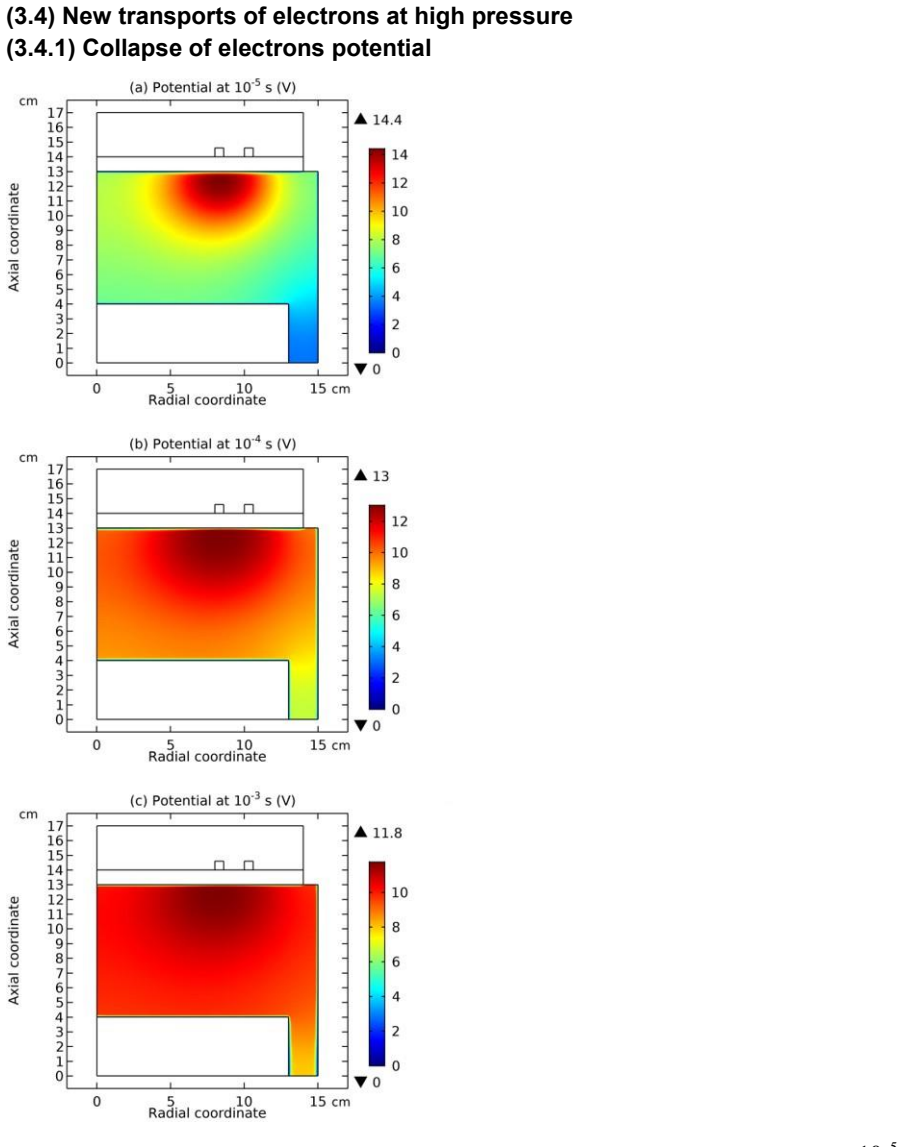
The load-bearing object is the parameter $\eta$ (Eq. 78), the ratio of twice the recombination rate to the combined ionization and attachment rates; its value selects the transport-dominated ($\eta<1$), balanced ($\eta\to 1$), and chemistry-dominated ($\eta>1$) regimes. In the chemistry-dominated regime the central equation is the quasi-Helmholtz equation $\nabla^2 n_- - k^2 n_- = 0$, with $k^2 = \nu_{rec}/D_-$, obtained from the anion continuity equation after the ambipolar diffusion potential collapses, leaving free diffusion balanced by a negative recombination source. Its formal solution is a product of a sinusoidal axial eigenfunction and an imaginary Bessel function $I_0$, which the paper collapses to a delta distribution using the limit $\lim_{z\to 0} 1/z$ together with the divergence of $I_0$. That delta is the 'astro-structure' embedded in the parabola or ellipse background.
What would settle it
Evaluate the eigenfunction series in Eq. (105) at finite order without invoking the invented limit: a genuine self-coagulation should sharpen toward the delta as the order grows, whereas a spurious artifact would show the peak height bounded or oscillating. In the laboratory, image the anion density and map the plasma potential simultaneously across 10 to 90 mTorr; the spike should appear only where the local potential is flat and the local ratio exceeds one.
Extended reading notes
Core claim
The central claim is that the full hierarchy of discharge structures in a highly electronegative inductively coupled Ar/SF6 plasma—parabola with stratification, ellipse without stratification, and self-coagulated anion peaks—is organized by the single parameter $\eta$ defined in Eq. (78). In the low-pressure regime the simulations reproduce the classical parabola profile, Boltzmann-distributed anions, a weighted ambipolar diffusion potential of order hundreds of kelvin, and a double layer that acts as a capacitor macroscopically and a dipole microscopically, with the whole plasma an open system coupled to the chamber wall. As the pressure rises and $\eta\to 1$, recombination can be rewritten as a drift flux that counteracts ambipolar diffusion, producing an elliptic density profile with a flattened center and steep edge, while the double layer and electropositive halo shrink; the system is then effectively closed. When $\eta>1$, recombination dominates the anion balance, the ambipolar potential collapses, and the anion continuity equation reduces to a quasi-Helmholtz equation whose formal solution is a delta distribution localized in the core or under the coil. The authors read the same weak electron self-coagulation at high pressure as a non-Boltzmann electron balance and a new quasi-chemical potential.
Load-bearing premise
The delta-shaped self-coagulation solution depends on the premise that at the coagulation site the ambipolar diffusion potential has collapsed completely, so anions transport by free diffusion alone, and that the series-to-delta limit using $\lim_{z\to 0} 1/z$ with the divergent imaginary Bessel function is a legitimate mathematical operation; if the potential collapse is incomplete or the limit is invalid, the predicted localized spike is not a consequence of the stated physics.
Editorial extensions
If this is right
- In the transport-dominated regime, the model reproduces the classical parabola profile, stratification into electronegative core and electropositive halo, and a double layer; the plasma is an open system that needs chamber walls for particle loss.
- When the ratio approaches one, the profile becomes elliptic with a flattened center and steep edge; the double layer and halo shrink enough that the plasma can be treated as a closed, self-balanced system.
- When the ratio exceeds one, negative ions self-coagulate into localized delta-shaped peaks, and those peaks are always embedded in a parabolic or elliptic background rather than standing alone.
- The same physical mechanism, applied weakly to electrons at 90 mTorr, yields a quasi-chemical potential, a collapsed electron potential, and a non-Boltzmann electron density balance.
- Because the regime is selected by a single ratio of reaction rates, the theory gives a practical criterion for predicting when localized negative-ion structures will appear.
Reading between the lines
- The sharp delta prediction provides a natural test of the continuum approximation: if the spike is real, a kinetic or particle simulation should exhibit a strongly localized but finite-width peak rather than a mathematical divergence.
- The same ratio, computed from local densities and rate constants, should predict transition pressures in other electronegative gas mixtures, such as Ar/O2 or Ar/CF4, provided the chemistry set is rescaled.
- The analogy between recombination-plus-diffusion localization and gravitational collapse suggests a general reaction-diffusion mechanism: any quadratic loss term balanced by free diffusion can concentrate density into a localized structure. That mechanism could be tested in a simpler experimental reaction-diffusion system without plasma.
- If the potential collapse is incomplete in a real experiment, the predicted spikes may be broader or absent; measuring the local plasma potential while imaging the anion peak would separate transport-limited from chemistry-limited coagulation.
Signed reviews
Editorial analysis
A structured set of objections, weighed in public.
Referee Report
Summary. This manuscript develops a fluid-model-based theory of discharge structure in a highly electronegative Ar/SF6 inductively coupled plasma. Using a two-dimensional finite-element simulation with a 58-reaction chemistry set, the authors classify the discharge into three regimes according to a parameter η defined in Eq. (78): transport-dominated (η<1, parabolic profiles), transport-chemistry self-balanced (η→1, elliptical profiles), and chemistry-dominated (η>1), in which negative ions allegedly self-coagulate into delta-shaped 'astro-structures' described by a quasi-Helmholtz equation with free diffusion and a negative chemical source. The paper also claims that at high pressure the electrons deviate from Boltzmann balance and that the hierarchy of discharge structures has interdisciplinary analogues in astrophysics, geophysics, and nuclear and quantum physics.
Significance. If the central derivation were correct, the paper would offer a useful classification and a predictive criterion for anion localization in electronegative plasmas. The simulation is substantial: it couples Maxwell, Poisson, and multispecies transport with a realistic SF6/Ar reaction set, and the analytic reduction to the classical parabola and ellipse profiles in Secs. 3.1-3.2 is a useful synthesis. However, the self-coagulation delta solution is not a valid consequence of the stated equations, the η criterion is constructed from the same simulation inputs it claims to predict, and the non-Boltzmann electron claim rests on a tunable fit. The manuscript contains no machine-checked proofs or reproducible code, and the authors state explicitly in Sec. I that no experiments have yet validated the new structures.
major comments (5)
- [Sec. 3.3.3, Eqs. (99)-(106)] The derivation of the delta-shaped self-coagulation solution is mathematically invalid. Equations (99)-(101) define the modified Helmholtz operator ∇²n - k²n = 0 with k² = ν_rec/D; on the bounded cylindrical chamber with the zero-density wall conditions used for anions, the only C² solution is n ≡ 0. The separated solution in Eqs. (102)-(105) uses I₀(√(k²+ν_m²)ρ) sin(mπz/l), but I₀ is positive and monotonically increasing in ρ, so it cannot satisfy a zero Dirichlet condition at the radial wall; the required radial eigenfunctions for this operator do not exist. In Eq. (106), the divergence of I₀ as m→∞ is replaced by the invented limit lim_{z→0} 1/z, which is not a distributional limit (1/z is not locally integrable and does not converge to δ), and the interchange of limits in m and z is unjustified. A δ-source term would be needed on the right-hand side of Eq. (99) to produce a localized spike, but no such term is present. Consequently, the predicted η>1 chemistry-dominated regime and its delta-type structures are not consequences of the stated equations.
- [Sec. 3.3.3, Eq. (99); Sec. 3.3.5, Eqs. (119)-(122)] The linearization of the recombination sink from n₊n₋ to -ν_rec n₋ is unjustified. At the alleged coagulation site the anion density is maximal, so the quadratic loss term cannot be replaced by a linear term; without this linearization the quasi-Helmholtz form of Eq. (100) does not follow. In Sec. 3.3.5, the conclusion that inertia 'disappears' is reached by setting the right-hand side of Eq. (120) to zero and then requiring the left-hand side to vanish; this is a restatement of the steady-state condition, not a mechanistic derivation of a tight self-balance.
- [Sec. 3.2.3, Eqs. (90)-(98)] The transformation of recombination into an effective drift flux is a dimensional rearrangement rather than a derivation. Equation (93) defines Γ_{d,eff} = μ₊n₊E_eff without specifying how E_eff is determined; the dimension check in Eq. (96) only shows that the combination has the units of a loss rate, and Eq. (95) removes the term proportional to ∇n₊ by assumption. The conclusion that recombination balances ambipolar diffusion in the ellipse regime is therefore an interpretation placed on the simulated profiles, not a consequence of the equations.
- [Sec. 3.2.1, Eq. (78); Sec. 3.3] The organizing parameter η of Eq. (78) is computed from the same rate coefficients and density fields used in the fluid simulation. The introduction states that the ratio 'somehow determines' the discharge structure, and the paper then divides the simulated cases into η<1, η→1, and η>1. This is a classification of model output by model inputs; it does not provide an independent predictive test. A predictive criterion would express η in terms of externally controlled parameters such as pressure, power, and gas composition without importing the simulated densities.
- [Sec. 3.4.3, Fig. 19] The claim that electrons deviate from Boltzmann balance is not supported by the presented comparison. The electron temperature in the exponential is freely tuned until the maxima of the exponential and the simulated density coincide; with an adjustable temperature, a Boltzmann-like curve can always be made to agree at selected points. The fitted temperatures 3.56, 3.73, and 3.66 eV are not independently constrained, so the comparison does not falsify the Boltzmann relation. An independent measure of T_e, or a fit over the full profile with fixed transport coefficients, is needed.
minor comments (5)
- [Throughout] The manuscript contains many equations with garbled or unreadable symbols, for example Eqs. (22), (55), (76)-(84), and (106); a cleanly typeset version with all variables defined is essential for evaluation.
- [Sec. 3.3.6] The interdisciplinary analogies involving white dwarfs, neutron stars, Earth's core, mesotrons, and wave-particle duality are not derived from the model and are stated too strongly; for example, the claim that 'precursor of our earth is probably the electronegative and laboratory plasma' goes far beyond the evidence and should be removed or explicitly labeled as speculation.
- [Sec. I] The paper explicitly states that no experiments have yet validated the self-coagulation structures; this limitation should be restated in the conclusions rather than only in the introduction.
- [Secs. 3.1.4(c), 3.3.6(d)] The terms 'quantum property of double layer' and 'wave-particle duality' are not defined operationally; if retained, they need precise mathematical definitions and testable criteria.
- [Fig. 4] The Boltzmann balance of anions could be tested more directly by plotting ln(n₋) versus V over the full path, rather than comparing with an exponential constructed from the potential extremes.
Circularity Check
Central 'self-coagulation delta' is inserted by an invented limit and inherited from same-group citations; supporting Boltzmann and parabola comparisons are fits.
-
self definitional
[Sec. 3.3.3, Eq. (106) and following paragraph]
"So, the invented limit lim(z→0) 1/z, although holding different evolving mathematic behavior with the imaginary Bessel, is used to replace the infinite given by the imaginary Bessel limit."
The quasi-Helmholtz equation (100)-(101) has no delta source term, so the localized spike is not a solution obtained from Eq. (99). The delta distribution is manufactured by replacing the divergent I_0 limit with an invented 1/z limit and then declaring δ(z). Because that limit operation is chosen precisely to produce the singularity, the 'self-coagulation' prediction is equivalent to assuming a delta-shaped peak rather than deriving it from the stated physics. The output is therefore put in by construction.
-
ansatz smuggled in via citation
[Sec. I Introduction, paragraph citing Refs. [24-26]]
"It is shown in the Refs. [24-26] that the coagulated bodies are given by a self-coagulation theory that consists of free diffusion and purely negative chemical source term."
The paper's central third regime is built on the self-coagulation ansatz of free diffusion plus a negative chemical source, which is asserted to have been 'shown' in Refs. [24-26], all authored by the same group. Those references are the origin of the ansatz, so citing them as justification is a self-citation chain rather than independent support. The re-derivation in Sec. 3.3.3 repeats the same ansatz, and the paper itself concedes that experiments have not yet validated self-coagulation.
2 more flagged steps
-
fitted input called prediction
[Sec. 3.4.3, Fig. 19 caption/text]
"The process is the electrons temperature is consistently tuned until the two maxima of exponential function and axial electrons density profile converge. The final electron temperatures that are tuned until satisfying the above requirement are found to be, 3.56 eV , 3.73 eV , and 3.66 eV , respectively, as illustrated in the figure."
The claimed 'non-Boltzmann balance' of electrons is evidenced by an exponential whose electron temperature is tuned to force the maxima to converge with the simulated density maxima. Because the temperature is not predicted by the model but chosen to match the data, the constructed exponential cannot independently confirm or refute Boltzmann's balance; any residual mismatch is a property of the fitted curve, not a test of the physics.
-
fitted input called prediction
[Sec. 3.1.2, Fig. 3 caption]
"Figure 3. (a) Simulated axial profiles of species density and (b) constructed parabola function based on two critical points from the simulated cations density curve, i.e., the peaked point with its coordinates, (8.7, 0.97×10^18), and the truncated close-zero point with its coordinates, (11.4, 0)."
The 'parabola' used to validate the transport-dominated regime is constructed from two data points taken from the simulated cation density curve. With two free parameters, the chosen points match by construction. Presenting this fitted curve as confirmation of the parabola theory reduces the predicted profile to a two-parameter fit rather than an independent prediction.
full rationale
The analytic parabola and ellipse derivations (Secs. 3.1.1 and 3.2.1) are algebraically self-contained: the parameter η emerges from factorization of the integrated cation continuity equation and is not fitted to the profiles, so the η-based regime ordering is not circular by itself. The finite-element fluid simulation is a legitimate self-consistent model. However, the central new result—the delta-shaped self-coagulation in the chemistry-dominated regime—is not derived from the quasi-Helmholtz equation; Eq. (106) manufactures δ(z) by replacing the divergent I_0 limit with an invented 1/z limit, so the singularity is put in by hand. That central premise is also inherited from Refs. [24-26], all same-group works, with no external validation; the paper explicitly states that experiments have not yet validated self-coagulation. Supporting comparisons are partly fitted: the 'parabola' is constructed from two simulated points, and the electron-temperature values in the Boltzmann test are tuned to force the maxima to converge. These are specific reductions, so a score of 7 is warranted: the η-based ordering itself is computed rather than fitted, but the central self-coagulation prediction is effectively defined into existence and reinforced by a self-citation chain.
Assumptions & free parameters
free parameters (4)
- electron temperature in Fig. 19 (tuned) =
3.56 eV, 3.73 eV, 3.66 eV
- central electronegativity alpha_0 =
100.0 (Fig. 9a)
- electron mobility mu_e =
3.3e3 / P (P in mTorr)
- anion temperature T_i =
300 K
assumptions (6)
- domain assumption Electrons and anions satisfy Boltzmann balances in the parabola regime (Eqs. 34-35).
- domain assumption High electronegativity, alpha >> 1, holds throughout the core.
- domain assumption Recombination loss of cations is negligible in the parabola regime.
- domain assumption The inequality |d2n_e/dx2| << gamma |d2n_+/dx2| defines the ellipse regime.
- ad hoc to paper The 'invented limit' lim(z to 0) 1/z replaces the divergence of the modified Bessel function in Eq. (106).
- ad hoc to paper At the self-coagulation site, the ambipolar potential has collapsed so that anions move by free diffusion alone.
invented entities (5)
-
quasi-chemical potential
-
self-coagulation of anions
-
brain heuristically named 'astro-structures' in the plasma
-
blue sheath as mesotrons
-
wave-particle duality model of the discharge
Cite this review
Pith. "Pith review of Discharge structure theory of highly electronegative plasma and its hierarchy and interdisciplinary meanings." pith.science (2026). https://pith.science/paper/5RJBT4YD
@misc{pith2026250414155,
  author       = {Pith},
  title        = {Pith review of: Discharge structure theory of highly electronegative plasma and its hierarchy and interdisciplinary meanings},
  year         = {2026},
  howpublished = {\url{https://pith.science/paper/5RJBT4YD}},
  note         = {Machine review of arXiv:2504.14155}
}
read the original abstract
In this work the systematic theory of discharge structure is built for highly electronegative plasma, by means of self-consistent fluid model simulation that is based on the finite element method. The highly electronegative plasma is selected to be the inductively coupled Ar/SF6 plasma source with 10% the reactive SF6 concentration and in a pressure range of 10~90mTorr. The discharge structure is classified the transport dominated regime, transport and chemistry self-balanced regime and chemistry dominated regime. At low pressure of 10mTorr, the parabola feature of core plasma, stratification of whole discharge area into electronegative core and electropositive halo, anion potential barrel, and the dipole and capacitor models of double layer characterize the discharge structure of transport dominated regime. At increasing the pressure, the recombination loss of ions becomes significant and the discharge structure is characterized by ellipse profile. Meanwhile, the regions of double layer and electropositive halo are strikingly shrunk, which means that the plasma of transport and chemistry self-balanced regime is a close system and probably do not need the shield of chamber anymore. The dimensional analysis shows the recombination can be transformed into drift flux, which balances the ambi-polar diffusion of plasma species. In the range of pressure considered, simulation shows astro-structures are inlayed in the parabolic and elliptic profiles. At observing the characteristics of the astro-structures, the self-coagulation theory and quasi-Helmholtz equation are built based on the free diffusion and negative chemical source. This is the chemistry dominated regime and defined as a tight type of self-balance since the inertia is lost automatically in the unsteady state continuity equations of anions after counteracting the diffusion and recombination.
Figures


Figures from the paper (5 more)



Reference graph
Works this paper leans on
-
[1]
Liberman, M.A.; Lichtenberg, A.J. Principles of Plasma Dis charges and Materials processing , 2nd ed.; Wiley-Interscience: New York, America, 2005; pp. 1-6
work page 2005
-
[2]
Physics of Radio-Frequency Plasmas; Cambridge University Press: New York, America, 2011; pp
Chabert, P.; Braithwaite, N. Physics of Radio-Frequency Plasmas; Cambridge University Press: New York, America, 2011; pp. 1-9
work page 2011
-
[3]
Wang, S.; Xu, X.; Wang, Y.N. Numerical investigation of ion energy distribution and ion angle distribution in a dual -frequency capacitively coupled plasma with a hybrid model. Phys. Plasmas 2007, 14, 113501. https://doi.org/10.1063/1.2780136
-
[4]
Fluid simulation of the E-H model transition in inductively coupled plasma
Zhao, S.X., Xu, X., Li, X.C., Wang, Y.N. Fluid simulation of the E-H model transition in inductively coupled plasma. J. Appl. Phys. 2009, 105, 083306. https://doi.org/10.1063/1.3112009
-
[5]
Dynamic investigation of mode transition in inductively coupled plasma with a hybrid model
Zhao, S.X., Gao, F., Wang, Y.N. Dynamic investigation of mode transition in inductively coupled plasma with a hybrid model. J. Phys. D: Appl. Phys. 2009, 42, 225203. https://doi.org/10.1088/0022- 3727/42/22/225203
doi:10.1088/0022- 2009
-
[6]
Modeling electronegative plasma discharges
Lichtenberg, A.J.; Vahedi, V.; Lieberman, M.A. Modeling electronegative plasma discharges. J. Appl. Phys. 1994, 75, 2339-2347. https://doi.org/ 10.1063/1.356252
-
[7]
Modelling plasma discharges at high electronegativity
Lichtenberg, A.J., Kouznetsov, I.G., Lee, Y.T., Lieberman, M.A., Kaganovich, I.D., Tsendin, L.D. Modelling plasma discharges at high electronegativity. Plasma Sources Sci. Technol. 1997, 6, 437-449. https://doi.org/ 10.1088/0963-0252/6/3/022
-
[8]
Internal sheaths in electronegative discharges
Kouznetsov, I.G., Lichtenberg, A.J., Lieberman, M.A. Internal sheaths in electronegative discharges. J. Appl. Phys. 1999, 86, 4142-4153. https://doi.org/ 10.1063/1.371339
Show all 78 references
-
[9]
The physical and mathematical basis of stratification in electronegative plasmas
Lampe, M., Manheimer, W.M., Fernsler, R.F., Slinker S.P., Joyce G. The physical and mathematical basis of stratification in electronegative plasmas. Plasma Sources Sci. Technol. 2004, 13, 1 5-26. https://doi.rog/ 10.1088/0963-0252/13/1/003
2004 doi
-
[10]
M.; Gousset, G.; Touzeau, M
Ferreira, C. M.; Gousset, G.; Touzeau, M. Quasi-neutral theory of positive columns in electronegative gases. J. Phys. D: Appl. Phys. 1988, 21, 1403-1413
1988
-
[11]
G.; Franklin, R
Deniels, P. G.; Franklin, R. N. The positive column in electronegative gases-a boundary layer approach. J. Phys. D: Appl. Phys. 1989, 22, 780-785
1989
-
[12]
G.; Franklin, R
Deniels, P. G.; Franklin, R. N.; Snell, J. The contracted positive column in electronegative gases. J. Phys. D: Appl. Phys. 1990, 23, 823-831
1990
-
[13]
N.; Daniels, P
Franklin, R. N.; Daniels, P. G.; Snell, J. Characteristics of electric discharges in the halogens: the recombination-dominated positive column. J. Phys. D: Appl. Phys. 1993, 26, 1638-1649
1993
-
[14]
Double layers in a modestly collisional electronegative discharge
Sheridan, T.E. Double layers in a modestly collisional electronegative discharge. J. Phys. D: Appl. Phys. 1999, 32, 1761-1767. https://doi.org/ 10.1088/0022-3727/32/15/301
1999 doi
-
[15]
Kinetic model for a low-pressure discharge with negative ions
Chabert, P.; Sheridan, T.E. Kinetic model for a low-pressure discharge with negative ions. J. Phys. D: Appl. Phys. 2000, 33, 1854-1860. https://doi.org/ 10.1088/0022-3727/33/15/315
2000 doi
-
[16]
Are the oscillations found in electronegative plasmas at low pressure an artefact? J
Franklin, R.N.; Snell, J. Are the oscillations found in electronegative plasmas at low pressure an artefact? J. Phys. D: Appl. Phys. 2000, 33, 1990-1995. https://doi.org/ 10.1088/0022-3727/33/16/310
-
[17]
I.; Economou, D
Kolobov, V. I.; Economou, D. J. Ion -ion pl asmas and double layer formation in weakly collisional electronegative discharges. Appl. Phys. Lett. 1998, 72, 656-658
1998
-
[18]
Economou, D. J. Fundamentals of applications of ion-ion plasmas. Appl. Surf. Sci. 2007, 253, 6672-6680
2007
-
[19]
G.; Lichtenberg, A
Kouznetsov, I. G.; Lichtenberg, A. J.; Lieberman, M. A. Modelling electronegative discharges at low pressure. Plasma Sources Sci. Technol. 1996, 5, 662-676
1996
-
[20]
J.; Lieberman, M
Lichtenberg, A. J.; Lieberman, M. A.; Kouznetsov, I. G.; Chung, T. H. Transitions and scaling laws for electronegative discharge models. Plasma Sources Sci. Technol. 2000, 9, 45-56
2000
-
[21]
N.; Snell, J
Franklin, R. N.; Snell, J. The recombination-dominated positive column with finite ion temperature. J. Phys. D: Appl. Phys. 1994, 27, 2102-2106
1994
-
[22]
Ionization by Drift and Ambipolar Electric Field in Electronegative Capacitive Radio Frequency Plasmas
Schulze, J.; Derzsi, A.; Dittmann, K.; Hemke, T.; Meichsner, J.; Donko, Z. Ionization by Drift and Ambipolar Electric Field in Electronegative Capacitive Radio Frequency Plasmas. Phys. Rev. Lett. 2011, 107, 275011. https://doi.org/10.1103/PhysRevLett.107.275001
2011 doi
-
[23]
Experimental Observation and Computational Analysis of Striations in Electronegative Capacitively Coupled Radio -Frequency Plasmas
Liu, Y.X.; Schungel, E.; Korolov, I.; Donko, Z.; Wang, Y.N.; Schulze, J. Experimental Observation and Computational Analysis of Striations in Electronegative Capacitively Coupled Radio -Frequency Plasmas. Phys. Rev. Lett. 2016, 116, 255002. https://doi.org/10.1103/PhysRevLett....
2016 doi
-
[24]
Quasi -delta negative ions density of Ar/O 2 inductively coupled plasma at very low electronegativity
Zhao, S.X. Quasi -delta negative ions density of Ar/O 2 inductively coupled plasma at very low electronegativity. Chin. Phys. B 2021, 30, 055201. https://doi.org/10.1088/1674-1056/abd16a
2021 doi
-
[25]
Delta distribution of electronegative plasma predicted by reformed spring oscillator dynamic equation with dispersing force
Zhao, S.X.; Li, J.Z. Delta distribution of electronegative plasma predicted by reformed spring oscillator dynamic equation with dispersing force. Chin. Phys. B 2021, 30, 055202. https://doi.org/10.1088/1674- 1056/abd166
2021 doi
-
[26]
Tian, Y.; Zhao, S. X. Self -coagulation theory and related comet - and semi -circle-shaped structures in electronegative and gaseous discharging plasmas in the laboratory. Appl. Sci. 2024, 14, 8041
2024
-
[27]
Wu, H. M. Two-dimensional hybrid model simulation and validation for radio frequency inductively coupled oxygen plasma. Plasma Sources Sci. Technol. 2000, 9, 347-352
2000
-
[28]
H.; Liu, W.; Zhang, Y
Wang, Y. H.; Liu, W.; Zhang, Y. R. ; Wang, Y. N. Fluid simulation of inductively coupled Ar/O2 plasmas: comparisons with experiment. Chin. Phys. B, 2015, 24, 095203
2015
-
[29]
L.; Xu, H
Chen, J. L.; Xu, H. J.; Wei, X. L.; Lv, H. Y.; Song, Z. J.; Chen, Z. H. Simulation and experimental research on the parameter distribution of low-pressure Ar/O2 inductively coupled plasma. Vacuum 2017, 145, 77-85
2017
-
[30]
N.; Snell, J
Franklin, R. N.; Snell, J. Fluid model of the collisional positive column in electronegative gases: transition from detachment dominated to recombination dominated. J. Phys. D: Appl. Phys. 2000, 33, 2019-2024
2000
-
[31]
Gudmundsson, J. T. Recombination and detachment in oxygen discharges: the role of metastable oxygen molecules. J. Phys. D: Appl. Phys. 2004, 37, 2073-2081
2004
-
[32]
S.; Gomez, S.; Graham, W
Corr, C. S.; Gomez, S.; Graham, W. G. Discharge kineti cs of inductively coupled oxygen plasmas: experiment and model. Plasma Sources Sci. Technol. 2012, 21, 055204
2012
-
[33]
G.; Sommerer, T
Ventzek, Peter L. G.; Sommerer, T. J.; Hoekstra, R. J.; Kushner, M. J. Two -dimensional hybrid model of inductively coupled plasma sources for etching. Appl. Phys. Lett. 1993, 63, 605-607
1993
-
[34]
Dickinson, E. J. F.; Ekstrom, H.; Fontes, E. Comsol Multiphysics: finite element software for electrochemical analysis. A mini-review. Electrochem. Commun. 2014, 40, 71-74
2014
-
[35]
T.; Bentejou, B
Gudmundsson, J. T.; Bentejou, B. The pressure dependence of the discharge properties in a capacitively coupled oxygen discharge. J. App. Phys. 2015, 118, 153302
2015
-
[36]
X.; Gao, F.; Wang, Y
Zhao, S. X.; Gao, F.; Wang, Y. N.; Bogaerts, A. Gas ratio effects on the Si etch rate and profile uniformity in an inductively coupled Ar/CF4 plasma. Plasma Sources Sci. Technol. 2013, 22, 015017
2013
-
[37]
X.; Gao, F.; Wang, Y
Zhao, S. X.; Gao, F.; Wang, Y. P.; Wang, Y. N.; Bogaerts, A. Effects of feedstock availability on the negative ion behavior in a C4F8 inductively coupled plasma. J. App. Phys. 2015, 118, 033301
2015
-
[38]
M.; Dong, X
Liu, X. M.; Dong, X. T.; Li, H. Y.; Zhao, S. X. The effects of dilution gas on nanoparticle growth in atmospheric-pressure acetylene microdischarges. Plasma Sci. Technol. 2022, 24, 105503
2022
-
[39]
M.; Liu, W
Liu, X. M.; Liu, W. J.; Zhang, X.; Dong, X. T.; Zhao, S. X. Effect of gas flow on the nanoparticles transport in dusty acetylene plasmas. Plasma Sci. Technol. 2023, 25, 150401
2023
-
[40]
Y.; Li, X
Wen, Y. Y.; Li, X. Y.; Zhang, Y. R.; Song, Y. H.; Wang, Y. N. Electron power absorption mode transition in capacitively coupled Ar/CF4 discharges: hybrid modeling investigation. J. Phys. D: Appl. Phys. 2022, 55, 200001
2022
-
[41]
H.; Liu, Y
Liu, G. H.; Liu, Y. X.; Wen, D. Q.; Wang, Y. N. Heating mode transition in capacitively coupled CF 4 discharges: comparison of experiments with simulations. Plasma Sources Sci. Technol. 2015, 24, 034006
2015
-
[42]
W.; Stoffels, E.; Kroesen, G
Vender, D.; Stoffels, W. W.; Stoffels, E.; Kroesen, G. M. W.; Hoog, F. J. Charged -species profiles in electronegative radio frequency plasmas. Phys. Rev. E 1995, 51, 2436-2444
1995
-
[43]
B.; Buddemeier, U.; Kaganovich, I
Berezhnoj, U.; Shin, C. B.; Buddemeier, U.; Kaganovich, I. Charged species profiles in oxygen plasma. Appl. Phys. Lett. 2000, 77, 800-802
2000
-
[44]
Spatial structure of electronegative Ar/CF4 plasmas in capacitive RF discharges
Kaga, K.; Kimura, T.; Imaeda, T.; Ohe, K. Spatial structure of electronegative Ar/CF4 plasmas in capacitive RF discharges. Jpn. J. Appl. Phys. 2001, 40, 6115-6116
2001
-
[45]
Electrons as quasi -bosons in magnetic white dwarfs
Dryzek, J.; Kato, A.; Munoz, G.; Singleton, D. Electrons as quasi -bosons in magnetic white dwarfs. International J. Modern Phys. D 2002, 11, 417-425
2002
-
[46]
Silverman, M. P. Condensates in the cosmos: quantum stabilization of the collapse of relativistic degenerate stars to the black holes. Foundations of Phys. 2007, 37, 632-669
2007
-
[47]
D.; Fremouw, E
Owren, L.; Jacobs, J. D.; Fremouw, E. J.; Diffraction of radio star radiation in solar corona and auroral ionosphere. Astronomical J. 1963, 68, 542
1963
-
[48]
W.; Savedoff, M
Schuerman, D. W.; Savedoff, M. P. Mass loss: a hydrodynamic envelope for stellar models. 1969, 130 th American Astronomical Society Meeting (Abstracts), pp. 68
1969
-
[49]
Eiby, G. A. Seismology in New Zealand. Geophysical Surveys 1975, 2, 55-72
1975
-
[50]
L.; Nier, A
Collins, T. L.; Nier, A. O.; Johnson, W. H. Atomic masses and nuclear shell structure at 20 and 28 neutrons and protons. Phys. Rev. 1952, 87, 236-237
1952
-
[51]
Proton or prouton?: Rutherford and the depths of the atom
Romer, A. Proton or prouton?: Rutherford and the depths of the atom. American Journal of Physics 1997, 65, 707-716
1997
-
[52]
Fretter, W. B. The mass of cosmic-ray mesotrons. Phys. Rev. 1946, 70, 625-632
1946
-
[53]
G; Teller, E
Mcmillan, W. G; Teller, E. On the production of mesotrons by nuclear bombardment. Phys. Rev. 1947, 72, 1-6
1947
-
[54]
Chen, F. F. Introduction to Plasma Physics and Controlled Fusion . 3rd ed.; Springer: Cham, Switzerland, 2018; pp. 7-10
2018
-
[55]
Life of u: The observation of the spontaneous decay of mesotrons and its consequences, 1938 -
Monaldi, D. Life of u: The observation of the spontaneous decay of mesotrons and its consequences, 1938 -
1938
-
[56]
On the nature of the mesotrons
Yukawa, H. On the nature of the mesotrons. Progress of Theoretic Phys. 1948, 3, 217
1948
-
[57]
Marcley, R. G. Apparatus for measuring the Rutherfold scattering of Alpha particles by thin metal foils. Am. J. Phys. 1961, 29, 349-354
1961
-
[58]
Gehrenbeck, R. K. Electron diffraction: fifty years ago. Physics Today 1978, 31, 34-41
1978
-
[59]
100 years of Photoemission
Margaritondo, G. 100 years of Photoemission. Physics Today 1988, 41, 66-72
1988
-
[60]
Hertz, Einstein, and the photoelectric effect
Wofford, T. Hertz, Einstein, and the photoelectric effect. Physics Today 2008, 61, 10
2008
-
[61]
G.; Ramsey, N
Cross, W. G.; Ramsey, N. F. The conservation of energy and momentum in Compton scattering. Phys. Rev. 1950, 80, 929-936
1950
-
[62]
Walker, C. B. X-Ray Compton scattering for aluminum. Phys. Rev. 1956, 103, 558-561
1956
-
[63]
M.; Ross, W
Crooker, A. M.; Ross, W. L. A note on black body radiation. Cana. J. Phys. 1955, 33, 257-260
1955
-
[64]
Thermodynamic derivation of a black body radiation isotherm
Bruzs, B. Thermodynamic derivation of a black body radiation isotherm. Proceedings of the National Academy of Sciences of the United States of America. 1926, 12, 233-238
1926
-
[65]
Nigam, A. N. Causes of the failure of Rayleigh-Jeans radiation formula as speculated by some physicists and the ultimate answer from Einstein. Current Sci. 1994, 67, 127-133
1994
-
[66]
A self -consistent method for solving ion diffusion and mobility coefficients
Wang, W.H.; Zhao, S.X.; Dai, Z.L. A self -consistent method for solving ion diffusion and mobility coefficients. Phys. Plasmas 2021, 28, 103503. https://doi.org/10.1063/5.0060272
2021 doi
-
[67]
The impact of ion mobility coefficients on plasma discharge characteristics
Wang, W.H.; Z hao, S.X.; Dai, Z.L. The impact of ion mobility coefficients on plasma discharge characteristics. Phys. Plasmas 2022, 29, 073501. https://doi.org/10.1063/5.0090423
2022 doi
-
[68]
Gaseous electronics; Huazhong Science and Technology University Press: Wuhan, Chin a, 1999; pp
Qiu, J.L. Gaseous electronics; Huazhong Science and Technology University Press: Wuhan, Chin a, 1999; pp. 36-39. (In Chinese)
1999
-
[69]
Https://fr.lxcat.net/instructions/: URL (accessed on 8th March, 2020)
Plasma Data Exchange Project. Https://fr.lxcat.net/instructions/: URL (accessed on 8th March, 2020)
2020
-
[70]
Yang, W.; Zhao, S.X.; Wen, D.Q.; Liu, W.; Liu, Y.X.; Li, X.C.; Wang, Y. N. F atom kinetics in SF 6/Ar inductively coupled plasmas. J. Vac. Sci. Technol. A 2016, 34, 031305. https://doi.org/10.1116/1.4945003
2016 doi
-
[71]
Numerical study of the plasma chemistry in inductively coupled SF6 and SF6/Ar plasmas used for deep silicon etching application
Mao, M.; Wang, Y.N.; Bogaerts, A. Numerical study of the plasma chemistry in inductively coupled SF6 and SF6/Ar plasmas used for deep silicon etching application. J. Phys. D: Appl. Phys. 2011, 44, 435202. https://doi.org/10.1088/0022-3727/44/43/435202
2011 doi
-
[72]
Rhallabi, A.; Cardinaud, C.; Peignon -Fernandez, M.C.; Alves, L.L
Lallement, L. ; Rhallabi, A.; Cardinaud, C.; Peignon -Fernandez, M.C.; Alves, L.L. Global model and diagnostic of a low -pressure SF6/Ar inductively coupled plasma. Plasma Sources Sci. Technol. 2009, 18, 025001. https://doi.org/10.1088/0963-0252/18/2/025001
2009 doi
-
[73]
Non -monotonic behavior of electron temperature in argon inductively coupled plasma and its analysis via novel electron mean energy equation
Zhao, S.X. Non -monotonic behavior of electron temperature in argon inductively coupled plasma and its analysis via novel electron mean energy equation. Phys. Plasmas 2018, 25, 033516. https://doi.org/10.1063/1.5012053
2018 doi
-
[74]
Continuum modeling of radio -frequency glow discharges I
Gogolides, E.; Sawin, H.H. Continuum modeling of radio -frequency glow discharges I. Theory and results for electropositive and electronegative gases. J. Appl. Phys. 1992, 72, 3971 -3987. https://doi.org/10.1063/1.352250
1992 doi
-
[75]
A.; Kudryavtsev, A.A.; Ochikova, Z.S
Bogdanov, E. A.; Kudryavtsev, A.A.; Ochikova, Z.S. Main Scenarios of Spatial Distribution of Charged and Neutral Components in SF 6 plasma. IEEE Trans. Plasma Sci. 2013, 41, 3254 -3267. https://doi.org/10.1109/TPS.2013.2278839
2013
-
[76]
Wazwaz, A. M. Multiple -soliton solutions of the perturbed KdV equation. Communications in Nonlinear Science and Numerical Simulation 2010, 15, 3270-3273
2010
-
[77]
L.; Jin, S
Xu, J. L.; Jin, S. X. Plasma Physics. Atomic Energy Press: Beijing, China, 1981; pp: 13-16. (In Chinese) Acknowledgement The authors are thankful to Profs. Lichtenberg and Lieberman since they have established the parabola and ellipse theories in the 90s years of last century....
1981
-
[1947]
2005, 62, 419-455
Annals of Science. 2005, 62, 419-455
2005
Reviewed August 16, 2026 · model on record in the stance chip above.
Discussion (0). Continue with ORCID to comment.