REVIEW 4 major objections 6 minor 1 cited by
DreamID: High-Fidelity and Fast diffusion-based Face Swapping via Triplet ID Group Learning
T0 review · 4 major / 6 minor · reviewed 2026-08-16 · deepseek-v4-flash
Pith's one-line read The paper claims that a Triplet ID Group—two photos of one identity plus a GAN-proxy pseudo target—gives explicit pixel-level supervision, enabling a one-step diffusion model to swap faces at 512×512 in 0.6 seconds with top identity…
desk verdict A genuinely new supervision trick for diffusion face swapping, but the paper mixes 1-step and 4-step numbers and leans on a proxy whose attribute errors propagate. read the letter →
The pith
A machine-rendered reading of the paper's core claim, the machinery that carries it, and where it could break.
The reading
What carries the argument
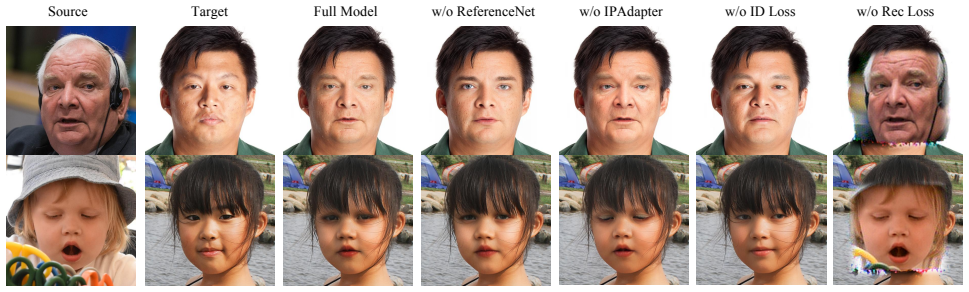
The load-bearing object is the Triplet ID Group $(A_1, \tilde{B}, A_2)$, where $\tilde{B}$ is made by a GAN proxy from A2 and B; A2 gives exact supervision because it shares identity with the source and all non-identity attributes with the pseudo target. The second piece is one-step accelerated diffusion, a distilled latent diffusion model that denoises in one iteration, making the reconstruction and identity losses tractable and the inference fast. The third is the architecture: SwapNet, the base U-Net initialized from the accelerated model; FaceNet, a U-Net encoder that injects pixel-level identity features into self-attention; and an ID Adapter that injects semantic-level identity embeddings into cross-attention. Pose and expression conditioning enters through landmarks from a 3D face reconstruction model.
What would settle it
Train the same pipeline with a proxy model that deliberately distorts the target's lighting or pose during the swap; if attribute preservation on the test set stays flat or the generated images reproduce the distorted lighting, the reconstruction loss is anchored to the pseudo target rather than to the real image A2, and the claimed supervisory ceiling breaks.
Extended reading notes
Core claim
The central claim is that the missing ground truth in face swapping can be manufactured. Given two images A1 and A2 of the same identity and one image B of a different identity, a GAN proxy model swaps A2's identity onto B, producing pseudo target $\tilde{B}$; then $(A_1, \tilde{B}, A_2)$ forms a triplet in which A2 is the exact target for swapping A1 into $\tilde{B}$. The pseudo target is deliberately not the learning target—the real image is—so the supervisory signal is not limited by the proxy's output quality. Because the base model is an accelerated one-step diffusion model, the training can apply an L2 reconstruction loss between the generated image and A2, a cosine identity loss against A1, and the standard diffusion noise-prediction loss, all in a single step. The paper's experiments claim this yields top quantitative results, including an identity similarity of 0.71, an FID of 4.69, and improved pose and expression preservation, and that attribute-specific control follows by editing the triplet data, for example removing glasses from the pseudo target or altering its face shape.
Load-bearing premise
Everything rests on the proxy model that builds the pseudo target faithfully preserving the target image's pose, lighting, expression, background, and makeup while only changing identity.
Editorial extensions
If this is right
- Face swapping becomes a supervised image-to-image task rather than an implicitly supervised generation problem, so identity and attribute objectives no longer need to be balanced through proxy losses alone.
- Diffusion-based face swapping can run at interactive speed: a single 512×512 swap in 0.6 seconds, compared with several seconds for prior diffusion methods.
- Attribute control reduces to editing the triplet data: removing glasses from the pseudo target teaches the model to keep glasses from the source, and reshaping the pseudo target teaches face-shape transfer.
- The trained model can surpass the proxy's attribute-preservation quality, because supervision comes from the real A2 rather than from the proxy's output.
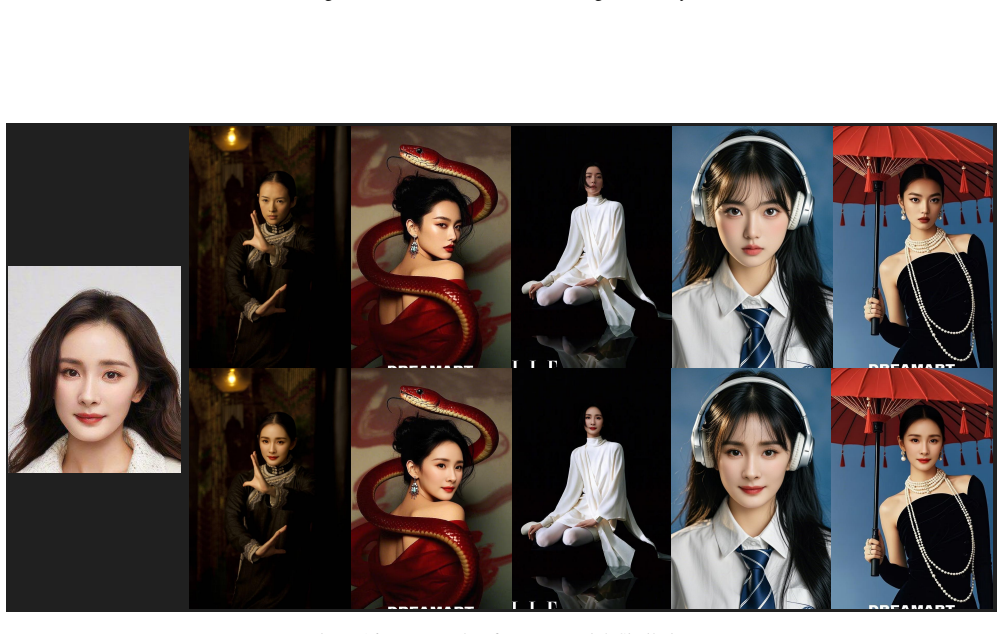
- The explicit-supervision framework extends beyond real-photo swapping, since the paper shows plausible results on stylized targets such as sketches, oil paintings, and cartoons.
Reading between the lines
- The same triplet construction should transfer to other image-to-image tasks without ground truth, such as relighting or expression transfer: generate a pseudo target with a proxy, then use a real image sharing the target's attributes as supervision.
- Because the real target A2 anchors the reconstruction, the method's ceiling is bounded by the quality of A2 itself; corrupting or lowering the resolution of A2 should degrade fidelity even if the proxy is perfect, which is a testable prediction.
- A natural extension is to bootstrap: use DreamID's own outputs, rather than a GAN proxy, to build pseudo targets for the next training round; if the claim about a high supervisory upper bound is right, this should improve attribute preservation further.
Signed reviews
Editorial analysis
A structured set of objections, weighed in public.
Referee Report
Summary. The paper introduces DreamID, a diffusion-based face swapping method. The key idea is a Triplet ID Group learning scheme: from two images of the same identity (A1, A2) and a different identity B, a GAN proxy (FaceDancer) generates a pseudo target B~ by transplanting A2's identity onto B. The triplet (A1, B~, A2) provides a real image A2 that shares identity with A1 and attributes with B~, enabling explicit pixel-level supervision through an ID loss, a reconstruction loss, and a diffusion loss. The method uses SD Turbo to enable one-step inference and proposes a three-part architecture (SwapNet, FaceNet, and ID Adapter). Experiments on FFHQ report state-of-the-art identity similarity, pose/expression preservation, and FID, with inference time of 0.6 seconds at 512×512. The supplementary includes a 4-step variant and reports its metrics separately.
Significance. The explicit-supervision idea is a genuine and potentially useful contribution: constructing paired training data for face swapping through a proxy model and a real target image is a practical workaround to the lack of ground-truth swapped images. The reported quantitative results are strong, the architecture components are reasonable, and the proxy-model ablation is informative. The fast single-step inference is practically valuable. However, the manuscript in its current form contains a major reporting inconsistency between the headline numbers and the speed claim, and a training detail (fixed t=999 diffusion loss) that is not adequately justified. These issues are fixable, but they currently prevent the central claim from being assessed fairly.
major comments (4)
- [§5.2 and Supplementary Table 5] The main quantitative results, shown in the table on p. 6 (called Table 2 in the text but numbered Table 1 in the PDF), are obtained from the 4-step model, while the 0.6 s speed claim in the Abstract and §5.2 corresponds to the 1-step model. Supplementary Table 5 shows that the 1-step model has FID 5.08, Pose 2.31, Expression 0.790, which are worse than the headline FID 4.69, Pose 2.20, Expression 0.789. The manuscript should disclose this discrepancy in the main text and clearly distinguish which model produced each reported number; otherwise the statement that DreamID outperforms previous methods in just 0.6 seconds is misleading.
- [§5.1, Table 1] No error bars, confidence intervals, or significance tests are reported for any metric. The differences that support the central claims, such as ID similarity 0.71 vs. CSCS 0.68 or Pose 2.20 vs. FaceDancer 2.32, may be within run-to-run or bootstrap variance on the 1,000-image test set. The authors should report standard deviations or confidence intervals, ideally over multiple training runs or at least via bootstrap resampling of the evaluation set, before claiming consistent superiority.
- [§4.1, Eq. (3)] The diffusion loss is defined with a fixed timestep t = 999, with the justification 'we use one step property of SD Turbo for diffusion loss calculating'. This is not self-evident: standard diffusion training samples t uniformly from the noise schedule, and a fixed maximum-noise timestep would, in a standard diffusion model, only train the model to denoise from pure noise. Since SD Turbo is a distilled adversarial model, the authors need to explain why fixing t = 999 is appropriate and how this loss interacts with the SD Turbo objective. As written, this detail is load-bearing for the training procedure and must be justified.
- [§4.1, Triplet ID Group Construction] The claim that using the real image A2 as the learning target 'ensures that the upper bound of the supervisory signal is very high' is overstated. Because the pseudo target B~ is generated by a GAN proxy, any attribute error in B~ makes the conditioning input inconsistent with the regression target A2; the effective upper bound is therefore limited by the proxy's attribute fidelity. The authors' own Table 4 demonstrates this: replacing FaceDancer with Inswapper as the proxy degrades Pose from 2.20 to 2.90 and Expression from 0.789 to 0.975. The observed improvement over FaceDancer itself (2.20 < 2.32) is suggestive but not controlled for metric variance. The claim should be tempered and the proxy-dependence explicitly acknowledged as a limitation of the framework.
minor comments (6)
- [Section 5.2] The text refers to the quantitative comparison as 'Table 2', but the PDF numbering labels it Table 1; the inference-speed table becomes Table 2, and the following tables are misaligned. Renumber the tables consistently.
- [Section 5.2, Inference Speed] The inference-time measurement is reported as '0.6s' without details on the hardware configuration (e.g., batch size, whether VAE encoding/decoding is included, or whether the 1-step model is used). Specify the measurement protocol so the speed claim is reproducible.
- [Section 3, Eq. (1)] The forward diffusion formula is garbled: 'p(1−αtϵ' should be '√(1−αt) ϵ'. The paper should be proofread for such typographical errors.
- [Section 4.2, SwapNet description] The notation 'E(ID ˜B)' is ambiguous because 'ID B~' is used to denote both an image and an identity. Use a consistent notation, e.g., write the image as I_{B~} and the identity as IDB.
- [References] Several references are URLs or incomplete (e.g., [12] and [13] are GitHub links, [16] is a software citation without a venue). Please format them according to the journal's reference style.
- [Figure 1 caption] The caption says 'replacing the source face (top-left) with the target face (bottom-left)', which is confusing because in face swapping the source provides identity and the target provides attributes. Clarify which image is the source and which is the target.
Circularity Check
No significant circularity: the Triplet ID Group supervision target is an external real image, the evaluation ID encoder differs from the training ID encoder, and proxy-model sensitivity is an acknowledged empirical limitation rather than a circular reduction.
full rationale
DreamID's derivation chain is not circular. The Triplet ID Group constructs a supervised pair (A1, B~, A2) by using a GAN proxy to swap A2's identity onto B, yielding B~; the training target is the real image A2, which is never fed into the model as conditioning input. The model conditions on IDA1 and IDB~ through FaceNet, the ID Adapter, landmarks, and the target latent, so the reconstruction loss Lrec = ||IDA2 - ID~A||^2_2 is genuine external supervision rather than an identity. The ID loss uses Glint36k while the reported ID similarity is measured with ArcFace, so the headline metric is not the training objective. The dependence of attribute preservation on the proxy's attribute fidelity is explicitly acknowledged in the proxy-model ablation (Table 4) and is an empirical robustness limitation, not a circular reduction. The only self-citation (PuLID [9] in the supplementary stylization variant) is not load-bearing for the central claim. No equation in the paper reduces a predicted quantity to a fitted input by construction, and no uniqueness theorem or ansatz is imported from the authors' prior work to force the result.
Assumptions & free parameters
free parameters (7)
- lambda_id =
1
- lambda_DM =
1
- lambda_rec =
10
- learning_rate =
1e-5
- batch_size =
8
- training_steps =
70000
- diffusion timestep t =
999
assumptions (5)
- domain assumption The GAN proxy FaceDancer generates pseudo targets that preserve the attributes of A2 while changing identity.
- domain assumption The 3DMM reconstruction model provides accurate identity, expression, and pose coefficients to generate landmarks.
- domain assumption SD Turbo retains single-step generation after fine-tuning with image-space losses.
- domain assumption The ID encoder (Glint36k) provides embeddings that align with identity similarity.
- domain assumption Training on VGGFace2-HQ and Arc2Face yields enough multi-image-per-ID pairs for triplet construction.
Cite this review
Pith. "Pith review of DreamID: High-Fidelity and Fast diffusion-based Face Swapping via Triplet ID Group Learning." pith.science (2026). https://pith.science/paper/37C7RAMQ
@misc{pith2026250414509,
  author       = {Pith},
  title        = {Pith review of: DreamID: High-Fidelity and Fast diffusion-based Face Swapping via Triplet ID Group Learning},
  year         = {2026},
  howpublished = {\url{https://pith.science/paper/37C7RAMQ}},
  note         = {Machine review of arXiv:2504.14509}
}
read the original abstract
In this paper, we introduce DreamID, a diffusion-based face swapping model that achieves high levels of ID similarity, attribute preservation, image fidelity, and fast inference speed. Unlike the typical face swapping training process, which often relies on implicit supervision and struggles to achieve satisfactory results. DreamID establishes explicit supervision for face swapping by constructing Triplet ID Group data, significantly enhancing identity similarity and attribute preservation. The iterative nature of diffusion models poses challenges for utilizing efficient image-space loss functions, as performing time-consuming multi-step sampling to obtain the generated image during training is impractical. To address this issue, we leverage the accelerated diffusion model SD Turbo, reducing the inference steps to a single iteration, enabling efficient pixel-level end-to-end training with explicit Triplet ID Group supervision. Additionally, we propose an improved diffusion-based model architecture comprising SwapNet, FaceNet, and ID Adapter. This robust architecture fully unlocks the power of the Triplet ID Group explicit supervision. Finally, to further extend our method, we explicitly modify the Triplet ID Group data during training to fine-tune and preserve specific attributes, such as glasses and face shape. Extensive experiments demonstrate that DreamID outperforms state-of-the-art methods in terms of identity similarity, pose and expression preservation, and image fidelity. Overall, DreamID achieves high-quality face swapping results at 512*512 resolution in just 0.6 seconds and performs exceptionally well in challenging scenarios such as complex lighting, large angles, and occlusions.
Figures


Figures from the paper (16 more)






Forward citations
Cited by 1 Pith paper
-
Adaptive Identity Anchoring: Closed-Loop Keyframe Placement for Synthetic Paired Supervision in Video Face Swapping
For video face swapping, adaptively adding swapped anchor frames at the moments of worst identity drift should make synthetic training pairs more faithful than the current first-and-last-frame-only scheme.
Reference graph
Works this paper leans on
-
[1]
Realistic and efficient face swapping: A unified approach with diffusion models
Sanoojan Baliah, Qinliang Lin, Shengcai Liao, Xiaodan Liang, and Muhammad Haris Khan. Realistic and efficient face swapping: A unified approach with diffusion models. arXiv preprint arXiv:2409.07269, 2024. 2, 3, 6, 1
arXiv 2024
-
[2]
Simswap: An efficient framework for high fidelity face swapping
Renwang Chen, Xuanhong Chen, Bingbing Ni, and Yanhao Ge. Simswap: An efficient framework for high fidelity face swapping. In MM ’20: The 28th ACM International Confer- ence on Multimedia, 2020. 1, 3, 6
work page 2020
-
[3]
Simswap++: Towards faster and high-quality identity swapping
Xuanhong Chen, Bingbing Ni, Yutian Liu, Naiyuan Liu, Zhilin Zeng, and Hang Wang. Simswap++: Towards faster and high-quality identity swapping. IEEE Trans. Pattern Anal. Mach. Intell., 46(1):576–592, 2024. 1, 3, 6
work page 2024
-
[4]
Arcface: Additive angular margin loss for deep face recognition
Jiankang Deng, Jia Guo, Niannan Xue, and Stefanos Zafeiriou. Arcface: Additive angular margin loss for deep face recognition. In Proceedings of the IEEE/CVF con- ference on computer vision and pattern recognition , pages 4690–4699, 2019. 6
2019
-
[5]
Accurate 3d face reconstruction with weakly-supervised learning: From single image to image set
Yu Deng, Jiaolong Yang, Sicheng Xu, Dong Chen, Yunde Jia, and Xin Tong. Accurate 3d face reconstruction with weakly-supervised learning: From single image to image set. In Proceedings of the IEEE/CVF conference on computer vi- sion and pattern recognition workshops , pages 0–0, 2019. 6
2019
-
[6]
Hope-net: A graph-based model for hand-object pose estimation
Bardia Doosti, Shujon Naha, Majid Mirbagheri, and David J Crandall. Hope-net: A graph-based model for hand-object pose estimation. In Proceedings of the IEEE/CVF conference on computer vision and pattern recognition , pages 6608– 6617, 2020. 6
work page 2020
-
[7]
Information bottleneck disentanglement for iden- tity swapping
Gege Gao, Huaibo Huang, Chaoyou Fu, Zhaoyang Li, and Ran He. Information bottleneck disentanglement for iden- tity swapping. In Proceedings of the IEEE/CVF Conference on Computer Vision and Pattern Recognition (CVPR), pages 3404–3413, 2021. 3, 1
work page 2021
-
[8]
Generative adversarial nets
Ian Goodfellow, Jean Pouget-Abadie, Mehdi Mirza, Bing Xu, David Warde-Farley, Sherjil Ozair, Aaron Courville, and Yoshua Bengio. Generative adversarial nets. In Advances in Neural Information Processing Systems. Curran Associates, Inc., 2014. 3
2014
Show all 40 references
-
[9]
Pulid: Pure and lightning id customization via contrastive alignment
Zinan Guo, Yanze Wu, Chen Zhuowei, Peng Zhang, Qian He, et al. Pulid: Pure and lightning id customization via contrastive alignment. Advances in neural information pro- cessing systems, 37:36777–36804, 2024. 1
2024
-
[10]
Face adapter for pre-trained diffusion models with fine-grained id and attribute control
Yue Han, Junwei Zhu, Keke He, Xu Chen, Yanhao Ge, Wei Li, Xiangtai Li, Jiangning Zhang, Chengjie Wang, and Yong Liu. Face adapter for pre-trained diffusion models with fine-grained id and attribute control. arXiv preprint arXiv:2405.12970, 2024. 2, 3, 6, 1
2024 arXiv
-
[11]
Denoising dif- fusion probabilistic models
Jonathan Ho, Ajay Jain, and Pieter Abbeel. Denoising dif- fusion probabilistic models. In Advances in Neural Infor- mation Processing Systems, pages 6840–6851. Curran Asso- ciates, Inc., 2020. 3
2020
-
[12]
https://github.com/deepinsight/insightface/tree/master/model zoo. 5, 6
-
[13]
https://github.com/haofanwang/inswapper. 6, 1
-
[14]
Animate anyone: Consistent and controllable image- to-video synthesis for character animation
Li Hu. Animate anyone: Consistent and controllable image- to-video synthesis for character animation. InProceedings of the IEEE/CVF Conference on Computer Vision and Pattern Recognition, pages 8153–8163, 2024. 5
2024
-
[15]
Identity- preserving face swapping via dual surrogate generative mod- els
Ziyao Huang, Fan Tang, Yong Zhang, Juan Cao, Chengyu Li, Sheng Tang, Jintao Li, and Tong-Yee Lee. Identity- preserving face swapping via dual surrogate generative mod- els. ACM Transactions on Graphics, 43(5):1–19, 2024. 1, 3, 6
2024
-
[16]
Open- clip, 2021
Gabriel Ilharco, Mitchell Wortsman, Ross Wightman, Cade Gordon, Nicholas Carlini, Rohan Taori, Achal Dave, Vaishaal Shankar, Hongseok Namkoong, John Miller, Han- naneh Hajishirzi, Ali Farhadi, and Ludwig Schmidt. Open- clip, 2021. If you use this software, please cite it as below. 5
2021
-
[17]
S. Cho J. Seo J. Nam K. Lee S. Kim K. Lee K. Kim, Y . Kim. Diffface: Diffusion-based face swapping with facial guid- ance. 2022. 2, 3, 6, 1
2022
-
[18]
Generative adversarial networks for face generation: A survey
Amina Kammoun, Rim Slama, Hedi Tabia, Tarek Ouni, and Mohmed Abid. Generative adversarial networks for face generation: A survey. ACM Computing Surveys, 55:1 – 37,
-
[19]
A style-based generator architecture for generative adversarial networks
Tero Karras, Samuli Laine, and Timo Aila. A style-based generator architecture for generative adversarial networks. In IEEE Conference on Computer Vision and Pattern Recogni- tion, CVPR 2019, Long Beach, CA, USA, June 16-20, 2019 , pages 4401–4410. Computer Vision Foundation / IEEE,
2019
-
[20]
Analyzing and improving the image quality of stylegan
Tero Karras, Samuli Laine, Miika Aittala, Janne Hellsten, Jaakko Lehtinen, and Timo Aila. Analyzing and improving the image quality of stylegan. In 2020 IEEE/CVF Confer- ence on Computer Vision and Pattern Recognition, CVPR 2020, Seattle, WA, USA, June 13-19, 2020 , pages 8107–
2020
-
[21]
Advancing high fidelity identity swapping for forgery detection
Lingzhi Li, Jianmin Bao, Hao Yang, Dong Chen, and Fang Wen. Advancing high fidelity identity swapping for forgery detection. In Proceedings of the IEEE/CVF Conference on Computer Vision and Pattern Recognition , pages 5074– 5083, 2020. 3
2020
-
[22]
Fine-grained face swapping via regional gan inversion
Zhian Liu, Maomao Li, Yong Zhang, Cairong Wang, Qi Zhang, Jue Wang, and Yongwei Nie. Fine-grained face swapping via regional gan inversion. In Proceedings of the IEEE/CVF conference on computer vision and pattern recognition, pages 8578–8587, 2023. 1 9
2023
-
[23]
Portrait eyeglasses and shadow removal by leveraging 3d synthetic data
Junfeng Lyu, Zhibo Wang, and Feng Xu. Portrait eyeglasses and shadow removal by leveraging 3d synthetic data. InPro- ceedings of the IEEE/CVF Conference on Computer Vision and Pattern Recognition, pages 3429–3439, 2022. 5
2022
-
[24]
Arc2face: A foundation model for id-consistent human faces
Foivos Paraperas Papantoniou, Alexandros Lattas, Stylianos Moschoglou, Jiankang Deng, Bernhard Kainz, and Stefanos Zafeiriou. Arc2face: A foundation model for id-consistent human faces. In Proceedings of the European Conference on Computer Vision (ECCV), 2024. 6
2024
-
[25]
Dpfks, Carl Shift Facenheim, Luis RP, Jian Jiang, Sheng Zhang, Pingyu Wu, Bo Zhou, and Weiming Zhang
Ivan Perov, Daiheng Gao, Nikolay Chervoniy, Kunlin Liu, Sugasa Marangonda, Chris Um ´e, Mr. Dpfks, Carl Shift Facenheim, Luis RP, Jian Jiang, Sheng Zhang, Pingyu Wu, Bo Zhou, and Weiming Zhang. Deepfacelab: A simple, flexible and extensible face swapping framework. CoRR, abs/2...
2005 arXiv
-
[26]
Hierarchical text-conditional image gen- eration with clip latents
Aditya Ramesh, Prafulla Dhariwal, Alex Nichol, Casey Chu, and Mark Chen. Hierarchical text-conditional image gen- eration with clip latents. arXiv preprint arXiv:2204.06125,
-
[27]
High-resolution image synthesis with latent diffusion models
Robin Rombach, Andreas Blattmann, Dominik Lorenz, Patrick Esser, and Bj ¨orn Ommer. High-resolution image synthesis with latent diffusion models. In Proceedings of the IEEE/CVF Conference on Computer Vision and Pattern Recognition, pages 10684–10695, 2022. 2, 3, 5
2022
-
[28]
Facedancer: Pose-and occlusion-aware high fidelity face swapping
Felix Rosberg, Eren Erdal Aksoy, Fernando Alonso- Fernandez, and Cristofer Englund. Facedancer: Pose-and occlusion-aware high fidelity face swapping. In Proceedings of the IEEE/CVF winter conference on applications of com- puter vision, pages 3454–3463, 2023. 3, 6, 1
2023
-
[29]
Photorealistic text-to-image diffusion models with deep language understanding
Chitwan Saharia, William Chan, Saurabh Saxena, Lala Li, Jay Whang, Emily L Denton, Kamyar Ghasemipour, Raphael Gontijo Lopes, Burcu Karagol Ayan, Tim Salimans, et al. Photorealistic text-to-image diffusion models with deep language understanding. Advances in Neural Information...
2022
-
[30]
Adversarial diffusion distillation
Axel Sauer, Dominik Lorenz, Andreas Blattmann, and Robin Rombach. Adversarial diffusion distillation. In European Conference on Computer Vision , pages 87–103. Springer,
-
[31]
Image de- formation using moving least squares
Scott Schaefer, Travis McPhail, and Joe Warren. Image de- formation using moving least squares. In ACM SIGGRAPH 2006 Papers, pages 533–540. 2006. 6
2006
-
[32]
Hififace: 3d shape and semantic prior guided high fidelity face swapping
Yuhan Wang, Xu Chen, Junwei Zhu, Wenqing Chu, Ying Tai, Chengjie Wang, Jilin Li, Yongjian Wu, Feiyue Huang, and Rongrong Ji. Hififace: 3d shape and semantic prior guided high fidelity face swapping. In IJCAI, pages 1136–1142. ij- cai.org, 2021. 3
2021
-
[33]
3d face reconstruction with the geometric guidance of facial part segmentation
Zidu Wang, Xiangyu Zhu, Tianshuo Zhang, Baiqin Wang, and Zhen Lei. 3d face reconstruction with the geometric guidance of facial part segmentation. In Proceedings of the IEEE/CVF Conference on Computer Vision and Pattern Recognition, pages 1672–1682, 2024. 5
2024
-
[34]
Region-aware face swapping
Chao Xu, Jiangning Zhang, Miao Hua, Qian He, Zili Yi, and Yong Liu. Region-aware face swapping. In Proceedings of the IEEE/CVF Conference on Computer Vision and Pattern Recognition (CVPR), pages 7632–7641, 2022. 3
2022
-
[35]
Styleswap: Style-based generator empow- ers robust face swapping
Zhiliang Xu, Hang Zhou, Zhibin Hong, Ziwei Liu, Jiaming Liu, Zhizhi Guo, Junyu Han, Jingtuo Liu, Errui Ding, and Jingdong Wang. Styleswap: Style-based generator empow- ers robust face swapping. In Proceedings of the European Conference on Computer Vision (ECCV), 2022. 3
2022
-
[36]
Ip- adapter: Text compatible image prompt adapter for text-to- image diffusion models
Hu Ye, Jun Zhang, Sibo Liu, Xiao Han, and Wei Yang. Ip- adapter: Text compatible image prompt adapter for text-to- image diffusion models. arXiv preprint arXiv:2308.06721,
-
[37]
Reliableswap: Boosting general face swapping via reliable supervision
Ge Yuan, Maomao Li, Yong Zhang, and Huicheng Zheng. Reliableswap: Boosting general face swapping via reliable supervision. arXiv preprint arXiv:2306.05356, 2023. 3, 1
2023 arXiv
-
[38]
Diffswap: High-fidelity and control- lable face swapping via 3d-aware masked diffusion
Wenliang Zhao, Yongming Rao, Weikang Shi, Zuyan Liu, Jie Zhou, and Jiwen Lu. Diffswap: High-fidelity and control- lable face swapping via 3d-aware masked diffusion. CVPR,
-
[39]
One shot face swapping on megapixels
Yuhao Zhu, Qi Li, Jian Wang, Chengzhong Xu, and Zhenan Sun. One shot face swapping on megapixels. In Proceed- ings of the IEEE conference on computer vision and pattern recognition (CVPR), pages 4834–4844, 2021. 3 10 DreamID: High-Fidelity and Fast diffusion-based Face Swappin...
2021
-
[8116]
Computer Vision Foundation / IEEE, 2020. 3
2020
Reviewed August 16, 2026 · model on record in the stance chip above.
Discussion (0). Continue with ORCID to comment.