REVIEW 3 major objections 7 minor 55 references
Mitigating Degree Bias in Graph Representation Learning with Learnable Structural Augmentation and Structural Self-Attention
T0 review · 3 major / 7 minor · reviewed 2026-08-16 · deepseek-v4-flash
Pith's one-line read A graph transformer that adds edges between similarly low-degree nodes in the same community can cut degree bias in node classification while improving accuracy on standard benchmarks.
desk verdict A plausible, well-engineered recipe for degree fairness that overstates itself slightly by calling a fixed heuristic 'learnable' and by selecting hyperparameters on test metrics. read the letter →
The pith
A machine-rendered reading of the paper's core claim, the machinery that carries it, and where it could break.
The reading
What carries the argument
The load-bearing object is the degree-weighted structural-similarity score $D_{ij} = 1/\sqrt{d_i d_j}$, which ranks candidate context nodes by the product of their degrees and is used both to sample new edges and to bias attention. Context candidates are first restricted to non-adjacent pairs inside the same k-means feature cluster that are reachable within $k$ hops; the score is then blended with the original adjacency matrix as $\tilde A = \xi A + \zeta D$, and edges are sampled from a Bernoulli distribution relaxed with Gumbel-Softmax so the whole augmentation is differentiable. The same structural information reaches the transformer through a high-order proximity vector $s_{ij}$, computed from shared $k$-hop neighborhoods, and through a linearly transformed $D_{ij}$ added to each attention logit. A self-supervised reconstruction of the log-scaled $p$-step transition matrix, combined with a binary cross-entropy loss between the original and augmented adjacency matrices, prevents the augmentation from collapsing into a fully connected or barren graph. These three pieces—degree-weighted edge sampling, structural attention bias, and structure-preserving regularization—jointly carry the argument.
What would settle it
Run DegFairGT against a variant in which $D_{ij}$ is replaced by a constant for all context pairs, so edges are sampled uniformly within the same community and $k$-hop range; if $\Delta SP$ and $\Delta EO$ stay unchanged, the degree-weighted score is not the cause of the fairness gains, while degradation would confirm the structural ranking is load-bearing. The same experiment can be repeated on a star-like graph where low-degree nodes share few features, testing whether the k-means community restriction removes informative low-degree pairs.
Extended reading notes
Core claim
The central claim is that a graph transformer can overcome degree bias by learning to add intra-community edges between non-adjacent nodes with similar low degree and by injecting the same structural-role information into self-attention. The paper argues that random or heuristic edge perturbations either add noisy long-range messages or destroy original topology, whereas edges sampled with probability proportional to the degree-balanced score $D_{ij} = 1/\sqrt{d_i d_j}$—restricted to nodes in the same k-means cluster within $k$ hops—provide informative messages to under-represented nodes while preserving homophily within the community. On six citation, co-purchase, and reference networks, the resulting embeddings are reported to give the best or near-best degree fairness (lower $\Delta SP$, $\Delta EO$), the highest node classification accuracy on five of six datasets, and the lowest conductance or highest modularity on clustering in most cases. The paper also presents an ablation showing that each module contributes, and a Pareto-style analysis indicating that DegFairGT shifts the fairness-accuracy trade-off compared with degree-modulated and graph-transformer baselines.
Load-bearing premise
The method assumes that two non-adjacent nodes in the same feature cluster within $k$ hops are informative message partners when they both have low degree, as quantified by the inverse square root of the product of their degrees.
Editorial extensions
If this is right
- If the central claim is correct, adding intra-community edges between similarly low-degree nodes should shrink the prediction gap between low- and high-degree groups without the accuracy penalty that usually accompanies fairness constraints.
- Graph transformers that sample context nodes without degree-role similarity should show higher degree bias on sparse networks, as the paper reports for Cora and Citeseer.
- The fairness gains should transfer to other transductive node-classification benchmarks with long-tailed degree distributions and recoverable community structure, since only hyper-parameters change between datasets.
- Preserving the $p$-step transition matrix of the original graph is the mechanism presented for keeping clustering quality while modifying the adjacency matrix.
Reading between the lines
- A testable extension is to replace the degree product $1/\sqrt{d_i d_j}$ with other structural-role scores (shared-neighborhood Jaccard, graphlet counts, or role embeddings) inside the same augmentation pipeline; if fairness improves further, the inverse-degree proxy is not the limiting factor.
- The method's reliance on k-means clusters of node features implies a hidden homophily assumption; on heterophilic graphs, the same pipeline might filter out informative low-degree nodes, so a degree-biased augmentation may need a community definition based on structure rather than features.
- The paper's Pareto analysis suggests that fairness methods should be compared by how far they move the fairness-accuracy frontier, not by a single fairness metric; this is an implicit methodological shift for the field.
- Because the transformer's quadratic attention limits scale, swapping the self-attention encoder for a linear transformer while keeping the degree-weighted augmentation would reveal whether the augmentation alone, rather than the attention, drives the fairness gains.
Signed reviews
Editorial analysis
A structured set of objections, weighed in public.
Referee Report
Summary. The paper proposes DegFairGT, a graph transformer framework that aims to mitigate degree bias in graph representation learning. The method constructs an augmented graph by combining the original adjacency matrix with a degree-weighted structural similarity matrix D_ij = 1/sqrt(d_i d_j), restricted to node pairs in the same k-means community within k-hop reachability, and then samples edges via Bernoulli draws relaxed with Gumbel-Softmax. The transformer encoder uses a structural self-attention that injects high-order proximity and the degree-weighted score into attention computation. A self-supervised loss reconstructs the p-step transition probability matrix and the input features, together with a BCE loss that regularizes the augmentation, and the model is pre-trained without labels before downstream evaluation. Experiments on six datasets report degree-fairness metrics (Delta-SP, Delta-EO), node classification accuracy, and clustering conductance/modularity compared with twelve baselines, including graph transformers and augmentation-based methods.
Significance. If the reported results hold under a proper validation protocol, the paper would make a useful empirical contribution to degree-fair graph representation learning: it combines degree-weighted edge augmentation with structure-aware self-attention, evaluates on six benchmarks with ten random splits, and reports improvements across fairness, accuracy, and clustering. The availability of source code is a positive reproducibility feature, and the ablation and sensitivity analyses (Tables 8-10, Figure 7) provide useful information about the contribution of the augmentation and attention modules. However, the central claim of a 'learnable' augmentation is not reflected in the equations, and the hyperparameter selection protocol, as described, risks optimistic bias in the headline comparisons. These issues are load-bearing for the novelty and reliability of the reported gains, so they must be addressed before the contribution can be fully assessed.
major comments (3)
- [Section 3.1, Eqs. (1)-(4)] The 'learnable structural augmentation' contains no learnable parameters. In Eq. (4), A'ij is sampled from a Bernoulli distribution with fixed probability A~ij = xi*Aij + zeta*Dij, where xi and zeta are hyperparameters; the Gumbel-Softmax relaxation merely makes the discrete sampling differentiable and does not introduce any learned transformation. Consequently, statements in Section 3.1 that the augmentation is 'end-to-end trainable through edge perturbation, making itself learn structural similarity between node pairs' and in Section 3.3 that 'the augmentation module could learn to produce a fully connected graph or remove too many edges' are not supported by the described architecture. Because 'learnable structural augmentation' is a stated contribution that differentiates the method from heuristic augmentation baselines, this mischaracterization needs to be corrected, or the method must be extended with genuinely learnable parameters that shape the sampling probabilities.
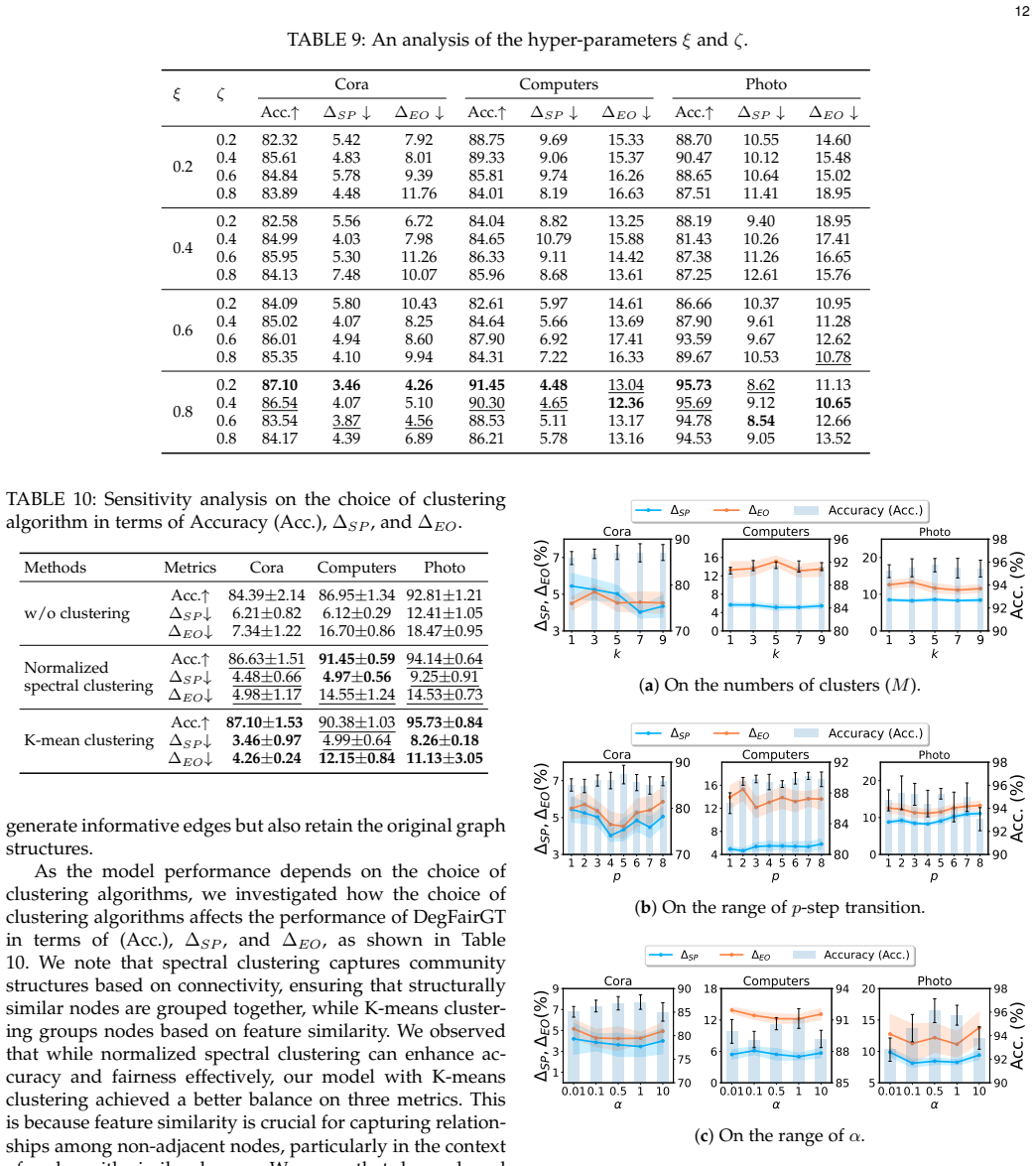
- [Section 4.4.2, Table 9 and Figure 7] The hyperparameter selection appears to use test-set metrics. The text states that xi and zeta are 'determined with a grid search' and that the chosen values 'have a better performance (higher accuracy and lower Delta-SP and Delta-EO)', and Table 9 reports exactly these test metrics for all combinations. Similarly, Figure 7 selects the number of clusters M, the p-step range, and alpha based on plots that show test accuracy, Delta-SP, and Delta-EO. Section 4.1.4 does not state that any of these selections were made on a validation split. If the test set was used to choose hyperparameters, the results in Tables 3-7 are optimistically biased, and the comparison with baselines, whose tuning procedure is not described, is not a controlled fair comparison. The authors should either clarify that all hyperparameters were selected using validation data, or re-run the experiments with a strictly validation-based selection protocol for both DegFairGT and the baselines.
- [Section 3.1.2, Eq. (3)] The degree-weighted score D_ij = 1/sqrt(d_i d_j) is the only structural-similarity signal in the augmentation, yet it is introduced without derivation, formal justification, or comparison against alternative structural similarity measures (e.g., Jaccard similarity of neighborhoods, Adamic-Adar, or role-similarity). The paper argues intuitively that low-degree pairs should be favored, but it does not validate that this particular inverse-degree product is the right way to capture structural similarity for informative message-passing edges. Since the claimed fairness gains rest on this choice, the authors should provide a principled motivation or an ablation that compares alternative scores to show that the specific form of D matters.
minor comments (7)
- [Section 2] The sentence ending with 'over time, presenting challenges in capturing temporal dependencies and structural changes' is a fragment and appears to be an incomplete leftover from a different discussion; it should be revised or removed.
- [Table 4] In the Graphormer row under Computers, the value '10.76±173' appears to be a typo; likely '10.76±1.73'.
- [Section 4.1.4] The text says 'The hyperparameters alpha2, beta1, and beta2 are determined with a grid search', but the loss in Eq. (16) uses alpha, not alpha2; please make the notation consistent.
- [Section 3.1.1, Eq. (2)] The matrix A^(k) = sum_{l=1}^k A^l is a reachability indicator matrix, not a transition probability matrix; calling it 'the transition matrix of G at k-step' is misleading and should be reworded (e.g., 'reachability matrix').
- [Table 3] In the UGT row, the Photo and WikiCS columns report identical values (9.41 +/- 0.25 and 14.31 +/- 0.39 for Delta-SP and Delta-EO, respectively); please check if one pair was accidentally copied from the other.
- [Figure 7] The subplots do not distinguish which line corresponds to Delta-SP, Delta-EO, and accuracy; adding a legend or direct labels would greatly improve readability.
- [Section 4.4.2] The sentence 'if zeta = 0.2 is large' is likely a typo; it should probably read 'if zeta is large' or 'if zeta = 0.8 is large'.
Circularity Check
The central empirical claim is partially circular: hyperparameters are selected on the test-set fairness/accuracy numbers that the paper then reports as its results.
-
fitted input called prediction
[Section 4.4.2 (Table 9, Figure 7) and Section 4.1.1 (Dataset description)]
"We further investigated the impact of edge sampling on three datasets, i.e., Cora, Computers, and Photo, in terms of accuracy, ∆SP , and ∆EO, as shown in Table 9. The hyperparametersξ andζ are determined with a grid search among{0.2, 0.4, 0.6, 0.8}. We observed that DegFairGT has a better performance (higher accuracy and lower ∆SP and ∆EO) with the ζ = 0.2 and ξ = 0.8."
Section 4.1.1 states: "The table results show the mean and standard deviation of the metrics on the testing set over the ten cases." Section 4.4.2 then selects ξ=0.8 and ζ=0.2 by comparing accuracy, ∆SP, and ∆EO in Table 9, and Figure 7 similarly selects M, p, and α from accuracy/∆SP/∆EO curves. These are the same testing-set metrics that later appear in Tables 3–7 as DegFairGT's reported performance. The reported benchmark numbers are therefore fit statistics: the test set is used as the selection criterion, so the claimed improvements over baselines are not independent out-of-sample predictions as presented.
full rationale
Aside from the test-set hyperparameter selection, the paper's formal derivation is not circular. The degree-weighted score D_ij = 1/sqrt(d_i d_j) is a fixed structural prior, not fitted to or derived from ∆SP/∆EO, and the fairness metrics do not appear in the training loss. Injecting D into the augmentation and self-attention is an inductive bias that favors degree fairness, not a self-definitional identification of the target quantity. Self-citations, e.g., ref. [32] for the p-step transition matrix with NCE, are used as implementation components from the authors' prior published work rather than as a uniqueness theorem or as the sole justification of the central claim; they do not make the derivation circular. The only load-bearing circularity is the empirical evaluation protocol: hyperparameters are selected using the same test-set metrics that are later reported as the method's headline results, so the accuracy and fairness wins are partly fitted rather than predicted.
Assumptions & free parameters
free parameters (6)
- xi =
0.8
- zeta =
0.2
- beta1 =
0.5
- beta2 =
0.5
- alpha =
1.0
- M (number of clusters) =
5
assumptions (5)
- domain assumption Homophily principle: adjacent nodes and same-community nodes share similar features.
- domain assumption k-means on raw node features yields communities that correspond to semantically meaningful groups.
- ad hoc to paper Degree-weighted score D_ij = 1/sqrt(d_i d_j) is a valid structural similarity measure.
- ad hoc to paper Bernoulli sampling with probabilities xi*A + zeta*D yields a graph that preserves useful structure.
- standard math Gumbel-Softmax approximates Bernoulli sampling well enough for end-to-end training.
Cite this review
Pith. "Pith review of Mitigating Degree Bias in Graph Representation Learning with Learnable Structural Augmentation and Structural Self-Attention." pith.science (2026). https://pith.science/paper/L36KTHMF
@misc{pith2026250415075,
  author       = {Pith},
  title        = {Pith review of: Mitigating Degree Bias in Graph Representation Learning with Learnable Structural Augmentation and Structural Self-Attention},
  year         = {2026},
  howpublished = {\url{https://pith.science/paper/L36KTHMF}},
  note         = {Machine review of arXiv:2504.15075}
}
read the original abstract
Graph Neural Networks (GNNs) update node representations through message passing, which is primarily based on the homophily principle, assuming that adjacent nodes share similar features. However, in real-world graphs with long-tailed degree distributions, high-degree nodes dominate message passing, causing a degree bias where low-degree nodes remain under-represented due to inadequate messages. The main challenge in addressing degree bias is how to discover non-adjacent nodes to provide additional messages to low-degree nodes while reducing excessive messages for high-degree nodes. Nevertheless, exploiting non-adjacent nodes to provide valuable messages is challenging, as it could generate noisy information and disrupt the original graph structures. To solve it, we propose a novel Degree Fairness Graph Transformer, named DegFairGT, to mitigate degree bias by discovering structural similarities between non-adjacent nodes through learnable structural augmentation and structural self-attention. Our key idea is to exploit non-adjacent nodes with similar roles in the same community to generate informative edges under our augmentation, which could provide informative messages between nodes with similar roles while ensuring that the homophily principle is maintained within the community. To enable DegFairGT to learn such structural similarities, we then propose a structural self-attention to capture the similarities between node pairs. To preserve global graph structures and prevent graph augmentation from hindering graph structure, we propose a Self-Supervised Learning task to preserve p-step transition probability and regularize graph augmentation. Extensive experiments on six datasets showed that DegFairGT outperformed state-of-the-art baselines in degree fairness analysis, node classification, and node clustering tasks.
Figures


Figures from the paper (5 more)


Reference graph
Works this paper leans on
-
[1]
Ming Li, Alessio Micheli, Yu Guang Wang, Shirui Pan, Pietro Li ´o, Giorgio Stefano Gnecco, and Marcello Sanguineti, ”Guest editorial: Deep neural networks for graphs: Theory, models, algorithms, and applications,” IEEE Trans. Neu. Net. Learn. Sys., 2024, vol. 35, no. 4, pp. 4367-4372
work page 2024
-
[2]
Xianfeng Tang, Huaxiu Yao, Yiwei Sun, Yiqi Wang, Jiliang Tang, Charu Aggarwal, Prasenjit Mitra, and Suhang Wang, ”Investigat- ing and mitigating degree-related biases in graph convoltuional networks,” in Proc. Int. Conf. Infor. Knowl. Management , 2020, pp. 1435-1444
work page 2020
-
[3]
Rui Huang and Ping Li, ”Hub-hub connections matter: Improving edge dropout to relieve over-smoothing in graph neural networks,” Knowl. Sys., 2023, vol. 270, Art. no. 110556
work page 2023
-
[4]
Vijay Prakash Dwivedi and Xavier Bresson, ”A generalization of transformer networks to graphs,” 2020, arXiv:2012.09699
arXiv 2020
-
[5]
Julian J. McAuley, Christopher Targett, Qinfeng Shi, and Anton van den Hengel, ”Image-based recommendations on styles and substitutes,” in Proc. Int. Conf. Res. Dev. Infor. Retrieval , 2015, pp. 43-52
work page 2015
-
[6]
Peng Ji, Jiachen Ye, Yu Mu, Wei Lin, Yang Tian, Chittaranjan Hens, Matjaˇz Perc, Yang Tang, Jie Sun, and J ¨urgen Kurths, ”Signal propagation in complex networks,” Phys. Rep., 2023, vol. 1017, pp. 1-96
work page 2023
-
[7]
Ruijia Wang, Xiao Wang, Chuan Shi, and Le Song, ”Uncovering the structural fairness in graph contrastive learning,” in Proc. Int. Conf. Neural Inf. Process. Syst., 2022, no. 2352, pp. 32465-32473
work page 2022
-
[8]
Namkyeong Lee, Dongmin Hyun, Junseok Lee, and Chanyoung Park, ”Relational self-supervised learning on graphs,” in Proc. Int. Conf. Infor. Knowl. Management, 2022, pp. 1054-1063
work page 2022
Show all 55 references
-
[9]
Oriol Artime, Marco Grassia, Manlio De Domenico, James P Glee- son, Hern ´an A Makse, Giuseppe Mangioni, Matja ˇz Perc, and Fil- ippo Radicchi, ”Robustness and resilience of complex networks,” Nat. Rev. Phy., 2024, vol. 6, pp. 114-131
2024
-
[10]
Peng Ji, Jan Nagler, Matja ˇz Perc, Michael Small, and Jinghua Xiao, ”Focus on the disruption of networks and system dynamics,”Chaos: Int. J. Non. Science, 2024, vol. 34, Art. no. 080401
2024
-
[11]
Sami Abu-El-Haija, Bryan Perozzi, Amol Kapoor, Nazanin Alipourfard, Kristina Lerman, Hrayr Harutyunyan, Greg Ver Steeg, and Aram Galstyan, ”Mixhop: Higher-order graph convolutional architectures via sparsified neighborhood mixing,” in Proc. Int. Conf. Mach. Learning, 2019, pp. 21-29
2019
-
[12]
Chengxuan Ying, Tianle Cai, Shengjie Luo, Shuxin Zheng, Guolin Ke, Di He, Yanming Shen, and Tie-Yan Liu, ”Do transformers really perform badly for graph representation?,” in Proc. Int. Conf. Neural Inf. Process. Syst., 2021, pp. 28877-28888
2021
-
[13]
”Graph representation learning and its applications: A survey,” Sensors, 2023, vol
Van Thuy Hoang, Hyeon-Ju Jeon, Eun-Soon You, Yoewon Yoon, Sungyeop Jung, and O-Joun Lee. ”Graph representation learning and its applications: A survey,” Sensors, 2023, vol. 23, no. 8, pp. 4168
2023
-
[14]
AAAI Conf
Zemin Liu, Trung-Kien Nguyen, and Yuan Fang, ”On generalized degree fairness in graph neural networks,” in Proc. AAAI Conf. Art. Intell., 2023, pp. 4525-4533
2023
-
[15]
Web Conf., 2021, pp
Yanqiao Zhu, Yichen Xu, Feng Yu, Qiang Liu, Shu Wu, and Liang Wang, ”Graph contrastive learning with adaptive augmentation,” in Proc. Web Conf., 2021, pp. 2069-2080
2021
-
[16]
Van Thuy Hoang and O-Joun Lee, ”Pre-training graph neural networks on molecules by using subgraph-conditioned graph in- formation bottleneck,” 2024, arXiv:2412.15589
2024 arXiv
-
[17]
Borgwardt, ”Structure-aware transformer for graph representation learning,” in Proc
Dexiong Chen, Leslie O’Bray, and Karsten M. Borgwardt, ”Structure-aware transformer for graph representation learning,” in Proc. Int. Conf. Mach. Learning, 2022, pp. 3469-3489
2022
-
[18]
Wei Zhuo and Guang Tan, ”Proximity enhanced graph neural networks with channel contrast,” inProc. Inter. Joint Conf. Art. Intell., 2022, pp. 2448-2455
2022
-
[19]
Hongbin Pei, Bingzhe Wei, Kevin Chen-Chuan Chang, Yu Lei, and Bo Yang, ”Geom-gcn: Geometric graph convolutional networks,” in Proc. Int. Conf. on Learn. Representations, 2020
2020
-
[20]
Lu Bai, Lixin Cui, Yue Wang, Ming Li, Jing Li, Philip S Yu, and Edwin R Hancock, ”Haqjsk: Hierarchical-aligned quantum jensen- shannon kernels for graph classification,” IEEE Trans. Knowl. Data Engineering, 2024, vol. 36, no. 11, pp. 6370-6384
2024
-
[21]
Yuning You, Tianlong Chen, Yongduo Sui, Ting Chen, Zhangyang Wang, and Yang Shen, ”Graph contrastive learning with augmen- tations,” in Proc. Int. Conf. Neural Inf. Process. Syst, 2020, no. 488, pp. 5812-5823
2020
-
[22]
Jung, ”Learning multi- resolution representations of research patterns in bibliographic networks,” J
O-Joun Lee, Hyeon-Ju Jeon, and Jason J. Jung, ”Learning multi- resolution representations of research patterns in bibliographic networks,” J. Infor., 2021, vol. 15, no. 1, pp. 101126-101147
2021
-
[23]
Van Thuy Hoang, Thanh Sang Nguyen, Sangmyeong Lee, Jooho Lee, Luong Vuong Nguyen, and O-Joun Lee, ”Companion ani- mal disease diagnostics based on literal-aware medical knowledge graph representation learning,” IEEE Access , 2023, vol. 11, pp. 114238-114249
2023
-
[24]
ICML Work
Yanqiao Zhu, Yichen Xu, Feng Yu, Qiang Liu, Shu Wu, and Liang Wang, ”Deep Graph Contrastive Representation Learning,” in Proc. ICML Work. Graph Rep. Learn. Bey., 2020
2020
-
[25]
Jung, ”Story embedding: Learning distributed representations of stories based on character networks (extended abstract),” in Proc
O-Joun Lee and Jason J. Jung, ”Story embedding: Learning distributed representations of stories based on character networks (extended abstract),” in Proc. Int. Joint Conf. Art. Intell. , 2020, pp. 5070–5074
2020
-
[26]
Hyeon-Ju Jeon, Min-Woo Choi, and O-Joun Lee, ”Day-ahead hourly solar irradiance forecasting based on multi-attributed spatio-temporal graph convolutional network,” Sensors, vol. 22, no. 19, pp. 7179
-
[27]
Keyulu Xu, Weihua Hu, Jure Leskovec, and Stefanie Jegelka, ”How powerful are graph neural networks?,” in Proc. Int. Conf. on Learn. Representations, 2019
2019
-
[28]
Petar Velickovic, Guillem Cucurull, Arantxa Casanova, Adriana Romero, Pietro Li `o, and Yoshua Bengio, ”Graph attention net- works,” 2017, arXiv:1710.10903
2017 arXiv
-
[29]
Hamilton, Vincent L´etourneau, and Prudencio Tossou, ”Rethinking graph transform- ers with spectral attention,” in Proc
Devin Kreuzer, Dominique Beaini, William L. Hamilton, Vincent L´etourneau, and Prudencio Tossou, ”Rethinking graph transform- ers with spectral attention,” in Proc. Int. Conf. Neural Inf. Process. Syst., 2021, pp. 21618-21629
2021
-
[30]
Zaixi Zhang, Qi Liu, Qingyong Hu, and Chee-Kong Lee, ”Hier- archical graph transformer with adaptive node sampling,” in Proc. Int. Conf. Neural Inf. Process. Syst. , 2022
2022
-
[31]
ACM SIGKDD Conf
Junyou Zhu, Chao Gao, Ze Yin, Xianghua Li, and J ¨urgen Kurths, ”Propagation structure-aware graph transformer for robust and interpretable fake news detection,” in Proc. ACM SIGKDD Conf. Knowl. Discov. Data Mining, 2024, pp. 4652-4663
2024
-
[32]
AAAI Conf
Van Thuy Hoang and O-Joun Lee, ”Transitivity-preserving graph representation learning for bridging local connectivity and role- based similarity,” in Proc. AAAI Conf. Art. Intell., 2024
2024
-
[33]
Wipf, and Junchi Yan, ”Nodeformer: A scalable graph structure learning transformer for node classification,” in Proc
Qitian Wu, Wentao Zhao, Zenan Li, David P . Wipf, and Junchi Yan, ”Nodeformer: A scalable graph structure learning transformer for node classification,” in Proc. Int. Conf. Neural Inf. Process. Syst., 2022
2022
-
[34]
Fusion, 2024, vol
Ming Li, Siwei Zhou, Yuting Chen, Changqin Huang, and Yun- liang Jiang, ”Educross: Dual adversarial bipartite hypergraph learn- ing for cross-modal retrieval in multimodal educational slides,” Infor. Fusion, 2024, vol. 109, Art. no. 102428
2024
-
[35]
Cyber., 2022, vol
Chao Gao, Junyou Zhu, Fan Zhang, Zhen Wang, and Xuelong Li, ”A novel representation learning for dynamic graphs based on graph convolutional networks,” IEEE Trans. Cyber., 2022, vol. 53, no. 6, pp. 3599-3612
2022
-
[36]
Sadamori Kojaku, Jisung Yoon, Isabel Constantino, and Yong-Yeol Ahn, ”Residual2vec: Debiasing graph embedding with random graphs,” in Proc. Int. Conf. Neural Inf. Process. Syst., 2021, pp. 24150- 24163
2021
-
[37]
ACM SIGKDD Conf
Zemin Liu, Trung-Kien Nguyen, and Yuan Fang, ”Tail-gnn: Tail- node graph neural networks,” in Proc. ACM SIGKDD Conf. Knowl. Discov. Data Mining, 2021, pp. 1109-1119
2021
-
[38]
Woodford, Meng Jiang, and Neil Shah, ”Data augmentation for graph neural networks,” in Proc
Tong Zhao, Yozen Liu, Leonardo Neves, Oliver J. Woodford, Meng Jiang, and Neil Shah, ”Data augmentation for graph neural networks,” in Proc. AAAI Conf. Art. Intell., 2021, pp. 11015-11023
2021
-
[39]
ACM SIGKDD Conf
Wei Jin, Yao Ma, Xiaorui Liu, Xianfeng Tang, Suhang Wang, and Jiliang Tang, ”Graph structure learning for robust graph neural networks,” in Proc. ACM SIGKDD Conf. Knowl. Discov. Data Mining, 2020, pp. 66-74
2020
-
[40]
Web Conf., 2022, pp
Jian Kang, Yan Zhu, Yinglong Xia, Jiebo Luo, and Hanghang Tong, ”Rawlsgcn: Towards rawlsian difference principle on graph convolutional network,” in Proc. Web Conf., 2022, pp. 1214-1225
2022
-
[41]
AAAI Conf
Namkyeong Lee, Junseok Lee, and Chanyoung Park, ”Augmentation-free self-supervised learning on graphs,” in Proc. AAAI Conf. Art. Intell., 2022, pp. 7372-7380
2022
-
[42]
Li, ”Dink-net: Neural clustering on large graphs,” in Proc
Yue Liu, Ke Liang, Jun Xia, Sihang Zhou, Xihong Yang, Xinwang Liu, and Stan Z. Li, ”Dink-net: Neural clustering on large graphs,” in Proc. Int. Conf. Mach. Learning, 2023, vol. 202, pp. 21794-21812
2023
-
[43]
”Categorical reparam- eterization with gumbel-softmax,” in Proc
Eric Jang, Shixiang Gu, and Ben Poole. ”Categorical reparam- eterization with gumbel-softmax,” in Proc. Int. Conf. on Learn. Representations, 2017. 15
2017
-
[44]
Maddison, Andriy Mnih, and Yee Whye Teh, ”The concrete distribution: A continuous relaxation of discrete random variables,” in Proc
Chris J. Maddison, Andriy Mnih, and Yee Whye Teh, ”The concrete distribution: A continuous relaxation of discrete random variables,” in Proc. Int. Conf. Learn. Representations, 2017
2017
-
[45]
Michael Gutmann and Aapo Hyv ¨arinen, ”Noise-contrastive es- timation of unnormalized statistical models, with applications to natural image statistics,” J. Mach. Learn. Research , 2012, vol. 13, pp. 307-361
2012
-
[46]
Prithviraj Sen, Galileo Namata, Mustafa Bilgic, Lise Getoor, Brian Gallagher, and Tina Eliassi-Rad, ”Collective classification in net- work data,” AI Mag., 2018, vol. 29, no. 3, pp. 93-106
2018
-
[47]
P ´eter Mernyei and Catalina Cangea, ”Wiki-cs: A wikipedia-based benchmark for graph neural networks,” 2020, arXiv:2007.02901
2020 arXiv
-
[48]
Zemel, ”Learning adversarially fair and transferable representa- tions,” in Proc
David Madras, Elliot Creager, Toniann Pitassi, and Richard S. Zemel, ”Learning adversarially fair and transferable representa- tions,” in Proc. Int. Conf. Mach. Learn., 2018, vol. 80, pp. 3381-3390
2018
-
[49]
Jaewon Yang and Jure Leskovec, ”Defining and evaluating net- work communities based on ground-truth,” Knowl. Inf. Syst., 2015, vol. 42, no. 1, pp. 181-213
2015
-
[50]
Matthias Fey and Jan Eric Lenssen, ”Fast graph representation learning with pytorch geometric,” 2019, arXiv:1903.02428
2019 arXiv
-
[51]
Minjie Wang, Da Zheng, Zihao Ye, Quan Gan, Mufei Li, Xiang Song, Jinjing Zhou, Chao Ma, Lingfan Yu, Yu Gai, Tianjun Xiao, Tong He, George Karypis, Jinyang Li, and Zheng Zhang, ”Deep graph library: A graph-centric, highly-performant package for graph neural networks,” 2019, arX...
2019 arXiv
-
[52]
Hamilton, ”Compositional fairness constraints for graph embeddings,” in Proc
Avishek Joey Bose and William L. Hamilton, ”Compositional fairness constraints for graph embeddings,” in Proc. Int. Conf. Mac. Learn., 2019, vol. 97, pp. 715-724
2019
-
[53]
Enyan Dai and Suhang Wang, ”Say no to the discrimination: Learning fair graph neural networks with limited sensitive attribute information,” in Proc. Int. Conf. Web Sea. Data Min. , 2021, pp. 680- 688
2021
-
[54]
Zhen Qin, Weixuan Sun, Hui Deng, Dongxu Li, Yunshen Wei, Baohong Lv, Junjie Yan, Lingpeng Kong, and Yiran Zhong, ”cos- former: Rethinking softmax in attention,” in Proc. Int. Conf. Learn. Representations, 2022
2022
-
[55]
Surveys , 2023, vol
Yi Tay, Mostafa Dehghani, Dara Bahri, and Donald Metzler, ”Ef- ficient transformers: A survey,” ACM Comp. Surveys , 2023, vol. 55, no. 109, pp. 1-28
2023
Reviewed August 16, 2026 · model on record in the stance chip above.
Discussion (0). Continue with ORCID to comment.