REVIEW 3 major objections 6 minor 80 references
Bacterial chemotaxis considering memory effects
T0 review · 3 major / 6 minor · reviewed 2026-08-16 · deepseek-v4-flash
Pith's one-line read Slow methylation makes bacterial chemotaxis nonlocal over 170 micrometres, requiring a new two-field macroscopic model.
desk verdict A genuinely new and mostly careful memory-aware closure for bacterial chemotaxis, but the divergent transport coefficients leave the closure's domain of validity under-specified. read the letter →
The pith
A machine-rendered reading of the paper's core claim, the machinery that carries it, and where it could break.
The reading
What carries the argument
The engine is the kinetic equation (7) for $f(r,\hat{n},X,t)$, where $X$ is a normalized internal variable (the CheY-P protein concentration in the linear model) evolving by a Fokker-Planck operator with a single long memory time $\tau$, coupled to run-and-tumble reorientations. The Chapman-Enskog method is applied with $\rho$ and $\rho_X$ as the slow fields, treating $\rho_X$ as a quasi-conserved field in analogy with granular temperature; the eigenfunctions of the Fokker-Planck operator provide the basis that converts the kinetic equation into algebraic equations for the transport coefficients $D_{ij}$ and $\mu_{ij}$. The central output is a two-field reaction-diffusion system whose linear response contains a Lorentzian kernel, with smoothing length $L_0 = V\tau\sqrt{1+(1-\alpha_1)(1+\lambda^2)\hat{\tau}e^{\lambda^2/2}}$, which sets the nonlocal scale absent from Keller-Segel.
What would settle it
Measure the steady bacterial density profile of E. coli near a sharp chemoattractant step in a microfluidic channel and compare the width of the rounded accumulation with the predicted $L_0\approx170$ $\mu$m; a discontinuous Keller-Segel-like profile, or a width that does not grow with the methylation time $\tau$, would falsify the nonlocal response. A second decisive check is the chemotactic current versus traveling-wave speed: the model predicts a maximum as a function of wave speed, whereas Keller-Segel predicts monotonic growth.
Extended reading notes
Core claim
The central claim is that Eqs. (91) and (92) with the constitutive relations Eq. (93), derived by a two-field Chapman-Enskog expansion of the kinetic equation (7), are the macroscopic equations that replace the Keller-Segel equations when the chemotactic memory time is appreciable. The density $\rho$ and the CheY-P density $\rho_X$ evolve through coupled reaction-diffusion equations; the fluxes contain cross-diffusion terms, chemotactic mobilities, and the source term in the $\rho_X$ equation includes an explicit ligand time-derivative coupling. For E. coli parameters, the static density response is a Lorentzian in wavevector with smoothing length $L_0 = 1.7\times 10^2$ $\mu$m, so a step in ligand concentration produces a rounded density profile over about 170 micrometres instead of the Keller-Segel discontinuity. The model also yields a maximum in the chemotactic current as a function of traveling-wave speed, a feature absent in Keller-Segel and observed in experiments. In the short-memory limit the equations reduce to the Keller-Segel equations with explicit expressions for the transport coefficients.
Load-bearing premise
The derivation rests on assuming that the chemotactic pathway can be reduced to a single internal variable $X$ with one long memory time $\tau$, with all other internal modes fast enough to be slaved; if CheY-P dynamics require additional slow variables or the memory spectrum is not cleanly separated, the two-field equations and the 170-micrometre smoothing length would need revision.
Editorial extensions
If this is right
- For E. coli parameters, the predicted smoothing length of about 170 micrometres makes memory relevant in microfluidic devices and porous media, and density profiles near chemical steps are rounded rather than discontinuous.
- The chemotactic current as a function of traveling-wave speed is nonmonotonic, with a maximum at wave speeds of order 10 micrometres per second, a feature that Keller-Segel lacks and that experiments on E. coli observe.
- In the absence of a ligand signal, the two-field system predicts scale-dependent diffusion: at wavelengths shorter than about $1.5\times10^3$ micrometres the diffusion coefficient is reduced, slowing relaxation of density fluctuations.
- The transport coefficients satisfy symmetries, including $D_{12}=D_{21}$ and, in the linear model, $\mu_{21}=\mu_{11}D_{22}/D_{12}$, giving testable relations among measurable transport coefficients.
- When the memory time is short, the Chapman-Enskog expansion recovers the Keller-Segel equations and gives explicit microscopic expressions for the diffusion coefficient and chemotactic mobility, including the memoryless limit $\mu = bV^2\lambda/d$.
Reading between the lines
- If the two-field equations are correct, a sharp chemoattractant step should produce a density profile whose edge width grows with the methylation time $\tau$; this could be tested directly in microfluidic experiments by comparing the fitted width to $L_0$.
- The divergences of $\mu_{12}$ and $\mu_{22}$ at specific memory times suggest that the two-field closure is incomplete for some parameter ranges; including higher CheY-P modes $u_2,u_3,\dots$ might cure the divergence and extend the description to larger sensitivities $\lambda$.
- A transiently enhanced effective mobility after strong-gradient exposure is a prediction that could be probed with pulse-like ligand histories, connecting the memory mechanism to navigation in time-varying chemical fields.
- The same two-field Chapman-Enskog structure could apply to other biological systems with one slow internal adaptation variable, such as eukaryotic chemotaxis or other run-and-tumble organisms, whenever that variable is not strictly conserved.
Signed reviews
Editorial analysis
A structured set of objections, weighed in public.
Referee Report
Summary. This paper derives macroscopic transport equations for run-and-tumble bacteria whose tumbling rate is controlled by an internal variable, the CheY-P concentration, with a finite memory time. Starting from a kinetic equation for the distribution f(r,n,X,t), the authors apply the Chapman-Enskog method in two regimes: for short memory they recover the Keller-Segel equation with explicit expressions for the diffusion coefficient and chemotactic mobility, and for long memory they treat the bacterial density rho and the CheY-P density rho_X as the two slow fields, obtaining the reaction-diffusion system in Eqs. (91)-(93). For the linear model with E. coli parameters the long-memory equations predict a nonlocal linear response with a Lorentzian smoothing kernel and a smoothing length L0=170 microns, and a nonmonotonic chemotactic current versus traveling-wave speed that is qualitatively consistent with the experiment in Ref. [72]. The paper also reports agent-based simulations for a step-like ligand profile that agree well with the density and tumbling-rate predictions of the two-field equations.
Significance. If the derivation is valid in the claimed regime, this is a substantial contribution: it provides a practical macroscopic description of chemotaxis with memory, reduces to Keller-Segel in the short-memory limit, gives transport coefficients entirely in terms of microscopics, and produces falsifiable predictions such as the 170 micron smoothing length and the traveling-wave current maximum. The systematic Chapman-Enskog procedure, the Onsager-type symmetry D12=D21, and the direct comparison with agent-based simulations are genuine strengths. The principal quantitative claims, however, rest on the domain of validity of the two-field closure, which the manuscript does not fully delimit because the transport coefficients mu12 and mu22 diverge at finite memory times.
major comments (3)
- [Section IV.E, Fig. 3] The text states that mu12 and mu22 diverge for specific values of tau that depend on lambda and for all alpha1, and it attributes this to 'a lack of full separation of the kinetic modes, a necessary condition for the Chapman-Enskog method.' Because Eqs. (91)-(93) are claimed to replace Keller-Segel whenever the chemotactic memory time is appreciable, the closure must be well defined in exactly that regime. The manuscript never reports the pole locations in the (lambda, alpha1, tau) space. Please provide these pole locations, mark the E. coli operating point (lambda=1.62, alpha1=0.33, tau=4.2) and the simulation point (lambda=1.0, alpha1=0, tau=1.0), and show explicitly that the Section VI transport coefficients and L0 are evaluated away from these singularities.
- [Section V.C, Figs. 5-6] The agent-based validation is performed only at lambda=1.0, alpha1=0, tau=1.0, which is not the E. coli point and does not approach the region near the mu12/mu22 poles. The good agreement at this parameter set supports the two-field closure in that neighborhood but does not validate the E. coli parameters used for Figure 7 and Section VI. Please add agent-based validation or a sensitivity analysis at the E. coli parameters and at a point near the nearest pole, or explain why the linear-response predictions are insensitive to the pole structure.
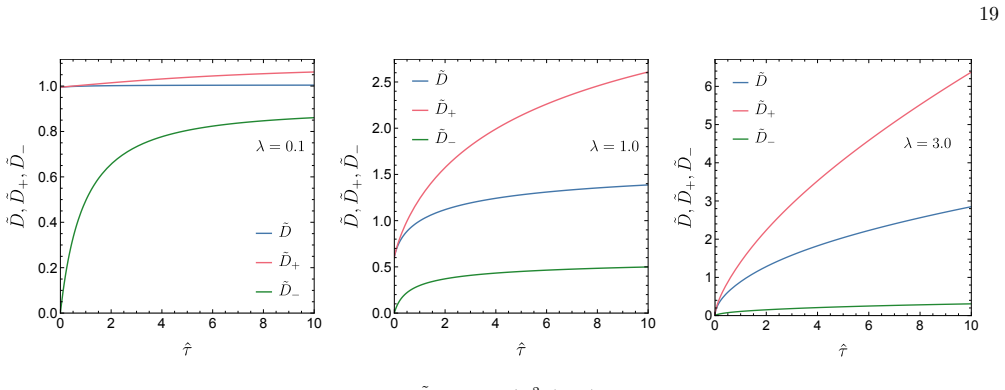
- [Section VI and Eqs. (80)] The numerical values for E. coli, including L0 and the transport coefficients, come from the numerical solution of Eqs. (80) with a Hermite truncation at n=10, but no convergence check with respect to the truncation order is shown. Given the near-resonant structure that produces the mu12 and mu22 divergences, the truncation error could be significant even where the exact system is finite. Please report the dependence of D11, D12, D22, mu11, mu12, mu21, mu22, and L0 on the Hermite truncation order at the E. coli parameters, and state the accuracy of the reported values.
minor comments (6)
- [Eq. (9)] The phrase 'Lorentz-type equation' should be replaced by a more standard descriptor such as 'linear Boltzmann-type collision operator' to avoid confusion with the Lorentz model of electrons.
- [Section II.A] There is a typo in 'Chey-P' in the introduction; it should be 'CheY-P' consistently.
- [Section IV.E] The phrase 'the election of the signs' should read 'the choice of signs'.
- [Figure 7] The caption does not state the normalization of the plotted current or the fact that the Keller-Segel curve is divided by 5; please add explicit axis labels and normalization details.
- [Eq. (107)] The expression for <X> in the step-profile case appears to mix orders in l1 within the denominator; please check the linearization and sign conventions, since this expression feeds into the tumbling-rate prediction Eq. (106a).
- [General] A notation table for the many transport coefficients (D11, D12, D21, D22, mu11, mu12, mu21, mu22, g1...g8) and their sign conventions would substantially improve readability, given the frequent sign choices in Eqs. (83)-(93).
Circularity Check
No significant circularity: Eqs. (91)-(93) are obtained by Chapman-Enskog closure from the stated kinetic equation; self-cited prior model and fitted E. coli parameters are inputs, not the predicted nonlocal response or traveling-wave maximum.
full rationale
The derivation chain is self-contained once the kinetic model is accepted. The self-citations to Refs. [24] and [22] supply the single-variable Ornstein-Uhlenbeck model for CheY-P, Eq. (2), the form of the kinetic equation, Eq. (7), and the E. coli parameters (V, nu0, tau, lambda, alpha1). These are input assumptions and empirical data, not the quantities the paper claims to predict. The smoothing length L0 and the traveling-wave current maximum are computed from the closed hydrodynamic equations (91)-(93) and the transport coefficients obtained by solving Eqs. (80); they are not fitted to the nonlocal density profile or to the current data of Ref. [72]. The agent-based simulations in Figs. 5-6 provide an independent consistency check of the closure at tau-hat=1, lambda=1, and the comparison with the E. coli traveling-wave experiment is qualitative and predictive. I also weighed the admitted divergence of mu12 and mu22 at specific tau values in Fig. 3: the authors attribute it to a lack of full separation of kinetic modes, a necessary condition for Chapman-Enskog. That is a domain-of-validity caveat and a correctness risk, not a circular reduction of the predicted results to the model inputs. No fitted parameter is renamed as a prediction and no central claim reduces by definition to an input, so no circular step is exhibited.
Assumptions & free parameters
free parameters (6)
- swim speed V =
27 micrometers per second (Ref. [22])
- base tumbling rate nu0 =
0.22 per second (Ref. [22])
- memory time tau =
19 seconds (Ref. [22])
- sensitivity lambda =
1.62 (Ref. [22])
- tumbling kernel first moment alpha1 =
0.33 (Ref. [1])
- ligand coupling b =
not specified; set to 1 in dimensionless equations
assumptions (6)
- domain assumption The chemotactic pathway of E. coli is reducible to a single internal variable X with Langevin dynamics (3) and a single memory time tau.
- domain assumption The Fokker-Planck operator for X has a discrete spectrum with eigenvalues gamma_n and a unique stationary distribution phi(X).
- domain assumption Spatial gradients of all fields are small, allowing a Chapman-Enskog expansion in a small parameter epsilon.
- domain assumption The tumbling kernel w depends only on the relative angle and is normalized; only its first moment alpha1 affects the results.
- domain assumption The normal solution ansatz holds: the distribution function depends on time and space only through the hydrodynamic fields rho and rho_X.
- ad hoc to paper The Hermite series can be truncated at low order (n=1 or n=2) for small lambda, and numerically at n=10 for larger lambda.
invented entities (1)
-
CheY-P density field rho_X(r,t)
independent evidence
Cite this review
Pith. "Pith review of Bacterial chemotaxis considering memory effects." pith.science (2026). https://pith.science/paper/J4PIM3DY
@misc{pith2026250415405,
  author       = {Pith},
  title        = {Pith review of: Bacterial chemotaxis considering memory effects},
  year         = {2026},
  howpublished = {\url{https://pith.science/paper/J4PIM3DY}},
  note         = {Machine review of arXiv:2504.15405}
}
abstract
Bacterial chemotaxis for E.coli is controlled by methylation of chemoreceptors, which in a biochemical pathway regulates the concentration of the CheY-P protein that finally controls the tumbling rate. As a consequence, the tumbling rate adjusts to changes in the concentration of relevant chemicals, to produce a biased random walk toward chemoattractants of against the repellers. Methylation is a slow process, implying that the internal concentration of CheY-P is not instantaneously adapted to the environment, and the tumbling rate presents memory. This implies that the Keller-Segel (KS) equations used to describe chemotaxis at the macroscopic scale, which assume a local relation between the bacterial flux and the chemical gradient, are not fully valid as memory and the associated nonlocal response are not considered. To derive the equations that replace the KS ones, we use a kinetic approach, in which a kinetic equation for the bacterial transport is written considering the dynamics of the protein concentration. When memory is large, the protein concentration field must be considered a relevant variable as the bacterial density. Working out the Chapman-Enskog (CE) method, the dynamical equations for these fields are obtained, which have the form of reaction-diffusion equations with flux and source terms depending on the gradients on the chemical signal. The transport coefficients are obtained entirely in terms of the microscopic dynamics, giving their values of the case of E.coli. Solving the equations for an inhomogeneous signal it is shown that the response is nonlocal, with a smoothing length as large as $170\mu$m for E.coli. The homogeneous response and the relaxational dynamics are also studied. The case of small memory is also studied, in which case the CE method reproduces the KS equations, with explicit expressions for the transport coefficients.
Figures


Figures from the paper (6 more)


Reference graph
Works this paper leans on
-
[72]
S. Khan, S. Jain, G. P. Reid, and D. R. Trentham, The fast tumble signal in bacterial chemotaxis, Biophysical journal 86, 4049 (2004)
work page 2004
-
[1]
As in the linear model g7 > 0, this results shows that on average bacteria move in the same direction of ligand gradient. Still in the case of stationary ligand profiles, the non- linear coupling between ρ and ρX with∇l in the fluxes, together with the memory effects, can generate interest- ing nonlinear responses. According to Eq. (3), if bacteria are su...
-
[2]
H. C. Berg, E. coli in Motion (Springer Science & Busi- ness Media, 2008)
work page 2008
-
[3]
, (99b) k0 = s D11γ1 τ (D11D22−D2 12). (99c) The response function Ψ( k, 0), has a constant term, as- sociated to a local response, added to a Lorentzian form, indicating a nonlocal response with a smoothing length L0 = k−1 0 . In the memoryless limit ( τ → 0) the den- sity response function becomes Ψ( k, 0) = ψ0 + ψ1 = µ11/D11 = µ/D, independent of k, in...
-
[4]
H. C. Berg and D. A. Brown, Chemotaxis in Escherichia coli analysed by three-dimensional tracking, Nature 239, 500 (1972)
1972
-
[5]
E. F. Keller and L. A. Segel, Initiation of slime mold ag- gregation viewed as an instability, Journal of theoretical biology 26, 399 (1970)
work page 1970
-
[6]
E. Korobkova, T. Emonet, J. M. Vilar, T. S. Shimizu, and P. Cluzel, From molecular noise to behavioural variability in a single bacterium, Nature 428, 574 (2004)
work page 2004
- [7]
Show all 80 references
-
[8]
R. M. Ford and P. T. Cummings, On the relationship be- tween cell balance equations for chemotactic cell popula- tions, SIAM Journal on Applied Mathematics 52, 1426 (1992)
1992
-
[9]
E. F. Keller and L. A. Segel, Model for chemotaxis, Jour- nal of theoretical biology 30, 225 (1971)
1971
-
[10]
M. A. Rivero, R. T. Tranquillo, H. M. Buettner, and D. A. Lauffenburger, Transport models for chemotactic cell populations based on individual cell behavior, Chem- ical engineering science 44, 2881 (1989)
1989
-
[11]
Cremer, T
J. Cremer, T. Honda, Y. Tang, J. Wong-Ng, M. Vergas- sola, and T. Hwa, Chemotaxis as a navigation strategy to boost range expansion, Nature 575, 658 (2019)
2019
-
[12]
, (99a) ψ1 = D22µ11−D12µ21 (D11D22−D2
-
[13]
Y. Tu, T. S. Shimizu, and H. C. Berg, Modeling the chemotactic response of Escherichia coli to time-varying stimuli, Proceedings of the National Academy of Sciences 105, 14855 (2008)
2008
-
[14]
Tu, Quantitative modeling of bacterial chemotaxis: signal amplification and accurate adaptation, Annual re- 22 view of biophysics 42, 337 (2013)
Y. Tu, Quantitative modeling of bacterial chemotaxis: signal amplification and accurate adaptation, Annual re- 22 view of biophysics 42, 337 (2013)
2013
-
[15]
Alt, Biased random walk models for chemotaxis and related diffusion approximations, Journal of mathemati- cal biology 9, 147 (1980)
W. Alt, Biased random walk models for chemotaxis and related diffusion approximations, Journal of mathemati- cal biology 9, 147 (1980)
1980
-
[17]
K. C. Chen, P. T. Cummings, and R. M. Ford, Pertur- bation expansion of alt’s cell balance equations reduces to segel’s one-dimensional equations for shallow chemoat- tractant gradients, SIAM Journal on Applied Mathemat- ics 59, 35 (1998)
1998
-
[18]
Bearon and T
R. Bearon and T. Pedley, Modelling run-and-tumble chemotaxis in a shear flow, Bulletin of mathematical bi- ology 62, 775 (2000)
2000
-
[19]
Kasyap and D
T. Kasyap and D. L. Koch, Instability of an inho- mogeneous bacterial suspension subjected to a chemo- attractant gradient, Journal of fluid mechanics 741, 619 (2014)
2014
-
[20]
Tostevin and P
F. Tostevin and P. Rein ten Wolde, Mutual information between input and output trajectories of biochemical net- works, Physical Review Letters 102, 218101 (2009)
2009
-
[21]
G. Lan, P. Sartori, S. Neumann, V. Sourjik, and Y. Tu, The energy–speed–accuracy trade-off in sensory adapta- tion, Nature Physics 8, 422 (2012)
2012
-
[22]
Ito and T
S. Ito and T. Sagawa, Maxwell’s demon in biochemical signal transduction with feedback loop, Nature Commu- nications 6, 7498 (2015)
2015
-
[23]
J. Yuan, R. W. Branch, B. G. Hosu, and H. C. Berg, Adaptation at the output of the chemotaxis signalling pathway, Nature 484, 233 (2012)
2012
-
[24]
Zhang, R
C. Zhang, R. He, R. Zhang, and J. Yuan, Motor adaptive remodeling speeds up bacterial chemotactic adaptation, Biophysical journal 114, 1225 (2018)
2018
-
[25]
Figueroa-Morales, R
N. Figueroa-Morales, R. Soto, G. Junot, T. Darnige, C. Douarche, V. A. Martinez, A. Lindner, and E. Cl´ ement, 3D spatial exploration by E. coli echoes mo- tor temporal variability, Physical Review X 10, 021004 (2020)
2020
-
[26]
super- contaminates
N. Figueroa-Morales, A. Rivera, R. Soto, A. Lind- ner, E. Altshuler, and ´E. Cl´ ement, E. coli “super- contaminates” narrow ducts fostered by broad run-time distribution, Science advances 6, eaay0155 (2020)
2020
-
[27]
Villa-Torrealba, S
A. Villa-Torrealba, S. Navia, and R. Soto, Kinetic mod- eling of the chemotactic process in run-and-tumble bac- teria, Physical Review E 107, 034605 (2023)
2023
-
[28]
Sarkar, G
A. Sarkar, G. Georgiou, and M. M. Sharma, Transport of bacteria in porous media: I. an experimental investiga- tion, Biotechnology and Bioengineering 44, 489 (1994)
1994
-
[29]
H. Mao, P. S. Cremer, and M. D. Manson, A sensitive, versatile microfluidic assay for bacterial chemotaxis, Pro- ceedings of the National Academy of Sciences 100, 5449 (2003)
2003
-
[30]
R. M. Ford and R. W. Harvey, Role of chemotaxis in the transport of bacteria through saturated porous media, Advances in Water Resources 30, 1608 (2007)
2007
-
[31]
N. A. Licata, B. Mohari, C. Fuqua, and S. Setayeshgar, Diffusion of bacterial cells in porous media, Biophysical journal 110, 247 (2016)
2016
-
[32]
Bhattacharjee and S
T. Bhattacharjee and S. S. Datta, Bacterial hopping and trapping in porous media, Nature communications 10, 2075 (2019)
2019
-
[33]
Blackburn, T
N. Blackburn, T. Fenchel, and J. Mitchell, Microscale nutrient patches in planktonic habitats shown by chemo- tactic bacteria, Science 282, 2254 (1998)
1998
-
[34]
Stocker, Marine microbes see a sea of gradients, sci- ence 338, 628 (2012)
R. Stocker, Marine microbes see a sea of gradients, sci- ence 338, 628 (2012)
2012
-
[35]
G. Si, T. Wu, Q. Ouyang, and Y. Tu, Pathway-based mean-field model for escherichia coli chemotaxis, Physical review letters 109, 048101 (2012)
2012
-
[36]
G. Si, M. Tang, and X. Yang, A pathway-based mean- field model for e. coli chemotaxis: Mathematical deriva- tion and its hyperbolic and parabolic limits, Multiscale Modeling & Simulation 12, 907 (2014)
2014
-
[37]
Chalub, Y
F. Chalub, Y. Dolak-Struss, P. Markowich, D. Oelz, C. Schmeiser, and A. Soreff, Model hierarchies for cell aggregation by chemotaxis, Mathematical Models and Methods in Applied Sciences 16, 1173 (2006)
2006
-
[38]
Xue and H
C. Xue and H. G. Othmer, Multiscale models of taxis- driven patterning in bacterial populations, SIAM Journal on Applied Mathematics 70, 133 (2009)
2009
-
[39]
Xue, Macroscopic equations for bacterial chemotaxis: integration of detailed biochemistry of cell signaling, Journal of mathematical biology 70, 1 (2015)
C. Xue, Macroscopic equations for bacterial chemotaxis: integration of detailed biochemistry of cell signaling, Journal of mathematical biology 70, 1 (2015)
2015
-
[40]
Taktikos, H
J. Taktikos, H. Stark, and V. Zaburdaev, How the motil- ity pattern of bacteria affects their dispersal and chemo- taxis, PLoS ONE 8, e81936 (2013)
2013
-
[41]
Y. S. Dufour, X. Fu, L. Hernandez-Nunez, and T. Emonet, Limits of feedback control in bacterial chemo- taxis, PLoS computational biology 10, e1003694 (2014)
2014
-
[42]
Wong-Ng, A
J. Wong-Ng, A. Melbinger, A. Celani, and M. Vergassola, The role of adaptation in bacterial speed races, PLoS computational biology 12, e1004974 (2016)
2016
-
[43]
Cluzel, M
P. Cluzel, M. Surette, and S. Leibler, An ultrasensitive bacterial motor revealed by monitoring signaling proteins in single cells, Science 287, 1652 (2000)
2000
-
[44]
F. Bai, R. W. Branch, D. V. Nicolau Jr, T. Pilizota, B. C. Steel, P. K. Maini, and R. M. Berry, Conforma- tional spread as a mechanism for cooperativity in the bacterial flagellar switch, science 327, 685 (2010)
2010
-
[45]
Colin, C
R. Colin, C. Rosazza, A. Vaknin, and V. Sourjik, Mul- tiple sources of slow activity fluctuations in a bacterial chemosensory network, Elife 6, e26796 (2017)
2017
-
[46]
J. M. Keegstra, K. Kamino, F. Anquez, M. D. Lazova, T. Emonet, and T. S. Shimizu, Phenotypic diversity and temporal variability in a bacterial signaling network re- vealed by single-cell fret, Elife 6, e27455 (2017)
2017
-
[47]
M. J. Schnitzer, Theory of continuum random walks and application to chemotaxis, Physical Review E 48, 2553 (1993)
1993
-
[48]
K. C. Chen, R. M. Ford, and C. P. T., Cell balance equation for chemotactic bacteria with a biphasic tum- bling frequency, Journal of Mathematical Biology47, 518 (2003)
2003
-
[49]
Lushi, R
E. Lushi, R. E. Goldstein, and M. J. Shelley, Collective chemotactic dynamics in the presence of self-generated fluid flows, Physical Review E 86, 040902 (2012)
2012
-
[50]
T. V. Kasyap and D. L. Koch, Chemotaxis driven insta- bility of a confined bacterial suspension, Physical Review Letters 108, 038101 (2012)
2012
-
[51]
R. N. Bearon and T. J. Pedley, Modelling run-and-tumble chemotaxis in a shear flow, Bulletin of Mathematical Bi- ology 62, 775 (2000)
2000
-
[52]
M. J. Tindall, P. K. Maini, S. L. Porter, and J. P. 23 Armitage, Overview of mathematical approaches used to model bacterial chemotaxis ii: bacterial populations, Bulletin of mathematical biology 70, 1570 (2008)
2008
-
[53]
Vladimirov, D
N. Vladimirov, D. Lebiedz, and V. Sourjik, Predicted auxiliary navigation mechanism of peritrichously flagel- lated chemotactic bacteria, PLoS computational biology 6, e1000717 (2010)
2010
-
[54]
Saragosti, V
J. Saragosti, V. Calvez, N. Bournaveas, B. Perthame, A. Buguin, and P. Silberzan, Directional persistence of chemotactic bacteria in a traveling concentration wave, Proceedings of the National Academy of Sciences 108, 16235 (2011)
2011
-
[55]
Saragosti, P
J. Saragosti, P. Silberzan, and A. Buguin, Modeling E. coli tumbles by rotational diffusion. Implications for chemotaxis, PloS ONE 7, 1 (2012)
2012
-
[56]
Celani and M
A. Celani and M. Vergassola, Bacterial strategies for chemotaxis response, Proceedings of the National Academy of Sciences 107, 1391 (2010)
2010
-
[57]
J. Long, S. W. Zucker, and T. Emonet, Feedback between motion and sensation provides nonlinear boost in run- and-tumble navigation, PLoS computational biology 13, e1005429 (2017)
2017
-
[58]
Risken, The Fokker-Planck equation: methods of so- lution and applications (Springer, 1997)
H. Risken, The Fokker-Planck equation: methods of so- lution and applications (Springer, 1997)
1997
-
[59]
G. B. Arfken, H. J. Weber, and F. E. Harris, Mathe- matical methods for physicists: a comprehensive guide (Academic press, 2011)
2011
-
[60]
Forster, Hydrodynamic fluctuations, broken symmetry, and correlation functions (CRC Press, 2018)
D. Forster, Hydrodynamic fluctuations, broken symmetry, and correlation functions (CRC Press, 2018)
2018
-
[61]
P. M. Chaikin and T. C. Lubensky, Principles of Con- densed Matter Physics (Cambridge University Press, 1995)
1995
-
[62]
Chapman and T
S. Chapman and T. G. Cowling, The mathematical theory of non-uniform gases: an account of the kinetic theory of viscosity, thermal conduction and diffusion in gases (Cambridge university press, 1990)
1990
-
[63]
Soto, Kinetic Theory and Transport Phenomena , Ox- ford Master Series in Physics (Oxford University Press, 2016)
R. Soto, Kinetic Theory and Transport Phenomena , Ox- ford Master Series in Physics (Oxford University Press, 2016)
2016
-
[64]
Brilliantov and T
N. Brilliantov and T. P¨ oschel,Kinetic theory of granular gases (Oxford University Press, 2004)
2004
-
[65]
Garz´ o,Granular gaseous flows (Springer, 2019)
V. Garz´ o,Granular gaseous flows (Springer, 2019)
2019
-
[66]
Villa-Torrealba, C
A. Villa-Torrealba, C. Ch´ avez-Raby, P. de Castro, and R. Soto, Run-and-tumble bacteria slowly approaching the diffusive regime, Physical Review E 101, 062607 (2020)
2020
-
[67]
Sela and I
N. Sela and I. Goldhirsch, Hydrodynamic equations for rapid flows of smooth inelastic spheres, to burnett order, Journal of Fluid Mechanics 361, 41 (1998)
1998
-
[68]
Khalil, V
N. Khalil, V. Garz´ o, and A. Santos, Hydrodynamic bur- nett equations for inelastic maxwell models of granular gases, Physical Review E 89, 052201 (2014)
2014
-
[69]
de Groot and P
S. de Groot and P. Mazur, Non-equilibrium Thermody- namics, Dover Books on Physics (Dover Publications, 1984)
1984
-
[70]
Santos, Transport coefficients of d-dimensional inelas- tic maxwell models, Physica A: Statistical Mechanics and its Applications 321, 442 (2003)
A. Santos, Transport coefficients of d-dimensional inelas- tic maxwell models, Physica A: Statistical Mechanics and its Applications 321, 442 (2003)
2003
-
[71]
J. J. Brey, M. Garc´ ıa de Soria, and P. Maynar, Break- down of hydrodynamics in the inelastic maxwell model of granular gases, Physical Review E—Statistical, Non- linear, and Soft Matter Physics 82, 021303 (2010)
2010
-
[73]
Junot, T
G. Junot, T. Darnige, A. Lindner, V. A. Martinez, J. Arlt, A. Dawson, W. C. Poon, H. Auradou, and E. Cl´ ement, Run-to-tumble variability controls the sur- face residence times of e. coli bacteria, Physical Review Letters 128, 248101 (2022)
2022
-
[74]
N. G. Van Kampen, Stochastic processes in physics and chemistry, Vol. 1 (Elsevier, 1992)
1992
-
[75]
Z. Li, Q. Cai, X. Zhang, G. Si, Q. Ouyang, C. Luo, and Y. Tu, Barrier crossing in escherichia coli chemotaxis, Physical review letters 118, 098101 (2017)
2017
-
[76]
J. P. Armitage and R. Schmitt, Bacterial chemotaxis: Rhodobacter sphaeroide and sinorhizobium meliloti- variations on a theme?, Microbiology 143, 3671 (1997)
1997
-
[77]
Garren, K
M. Garren, K. Son, J.-B. Raina, R. Rusconi, F. Meno- lascina, O. H. Shapiro, J. Tout, D. G. Bourne, J. R. Seymour, and R. Stocker, A bacterial pathogen uses dimethylsulfoniopropionate as a cue to target heat- stressed corals, The ISME journal 8, 999 (2014)
2014
-
[78]
A. P. Berke, L. Turner, H. C. Berg, and E. Lauga, Hy- drodynamic attraction of swimming microorganisms by surfaces, Physical Review Letters 101, 038102 (2008)
2008
-
[79]
Lauga, W
E. Lauga, W. R. DiLuzio, G. M. Whitesides, and H. A. Stone, Swimming in circles: motion of bacteria near solid boundaries, Biophysical journal 90, 400 (2006)
2006
-
[80]
A. M. Hein, D. R. Brumley, F. Carrara, R. Stocker, and S. A. Levin, Physical limits on bacterial navigation in dynamic environments, Journal of The Royal Society In- terface 13, 20150844 (2016)
2016
-
[81]
Jakuszeit, J
T. Jakuszeit, J. Lindsey-Jones, F. J. Peaudecerf, and O. A. Croze, Migration and accumulation of bacteria with chemotaxis and chemokinesis, The European Phys- ical Journal E 44, 1 (2021)
2021
Reviewed August 16, 2026 · model on record in the stance chip above.
Discussion (0). Continue with ORCID to comment.