REVIEW 3 major objections 5 minor 17 references
LLM-based Semantic Augmentation for Harmful Content Detection
T0 review · 3 major / 5 minor · reviewed 2026-08-16 · deepseek-v4-flash
Pith's one-line read The paper claims that LLM-generated cleaning and explanations can substitute for paid human annotations in training harmful-content detectors at a tiny fraction of the cost, even though zero-shot LLMs themselves underperform on the same…
desk verdict The trigger-based augmentation idea is genuinely new and useful, but the headline parity-with-human-annotation claim rests on an unequal comparison and should be substantially revised before this paper is ready. read the letter →
The pith
A machine-rendered reading of the paper's core claim, the machinery that carries it, and where it could break.
The reading
What carries the argument
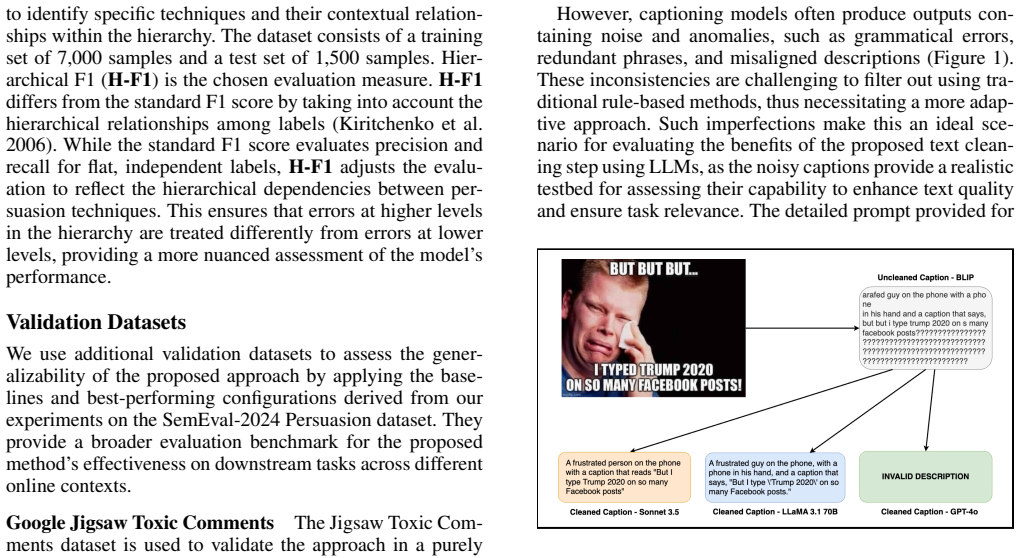
The mechanism is a two-stage prompting pipeline feeding a supervised decoder. First, a cleaning prompt repairs grammatical errors, repetition, and misaligned descriptions in captions produced by the image-captioning models BLIP and GIT, returning 'INVALID DESCRIPTION' when a caption is beyond repair so the original meme text is kept. Second, a semantic-augmentation prompt generates either a concise explanation of the meme's persuasive message or, in offensive-language domains, a 'TRIGGERS' field that must reproduce hateful words and themes verbatim, bypassing LLM safety filters that would otherwise strip the signal. All three text sources are concatenated and fed to a BART sequence-to-sequence decoder, whose hierarchical decoding fits the 22-technique label hierarchy; validation tasks use DistilBERT and CLIP encoders. The trigger field is the load-bearing mechanism for toxic and hateful content, and repeating explanation generation five times and averaging the downstream results is the device that turns stochastic LLM output into a stable training signal.
What would settle it
Run the paper's best configuration (meme text + GPT-4o-cleaned caption + GPT-4o explanation into the BART decoder) with two control conditions: explanations randomly reassigned from other memes, and human captions and explanations collected for all 9,500 memes at the paper's measured rate. If shuffled explanations retain most of the 62.2% hierarchical F1, the gain is not semantic; if full human annotation lifts hierarchical F1 above 62.2% by more than the reported run-to-run variance (about 1.4 points), the parity claim fails.
Extended reading notes
Core claim
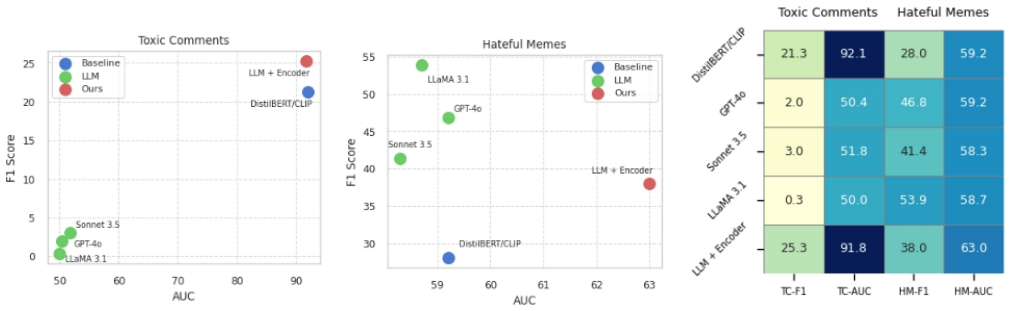
The central finding is a separation between LLMs as classifiers and LLMs as data enrichments: across three datasets (persuasive memes, toxic comments, hateful memes), zero-shot LLM classification underperforms supervised models, yet LLM-generated context substantially improves those same supervised models. On the main benchmark, concatenating meme text, an LLM-cleaned image caption, and an LLM-written explanation into a BART decoder reaches 62.2% hierarchical F1, the best of all tested configurations, with the gain over text-only training statistically significant for GPT-4o (60.2 +/- 1.4 vs 57.1 on the text+caption baseline). The paper additionally finds that explanation-based augmentation fails when the content is explicitly hateful, because the LLMs censor or paraphrase the very words that indicate toxicity; replacing explanations with a trigger list that quotes offensive phrases verbatim raises hateful-meme F1 from 27.3 to 38.0 and toxic-comment F1 from 20.8 to 25.3.
Load-bearing premise
The central cost-parity claim rests on comparing LLM-augmented training over all 9,500 memes with human-annotated training over only 2,000 memes; if human annotations over the full dataset produced a stronger signal, the conclusion that LLM augmentation matches human annotation would not hold.
Editorial extensions
If this is right
- Training a small supervised model on LLM-enriched text can replace human-annotated captions and explanations in harmful-content detection while improving accuracy over text-only and zero-shot baselines.
- Zero-shot LLM classification should not be the default tool for high-context, multi-label social-media tasks; the results place LLMs upstream, as cleaners and explainers, rather than as final classifiers.
- In domains involving profanity or hateful language, augmentation must preserve explicit terms; trigger-based augmentation outperforms explanation-based augmentation and the plain baselines on both toxic comments and hateful memes.
- Combining multiple context sources (text + cleaned caption + explanation) is more stable and accurate than any single source, while training on explanations alone degrades performance.
- LLM-based cleaning of noisy captions yields only modest hierarchical-F1 gains, statistically significant only for GPT-4o on BLIP captions, so cleaning alone is not the main driver of the improvement.
Reading between the lines
- A check the paper does not run: reassign each meme the explanation written for a different meme; if shuffled explanations keep most of the 62.2% gain, the benefit comes from added text volume or style rather than from semantic content, which would alter how the method should be described.
- The trigger mechanism reads as a general design principle for tasks where model safeguards erase the evidence, such as detecting self-harm language or coordinated harassment, where a constrained verbatim-quote field could be tested as a cheap alternative to fighting the filters.
- The headline cost numbers ($3 for 9,500 memes with LLaMA or Sonnet versus $1,100 for 2,000 human-annotated memes) will likely be quoted out of context; a fair reformulation would report cost per meme and re-run the comparison on a fully human-annotated set.
- In a deployed moderation pipeline the explanation doubles as a review artifact that a human moderator can read when deciding appeals, a use the paper does not discuss but its own examples support.
Signed reviews
Editorial analysis
A structured set of objections, weighed in public.
Referee Report
Summary. The paper proposes a pipeline that uses LLMs to clean noisy image captions and to generate context-rich explanations (or, in offensive-language domains, trigger lists) that are concatenated with the original text and fed into a supervised decoder or encoder. The method is evaluated on the SemEval 2024 Persuasive Memes dataset, Google Jigsaw Toxic Comments, and Facebook Hateful Memes. The main claims are that zero-shot LLM classification underperforms on these high-context tasks, that LLM-based semantic augmentation improves over text-only and caption-based baselines, and that the resulting performance is on par with human-annotated data at a fraction of the cost.
Significance. If the central claims held, the paper would offer a practical, low-cost alternative to expensive human annotation for harmful-content detection, which is a socially important application area. The work has several concrete strengths: it evaluates across three datasets, uses multiple LLMs (GPT-4o, Sonnet 3.5, LLaMA 3.1), reports repeated runs with variance for LLM-generated explanations, applies multiple-comparison corrections in some significance tests, and explicitly discusses and partially addresses LLM censorship through trigger-based augmentation. These properties make the study more informative than a simple accuracy comparison. However, the headline cost-parity claim is built on a confounded comparison, and one of the generalization claims is contradicted by the paper's own Table 4. The underlying method may still be sound, but the stated claims need substantial revision to match the evidence.
major comments (3)
- [Human and LLM-Based Annotations; Table 3; Limitations] The central claim that LLM-based semantic augmentation is 'on par with' human-annotated data is confounded by annotation coverage. In the Human Annotation condition, captions and explanations were collected for only 1,000 training and 1,000 test memes; the remaining samples use raw meme text only. In the LLM condition, explanations and cleaned captions cover all 7,000 training and 1,500 test memes. The observed H-F1 gap (62.2 vs. 57.8) could therefore be driven by the 7x larger annotated training set and 1.5x larger annotated test set, not by any qualitative advantage of LLM-generated text. The Limitations section acknowledges 'the lack of human annotations on the full dataset may introduce potential bias,' but the abstract and conclusion restate the parity claim without this caveat. A matched comparison, e.g., human annotations on the same full set or LLM augmentation on only the 1,000-meme training subset, is needed before the cost-parity claim can be supported.
- [Abstract; RQ4; Table 4] The abstract and RQ4 state that zero-shot LLMs underperform compared with the proposed supervised approach, but Table 4 shows the opposite on hateful memes: zero-shot LLaMA 3.1 achieves F1=53.9 while the proposed LLM+Encoder achieves F1=38.0. The paper's own text acknowledges only that LLM+Encoder obtains 'competitive F1 (38.0)' on that dataset, which is not competitive with the zero-shot result. The generalization claim in the abstract should be qualified by task and metric, or the hateful-meme result should be reconciled with the abstract's broad statement.
- [Results, 'Comparison with Other Approaches'; Table 3; Table 7; Table 8] The headline H-F1 of 62.2 is the best of five runs for GPT-4o in the T+C+E condition (Table 7), while the baselines in Table 3 (CLIP, Text Only, Text+Caption, Human Annotation) appear to be single runs with no reported variance. The text says this 'significantly exceeding all baselines,' but no significance test accompanies Table 3. Moreover, Table 8 shows that on the development set GPT-4o T+C+E vs. T+C has BH-p=0.085 (not significant), and Sonnet 3.5 T+C+E vs. T+C on the test set has BH-p=0.085; these within-condition comparisons do not support the word 'significantly' for comparisons against all baselines. The authors should either run repeated trials for the baselines and test the relevant differences or soften the significance claim.
minor comments (5)
- [Variability in LLM Outputs; Figure 4; Table 3 caption] The paper states that five versions of LLM explanations were generated and that average performance is reported, but Figure 4 and Table 3 say '3 runs' while Table 7 reports five repetitions. The number of runs should be consistent and clearly stated.
- [Table 4 caption] The caption says 'Best metrics for each task are highlighted in bold,' but no bolding appears in the table as presented; the formatting should be fixed or the caption adjusted.
- [Cost comparison in 'Human and LLM-Based Annotations'] The reported LLM cost of $3 for LLaMA 3.1/Sonnet 3.5 and $30 for GPT-4o appears to cover annotation of the full dataset, but it is unclear whether this includes the five generated explanation versions or only a single pass. This should be clarified for a fair cost comparison.
- [Computational Resources; Experimental setup] The paper claims in the checklist that all training details are specified, but the text does not give hyperparameters for the BART decoder (learning rate, epochs, batch size, sequence length, etc.). Providing these would improve reproducibility.
- [General editorial] Some references are incomplete (e.g., 'Li, Z.; Zhu, H.; Lu, Z.; and Yin, M. 2023b' appears without a full title in the reference list as printed). The authors should check that all bibliography entries are complete.
Circularity Check
No significant circularity: the paper's claims are empirical comparisons on external benchmarks, not derivations from fitted inputs or self-citation chains.
full rationale
This paper does not contain a derivation chain in which an output is equivalent to an input by construction. The central claim—that LLM-based semantic augmentation performs on par with human-annotated data at lower cost—is an empirical result based on training supervised classifiers on externally defined benchmark datasets (SemEval 2024 Persuasive Memes, Jigsaw Toxic Comments, and Facebook Hateful Memes). The LLM-generated explanations and triggers are produced by prompting publicly available LLMs and are then concatenated with the original text; the downstream BART/DistilBERT/CLIP models are evaluated on fixed test splits defined by dataset organizers. No parameter is fitted to the target metric and then renamed as a prediction. The paper also does not rely on any load-bearing self-citation or imported uniqueness theorem; its references to prior work are contextual, not used to force the paper's conclusions. The most notable methodological concern is the imbalance in annotation coverage between the human-annotation condition (2,000 memes) and the LLM-augmentation condition (9,500 memes), which the authors explicitly acknowledge in the Limitations section ('the lack of human annotations on the full dataset may introduce potential bias when benchmarking against other baselines'). That is a threat to the fairness of the comparison and to the strength of the cost-parity claim, but it is not circularity: the human-annotation condition is an independent human benchmark, not a quantity derived from the LLM outputs or from the paper's own fitted parameters. The reported improvements over zero-shot LLMs and text-only baselines are externally falsifiable empirical findings, so the honest circularity verdict is 0.
Assumptions & free parameters
free parameters (6)
- Explanation length cap =
50 tokens
- Trigger list cap =
20 tokens
- Number of explanation versions per sample =
5
- Crowdworker retention =
70 of 300
- Validation LLM =
LLaMA 3.1 70B
- Captioning model set =
BLIP and GIT
assumptions (5)
- domain assumption Image content of memes is adequately captured by BLIP/GIT captions.
- domain assumption LLM-generated explanations provide discriminative cues beyond the original meme text and captions.
- domain assumption LLM explanations and triggers do not leak task labels or dataset statistics.
- domain assumption BART, DistilBERT, and CLIP are adequate base classifiers for measuring augmentation benefit.
- domain assumption Statistical tests with n=5 and single-run baselines are valid for comparing augmented conditions to baselines.
Cite this review
Pith. "Pith review of LLM-based Semantic Augmentation for Harmful Content Detection." pith.science (2026). https://pith.science/paper/HFAQUUKN
@misc{pith2026250415548,
  author       = {Pith},
  title        = {Pith review of: LLM-based Semantic Augmentation for Harmful Content Detection},
  year         = {2026},
  howpublished = {\url{https://pith.science/paper/HFAQUUKN}},
  note         = {Machine review of arXiv:2504.15548}
}
read the original abstract
Recent advances in large language models (LLMs) have demonstrated strong performance on simple text classification tasks, frequently under zero-shot settings. However, their efficacy declines when tackling complex social media challenges such as propaganda detection, hateful meme classification, and toxicity identification. Much of the existing work has focused on using LLMs to generate synthetic training data, overlooking the potential of LLM-based text preprocessing and semantic augmentation. In this paper, we introduce an approach that prompts LLMs to clean noisy text and provide context-rich explanations, thereby enhancing training sets without substantial increases in data volume. We systematically evaluate on the SemEval 2024 multi-label Persuasive Meme dataset and further validate on the Google Jigsaw toxic comments and Facebook hateful memes datasets to assess generalizability. Our results reveal that zero-shot LLM classification underperforms on these high-context tasks compared to supervised models. In contrast, integrating LLM-based semantic augmentation yields performance on par with approaches that rely on human-annotated data, at a fraction of the cost. These findings underscore the importance of strategically incorporating LLMs into machine learning (ML) pipeline for social media classification tasks, offering broad implications for combating harmful content online.
Figures


Figures from the paper (10 more)



Reference graph
Works this paper leans on
-
[1]
For most authors... (a) Would answering this research question advance sci- ence without violating social contracts, such as violat- ing privacy norms, perpetuating unfair profiling, exac- erbating the socio-economic divide, or implying disre- spect to societies or cultures? Yes (b) Do your main claims in the abstract and introduction accurately reflect t...
-
[2]
Additionally, if your study involves hypotheses testing... (a) Did you clearly state the assumptions underlying all theoretical results? Yes (b) Have you provided justifications for all theoretical re- sults? Yes (c) Did you discuss competing hypotheses or theories that might challenge or complement your theoretical re- sults? Yes (d) Have you considered ...
-
[3]
(a) Did you state the full set of assumptions of all theoret- ical results? NA (b) Did you include complete proofs of all theoretical re- sults? NA
Additionally, if you are including theoretical proofs... (a) Did you state the full set of assumptions of all theoret- ical results? NA (b) Did you include complete proofs of all theoretical re- sults? NA
-
[4]
Additionally, if you ran machine learning experiments... (a) Did you include the code, data, and instructions needed to reproduce the main experimental results (ei- ther in the supplemental material or as a URL)? Yes (b) Did you specify all the training details (e.g., data splits, hyperparameters, how they were chosen)? Yes (c) Did you report error bars (...
-
[5]
arXiv preprint arXiv:1907.11692
RoBERTa: A Robustly Optimized BERT Pretraining Approach. arXiv preprint arXiv:1907.11692. Long, L.; Wang, R.; Xiao, R.; Zhao, J.; Ding, X.; Chen, G.; and Wang, H. 2024. On LLMs-Driven Synthetic Data Gen- eration, Curation, and Evaluation: A Survey. In Ku, L.-W.; Martins, A.; and Srikumar, V ., eds., Findings of the Asso- ciation for Computational Linguist...
arXiv 1907
-
[6]
Additionally, if you used crowdsourcing or conducted research with human subjects, without compromising anonymity... (a) Did you include the full text of instructions given to participants and screenshots? Yes (b) Did you describe any potential participant risks, with mentions of Institutional Review Board (IRB) ap- provals? Yes (c) Did you include the es...
-
[10]
Additionally, if you are using existing assets (e.g., code, data, models) or curating/releasing new assets, without compromising anonymity... (a) If your work uses existing assets, did you cite the cre- ators? Yes (b) Did you mention the license of the assets? NA (c) Did you include any new assets in the supplemental material or as a URL? NA (d) Did you d...
-
[12]
Response must be ONE clear, concise sentence (max 50 tokens)
Show all 17 references
-
[13]
Focus on the main message or emotional impact
-
[14]
Be specific and direct
-
[15]
"" Figure 9: Explanation generation prompt used to extract concise interpretations of meme content. prompt = ( f
Only respond ’NA’ if the text is completely incomprehensible""" Figure 9: Explanation generation prompt used to extract concise interpretations of meme content. prompt = ( f""" You are analyzing memes to train a hateful content classifier. It is crucial that you reproduce all ...
-
[16]
A brief explanation (max 50 tokens) of the meme’s implied meaning and cultural context
-
[17]
"" ) Figure 10: Hateful meme analysis prompt designed to capture both explanations and trigger words. CLASSIFICATION_PROMPT =
A combined TRIGGERS list (max 20 tokens), which must include: - Themes or categories (e.g., racism, islamophobia, etc.) - Any hateful or offensive words/phrases directly quoted from the meme text. Use the following plain-text format (no extra commentary): [Explanation] TRIGGER...
-
[2006]
Learning and Evaluation in the Presence of Class Hi- erarchies: Application to Text Categorization. In Advances in Artificial Intelligence: 19th Conference of the Canadian Society for Computational Studies of Intelligence, Canadian AI 2006, Qu ´ebec City, Qu ´ebec, Canada, Jun...
2006
-
[2019]
Submodular optimization-based diverse paraphrasing and its effectiveness in data augmentation. NAACL. Lewis, M.; Liu, Y .; Goyal, N.; Ghazvininejad, M.; Mo- hamed, A.; Levy, O.; Stoyanov, V .; and Zettlemoyer, L
-
[2020]
arXiv preprint arXiv:1910.13461
BART: Denoising Sequence-to-Sequence Pre-training for Natural Language Generation, Translation, and Compre- hension. arXiv preprint arXiv:1910.13461. Li, J.; Li, D.; Xiong, C.; and Hoi, S. C. H. 2022. BLIP: Bootstrapped Learning from Image and Text.arXiv preprint arXiv:2201.12...
1910 arXiv
-
[2023]
arXiv preprint arXiv:2307.07099
SunGen: A Framework for Mitigating Noise in Synthetic Data for Text Classification. arXiv preprint arXiv:2307.07099. Golovchenko, Y .; Buntain, C.; Eady, G.; Brown, M. A.; and Tucker, J. A. 2020. Cross-platform state propaganda: Rus- sian trolls on Twitter and YouTube during t...
2020 arXiv
Reviewed August 16, 2026 · model on record in the stance chip above.
Discussion (0). Continue with ORCID to comment.