REVIEW 4 major objections 6 minor 87 references
Cequel: Cost-Effective Querying of Large Language Models for Text Clustering
T0 review · 4 major / 6 minor · reviewed 2026-08-16 · deepseek-v4-flash
Pith's one-line read Cequel claims that a small budget of well-chosen LLM pair and triplet queries, turned into weighted constraints, clusters text better than strong baselines at the same token cost.
desk verdict Cequel has a genuinely useful core and solid experiments, but the cost-comparison claim rests on a budget model that ignores prompt/response tokens—worth refereeing, conditional on fixing that. read the letter →
The pith
A machine-rendered reading of the paper's core claim, the machinery that carries it, and where it could break.
The reading
What carries the argument
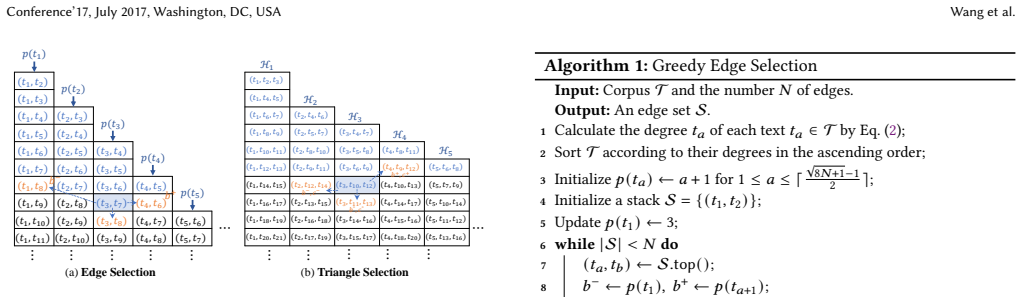
The load-bearing object is a pair of greedy selection algorithms built on spanning edge centrality (SEC), the effective resistance of an edge in the similarity graph. SEC is estimated by the sum of inverse degrees $\Phi(t_a,t_b)=1/d(a)+1/d(b)$, which makes the quadratic set of all pairs tractable: the algorithm only needs to inspect three candidates per step and runs in $O(N+n\log n+nd)$ time. For triangles the same centrality is summed over the three edges, and a min-heap per text keeps the search for the next triplet cheap. The second mechanism is the weighting step: each constraint receives a pointwise mutual information weight derived from text embeddings, and WCSC and WCKMeans fold those weights into the spectral Laplacian or the k-means objective, so noisy LLM answers count for less.
What would settle it
On a short-text corpus, log the actual billed tokens for the exact edge and triangle prompts used in the paper and divide the advertised budget by the real per-query cost; if the resulting number of feasible queries is substantially below $Q/(2s)$ or $Q/(3s)$, then the reported accuracy under 'the same query budget' is not attainable at that budget.
Extended reading notes
Core claim
The paper's central claim is that pairwise supervision from an LLM, concentrated on a handful of informative comparisons, transfers enough signal to cluster an entire corpus. EdgeLLM greedily selects pairs with the largest estimated spanning edge centrality—roughly, pairs whose similarity is most load-bearing for the graph topology—and TriangleLLM extends the idea to triplets, whose multiple-choice answers yield three constraints per query instead of one. The selected constraints are then weighted by pointwise mutual information computed from cheap text embeddings, which down-weights unreliable LLM answers. The authors state that under the same query budget, Cequel outperforms the compared methods on all six datasets, with the best configuration (TriangleLLM plus weighted constrained spectral clustering) reaching 91.01% accuracy on BBC News and 73.10% on Tweet.
Load-bearing premise
Everything rests on the budget model that one edge query costs about two average texts' tokens and one triangle query costs about three; in reality the prompt template, instructions, and the model's response also consume tokens, and for short texts those overheads can dwarf the documents themselves.
Editorial extensions
If this is right
- An O(n)-query budget can replace the O(n^2) pairwise oracle calls that graph-based LLM clustering previously required, making LLM-guided clustering feasible for corpora of thousands of documents.
- Because TriangleLLM extracts three constraints per query, its performance advantage over EdgeLLM under the same budget follows directly from the ratio $3\cdot (Q/3s)$ versus $Q/(2s)$; any setting where triplet judgments are reliable should favor triangles.
- The weighting scheme is what lets the framework tolerate noisy LLM answers: unweighted constraints lose several accuracy points on Tweet, so ignoring answer reliability would erase most of the gain.
- Cequel reaches higher accuracy at a budget of $Q=\Omega/10$ than two LLM baselines reach at $Q=2\Omega$ on BBC News and Tweet, so query effectiveness, not raw budget, is the driver.
Reading between the lines
- Outside the paper's own accounting, real API billing counts the prompt template and reply tokens; recomputing constraint counts under true token cost would likely reduce the number of feasible queries, so the headline 'same budget' comparison should be re-run with billed tokens rather than text-only tokens.
- The same recipe—greedy centrality-based selection of informative comparisons plus an LLM oracle plus weighted constrained clustering—should transfer to other pairwise-supervision tasks such as entity resolution, record linkage, or relevance judgments, where labeling every pair is expensive.
- The PMI weighting could be interpreted as a lightweight calibration of LLM reliability: pairs whose embedding similarity is extreme receive higher weight, so the framework is implicitly betting that the LLM is more trustworthy where cheap embeddings already agree or disagree strongly.
- A testable extension: replace the LLM with any expensive oracle (human annotators, search engines, ML models) and the selection algorithms should still improve constraint efficiency, since the centrality and PMI logic does not depend on the oracle's internals.
Signed reviews
Editorial analysis
A structured set of objections, weighed in public.
Referee Report
Summary. The paper proposes Cequel, a two-stage framework for text clustering under a limited LLM query budget. In the first stage, EdgeLLM or TriangleLLM greedily selects informative text pairs or triplets, respectively, based on spanning-edge/spanning-triangle centralities, and queries an LLM for same-cluster judgments to produce must-link and cannot-link constraints. In the second stage, the authors extend constrained spectral clustering and constrained K-Means to weighted variants (WCSC and WCKMeans), where each constraint is weighted by a PMI-like quantity computed from the text embeddings. The central claim, stated in the abstract and in Section 1, is that under the same token budget Cequel consistently outperforms existing unsupervised and semi-supervised LLM-guided clustering baselines across six benchmark datasets, and that it achieves this with far fewer than the O(n^2) pairwise queries used by graph-clustering approaches. The paper includes an ablation study, a comparison to multiple constrained-clustering back ends, and an analysis of sensitivity to the choice of text encoder and LLM.
Significance. If the central claim holds, Cequel offers a practical reduction in LLM query cost while improving clustering quality over methods such as ClusterLLM and PO-PCKMeans. The design is principled in that the constraints come from an external LLM oracle and the PMI weights are derived from embeddings, so the headline result is not reduced to fitting a constant to the test labels. The paper also provides several strengths: the source code and datasets are publicly linked, the ablations isolate the contributions of the selection strategy and the weighting scheme, and the comparison spans multiple datasets, encoders, and LLMs. The main reservations concern the operationalization of the query budget, the lack of statistical variability information, and the absence of an optimality guarantee for the greedy selection procedures.
major comments (4)
- [§4, Eqs. (3)–(4)] The token-budget model N = Q/(2s) and NΔ = Q/(3s) assumes that only the concatenated document texts consume the budget. The prompt templates in Tables 1 and 8 include a task context, category instructions, and, for triangle queries, a five-option multiple-choice block; the model's response also consumes output tokens. For Tweet, the average text length is about 11 tokens, so the prompt/response overhead can exceed the document tokens by a large factor. Because the headline comparison is made 'under the same query budget' and the single cost figure ($0.0185 on Tweet) is not derived from a model that includes prompts and outputs, the number of feasible queries is currently overstated and the comparison is not yet a fair token- or dollar-equivalent test. Please measure actual prompt/response token usage per method and rerun Table 3 and Fig. 4 under a token-accurate budget, or clearly state that the budget counts only document tokens and justify why that is the appropriate cost measure for the intended deployment.
- [§7, Table 3] All clustering results are reported as single numbers, although both the LLM answers and the KMeans/KMeans++ initializations are stochastic, and the spectral variants are randomized as well. The claim that Cequel 'consistently outperforms' the baselines needs repeated runs with mean and standard deviation (and preferably a paired significance test) before the margins in Table 3 can be considered reliable, particularly on datasets such as Reddit where the reported differences are only a few ACC points.
- [§5.2 and §6.2, Eqs. (8) and (11)] The greedy selection algorithms are presented as solving a maximization problem for the sum of spanning-edge or spanning-triangle centralities, but no approximation guarantee is established for the greedy solution relative to the exact top-N selection. The ablation in Table 5 compares Max only against Min and Random. Since the selection procedure is a core contribution, please add either a theoretical bound on the greedy objective ratio or an empirical comparison to the exact top-N solution on the smaller datasets (e.g., BBC News and Tweet) to justify that the heuristic is near-optimal.
- [§4, Eqs. (5)–(6)] The PMI-based weights rely on a normalization range chosen by hand ([0.5, 1.5] for WCSC and [0.01, 0.1]/[0, 0.01] for WCKMeans) and on the '+1' shift in Eq. (5). No sensitivity analysis is reported for these ranges, and the relationship between the PMI formula in Eq. (5) and the stated probability definitions in the surrounding text is not immediately transparent. Please clarify the derivation of Eq. (5) and report how sensitive the results in Tables 3 and 6 are to the chosen ranges.
minor comments (6)
- [§7.1] The heading 'Experimental Seup' should be 'Experimental Setup'.
- [Table 2 and §7] Table 2 lists six datasets, but the text in §7.1 refers to 'five text corpora'; please make the count consistent.
- [Table 4] In the ablation table, the rows labeled 'w/oEdgeLLM' and 'w/oTriangleLLM' do not specify what replaces the removed component (e.g., random selection or the other selection method); please state the replacement to make the ablation interpretable.
- [Eq. (5)] The definitions of P(a), P(b), and P(a,b) in the prose do not obviously produce the expression written in Eq. (5); please align the notation and derivation.
- [Appendix C.2] The description of WCSC says 'selecting top-K eigenvectors' but does not specify the exact generalized eigenvalue problem involving L and Rα; please add the precise formulation or a reference.
- [Title page and references] The manuscript uses an outdated ACM 'Conference’17' template and reference metadata; if this is intended as a journal submission, the venue and date metadata should be updated.
Circularity Check
No circularity: the clustering result is measured against an external LLM oracle and pre-trained embeddings; the SEC self-citation is not load-bearing, and the budget formula is a cost-accounting assumption, not a derived prediction.
full rationale
Cequel's central claim is an empirical comparison: under a token budget Q, constraints are generated by querying an external LLM oracle on pairs/triplets selected by greedy algorithms, and then used by weighted constrained clustering over pre-trained embeddings. The final ACC and NMI numbers are measured, not derived from the budget formula, so no prediction reduces to an input by construction. The SEC approximation in Eq. (7) is supported by Lemma 5.1 from [28] (which shares authors) and [43], but it is not load-bearing: Table 5 directly tests the Max selection strategy against Min and Random, and the full framework is validated against many baselines. The PMI weighting is an algorithmic design choice tested against alternative weights in Table 6; the normalization ranges are hyperparameters, not fitted predictions. The only notable weakness is the budget accounting in Eqs. (3)-(4), which assumes each LLM query consumes only the document tokens and omits prompt and response tokens; this is a correctness and fairness risk in the cost comparison, not a circularity, because the query-count identity N=Q/(2s) is a modeling assumption rather than a result claimed to be derived from the data. Accordingly, no circular step is identified.
Assumptions & free parameters
free parameters (4)
- WCSC PMI normalization range =
[0.5, 1.5]
- WCKMeans must-link weight range =
[0.01, 0.1]
- WCKMeans cannot-link weight range =
[0, 0.01]
- PMI shift constant =
1
assumptions (5)
- domain assumption The LLM oracle gives reliable enough yes/no and multiple-choice judgments about whether texts belong to the same cluster.
- domain assumption The embedding similarity graph from Instructor-Large is a meaningful substrate for selecting informative constraints.
- domain assumption Spanning edge centrality can be approximated by 1/d(a)+1/d(b).
- ad hoc to paper Greedy selection is near-optimal for the SEC and STC maximization objectives in Eq. (8) and Eq. (11).
- domain assumption The token budget is proportional to document length with no prompt or response overhead.
Cite this review
Pith. "Pith review of Cequel: Cost-Effective Querying of Large Language Models for Text Clustering." pith.science (2026). https://pith.science/paper/IBZC7HJI
@misc{pith2026250415640,
  author       = {Pith},
  title        = {Pith review of: Cequel: Cost-Effective Querying of Large Language Models for Text Clustering},
  year         = {2026},
  howpublished = {\url{https://pith.science/paper/IBZC7HJI}},
  note         = {Machine review of arXiv:2504.15640}
}
read the original abstract
Text clustering aims to automatically partition a collection of documents into coherent groups based on their linguistic features. In the literature, this task is formulated either as metric clustering over pre-trained text embeddings or as graph clustering based on pairwise similarities derived from an oracle, e.g., a large machine learning model. Recent advances in large language models (LLMs) have significantly improved this field by providing high-quality contextualized embeddings and accurate semantic similarity estimates. However, leveraging LLMs at scale introduces substantial computational and financial costs due to the large number of required API queries or inference calls. To address this issue, we propose Cequel, a cost-effective framework that achieves accurate text clustering under a limited budget of LLM queries. At its core, Cequel constructs must-link and cannot-link constraints by selectively querying LLMs on informative text pairs or triplets, identified via our proposed algorithms, EdgeLLM and TriangleLLM. These constraints are then utilized in a weighted constrained clustering algorithm to form high-quality clusters. Specifically, EdgeLLM and TriangleLLM employ carefully designed greedy selection strategies and prompting techniques to identify and extract informative constraints efficiently. Experiments on multiple benchmark datasets demonstrate that Cequel consistently outperforms existing methods in unsupervised text clustering under the same query budget.
Figures


Figures from the paper (3 more)


Reference graph
Works this paper leans on
-
[1]
Charu C Aggarwal and ChengXiang Zhai. 2012. A survey of text clustering algorithms. Mining text data (2012), 77–128
2012
-
[2]
Sugato Basu, Arindam Banerjee, and Raymond J Mooney. 2004. Active semi- supervision for pairwise constrained clustering. In Proceedings of the 2004 SIAM international conference on data mining . SIAM, 333–344
2004
-
[3]
Adel Bibi, Ali Alqahtani, and Bernard Ghanem. 2023. Constrained clustering: General pairwise and cardinality constraints. IEEE Access 11 (2023), 5824–5836
2023
-
[4]
Mikhail Bilenko, Sugato Basu, and Raymond J Mooney. 2004. Integrating con- straints and metric learning in semi-supervised clustering. In Proceedings of the twenty-first international conference on Machine learning . 11
2004
-
[5]
Tom Brown, Benjamin Mann, Nick Ryder, Melanie Subbiah, Jared D Kaplan, Prafulla Dhariwal, Arvind Neelakantan, Pranav Shyam, Girish Sastry, Amanda Askell, et al. 2020. Language models are few-shot learners. Advances in neural information processing systems 33 (2020), 1877–1901
2020
-
[6]
Mathilde Caron, Piotr Bojanowski, Armand Joulin, and Matthijs Douze. 2018. Deep clustering for unsupervised learning of visual features. In Proceedings of the European conference on computer vision (ECCV) . 132–149
2018
-
[7]
Ángel Castellanos, Juan Cigarrán, and Ana García-Serrano. 2017. Formal concept analysis for topic detection: a clustering quality experimental analysis. Informa- tion Systems 66 (2017), 24–42
2017
-
[8]
Ashok K Chandra, Prabhakar Raghavan, Walter L Ruzzo, and Roman Smolensky
Show all 87 references
-
[9]
Jianlong Chang, Lingfeng Wang, Gaofeng Meng, Shiming Xiang, and Chunhong Pan. 2017. Deep adaptive image clustering. InProceedings of the IEEE international conference on computer vision . 5879–5887
2017
-
[10]
Gang Chen. 2015. Deep transductive semi-supervised maximum margin cluster- ing. arXiv preprint arXiv:1501.06237 (2015)
2015 arXiv
-
[11]
Aakanksha Chowdhery, Sharan Narang, Jacob Devlin, Maarten Bosma, Gaurav Mishra, Adam Roberts, Paul Barham, Hyung Won Chung, Charles Sutton, Se- bastian Gehrmann, et al. 2023. Palm: Scaling language modeling with pathways. JMLR 24, 240 (2023), 1–113
2023
-
[12]
Kenneth Church and Patrick Hanks. 1990. Word association norms, mutual information, and lexicography. Computational linguistics 16, 1 (1990), 22–29
1990
-
[13]
Tijl De Bie, Johan Suykens, and Bart De Moor. 2004. Learning from general label constraints. In Structural, Syntactic, and Statistical Pattern Recognition: Joint IAPR International Workshops, SSPR 2004 and SPR 2004, Lisbon, Portugal, August 18-20,
2004
-
[14]
Maarten De Raedt, Fréderic Godin, Thomas Demeester, and Chris Develder
-
[15]
Jacob Devlin. 2018. Bert: Pre-training of deep bidirectional transformers for language understanding. arXiv preprint arXiv:1810.04805 (2018)
2018 arXiv
-
[16]
Nat Dilokthanakul, Pedro AM Mediano, Marta Garnelo, Matthew CH Lee, Hugh Salimbeni, Kai Arulkumaran, and Murray Shanahan. 2016. Deep unsuper- vised clustering with gaussian mixture variational autoencoders. arXiv preprint arXiv:1611.02648 (2016)
2016 arXiv
-
[17]
Derya Dinler and Mustafa Kemal Tural. 2016. A survey of constrained clustering. In Unsupervised learning algorithms . Springer, 207–235
2016
-
[18]
Zijin Feng, Luyang Lin, Lingzhi Wang, Hong Cheng, and Kam-Fai Wong. 2024. LLMEdgeRefine: Enhancing Text Clustering with LLM-Based Boundary Point Refinement. In Proceedings of the 2024 Conference on Empirical Methods in Natural Language Processing. 18455–18462
2024
-
[19]
Jack FitzGerald, Christopher Hench, Charith Peris, Scott Mackie, Kay Rottmann, Ana Sanchez, Aaron Nash, Liam Urbach, Vishesh Kakarala, Richa Singh, et al
-
[20]
Amir Hadifar, Lucas Sterckx, Thomas Demeester, and Chris Develder. 2019. A self-training approach for short text clustering. InProceedings of the 4th Workshop on Representation Learning for NLP (RepL4NLP-2019) . 194–199
2019
-
[21]
Yen-Chang Hsu and Zsolt Kira. 2015. Neural network-based clustering using pairwise constraints. arXiv preprint arXiv:1511.06321 (2015)
2015 arXiv
-
[22]
Chen Huang and Guoxiu He. 2024. Text clustering as classification with llms. arXiv preprint arXiv:2410.00927 (2024)
2024
-
[23]
Lida Huang, Panpan Shi, Haichao Zhu, and Tao Chen. 2022. Early detection of emergency events from social media: A new text clustering approach. Natural Hazards 111, 1 (2022), 851–875
2022
-
[24]
Peihao Huang, Yan Huang, Wei Wang, and Liang Wang. 2014. Deep embedding network for clustering. In2014 22nd International conference on pattern recognition. IEEE, 1532–1537
2014
-
[25]
Kamvar Kamvar, Sepandar Sepandar, Klein Klein, Dan Dan, Manning Manning, and Christopher Christopher. 2003. Spectral learning. In International Joint Conference of Artificial Intelligence. Stanford InfoLab
2003
-
[26]
Imed Keraghel, Stanislas Morbieu, and Mohamed Nadif. 2024. Beyond words: a comparative analysis of LLM embeddings for effective clustering. InInternational Symposium on Intelligent Data Analysis . Springer, 205–216
2024
-
[27]
Brian Kulis, Sugato Basu, Inderjit Dhillon, and Raymond Mooney. 2005. Semi- supervised graph clustering: a kernel approach. In Proceedings of the 22nd inter- national conference on machine learning . 457–464
2005
-
[28]
Yurui Lai, Xiaoyang Lin, Renchi Yang, and Hongtao Wang. 2024. Efficient topology-aware data augmentation for high-degree graph neural networks. In Proceedings of the 30th ACM SIGKDD Conference on Knowledge Discovery and Data Mining. 1463–1473
2024
-
[29]
Martin HC Law, Alexander Topchy, and Anil K Jain. 2004. Clustering with soft and group constraints. In Structural, Syntactic, and Statistical Pattern Recognition: Joint IAPR International Workshops, SSPR 2004 and SPR 2004, Lisbon, Portugal, August 18-20, 2004. Proceedings . Sp...
2004
-
[30]
Martin HC Law, Alexander Topchy, and Anil K Jain. 2005. Model-based cluster- ing with probabilistic constraints. In Proceedings of the 2005 SIAM international conference on data mining . SIAM, 641–645
2005
-
[31]
Pei-Cheng Li and Cheng-Te Li. 2024. TCGNN: Text-Clustering Graph Neural Networks for Fake News Detection on Social Media. In Pacific-Asia Conference on Knowledge Discovery and Data Mining . Springer, 134–146
2024
-
[32]
Yinhan Liu. 2019. Roberta: A robustly optimized bert pretraining approach.arXiv preprint arXiv:1907.11692 (2019)
2019 arXiv
-
[33]
Yucen Luo, Tian Tian, Jiaxin Shi, Jun Zhu, and Bo Zhang. 2018. Semi- crowdsourced clustering with deep generative models. Advances in Neural Information Processing Systems 31 (2018)
2018
-
[34]
Tomas Mikolov. 2013. Efficient estimation of word representations in vector space. arXiv preprint arXiv:1301.3781 3781 (2013)
2013 arXiv
-
[35]
Niklas Muennighoff, Nouamane Tazi, Loic Magne, and Nils Reimers. 2023. MTEB: Massive Text Embedding Benchmark. In Proceedings of the 17th Conference of the European Chapter of the Association for Computational Linguistics . 2014–2037
2023
-
[36]
Chuang Niu, Hongming Shan, and Ge Wang. 2022. Spice: Semantic pseudo- labeling for image clustering. IEEE Transactions on Image Processing 31 (2022), 7264–7278
2022
-
[37]
Chuang Niu, Jun Zhang, Ge Wang, and Jimin Liang. 2020. Gatcluster: Self- supervised gaussian-attention network for image clustering. In Computer Vision– ECCV 2020: 16th European Conference, Glasgow, UK, August 23–28, 2020, Proceed- ings, Part XXV 16 . Springer, 735–751
2020
-
[38]
Robert M Nosofsky. 2011. The generalized context model: An exemplar model of classification. Formal approaches in categorization (2011), 18–39
2011
-
[39]
OpenAI. 2023. GPT-4 Technical Report. arXiv:2303.08774
2023 arXiv
-
[40]
Jeffrey Pennington, Richard Socher, and Christopher D Manning. 2014. Glove: Global vectors for word representation. In Proceedings of the 2014 conference on empirical methods in natural language processing (EMNLP) . 1532–1543
2014
-
[41]
Alina Petukhova, Joao P Matos-Carvalho, and Nuno Fachada. 2024. Text cluster- ing with LLM embeddings. arXiv preprint arXiv:2403.15112 (2024)
2024 arXiv
-
[42]
Alina Petukhova, João P Matos-Carvalho, and Nuno Fachada. 2025. Text cluster- ing with large language model embeddings. International Journal of Cognitive Computing in Engineering 6 (2025), 100–108
2025
-
[43]
Jiezhong Qiu, Laxman Dhulipala, Jie Tang, Richard Peng, and Chi Wang. 2021. Lightne: A lightweight graph processing system for network embedding. In Proceedings of the 2021 international conference on management of data . 2281– 2289
2021
-
[44]
Jayasree Ravi and Sushil Kulkarni. 2023. Text embedding techniques for efficient clustering of twitter data. Evolutionary Intelligence 16, 5 (2023), 1667–1677
2023
-
[45]
N Reimers. 2019. Sentence-BERT: Sentence Embeddings using Siamese BERT- Networks. arXiv preprint arXiv:1908.10084 (2019)
2019 arXiv
-
[46]
Yazhou Ren, Kangrong Hu, Xinyi Dai, Lili Pan, Steven CH Hoi, and Zenglin Xu
-
[47]
Juan A Rodriguez, Nicholas Botzer, David Vazquez, Christopher Pal, Marco Pedersoli, and Issam Laradji. 2024. IntentGPT: Few-shot Intent Discovery with Large Language Models. arXiv preprint arXiv:2411.10670 (2024)
2024 arXiv
-
[48]
Napat Rujeerapaiboon, Kilian Schindler, Daniel Kuhn, and Wolfram Wiesemann
-
[49]
Eldar Sadikov, Jayant Madhavan, Lu Wang, and Alon Halevy. 2010. Cluster- ing query refinements by user intent. In Proceedings of the 19th international conference on World wide web. 841–850
2010
-
[50]
Rohan Saha. 2023. Influence of various text embeddings on clustering perfor- mance in NLP. arXiv preprint arXiv:2305.03144 (2023)
2023 arXiv
-
[51]
Hinrich Schütze, Christopher D Manning, and Prabhakar Raghavan. 2008. Intro- duction to information retrieval . Vol. 39. Cambridge University Press
2008
-
[52]
Noam Shental, Aharon Bar-Hillel, Tomer Hertz, and Daphna Weinshall. 2003. Computing Gaussian mixture models with EM using equivalence constraints. 10 Cequel: Cost-Effective Querying of Large Language Models for Text Clustering Conference’17, July 2017, Washington, DC, USA Adva...
2003
-
[53]
Sandeep Silwal, Sara Ahmadian, Andrew Nystrom, Andrew McCallum, Deepak Ramachandran, and Mehran Kazemi. 2023. Kwikbucks: Correlation clustering with cheap-weak and expensive-strong signals. In Proceedings of The Fourth Workshop on Simple and Efficient Natural Language Processi...
2023
-
[54]
SIAM Journal on Optimization 29, 2 (2019), 1211–1239
Size matters: Cardinality-constrained clustering and outlier detection via conic optimization. SIAM Journal on Optimization 29, 2 (2019), 1211–1239
2019
-
[55]
Hongjin Su, Weijia Shi, Jungo Kasai, Yizhong Wang, Yushi Hu, Mari Ostendorf, Wen-tau Yih, Noah A Smith, Luke Zettlemoyer, and Tao Yu. 2023. One Embedder, Any Task: Instruction-Finetuned Text Embeddings. In Findings of the Association for Computational Linguistics: ACL 2023 . 1102–1121
2023
-
[56]
Chi Sun, Xipeng Qiu, Yige Xu, and Xuanjing Huang. 2019. How to fine-tune bert for text classification?. In Chinese computational linguistics: 18th China na- tional conference, CCL 2019, Kunming, China, October 18–20, 2019, proceedings 18 . Springer, 194–206
2019
-
[57]
Yaling Tao, Kentaro Takagi, and Kouta Nakata. 2021. Clustering-friendly repre- sentation learning via instance discrimination and feature decorrelation. arXiv preprint arXiv:2106.00131 (2021)
2021 arXiv
-
[58]
Andreia Sofia Teixeira, Pedro T Monteiro, João A Carriço, Mário Ramirez, and Alexandre P Francisco. 2013. Spanning edge betweenness. InWorkshop on mining and learning with graphs , Vol. 24. Citeseer, 27–31
2013
-
[59]
Hugo Touvron, Thibaut Lavril, Gautier Izacard, Xavier Martinet, Marie-Anne Lachaux, Timothée Lacroix, Baptiste Rozière, Naman Goyal, Eric Hambro, Faisal Azhar, et al. 2023. Llama: Open and efficient foundation language models. arXiv preprint arXiv:2302.13971 (2023)
2023 arXiv
-
[60]
Daniel A Spielman and Nikhil Srivastava. 2008. Graph sparsification by effective resistances. In STOC. 563–568
2008
-
[61]
Vijay Viswanathan, Kiril Gashteovski, Carolin Lawrence, Tongshuang Wu, and Graham Neubig. 2023. Large language models enable few-shot clustering. arXiv preprint arXiv:2307.00524 (2023)
2023 arXiv
-
[62]
Ulrike Von Luxburg. 2007. A tutorial on spectral clustering. Statistics and computing 17 (2007), 395–416
2007
-
[63]
Kiri Wagstaff, Claire Cardie, Seth Rogers, Stefan Schrödl, et al. 2001. Constrained k-means clustering with background knowledge. In Icml, Vol. 1. 577–584
2001
-
[64]
Liang Wang, Nan Yang, Xiaolong Huang, Binxing Jiao, Linjun Yang, Daxin Jiang, Rangan Majumder, and Furu Wei. 2022. Text embeddings by weakly-supervised contrastive pre-training. arXiv preprint arXiv:2212.03533 (2022)
2022 arXiv
-
[65]
Xiang Wang, Buyue Qian, and Ian Davidson. 2014. On constrained spectral clustering and its applications. Data Mining and Knowledge Discovery 28 (2014), 1–30
2014
-
[66]
Wouter Van Gansbeke, Simon Vandenhende, Stamatios Georgoulis, Marc Proes- mans, and Luc Van Gool. 2020. Scan: Learning to classify images without labels. In European conference on computer vision . Springer, 268–285
2020
-
[67]
Junyuan Xie, Ross Girshick, and Ali Farhadi. 2016. Unsupervised deep embedding for clustering analysis. In International conference on machine learning . PMLR, 478–487
2016
-
[68]
Chen Yang, Bin Cao, and Jing Fan. 2024. TeC: A Novel Method for Text Clustering with Large Language Models Guidance and Weakly-Supervised Contrastive Learning. In Proceedings of the International AAAI Conference on Web and Social Media, Vol. 18. 1702–1712
2024
-
[69]
Jianwei Yang, Devi Parikh, and Dhruv Batra. 2016. Joint unsupervised learning of deep representations and image clusters. In Proceedings of the IEEE conference on computer vision and pattern recognition . 5147–5156
2016
-
[70]
Renchi Yang and Jing Tang. 2023. Efficient estimation of pairwise effective resistance. Proceedings of the ACM on Management of Data 1, 1 (2023), 1–27
2023
-
[71]
Jianhua Yin and Jianyong Wang. 2016. A model-based approach for text cluster- ing with outlier detection. In 2016 IEEE 32nd International Conference on Data Engineering (ICDE). IEEE, 625–636
2016
-
[72]
Zihan Wang, Jingbo Shang, and Ruiqi Zhong. 2023. Goal-Driven Explainable Clustering via Language Descriptions. In Proceedings of the 2023 Conference on Empirical Methods in Natural Language Processing . 10626–10649
2023
-
[73]
Dejiao Zhang, Feng Nan, Xiaokai Wei, Shang-Wen Li, Henghui Zhu, Kathleen Mckeown, Ramesh Nallapati, Andrew O Arnold, and Bing Xiang. 2021. Support- ing Clustering with Contrastive Learning. In Proceedings of the 2021 Conference of the North American Chapter of the Association ...
2021
-
[74]
Hanlei Zhang, Hua Xu, Ting-En Lin, and Rui Lyu. 2021. Discovering new intents with deep aligned clustering. In Proceedings of the AAAI Conference on Artificial Intelligence, Vol. 35. 14365–14373
2021
-
[75]
Hongjing Zhang, Tianyang Zhan, Sugato Basu, and Ian Davidson. 2021. A framework for deep constrained clustering.Data Mining and Knowledge Discovery 35 (2021), 593–620
2021
-
[76]
Shiqi Zhang, Renchi Yang, Jing Tang, Xiaokui Xiao, and Bo Tang. 2023. Efficient Approximation Algorithms for Spanning Centrality. In SIGKDD. 3386–3395
2023
-
[77]
Yuwei Zhang, Zihan Wang, and Jingbo Shang. 2023. ClusterLLM: Large Language Models as a Guide for Text Clustering. In Proceedings of the 2023 Conference on Empirical Methods in Natural Language Processing . 13903–13920
2023
-
[78]
Zhijun Yin, Liangliang Cao, Jiawei Han, Chengxiang Zhai, and Thomas Huang
-
[79]
all-same
Sheng Zhou, Hongjia Xu, Zhuonan Zheng, Jiawei Chen, Jiajun Bu, Jia Wu, Xin Wang, Wenwu Zhu, Martin Ester, et al . 2022. A comprehensive survey on deep clustering: Taxonomy, challenges, and future directions. arXiv preprint arXiv:2206.07579 (2022). 11 Conference’17, July 2017, ...
2022 arXiv
-
[85]
Yuwei Zhang, Haode Zhang, Li-Ming Zhan, Xiao-Ming Wu, and Albert Lam
-
[86]
arXiv preprint arXiv:2205.12914 (2022)
New intent discovery with pre-training and contrastive learning. arXiv preprint arXiv:2205.12914 (2022)
2022 arXiv
-
[1989]
In Proceedings of the twenty-first annual ACM symposium on Theory of computing
The electrical resistance of a graph captures its commute and cover times. In Proceedings of the twenty-first annual ACM symposium on Theory of computing . 574–586
-
[2004]
Springer, 671–679
Proceedings. Springer, 671–679
-
[2011]
In Proceedings of the 20th international conference on World wide web
Geographical topic discovery and comparison. In Proceedings of the 20th international conference on World wide web . 247–256
-
[2019]
Neurocomputing 325 (2019), 121–130
Semi-supervised deep embedded clustering. Neurocomputing 325 (2019), 121–130
2019
-
[2022]
arXiv preprint arXiv:2204.08582 (2022)
MASSIVE: A 1M-example multilingual natural language understanding dataset with 51 typologically-diverse languages. arXiv preprint arXiv:2204.08582 (2022)
2022 arXiv
-
[2023]
arXiv preprint arXiv:2305.19783 (2023)
IDAS: Intent discovery with abstractive summarization. arXiv preprint arXiv:2305.19783 (2023)
2023 arXiv
Reviewed August 16, 2026 · model on record in the stance chip above.
Discussion (0). Continue with ORCID to comment.