REVIEW 4 major objections 6 minor 1 cited by
Evaluating Multi-Hop Reasoning in Large Language Models: A Chemistry-Centric Case Study
T0 review · 4 major / 6 minor · reviewed 2026-08-16 · deepseek-v4-flash
Pith's one-line read A chemistry benchmark shows that even with the right context, LLMs struggle to chain several facts.
desk verdict A useful new chemistry multi-hop QA benchmark whose headline difficulty numbers are softened by an outcome-dependent exclusion filter; worth refereeing with revisions. read the letter →
The pith
A machine-rendered reading of the paper's core claim, the machinery that carries it, and where it could break.
The reading
What carries the argument
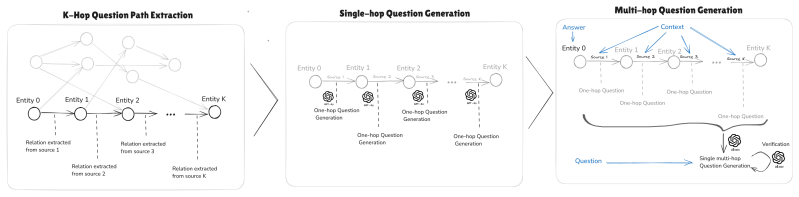
The central mechanism is a knowledge graph built from the introductions of chemistry preprints. Chemical entities are extracted and verified through a named entity recognition model refined by a language model, relations between co-occurring entities are extracted as triplets, and nodes are enriched with external database information. A randomized breadth-first search samples paths whose edges come from different source documents, guaranteeing that no single passage can answer the question. One-hop questions are then generated per triplet and combined into a single multi-hop question by reverse chaining, so the final answer is the first entity in the path and the question cannot be solved without composing evidence across documents.
What would settle it
Ask expert chemists to judge a random sample of the questions that the paper excluded because all evaluated models answered them incorrectly. If a substantial share of those excluded questions are judged unambiguous, factual, and answerable from the provided context, then the exclusion rule biases the benchmark toward easier questions and the reported error rates need to be recalculated.
Extended reading notes
Core claim
The paper's claim, stated on its own terms, is that even state-of-the-art large language models, including reasoning-specialised models that scale test-time computation, face significant challenges in multi-hop compositional reasoning within chemistry. The strongest evidence is that with full relevant context supplied, the top correctness rate is 84.35%, while without context the top rate is 47.58%; context nearly doubles average performance across models. Because even perfect retrieval still leaves a substantial error rate, the paper concludes that the limiting factor is compositional reasoning itself rather than access to the necessary facts. The authors further claim that their automated pipeline—named entity recognition, relation extraction, knowledge graph construction, and reverse-chained question aggregation—produces questions requiring one to four hops from distinct source documents, and that an expert-filtered subset supports the benchmark's validity.
Load-bearing premise
The benchmark's scores are only meaningful if questions that every tested model got wrong were genuinely ambiguous or flawed; if some were merely hard, the reported correctness rates are inflated.
Editorial extensions
If this is right
- Providing full relevant context roughly doubles correctness for both reasoning and non-reasoning models, so retrieval augmentation remains a high-leverage intervention for multi-hop scientific question answering.
- Because even perfect context leaves a measurable error floor, multi-hop QA systems should not assume that retrieving the right documents is sufficient for a correct answer.
- Reasoning-specialised models use fewer thinking tokens when context is supplied, suggesting that external evidence reduces the burden of internal knowledge search during reasoning.
- Accuracy is higher for single-hop than for multi-hop questions in the context-provided setting, but remains fairly flat across two to four hops, indicating that hop count alone does not fully capture difficulty.
- The pipeline can generate large domain-specific reasoning datasets with only a sample of expert verification, lowering the cost of building new benchmarks in specialised fields.
Reading between the lines
- The exclusion of questions that every evaluated model answered incorrectly could inflate measured capability if some of those questions were valid but simply hard; re-testing the excluded pool with stronger future models, or with expert chemists, would calibrate the benchmark's difficulty.
- The reverse-chaining construction always produces a single entity as the final answer, so an extension to relational, numerical, or procedural answers would test a different and potentially harder form of composition.
- A natural next experiment is iterative retrieval, where the model receives one source at a time and decides what to fetch next, matching the paper's stated limitation of using a single full-context block.
- If the error floor persists when context is guaranteed correct, a useful diagnostic is to probe each hop independently before asking the model to combine the answers, thereby separating failure to retrieve a fact from failure to compose facts.
Signed reviews
Editorial analysis
A structured set of objections, weighed in public.
Referee Report
Summary. The paper introduces ChemKGMultiHopQA, a chemistry-domain multi-hop question-answering benchmark of 971 questions generated from ChemRxiv articles through named entity recognition, knowledge graph construction, and OpenAI o3-mini/gpt-4o-based question generation and verification. The authors evaluate 13 large language models in two settings: with full supporting context and without context. They report that providing context nearly doubles correctness rates, that the best model with context (Claude Sonnet 3.7 with extended thinking) reaches 84.35%, and that the best no-context model (o3-mini) reaches 47.58%. The central claim is that even state-of-the-art models struggle with multi-hop compositional reasoning in chemistry, and that even perfect retrieval with full context does not eliminate reasoning errors.
Significance. If the benchmark is valid, it fills a real gap in domain-specific multi-hop reasoning evaluation: existing resources such as ChemLitQA-multi are smaller, mostly single-entity chains, or not chemistry-specific. The automated pipeline is a plausible contribution, and the design choices—short answers, distinct source documents per hop, and context/no-context comparison—are sensible. The evaluation of 13 models and the public release of the dataset and code are strengths. However, the validity evidence is currently too thin to support the strongest claim that residual errors are attributable to compositional reasoning failures rather than to ambiguous, invalid, or incorrectly grounded benchmark items. The paper is honest in disclosing the outcome-dependent filter (S7.3) and the generation-model overlap (S7.5), but those disclosures directly weaken the headline inference.
major comments (4)
- [S7.3] The filtering rule described in S7.3—'To minimize ambiguity, we excluded questions that were answered incorrectly by all evaluated models from the benchmark'—is outcome-dependent and affects the central difficulty and validity claims. The paper acknowledges that only a subset of the excluded questions was manually assessed and that 'most' were categorized as having multiple valid answers, leaving open the possibility that valid hard questions were removed. Because the reported correctness rates are computed on the post-filter set, they overstate model capability relative to the original generated pool, and the observation that models make residual errors on the remaining questions cannot be interpreted as evidence about compositional reasoning unless the authors show that the filter does not preferentially remove valid difficult items. Please report statistics on the full generated pool, or re-run the evaluation on a random sample not subjected to this filter, and quantify how the headline numbers change.
- [5.1 and S7.4] The expert validation is too small to support the inference that the residual errors are reasoning failures. Out of 52 pilot questions, 12 (23%) were dropped due to low evaluator confidence, and of the remaining 40, 5 (12.5%) were rated Poor. If a similar rate holds in the full benchmark, roughly 120 of the 971 items could be defective, a number comparable to or larger than the best model's 15.65% error rate with context. Please report the residual error rates restricted to the expert-validated Good and Ok items, release the per-question expert annotations, and conduct a substantially larger validation sample before attributing residual errors to compositional reasoning.
- [3.2 and S7.5] There is a circularity concern in the evaluation design: the questions are generated with o3-mini and verified with gpt-4o, and the same models are then evaluated on those questions. Section S7.5 acknowledges that 'o3-mini was primarily used to generate the questions, which may have introduced a slight bias, resulting in its minor improvement in correctness.' This undermines the no-context model comparison, particularly the claim that OpenAI models perform better because of richer pretraining data. Please quantify the effect by evaluating on a held-out set generated with different models, or by reporting performance separately on items that the evaluated OpenAI models did and did not generate, and disclose the generation overlap per question.
- [4, evaluation metric] The correctness metric uses exact match followed by a GPT-4o binary assessment for non-matching answers. Since gpt-4o is also one of the evaluated models and is part of the generation and verification pipeline, the judge may have systematic preferences for outputs from the same model family, potentially inflating the correctness rates of OpenAI models. Please provide a sample of judge decisions with human agreement rates, and clarify how near-miss or partially correct answers are treated.
minor comments (6)
- [4.2 and Table S5] Mistral Large's performance on the HotpotQA chemistry subset (4.59% without context and 0.92% with context) is dramatically lower than all other models and is inconsistent with its ChemKGMultiHopQA results; this anomaly is never discussed and could distort the dataset comparison in Figure 4.
- [S7.9] The text contains an unresolved 'Figure ??' placeholder in the sentence referencing Figure S13; this should be fixed.
- [Table 2] The HotpotQA-Chemistry row lists 'no chemical entities' under entity types, which is confusing because the subset is defined by chemistry categories; please clarify whether the intended meaning is that the questions are not grounded in chemistry-specific knowledge bases.
- [4.1] Model names are used inconsistently, e.g., 'Qwen QWEN 32B' and 'Deepseek R1 Distil QWEN 32B'; please standardize the model names and match them exactly to the provider names in Table 3.
- [S7.4, Table S4] The 'Avg. Corr.' columns in Table S4 are not directly interpretable because the denominator (number of models considered) is not stated; please report the number of models and standard deviations or confidence intervals.
- [4] The statement 'The full Q&A dataset, along with the evaluation code, is accessible here' does not include a URL or repository identifier in the manuscript text; please provide a working link.
Circularity Check
No circularity: model scores are empirical measurements, and the benchmark construction does not encode the measured outcomes.
full rationale
I find no circular derivation in this paper. The central claims are empirical evaluations of LLMs on a newly constructed chemistry multi-hop QA benchmark; no reported correctness rate is obtained by fitting a parameter to the outcome it is then said to predict. The construction pipeline (knowledge-graph extraction, path sampling, one-hop question formulation, multi-hop aggregation, and verification) runs upstream of evaluation and does not encode the measured accuracy values. The outcome-dependent exclusion of questions answered incorrectly by all evaluated models (S7.3) is a genuine benchmark-validity concern because it can make the remaining set easier and can bias difficulty comparisons, but it does not make any model's score equivalent to an input by construction, and the paper explicitly discloses the generation/evaluation overlap: 'o3-mini was primarily used to generate the questions, which may have introduced a slight bias, resulting in its minor improvement in correctness' (S7.5). The HotpotQA chemistry subset provides an external benchmark anchored to a different, human-curated source, and the expert review, though limited to 40 high-confidence questions, is independent of the automated pipeline. No load-bearing self-citations or imported uniqueness theorems appear. For these reasons, the observed residual errors and the claim that perfect retrieval does not eliminate reasoning errors are empirical findings rather than artifacts of definitional circularity.
Assumptions & free parameters
assumptions (5)
- domain assumption ChemRxiv introduction text is a sufficient source of factual, objective chemical statements for constructing valid ground-truth QA pairs.
- domain assumption LLM-based verification with gpt-4o and o3-mini reliably determines factuality, answerability, and uniqueness of answers.
- ad hoc to paper Questions answered incorrectly by all evaluated models are ambiguous or flawed, rather than simply difficult.
- domain assumption The 40 high-confidence expert-reviewed questions are representative of the full 971-question dataset.
- domain assumption Graph paths with edges from distinct source texts require genuine multi-hop reasoning rather than lexical shortcutting.
Cite this review
Pith. "Pith review of Evaluating Multi-Hop Reasoning in Large Language Models: A Chemistry-Centric Case Study." pith.science (2026). https://pith.science/paper/S6IOOZVM
@misc{pith2026250416414,
  author       = {Pith},
  title        = {Pith review of: Evaluating Multi-Hop Reasoning in Large Language Models: A Chemistry-Centric Case Study},
  year         = {2026},
  howpublished = {\url{https://pith.science/paper/S6IOOZVM}},
  note         = {Machine review of arXiv:2504.16414}
}
read the original abstract
In this study, we introduced a new benchmark consisting of a curated dataset and a defined evaluation process to assess the compositional reasoning capabilities of large language models within the chemistry domain. We designed and validated a fully automated pipeline, verified by subject matter experts, to facilitate this task. Our approach integrates OpenAI reasoning models with named entity recognition (NER) systems to extract chemical entities from recent literature, which are then augmented with external knowledge bases to form a comprehensive knowledge graph. By generating multi-hop questions across these graphs, we assess LLM performance in both context-augmented and non-context augmented settings. Our experiments reveal that even state-of-the-art models face significant challenges in multi-hop compositional reasoning. The results reflect the importance of augmenting LLMs with document retrieval, which can have a substantial impact on improving their performance. However, even perfect retrieval accuracy with full context does not eliminate reasoning errors, underscoring the complexity of compositional reasoning. This work not only benchmarks and highlights the limitations of current LLMs but also presents a novel data generation pipeline capable of producing challenging reasoning datasets across various domains. Overall, this research advances our understanding of reasoning in computational linguistics.
Figures


Figures from the paper (3 more)


Forward citations
Cited by 1 Pith paper
-
When Iterative RAG Beats Ideal Evidence: A Diagnostic Study in Scientific Multi-hop Question Answering
On ChemKGMultiHopQA, iterative retrieval-reasoning outperformed oracle gold-context static RAG for all 11 LLMs tested, with gains up to 25.6 percentage points.
Reference graph
Works this paper leans on
-
[1]
Chain-of-thought prompting elicits reasoning in large language models
Jason Wei, Xuezhi Wang, Dale Schuurmans, Maarten Bosma, Fei Xia, Ed Chi, Quoc V Le, Denny Zhou, et al. Chain-of-thought prompting elicits reasoning in large language models. Advances in neural information processing systems, 35:24824–24837, 2022
2022
-
[2]
Self-consistency improves chain of thought reasoning in language models
Xuezhi Wang, Jason Wei, Dale Schuurmans, Quoc Le, Ed Chi, Sharan Narang, Aakanksha Chowdhery, and Denny Zhou. Self-consistency improves chain of thought reasoning in language models. arXiv preprint arXiv:2203.11171, 2022
arXiv 2022
-
[3]
Tree of thoughts: Deliberate problem solving with large language models
Shunyu Yao, Dian Yu, Jeffrey Zhao, Izhak Shafran, Tom Griffiths, Yuan Cao, and Karthik Narasimhan. Tree of thoughts: Deliberate problem solving with large language models. Advances in neural information processing systems, 36:11809–11822, 2023
2023
-
[4]
Graph of thoughts: Solving elaborate problems with large language models
Maciej Besta, Nils Blach, Ales Kubicek, Robert Gerstenberger, Michal Podstawski, Lukas Gianinazzi, Joanna Gajda, Tomasz Lehmann, Hubert Niewiadomski, Piotr Nyczyk, et al. Graph of thoughts: Solving elaborate problems with large language models. In Proceedings of the AAAI Conference on Artificial Intelligence, volume 38, pages 17682–17690, 2024. 10
work page 2024
-
[5]
Towards system 2 reasoning in llms: Learning how to think with meta chain-of-though
Violet Xiang, Charlie Snell, Kanishk Gandhi, Alon Albalak, Anikait Singh, Chase Blagden, Duy Phung, Rafael Rafailov, Nathan Lile, Dakota Mahan, et al. Towards system 2 reasoning in llms: Learning how to think with meta chain-of-though. arXiv preprint arXiv:2501.04682, 2025
arXiv 2025
-
[6]
Retrieval-augmented generation for knowledge-intensive nlp tasks
Patrick Lewis, Ethan Perez, Aleksandra Piktus, Fabio Petroni, Vladimir Karpukhin, Naman Goyal, Heinrich Küttler, Mike Lewis, Wen-tau Yih, Tim Rocktäschel, et al. Retrieval-augmented generation for knowledge-intensive nlp tasks. Advances in neural information processing systems, 33:9459–9474, 2020
2020
-
[7]
Neurosymbolic ai: the 3rd wave
Artur d’Avila Garcez and Luis C Lamb. Neurosymbolic ai: the 3rd wave. arXiv e-prints, pages arXiv–2012, 2020
work page 2012
-
[8]
A simple neural network module for relational reasoning
Adam Santoro, David Raposo, David G Barrett, Mateusz Malinowski, Razvan Pascanu, Peter Battaglia, and Timothy Lillicrap. A simple neural network module for relational reasoning. Advances in neural information processing systems, 30, 2017
2017
Show all 53 references
-
[9]
Openai o1 system card, 2024
OpenAI. Openai o1 system card, 2024. Accessed: 2025-03-20
2024
-
[10]
Openai o3 mini system card, 2024
OpenAI. Openai o3 mini system card, 2024. Accessed: 2025-03-20
2024
-
[11]
Star: Bootstrapping reasoning with reasoning
Eric Zelikman, Yuhuai Wu, Jesse Mu, and Noah Goodman. Star: Bootstrapping reasoning with reasoning. Advances in Neural Information Processing Systems, 35:15476–15488, 2022
2022
-
[12]
Deepseek-r1: Incentivizing reasoning capability in llms via reinforcement learning
Daya Guo, Dejian Yang, Haowei Zhang, Junxiao Song, Ruoyu Zhang, Runxin Xu, Qihao Zhu, Shirong Ma, Peiyi Wang, Xiao Bi, et al. Deepseek-r1: Incentivizing reasoning capability in llms via reinforcement learning. arXiv preprint arXiv:2501.12948, 2025
2025 arXiv
-
[13]
Advancing reasoning in large language models: Promising methods and approaches
Avinash Patil. Advancing reasoning in large language models: Promising methods and approaches. arXiv preprint arXiv:2502.03671, 2025
2025 arXiv
-
[14]
Training verifiers to solve math word problems
Karl Cobbe, Vineet Kosaraju, Mohammad Bavarian, Mark Chen, Heewoo Jun, Lukasz Kaiser, Matthias Plappert, Jerry Tworek, Jacob Hilton, Reiichiro Nakano, et al. Training verifiers to solve math word problems. arXiv preprint arXiv:2110.14168, 2021
-
[15]
Measuring mathematical problem solving with the math dataset
Dan Hendrycks, Collin Burns, Saurav Kadavath, Akul Arora, Steven Basart, Eric Tang, Dawn Song, and Jacob Steinhardt. Measuring mathematical problem solving with the math dataset. arXiv preprint arXiv:2103.03874, 2021
2021 arXiv
-
[16]
Evaluating large language models trained on code
Mark Chen, Jerry Tworek, Heewoo Jun, Qiming Yuan, Henrique Ponde De Oliveira Pinto, Jared Kaplan, Harri Edwards, Yuri Burda, Nicholas Joseph, Greg Brockman, et al. Evaluating large language models trained on code. arXiv preprint arXiv:2107.03374, 2021
2021 arXiv
-
[17]
Program synthesis with large language models
Jacob Austin, Augustus Odena, Maxwell Nye, Maarten Bosma, Henryk Michalewski, David Dohan, Ellen Jiang, Carrie Cai, Michael Terry, Quoc Le, et al. Program synthesis with large language models. arXiv preprint arXiv:2108.07732, 2021
2021 arXiv
-
[18]
Swe-bench: Can language models resolve real-world github issues? arXiv preprint arXiv:2310.06770, 2023
Carlos E Jimenez, John Yang, Alexander Wettig, Shunyu Yao, Kexin Pei, Ofir Press, and Karthik Narasimhan. Swe-bench: Can language models resolve real-world github issues? arXiv preprint arXiv:2310.06770, 2023
2023 arXiv
-
[19]
Hotpotqa: A dataset for diverse, explainable multi-hop question answering
Zhilin Yang, Peng Qi, Saizheng Zhang, Yoshua Bengio, William W Cohen, Ruslan Salakhutdinov, and Christopher D Manning. Hotpotqa: A dataset for diverse, explainable multi-hop question answering. arXiv preprint arXiv:1809.09600, 2018
2018 arXiv
-
[20]
Did aristotle use a laptop? a question answering benchmark with implicit reasoning strategies
Mor Geva, Daniel Khashabi, Elad Segal, Tushar Khot, Dan Roth, and Jonathan Berant. Did aristotle use a laptop? a question answering benchmark with implicit reasoning strategies. Transactions of the Association for Computational Linguistics, 9:346–361, 2021
2021
-
[21]
Chemlit-qa: A human evaluated dataset for chemistry rag tasks
Geemi Wellawatte, Huixuan Guo, Magdalena Lederbauer, Anna Borisova, Matthew Hart, Marta Brucka, and Philippe Schwaller. Chemlit-qa: A human evaluated dataset for chemistry rag tasks. In AI for Accelerated Materials Design-NeurIPS 2024
2024
-
[22]
Olympicarena medal ranks: Who is the most intelligent ai so far? arXiv preprint arXiv:2406.16772, 2024
Zhen Huang, Zengzhi Wang, Shijie Xia, and Pengfei Liu. Olympicarena medal ranks: Who is the most intelligent ai so far? arXiv preprint arXiv:2406.16772, 2024. 11
2024 arXiv
-
[23]
Gpqa: A graduate-level google-proof q&a benchmark
David Rein, Betty Li Hou, Asa Cooper Stickland, Jackson Petty, Richard Yuanzhe Pang, Julien Dirani, Julian Michael, and Samuel R Bowman. Gpqa: A graduate-level google-proof q&a benchmark. In First Conference on Language Modeling, 2024
2024
-
[24]
Large language models for reticular chemistry
Zhiling Zheng, Nakul Rampal, Theo Jaffrelot Inizan, Christian Borgs, Jennifer T Chayes, and Omar M Yaghi. Large language models for reticular chemistry. Nature Reviews Materials, pages 1–13, 2025
2025
-
[25]
Multi-hop question answering.Foundations and Trends® in Information Retrieval, 17(5):457–586, 2024
Vaibhav Mavi, Anubhav Jangra, Adam Jatowt, et al. Multi-hop question answering.Foundations and Trends® in Information Retrieval, 17(5):457–586, 2024
2024
-
[26]
Constructing datasets for multi-hop reading comprehension across documents
Johannes Welbl, Pontus Stenetorp, and Sebastian Riedel. Constructing datasets for multi-hop reading comprehension across documents. Transactions of the Association for Computational Linguistics, 6:287–302, 2018
2018
-
[27]
Musique: Multihop questions via single-hop question composition
Harsh Trivedi, Niranjan Balasubramanian, Tushar Khot, and Ashish Sabharwal. Musique: Multihop questions via single-hop question composition. Transactions of the Association for Computational Linguistics, 10:539–554, 2022
2022
-
[28]
Multihop-rag: Benchmarking retrieval-augmented generation for multi-hop queries
Yixuan Tang and Yi Yang. Multihop-rag: Benchmarking retrieval-augmented generation for multi-hop queries. arXiv preprint arXiv:2401.15391, 2024
2024 arXiv
-
[29]
A framework for evaluating the chemical knowledge and reasoning abilities of large language models against the expertise of chemists
Adrian Mirza, Nawaf Alampara, Sreekanth Kunchapu, Martiño Ríos-García, Benedict Emoekabu, Aswanth Krishnan, Tanya Gupta, Mara Schilling-Wilhelmi, Macjonathan Okereke, Anagha Aneesh, et al. A framework for evaluating the chemical knowledge and reasoning abilities of large langu...
2025
-
[30]
Knowledge graph generation from text
Igor Melnyk, Pierre Dognin, and Payel Das. Knowledge graph generation from text. arXiv preprint arXiv:2211.10511, 2022
2022 arXiv
-
[31]
Extract, define, canonicalize: An llm-based framework for knowledge graph construction
Bowen Zhang and Harold Soh. Extract, define, canonicalize: An llm-based framework for knowledge graph construction. arXiv preprint arXiv:2404.03868, 2024
2024 arXiv
-
[32]
Building dynamic knowledge graphs from text using machine reading comprehension
Rajarshi Das, Tsendsuren Munkhdalai, Xingdi Yuan, Adam Trischler, and Andrew McCallum. Building dynamic knowledge graphs from text using machine reading comprehension. arXiv preprint arXiv:1810.05682, 2018
2018 arXiv
-
[33]
Cear: Automatic construction of a knowledge graph of chemical entities and roles from scientific literature
Stefan Langer, Fabian Neuhaus, and Andreas Nürnberger. Cear: Automatic construction of a knowledge graph of chemical entities and roles from scientific literature. arXiv preprint arXiv:2407.21708, 2024
2024 arXiv
-
[34]
Coarse-to-fine knowledge graph domain adaptation based on distantly-supervised iterative training
Wenxiong Liao, Zhengliang Liu, Yiyang Zhang, Xiaoke Huang, Fei Qi, Siqi Ding, Hui Ren, Zihao Wu, Haixing Dai, Sheng Li, et al. Coarse-to-fine knowledge graph domain adaptation based on distantly-supervised iterative training. In 2023 IEEE International Conference on Bioinforma...
2023
-
[35]
Nilinker: attention-based approach to nil entity linking
Pedro Ruas and Francisco M Couto. Nilinker: attention-based approach to nil entity linking. Journal of Biomedical Informatics, 132:104137, 2022
2022
-
[36]
Domain-specific language model pretraining for biomedical natural language processing, 2020
Yu Gu, Robert Tinn, Hao Cheng, Michael Lucas, Naoto Usuyama, Xiaodong Liu, Tristan Naumann, Jianfeng Gao, and Hoifung Poon. Domain-specific language model pretraining for biomedical natural language processing, 2020
2020
-
[37]
Pubchem in 2021: new data content and improved web interfaces
Sunghwan Kim, Jie Chen, Tiejun Cheng, Asta Gindulyte, Jia He, Siqian He, Qingliang Li, Benjamin A Shoemaker, Paul A Thiessen, Bo Yu, et al. Pubchem in 2021: new data content and improved web interfaces. Nucleic acids research, 49(D1):D1388–D1395, 2021
2021
-
[38]
Generate-then-ground in retrieval-augmented generation for multi-hop question answering
Zhengliang Shi, Weiwei Sun, Shen Gao, Pengjie Ren, Zhumin Chen, and Zhaochun Ren. Generate-then-ground in retrieval-augmented generation for multi-hop question answering. arXiv preprint arXiv:2406.14891, 2024
2024 arXiv
-
[39]
Hierarchical retrieval-augmented generation model with rethink for multi-hop question answering
Xiaoming Zhang, Ming Wang, Xiaocui Yang, Daling Wang, Shi Feng, and Yifei Zhang. Hierarchical retrieval-augmented generation model with rethink for multi-hop question answering. arXiv preprint arXiv:2408.11875, 2024. 12
2024 arXiv
-
[40]
MeOH" to
Hao Liu, Zhengren Wang, Xi Chen, Zhiyu Li, Feiyu Xiong, Qinhan Yu, and Wentao Zhang. Hoprag: Multi-hop reasoning for logic-aware retrieval-augmented generation. arXiv preprint arXiv:2502.12442, 2025. 13 7 Appendix S7.1 Detailed Knowledge Graph Generation In this section, we ex...
2025 arXiv
-
[41]
If an entity appears in the text but has no meaningful chemical relationship with another entity in the set, ignore it
Entity Matching: Consider only the entities provided in the given set. If an entity appears in the text but has no meaningful chemical relationship with another entity in the set, ignore it
-
[42]
reacts with,
Chemically Significant Relations Only: Extract relations that describe actual chemical interactions, transformations, or properties (e.g., "reacts with," "catalyzes," "dissolves in," "produces")
-
[43]
Avoid observations, opinions, and findings
Factual Relations: Only extract factual relations. Avoid observations, opinions, and findings
-
[44]
Tuple Format: Output extracted facts in the form of (entity1, relation, entity2)
-
[45]
is," "are,
Avoid Generic Relations: Exclude weak relations like "is," "are," "exists," "relates to." Focus on specific interactions. Valid Relation Types (Examples): ✓ "reacts with" ✓ "catalyzes" ✓ "binds to" ✓ "dissolves in" ✓ "oxidizes" ✓ "inhibits" ✓ "precipitates with" ✓ "acts as a s...
-
[46]
formic acid can be produced from carbon dioxide
-
[47]
formic acid is the simplest carboxylic acid with antibacterial and preservative properties
-
[48]
formic acid can act as a non-gaseous CO surrogate
-
[49]
Path (multi-hop chain of reasoning): carbon dioxide → formic acid → carbonylation reactions * Source 1 and source 2 are coming from different documents
carbonylation reactions safely produce carboxylic acids under mild conditions using formic acid as a CO surrogate. Path (multi-hop chain of reasoning): carbon dioxide → formic acid → carbonylation reactions * Source 1 and source 2 are coming from different documents. Figure S1...
-
[50]
Solution -phase chemistry is the standard route to functionalise graphene
-
[51]
Graphene can form membranes that provide radiolytic shielding
-
[52]
Membranes used for DAC selectively excludenitrogen
-
[53]
Path (multi-hop chain of reasoning): solution → graphene → membranes→ nitrogen→ Cr3(Cr4Cl)3(BTT)82 *Sources 1–4 are extracted from four different documents
Cr3(Cr4Cl)3(BTT)82 MOF shows very high O2 selectivity over nitrogen. Path (multi-hop chain of reasoning): solution → graphene → membranes→ nitrogen→ Cr3(Cr4Cl)3(BTT)82 *Sources 1–4 are extracted from four different documents. Figure S11: A 4-hop multi-document question–answer ...
Reviewed August 16, 2026 · model on record in the stance chip above.
Discussion (0). Continue with ORCID to comment.