REVIEW 3 major objections 4 minor 1 cited by
Spontaneous symmetry breaking induced by curvature : Analysis via non-perturbative 2PI Hartree approximation
T0 review · 3 major / 4 minor · reviewed 2026-08-16 · deepseek-v4-flash
Pith's one-line read Curvature alone can break symmetry for a positive-mass scalar.
desk verdict A competent 2PI Hartree calculation whose headline claim—curvature-driven SSB at ξ=0—rests on an uncontrolled O(R^2) truncation in the infrared. read the letter →
The pith
A machine-rendered reading of the paper's core claim, the machinery that carries it, and where it could break.
The reading
What carries the argument
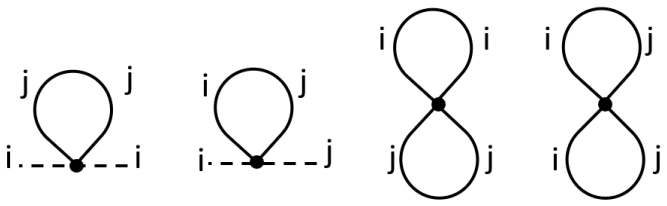
The load-bearing object is the 2PI effective action in the two-loop Hartree, or local, approximation, combined with the Schwinger-DeWitt local momentum-space propagator truncated at quadratic order in curvature. The Schwinger-Dyson equation for the exact propagator turns the coincident bubble self-energy into a curvature-dependent dynamical mass squared, $m^2_{dyn,eff} = m_0^2 + \lambda v^2/2 + \lambda f_{fin}/2$, where $f_{fin}$ contains the finite parts of the one-loop bubble and the curvature invariants $R$, $R_{\mu\nu}R^{\mu\nu}$, and $R_{\mu\nu\rho\sigma}R^{\mu\nu\rho\sigma}$. Because $f_{fin}$ itself depends on $m^2_{dyn,eff}$, the dynamical mass is fixed by a transcendental equation that resums both self-energy and curvature terms; this resummed mass is then inserted into the effective potential, producing the SSB minimum for $\xi=0$ that the perturbative computation of [70] did not find.
What would settle it
Recompute the same 2PI Hartree effective potential for $m_0=10^{-5}$ GeV, $\lambda=0.01$, $\xi=0$ in de Sitter with the next-order ($O(R^3)$) Schwinger-DeWitt terms included, or with the exact coincident de Sitter propagator in place of the truncated local one; if the Mexican-hat minimum of Eq. (42) disappears or is replaced by a single minimum at $v=0$, the claimed curvature-driven SSB is an artifact of the truncation.
Extended reading notes
Core claim
The central discovery is that, in the two-loop Hartree approximation of the 2PI effective action, a self-interacting scalar with $m_0^2>0$ develops a symmetry-breaking effective potential in a curved spacetime even at $\xi=0$, provided the Schwinger-DeWitt propagator is kept through $O(R^2)$. For de Sitter space this happens for small cosmological constant (for example $m_0=10^{-5}$ GeV, $\lambda=0.01$, and $\Lambda$ between $10^{-5}$ and $0.01$ GeV$^2$), while larger curvature washes the minimum out. The paper concludes that curvature-driven SSB is indeed possible for fields with positive rest mass squared, with no analogue in flat spacetimes, and that the resummation produces SSB with vanishing non-minimal coupling, in contrast to the perturbative result of [70]. The analysis is extended to an $O(N)$ scalar model: the symmetric phase shows SSB, while in the broken phase for $N>1$ no SSB appears when the $\pi$-field dynamical mass is positive, but SSB can occur for negative rest mass squared or negative dynamical mass and is washed out by increasing $\Lambda$. High-temperature versions of the potential restore the symmetry.
Load-bearing premise
The argument stands or falls on the assumption that a short-distance, curvature-expanded propagator cut off at second order in curvature is adequate for computing the effective potential, a zero-momentum, long-wavelength quantity; the paper itself warns this expansion is meant for ultraviolet, local computations and cannot be used for infrared or non-local ones.
Editorial extensions
If this is right
- For a scalar with $m_0^2>0$, a non-singular curved background can act as the source of symmetry breaking: the effective potential develops a non-zero minimum where flat spacetime would keep the symmetric vacuum.
- The non-minimal coupling $\xi$ is not needed: the 2PI resummation transfers curvature into the effective mass even at $\xi=0$, unlike the perturbative $O(R^2)$ computation of [70], which required a positive non-minimal coupling.
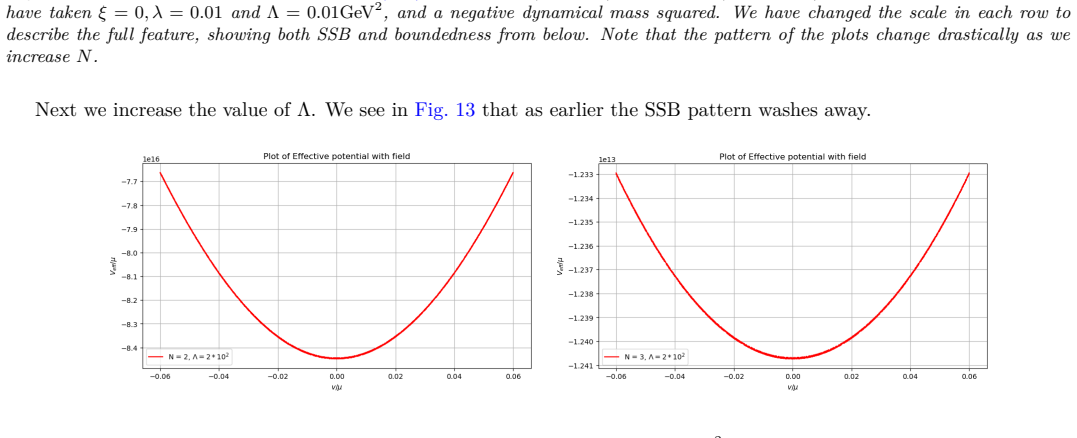
- In the $O(N)$ model, the symmetric phase inherits the SSB, but the broken phase with $N>1$ does not show SSB for positive $\pi$-field dynamical mass; SSB reappears for negative $m_0^2$ or negative dynamical mass, and increasing $\Lambda$ washes it out in both cases.
- High-temperature corrections restore the broken symmetry, with the asymptotic thermal mass behaving as $m^2 \sim \lambda T^2$, so curvature-induced SSB is a low-temperature or transient early-universe effect.
- Because the computation uses only local curvature data at a point, the same formalism applies to any non-singular curved spacetime, such as Schwarzschild, with the dynamical mass depending on the point where the normal coordinate system is erected.
Reading between the lines
- If this short-scale curvature-induced SSB is real, an early-universe scalar with positive tree-level mass could temporarily break its symmetry during a high-curvature phase and restore it as curvature decays, producing a curvature-driven phase transition that the paper mentions but does not model dynamically.
- The same resummation gives curvature-generated mass for an otherwise massless field, $m^2_{dyn,eff} \simeq \sqrt{\lambda f_1}/(4\sqrt{2}\pi)$ at leading order, suggesting a general mechanism by which spacetime geometry alone can act as a mass generator; this could be probed in spectator-field or reheating scenarios.
- The paper's own estimate that the dynamical mass is about half the value obtained with the exact large-scale de Sitter propagator suggests the curvature-driven minimum found here is sensitive to the local truncation; a natural test is to repeat the analysis with the exact coincident propagator and see whether the SSB minimum survives, deepens, or moves.
- The observed pattern that increasing $\Lambda$ washes out SSB invites a sharper statement: for fixed $m_0$ and $\lambda$, there may be a critical curvature above which the broken minimum disappears, analogous to a critical temperature, defining a phase boundary in $(\Lambda, m_0, \lambda)$ space that the paper does not extract.
Signed reviews
Editorial analysis
A structured set of objections, weighed in public.
Referee Report
Summary. The manuscript claims that in the two-loop 2PI Hartree approximation, using the Schwinger-DeWitt propagator truncated at quadratic order in curvature, a self-interacting scalar with positive rest mass squared and zero non-minimal coupling undergoes spontaneous symmetry breaking in a curved spacetime, with de Sitter as the worked example. This is presented as a non-perturbative confirmation and sharpening of the earlier perturbative result in [70], with the novel feature that SSB occurs at xi = 0. The paper derives a self-consistent gap equation for the dynamical mass, obtains a renormalized effective potential, and then extends the analysis to finite temperature and to an O(N) model in the symmetric and broken phases.
Significance. If established, the claim that curvature alone can induce SSB for m0^2>0 and xi=0 would be a genuinely interesting result with possible implications for early-universe scalar dynamics. The manuscript has clear strengths: the counterterm structure is presented explicitly, the gap equation is stated in closed form, the flat-spacetime Coleman-Weinberg and high-temperature limits are recovered as consistency checks, and the xi=0 claim is not obtained by fitting parameters to the desired conclusion. However, the central physical conclusion is presently supported only by a local ultraviolet propagator expansion that the paper itself says is inapplicable to infrared quantities, and the self-consistent mass obtained at the plotted parameters is far outside the radius of convergence of that expansion. The result is therefore not established by the evidence in the paper, although the derivation is internally coherent within its stated approximation.
major comments (3)
- [Section 2.1 and Section 3.1, Eqs. (10), (25), (26), (42)] The central SSB claim rests on an uncontrolled truncation of the Schwinger-DeWitt propagator. The expansion in Eq. (10) is an expansion in powers of curvature over (k^2+m^2); after the Hartree resummation, m^2 is the dynamical mass m_dyn^2. For the plotted de Sitter parameters (m0=10^-5 GeV, lambda=0.01, Lambda=10^-5 GeV^2, xi=0), Eq. (26) at v=0 gives m_dyn^2 approximately 2.6x10^-8 GeV^2 while R=4Lambda=4x10^-5 GeV^2, so R/m_dyn^2 is around 1.5x10^3. The omitted O(R^3) contributions to the coincident propagator behave as R^3/(4pi)^2 m_dyn^4, which is not smaller than the retained f1/(4pi)^2 m_dyn^2 term; in fact it is parametrically larger at these parameters. Since the effective potential is evaluated at constant background field, i.e., in the zero-momentum, infrared limit, the paper's own caveat in Section 2.1 that the expansion 'cannot be used for non-local or IR computations' applies directly to Eq. (42). The claim that curvature-driven SSB occurs for xi=0 and m0^2>0 is therefore not established; it may be an artifact of truncating at O(R^2). A concrete remedy would be to compute the O(R^3) contribution and show that it does not change the shape of Veff, or to repeat the Hartree calculation with an infrared-valid propagator in de Sitter, e.g., along the lines of Refs. [40,44,51].
- [Section 5.2, Eqs. (109)-(110)] The broken-phase O(N) conclusion ('no SSB for N>1 with positive pion dynamical mass') relies on an additional uncontrolled approximation. The paper assumes f_pi_fin is dominated by its f1/(4pi)^2 m_pi^2 term and that m_pi^2/Lambda is small, then drops f_sigma_fin and the logarithmic terms in f_pi_fin to obtain Eqs. (109)-(110). No estimate is given for the size of the omitted logarithmic or f_sigma_fin contributions in the parameter ranges plotted in Figs. 9-13. Because the qualitative conclusion of this section depends on which root and which terms are retained, the approximations need to be justified quantitatively or the claims restricted to the parameter regime where the retained term provably dominates.
- [Section 3.1, Figs. 3-4 and Eq. (26)] It is not stated whether the numerical plots use the transcendental gap equation Eq. (25) or the approximate expression Eq. (26). The two can differ substantially when the argument of the square root in Eq. (26) is not small, and the text gives no error estimate for the approximation. Since the plotted shape of Veff is the evidence for SSB, the figure captions or the text should specify the equation actually used and quantify the difference at the plotted minima.
minor comments (4)
- [Throughout] The manuscript contains many typographical and formatting errors, including malformed references (e.g., Reference [12] reads 'Phys. Rev. D 77, 9 (1974)') and inconsistent notation for integrals over d-dimensional versus three-dimensional loop momenta in Section 4. A careful proofreading pass is needed.
- [Section 3.1, Fig. 3 caption] The caption refers to 'the second of Fig. 3' in the main text; this should be made clearer by referencing the specific panels, since the two plots are presented side by side.
- [Section 4, Eq. (60)] The high-temperature expansions for S1, S2, and S3 are given without stating the conditions on m_beta_dyn_eff/beta under which they are valid; noting the small-parameter criterion would help readers apply these formulas.
- [Section 5.2, Figs. 10-13] The text states that for m0^2<0 'there will be SSB at loop level as well,' but does not explain the sign convention used for the negative root of Eq. (110) or why the maximum height increases with N in Fig. 10. A brief comment on the chosen root and its physical interpretation would improve readability.
Circularity Check
No circularity: the curvature-driven SSB follows from the paper's own 2PI gap equation and effective potential, with self-citations used only for comparison.
full rationale
The central claim, curvature-driven SSB for m0^2>0 and xi=0, is derived from the 2PI Hartree equations, not imposed by a fitted parameter. The gap equation (25) determines m_dyn^2 as a function of m0, lambda, v, and curvature; the effective potential (42) is then evaluated from the renormalized action. The qualitative SSB pattern is a consequence of the algebraic structure of these equations, so no quantity is fitted and then renamed a prediction. The paper's citations [70] and [51] are self-citations, but they are used as comparisons: [70] is a perturbative result with positive non-minimal coupling against which the present xi=0 result is contrasted, and [51] is cited only for a numerical comparison of the dynamical mass. Neither is load-bearing for the derivation of Eq. (42). The O(R^2) Schwinger-DeWitt truncation may raise a legitimate question about whether the approximation is controlled at the plotted parameters, but that is a correctness or robustness concern, not circularity. There is no definition of the target result in terms of its input, no fitted input relabeled as a prediction, and no load-bearing self-citation chain. Accordingly, no significant circularity is present.
Assumptions & free parameters
free parameters (5)
- Quartic coupling lambda =
0.01
- Rest mass m0 =
10^-5 GeV
- Cosmological constant Lambda =
10^-5 to 0.01 GeV^2
- Non-minimal coupling xi =
0
- Renormalization scale mu =
not specified numerically
assumptions (6)
- domain assumption Spacetime is a fixed classical background and quantum gravity fluctuations are ignored.
- ad hoc to paper The Schwinger-DeWitt expansion up to quadratic order in curvature is sufficient for the effective potential.
- domain assumption The two-loop Hartree (double-bubble) approximation gives the dominant non-perturbative self-energy.
- standard math The Bunch-Parker local momentum space representation is valid.
- domain assumption The renormalization prescription with the chosen counterterms and gravitational counterterms renders the effective action finite.
- ad hoc to paper The approximate solution of the gap equation in Eq. (26) is valid for the parameter ranges plotted.
Cite this review
Pith. "Pith review of Spontaneous symmetry breaking induced by curvature : Analysis via non-perturbative 2PI Hartree approximation." pith.science (2026). https://pith.science/paper/TVSU5EZL
@misc{pith2026250416578,
  author       = {Pith},
  title        = {Pith review of: Spontaneous symmetry breaking induced by curvature : Analysis via non-perturbative 2PI Hartree approximation},
  year         = {2026},
  howpublished = {\url{https://pith.science/paper/TVSU5EZL}},
  note         = {Machine review of arXiv:2504.16578}
}
abstract
In this work we investigate the spontaneous symmetry breaking (SSB) induced by a classical background spacetime's curvature, via the 2 particle irreducible (2PI) non-perturbative effective action formalism. We use the standard Schwinger-DeWitt local expansion of the Feynman propagator, appropriate to probe the effect of spacetime curvature on the local or short scale physics. Recently it was shown using perturbative computations that such SSB is possible with a scalar with a quartic self interaction, positive rest mass squared and positive non-minimal coupling. Here we confirm in the two loop Hartree approximation that curvature can indeed induce SSB for such a theory. SSB for such a model is not possible in a flat spacetime. The 2PI technique does not only resum the self energy resulting in mass generation, but also resums, as we have discussed, curvature terms through such mass generation. We have explicitly discussed our results in the context of the de Sitter spacetime, although our calculations are valid for any non-singular curved spacetime. We show that, in contrast to the perturbative results, SSB is possible with a vanishing non-minimal coupling. These results are further extended to the case of an $O(N)$ symmetric scalar field theory. Restoration of the broken symmetry in the thermal case is also briefly discussed.
Figures


Figures from the paper (11 more)




Forward citations
Cited by 1 Pith paper
-
Stochastic inflation from a non-equilibrium renormalization group
Stochastic inflation is the leading infrared limit of a coarse-grained Schwinger–Keldysh effective theory, and the same Fokker–Planck dynamics follows from a Polchinski-type renormalization-group flow for the reduced ...
Reference graph
Works this paper leans on
-
[70]
V. Nath and S. Bhattacharya, Self interacting scalar field theory in general curved spacetimes at zero and finite temperature revisited, Phys. Rev. D111, no.8, 085011 (2025) [arXiv:2410.06563 [gr-qc]]
-
[1]
B. S. DeWitt, Quantum Field Theory in Curved Spacetime , Phys. Rept.19, 295 (1975)
work page 1975
-
[2]
N. D. Birrell and P. C. W. Davies, Quantum Fields in Curved Space , Cambridge Univ. Press (1984) ISBN 978-0-521- 27858-4, 978-0-521-27858-4. 28
work page 1984
-
[3]
R. M. Wald, Quantum Field Theory in Curved Space-Time and Black Hole Thermodynamics , University of Chicago Press, ISBN 978-0-226-87027-4
-
[4]
L. E. Parker and D. J. Toms, Quantum Field Theory in Curved Spacetime : Quantized Field and Gravity , Cambridge University Press (2009)
work page 2009
-
[5]
L. Senatore and M. Zaldarriaga, On Loops in Inflation , JHEP12, 008 (2010) [arXiv:0912.2734 [hep-th]]
arXiv 2010
-
[6]
T. Tanaka and Y. Urakawa, Loops in inflationary correlation functions , Class. Quant. Grav. 30, 233001 (2013) [arXiv:1306.4461 [hep-th]]
arXiv 2013
-
[7]
Coleman J. Goldstone, A. Salam and S. Weinberg, Broken Symmetries, Phys. Rev. 127, 965-970 (1962)
work page 1962
Show all 75 references
-
[8]
S. R. Coleman and E. J. Weinberg, Radiative Corrections as the Origin of Spontaneous Symmetry Breaking , Phys. Rev. D7, 1888 (1973)
1973
-
[9]
J. R. Espinosa, M. Quiros and F. Zwirner, On the phase transition in the scalar theory , Phys. Lett. B 291, 115-124 (1992) [arXiv:hep-ph/9206227 [hep-ph]]
1992 arXiv
-
[10]
Dolan and R
L. Dolan and R. Jackiw, Symmetry Behavior at Finite Temperature , Phys. Rev. D9, 3320 (1974)
1974
-
[11]
Weinberg, Gauge and Global Symmetries at High Temperature , Phys
S. Weinberg, Gauge and Global Symmetries at High Temperature , Phys. Rev. D9, 3357 (1974)
1974
-
[12]
B. J. Harrington and A. Yildiz, Restoration of Dynamically Broken Symmetries at Finite Temperature , Phys. Rev. D779, (1974)
1974
-
[13]
Roditi, Scalar Fields at Finite Temperature: The Gaussian Effective Potential Approach , Phys
I. Roditi, Scalar Fields at Finite Temperature: The Gaussian Effective Potential Approach , Phys. Lett. B 169 264 (1986)
1986
-
[14]
Fendley, The Effective Potential and the Coupling Constant at High Temperature , Phys
P. Fendley, The Effective Potential and the Coupling Constant at High Temperature , Phys. Lett. B196, 175 (1987)
1987
-
[15]
Altherr, Infrared Problem in gϕ4 Theory at Finite Temperature, Phys
T. Altherr, Infrared Problem in gϕ4 Theory at Finite Temperature, Phys. Lett. B238, 360 (1990)
1990
-
[16]
I. G. Moss and S. J. Poletti, Finite temperature effective actions for gauge fields , Phys. Rev. D47, 5477 (1993)
1993
-
[17]
Gusev and A
Y. Gusev and A. Zelnikov, Finite Temperature Nonlocal Effective Action for Scalar Fields, Class. Quant. Grav.15, L13 (1998) [arXiv:9709074 [hep-th]]
1998
-
[18]
A. K. Das, Finite Temperature Field Theory, World Scientific (1997)
1997
-
[19]
Jackiw, Functional evaluation of the effective potential , Phys
R. Jackiw, Functional evaluation of the effective potential , Phys. Rev. D9, 1686 (1974)
1974
-
[20]
Ford and D
C. Ford and D. R. T. Jones, The Effective potential and the differential equations method for Feynman integrals , Phys. Lett. B274, 409 (1992)
1992
-
[21]
Arafune, K
J. Arafune, K. Ogure and J. Sato, Nonperturbative evaluation of the effective potential of lambda phi**4 theory at finite temperature under the superdaisy approximation , Prog. Theor. Phys. 99, 119-128 (1998) [arXiv:hep-th/9705158 [hep-th]]
1998 arXiv
-
[22]
Inagaki, K
T. Inagaki, K. Ogure and J. Sato, Nonperturbative approach to the effective potential of the lambda phi**4 theory at finite temperature, Prog. Theor. Phys.99, 1069-1084 (1998) [arXiv:hep-th/9705133 [hep-th]]
1998 arXiv
-
[23]
Bordag and V
M. Bordag and V. Skalozub, Super daisy resummations and an effective expansion parameter in the O(N)-model near the phase transition , Phys. Lett. B533, 182-190 (2002)
2002
-
[24]
Herring, S
N. Herring, S. Cao and D. Boyanovsky, Is the effective potential, effective for dynamics? , [arXiv:2403.07084[hep-th]]. 29
-
[25]
Ishikawa, Gravitational effect on effective potential , Phys
K. Ishikawa, Gravitational effect on effective potential , Phys. Rev. D28, 2445 (1983)
1983
-
[26]
I. L. Buchbinder and S. D. Odintsov, Effective potential in a curved space-time , Sov. Phys. J.136, 554 (1984)
1984
-
[27]
I. L. Buchbinder and S. D. Odintsov, Effective Potential and Phase Transitions Induced by Curvature in Gauge Theories in Curved Space-time, Class. Quant. Grav.2, 721 (1985)
1985
-
[28]
I. L. Buchbinder, S. D. Odintsov and I. L. Shapiro, Effective action in quantum gravity , IOP Publishing (1992)
1992
-
[29]
Elizalde and S
E. Elizalde and S. D. Odintsov, Renormalization group improved effective potential for gauge theories in curved space- time, Phys. Lett. B 303, 240-248 (1993) [arXiv:hep-th/9302074 [hep-th]]
1993 arXiv
-
[30]
D. J. Toms, Effective action for the Yukawa model in curved spacetime , JHEP05, 139 (2018) [arXiv:1804.08350 [hep- th]]
2018 arXiv
-
[31]
D. J. Toms, Yang-Mills Yukawa model in curved spacetime , [arXiv:1906.02515 [hep-th]]
1906 arXiv
-
[32]
T. S. Bunch and P. Panangaden, On renormalisation of λϕ4 field theory in curved space-time. II , J. Phys. A 13, 919 (1980)
1980
-
[33]
T. S. Bunch, Local Momentum Space and Two Loop Renormalizability of λϕ4 Field Theory in Curved Space-time , Gen. Rel. Grav.13, 711 (1981)
1981
-
[34]
Panangaden, One Loop Renormalization of Quantum Electrodynamics in Curved Space-time , Phys
P. Panangaden, One Loop Renormalization of Quantum Electrodynamics in Curved Space-time , Phys. Rev. D23, 1735 (1981)
1981
-
[35]
T. S. Bunch and L. Parker, Feynman Propagator in Curved Space-Time: A Momentum Space Representation , Phys. Rev. D20, 2499 (1984)
1984
-
[36]
G. M. Shore, Radiatively Induced Spontaneous Symmetry Breaking and Phase Transitions in Curved Space-Time , Annals Phys.128 376 (1980)
1980
-
[37]
Prokopec, Symmetry breaking and the Goldstone theorem in de Sitter space , JCAP12, 023 (2012) [arXiv:1110.3187 [gr-qc]]
T. Prokopec, Symmetry breaking and the Goldstone theorem in de Sitter space , JCAP12, 023 (2012) [arXiv:1110.3187 [gr-qc]]
2012 arXiv
-
[38]
Arai, Renormalization of the 2PI Hartree-Fock approximation on de Sitter background in the broken phase , Phys
T. Arai, Renormalization of the 2PI Hartree-Fock approximation on de Sitter background in the broken phase , Phys. Rev. D 86, 104064 (2012) [arXiv:1204.0476 [hep-th]]
2012 arXiv
-
[39]
Arai, Effective potential and Goldstone bosons in de Sitter space , Phys
T. Arai, Effective potential and Goldstone bosons in de Sitter space , Phys. Rev. D 88, 064029 (2013) [arXiv:1304.5631 [hep-th]]
2013 arXiv
-
[40]
D. L. Lopez Nacir, F. D. Mazzitelli and L. G. Trombetta, Hartree approximation in curved spacetimes revisited: The effective potential in de Sitter spacetime , Phys. Rev. D 89, 024006 (2014) [arXiv:1309.0864 [hep-th]]
2014 arXiv
-
[41]
D. L. L´ opez Nacir, F. D. Mazzitelli and L. G. Trombetta,Hartree approximation in curved spacetimes revisited II: The semiclassical Einstein equations and de Sitter self-consistent solutions, Phys. Rev. D89, 084013 (2014) [arXiv:1401.6094 [hep-th]]
2014 arXiv
-
[42]
L´ opez Nacir, F
D. L´ opez Nacir, F. D. Mazzitelli and L. G. Trombetta, O(N) model in Euclidean de Sitter space: beyond the leading infrared approximation, JHEP09, 117 (2016) [arXiv:1606.03481 [hep-th]]
2016 arXiv
-
[43]
D. L. L´ opez Nacir and J. Rovner, Quantum backreaction of O(N)-symmetric scalar fields and de Sitter spacetimes at the renormalization point: renormalization schemes and the screening of the cosmological constant , Phys. Rev. D103, no.12, 125002 (2021) [arXiv:2012.01816 [hep-th]]. 30
2021 arXiv
-
[44]
Serreau, Effective potential for quantum scalar fields on a de Sitter geometry , Phys
J. Serreau, Effective potential for quantum scalar fields on a de Sitter geometry , Phys. Rev. Lett. 107, 191103 (2011) [arXiv:1105.4539 [hep-th]]
2011 arXiv
-
[45]
Gautier and J
F. Gautier and J. Serreau, Scalar field correlator in de Sitter space at next-to-leading order in a 1/N expansion , Phys. Rev. D92, no.10, 105035 (2015) [arXiv:1509.05546 [hep-th]]
2015 arXiv
-
[46]
Guilleux and J
M. Guilleux and J. Serreau, Nonperturbative renormalization group for scalar fields in de Sitter space: beyond the local potential approximation, Phys. Rev. D95, no.4, 045003 (2017) [arXiv:1611.08106 [gr-qc]]
2017 arXiv
-
[47]
S. P. Miao, L. Tan and R. P. Woodard, Bose–Fermi cancellation of cosmological Coleman–Weinberg potentials, Class. Quant. Grav.37, no.16, 165007 (2020) [arXiv:2003.03752 [gr-qc]]
2020 arXiv
-
[48]
Eriksson, Non-equilibrium quantum field dynamics in the early Universe , PhD Stavanger U., University of Stavanger (defense: 2023)
M. Eriksson, Non-equilibrium quantum field dynamics in the early Universe , PhD Stavanger U., University of Stavanger (defense: 2023)
2023
-
[49]
E. T. Akhmedov, Lecture notes on interacting quantum fields in de Sitter space , Int. J. Mod. Phys. D 23, 1430001 (2014) [arXiv:1309.2557 [hep-th]]
2014 arXiv
-
[50]
E. T. Akhmedov, V. I. Lapushkin and D. I. Sadekov, Light fields in various patches of de Sitter space-time , [arXiv:2411.11106 [hep-th]]
-
[51]
Bhattacharya and K
S. Bhattacharya and K. Roy, Effective action for ϕ4-Yukawa theory via 2PI formalism in the inflationary de Sitter spacetime, [arXiv:2503.21578 [hep-th]]
-
[52]
Elizalde, K
E. Elizalde, K. Kirsten and S. D. Odintsov, Effective Lagrangian and the back reaction problem in a selfinteracting O(N) scalar theory in curved space-time , Phys. Rev. D 50 (1994), 5137-5147 [arXiv:hep-th/9404084 [hep-th]]
1994 arXiv
-
[53]
Romatschke, Quantum Field Theory in Large- N Wonderland: Three Lectures, Acta Phys
P. Romatschke, Quantum Field Theory in Large- N Wonderland: Three Lectures, Acta Phys. Polon. B 55, no.4, 4-A2 (2024) [arXiv:2310.00048 [hep-th]]
2024 arXiv
-
[54]
Romatschke, C
P. Romatschke, C. W. Su and R. Weller, Mass generation in an Abelian gauge theory with multiple scalar fields and no tree-level dimensionful couplings , Phys. Rev. D110, no.11, 113006 (2024) [arXiv:2405.00088 [hep-ph]]
2024 arXiv
-
[55]
B. L. Hu, Finite temperature quantum fields in expanding universes , Phys. Lett. B108, 19 (1982)
1982
-
[56]
B. L. Hu, Finite Temperature Effective Potential for λϕ4 Theory in Robertson-walker Universes , Phys. Lett. B 123, 189 (1983)
1983
-
[57]
Nakazawa and T
N. Nakazawa and T. Fukuyama, On the Energy Momentum Tensor at Finite Temperature in Curved Space-time , Nucl. Phys. B252 621 (1985)
1985
-
[58]
B. L. Hu, R. Critchley, and A. Stylianopoulos, Finite Temperature Quantum Field Theory in Curved Space-time: Quasilocal Effective Lagrangians, Phys. Rev. D35, 510 (1987)
1987
-
[59]
J. S. Dowker and J. P. Schofield, High Temperature Expansion of the Free Energy of a Massive Scalar Field in a Curved Space, Phys. Rev. D38, 3327 (1988)
1988
-
[60]
Cognola, K
G. Cognola, K. Kirsten, L. Vanzo and S. Zerbini, Finite temperature effective potential on hyperbolic spacetimes , Phys. Rev. D49, 5307 (1994) [arXiv:hep-th/9310141 [hep-th]]
1994 arXiv
-
[61]
De Nardo, D
L. De Nardo, D. V. Fursaev and G. Miele, Finite temperature effective potential for gauge models in de Sitter space , Class. Quant. Grav.14, 3269 (1997) [arXiv:hep-th/9703125 [hep-th]]
1997 arXiv
-
[62]
Hattori, M
T. Hattori, M. Hayashi, T. Inagaki and Y. Kitadono, Effective potential for λϕ4 theory at finite temperature in R⊗ S(D−1) and R⊗H(D−1), TSPU Bulletin44N7, 99 (2004). 31
2004
-
[63]
Hattori, M
T. Hattori, M. Hayashi, T. Inagaki and Y. Kitadono, Thermal and curvature effects to spontaneous symmetry breaking in ϕ4 theory, J. Phys. A39, 6441 (2006) [arXiv:hep-ph/0601154 [hep-ph]]
2006 arXiv
-
[64]
Buchholz and J
D. Buchholz and J. Schlemmer, Local Temperature in Curved Spacetime , Class. Quant. ˜Grav.24, F25-F31 (2007) [arXiv:gr-qc/0608133 [gr-qc]]
2007 arXiv
-
[65]
I. S. Kalinichenko and P. O. Kazinski, High-temperature expansion of the one-loop free energy of a scalar field on a curved background, Phys. Rev. D87, no 8, 084036 (2013) [arXiv:1301.5103v4 [gr-qc]]
2013 arXiv
-
[66]
Bhattacharjee and P
S. Bhattacharjee and P. Majumdar, Gravitational Coleman–Weinberg potential and its finite temperature counterpart , Nucl. Phys. B 885, 481-492 (2014) [arXiv:1210.0497 [hep-th]]
2014 arXiv
-
[67]
Cheung, M
Yeuk-Kwan E. Cheung, M. Drewes, Jin U. Kang and Jong Chol Kim, Effective Action for Cosmological Scalar Fields at Finite Temperature, JHEP08, 059 (2015) [arXiv:1504.04444[hep-th]]
2015 arXiv
-
[68]
P. W. Chang, C. W. Chiang and K. W. Ng, Thermal Loop Effects on Large-Scale Curvature Perturbation in the Higgs Inflation, JHEP04, 163 (2020)
2020
-
[69]
R. V. Khakimov, G. Y. Prokhorov, O. V. Teryaev and V. I. Zakharov, Unruh effect in curved spacetime and hydrody- namics, Phys. Rev. D108, no.12, L121701 (2023) [arXiv:2308.08647 [hep-th]]
2023 arXiv
-
[71]
Berges, Introduction to nonequilibrium quantum field theory , AIP Conf
J. Berges, Introduction to nonequilibrium quantum field theory , AIP Conf. Proc. 739, no.1, 3-62 (2004) [arXiv:hep- ph/0409233 [hep-ph]]
2004
-
[72]
Berges, S
J. Berges, S. Borsanyi, U. Reinosa and J. Serreau, Nonperturbative renormalization for 2PI effective action techniques , Annals Phys.320, 344-398 (2005) [arXiv:hep-ph/0503240 [hep-ph]]
2005 arXiv
-
[73]
Kainulainen and O
K. Kainulainen and O. Koskivaara, Non-equilibrium dynamics of a scalar field with quantum backreaction , JHEP12, 190 (2021) [arXiv:2105.09598 [hep-ph]]
2021 arXiv
-
[74]
R. R. Parwani, Resummation in a hot scalar field theory , Phys. Rev. D45, 4695 (1992) [arXiv:9204216 [hep-th]]
1992
-
[75]
Arjun, A
K. Arjun, A. M. Vinodkumar and V. M. Bannur, Running coupling constant in thermal ϕ4 theory up to two loop order , Phys. Rev. D105, no 2, 025023 (2022) [arXiv:2112.02968 [hep-th]]. 32
2022 arXiv
Reviewed August 16, 2026 · model on record in the stance chip above.
Discussion (0). Continue with ORCID to comment.