REVIEW 3 major objections 4 minor 89 references
Ultradense Sphere Packings Derived From Disordered Stealthy Hyperuniform Ground States
T0 review · 3 major / 4 minor · reviewed 2026-08-16 · deepseek-v4-flash
Pith's one-line read Adding a soft-core repulsion to the collective-coordinate energy turns disordered stealthy hyperuniform point patterns into sphere packings with maximal packing fractions of 1.00, 0.86, and 0.63 in dimensions 1, 2, and 3.
desk verdict The φmax values in the abstract are algorithm-dependent thresholds, not true maxima: BCC and square-lattice ground states are exact zero-energy states with higher density. read the letter →
The pith
A machine-rendered reading of the paper's core claim, the machinery that carries it, and where it could break.
The reading
What carries the argument
The load-bearing object is the modified collective-coordinate potential (17), Φ(r^N) = (ρ/2) Σ_{k≠0} ṽ(k)S(k) + Σ_{i<j} u(r_ij), with ṽ(k)/v0 = Θ(K − |k|) and the soft-core repulsion u(r)/ε0 = (1 − r/σ)^2 Θ(σ − r). Because both sums are non-negative, any zero-energy ground state must simultaneously satisfy S(k) = 0 for |k| < K and rmin ≥ σ, so the point pattern maps directly to a packing of nonoverlapping spheres of diameter σ with packing fraction ρv1(σ/2). The extreme-value connection (8)-(9), which approximates the minimum-distance distribution through the nearest-neighbor distribution HP(r;∞) under an independence assumption with empirical correction γ = 1/2, supplies the no-soft-core upper bounds and the Weibull extrapolation.
What would settle it
Numerically measure the minimum-distance distribution P(rmin;N) for standard-potential SHU ground states in d = 2 and d = 3 at χ = 0.3 for N up to $10^{5}$ or $10^{6}$ and check whether the mean minimum distance decays according to the Weibull extrapolation (23) or instead saturates at a positive plateau; the prediction fails if a positive plateau appears.
Extended reading notes
Core claim
The paper establishes that the maximal packing fraction of a sphere packing derived from a stealthy hyperuniform ground-state point pattern is governed by the minimum pair distance of that pattern. For ground states of the standard stealthy potential with no soft-core repulsion, the nearest-neighbor statistics imply that as N increases the minimum distance shrinks, so that the maximal packing fraction approaches zero on average in the thermodynamic limit for χ below 1/2. With the soft-core repulsion added, every ground state must have all pair separations at least σ, so the packing fraction ρv1(σ/2) can be raised to a well-defined maximum that does not depend on N. The reported maxima are φmax = 1.00, 0.86, 0.63 for d = 1, 2, 3 in the zero-χ limit, decreasing to 1.00, 0.67, and 0.47 at χ = 0.45, and the mean contact number follows the isostaticity bound Z(σ+) = 2d(1 − 2χ).
Load-bearing premise
The claim that, without soft-core repulsions, the maximal packing fraction vanishes in the thermodynamic limit rests on treating the N nearest-neighbor distances as independent random variables drawn from the infinite-N distribution, corrected by an empirical factor γ = 1/2; if correlations among these distances become significant at large N, the predicted decay to zero could be wrong in rate or in existence.
Editorial extensions
If this is right
- In two and three dimensions the soft-core SHU packings achieve φmax = 0.86 and 0.63 at small χ while preserving exact stealthy hyperuniformity, S(k) = 0 for |k| ≤ K, enabling high-density photonic, acoustic, and transport applications.
- For χ → 0 the packings become effectively jammed and isostatic, with contact numbers Z(σ+) = 4.42 (2D) and 5.91 (3D), so the optimization provides a non-compression route to such states.
- The mean contact number follows Z(σ+) = 2d(1 − 2χ), so increasing χ progressively fragments the packings into polymer-like chains with fewer contacts and lower φmax.
- The computed spectral densities of the packings allow quantitative estimates of effective dynamic dielectric response, fluid permeability, and mean survival time of the resulting two-phase dispersions.
- The one-dimensional packings are integer lattices with φmax = 1.00 for all χ < 1/2, so the construction saturates the density bound in d = 1.
Reading between the lines
- If the independence approximation in Eq. (9) survives scrutiny, the no-soft-core decay of φmax should follow a Weibull extreme-value law; a direct numerical measurement of P(rmin;N) at N = 10^5 for d = 2, 3 would settle this.
- The soft-core construction with σ chosen larger than the particle diameter should produce fully connected-matrix microstructures, and the accompanying transport predictions (effective permittivity, permeability, survival time) can be computed directly from the spectral densities the paper reports.
- The near-identity of the zero-χ packings with jammed MRJ states suggests that the degenerate SHU ground-state manifold may contain jamming-relevant configurations in all dimensions, which a study of contact-network statistics as N → ∞ could test.
Signed reviews
Editorial analysis
A structured set of objections, weighed in public.
Referee Report
Summary. The paper proposes a modified collective-coordinate optimization scheme that adds a soft-core repulsion to the standard stealthy pair potential [Eq. (17)] and uses it to generate sphere packings from disordered stealthy hyperuniform (SHU) point patterns. Using the minimum-distance distribution P(rmin;N) and nearest-neighbor distribution HP(r;N), the paper reports that without soft-core repulsions the maximal packing fraction phi_max decreases to zero on average as N→∞ for chi<0.5, whereas with soft-core repulsions phi_max is independent of N and reaches 1.00, 0.86, and 0.63 in the zero-chi limit, decreasing to 1.00, 0.67, and 0.47 at chi=0.45 for d=1,2,3. The paper also provides empirical Padé and Weibull formulas for phi_max, characterizes pair statistics, contact numbers, hyperuniformity order metrics, and spectral densities, and compares the small-chi packings to fast-compression jammed hard-particle packings and MRJ states.
Significance. If interpreted as a characterization of typical disordered SHU ground states obtained from random initial conditions, the numerical results are a useful contribution: they show that a non-compression, fixed-density optimization can produce nearly jammed disordered SHU packings, with the d=3 packings closely matching MRJ packings in pair statistics, contact number, and packing fraction. The tabulated data for phi_max, Z(r=sigma+), and Lambda, together with the spectral-density calculations, are concrete assets for the stealthy-hyperuniform two-phase materials community. However, the paper's literal claims that phi_max is the true maximum over the ground-state manifold and that the boundary in Fig. 5(a) is a SAT-UNSAT phase transition are not supported, because ordered lattices with higher packing fractions are exact ground states of the same potentials. The significance of the work therefore depends on reframing the claims as statements about the random-initial-condition ensemble, not about the potential's ground-state manifold.
major comments (3)
- [Sec. III, Sec. II.D, Fig. 5(a)] The quantity phi_max is defined in Sec. III as the largest target packing fraction for which at least 5 of 50 L-BFGS runs from random initial conditions reach the energy tolerance Phi<7chi*10^-20. This is an algorithm-dependent threshold for a particular optimization protocol, not the satisfiability threshold (SAT-UNSAT boundary) of the potential (17). Exact zero-energy ground states with larger packing fractions exist: in d=3 at rho=1, the BCC lattice with nearest-neighbor distance 1.091 has S(k)=0 for all |k|<=K (the shortest reciprocal vector is about 7.05, while K<=5.43 for chi<=0.45) and rmin>=sigma for the sigma corresponding to every reported phi_max, so it is a ground state of both (2) and (17) with packing fraction pi*sqrt(3)/8=0.680, exceeding the reported phi_max=0.63 (chi->0) and 0.47 (chi=0.45). In d=2, the square lattice with phi=pi/4=0.785 is likewise a ground state for chi<=0.45, exceeding the reported phi_max=0.67 at chi=0.45. Thus the statements that beyond phi_max 'the ground state ceases to exist' and that Fig. 5(a) separates satisfiable and unsatisfiable phases are not correct as statements about the potential; the abstract, Sec. IV.A, Sec. V, and Fig. 5 must be rephrased to refer to typical disordered ground states obtained from random initial conditions.
- [Sec. IV.A, Eqs. (8)-(9), (21)-(23)] The thermodynamic-limit conclusion for the no-soft-core case rests on the approximation that the N nearest-neighbor distances r(i) are independent and identically distributed, with HP(r;N) replaced by HP(r;infinity) and an empirical correction factor gamma=1/2 inserted in Eq. (9). This is an unproven assumption about correlations among nearest-neighbor distances. If the r(i) are positively correlated, the decay of the minimum distance with N could be slower than predicted, or could saturate at a positive value; negative correlations would make the decay faster. Because this approximation directly underlies the probabilistic upper bound in Eq. (21), the estimate in Eq. (22), and the Weibull extrapolation in Eq. (23), the claim that phi_max tends to zero for chi<0.5 needs either a rigorous bound or an explicit restriction to the random-initial-condition ensemble, with the accuracy of Eq. (9) quantified in the main text rather than only asserted via the supplementary material.
- [Sec. IV.A and Abstract] There is an internal inconsistency about the chi threshold for the no-soft-core decay: Sec. IV.A states that phi_max decreases to zero in the thermodynamic limit for chi<0.5 in d=1 but only for chi<=0.35 in d=2 and chi<=0.30 in d=3, whereas the abstract and conclusions claim the decay for all chi<0.5. This discrepancy is not cosmetic: Fig. 4 shows a qualitative change near chi=0.4, and the Weibull extrapolation in Eq. (23) is used precisely for the difficult regime 0.35<chi<0.5. The authors should specify the actual threshold as a function of d and reconcile the abstract and main text.
minor comments (4)
- [Eq. (24) and Table II] The Padé approximant in Eq. (24) is fitted to the same simulation data shown in Fig. 5(a), so it is an interpolation formula for the random-start threshold, not an independently predictive law or a physical phase boundary; this should be stated explicitly.
- [Eq. (25) and Fig. 5(b)] Equation (25) is introduced as a theoretical upper bound on the mean contact number, but the text and Fig. 5(b) treat it as an equality. Please clarify that equality corresponds to isostatic saturation and that the simulation data approach the bound from below.
- [Abstract and Sec. III] The phrase 'phi_max decreases to zero on average' is ambiguous: if phi_max denotes the maximum over all ground states, the statement is false because lattice ground states exist; if it denotes a typical value or an algorithm-dependent threshold, the ensemble and optimization protocol should be part of the definition.
- [Sec. VI] The description of the chi=0.0025 d=2 states as 'highly ordered structures with large triangular coordination domains' is in tension with calling them disordered SHU packings; a quantitative measure of orientational order or a clearer statement about the presence of defects would help avoid confusion.
Circularity Check
Central φmax values are direct numerical measurements; only mild fitted-formula and definitional circularity, plus a minor same-author companion citation.
-
fitted input called prediction
[Sec. V, Eq. (24) and Table II]
"Such χ-dependence on ϕmax(χ,d ) can be well approximated by the following [1,1] Pad´e approximants: ϕmax(χ,d ) =ϕmax(0,d ) 1−c1(d)χ / 1−c2(d)χ, (d = 2, 3), where the d-dependent values of the positive parameters c1(d) and c2(d) given in Table II."
The Padé formula is fit to the Table I simulation values it describes, and the zero-χ intercepts are fixed to those same data. Presenting Eq. (24) as an 'explicit formula' for φmax is therefore a curve fit to the measured threshold, not an independent first-principles prediction; it carries no information beyond the points it was fitted to.
-
self definitional
[Sec. III (definition of φmax) and Sec. V / Fig. 5 (SAT-UNSAT labeling)]
"We define it as the largest value of the target packing fractions ϕ that generates at least 5 ground states from 50 random initial conditions across system sizes N. ... the lower and upper regions in (a) and (b) represent the SAT and UNSAT phases of Eq. (17)."
The reported φmax is defined as a search-success threshold for random initial conditions, so the values are, by construction, outputs of that optimization protocol. Re-labeling the same curve as the SAT-UNSAT boundary of Eq. (17) imports the stronger meaning that zero-energy ground states cease to exist, which the algorithm-dependent definition does not establish. This is a definitional conflation rather than a derivation.
1 more flagged steps
-
self citation load bearing
[Sec. VI and Conclusions, with Ref. 61]
"For d=3, these results are expanded upon in Ref. 61. ... this manifold contains the 3D MRJ packings; see Ref. 61."
The statement that the SHU ground-state manifold contains 3D MRJ packings, and the refined zero-χ φmax estimate for d=3, are delegated to the same-authors companion paper Ref. 61. Because Fig. 8 independently compares with published MRJ data (Ref. 60) and the paper's own χ=0.0025 configurations, this citation is only mildly load-bearing; it does not by itself force the central conclusions.
full rationale
The paper's main quantitative results—the soft-core φmax values and the no-soft-core decay of typical minimal distances—are direct numerical measurements, not derived from the fitted formulas. The probabilistic bound (21)-(23) is an empirical extreme-value model built on measured HP(r;N) and an explicitly empirical γ=1/2 correction; it is used descriptively, and its accuracy is checked in the supplement, so it is not a hidden input recycled as a prediction. The chief caveats are not circularity but labeling: literal lattice ground states (e.g., square and fcc/BCC packings satisfying both potentials with Φ=0) may exceed the reported algorithm-defined threshold, and 'maximal' should be read as 'typical under the random-initial-condition protocol.' Those are correctness/interpretation concerns outside the circularity mandate. A low-moderate score is assigned for the fitted Padé formula, the definitional use of an optimization success threshold as a SAT-UNSAT boundary, and minor reliance on the same-authors companion Ref. 61.
Assumptions & free parameters
free parameters (5)
- c1(d), c2(d) =
d=2: 1.058, 0.748; d=3: 1.244, 0.899
- γ (independence correction factor) =
1/2
- Weibull parameters a', b', c' =
d- and χ-dependent, not reported in main text
- φmax(0,d) =
0.870 (d=2), 0.638 (d=3)
- ε0/v0 ratio =
100
assumptions (6)
- domain assumption SHU ground states for χ<1/2 are disordered and highly degenerate for d=2,3.
- domain assumption The collective-coordinate minimization (L-BFGS) with the given stopping criteria finds true zero-energy ground states of potential (17) with high probability.
- ad hoc to paper Nearest-neighbor distances of distinct particles are approximately independent, with the correction factor γ=1/2 in Eq. (9).
- domain assumption HP(r;∞) is well approximated by HP(r;N=10000) for d=2 and N=8000 for d=3.
- standard math The set of zero-energy configurations of the modified potential is exactly those with S(k)=0 for 0≤|k|≤K and rmin≥σ.
- domain assumption Configurational proximity in pair statistics implies proximity to the jammed-state manifold.
Cite this review
Pith. "Pith review of Ultradense Sphere Packings Derived From Disordered Stealthy Hyperuniform Ground States." pith.science (2026). https://pith.science/paper/FTD73I5A
@misc{pith2026250416924,
  author       = {Pith},
  title        = {Pith review of: Ultradense Sphere Packings Derived From Disordered Stealthy Hyperuniform Ground States},
  year         = {2026},
  howpublished = {\url{https://pith.science/paper/FTD73I5A}},
  note         = {Machine review of arXiv:2504.16924}
}
abstract
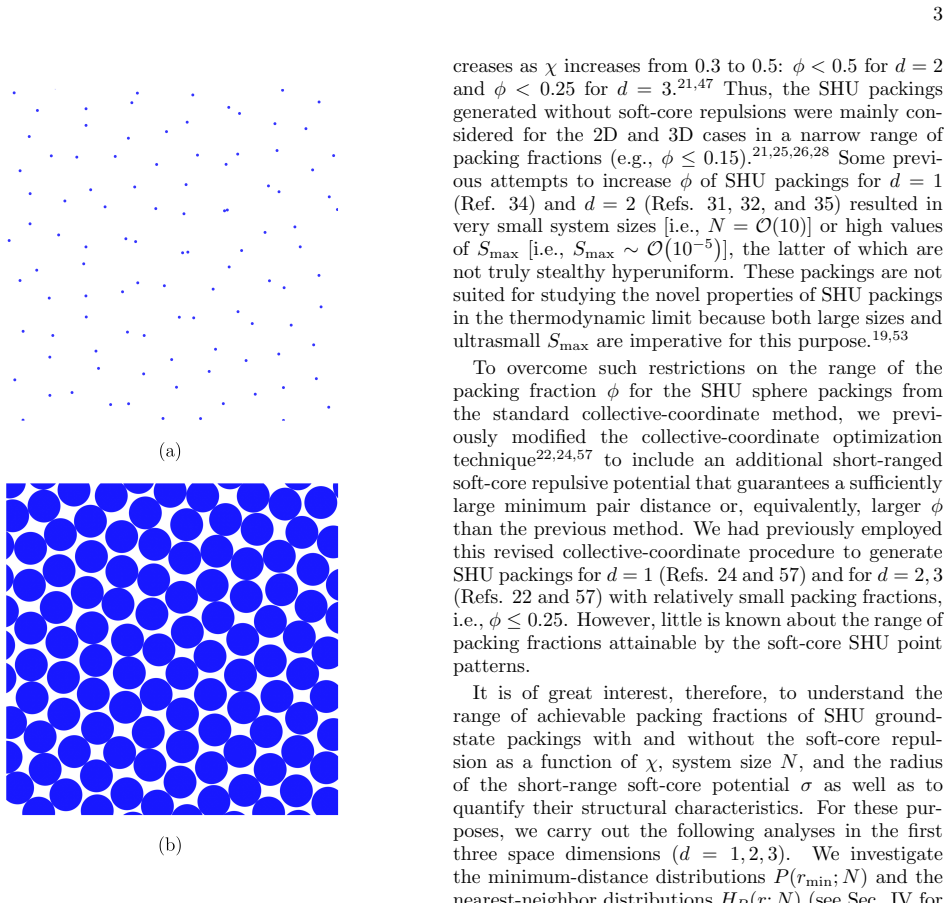
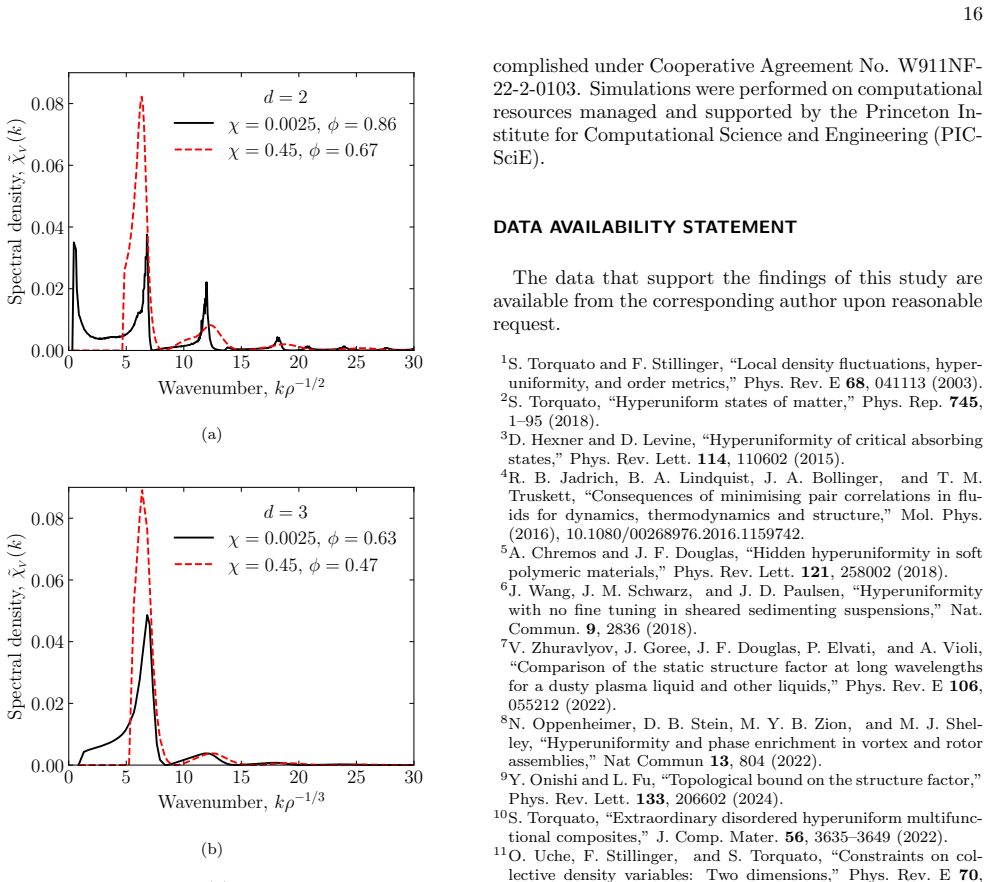
Disordered stealthy hyperuniform (SHU) packings are an emerging class of exotic amorphous two-phase materials endowed with novel physical properties. Such packings of identical spheres have been created from SHU point patterns via a modified collective-coordinate optimization scheme that includes a soft-core repulsion, besides the standard `stealthy' pair potential. Using the distributions of minimum pair distances and nearest-neighbor distances, we find that when the stealthiness parameter $\chi$ is lower than 0.5, the maximal values of $\phi$, denoted by $\phi_{\max}$, decrease to zero on average as the particle number $N$ increases if there are no soft-core repulsions. By contrast, the inclusion of soft-core repulsions results in very large $\phi_{\max}$ independent of $N$, reaching up to $\phi_{\max}=1.0, 0.86, 0.63$ in the zero-$\chi$ limit and decreasing to $\phi_{\max}=1.0, 0.67, 0.47$ at $\chi=0.45$ for $d=1,2,3$, respectively. We obtain explicit formulas for $\phi_{\max}$ as functions of $\chi$ and $N$ for a given $d$. For $d=2,3$, our soft-core SHU packings for small $\chi$ become configurationally very close to the jammed hard-particle packings created by fast compression algorithms, as measured by the pair statistics. As $\chi$ increases beyond $0.20$, the packings form fewer contacts and linear polymer-like chains. The resulting structure factors $S(k)$ and pair correlation functions $g_2(r)$ reveal that soft-core repulsions significantly alter the short- and intermediate-range correlations in the SHU ground states. We also compute the spectral density $\tilde{\chi}_{_V}(k)$, which can be used to estimate various physical properties (e.g., electromagnetic properties, fluid permeability, and mean survival time) of SHU two-phase dispersions. Our results offer a new route for discovering novel disordered hyperuniform two-phase materials with unprecedentedly high density.
Figures


Figures from the paper (6 more)


Reference graph
Works this paper leans on
-
[1]
merlin.mbs aapmrev4-1.bst 2010-07-25 4.21a (PWD, AO, DPC) hacked
FUNCTION id.bst "merlin.mbs aapmrev4-1.bst 2010-07-25 4.21a (PWD, AO, DPC) hacked" ENTRY address archive archivePrefix author bookaddress booktitle chapter collaboration doi edition editor eid eprint howpublished institution isbn issn journal key language month note number organization pages primaryClass publisher school SLACcitation series title translat...
2010
-
[2]
merlin.mbs aipauth4-1.bst 2010-07-25 4.21a (PWD, AO, DPC) hacked
FUNCTION id.bst "merlin.mbs aipauth4-1.bst 2010-07-25 4.21a (PWD, AO, DPC) hacked" ENTRY address archive archivePrefix author bookaddress booktitle chapter collaboration doi edition editor eid eprint howpublished institution isbn issn journal key language month note number organization pages primaryClass publisher school SLACcitation series title translat...
2010
-
[3]
merlin.mbs aipnum4-1.bst 2010-07-25 4.21a (PWD, AO, DPC) hacked
FUNCTION id.bst "merlin.mbs aipnum4-1.bst 2010-07-25 4.21a (PWD, AO, DPC) hacked" ENTRY address archive archivePrefix author bookaddress booktitle chapter collaboration doi edition editor eid eprint howpublished institution isbn issn journal key language month note number organization pages primaryClass publisher school SLACcitation series title translati...
2010
-
[4]
merlin.mbs apsrev4-1.bst 2010-07-25 4.21a (PWD, AO, DPC) hacked
FUNCTION id.bst "merlin.mbs apsrev4-1.bst 2010-07-25 4.21a (PWD, AO, DPC) hacked" ENTRY address archive archivePrefix author bookaddress booktitle chapter collaboration doi edition editor eid eprint howpublished institution isbn issn journal key language month note number organization pages primaryClass publisher school SLACcitation series title translati...
2010
-
[5]
merlin.mbs apsrmp4-1.bst 2010-07-25 4.21a (PWD, AO, DPC) hacked
FUNCTION id.bst "merlin.mbs apsrmp4-1.bst 2010-07-25 4.21a (PWD, AO, DPC) hacked" ENTRY address archive archivePrefix author bookaddress booktitle chapter collaboration doi edition editor eid eprint howpublished institution isbn issn journal key language month note number organization pages primaryClass publisher school SLACcitation series title translati...
2010
-
[6]
author author S. Torquato \ and\ author F. Stillinger ,\ title title Local density fluctuations, hyperuniformity, and order metrics , \ 10.1103/PhysRevE.68.041113 journal journal Phys. Rev. E \ volume 68 ,\ pages 041113 ( year 2003 ) NoStop
-
[7]
author author S. Torquato ,\ title title Hyperuniform states of matter , \ 10.1016/j.physrep.2018.03.001 journal journal Phys. Rep. \ volume 745 ,\ pages 1--95 ( year 2018 a ) NoStop
-
[8]
author author D. Hexner \ and\ author D. Levine ,\ title title Hyperuniformity of critical absorbing states , \ 10.1103/PhysRevLett.114.110602 journal journal Phys. Rev. Lett. \ volume 114 ,\ pages 110602 ( year 2015 ) NoStop
Show all 89 references
-
[9]
author author R. B. \ Jadrich , author B. A. \ Lindquist , author J. A. \ Bollinger , \ and\ author T. M. \ Truskett ,\ title title Consequences of minimising pair correlations in fluids for dynamics, thermodynamics and structure , \ 10.1080/00268976.2016.1159742 journal journ...
-
[10]
Chremos \ and\ author J
author author A. Chremos \ and\ author J. F. \ Douglas ,\ title title Hidden hyperuniformity in soft polymeric materials , \ 10.1103/PhysRevLett.121.258002 journal journal Phys. Rev. Lett. \ volume 121 ,\ pages 258002 ( year 2018 ) NoStop
-
[11]
Wang , author J
author author J. Wang , author J. M. \ Schwarz , \ and\ author J. D. \ Paulsen ,\ title title Hyperuniformity with no fine tuning in sheared sedimenting suspensions , \ 10.1038/s41467-018-05195-4 journal journal Nat. Commun. \ volume 9 ,\ pages 2836 ( year 2018 ) NoStop
-
[12]
Zhuravlyov , author J
author author V. Zhuravlyov , author J. Goree , author J. F. \ Douglas , author P. Elvati , \ and\ author A. Violi ,\ title title Comparison of the static structure factor at long wavelengths for a dusty plasma liquid and other liquids , \ 10.1103/PhysRevE.106.055212 journal j...
-
[13]
Oppenheimer , author D
author author N. Oppenheimer , author D. B. \ Stein , author M. Y. B. \ Zion , \ and\ author M. J. \ Shelley ,\ title title Hyperuniformity and phase enrichment in vortex and rotor assemblies , \ 10.1038/s41467-022-28375-9 journal journal Nat Commun \ volume 13 ,\ pages 804 ( ...
-
[14]
Onishi \ and\ author L
author author Y. Onishi \ and\ author L. Fu ,\ title title Topological bound on the structure factor , \ 10.1103/PhysRevLett.133.206602 journal journal Phys. Rev. Lett. \ volume 133 ,\ pages 206602 ( year 2024 ) NoStop
2024 doi
-
[15]
Torquato ,\ title title Extraordinary disordered hyperuniform multifunctional composites , \ 10.1177/00219983221116432 journal journal J
author author S. Torquato ,\ title title Extraordinary disordered hyperuniform multifunctional composites , \ 10.1177/00219983221116432 journal journal J. Comp. Mater. \ volume 56 ,\ pages 3635--3649 ( year 2022 ) NoStop
2022 doi
-
[16]
Uche , author F
author author O. Uche , author F. Stillinger , \ and\ author S. Torquato ,\ title title Constraints on collective density variables: Two dimensions , \ 10.1103/PhysRevE.70.046122 journal journal Phys. Rev. E \ volume 70 ,\ pages 046122 ( year 2004 ) NoStop
-
[17]
Zhang , author F
author author G. Zhang , author F. Stillinger , \ and\ author S. Torquato ,\ title title Ground states of stealthy hyperuniform potentials: I. entropically favored configurations , \ 10.1103/PhysRevE.92.022119 journal journal Phys. Rev. E \ volume 92 ,\ pages 022119 ( year 201...
-
[18]
Torquato , author G
author author S. Torquato , author G. Zhang , \ and\ author F. H. \ Stillinger ,\ title title Ensemble theory for stealthy hyperuniform disordered ground states , \ 10.1103/PhysRevX.5.021020 journal journal Phys. Rev. X \ volume 5 ,\ pages 021020 ( year 2015 ) NoStop
-
[19]
Batten , author F
author author R. Batten , author F. Stillinger , \ and\ author S. Torquato ,\ title title Classical disordered ground states: Super-ideal gases and stealth and equi-luminous materials , \ 10.1063/1.2961314 journal journal J. Appl. Phys. \ volume 104 ,\ pages 033504 ( year 2008...
-
[20]
Florescu , author S
author author M. Florescu , author S. Torquato , \ and\ author P. Steinhardt ,\ title title Designer disordered materials with large, complete photonic band gaps , \ 10.1073/pnas.0907744106 journal journal Proc. Natl. Acad. Sci. U.S.A. \ volume 106 ,\ pages 20658--20663 ( year...
-
[21]
Aeby , author G
author author S. Aeby , author G. J. \ Aubry , author L. S. \ Froufe-P \'e rez , \ and\ author F. Scheffold ,\ title title Fabrication of hyperuniform dielectric networks via heat-induced shrinkage reveals a bandgap at telecom wavelengths , \ 10.1002/adom.202200232 journal jou...
-
[22]
Torquato \ and\ author D
author author S. Torquato \ and\ author D. Chen ,\ title title Multifunctional hyperuniform cellular networks: optimality, anisotropy and disorder , \ 10.1088/2399-7532/aaca91 journal journal Multifunct. Mater. \ volume 1 ,\ pages 015001 ( year 2018 ) NoStop
-
[23]
Zhou , author Y
author author W. Zhou , author Y. Tong , author X. Sun , \ and\ author H. K. \ Tsang ,\ title title Ultra-broadband hyperuniform disordered silicon photonic polarizers , \ 10.1109/JSTQE.2019.2938069 journal journal IEEE J. Sel. Top. Quantum Electron. \ volume 26 ,\ pages 1--9 ...
2019
-
[24]
author author M. A. \ Klatt , author P. J. \ Steinhardt , \ and\ author S. Torquato ,\ title title Wave propagation and band tails of two-dimensional disordered systems in the thermodynamic limit , \ 10.1073/pnas.2213633119 journal journal Proc. Natl. Acad. Sci. U.S.A. \ volum...
-
[25]
Granchi , author R
author author N. Granchi , author R. Spalding , author M. Lodde , author M. Petruzzella , author F. W. \ Otten , author A. Fiore , author F. Intonti , author R. Sapienza , author M. Florescu , \ and\ author M. Gurioli ,\ title title Near-field investigation of luminescent hype...
-
[26]
Zhang , author F
author author G. Zhang , author F. Stillinger , \ and\ author S. Torquato ,\ title title Transport, geometrical, and topological properties of stealthy disordered hyperuniform two-phase systems , \ 10.1063/1.4972862 journal journal J. Chem. Phys. \ volume 145 ,\ pages 244109 (...
-
[27]
Kim \ and\ author S
author author J. Kim \ and\ author S. Torquato ,\ title title Multifunctional composites for elastic and electromagnetic wave propagation , \ 10.1073/pnas.1914086117 journal journal Proc. Natl. Acad. Sci. U.S.A. \ volume 117 ,\ pages 8764--8774 ( year 2020 ) ,\ http://arxiv.or...
-
[28]
Romero-Garc\' i a , author N
author author V. Romero-Garc\' i a , author N. Lamothe , author G. Theocharis , author O. Richoux , \ and\ author L. M. \ Garc\' i a-Raffi ,\ title title Stealth acoustic materials , \ 10.1103/PhysRevApplied.11.054076 journal journal Phys. Rev. Applied \ volume 11 ,\ pages 054...
-
[29]
Kim \ and\ author S
author author J. Kim \ and\ author S. Torquato ,\ title title Effective electromagnetic wave properties of disordered stealthy hyperuniform layered media beyond the quasistatic regime , \ 10.1364/optica.489797 journal journal Optica \ volume 10 ,\ pages 965--972 ( year 2023 ) NoStop
-
[30]
author author L. S. \ Froufe-P \'e rez , author G. J. \ Aubry , author F. Scheffold , \ and\ author S. Magkiriadou ,\ title title Bandgap fluctuations and robustness in two-dimensional hyperuniform dielectric materials , \ 10.1364/OE.484232 journal journal Optics Express \ vol...
-
[31]
Alha \"i tz , author J.-M
author author L. Alha \"i tz , author J.-M. \ Conoir , \ and\ author T. Valier-Brasier ,\ title title Experimental evidence of isotropic transparency and complete band gap formation for ultrasound propagation in stealthy hyperuniform media , \ 10.1103/PhysRevE.108.065001 journ...
-
[32]
Bigourdan , author R
author author F. Bigourdan , author R. Pierrat , \ and\ author R. Carminati ,\ title title Enhanced absorption of waves in stealth hyperuniform disordered media , \ 10.1364/OE.27.008666 journal journal Opt. Express \ volume 27 ,\ pages 8666--8682 ( year 2019 ) NoStop
-
[33]
Froufe-P \'e rez , author M
author author L. Froufe-P \'e rez , author M. Engel , author J. S \'a enz , \ and\ author F. Scheffold ,\ title title Band gap formation and anderson localization in disordered photonic materials with structural correlations , \ 10.1073/pnas.1705130114 journal journal Proc. Na...
-
[34]
Sgrignuoli , author S
author author F. Sgrignuoli , author S. Torquato , \ and\ author L. Dal Negro ,\ title title Subdiffusive wave transport and weak localization transition in three-dimensional stealthy hyperuniform disordered systems , \ 10.1103/PhysRevB.105.064204 journal journal Phys. Rev. B ...
-
[35]
Tavakoli , author R
author author N. Tavakoli , author R. Spalding , author A. Lambertz , author P. Koppejan , author G. Gkantzounis , author C. Wan , author R. R \"o hrich , author E. Kontoleta , author A. F. \ Koenderink , author R. Sapienza , author M. Florescu , \ and\ author E. Alarcon-Llado...
-
[36]
Merkel , author M
author author M. Merkel , author M. Stappers , author D. Ray , author C. Denz , \ and\ author J. Imbrock ,\ title title Stealthy hyperuniform surface structures for efficiency enhancement of organic solar cells , \ 10.1002/adpr.202300256 journal journal Adv. Photonics Res. \ v...
-
[37]
Gkantzounis , author T
author author G. Gkantzounis , author T. Amoah , \ and\ author M. Florescu ,\ title title Hyperuniform disordered phononic structures , \ 10.1103/PhysRevB.95.094120 journal journal Phys. Rev. B \ volume 95 ,\ pages 094120 ( year 2017 ) NoStop
-
[38]
Gkantzounis \ and\ author M
author author G. Gkantzounis \ and\ author M. Florescu ,\ title title Freeform phononic waveguides , \ 10.3390/cryst7120353 journal journal Crystals \ volume 7 ,\ pages 353 ( year 2017 ) NoStop
2017 doi
-
[39]
Romero-Garc \'i a , author \'E
author author V. Romero-Garc \'i a , author \'E . Ch \'e ron , author S. Kuznetsova , author J.-P. \ Groby , author S. F \'e lix , author V. Pagneux , \ and\ author L. M. \ Garcia-Raffi ,\ title title Wave transport in 1d stealthy hyperuniform phononic materials made of non-re...
-
[40]
Rohfritsch , author J.-M
author author A. Rohfritsch , author J.-M. \ Conoir , author T. Valier-Brasier , \ and\ author R. Marchiano ,\ title title Impact of particle size and multiple scattering on the propagation of waves in stealthy-hyperuniform media , \ 10.1103/PhysRevE.102.053001 journal journal...
-
[41]
Ch\' e ron , author J.-P
author author E. Ch\' e ron , author J.-P. \ Groby , author V. Pagneux , author S. Félix , \ and\ author V. Romero-Garc\' i a ,\ title title Experimental characterization of rigid-scatterer hyperuniform distributions for audible acoustics , \ 10.1103/PhysRevB.106.064206 journa...
-
[42]
Zhuang , author D
author author H. Zhuang , author D. Chen , author L. Liu , author D. Keeney , author G. Zhang , \ and\ author Y. Jiao ,\ title title Vibrational properties of disordered stealthy hyperuniform 1d atomic chains , \ 10.1088/1361-648X/ad3b5c journal journal J. Phys.: Condens. Matt...
-
[43]
Castro-Lopez , author M
author author M. Castro-Lopez , author M. Gaio , author S. Sellers , author G. Gkantzounis , author M. Florescu , \ and\ author R. Sapienza ,\ title title Reciprocal space engineering with hyperuniform gold disordered surfaces , \ 10.1063/1.4983990 journal journal APL Photonic...
-
[44]
Gorsky , author W
author author S. Gorsky , author W. A. \ Britton , author Y. Chen , author J. Montaner , author A. Lenef , author M. Raukas , \ and\ author L. Dal Negro ,\ title title Engineered hyperuniformity for directional light extraction , \ 10.1063/1.5124302 journal journal APL Photoni...
-
[45]
Degl\'Innocenti , author Y
author author R. Degl\'Innocenti , author Y. D. \ Shah , author L. Masini , author A. Ronzani , author A. Pitanti , author Y. Ren , author D. S. \ Jessop , author A. Tredicucci , author H. E. \ Beere , \ and\ author D. A. \ Ritchie ,\ title title Hyperuniform disordered terahe...
-
[46]
Zhang , author H
author author H. Zhang , author H. Chu , author H. Giddens , author W. Wu , \ and\ author Y. Hao ,\ title title Experimental demonstration of luneburg lens based on hyperuniform disordered media , \ 10.1063/1.5055295 journal journal Appl. Phys. Lett. \ volume 114 ,\ pages 0535...
-
[47]
Christogeorgos , author H
author author O. Christogeorgos , author H. Zhang , author Q. Cheng , \ and\ author Y. Hao ,\ title title Extraordinary directive emission and scanning from an array of radiation sources with hyperuniform disorder , \ 10.1103/PhysRevApplied.15.014062 journal journal Phys. Rev....
-
[48]
Tang , author Y
author author K. Tang , author Y. Wang , author S. Wang , author D. Gao , author H. Li , author X. Liang , author P. Sebbah , author J. Zhang , \ and\ author J. Shi ,\ title title Hyperuniform disordered parametric loudspeaker array , \ 10.1103/PhysRevApplied.19.054035 journal...
-
[49]
Zhang , author Q
author author H. Zhang , author Q. Cheng , author H. Chu , author O. Christogeorgos , author W. Wu , \ and\ author Y. Hao ,\ title title Hyperuniform disordered distribution metasurface for scattering reduction , \ 10.1063/5.0041911 journal journal Appl. Phys. Lett. \ volume 1...
-
[50]
Kuznetsova , author J
author author S. Kuznetsova , author J. P. \ Groby , author L. M. \ Garcia-Raffi , \ and\ author V. Romero-Garc\' i a ,\ title title Stealth and equiluminous materials for scattering cancellation and wave diffusion , \ 10.1080/17455030.2021.1948630 journal journal Waves Random...
-
[51]
Tamraoui , author E
author author M. Tamraoui , author E. Roux , \ and\ author H. Liebgott ,\ title title Hyperuniform disordered sparse array for 3d ultrasound imaging , \ in\ 10.1109/IUS51837.2023.10308368 booktitle 2023 IEEE International Ultrasonics Symposium (IUS) \ ( year 2023 )\ pp.\ pages...
2023
-
[52]
Zhang , author F
author author G. Zhang , author F. H. \ Stillinger , \ and\ author S. Torquato ,\ title title Can exotic disordered ``stealthy" particle configurations tolerate arbitrarily large holes? \ 10.1039/c7sm01028a journal journal Soft Matter \ volume 13 ,\ pages 6197--6207 ( year 201...
-
[53]
Ghosh \ and\ author J
author author S. Ghosh \ and\ author J. L. \ Lebowitz ,\ title title Generalized stealthy hyperuniform processes: maximal rigidity and the bounded holes conjecture , \ 10.1007/s00220-018-3226-5 journal journal Commun. Math. Phys. \ volume 363 ,\ pages 97--110 ( year 2018 ) NoStop
-
[54]
Martis , author \'E
author author S. Martis , author \'E . Marcotte , author F. H. \ Stillinger , \ and\ author S. Torquato ,\ title title Exotic ground states of directional pair potentials via collective-density variables , \ 10.1007/s10955-012-0619-2 journal journal J. Stat. Phys. \ volume 150...
-
[55]
Torquato ,\ title title Hyperuniformity and its generalizations , \ 10.1103/PhysRevE.94.022122 journal journal Phys
author author S. Torquato ,\ title title Hyperuniformity and its generalizations , \ 10.1103/PhysRevE.94.022122 journal journal Phys. Rev. E \ volume 94 ,\ pages 022122 ( year 2016 a ) NoStop
2016 doi
-
[56]
note The total energy expression ( eq:pot ) actually also contains the sum @ @ _ k v ( k ) , but this is a structure-independent constant that is set to zero here without loss of generality. Stop
-
[57]
@citealpnum batten_classical_2008
note More generally, stealthy configurations are ground states that minimize S(k) to be zero at other sets of wave vectors, not necessarily in a connected set around the origin and hence nonhyperuniform, specific examples of which were investigated in Ref. @citealpnum batten_c...
-
[58]
author author P. K. \ Morse , author J. Kim , author P. J. \ Steinhardt , \ and\ author S. Torquato ,\ title title Generating large disordered stealthy hyperuniform systems with ultrahigh accuracy to determine their physical properties , \ 10.1103/PhysRevResearch.5.033190 jour...
-
[59]
Shih , author M
author author A. Shih , author M. Casiulis , \ and\ author S. Martiniani ,\ title title Fast generation of spectrally shaped disorder , \ 10.1103/PhysRevE.110.034122 journal journal Phys. Rev. E \ volume 110 ,\ pages 034122 ( year 2024 ) NoStop
-
[60]
uche_constraints_2004,batten_classical_2008,martis_exotic_2013 , even for much larger system sizes
note Reference morse_generating_2023 reports techniques that reduce the deviations from zero within the exclusion region (distance to exact stealthiness) by a factor of approximately 10^ 30 compared to the previous ones described in Refs. uche_constraints_2004,batten_classical...
-
[61]
author author T. M. \ Middlemas \ and\ author S. Torquato ,\ title title Nearest-neighbor functions for disordered stealthy hyperuniform many-particle systems , \ 10.1088/1742-5468/abb8cb journal journal J. Stat. Mech. \ volume 2020 ,\ pages 103302 ( year 2020 ) NoStop
-
[62]
Kim \ and\ author S
author author J. Kim \ and\ author S. Torquato ,\ title title Theoretical prediction of the effective dynamic dielectric constant of disordered hyperuniform anisotropic composites beyond the long-wavelength regime , \ 10.1364/OME.507918 journal journal Opt. Mater. Express \ vo...
-
[63]
Torquato , author T
author author S. Torquato , author T. M. \ Truskett , \ and\ author P. G. \ Debenedetti ,\ title title Is random close packing of spheres well defined? \ 10.1103/physrevlett.84.2064 journal journal Phys. Rev. Lett. \ volume 84 ,\ pages 2064--2067 ( year 2000 ) NoStop
-
[64]
Donev , author F
author author A. Donev , author F. Stillinger , \ and\ author S. Torquato ,\ title title Unexpected density fluctuations in jammed disordered sphere packings , \ 10.1103/PhysRevLett.95.090604 journal journal Phys. Rev. Lett. \ volume 95 ,\ pages 090604 ( year 2005 ) NoStop
-
[65]
author author C. E. \ Maher , author Y. Jiao , \ and\ author S. Torquato ,\ title title Hyperuniformity of maximally random jammed packings of hyperspheres across spatial dimensions , \ 10.1103/PhysRevE.108.064602 journal journal Phys. Rev. E \ volume 108 ,\ pages 064602 ( yea...
-
[66]
Torquato \ and\ author J
author author S. Torquato \ and\ author J. Kim ,\ 10.48550/arXiv.2504.10310 title Existence of nonequilibrium glasses in the degenerate stealthy hyperuniform ground-state manifold , \ ( year 2025 ),\ http://arxiv.org/abs/2504.10310 arXiv:2504.10310 [cond-mat] NoStop
-
[67]
author author S. Torquato ,\ title title Predicting transport characteristics of hyperuniform porous media via rigorous microstructure-property relations , \ 10.1016/j.advwatres.2020.103565 journal journal Adv. Water Resour. \ volume 140 ,\ pages 103565 ( year 2020 ) NoStop
2020
-
[68]
Torquato \ and\ author F
author author S. Torquato \ and\ author F. H. \ Stillinger ,\ title title New conjectural lower bounds on the optimal density of sphere packings , \ 10.1080/10586458.2006.10128964 journal journal Exper. Math. \ volume 15 ,\ pages 307--331 ( year 2006 ) NoStop
2006
-
[69]
Salvadori ,\ ed.,\ @noop title Extremes in nature: an approach using copulas ,\ series Water science and technology library \ No
editor G. Salvadori ,\ ed.,\ @noop title Extremes in nature: an approach using copulas ,\ series Water science and technology library \ No. number 56 \ ( publisher Springer ,\ address Dordrecht ,\ year 2007 ) NoStop
2007
-
[70]
author author M. I. \ Gomes \ and\ author A. Guillou ,\ title title Extreme value theory and statistics of univariate extremes: A review , \ 10.1111/insr.12058 journal journal Int. Stat. Rev. \ volume 83 ,\ pages 263--292 ( year 2015 ) NoStop
-
[71]
Zachary \ and\ author S
author author C. Zachary \ and\ author S. Torquato ,\ title title Hyperuniformity in point patterns and two-phase random heterogeneous media , \ 10.1088/1742-5468/2009/12/P12015 journal journal J. Stat. Mech: Theory Exp. \ volume 2009 ,\ pages P12015 ( year 2009 ) NoStop
2009 doi
-
[72]
Torquato ,\ title title Structural characterization of many-particle systems on approach to hyperuniform states , \ 10.1103/PhysRevE.103.052126 journal journal Phys
author author S. Torquato ,\ title title Structural characterization of many-particle systems on approach to hyperuniform states , \ 10.1103/PhysRevE.103.052126 journal journal Phys. Rev. E \ volume 103 ,\ pages 052126 ( year 2021 ) NoStop
-
[73]
author author C. S. \ O'Hern , author L. E. \ Silbert , author A. J. \ Liu , \ and\ author S. R. \ Nagel ,\ title title Jamming at zero temperature and zero applied stress: The epitome of disorder , \ 10.1103/PhysRevE.68.011306 journal journal Phys. Rev. E \ volume 68 ,\ pages...
-
[74]
Charbonneau , author E
author author P. Charbonneau , author E. I. \ Corwin , author G. Parisi , \ and\ author F. Zamponi ,\ title title Universal microstructure and mechanical stability of jammed packings , \ 10.1103/PhysRevLett.109.205501 journal journal Phys. Rev. Lett. \ volume 109 ,\ pages 2055...
-
[75]
Jin \ and\ author H
author author Y. Jin \ and\ author H. Yoshino ,\ title title A jamming plane of sphere packings , \ 10.1073/pnas.2021794118 journal journal Proc. Natl. Acad. Sci. U.S.A. \ volume 118 ,\ pages e2021794118 ( year 2021 ) NoStop
2021 doi
-
[76]
M \'e zard \ and\ author A
author author M. M \'e zard \ and\ author A. Montanari ,\ title title Satisfiability , \ in\ 10.1093/acprof:oso/9780198570837.003.0010 booktitle Information, Physics, and Computation ,\ editor edited by\ editor M. M \'e zard \ and\ editor A. Montanari \ ( publisher Oxford Univ...
-
[77]
Franz , author G
author author S. Franz , author G. Parisi , author M. Sevelev , author P. Urbani , \ and\ author F. Zamponi ,\ title title Universality of the sat-unsat (jamming) threshold in non-convex continuous constraint satisfaction problems , \ 10.21468/SciPostPhys.2.3.019 journal journ...
-
[78]
It takes around 0.1 core-hours on the same CPU to generate one 3D SHU ground-state packing with =0.0025 , =0.63 , and N=4000 NoStop
note For example, on an Intel(R) Xeon(R) CPU (E5-2680, 2.40 GHz), it takes around 15 core-hours to generate one 3D SHU ground-state packing with =0.45 , =0.47 , and N=4000 . It takes around 0.1 core-hours on the same CPU to generate one 3D SHU ground-state packing with =0.0025...
-
[79]
Nocedal ,\ title title Updating quasi-newton matrices with limited storage , \ 10.1090/S0025-5718-1980-0572855-7 journal journal Math
author author J. Nocedal ,\ title title Updating quasi-newton matrices with limited storage , \ 10.1090/S0025-5718-1980-0572855-7 journal journal Math. Comput. \ volume 35 ,\ pages 773--782 ( year 1980 ) NoStop
1980 doi
-
[80]
author author D. C. \ Liu \ and\ author J. Nocedal ,\ title title On the limited memory bfgs method for large scale optimization , \ 10.1007/BF01589116 journal journal Math. Program. \ volume 45 ,\ pages 503--528 ( year 1989 ) NoStop
1989 doi
-
[81]
note This threshold is close to zero energy of the potentials @ ( eq:pot \@@italiccorr ) and @ ( eq:Phi \@@italiccorr ) within the double precision of the machine NoStop
-
[82]
Donev , author F
author author A. Donev , author F. H. \ Stillinger , \ and\ author S. Torquato ,\ title title Configurational entropy of binary hard-disk glasses: Nonexistence of an ideal glass transition , \ 10.1063/1.2775928 journal journal J. Chem. Phys. \ volume 127 ,\ pages 124509 ( year...
-
[83]
Torquato ,\ title title Perspective: Basic understanding of condensed phases of matter via packing models , \ 10.1063/1.5036657 journal journal J
author author S. Torquato ,\ title title Perspective: Basic understanding of condensed phases of matter via packing models , \ 10.1063/1.5036657 journal journal J. Chem. Phys. \ volume 149 ,\ pages 020901 ( year 2018 b ) NoStop
2018 doi
-
[84]
Wyart , author L
author author M. Wyart , author L. E. \ Silbert , author S. R. \ Nagel , \ and\ author T. A. \ Witten ,\ title title Effects of compression on the vibrational modes of marginally jammed solids , \ 10.1103/PhysRevE.72.051306 journal journal Phys. Rev. E \ volume 72 ,\ pages 051...
-
[85]
Donev , author S
author author A. Donev , author S. Torquato , \ and\ author F. H. \ Stillinger ,\ title title Pair correlation function characteristics of nearly jammed disordered and ordered hard-sphere packings , \ 10.1103/PhysRevE.71.011105 journal journal Phys. Rev. E \ volume 71 ,\ pages...
-
[86]
note For a N -particle system in a d -dimensional simple cubic fundamental cell, the smallest value of M(K) is d , and thus = M(K)/[d(N-1)] (N-1)^ -1 . Stop
-
[87]
Vanoni , author J
author author C. Vanoni , author J. Kim , author P. J. \ Steinhardt , \ and\ author S. Torquato ,\ 10.48550/arXiv.2503.24297 title Dynamical properties of particulate composites derived from ultradense stealthy hyperuniform sphere packings , \ ( year 2025 ),\ http://arxiv.org/...
-
[88]
Torquato ,\ title title Disordered hyperuniform heterogeneous materials , \ 10.1088/0953-8984/28/41/414012 journal journal J
author author S. Torquato ,\ title title Disordered hyperuniform heterogeneous materials , \ 10.1088/0953-8984/28/41/414012 journal journal J. Phys.: Condens. Matter \ volume 28 ,\ pages 414012 ( year 2016 b ) NoStop
2016 doi
-
[89]
Zhang , author F
author author G. Zhang , author F. H. \ Stillinger , \ and\ author S. Torquato ,\ title title The perfect glass paradigm: Disordered hyperuniform glasses down to absolute zero , \ 10.1038/srep36963 journal journal Sci. Rep. \ volume 6 ,\ pages 36963 ( year 2016 b ) NoStop
Reviewed August 16, 2026 · model on record in the stance chip above.
Discussion (0). Continue with ORCID to comment.