REVIEW 3 major objections 5 minor 237 references
Improving Human-Autonomous Vehicle Interaction in Complex Systems
T0 review · 3 major / 5 minor · reviewed 2026-08-16 · deepseek-v4-flash
Pith's one-line read This dissertation argues that AV communications must adapt to rider, goal, and context; three studies show explanations can teach, errors can erode trust even when driving is flawless, and risk-benefit attitudes best predict trust.
desk verdict A useful, honest dissertation whose Chapter 3 provides a real but over-stated result: explanation errors hurt trust even with identical driving, but the errors also leak information about perceived driving competence. read the letter →
The pith
A machine-rendered reading of the paper's core claim, the machinery that carries it, and where it could break.
The reading
What carries the argument
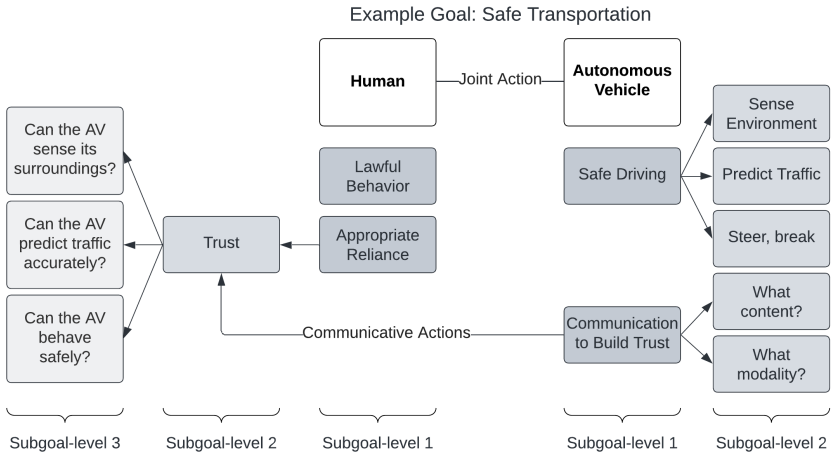
The central object is the human-AV complex system viewed as joint action: a multi-level success function in which high-level goals like safe transport or learning have subgoal criteria, and those criteria shift when components of the system change. Situational awareness—perception, comprehension, and projection—is the mechanism by which the team coordinates, and explanatory communication ('what' the AV is doing and 'why') is the main lever for building it. The dissertation manipulates that lever across three studies: explanation type and modality, explanation errors, and personal predictors of trust.
What would settle it
Run the same full-motion simulator protocol with an added control group that drives the same pre and post laps with the same time-on-task but no AI coach; if that group shows pre-post gains equal to the coached groups, the claim that AI explanations drive learning is falsified.
Extended reading notes
Core claim
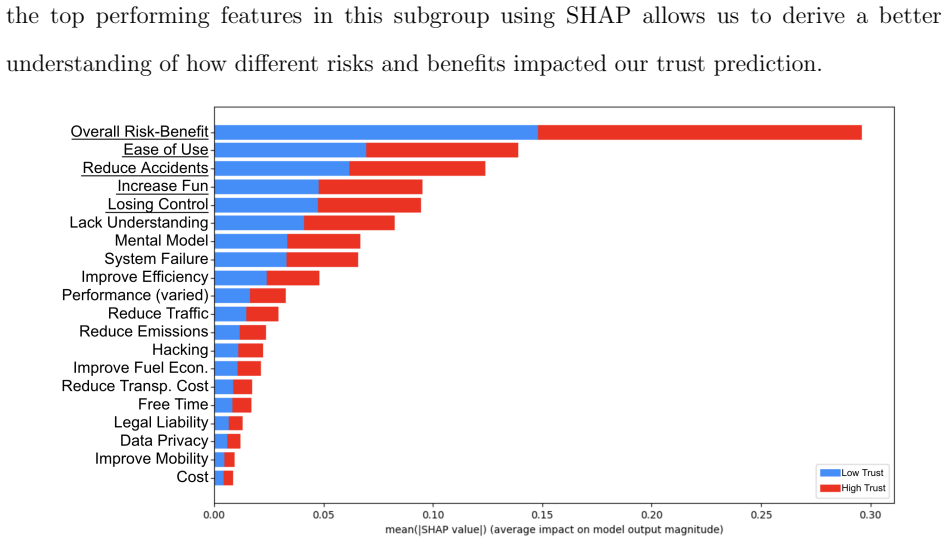
In its own terms, the dissertation's central claim is that a human and an autonomous vehicle form a joint-action team whose success depends on filling situational-awareness gaps, and that these gaps change with the human's traits, the AV's traits, the goal, and the driving context. The sharpest evidence comes from the explanation-error study: riders saw identical, flawless driving, yet when the AV's spoken and on-screen explanations were inaccurate, comfort, reliance, satisfaction, and confidence in driving ability all fell significantly, with bigger falls for more severe errors. The AI-coach study shows the same communication machinery can be tuned for learning: visual 'what' guidance plus auditory 'why' rationale improved novices' racing-line performance without the overload produced by all-auditory explanations. The trust-prediction study shows that perceived risks and benefits of AVs dominate other personal factors in predicting young adults' trust. The dissertation concludes that accurate, context-sensitive, personalized explanations are a necessary condition for AV acceptance.
Load-bearing premise
The Chapter 2 claim that the AI coach caused the learning gains assumes the gains are larger than plain practice would produce, but the study has no practice-only control group, a gap the author acknowledges; if practice alone explains the gains, the coaching effect does not stand.
Editorial extensions
If this is right
- AV explanation systems should be held to accuracy standards comparable to driving-system safety, because wrong explanations reduce riders' willingness to rely on the AV even when the driving is perfect.
- HMI design should match information to modality: visuospatial 'what' guidance works best as a visual cue, while 'why' rationale can be auditory, reducing uncertainty and cognitive overload.
- Communication should adapt to context: high perceived harm amplifies the damage of explanation errors, while in very difficult situations riders may prefer to keep relying on the AV rather than take over.
- Personalization of trust should target risk and benefit perceptions, since these predicted young adults' AV trust more strongly than other psychosocial traits in the machine-learning model.
- Explanation systems should be deployed only when their accuracy is assured, since the studies indicate faulty communication can be worse than silence or observation alone.
Reading between the lines
- Editorial: If explanation errors contaminate perceived driving ability, then a Level-3 conditional automation system could provoke unsafe takeovers after a communication failure; a takeover-timing study would test this.
- Editorial: The dominance of risk-benefit perceptions implies trust interventions could work through benefit framing and risk communication rather than more transparency alone; the dissertation does not test this.
- Editorial: The error-to-driving-confidence crossover may generalize to other XAI domains, where explanation quality shapes perceived model competence even when outputs are correct.
Signed reviews
Editorial analysis
A structured set of objections, weighed in public.
Referee Report
Summary. The dissertation argues that human-autonomous-vehicle (AV) interaction should be understood as a complex system in which successful communication depends on the driving context, the interaction goal, human traits, and AV traits. Three empirical studies support the argument. Chapter 2 reports a pre-post driving-simulator experiment (n=41) evaluating an AI race-car driving coach that provides 'what' and 'why' explanations in visual or auditory modalities; it concludes that AI coaching can improve novice performance-driving skills and that modality-appropriate, task-sensitive explanations reduce cognitive load and uncertainty. Chapter 3 reports a within-subjects online video study (n=232) in which AV explanation errors were manipulated while the AV's driving was identical across conditions; it finds that explanation errors reduce comfort, reliance, satisfaction, and confidence in the AV's driving ability, with context (perceived harm, difficulty) and personal traits (initial trust, expertise) moderating these outcomes. Chapter 4 applies machine learning to survey data from young adults to predict trust in AVs from psychosocial traits, risk-benefit attitudes, and driving factors, reporting that risk and benefit perceptions are the strongest predictors. The dissertation concludes with design implications for transparent, adaptable, and personalized AV communication.
Significance. If the central claims hold, the dissertation makes a useful contribution to human-AI interaction and AV human factors. Its strengths include three distinct empirical studies, the use of linear mixed-effects models with random effects for participant and scenario, and a relatively large Chapter 3 sample. The chapters have already appeared in or been accepted for peer-reviewed venues, which speaks to the maturity of the individual studies. Chapter 4's machine-learning pipeline with SHAP values and ablation experiments provides a concrete, reproducible method for studying trust prediction. The dissertation is also unusually candid about its limitations, particularly the practice-effect confound in Chapter 2 and the post hoc scenario exclusions in Chapter 3. The proposed complex-systems framing is generative and practical. However, the strongest interpretive claim, that explanation errors matter 'even if the AV's driving performance is perfect,' is not cleanly supported by the Chapter 3 manipulation, because the errors used there are diagnostic of the AV's perceptual and planning competence.
major comments (3)
- [Section 3.4.3, Table 3.2; Section 3.5.1; Section 3.6] The crossover claim that explanation errors reduce 'confidence in driving ability' despite 'identical driving' is not cleanly supported, because the error manipulation does not isolate communication accuracy from perceived system competence. In the Low condition the AV says 'Braking, a cyclist is crossing the road' while the video shows a pedestrian; in the High condition it says 'Merging right, a cyclist is crossing the road' while the vehicle is slowing and the obstacle is a pedestrian. These are not merely inaccurate descriptions of an independent communication channel; they are incorrect statements about the AV's perceptual beliefs and intended actions. A participant can rationally infer that the AV's object recognition or planning model is faulty and update their confidence in the AV's driving ability accordingly. The dissertation's strong conclusion in Section 3.6 ('even if the AV's driving performance is perfect ... people may still refuse to adopt AV technology') therefore overreaches. The study remains informative about holistic judgments of AV competence, but the claim that explanation quality is evaluated independently of driving quality must be reframed, or the design needs errors that cannot be diagnostic of perception or planning (and a manipulation check confirming that participants perceive the errors as communication-only). The within-subjects repetition of the same scenario three times is a secondary source of contrast effects and should be acknowledged in the interpretation.
- [Section 3.4.2 and Section 3.4.4] The post hoc removal of three scenarios because the AV's driving was deemed 'imperfect' is a defensible quality check, but it means the 'identical driving' claim is defined only on the retained subset of 24 scenarios. Please report the main analyses both with and without the removed scenarios, and justify that the exclusion rule was applied independently of the outcome measures. Relatedly, the binary reliance measure ('rely on AV' vs. 'take control myself') is scaled from 0-1 to 0-10 and entered into linear mixed-effects models as if it were continuous. A mixed-effects logistic model or ordinal model would be more statistically appropriate. This does not necessarily change the direction of the reported effects, but a dissertation-level analysis should address the distributional issue rather than only noting that scaling does not affect interpretation.
- [Chapter 2, Sections 2.4.2 and 2.5.2] The pre-post design has no practice-only control group for the all-groups-combined improvements, and the manuscript explicitly acknowledges this limitation. Because the chapter's broad claim that 'AI coaching can effectively teach performance driving skills' partly relies on these combined improvements, the practice confound is load-bearing; the credible between-group evidence is essentially limited to racing-line distance in a sample of n=41. In addition, the analysis runs numerous linear mixed-effects models across multiple performance and self-report outcomes without correction for multiple comparisons. I recommend reporting effect sizes and confidence intervals, and either correcting for multiple comparisons or explicitly labeling secondary analyses as exploratory. This does not undermine the chapter's contribution, but it should be reflected in the strength of the conclusions.
minor comments (5)
- [Table 2.1 caption] The caption contains a typo: 'Presentaton' should be 'Presentation'.
- [Section 3.5.1] The text says 'Individual comparisons between each condition ... show highly significant effects ... (Figure 3.4)' but the pairwise condition comparisons are reported in Table 3.4; Figure 3.4 is the later chart of reliance-decision factor importance. Please correct the cross-reference.
- [Section 4.4.3] The model-development section would benefit from explicit hyperparameter settings, software versions, and the exact train/validation split used, so that the SHAP analyses are reproducible from the text.
- [Chapter 3, Section 3.5.2] The interaction-effect discussion distinguishes significant, trending, and non-significant results in the text, but the tables only use significance stars; adding standard errors or confidence intervals to the text summary would help readers calibrate the strength of the moderation effects.
- [Chapter 2, Section 2.4.5] The interview quotes are illustrative but are not accompanied by a formal coding scheme or inter-rater reliability; a sentence describing how themes were derived would strengthen the mixed-methods claims.
Circularity Check
No significant circularity: the dissertation's three studies rest on independent data, and the self-cited framework is not used as a derivation.
full rationale
This is an empirical dissertation rather than a derivational one. Chapter 2 is a pre-post simulator experiment, Chapter 3 is a within-subjects scenario-rating experiment, and Chapter 4 is a survey-based machine-learning study. None of the chapters defines a target quantity in terms of a fitted input, and none renames a fitted parameter as a prediction. The 'success function' framework in Chapter 1 is a conceptual checklist, not an equation, and it is supported by independent literature (e.g., Endsley, Stanton, Hoff and Bashir) as well as by the dissertation's own new data; the self-citation to Kaufman, Kirsh and Weibel (2024) reprints framework material but is not load-bearing for any empirical result. The passage in Section 2.5.2 explicitly acknowledges that the all-groups pre-post gains cannot be separated from practice effects because there is no practice-only control; this is a validity limitation, not a circularity, and the text itself flags it as a limitation for future study. The Chapter 3 crossover finding—identical driving with explanation errors lowering confidence in driving ability—is an empirical outcome, not a construction: it is inferred from observed ratings rather than encoded in the manipulation definitions. A skeptic's concern that the error manipulation may imply faulty perception or planning is a threat to internal validity, but it is not a circularity, because the claim is not derived from the definition of the error conditions. Chapter 4 uses cross-validated machine learning, and the manuscript does not show that the trust target is composed of the predictor items, so the 'risk and benefit perceptions predict trust' result is not forced by definition. No specific circular step could be identified.
Assumptions & free parameters
free parameters (1)
- Machine learning model hyperparameters (Chapter 4)
assumptions (6)
- standard math Linear mixed-effects models correctly account for repeated measures and random effects in Chapters 2 and 3.
- domain assumption Driving simulator and video scenarios are valid proxies for real-world human-AV interaction.
- domain assumption Self-report scales (trust, comfort, satisfaction, confidence) validly measure the intended constructs.
- ad hoc to paper The three scenarios removed from Chapter 3 analysis were excluded because of imperfect AV driving, and the remaining scenarios represent the domain.
- ad hoc to paper In Chapter 2, pre-post improvements are attributable to the AI coach rather than practice alone.
- domain assumption In Chapter 4, the machine learning pipeline (5-fold CV, SHAP) is correctly applied and avoids leakage.
Cite this review
Pith. "Pith review of Improving Human-Autonomous Vehicle Interaction in Complex Systems." pith.science (2026). https://pith.science/paper/GNSYDG2V
@misc{pith2026250417170,
  author       = {Pith},
  title        = {Pith review of: Improving Human-Autonomous Vehicle Interaction in Complex Systems},
  year         = {2026},
  howpublished = {\url{https://pith.science/paper/GNSYDG2V}},
  note         = {Machine review of arXiv:2504.17170}
}
read the original abstract
Unresolved questions about how autonomous vehicles (AVs) should meet the informational needs of riders hinder real-world adoption. Complicating our ability to satisfy rider needs is that different people, goals, and driving contexts have different criteria for what constitutes interaction success. Unfortunately, most human-AV research and design today treats all people and situations uniformly. It is crucial to understand how an AV should communicate to meet rider needs, and how communications should change when the human-AV complex system changes. I argue that understanding the relationships between different aspects of the human-AV system can help us build improved and adaptable AV communications. I support this argument using three empirical studies. First, I identify optimal communication strategies that enhance driving performance, confidence, and trust for learning in extreme driving environments. Findings highlight the need for task-sensitive, modality-appropriate communications tuned to learner cognitive limits and goals. Next, I highlight the consequences of deploying faulty communication systems and demonstrate the need for context-sensitive communications. Third, I use machine learning (ML) to illuminate personal factors predicting trust in AVs, emphasizing the importance of tailoring designs to individual traits and concerns. Together, this dissertation supports the necessity of transparent, adaptable, and personalized AV systems that cater to individual needs, goals, and contextual demands. By considering the complex system within which human-AV interactions occur, we can deliver valuable insights for designers, researchers, and policymakers. This dissertation also provides a concrete domain to study theories of human-machine joint action and situational awareness, and can be used to guide future human-AI interaction research. [shortened for arxiv]
Figures


Figures from the paper (19 more)




Reference graph
Works this paper leans on
-
[1]
URL https://crashstats.nhtsa.dot.gov/Api/Public/ViewPublication/813473.pdf
National highway traffic safety administration traffic safety facts: 2021 data, 2021. URL https://crashstats.nhtsa.dot.gov/Api/Public/ViewPublication/813473.pdf
2021
-
[2]
Autonomous vehicles and alternatives to driving: trust, preferences, and effects of age
Hillary Abraham, Chaiwoo Lee, Samantha Brady, Craig Fitzgerald, Bruce Mehler, Bryan Reimer, and Joseph F Coughlin. Autonomous vehicles and alternatives to driving: trust, preferences, and effects of age. In Proceedings of the transportation research board 96th annual meeting , pages 8–12. Transportation Research Board Washington, DC, 2017
2017
-
[3]
Case study of today’s automotive dealerships: Introduction and delivery of advanced driver assistance systems
Hillary Abraham, Hale McAnulty, Bruce Mehler, and Bryan Reimer. Case study of today’s automotive dealerships: Introduction and delivery of advanced driver assistance systems. Transportation research record, 2660(1):7–14, 2017
2017
-
[4]
Ransford A Acheampong and Federico Cugurullo. Capturing the behavioural deter- minants behind the adoption of autonomous vehicles: Conceptual frameworks and measurement models to predict public transport, sharing and ownership trends of self-driving cars. Transportation research part F: traffic psychology and behaviour , 62: 349–375, 2019
2019
-
[5]
Risk and trust in artificial intelligence technologies: A case study of autonomous vehicles
Ighoyota Ben Ajenaghughrure, Sonia Claudia da Costa Sousa, and David Lamas. Risk and trust in artificial intelligence technologies: A case study of autonomous vehicles. In 2020 13th international conference on human system interaction (HSI) , pages 118–123. Ieee, 2020
2020
-
[6]
A classification model for sensing human trust in machines using eeg and gsr
Kumar Akash, Wan-Lin Hu, Neera Jain, and Tahira Reid. A classification model for sensing human trust in machines using eeg and gsr. ACM Transactions on Interactive Intelligent Systems (TiiS) , 8(4):1–20, 2018
2018
-
[7]
Incorporating personality in user interface design: A review
Tom´ as Alves, Joana Nat´ alio, Joana Henriques-Calado, and Sandra Gama. Incorporating personality in user interface design: A review. Personality and Individual Differences , 155:109709, 2020
2020
-
[8]
The future of well-being in a tech-saturated world
Janna Anderson and Lee Rainie. The future of well-being in a tech-saturated world. 2018. 154
2018
Show all 237 references
-
[9]
In ai we trust? perceptions about automated decision-making by artificial intelligence
Theo Araujo, Natali Helberger, Sanne Kruikemeier, and Claes H De Vreese. In ai we trust? perceptions about automated decision-making by artificial intelligence. AI & society, 35(3):611–623, 2020
2020
-
[10]
Ex- plainable artificial intelligence for autonomous driving: A comprehensive overview and field guide for future research directions
Shahin Atakishiyev, Mohammad Salameh, Hengshuai Yao, and Randy Goebel. Ex- plainable artificial intelligence for autonomous driving: A comprehensive overview and field guide for future research directions. arXiv preprint arXiv:2112.11561 , 2021
2021 arXiv
-
[11]
Investigating explanations in condi- tional and highly automated driving: The effects of situation awareness and modality
Lilit Avetisyan, Jackie Ayoub, and Feng Zhou. Investigating explanations in condi- tional and highly automated driving: The effects of situation awareness and modality. Transportation research part F: traffic psychology and behaviour , 89:456–466, 2022
2022
-
[12]
An investigation of drivers’ dynamic situational trust in conditionally automated driving
Jackie Ayoub, Lilit Avetisyan, Mustapha Makki, and Feng Zhou. An investigation of drivers’ dynamic situational trust in conditionally automated driving. IEEE Transac- tions on Human-Machine Systems , 52(3):501–511, 2021
2021
-
[13]
Modeling dispositional and initial learned trust in automated vehicles with predictability and explainability
Jackie Ayoub, X Jessie Yang, and Feng Zhou. Modeling dispositional and initial learned trust in automated vehicles with predictability and explainability. Transportation research part F: traffic psychology and behaviour , 77:102–116, 2021
2021
-
[14]
Real-time trust prediction in conditionally automated driving using physiological measures
Jackie Ayoub, Lilit Avetisian, X Jessie Yang, and Feng Zhou. Real-time trust prediction in conditionally automated driving using physiological measures. IEEE Transactions on Intelligent Transportation Systems , 2023
2023
-
[15]
Education in the era of generative artificial intelligence (ai): Understanding the potential benefits of chatgpt in promoting teaching and learning
David Baidoo-Anu and Leticia Owusu Ansah. Education in the era of generative artificial intelligence (ai): Understanding the potential benefits of chatgpt in promoting teaching and learning. Journal of AI , 7(1):52–62, 2023
2023
-
[16]
Random effects structure for confirmatory hypothesis testing: Keep it maximal
Dale J Barr, Roger Levy, Christoph Scheepers, and Harry J Tily. Random effects structure for confirmatory hypothesis testing: Keep it maximal. Journal of memory and language, 68(3):255–278, 2013
2013
-
[17]
The role of domain expertise in trusting and following explainable ai decision support systems
Sarah Bayer, Henner Gimpel, and Moritz Markgraf. The role of domain expertise in trusting and following explainable ai decision support systems. Journal of Decision Systems, 32(1):110–138, 2022
2022
-
[18]
Programming is hard-or at least it used to be: Educational opportunities and challenges of ai code generation
Brett A Becker, Paul Denny, James Finnie-Ansley, Andrew Luxton-Reilly, James Prather, and Eddie Antonio Santos. Programming is hard-or at least it used to be: Educational opportunities and challenges of ai code generation. In Proceedings of the 54th ACM Technical Symposium on ...
2023
-
[19]
Conversense: An automated 155 approach to assess patient-provider interactions using social signals
Manas Satish Bedmutha, Anuujin Tsedenbal, Kelly Tobar, Sarah Borsotto, Kimberly R Sladek, Deepansha Singh, Reggie Casanova-Perez, Emily Bascom, Brian Wood, Janice Sabin, Wanda Pratt, Andrea Hartzler, and Nadir Weibel. Conversense: An automated 155 approach to assess patient-pr...
2024
-
[20]
Can we trust ai? an empirical investigation of trust requirements and guide to successful ai adoption
Patrick Bedu´ e and Albrecht Fritzsche. Can we trust ai? an empirical investigation of trust requirements and guide to successful ai adoption. Journal of Enterprise Information Management, 35(2):530–549, 2022
2022
-
[21]
Trust in and adoption of online recommendation agents
Izak Benbasat and Weiquan Wang. Trust in and adoption of online recommendation agents. Journal of the association for information systems , 6(3):4, 2005
2005
-
[22]
Attitudes towards autonomous vehicles among people with physical disabilities
Roger Bennett, Rohini Vijaygopal, and Rita Kottasz. Attitudes towards autonomous vehicles among people with physical disabilities. Transportation research part A: policy and practice, 127:1–17, 2019
2019
-
[23]
Uncovering early adopter’s perceptions and purchase intentions of automated vehicles: Insights from early adopters of electric vehicles in california
Rosaria M Berliner, Scott Hardman, and Gil Tal. Uncovering early adopter’s perceptions and purchase intentions of automated vehicles: Insights from early adopters of electric vehicles in california. Transportation research part F: traffic psychology and behaviour , 60:712–722, 2019
2019
-
[24]
The economic and societal impact of motor vehicle crashes, 2019
Lawrence Blincoe, Ted R Miller, Jing-Shiarn Wang, David Swedler, Tom Coughlin, Bruce Lawrence, Feng Guo, Sheila Klauer, and Thomas Dingus. The economic and societal impact of motor vehicle crashes, 2019. Technical report, 2022
2019
-
[25]
Can you trust the black box? the effect of personality traits on trust in ai-enabled user interfaces
Martin B¨ ockle, Kwaku Yeboah-Antwi, and Iana Kouris. Can you trust the black box? the effect of personality traits on trust in ai-enabled user interfaces. In International Conference on Human-Computer Interaction , pages 3–20. Springer, 2021
2021
-
[26]
The anova to mixed model transition
Matthieu P Boisgontier and Boris Cheval. The anova to mixed model transition. Neuroscience & Biobehavioral Reviews, 68:1004–1005, 2016
2016
-
[27]
Race driver model
Francesco Braghin, Federico Cheli, Stefano Melzi, and Edoardo Sabbioni. Race driver model. Computers & Structures , 86(13-14):1503–1516, 2008
2008
-
[28]
A quasi steady state approach to race car lap simulation in order to understand the effects of racing line and centre of gravity location
DL Brayshaw and MF Harrison. A quasi steady state approach to race car lap simulation in order to understand the effects of racing line and centre of gravity location. Proceedings of the Institution of Mechanical Engineers, Part D: Journal of Automobile Engineering, 219(6):725...
2005
-
[29]
Random forests
Leo Breiman. Random forests. Machine learning, 45:5–32, 2001
2001
-
[30]
The desirability of control
Jerry M Burger and Harris M Cooper. The desirability of control. Motivation and emotion, 3:381–393, 1979. 156
1979
-
[31]
Post-traumatic stress reactions following motor vehicle accidents
Dennis J Butler, H Steven Moffic, and NICK W TURKAL. Post-traumatic stress reactions following motor vehicle accidents. American Family Physician, 60(2):524–530, 1999
1999
-
[32]
Explana- tions considered harmful: The impact of misleading explanations on accuracy in hybrid human-ai decision making
Federico Cabitza, Caterina Fregosi, Andrea Campagner, and Chiara Natali. Explana- tions considered harmful: The impact of misleading explanations on accuracy in hybrid human-ai decision making. In World Conference on Explainable Artificial Intelligence , pages 255–269. Springer, 2024
2024
-
[33]
Human-vehicle interaction to support driver’s situation awareness in automated vehicles: a systematic review
Marine Capallera, Leonardo Angelini, Quentin Meteier, Omar Abou Khaled, and Elena Mugellini. Human-vehicle interaction to support driver’s situation awareness in automated vehicles: a systematic review. IEEE Transactions on intelligent vehicles , 8 (3):2551–2567, 2022
2022
-
[34]
Ai in cai: An artificial-intelligence approach to computer-assisted instruction
Jaime R Carbonell. Ai in cai: An artificial-intelligence approach to computer-assisted instruction. IEEE transactions on man-machine systems , 11(4):190–202, 1970
1970
-
[35]
Don’t speak and drive: cognitive workload of in-vehicle speech interactions
Chun-Cheng Chang, Jaka Sodnik, and Linda Ng Boyle. Don’t speak and drive: cognitive workload of in-vehicle speech interactions. In Adjunct Proceedings of the 8th International Conference on Automotive User Interfaces and Interactive Vehicular Applications, pages 99–104, 2016
2016
-
[36]
Smote: synthetic minority over-sampling technique
Nitesh V Chawla, Kevin W Bowyer, Lawrence O Hall, and W Philip Kegelmeyer. Smote: synthetic minority over-sampling technique. Journal of artificial intelligence research, 16:321–357, 2002
2002
-
[37]
Situation awareness-based agent transparency and human- autonomy teaming effectiveness
Jessie YC Chen, Shan G Lakhmani, Kimberly Stowers, Anthony R Selkowitz, Julia L Wright, and Michael Barnes. Situation awareness-based agent transparency and human- autonomy teaming effectiveness. Theoretical issues in ergonomics science, 19(3):259–282, 2018
2018
-
[38]
A review of technology acceptance by older adults
Ke Chen and Alan HS Chan. A review of technology acceptance by older adults. Gerontechnology, 2011
2011
-
[39]
Learn thy enemy: Online, task-aware opponent modeling in autonomous racing
Letian Chen, Shawn Manuel James Delgado John Subosits, and Paul Tylkin. Learn thy enemy: Online, task-aware opponent modeling in autonomous racing. Machine Learning for Autonomous Driving Symposium (ML4AD) , 2023
2023
-
[40]
Xgboost: A scalable tree boosting system
Tianqi Chen and Carlos Guestrin. Xgboost: A scalable tree boosting system. In Proceedings of the 22nd acm sigkdd international conference on knowledge discovery and data mining , pages 785–794, 2016
2016
-
[41]
Relation between trust attitudes toward automation, hofstede’s cultural dimensions, and big five personality traits
Shih-Yi Chien, Katia Sycara, Jyi-Shane Liu, and Asiye Kumru. Relation between trust attitudes toward automation, hofstede’s cultural dimensions, and big five personality traits. In Proceedings of the human factors and ergonomics society annual meeting , 157 volume 60, pages 84...
2016
-
[42]
The effect of culture on trust in automation: reliability and workload
Shih-Yi Chien, Michael Lewis, Katia Sycara, Jyi-Shane Liu, and Asiye Kumru. The effect of culture on trust in automation: reliability and workload. ACM Transactions on Interactive Intelligent Systems (TiiS) , 8(4):1–31, 2018
2018
-
[43]
Investigating the importance of trust on adopting an autonomous vehicle
Jong Kyu Choi and Yong Gu Ji. Investigating the importance of trust on adopting an autonomous vehicle. International Journal of Human-Computer Interaction , 31(10): 692–702, 2015
2015
-
[44]
Trust and ethics in ai
Hyesun Choung, Prabu David, and Arun Ross. Trust and ethics in ai. Ai & Society, 38 (2):733–745, 2023
2023
-
[45]
Situated cognition: On human knowledge and computer representa- tions
William J Clancey. Situated cognition: On human knowledge and computer representa- tions. Cambridge university press, 1997
1997
-
[46]
Effects of semantic segmentation visualization on trust, situation awareness, and cognitive load in highly automated vehicles
Mark Colley, Benjamin Eder, Jan Ole Rixen, and Enrico Rukzio. Effects of semantic segmentation visualization on trust, situation awareness, and cognitive load in highly automated vehicles. In Proceedings of the 2021 CHI conference on human factors in computing systems, pages 1...
2021
-
[47]
Little road driving hud: Heads-up display complexity influences drivers’ perceptions of automated vehicles
Rebecca Currano, So Yeon Park, Dylan James Moore, Kent Lyons, and David Sirkin. Little road driving hud: Heads-up display complexity influences drivers’ perceptions of automated vehicles. In Proceedings of the 2021 CHI conference on human factors in computing systems, pages 1–15, 2021
2021
-
[48]
Knowing me, knowing you: theory of mind in ai
Fabio Cuzzolin, Alice Morelli, Bogdan Cirstea, and Barbara J Sahakian. Knowing me, knowing you: theory of mind in ai. Psychological medicine, 50(7):1057–1061, 2020
2020
-
[49]
Cooperative ai: machines must learn to find common ground, 2021
Allan Dafoe, Yoram Bachrach, Gillian Hadfield, Eric Horvitz, Kate Larson, and Thore Graepel. Cooperative ai: machines must learn to find common ground, 2021
2021
-
[50]
Opportunities and challenges in explainable artificial intelli- gence (xai): A survey
Arun Das and Paul Rad. Opportunities and challenges in explainable artificial intelli- gence (xai): A survey. arXiv preprint arXiv:2006.11371 , 2020
2006 arXiv
-
[51]
Amazon scraps secret ai recruiting tool that showed bias against women
Jeffrey Dastin. Amazon scraps secret ai recruiting tool that showed bias against women. Reuters, October 10 2018. URL https://www.reuters.com/article/world/ insight-amazon-scraps-secret-ai-recruiting-tool-that-showed-bias-against-women
2018
-
[52]
Designing an ai-companion to support the driver in highly autonomous cars
Emmanuel De Salis, Marine Capallera, Quentin Meteier, Leonardo Angelini, Omar Abou Khaled, Elena Mugellini, Marino Widmer, and Stefano Carrino. Designing an ai-companion to support the driver in highly autonomous cars. In Human-Computer Interaction. Multimodal and Natural Inte...
2020
-
[53]
How to increase automated vehicles’ acceptance through in-vehicle interaction design: A review
Henrik Detjen, Sarah Faltaous, Bastian Pfleging, Stefan Geisler, and Stefan Schneegass. How to increase automated vehicles’ acceptance through in-vehicle interaction design: A review. International Journal of Human–Computer Interaction , 37(4):308–330, 2021
2021
-
[54]
Haptic feedback for the transfer of control in autonomous vehicles
Patrizia Di Campli San Vito, Edward Brown, Stephen Brewster, Frank Pollick, Simon Thompson, Lee Skrypchuk, and Alexandros Mouzakitis. Haptic feedback for the transfer of control in autonomous vehicles. In 12th International Conference on Automotive User Interfaces and Interact...
2020
-
[55]
Individual risk attitudes: New evidence from a large, representative, experimentally-validated survey
Thomas J Dohmen, Armin Falk, David Huffman, Uwe Sunde, J¨ urgen Schupp, and Gert G Wagner. Individual risk attitudes: New evidence from a large, representative, experimentally-validated survey. 2005
2005
-
[56]
Carla: An open urban driving simulator
Alexey Dosovitskiy, German Ros, Felipe Codevilla, Antonio Lopez, and Vladlen Koltun. Carla: An open urban driving simulator. In Conference on robot learning, pages 1–16. Pmlr, 2017
2017
-
[57]
Artificial intelligence for precision education in radiology
Michael Tran Duong, Andreas M Rauschecker, Jeffrey D Rudie, Po-Hao Chen, Tessa S Cook, R Nick Bryan, and Suyash Mohan. Artificial intelligence for precision education in radiology. The British journal of radiology , 92(1103):20190389, 2019
2019
-
[58]
The role of trust in automation reliance
Mary T Dzindolet, Scott A Peterson, Regina A Pomranky, Linda G Pierce, and Hall P Beck. The role of trust in automation reliance. International journal of human-computer studies, 58(6):697–718, 2003
2003
-
[59]
The driving cognitions questionnaire: Development and preliminary psychometric properties
Anke Ehlers, Joanne E Taylor, Thomas Ehring, Stefan G Hofmann, Frank P Deane, Walton T Roth, and John V Podd. The driving cognitions questionnaire: Development and preliminary psychometric properties. Journal of anxiety disorders , 21(4):493–509, 2007
2007
-
[60]
Human-centered explainable ai: Towards a reflective sociotechnical approach
Upol Ehsan and Mark O Riedl. Human-centered explainable ai: Towards a reflective sociotechnical approach. In HCI International 2020-Late Breaking Papers: Multimodal- ity and Intelligence: 22nd HCI International Conference, HCII 2020, Copenhagen, Denmark, July 19–24, 2020, Proc...
2020
-
[61]
The who in explainable ai: How ai background shapes perceptions of ai explanations
Upol Ehsan, Samir Passi, Q Vera Liao, Larry Chan, I Lee, Michael Muller, Mark O Riedl, et al. The who in explainable ai: How ai background shapes perceptions of ai explanations. arXiv preprint arXiv:2107.13509 , 2021
2021 arXiv
-
[62]
Creating appropriate trust in automated vehicle systems: A framework for hmi design
Fredrick Ekman, Mikael Johansson, and Jana Sochor. Creating appropriate trust in automated vehicle systems: A framework for hmi design. IEEE Transactions on Human-Machine Systems, 48(1):95–101, 2017
2017
-
[63]
Toward a theory of situation awareness in dynamic systems
Mica R Endsley. Toward a theory of situation awareness in dynamic systems. Human factors, 37(1):32–64, 1995. 159
1995
-
[64]
Situation awareness in future autonomous vehicles: Beware of the unexpected
Mica R Endsley. Situation awareness in future autonomous vehicles: Beware of the unexpected. In Congress of the International Ergonomics Association , pages 303–309. Springer, 2018
2018
-
[65]
Cognitive uncertainty
Benjamin Enke and Thomas Graeber. Cognitive uncertainty. The Quarterly Journal of Economics, 138(4):2021–2067, 2023
2021
-
[66]
Preparing a nation for autonomous vehicles: opportunities, barriers and policy recommendations
Daniel J Fagnant and Kara Kockelman. Preparing a nation for autonomous vehicles: opportunities, barriers and policy recommendations. Transportation Research Part A: Policy and Practice, 77:167–181, 2015
2015
-
[67]
Analysing the role of chatgpt in improving student productivity in higher education
Fauzi Fauzi, Laros Tuhuteru, Ferdinandus Sampe, Abu Muna Almaududi Ausat, and Heliza Rahmania Hatta. Analysing the role of chatgpt in improving student productivity in higher education. Journal on Education , 5(4):14886–14891, 2023
2023
-
[68]
Examining accident reports involving autonomous vehicles in california
Francesca M Favar` o, Nazanin Nader, Sky O Eurich, Michelle Tripp, and Naresh Varadaraju. Examining accident reports involving autonomous vehicles in california. PLoS one, 12(9):e0184952, 2017
2017
-
[69]
An examination of dispositional trust in human and autonomous system interactions
Priscilla Ferronato and Masooda Bashir. An examination of dispositional trust in human and autonomous system interactions. In Human-Computer Interaction. Human Values and Quality of Life: Thematic Area, HCI 2020, Held as Part of the 22nd International Conference, HCII 2020, Co...
2020
-
[70]
Transition pathways to fully automated driving and its implications for the sociotechnical system of automobility
Eva Fraedrich, Sven Beiker, and Barbara Lenz. Transition pathways to fully automated driving and its implications for the sociotechnical system of automobility. European Journal of Futures Research, 3:1–11, 2015
2015
-
[71]
A personal resource for technology interaction: development and validation of the affinity for technology interaction (ati) scale
Thomas Franke, Christiane Attig, and Daniel Wessel. A personal resource for technology interaction: development and validation of the affinity for technology interaction (ati) scale. International Journal of Human–Computer Interaction , 35(6):456–467, 2019
2019
-
[72]
In ux we trust: Investigation of aesthetics and usability of driver-vehicle interfaces and their impact on the perception of automated driving
Anna-Katharina Frison, Philipp Wintersberger, Andreas Riener, Clemens Schartm¨ uller, Linda Ng Boyle, Erika Miller, and Klemens Weigl. In ux we trust: Investigation of aesthetics and usability of driver-vehicle interfaces and their impact on the perception of automated driving...
2019
-
[73]
Effect size estimates: current use, calculations, and interpretation
Catherine O Fritz, Peter E Morris, and Jennifer J Richler. Effect size estimates: current use, calculations, and interpretation. Journal of experimental psychology: General , 141 (1):2, 2012
2012
-
[74]
Trust and mistrust in americans’ views of scientific experts
Cary Funk, Meg Hefferon, Brian Kennedy, and Courtney Johnson. Trust and mistrust in americans’ views of scientific experts. Pew Research Center, 2:1–96, 2019. 160
2019
-
[75]
Explainable active learning (xal) toward ai explanations as interfaces for machine teachers
Bhavya Ghai, Q Vera Liao, Yunfeng Zhang, Rachel Bellamy, and Klaus Mueller. Explainable active learning (xal) toward ai explanations as interfaces for machine teachers. Proceedings of the ACM on Human-Computer Interaction , 4(Cscw3):1–28, 2021
2021
-
[76]
Trusting explainable autonomous driving: Simulated studies
Claudia V Goldman and Ronit Bustin. Trusting explainable autonomous driving: Simulated studies. In 2022 IEEE Intelligent Vehicles Symposium (IV) , pages 1255–1260. Ieee, 2022
2022
-
[77]
Darpa’s explainable artificial intelligence (xai) program
David Gunning and David Aha. Darpa’s explainable artificial intelligence (xai) program. AI magazine, 40(2):44–58, 2019
2019
-
[78]
Effects of explanation types and perceived risk on trust in autonomous vehicles
Taehyun Ha, Sangyeon Kim, Donghak Seo, and Sangwon Lee. Effects of explanation types and perceived risk on trust in autonomous vehicles. Transportation research part F: traffic psychology and behaviour , 73:271–280, 2020
2020
-
[79]
Personality and the autonomous vehicle: Overcoming psychological barriers to the driverless car
Yair Amichai Hamburger, Yaron Sela, Sharon Kaufman, Tamar Wellingstein, Noy Stein, and Joel Sivan. Personality and the autonomous vehicle: Overcoming psychological barriers to the driverless car. Technology in Society, 69:101971, 2022
2022
-
[80]
How and why humans trust: A meta-analysis and elaborated model
PA Hancock, Theresa T Kessler, Alexandra D Kaplan, Kimberly Stowers, J Christopher Brill, Deborah R Billings, Kristin E Schaefer, and James L Szalma. How and why humans trust: A meta-analysis and elaborated model. Frontiers in psychology, 14, 2023
2023
-
[81]
A meta-analysis of factors affecting trust in human- robot interaction
Peter A Hancock, Deborah R Billings, Kristin E Schaefer, Jessie YC Chen, Ewart J De Visser, and Raja Parasuraman. A meta-analysis of factors affecting trust in human- robot interaction. Human factors, 53(5):517–527, 2011
2011
-
[82]
Nasa-task load index (nasa-tlx); 20 years later
Sandra G Hart. Nasa-task load index (nasa-tlx); 20 years later. In Proceedings of the human factors and ergonomics society annual meeting , volume 50, pages 904–908. Sage publications Sage CA: Los Angeles, CA, 2006
2006
-
[83]
Interpreting black-box models: a review on explainable artificial intelligence
Vikas Hassija, Vinay Chamola, Atmesh Mahapatra, Abhinandan Singal, Divyansh Goel, Kaizhu Huang, Simone Scardapane, Indro Spinelli, Mufti Mahmud, and Amir Hussain. Interpreting black-box models: a review on explainable artificial intelligence. Cognitive Computation, 16(1):45–74, 2024
2024
-
[84]
Modelling perceived risk and trust in driving automation reacting to merging and braking vehicles
Xiaolin He, Jork Stapel, Meng Wang, and Riender Happee. Modelling perceived risk and trust in driving automation reacting to merging and braking vehicles. Transportation research part F: traffic psychology and behaviour , 86:178–195, 2022
2022
-
[85]
In automatic we trust: investigating the impact of trust, control, personality characteristics, and extrinsic and intrinsic motivations on the acceptance of autonomous vehicles
Sabrina M Hegner, Ardion D Beldad, and Gary J Brunswick. In automatic we trust: investigating the impact of trust, control, personality characteristics, and extrinsic and intrinsic motivations on the acceptance of autonomous vehicles. International Journal 161 of Human–Compute...
2019
-
[86]
Assessing public perception of self-driving cars: The autonomous vehicle acceptance model
Charlie Hewitt, Ioannis Politis, Theocharis Amanatidis, and Advait Sarkar. Assessing public perception of self-driving cars: The autonomous vehicle acceptance model. In Proceedings of the 24th international conference on intelligent user interfaces , pages 518–527, 2019
2019
-
[87]
Trust in automation: Integrating empirical evidence on factors that influence trust
Kevin Anthony Hoff and Masooda Bashir. Trust in automation: Integrating empirical evidence on factors that influence trust. Human factors, 57(3):407–434, 2015
2015
-
[88]
Metrics for explainable ai: Challenges and prospects
Robert R Hoffman, Shane T Mueller, Gary Klein, and Jordan Litman. Metrics for explainable ai: Challenges and prospects. arXiv preprint arXiv:1812.04608 , 2018
2018 arXiv
-
[89]
How and why do men and women differ in their willingness to use automated cars? the influence of emotions across different age groups
Christoph Hohenberger, Matthias Sp¨ orrle, and Isabell M Welpe. How and why do men and women differ in their willingness to use automated cars? the influence of emotions across different age groups. Transportation Research Part A: Policy and Practice , 94: 374–385, 2016
2016
-
[90]
Situational trust scale for automated driving (sts-ad): Development and initial valida- tion
Brittany E Holthausen, Philipp Wintersberger, Bruce N Walker, and Andreas Riener. Situational trust scale for automated driving (sts-ad): Development and initial valida- tion. In 12th international conference on automotive user interfaces and interactive vehicular applications...
2020
-
[91]
Causability and explainability of artificial intelligence in medicine
Andreas Holzinger, Georg Langs, Helmut Denk, Kurt Zatloukal, and Heimo M¨ uller. Causability and explainability of artificial intelligence in medicine. Wiley Interdisci- plinary Reviews: Data Mining and Knowledge Discovery , 9(4):e1312, 2019
2019
-
[92]
Artificial intelligence in radiology
Ahmed Hosny, Chintan Parmar, John Quackenbush, Lawrence H Schwartz, and Hugo JWL Aerts. Artificial intelligence in radiology. Nature Reviews Cancer , 18 (8):500–510, 2018
2018
-
[93]
Public perceptions of self-driving cars: The case of berkeley, california
Daniel Howard and Danielle Dai. Public perceptions of self-driving cars: The case of berkeley, california. In Transportation research board 93rd annual meeting, volume 14, pages 1–16. The National Academies of Sciences, Engineering, and Medicine Washington, DC . . . , 2014
2014
-
[94]
Exploring factors related to drivers’ mental model of and trust in advanced driver assistance systems using an abn-based mixed approach
Chunxi Huang, Jiyao Wang, Song Yan, and Dengbo He. Exploring factors related to drivers’ mental model of and trust in advanced driver assistance systems using an abn-based mixed approach. IEEE Transactions on Human-Machine Systems , 2024
2024
-
[95]
People’s attitudes to autonomous vehicles
John Hudson, Marta Orviska, and Jan Hunady. People’s attitudes to autonomous vehicles. Transportation research part A: policy and practice, 121:164–176, 2019
2019
-
[96]
Perceptions of autonomous vehicles: Relationships with road users, risk, gender and age
Lynn M Hulse, Hui Xie, and Edwin R Galea. Perceptions of autonomous vehicles: Relationships with road users, risk, gender and age. Safety science, 102:1–13, 2018. 162
2018
-
[97]
A critique of the sae conditional driving automation definition, and analyses of options for improvement
Toshiyuki Inagaki and Thomas B Sheridan. A critique of the sae conditional driving automation definition, and analyses of options for improvement. Cognition, technology & work, 21:569–578, 2019
2019
-
[98]
Aws amazon polly
Amazon Web Services Inc. Aws amazon polly. https://aws.amazon.com/polly/, 2023. URL https://aws.amazon.com/polly/
2023
-
[99]
Tesla Model Y Owner’s Manual
Tesla Inc. Tesla Model Y Owner’s Manual. https://www.tesla.com/ ownersmanual/modely/en us/GUID-2CB60804-9CEA-4F4B-8B04-09B991368DC5. html. URL https://www.tesla.com/ownersmanual/modely/en us/ GUID-2CB60804-9CEA-4F4B-8B04-09B991368DC5.html. Accessed: 2024-07- 22
2024
-
[100]
Chex- pert: A large chest radiograph dataset with uncertainty labels and expert comparison
Jeremy Irvin, Pranav Rajpurkar, Michael Ko, Yifan Yu, Silviana Ciurea-Ilcus, Chris Chute, Henrik Marklund, Behzad Haghgoo, Robyn Ball, Katie Shpanskaya, et al. Chex- pert: A large chest radiograph dataset with uncertainty labels and expert comparison. In Proceedings of the AAA...
2019
-
[101]
Enhanced auditory menu cues improve dual task performance and are preferred with in-vehicle technologies
Myounghoon Jeon, Benjamin K Davison, Michael A Nees, Jeff Wilson, and Bruce N Walker. Enhanced auditory menu cues improve dual task performance and are preferred with in-vehicle technologies. In Proceedings of the 1st international conference on automotive user interfaces and ...
2009
-
[102]
Foundations for an empirically determined scale of trust in automated systems
Jiun-Yin Jian, Ann M Bisantz, and Colin G Drury. Foundations for an empirically determined scale of trust in automated systems. International journal of cognitive ergonomics, 4(1):53–71, 2000
2000
-
[103]
The global landscape of ai ethics guidelines
Anna Jobin, Marcello Ienca, and Effy Vayena. The global landscape of ai ethics guidelines. Nature machine intelligence , 1(9):389–399, 2019
2019
-
[104]
Trust in artificial intelligence: Meta-analytic findings
Alexandra D Kaplan, Theresa T Kessler, J Christopher Brill, and Peter A Hancock. Trust in artificial intelligence: Meta-analytic findings. Human factors, 65(2):337–359, 2023
2023
-
[105]
Explainable ai and visual reasoning: Insights from radiology
Robert Kaufman and David Kirsh. Explainable ai and visual reasoning: Insights from radiology. arXiv preprint arXiv:2304.03318 , 2023
2023 arXiv
-
[106]
Warning this contains misin- formation: The effect of cognitive factors, beliefs, and personality on misinformation warning tag attitudes
Robert Kaufman, Aaron Broukhim, and Michael Haupt. Warning this contains misin- formation: The effect of cognitive factors, beliefs, and personality on misinformation warning tag attitudes. arXiv preprint arXiv:2407.02710 , 2024
2024 arXiv
-
[107]
What did my car say? impact of autonomous vehicle explanation errors and driving context on comfort, reliance, satisfaction, and driving confidence
Robert Kaufman, Aaron Broukhim, David Kirsh, and Nadir Weibel. What did my car say? impact of autonomous vehicle explanation errors and driving context on comfort, reliance, satisfaction, and driving confidence. arXiv preprint arXiv:2409.05731 , 2024. 163
2024 arXiv
-
[108]
Effects of multimodal explanations for autonomous driving on driving performance, cognitive load, expertise, confidence, and trust
Robert Kaufman, Jean Costa, and Everlyne Kimani. Effects of multimodal explanations for autonomous driving on driving performance, cognitive load, expertise, confidence, and trust. Scientific reports, 14(1):13061, 2024
2024
-
[109]
Learning racing from an ai coach: Effects of multimodal autonomous driving explanations on driving performance, cognitive load, expertise, and trust
Robert Kaufman, Jean Costa, and Everlyne Kimani. Learning racing from an ai coach: Effects of multimodal autonomous driving explanations on driving performance, cognitive load, expertise, and trust. arXiv preprint arXiv:2401.04206 , 2024
2024 arXiv
-
[110]
Developing situational awareness for joint action with autonomous vehicles
Robert Kaufman, David Kirsh, and Nadir Weibel. Developing situational awareness for joint action with autonomous vehicles. arXiv preprint arXiv:2404.11800 , 2024
2024 arXiv
-
[111]
Predicting trust in autonomous vehicles: Modeling young adult psychosocial traits, risk-benefit attitudes, and driving factors with machine learning
Robert Kaufman, Emi Lee, Manas Satish Bedmutha, David Kirsh, and Nadir Weibel. Predicting trust in autonomous vehicles: Modeling young adult psychosocial traits, risk-benefit attitudes, and driving factors with machine learning. arXiv preprint arXiv:2409.08980, 2024
2024 arXiv
-
[112]
Cognitive differences in human and ai explanation
Robert A Kaufman and David Kirsh. Cognitive differences in human and ai explanation. In Proceedings of the Annual Meeting of the Cognitive Science Society , volume 44, 2022
2022
-
[113]
Who’s in the crowd matters: Cognitive factors and beliefs predict misinformation assessment accuracy
Robert A Kaufman, Michael Robert Haupt, and Steven P Dow. Who’s in the crowd matters: Cognitive factors and beliefs predict misinformation assessment accuracy. Proceedings of the ACM on Human-Computer Interaction , 6(Cscw2):1–18, 2022
2022
-
[114]
Trust and perceived risk: How different manifestations affect the adoption of autonomous vehicles
Zs´ ofia Kenesei, Katalin´Asv´ anyi, L´ aszl´ o K¨ ok´ eny, Melinda J´ aszber´ enyi, M´ ark Miskolczi, Tam´ as Gyulav´ ari, and Jhanghiz Syahrivar. Trust and perceived risk: How different manifestations affect the adoption of autonomous vehicles. Transportation research part A...
2022
-
[115]
Explaining black-box classifiers using post-hoc explanations-by-example: The effect of explanations and error-rates in xai user studies
Eoin M Kenny, Courtney Ford, Molly Quinn, and Mark T Keane. Explaining black-box classifiers using post-hoc explanations-by-example: The effect of explanations and error-rates in xai user studies. Artificial Intelligence, 294:103459, 2021
2021
-
[116]
Calibrat- ing trust through knowledge: Introducing the concept of informed safety for automation in vehicles
Siddartha Khastgir, Stewart Birrell, Gunwant Dhadyalla, and Paul Jennings. Calibrat- ing trust through knowledge: Introducing the concept of informed safety for automation in vehicles. Transportation research part C: emerging technologies, 96:290–303, 2018
2018
-
[117]
What and when to explain? on-road evaluation of explanations in highly automated vehicles
Gwangbin Kim, Dohyeon Yeo, Taewoo Jo, Daniela Rus, and SeungJun Kim. What and when to explain? on-road evaluation of explanations in highly automated vehicles. Proceedings of the ACM on Interactive, Mobile, Wearable and Ubiquitous Technologies , 7(3):1–26, 2023
2023
-
[118]
Textual explanations for self-driving vehicles
Jinkyu Kim, Anna Rohrbach, Trevor Darrell, John Canny, and Zeynep Akata. Textual explanations for self-driving vehicles. In Proceedings of the European conference on computer vision (ECCV) , pages 563–578, 2018. 164
2018
-
[119]
Cognitive load theory: Implications of cognitive load theory on the design of learning, 2002
Paul A Kirschner. Cognitive load theory: Implications of cognitive load theory on the design of learning, 2002
2002
-
[120]
Problem solving and situated cognition
David Kirsh. Problem solving and situated cognition. 2009
2009
-
[121]
Measurement of trust in automation: A narrative review and reference guide
Spencer C Kohn, Ewart J De Visser, Eva Wiese, Yi-Ching Lee, and Tyler H Shaw. Measurement of trust in automation: A narrative review and reference guide. Frontiers in psychology, 12:604977, 2021
2021
-
[122]
Why did my car just do that? explaining semi-autonomous driving actions to improve driver understanding, trust, and performance
Jeamin Koo, Jungsuk Kwac, Wendy Ju, Martin Steinert, Larry Leifer, and Clifford Nass. Why did my car just do that? explaining semi-autonomous driving actions to improve driver understanding, trust, and performance. International Journal on Interactive Design and Manufacturing ...
2015
-
[123]
Scared to trust?–predicting trust in highly automated driving by depres- siveness, negative self-evaluations and state anxiety
Johannes Kraus, David Scholz, Eva-Maria Messner, Matthias Messner, and Martin Baumann. Scared to trust?–predicting trust in highly automated driving by depres- siveness, negative self-evaluations and state anxiety. Frontiers in Psychology, 10:2917, 2020
2020
-
[124]
What’s driving me? exploration and validation of a hierarchical personality model for trust in automated driving.Human factors, 63(6):1076–1105, 2021
Johannes Kraus, David Scholz, and Martin Baumann. What’s driving me? exploration and validation of a hierarchical personality model for trust in automated driving.Human factors, 63(6):1076–1105, 2021
2021
-
[125]
What is a complex system? European Journal for Philosophy of Science , 3:33–67, 2013
James Ladyman, James Lambert, and Karoline Wiesner. What is a complex system? European Journal for Philosophy of Science , 3:33–67, 2013
2013
-
[126]
Diagnostic doubt and artificial intelligence: An inductive field study of radiology work
Sarah Lebovitz. Diagnostic doubt and artificial intelligence: An inductive field study of radiology work. International Conference on Information Systems , 2019
2019
-
[127]
Trust in automation: Designing for appropriate reliance
John D Lee and Katrina A See. Trust in automation: Designing for appropriate reliance. Human factors, 46(1):50–80, 2004
2004
-
[128]
Who is included in human perceptions of ai?: Trust and perceived fairness around healthcare ai and cultural mistrust
Min Kyung Lee and Katherine Rich. Who is included in human perceptions of ai?: Trust and perceived fairness around healthcare ai and cultural mistrust. In Proceedings of the 2021 CHI conference on human factors in computing systems , pages 1–14, 2021
2021
-
[129]
Investigating effects of multimodal explanations using multiple in-vehicle displays for takeover request in conditionally automated driving
Sangwon Lee, Jeonguk Hong, Gyewon Jeon, Jeongmin Jo, Sanghyeok Boo, Hwiseong Kim, Seoyoon Jung, Jieun Park, Inheon Choi, and Sangyeon Kim. Investigating effects of multimodal explanations using multiple in-vehicle displays for takeover request in conditionally automated drivin...
2023
-
[130]
Towards fully autonomous driving: Systems and algorithms
Jesse Levinson, Jake Askeland, Jan Becker, Jennifer Dolson, David Held, Soeren Kammel, J Zico Kolter, Dirk Langer, Oliver Pink, Vaughan Pratt, et al. Towards fully autonomous driving: Systems and algorithms. In 2011 IEEE intelligent vehicles 165 symposium (IV), pages 163–168. ...
2011
-
[131]
Personality openness predicts driver trust in automated driving
Wenmin Li, Nailang Yao, Yanwei Shi, Weiran Nie, Yuhai Zhang, Xiangrong Li, Jiawen Liang, Fang Chen, and Zaifeng Gao. Personality openness predicts driver trust in automated driving. Automotive Innovation, 3:3–13, 2020
2020
-
[132]
Designing for responsible trust in ai systems: A communication perspective
Q Vera Liao and S Shyam Sundar. Designing for responsible trust in ai systems: A communication perspective. In Proceedings of the 2022 ACM Conference on Fairness, Accountability, and Transparency, pages 1257–1268, 2022
2022
-
[133]
Human-centered explainable ai (xai): From algorithms to user experiences
Q Vera Liao and Kush R Varshney. Human-centered explainable ai (xai): From algorithms to user experiences. arXiv preprint arXiv:2110.10790 , 2021
2021 arXiv
-
[134]
Questioning the ai: informing design practices for explainable ai user experiences
Q Vera Liao, Daniel Gruen, and Sarah Miller. Questioning the ai: informing design practices for explainable ai user experiences. In Proceedings of the 2020 CHI conference on human factors in computing systems , pages 1–15, 2020
2020
-
[135]
Connecting algorithmic research and usage contexts: a perspective of contextualized evaluation for explainable ai
Q Vera Liao, Yunfeng Zhang, Ronny Luss, Finale Doshi-Velez, and Amit Dhurandhar. Connecting algorithmic research and usage contexts: a perspective of contextualized evaluation for explainable ai. In Proceedings of the AAAI Conference on Human Computation and Crowdsourcing, vol...
2022
-
[136]
Driver profile modeling based on driving style, personality traits, and mood states
Xishun Liao, Shashank Mehrotra, Samson Ho, Yuki Gorospe, Xingwei Wu, and Teruhisa Mistu. Driver profile modeling based on driving style, personality traits, and mood states. In 2022 IEEE 25th international conference on intelligent transportation systems (ITSC), pages 709–716....
2022
-
[137]
Why and why not explanations improve the intelligibility of context-aware intelligent systems
Brian Y Lim, Anind K Dey, and Daniel Avrahami. Why and why not explanations improve the intelligibility of context-aware intelligent systems. In Proceedings of the SIGCHI conference on human factors in computing systems , pages 2119–2128, 2009
2009
-
[138]
Why these explanations? selecting intelligibility types for explanation goals
Brian Y Lim, Qian Yang, Ashraf M Abdul, and Danding Wang. Why these explanations? selecting intelligibility types for explanation goals. In IUI Workshops, 2019
2019
-
[139]
What is gender, anyway: a review of the options for operationalising gender
Anna Lindqvist, Marie Gustafsson Send´ en, and Emma A Renstr¨ om. What is gender, anyway: a review of the options for operationalising gender. Psychology & sexuality , 12 (4):332–344, 2021
2021
-
[140]
Design study on the effect of intelligent vehicles interaction mode on drivers’ cognitive load
Miao Liu and Bo Qi. Design study on the effect of intelligent vehicles interaction mode on drivers’ cognitive load. In International Conference on Human-Computer Interaction, pages 42–57. Springer, 2023
2023
-
[141]
Public acceptance of fully automated driving: Effects of social trust and risk/benefit perceptions
Peng Liu, Run Yang, and Zhigang Xu. Public acceptance of fully automated driving: Effects of social trust and risk/benefit perceptions. Risk Analysis, 39(2):326–341, 2019. 166
2019
-
[142]
A generic trust framework for large-scale open systems using machine learning
Xin Liu, Gilles Tredan, and Anwitaman Datta. A generic trust framework for large-scale open systems using machine learning. Computational Intelligence, 30(4):700–721, 2014
2014
-
[143]
Waymo One
Waymo LLC. Waymo One. https://waymo.com/waymo-one/, 2024. URL https: //waymo.com/waymo-one/. Accessed: 2024-07-22
2024
-
[144]
Towards adaptive ambient in-vehicle displays and interactions: Insights and design guidelines from the 2015 automotiveui dedicated workshop
Andreas L¨ ocken, Shadan Sadeghian Borojeni, Heiko M¨ uller, Thomas M Gable, Stefano Triberti, Cyriel Diels, Christiane Glatz, Ignacio Alvarez, Lewis Chuang, and Susanne Boll. Towards adaptive ambient in-vehicle displays and interactions: Insights and design guidelines from th...
2015
-
[145]
Automated or human: Which driver wins the race for the passengers’ trust? examining passenger trust in human-driven and automated vehicles following a dangerous situation
Leonie Lohaus, Marcel Woide, Nicole Damm, Zeynep Demiral, Hannah Friedrich, Anna Pet´ akov´ a, and Francesco Walker. Automated or human: Which driver wins the race for the passengers’ trust? examining passenger trust in human-driven and automated vehicles following a dangerous...
2024
-
[146]
Towards a generic trust management framework using a machine-learning-based trust model
Jorge L´ opez and Stephane Maag. Towards a generic trust management framework using a machine-learning-based trust model. In 2015 IEEE Trustcom/BigDataSE/ISPA, volume 1, pages 1343–1348. Ieee, 2015
2015
-
[147]
From local explanations to global understanding with explainable ai for trees
Scott M Lundberg, Gabriel Erion, Hugh Chen, Alex DeGrave, Jordan M Prutkin, Bala Nair, Ronit Katz, Jonathan Himmelfarb, Nisha Bansal, and Su-In Lee. From local explanations to global understanding with explainable ai for trees. Nature machine intelligence, 2(1):56–67, 2020
2020
-
[148]
Trust dynamics in human-av (automated vehicle) interaction
Ruikun Luo, Jian Chu, and X Jessie Yang. Trust dynamics in human-av (automated vehicle) interaction. In Extended abstracts of the 2020 CHI conference on human factors in computing systems , pages 1–7, 2020
2020
-
[149]
Analysing the effects of scenario-based explanations on automated vehicle hmis from objective and subjective perspectives
Jun Ma and Xuejing Feng. Analysing the effects of scenario-based explanations on automated vehicle hmis from objective and subjective perspectives. Sustainability, 16 (1):63, 2023
2023
-
[150]
Dsac: Distributional soft actor critic for risk-sensitive reinforcement learning
Xiaoteng Ma, Li Xia, Zhengyuan Zhou, Jun Yang, and Qianchuan Zhao. Dsac: Distributional soft actor critic for risk-sensitive reinforcement learning. arXiv preprint arXiv:2004.14547, 2020
2004 arXiv
-
[151]
Understanding reliance decisions in automated vehicles using random forest analysis
Xingjian Ma, Xizi Xiao, Ranjana Mehta, and Anthony D McDonald. Understanding reliance decisions in automated vehicles using random forest analysis. In Proceedings of the Human Factors and Ergonomics Society Annual Meeting , page 10711813241262982. SAGE Publications Sage CA: Lo...
2024
-
[152]
The politics of new driving technologies: Political ideology and autonomous vehicle adoption
Elizabeth A Mack, Steven R Miller, Chu-Hsiang Chang, Jenna A Van Fossen, Shelia R 167 Cotten, Peter T Savolainen, and John Mann. The politics of new driving technologies: Political ideology and autonomous vehicle adoption. Telematics and Informatics, 61: 101604, 2021
2021
-
[153]
The relative roles of visuospatial and linguistic working memory systems in generating inferences during visual narrative comprehension
Joseph P Magliano, Adam M Larson, Karyn Higgs, and Lester C Loschky. The relative roles of visuospatial and linguistic working memory systems in generating inferences during visual narrative comprehension. Memory & Cognition , 44:207–219, 2016
2016
-
[154]
Technology acceptance model: a literature review from 1986 to 2013
Nikola Maranguni´ c and Andrina Grani´ c. Technology acceptance model: a literature review from 1986 to 2013. Universal access in the information society , 14:81–95, 2015
1986
-
[155]
Ethical issues in focus by the autonomous vehicles industry
Andreia Martinho, Nils Herber, Maarten Kroesen, and Caspar Chorus. Ethical issues in focus by the autonomous vehicles industry. Transport reviews, 41(5):556–577, 2021
2021
-
[156]
Identifying objective behavioural measures of expert driver situation awareness
Angus McKerral and Kristen Pammer. Identifying objective behavioural measures of expert driver situation awareness. Accident Analysis & Prevention, 163:106465, 2021
2021
-
[157]
Best practice guidance for linear mixed-effects models in psychological science
Lotte Meteyard and Robert AI Davies. Best practice guidance for linear mixed-effects models in psychological science. Journal of Memory and Language , 112:104092, 2020
2020
-
[158]
baby, you can drive my car
Lars Meyer-Waarden and Julien Cloarec. “baby, you can drive my car”: Psycholog- ical antecedents that drive consumers’ adoption of ai-powered autonomous vehicles. Technovation, 109:102348, 2022
2022
-
[159]
Explanation in artificial intelligence: Insights from the social sciences
Tim Miller. Explanation in artificial intelligence: Insights from the social sciences. Artificial intelligence, 267:1–38, 2019
2019
-
[160]
Understanding driver-automated vehicle interactions through wizard of oz design improvisation
Brian Ka-Jun Mok, David Sirkin, Srinath Sibi, David Bryan Miller, and Wendy Ju. Understanding driver-automated vehicle interactions through wizard of oz design improvisation. In Driving Assessment Conference, volume 8. University of Iowa, 2015
2015
-
[161]
The efficient assessment of self- esteem: proposing the brief rosenberg self-esteem scale
Renan P Monteiro, Gabriel Lins de Holanda Coelho, Paul HP Hanel, Emerson Di´ ogenes de Medeiros, and Phillip Dyamond Gomes da Silva. The efficient assessment of self- esteem: proposing the brief rosenberg self-esteem scale. Applied Research in Quality of Life, 17(2):931–947, 2022
2022
-
[162]
Building trust in autonomous vehicles: Role of virtual reality driving simulators in hmi design
Lia Morra, Fabrizio Lamberti, F Gabriele Prattic´ o, Salvatore La Rosa, and Paolo Montuschi. Building trust in autonomous vehicles: Role of virtual reality driving simulators in hmi design. IEEE Transactions on Vehicular Technology, 68(10):9438– 9450, 2019
2019
-
[163]
How personality, demographics, and technology affinity affect trust in autonomous vehicles: A case study
Saeedeh Mosaferchi, Rosaria Califano, and Alessandro Naddeo. How personality, demographics, and technology affinity affect trust in autonomous vehicles: A case study. Human Factors in Transportation, 95(95), 2023. 168
2023
-
[164]
Artificial intelligence to support human instruction
Michael C Mozer, Melody Wiseheart, and Timothy P Novikoff. Artificial intelligence to support human instruction. Proceedings of the National Academy of Sciences , 116 (10):3953–3955, 2019
2019
-
[165]
Trust in automation: Part i
Bonnie M Muir. Trust in automation: Part i. theoretical issues in the study of trust and human intervention in automated systems. Ergonomics, 37(11):1905–1922, 1994
1905
-
[166]
Pre-crash scenario typology for crash avoidance research
Wassim G Najm, John D Smith, Mikio Yanagisawa, et al. Pre-crash scenario typology for crash avoidance research. Technical report, United States. Department of Transportation. National Highway Traffic Safety . . . , 2007
2007
-
[167]
Computers are social actors
Clifford Nass, Jonathan Steuer, and Ellen R Tauber. Computers are social actors. In Proceedings of the SIGCHI conference on Human factors in computing systems , pages 72–78, 1994
1994
-
[168]
Moodcapture: Depression detection using in-the-wild smartphone images
Subigya Nepal, Arvind Pillai, Weichen Wang, Tess Griffin, Amanda C Collins, Michael Heinz, Damien Lekkas, Shayan Mirjafari, Matthew Nemesure, George Price, et al. Moodcapture: Depression detection using in-the-wild smartphone images. In Proceedings of the CHI Conference on Hum...
2024
-
[169]
Defining and measuring shared situational awareness
Albert A Nofi. Defining and measuring shared situational awareness. 2000
2000
-
[170]
The role of domain expertise in user trust and the impact of first impressions with intelligent systems
Mahsan Nourani, Joanie King, and Eric Ragan. The role of domain expertise in user trust and the impact of first impressions with intelligent systems. In Proceedings of the AAAI Conference on Human Computation and Crowdsourcing , volume 8, pages 112–121, 2020
2020
-
[171]
Why not explain? effects of explanations on human perceptions of autonomous driving
Daniel Omeiza, Konrad Kollnig, Helena Web, Marina Jirotka, and Lars Kunze. Why not explain? effects of explanations on human perceptions of autonomous driving. In 2021 IEEE International Conference on Advanced Robotics and Its Social Impacts (ARSO), pages 194–199. Ieee, 2021
2021
-
[172]
Towards accountability: providing intelligible explanations in autonomous driving
Daniel Omeiza, Helena Web, Marina Jirotka, and Lars Kunze. Towards accountability: providing intelligible explanations in autonomous driving. In 2021 IEEE Intelligent Vehicles Symposium (IV), pages 231–237. Ieee, 2021
2021
-
[173]
Explanations in autonomous driving: A survey
Daniel Omeiza, Helena Webb, Marina Jirotka, and Lars Kunze. Explanations in autonomous driving: A survey. IEEE Transactions on Intelligent Transportation Systems, 23(8):10142–10162, 2021
2021
-
[174]
It’s complicated: The relationship between user trust, model accuracy and explanations in ai
Andrea Papenmeier, Dagmar Kern, Gwenn Englebienne, and Christin Seifert. It’s complicated: The relationship between user trust, model accuracy and explanations in ai. ACM Transactions on Computer-Human Interaction (TOCHI) , 29(4):1–33, 2022
2022
-
[175]
Learning styles: 169 Concepts and evidence
Harold Pashler, Mark McDaniel, Doug Rohrer, and Robert Bjork. Learning styles: 169 Concepts and evidence. Psychological science in the public interest , 9(3):105–119, 2008
2008
-
[176]
Influencing human–ai interaction by priming beliefs about ai can increase perceived trustworthiness, empathy and effectiveness
Pat Pataranutaporn, Ruby Liu, Ed Finn, and Pattie Maes. Influencing human–ai interaction by priming beliefs about ai can increase perceived trustworthiness, empathy and effectiveness. Nature Machine Intelligence , 5(10):1076–1086, 2023
2023
-
[177]
Expert-informed, user-centric explanations for machine learning
Michael Pazzani, Severine Soltani, Robert Kaufman, Samson Qian, and Albert Hsiao. Expert-informed, user-centric explanations for machine learning. In Proceedings of the AAAI Conference on Artificial Intelligence , volume 36, pages 12280–12286, 2022
2022
-
[178]
The book of why: the new science of cause and effect
Judea Pearl and Dana Mackenzie. The book of why: the new science of cause and effect . Basic books, 2018
2018
-
[179]
Applying machine learning for sensor data analysis in interactive systems: Common pitfalls of pragmatic use and ways to avoid them
Thomas Pl ¨Otz. Applying machine learning for sensor data analysis in interactive systems: Common pitfalls of pragmatic use and ways to avoid them. ACM Computing Surveys (CSUR), 54(6):1–25, 2021
2021
-
[180]
Does the chimpanzee have a theory of mind? Behavioral and brain sciences , 1(4):515–526, 1978
David Premack and Guy Woodruff. Does the chimpanzee have a theory of mind? Behavioral and brain sciences , 1(4):515–526, 1978
1978
-
[181]
Qualtrics: Online survey software, 2024
Qualtrics. Qualtrics: Online survey software, 2024. URL https://www.qualtrics.com. Provo, UT, USA. https://www.qualtrics.com
2024
-
[182]
Physiological indicators of driver workload during car-following scenarios and takeovers in highly automated driving
Vishnu Radhakrishnan, Natasha Merat, Tyron Louw, Rafael Cirino Gon¸ calves, Guil- hermina Torrao, Wei Lyu, Pablo Puente Guillen, and Michael G Lenn´ e. Physiological indicators of driver workload during car-following scenarios and takeovers in highly automated driving. Transpo...
2022
-
[183]
Chexnet: Radiologist-level pneumonia detection on chest x-rays with deep learning.arXiv preprint arXiv:1711.05225, 2017
Pranav Rajpurkar, Jeremy Irvin, Kaylie Zhu, Brandon Yang, Hershel Mehta, Tony Duan, Daisy Ding, Aarti Bagul, Curtis Langlotz, Katie Shpanskaya, et al. Chexnet: Radiologist-level pneumonia detection on chest x-rays with deep learning.arXiv preprint arXiv:1711.05225, 2017
2017 arXiv
-
[184]
Measuring personality in one minute or less: A 10-item short version of the big five inventory in english and german
Beatrice Rammstedt and Oliver P John. Measuring personality in one minute or less: A 10-item short version of the big five inventory in english and german. Journal of research in Personality, 41(1):203–212, 2007
2007
-
[185]
” why should i trust you?” explaining the predictions of any classifier
Marco Tulio Ribeiro, Sameer Singh, and Carlos Guestrin. ” why should i trust you?” explaining the predictions of any classifier. In Proceedings of the 22nd ACM SIGKDD international conference on knowledge discovery and data mining , pages 1135–1144, 2016
2016
-
[186]
Item selection and validation of a brief, 15-item version of the need for closure scale
Arne Roets and Alain Van Hiel. Item selection and validation of a brief, 15-item version of the need for closure scale. Personality and individual differences , 50(1):90–94, 2011. 170
2011
-
[187]
Englishbot: An ai-powered conversational system for second language learning
Sherry Ruan, Liwei Jiang, Qianyao Xu, Zhiyuan Liu, Glenn M Davis, Emma Brunskill, and James A Landay. Englishbot: An ai-powered conversational system for second language learning. In 26th international conference on intelligent user interfaces , pages 434–444, 2021
2021
-
[188]
Enhancing trust in autonomous vehicles through intelligent user interfaces that mimic human behavior
Peter AM Ruijten, Jacques MB Terken, and Sanjeev N Chandramouli. Enhancing trust in autonomous vehicles through intelligent user interfaces that mimic human behavior. Multimodal Technologies and Interaction, 2(4):62, 2018
2018
-
[189]
Person-centered predictions of psychological constructs with social media contextualized by multimodal sensing
Koustuv Saha, Ted Grover, Stephen M Mattingly, Vedant Das Swain, Pranshu Gupta, Gonzalo J Martinez, Pablo Robles-Granda, Gloria Mark, Aaron Striegel, and Munmun De Choudhury. Person-centered predictions of psychological constructs with social media contextualized by multimodal...
2021
-
[190]
Situation awareness in team performance: Implications for measurement and training
Eduardo Salas, Carolyn Prince, David P Baker, and Lisa Shrestha. Situation awareness in team performance: Implications for measurement and training. Human factors, 37 (1):123–136, 1995
1995
-
[191]
A missing piece in the puzzle: Considering the role of task complexity in human-ai decision making
Sara Salimzadeh, Gaole He, and Ujwal Gadiraju. A missing piece in the puzzle: Considering the role of task complexity in human-ai decision making. In Proceedings of the 31st ACM Conference on User Modeling, Adaptation and Personalization , pages 215–227, 2023
2023
-
[192]
Distributed situation awareness: From awareness in individuals and teams to the awareness of technologies, sociotechnical systems, and societies
Paul M Salmon and Katherine L Plant. Distributed situation awareness: From awareness in individuals and teams to the awareness of technologies, sociotechnical systems, and societies. Applied Ergonomics, 98:103599, 2022
2022
-
[193]
13 distributed situation awareness and vehicle automation
Paul M Salmon, Neville A Stanton, and Guy H Walker. 13 distributed situation awareness and vehicle automation. Handbook of human factors for automated, connected, and intelligent vehicles , 2020
2020
-
[194]
Measuring and predicting shared situation awareness in teams
Lelyn D Saner, Cheryl A Bolstad, Cleotilde Gonzalez, and Haydee M Cuevas. Measuring and predicting shared situation awareness in teams. Journal of cognitive engineering and decision making , 3(3):280–308, 2009
2009
-
[195]
Text comprehension: Heads-up vs
Clemens Schartm¨ uller, Klemens Weigl, Philipp Wintersberger, Andreas Riener, and Marco Steinhauser. Text comprehension: Heads-up vs. auditory displays: Implications for a productive work environment in sae level 3 automated vehicles. In Proceedings of the 11th International C...
2019
-
[196]
Context-aware computing applications
Bill Schilit, Norman Adams, and Roy Want. Context-aware computing applications. In 1994 first workshop on mobile computing systems and applications , pages 85–90. Ieee, 1994. 171
1994
-
[197]
Personalized explanation in machine learning: A conceptualization
Johanes Schneider and Joshua Handali. Personalized explanation in machine learning: A conceptualization. arXiv preprint arXiv:1901.00770 , 2019
1901 arXiv
-
[198]
Waymo public road safety performance data
Matthew Schwall, Tom Daniel, Trent Victor, Francesca Favaro, and Henning Hohnhold. Waymo public road safety performance data. arXiv preprint arXiv:2011.00038 , 2020
2011 arXiv
-
[199]
Decision-making style: The development and assessment of a new measure
Susanne G Scott and Reginald A Bruce. Decision-making style: The development and assessment of a new measure. Educational and psychological measurement, 55(5): 818–831, 1995
1995
-
[200]
Joint action: bodies and minds moving together
Natalie Sebanz, Harold Bekkering, and G¨ unther Knoblich. Joint action: bodies and minds moving together. Trends in cognitive sciences, 10(2):70–76, 2006
2006
-
[201]
Differential impact of autonomous vehicle malfunctions on human trust
Manuel Seet, Jonathan Harvy, Rohit Bose, Andrei Dragomir, Anastasios Bezerianos, and Nitish Thakor. Differential impact of autonomous vehicle malfunctions on human trust. IEEE transactions on intelligent transportation systems , 23(1):548–557, 2020
2020
-
[202]
Dreye vr: democratizing vir- tual reality driving simulation for behavioural & interaction research
Gustavo Silvera, Abhijat Biswas, and Henny Admoni. Dreye vr: democratizing vir- tual reality driving simulation for behavioural & interaction research. In 2022 17th ACM/IEEE International Conference on Human-Robot Interaction (HRI) , pages 639–
2022
-
[203]
Deep inside convolutional networks: Visualising image classification models and saliency maps
Karen Simonyan, Andrea Vedaldi, and Andrew Zisserman. Deep inside convolutional networks: Visualising image classification models and saliency maps. arXiv preprint arXiv:1312.6034, 2013
2013 arXiv
-
[204]
Critical reasons for crashes investigated in the national motor vehicle crash causation survey
Santokh Singh. Critical reasons for crashes investigated in the national motor vehicle crash causation survey. Technical report, 2015
2015
-
[205]
User-centric enhancements to explainable ai algorithms for image classification
Severine Soltani, Robert A Kaufman, and Michael J Pazzani. User-centric enhancements to explainable ai algorithms for image classification. In Proceedings of the Annual Meeting of the Cognitive Science Society , volume 44, 2022
2022
-
[206]
Investigating the effect of childhood socioeconomic background on interpersonal trust: Lower childhood socioe- conomic status predicts lower levels of trust
Angelos Stamos, Efthymios Altsitsiadis, and Siegfried Dewitte. Investigating the effect of childhood socioeconomic background on interpersonal trust: Lower childhood socioe- conomic status predicts lower levels of trust. Personality and Individual Differences , 145:19–25, 2019
2019
-
[207]
Situational awareness and safety
Neville A Stanton, Peter RG Chambers, and John Piggott. Situational awareness and safety. Safety science, 39(3):189–204, 2001
2001
-
[208]
Distributed situation awareness in dynamic systems: theoretical development and application of an ergonomics methodology
Neville A Stanton, Rebecca Stewart, Don Harris, Robert J Houghton, Chris Baber, Richard McMaster, Paul Salmon, Geoff Hoyle, Guy Walker, Mark S Young, et al. Distributed situation awareness in dynamic systems: theoretical development and application of an ergonomics methodology...
2006
-
[209]
Trust in ambient assisted living (aal)-a systematic review of trust in automation and assistance systems
Frederick Steinke, Tobias Fritsch, and Lina Silbermann. Trust in ambient assisted living (aal)-a systematic review of trust in automation and assistance systems. International Journal on Advances in Life Sciences , 4(3-4), 2012
2012
-
[210]
The multidimensional driving style inventory—scale construct and validation
Orit Taubman-Ben-Ari, Mario Mikulincer, and Omri Gillath. The multidimensional driving style inventory—scale construct and validation. Accident Analysis & Prevention, 36(3):323–332, 2004
2004
-
[211]
Understanding the intention to use technology by preservice teachers: An empirical test of competing theoretical models
Timothy Teo and Paul Van Schaik. Understanding the intention to use technology by preservice teachers: An empirical test of competing theoretical models. International Journal of Human-Computer Interaction , 28(3):178–188, 2012
2012
-
[212]
Linear discriminant analysis: A detailed tutorial
Alaa Tharwat, Tarek Gaber, Abdelhameed Ibrahim, and Aboul Ella Hassanien. Linear discriminant analysis: A detailed tutorial. AI communications, 30(2):169–190, 2017
2017
-
[213]
Regression shrinkage and selection via the lasso
Robert Tibshirani. Regression shrinkage and selection via the lasso. Journal of the Royal Statistical Society Series B: Statistical Methodology , 58(1):267–288, 1996
1996
-
[214]
Explainable Agency in Artificial Intelligence: Research and Practice
Silvia Tulli and David W Aha. Explainable Agency in Artificial Intelligence: Research and Practice. CRC Press, 2024
2024
-
[215]
Multimodal interaction: A review
Matthew Turk. Multimodal interaction: A review. Pattern recognition letters, 36: 189–195, 2014
2014
-
[216]
Declines in trust in others and confidence in institutions among american adults and late adolescents, 1972–2012
Jean M Twenge, W Keith Campbell, and Nathan T Carter. Declines in trust in others and confidence in institutions among american adults and late adolescents, 1972–2012. Psychological science, 25(10):1914–1923, 2014
1972
-
[217]
Differences between racing and non-racing drivers: A simulator study using eye-tracking
Peter M Van Leeuwen, Stefan De Groot, Riender Happee, and Joost CF De Winter. Differences between racing and non-racing drivers: A simulator study using eye-tracking. PLoS one, 12(11):e0186871, 2017
2017
-
[218]
Explanations can reduce overreliance on ai systems during decision-making
Helena Vasconcelos, Matthew J¨ orke, Madeleine Grunde-McLaughlin, Tobias Gersten- berg, Michael S Bernstein, and Ranjay Krishna. Explanations can reduce overreliance on ai systems during decision-making. Proceedings of the ACM on Human-Computer Interaction, 7(Cscw1):1–38, 2023
2023
-
[219]
Integrating transparency, trust, and acceptance: The intelligent systems technology acceptance model (istam)
Eric S Vorm and David JY Combs. Integrating transparency, trust, and acceptance: The intelligent systems technology acceptance model (istam). International Journal of Human–Computer Interaction, 38(18-20):1828–1845, 2022
2022
-
[220]
Designing theory-driven user-centric explainable ai
Danding Wang, Qian Yang, Ashraf Abdul, and Brian Y Lim. Designing theory-driven user-centric explainable ai. In Proceedings of the 2019 CHI conference on human factors in computing systems , pages 1–15, 2019. 173
2019
-
[221]
A survey on trust evaluation based on machine learning
Jingwen Wang, Xuyang Jing, Zheng Yan, Yulong Fu, Witold Pedrycz, and Laurence T Yang. A survey on trust evaluation based on machine learning. ACM Computing Surveys (CSUR), 53(5):1–36, 2020
2020
-
[222]
Towards mutual theory of mind in human-ai interaction: How language reflects what students perceive about a virtual teaching assistant
Qiaosi Wang, Koustuv Saha, Eric Gregori, David Joyner, and Ashok Goel. Towards mutual theory of mind in human-ai interaction: How language reflects what students perceive about a virtual teaching assistant. In Proceedings of the 2021 CHI conference on human factors in computin...
2021
-
[223]
Immediate perceptual response to intersensory discrepancy
Robert B Welch and David H Warren. Immediate perceptual response to intersensory discrepancy. Psychological bulletin, 88(3):638, 1980
1980
-
[224]
Processing resources and attention
Christopher D Wickens. Processing resources and attention. In Multiple task perfor- mance, pages 3–34. CRC Press, 2020
2020
-
[225]
I drive-you trust: Explaining driving behavior of autonomous cars
Gesa Wiegand, Matthias Schmidmaier, Thomas Weber, Yuanting Liu, and Heinrich Hussmann. I drive-you trust: Explaining driving behavior of autonomous cars. In Extended abstracts of the 2019 chi conference on human factors in computing systems , pages 1–6, 2019
2019
-
[226]
Towards a personalized trust model for highly automated driving.Mensch und Computer 2016–Workshopband, 2016
Philipp Wintersberger, Anna-Katharina Frison, Andreas Riener, and Linda Ng Boyle. Towards a personalized trust model for highly automated driving.Mensch und Computer 2016–Workshopband, 2016
2016
-
[227]
Racing line optimization
Ying Xiong et al. Racing line optimization . PhD thesis, Massachusetts Institute of Technology, 2010
2010
-
[228]
Hallucination is inevitable: An innate limitation of large language models
Ziwei Xu, Sanjay Jain, and Mohan Kankanhalli. Hallucination is inevitable: An innate limitation of large language models. arXiv preprint arXiv:2401.11817 , 2024
2024 arXiv
-
[229]
Choosing prediction over explanation in psychology: Lessons from machine learning
Tal Yarkoni and Jacob Westfall. Choosing prediction over explanation in psychology: Lessons from machine learning. Perspectives on Psychological Science, 12(6):1100–1122, 2017
2017
-
[230]
The relation of strength of stimulus to rapidity of habit-formation
Robert Mearns Yerkes, John D Dodson, et al. The relation of strength of stimulus to rapidity of habit-formation. Journal of Comparative Neurology and Psychology , 1908
1908
-
[231]
Measurement and real-time recognition of driver trust in conditionally automated vehicles: Using multimodal feature fusions network
Binlin Yi, Haotian Cao, Xiaolin Song, Jianqiang Wang, Wenfeng Guo, and Zhi Huang. Measurement and real-time recognition of driver trust in conditionally automated vehicles: Using multimodal feature fusions network. Transportation research record, 2677(8):311–330, 2023
2023
-
[232]
Measuring hofstede’s five dimensions of cultural values at the individual level: Development and validation of cvscale
Boonghee Yoo, Naveen Donthu, and Tomasz Lenartowicz. Measuring hofstede’s five dimensions of cultural values at the individual level: Development and validation of cvscale. Journal of international consumer marketing , 23(3-4):193–210, 2011. 174
2011
-
[233]
Human acceptance of autonomous vehicles: Research status and prospects
Qidi Zhang, Tingru Zhang, and Liang Ma. Human acceptance of autonomous vehicles: Research status and prospects. International journal of industrial ergonomics , 95: 103458, 2023
2023
-
[234]
Effects of driving style on takeover performance during automated driving: Under the influence of warning system factors
Yaping Zhang, Qianli Ma, Jianhong Qu, and Ronggang Zhou. Effects of driving style on takeover performance during automated driving: Under the influence of warning system factors. Applied Ergonomics, 117:104229, 2024
2024
-
[235]
Trust in automated vehicle: A meta-analysis
Zhengming Zhang, Renran Tian, and Vincent G Duffy. Trust in automated vehicle: A meta-analysis. In Human-Automation Interaction: Transportation, pages 221–234. Springer, 2022
2022
-
[236]
The effectiveness of artificial intelligence on learning achievement and learning perception: A meta-analysis
Lanqin Zheng, Jiayu Niu, Lu Zhong, and Juliana Fosua Gyasi. The effectiveness of artificial intelligence on learning achievement and learning perception: A meta-analysis. Interactive Learning Environments, 31(9):5650–5664, 2023
2023
-
[237]
A syntactical approach for interpersonal trust prediction in social web applications: Combining contextual and structural data
Kiyana Zolfaghar and Abdollah Aghaie. A syntactical approach for interpersonal trust prediction in social web applications: Combining contextual and structural data. Knowledge-Based Systems, 26:93–102, 2012. 175
2012
Reviewed August 16, 2026 · model on record in the stance chip above.
Discussion (0). Continue with ORCID to comment.