REVIEW 3 major objections 5 minor 39 references
Study of QCD critical point with three-nucleon correlations in light nuclei yields ratios using PYTHIA8/Angantyr
T0 review · 3 major / 5 minor · reviewed 2026-08-16 · deepseek-v4-flash
Pith's one-line read This paper argues that a three-nucleon correlation term measurably raises the predicted light-nuclei yield ratio in heavy-ion collisions and that the QGP-free Angantyr simulation cannot reproduce the experimental bump around 20-30 GeV.
desk verdict Useful Angantyr baseline, but Eq. (4) defines Cn2p so that it already contains Delta_rho_n and Eq. (6) then adds Delta_rho_n again, so the paper's central enhancement claim rests on an algebraic double counting. read the letter →
The pith
A machine-rendered reading of the paper's core claim, the machinery that carries it, and where it could break.
The reading
What carries the argument
The load-bearing object is the three-nucleon correlation $C_{n^2p} = \frac{\langle \rho_p \rho_n^2 \rangle}{\langle \rho_p \rangle \langle \rho_n \rangle^2} - (1 + 2C_{np})$, introduced in Eq. (4), together with the yield-ratio identity $R = \frac{1}{2\sqrt{3}}\frac{1+\Delta\rho_n + 2C_{np} + C_{n^2p}}{(1+C_{np})^2}$. It connects the empirically accessible ratio $N_t N_p/N_d^2$ to the relative neutron density fluctuation $\Delta\rho_n = \sigma_n^2/\langle \rho_n \rangle^2$ and to the two- and three-nucleon density correlations; when all correlations are set to zero the identity reduces to $R = (1+\Delta\rho_n)/(2\sqrt{3})$, which is the relation that motivates treating $R$ as a critical-fluctuation observable. The simulations in the paper compute $\Delta\rho_n$, $C_{np}$, and $C_{n^2p}$ from final-state nucleon configurations and feed them into this identity.
What would settle it
Recompute $C_{n^2p}$ two ways on the same simulated events: directly from the three-point density correlator and via Eq. (4) after measuring $\Delta\rho_n$ and $C_{np}$; the two must agree within Monte Carlo uncertainty. Then check whether replacing the analytic triton yield formula by an explicit coalescence of the final-state nucleons gives the same $R$; if either comparison fails, the enhancement conclusion does not follow from the model.
Extended reading notes
Core claim
The central claim is that the three-nucleon correlation $C_{n^2p}$ substantially alters the interpretation of the light-nuclei yield ratio as a probe of neutron density fluctuations. The paper defines $C_{n^2p}$ by factoring the three-point density correlator out of the triton yield and derives the identity $R = \frac{1}{2\sqrt{3}}\frac{1 + \Delta\rho_n + 2C_{np} + C_{n^2p}}{(1 + C_{np})^2}$. Within PYTHIA8/Angantyr, which lacks QGP evolution and critical dynamics, including $C_{n^2p}$ increases $R$ in both 0-10% central and 60-80% peripheral Au+Au collisions at all studied energies, while omitting it leads to an overestimate of the extracted neutron fluctuation. The simulated ratio grows only mildly with collision energy and depends little on centrality or rapidity window; color reconnection affects the ratio only when multiparton interactions are enabled. Because the model's monotonic, slightly rising ratio sits below the STAR measurements and shows no bump at 20-30 GeV, the paper concludes that the measured non-monotonic behaviour cannot be explained by coalescence without critical or QGP physics, and offers Angantyr as a baseline for such effects.
Load-bearing premise
The load-bearing premise is that the algebra connecting the three-nucleon correlation $C_{n^2p}$ to the yield ratio $R$ counts every fluctuation term exactly once; if it miscounts, the reported ratio values and the claimed enhancement are unsupported.
Editorial extensions
If this is right
- Including $C_{n^2p}$ changes the value of the relative neutron density fluctuation extracted from a given measured $R$, so future extractions should either fit $C_{n^2p}$ together with $\Delta\rho_n$ or justify omitting it.
- Since Angantyr's ratio rises monotonically with energy, a non-monotonic peak in data cannot be attributed to ordinary nucleon coalescence; it remains a candidate signature of critical fluctuations or first-order phase-transition dynamics.
- The near-flatness of $R$ with centrality and rapidity in the model gives experimentalists a concrete baseline for comparing different collision geometries and acceptances.
- The finding that color reconnection matters only when MPI is on means model comparisons must specify both settings; otherwise apparent energy or centrality trends in $R$ could be tuning artifacts.
- Any model with QGP or critical dynamics should reproduce the Angantyr baseline at high energies and then show an additional enhancement at lower energies to match STAR and NA49 data.
Reading between the lines
- If the Angantyr baseline is accurate, the excess of the STAR data over this baseline could be mapped as a function of energy; a natural next step is to run a transport code with a critical-point or spinodal equation of state and see whether its ratio rises toward the data exactly where Angantyr stays flat.
- Because $R$ involves two neutrons and one proton, the same method applied to the ${}^3$He-to-$p d$ ratio (two protons, one neutron) would provide a cross-check that separates $C_{n^2p}$ from $C_{n p^2}$ and tests the symmetry of the correlation formalism.
- The centrality-flatness seen here suggests that measurements in smaller collision systems (p+Au, $d$+Au) at the same energies should also show a flat $R$; deviations in those systems would point to volume-dependent physics beyond coalescence.
- A direct Monte Carlo test of Eq. (7) — forming deuterons and tritons by explicit coalescence on the same Angantyr events and comparing with the analytic identity — would independently verify the correlation algebra before the formula is used to claim a critical-point signal.
Signed reviews
Editorial analysis
A structured set of objections, weighed in public.
Referee Report
Summary. This paper presents a PYTHIA8/Angantyr study of the three-nucleon correlation C_{n^2p} and its effect on the light-nuclei yield ratio R = N_t N_p / N_d^2 in Au+Au collisions at sqrt(s_NN) = 7.7, 11.5, 14.5, 19.6, 27, 39, 62.4, and 200 GeV. The authors compute R across rapidity ranges, centralities, and collision energies, examine the roles of multi-parton interactions (MPI) and color reconnection (CR), and compare their results with STAR and NA49 data. The central claims are that R is stable with rapidity and centrality, increases slightly with collision energy, is enhanced by the three-nucleon correlation C_{n^2p}, and that the Angantyr model cannot reproduce the non-monotonic energy dependence observed by STAR. The paper argues that the model provides a useful baseline for scenarios without QGP and critical phenomena.
Significance. The topic is of current interest: a QGP-free baseline for the STAR light-nuclei ratio measurement would be a valuable reference for critical-point searches, and the comparison is non-circular because no parameters are fitted to the data. The study is based on a large simulated event sample and documents the model settings. However, the quantitative contribution, namely the claimed enhancement of R by C_{n^2p}, is undermined by a load-bearing algebraic inconsistency in the definition of C_{n^2p}; the reported enhancement appears to be at least partly an artifact of double-counting the neutron-density fluctuation. The qualitative conclusion that Angantyr misses the low-energy peak is plausible and useful, but it is not new and does not by itself support the paper's central quantitative claims.
major comments (3)
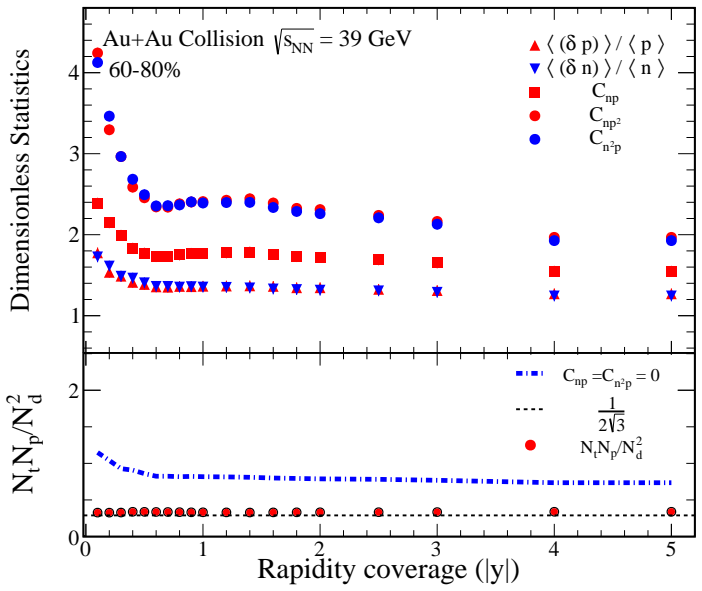
- [Section II B, Eq. (4)] The equality asserted in Eq. (4) is algebraically incorrect. Writing ρ_p = ⟨ρ_p⟩(1+δ_p) and ρ_n = ⟨ρ_n⟩(1+δ_n), the left-hand side equals ⟨δ_p δ_n^2⟩. The second expression on the right, using Eq. (3), equals ⟨ρ_p ρ_n^2⟩/(⟨ρ_p⟩⟨ρ_n⟩^2) − (1+2C_{np}) = ⟨δ_p δ_n^2⟩ + Δρ_n, where Δρ_n = ⟨δ_n^2⟩. The two sides therefore differ by Δρ_n, and the equality holds only if Δρ_n = 0. If the second expression is used to compute C_{n^2p}, then Eq. (6) contains Δρ_n twice; if the left-hand expression is used, the plotted C_{n^2p} is not the quantity inserted into Eq. (6). In either case the reported values of R and the central claim that C_{n^2p} enhances R are not supported. The correct connected definition is C_{n^2p} = ⟨ρ_p ρ_n^2⟩/(⟨ρ_p⟩⟨ρ_n⟩^2) − 1 − 2C_{np} − Δρ_n, and all quantitative results in Figures 1–7 need to be recomputed with this definition.
- [Section III, Figures 5 and 6] No statistical uncertainties are reported. The abstract and Section IV state that R "slightly increases" with collision energy, but without error bars it is impossible to determine whether the trend is significant. Because the comparison with the STAR peak in Figure 7 depends on the energy dependence of the model, the authors should provide event-by-event statistical uncertainties on all plotted quantities.
- [Section III, Figure 4 caption and text] The sentence "As shown in the figure, the light nuclei yield ratio exhibits a decrease with rising collision energy" appears in the discussion of Figure 4, which displays the correlations C_{np}, C_{np^2}, and C_{n^2p}, not the yield ratio. The yield ratio is shown in Figure 5 and is described as slightly increasing with energy. This contradictory statement should be corrected, and the energy dependence of the correlations should be discussed separately from that of R.
minor comments (5)
- [Notation, throughout] The notation C_{np^2} and C_{n^2p} is used interchangeably (e.g., Figures 1–4); please unify the notation.
- [Section II A and Figures 1–3] The quantities denoted ⟨(δp)⟩/⟨p⟩ and ⟨(δn)⟩/⟨n⟩ are not properly defined; if δp is the fluctuation around the mean, its expectation value vanishes, so the positive values shown imply a different definition (e.g., a root-mean-square or Δρ_n). Please define these quantities explicitly.
- [Figure 6 caption] The caption refers to "upper and lower panels of Figure 5" but the panels are in Figure 6; this cross-reference should be corrected.
- [Section IV and discussion around Figure 6] The abstract and Section IV state that C_{n^2p} enhances R, while the text near Figure 6 says "When Cn2p and Cnp are taken into account, a reduction in the yield ratio is observed" (comparing with Eq. (9)). Clarify which baseline is used in each comparison.
- [Acknowledgments] The acknowledgments thank "the referee" for reading the manuscript; this sentence is inappropriate in a submitted paper and should be removed.
Circularity Check
The three-nucleon correlation Cn2p is defined by Eq. (4) to contain the neutron density fluctuation Δρ_n, and Eq. (7) then adds Δρ_n again, so the reported Cn2p enhancement of R is partly the same fluctuation counted twice by construction.
-
self definitional
[Sec. II B, Eq. (4) with Eqs. (6)-(7)]
"For higher-order correlations, such as the three-nucleon correlation, Cn2p, the expression becomes: Cn2p = <δρpδρ^2_n>/(<ρp><ρ^2_n>) = <ρpρ^2_n>/(<ρp><ρn>^2) - (1 + 2Cnp). ... R = 1/(2√3) (1 + ∆ρn + 2Cnp + Cn2p)/(1+Cnp)^2."
Writing rho_n = <rho_n>(1+delta_n) and rho_p = <rho_p>(1+delta_p), the full moment in Eq. (4) expands to <rho_p rho_n^2>/(<rho_p><rho_n>^2) = 1 + Δρ_n + 2Cnp + <delta_p delta_n^2>. The right-hand side of Eq. (4) is therefore Δρ_n + <delta_p delta_n^2>, while the connected three-nucleon correlation defined by Eq. (2) is just <delta_p delta_n^2>. The two expressions in Eq. (4) differ by Δρ_n, so they cannot both define Cn2p. Inserting the right-hand expression into Eq. (7) makes Δρ_n appear twice: once explicitly and once inside Cn2p.
full rationale
The comparison between Angantyr and the STAR/NA49 data is not circular, because no parameter is fitted to the experimental ratios and the model baseline is self-contained. The circularity is confined to the derivation chain for Cn2p. Equation (4) equates two nonequivalent definitions: the connected third-order correlation <delta_p delta_n^2> and the full factorial moment minus lower-order terms, which equals <delta_p delta_n^2> + Δρ_n. Since Eq. (7) also contains the explicit 1 + Δρ_n term, the claimed Cn2p enhancement of R is inflated by the very neutron density fluctuation the paper intends to control for. This is a definitional double-counting rather than a fitted-input problem; the qualitative statement that Angantyr misses the observed peak near 20-30 GeV is unaffected. The score reflects partial circularity in the central quantitative claim, not an overall lack of independent content.
Assumptions & free parameters
assumptions (4)
- domain assumption The coalescence-model expansion for N_t, truncated at third-order correlations, is valid for the simulated nucleon system.
- domain assumption Nucleon density fluctuations in the PYTHIA/Angantyr final state correspond to the freeze-out density fluctuations sampled by coalescence, and T_eff and V cancel exactly in R.
- ad hoc to paper The algebraic identity in Eq. (4) correctly represents the connected three-nucleon correlation.
- domain assumption STAR and NA49 data can be compared directly to model results with |y| < 0.5 and 0-10% or 60-80% centrality without acceptance or efficiency corrections.
Cite this review
Pith. "Pith review of Study of QCD critical point with three-nucleon correlations in light nuclei yields ratios using PYTHIA8/Angantyr." pith.science (2026). https://pith.science/paper/T2RY666D
@misc{pith2026250417394,
  author       = {Pith},
  title        = {Pith review of: Study of QCD critical point with three-nucleon correlations in light nuclei yields ratios using PYTHIA8/Angantyr},
  year         = {2026},
  howpublished = {\url{https://pith.science/paper/T2RY666D}},
  note         = {Machine review of arXiv:2504.17394}
}
abstract
This study utilizes the PYTHIA8 Angantyr model to systematically investigate the effects of three nucleons correlation $C_{n^2p}$ on the light nuclei yield ratio $N_tN_p/N_d^2$ in Au+Au collisions at $\sqrt{s_{\rm NN}}$ = 7.7, 11.5, 14.5, 19.6, 27, 39, 62.4, and 200 GeV. The analysis explores this property across different rapidity ranges, collision centralities, and collision energies, while also examining the roles of multi-parton interactions (MPI) and color reconnection (CR) mechanisms. The results show that the light nuclei yield ratio remains stable with changes in rapidity coverage and collision centrality but slightly increases with rising collision energy. The impact of CR on the light nuclei yield ratio depends entirely on the presence of MPI; when MPI is turned off, CR has no effect. Additionally, the three-nucleon correlation, enhances the light nuclei yield ratio in both central and peripheral collisions. However, the non-monotonic energy dependence observed in experiments, the peak at $\sqrt{s_{\rm NN}}$ = $20\sim30$ GeV reported by the STAR experiment, cannot be explained by the Angantyr model due to its lack of key mechanisms related to the quark-gluon plasma (QGP). Nevertheless, the Angantyr model serves as an important baseline for studying collision behaviors in the absence of QGP effects.
Figures


Figures from the paper (4 more)


Reference graph
Works this paper leans on
-
[1]
On the QCD phase structure from effective models,
B. J. Schaefer and M. Wagner, “On the QCD phase structure from effective models,” Progress in Particle and Nuclear Physics 62 (2009), 381-385
work page 2009
-
[2]
Y. Aoki, G. Endrodi, Z. Fodor, S. D. Katz and K. K. Szabo, “The order of the quantum chromodynamics transition predicted by the standard model of particle physics,” Nature 443, (2006) 675
work page 2006
-
[3]
Additionally, the results for the case where the correlationsCnp andCn2p are excluded are also presented in the figure, 11 7 8 9 10 20 30 40 50 100 200 (GeV) NNs0.2 0.4 0.6 0.8 1 2 d /N p N t N = 0 p2n = Cnp0-10%, C = 0 p2n = Cnp60-80%, C0-10% 60-80% FIG. 5. The PYTHIA8 Angantyr model was employed to investigate the collision energy de- pendence of the li...
-
[4]
The QCD phase diagram at nonzero quark density,
G. Endrodi, Z. Fodor, S. D. Katz and K. K. Szabo, “The QCD phase diagram at nonzero quark density,” JHEP 1104, (2011) 001
work page 2011
-
[5]
The equation of state in (2+1)-flavor QCD,
Alexei Bazavov etal., “The equation of state in (2+1)-flavor QCD,” Phys. Rev. D90 (2014) 094503
work page 2014
-
[6]
What RHIC experiments and theory tell us about properties of quark gluon plasma ?
E. V. Shuryak, “What RHIC experiments and theory tell us about properties of quark gluon plasma ?” Nucl. Phys. A750 (2005), 64-83
work page 2005
-
[7]
Deconfinement and quarkonium suppression,
F. Karsch, “Deconfinement and quarkonium suppression,” Eur.Phys.J.C 43 (2005), 35-43
work page 2005
-
[8]
Heavy Ion Physics at the CERN SPS: Roots 1974-1984 and Key Results,
Hans J. Specht, “Heavy Ion Physics at the CERN SPS: Roots 1974-1984 and Key Results,” CERN, September 8, 2014
work page 1974
Show all 39 references
-
[9]
RHIC Experimental Evaluations,
A. Franz, et. al., “RHIC Experimental Evaluations,” Nuclear Physics A Volume 757, (2005) Issues 1-2
2005
-
[10]
Scale for the Phase Diagram of Quantum Chromodynamics,
S. Gupta, X. Luo, B. Mohanty, H. G. Ritter and N. Xu, “Scale for the Phase Diagram of Quantum Chromodynamics,” Science 332, (2011) 1525
2011
-
[11]
Search for the QCD Critical Point with Fluctuations of Conserved Quan- tities in Relativistic Heavy-Ion Collisions at RHIC : An Overview,
X. Luo and N. Xu, “Search for the QCD Critical Point with Fluctuations of Conserved Quan- tities in Relativistic Heavy-Ion Collisions at RHIC : An Overview,” Nucl. Sci. Tech. 28, no. 8, (2017) 112
2017
-
[12]
Mapping the Phases of Quantum Chromodynamics with Beam Energy Scan,
A. Bzdak, S. Esumi, V. Koch, J. Liao, M. Stephanov and N. Xu, “Mapping the Phases of Quantum Chromodynamics with Beam Energy Scan,” Phys. Rep. 853, (2020) pp. 1-87
2020
-
[13]
Higher Moments of Net-proton Multiplicity Distributions at RHIC,
M. M. Aggarwal et al. [STAR Collaboration], “Higher Moments of Net-proton Multiplicity Distributions at RHIC,” Phys. Rev. Lett. 105, (2010) 022302
2010
-
[14]
Exploring the QCD Phase Structure with Beam Energy Scan in Heavy-ion Colli- sions,
X. Luo, “Exploring the QCD Phase Structure with Beam Energy Scan in Heavy-ion Colli- sions,” Nucl. Phys. A 956, (2016) 75-82
2016
-
[15]
Beam energy dependence of moments of the net- 16 charge multiplicity distributions in Au+Au collisions at RHIC,
L. Adamczyk et al. [STAR Collaboration], “Beam energy dependence of moments of the net- 16 charge multiplicity distributions in Au+Au collisions at RHIC,” Phys. Rev. Lett. 113, (2014) 092301
2014
-
[16]
Energy Dependence of Moments of Net-proton Multiplicity Distributions at RHIC,
L. Adamczyk et al. [STAR Collaboration], “Energy Dependence of Moments of Net-proton Multiplicity Distributions at RHIC,” Phys. Rev. Lett. 112, (2014) 032302
2014
-
[17]
Collision Energy Dependence of Moments of Net- Kaon Multiplicity Distributions at RHIC,
L. Adamczyk et al. [STAR Collaboration], “Collision Energy Dependence of Moments of Net- Kaon Multiplicity Distributions at RHIC,” Phys. Lett. B 785, (2018) 551
2018
-
[18]
Net-proton number fluctuations and the Quantum Chromodynamics critical point,
J. Adam et al. [STAR Collaboration], “Net-proton number fluctuations and the Quantum Chromodynamics critical point,” Phys. Rev. Lett. 126, (2021) 092301
2021
-
[19]
QCD phase diagram: an overview,
M. Stephanov, “QCD phase diagram: an overview,” PoS LAT 2006, (2006) 024
2006
-
[20]
Higher Moments of Net Proton Multiplicity Distributions at RHIC,
M. M. Aggarwal et al. (STAR Collaboration), “Higher Moments of Net Proton Multiplicity Distributions at RHIC,” Phys Rev Lett 105, (2010) 022302
2010
-
[21]
Energy Dependence of Moments of Net-Proton Multiplicity Distributions at RHIC,
L. Adamczyk et al. (STAR Collaboration), “Energy Dependence of Moments of Net-Proton Multiplicity Distributions at RHIC,” Phys Rev Lett 112, (2014) 032302
2014
-
[22]
Beam Energy Dependence of Moments of the Net-Charge Multiplicity Distri- butions in Au+Au Collisions at RHIC,
M. Stephanov, “Beam Energy Dependence of Moments of the Net-Charge Multiplicity Distri- butions in Au+Au Collisions at RHIC,” Phys Rev Lett 113, (2014) 092301
2014
-
[23]
Probing QCD critical fluctuations from light nuclei production in relativistic heavy-ion collisions,
K. J. Sun, L. W. Chen, C. M. Ko and Z. Xu, “Probing QCD critical fluctuations from light nuclei production in relativistic heavy-ion collisions,” Phys. Lett. B 774, (2017) 103
2017
-
[24]
Light nuclei production in Au + Au collisions at √sN N = 7.7-80 GeV from UrQMD model,
X. G. Deng, and Y. G. Ma, “Light nuclei production in Au + Au collisions at √sN N = 7.7-80 GeV from UrQMD model,” Phys. Lett. B 808, (2020) 135668
2020
-
[25]
Baryon preclustering at the freeze-out of heavy-ion collisions and light-nuclei production,
E. Shuryak and J. M. Torres-Rincon, “Baryon preclustering at the freeze-out of heavy-ion collisions and light-nuclei production,” Phys. Rev. C 101, no.3, (2020) 034914
2020
-
[26]
Search for the QCD Critical Point by Transverse Velocity Dependence of Anti-deuteron to Deuteron Ratio,
N. Yu, D. Zhang and X. Luo, “Search for the QCD Critical Point by Transverse Velocity Dependence of Anti-deuteron to Deuteron Ratio,” Chin. Phys. C 44, no. 1, (2020) 014002
2020
-
[27]
Probing QCD critical fluctuations from the yield ratio of strange hadrons in relativistic heavy-ion collisions,
T. Shao, J. Chen, C. M. Ko and K. Sun, “Probing QCD critical fluctuations from the yield ratio of strange hadrons in relativistic heavy-ion collisions,” Phys. Lett. B 801, (2020) 135177
2020
-
[28]
Light nuclei production as a probe of the QCD phase diagram,
K. J. Sun, L. W. Chen, C. M. Ko, J. Pu and Z. B. Xu, “Light nuclei production as a probe of the QCD phase diagram,” Phys. Lett. B 781, (2018) 499
2018
-
[29]
Energy Dependence of Light Nuclei (d, t) Production at STAR,
D. Zhang, “Energy Dependence of Light Nuclei (d, t) Production at STAR,” JPS Conf. Proc. 32, (2020) 010069
2020
-
[30]
Light Nuclei (d, t) Production in Au + Au Collisions at √sN N=7.7−200GeV,
D. Zhang, “Light Nuclei (d, t) Production in Au + Au Collisions at √sN N=7.7−200GeV,” Nucl. Phys. A 1005, (2021) 121825. 17
2021
-
[31]
PYTHIA 6.4 Physics and Manual,
T. Sjostrand, S. Mrenna and P. Z. Skands, “PYTHIA 6.4 Physics and Manual,” JHEP 05 (2006), 026
2006
-
[32]
The Angantyr model for Heavy-Ion Collisions in PYTHIA8,
C. Bierlich, G. Gustafson, L. L¨ onnblad and H. Shah, “The Angantyr model for Heavy-Ion Collisions in PYTHIA8,” JHEP 10 (2018), 134
2018
-
[33]
A comprehensive guide to the physics and usage of PYTHIA 8.3,
C. Bierlich et al, “A comprehensive guide to the physics and usage of PYTHIA 8.3,” arXiv:2203.11601[hep-ph]
-
[34]
Investigating π− production in central 7Be +9Be and 40Ar+45Sc collisions at CERN SPS energies with PYTHIA8/Angantyr,
K. Abdel-Waged, “Investigating π− production in central 7Be +9Be and 40Ar+45Sc collisions at CERN SPS energies with PYTHIA8/Angantyr,” Eur. Phys. J. C 82 (2022), 65
2022
-
[35]
Charged-particles distribution in proton- proton and heavy-ion collisions using PYTHIA8 Angantyr model at LHC energies,
I. M. Samsul, S. Tinku, R. Pradip, B. P. Pratim, “Charged-particles distribution in proton- proton and heavy-ion collisions using PYTHIA8 Angantyr model at LHC energies,” Eur. Phys. J. Plus, 137 12 (2022), 1327
2022
-
[36]
Light nuclei production in Au+Au collisions at√sN N = 5−200 GeV from JAM model,
H. Liu, D. Zhang, S. He, K. j. Sun, N. Yu, and X. Luo, “Light nuclei production in Au+Au collisions at√sN N = 5−200 GeV from JAM model,” Phys. Lett. B 805, (2020) 135452
2020
-
[37]
Beam Energy Dependence of Triton Production and Yield Ratio (Nt× Np/N2 d) in Au+Au Collisions at RHIC,
The STAR Collaboration, “Beam Energy Dependence of Triton Production and Yield Ratio (Nt× Np/N2 d) in Au+Au Collisions at RHIC,” Phys. Rev. Lett. 130, (2023) 202301
2023
-
[38]
Production of deuterium, tritium, and 3He in cen- tral Pb + Pb collisions at 20 A, 30A, 40A, 80A, and 158A GeV at the CERN Super Proton Synchrotron,
T. Anticic et al. (NA49 Collaboration), “Production of deuterium, tritium, and 3He in cen- tral Pb + Pb collisions at 20 A, 30A, 40A, 80A, and 158A GeV at the CERN Super Proton Synchrotron,” Phys. Rev. C 94, (2016) 044906
2016
-
[39]
Study of neutron density fluctuation and neutron-proton correlation in Au+Au collisions using PYTHIA8/Angantyr,
Z. Zhang, S. Li, N. Yu, J. Lin, S. Li, S. Tang, D. Zhou, “Study of neutron density fluctuation and neutron-proton correlation in Au+Au collisions using PYTHIA8/Angantyr,” Chin. Phys. C 47, no.11, (2023) 114102. 18
2023
Reviewed August 16, 2026 · model on record in the stance chip above.
Discussion (0). Continue with ORCID to comment.