REVIEW 5 major objections 6 minor 29 references
Evaluating Uncertainty in Deep Gaussian Processes
T0 review · 5 major / 6 minor · reviewed 2026-08-16 · deepseek-v4-flash
Pith's one-line read Deep sigma point processes calibrate best in-distribution, but deep ensembles hold up better under distribution shift.
desk verdict First DSPP/ensemble calibration benchmark, but the DSPP scoring is underspecified and the headline numbers need tightening before I'd fully trust them. read the letter →
The pith
A machine-rendered reading of the paper's core claim, the machinery that carries it, and where it could break.
The reading
What carries the argument
The central object is the Deep Sigma Point Process (DSPP), whose layers propagate uncertainty through learnable quadrature points (sigma points) instead of Monte Carlo sampling; this produces a finite Gaussian mixture predictive distribution (Eq 12) and enables direct maximum-likelihood training. The evaluation machinery consists of NLL and ECE metrics plus five synthetic feature-level perturbations (Gaussian noise, feature masking, feature scaling, feature permutation, outlier injection) applied at increasing severity.
What would settle it
Recompute DSPP NLL and ECE from the full Gaussian mixture of its predictive distribution instead of a collapsed single Gaussian; if Table 2 changes materially, the claimed calibration advantage is an artifact of the collapse. Independently, run the same models under real covariate shift datasets to see whether the ensemble's stability persists beyond the paper's five synthetic perturbations.
Extended reading notes
Core claim
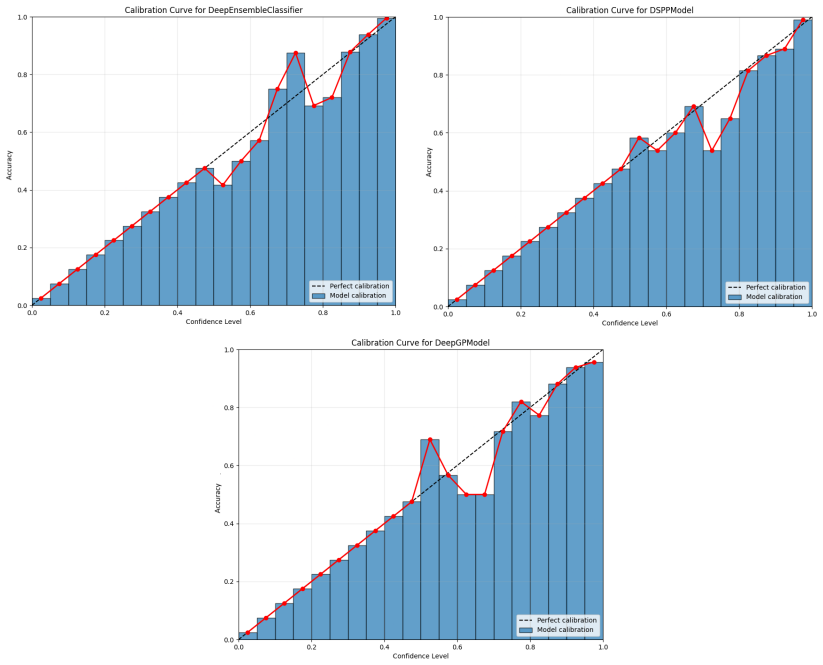
On the paper's own terms, the discovery is that DSPPs' sigma-point approximation yields excellent in-distribution calibration (ECE 0.026 on CASP, 0.035 on ESR) but that this advantage does not carry over to robustness: under the five feature-level shifts, the Deep Ensemble maintains roughly stable ECE and accuracy, whereas DGP and DSPP degrade—DGP sharply on regression. The paper concludes that good in-distribution calibration does not guarantee robustness, and that deep ensembles remain a strong baseline for deployment under shift.
Load-bearing premise
The paper evaluates DSPPs with a single mean and variance while its equations define a mixture predictive distribution; that unstated collapse is load-bearing for every calibration number reported.
Editorial extensions
If this is right
- On tabular regression and classification, a DSPP is the better choice when in-distribution calibration is the priority.
- For deployment where input features may be corrupted, a deep ensemble is the safer default because it held ECE near 0.11 on CASP and accuracy near 0.97 on ESR while the GP models degraded.
- NLL alone is not enough to judge uncertainty quality; the severity curves of ECE reveal robustness differences that a single NLL average hides.
- DSPP's sigma-point training works with a softmax likelihood, so its calibration benefit is not limited to Gaussian regression.
Reading between the lines
- If the goal is deployment under shift, an immediate next test is whether the ranking holds under label-preserving covariate shifts that change feature marginal distributions in ways the five synthetic perturbations do not.
- The paper leaves implicit how the DSPP mixture predictive is reduced to the single mean and variance used in NLL and interval metrics; spelling out that reduction, or evaluating the mixture directly, would let others reproduce the calibration numbers.
- The ensemble's stability suggests diversity across members, rather than Bayesian posterior propagation, protects calibration under feature corruption; comparing DSPPs with more sigma points would test whether the gap is architectural or inferential.
Signed reviews
Editorial analysis
A structured set of objections, weighed in public.
Referee Report
Summary. This paper empirically compares Deep Gaussian Processes (DGPs), Deep Sigma Point Processes (DSPPs), and Deep Ensembles on two tabular benchmarks: regression on the CASP protein structure dataset and binary classification on the ESR seizure recognition dataset. It reports MAE/accuracy, NLL, and ECE for in-distribution performance, and evaluates ECE/MAE/accuracy under five synthetic feature-level perturbations at increasing severity. The authors conclude that DSPPs provide the strongest in-distribution calibration (ECE 0.026 on CASP, 0.035 on ESR), while Deep Ensembles are the most robust under shift, maintaining stable ECE and accuracy while GP-based methods degrade. The paper includes ablations on inducing points and depth, and makes code publicly available.
Significance. If the central results survive verification, this is a useful benchmark study: it extends the evaluation of DSPPs beyond NLL, applies DSPPs to classification with a softmax likelihood, and applies a uniform shift protocol across regression and classification. The provision of code, public datasets, and ablations strengthens reproducibility. However, the paper's quantitative claims are currently undermined by an unstated transformation of the mixture predictive distributions into the single-Gaussian NLL/interval formulas, by a likely misspecified ECE formula, and by the absence of error bars or statistical tests for the headline comparisons. These issues affect the central claims and require correction before the results can be interpreted.
major comments (5)
- [§2.3, §3.1, Eqs. (12), (19), (22)] The DSPP predictive is defined in Eq. (12) as a Q-component Gaussian mixture, and the DGP predictive is a Monte Carlo mixture, but the regression metrics in §3.1 are written for a single Gaussian: Eq. (19) evaluates NLL with one μ(x) and σ²(x), and Eq. (22) builds prediction intervals from the same two moments. The paper never states whether μ and σ² are the moments of the mixture, whether the exact mixture density is used for NLL, or whether interval calibration uses mixture quantiles. This is load-bearing because NLL is a proper scoring rule only for the exact predictive distribution, and interval-based ECE depends on the full CDF; if the mixture is collapsed to moments, the headline DSPP calibration numbers in Table 2 score a Gaussian approximation rather than the trained model, and if it is not, Eqs. (19) and (22) do not describe the evaluation. Please specify the exact evaluation procedure and recompute the affected numbers if needed.
- [§3.1, Eq. (21)] The ECE formula in Eq. (21) uses |B_b|/B as the bin weight instead of |B_b|/N, even though the bins partition the N test points and Σ_b |B_b| = N. With this formula the reported ECE values are not on the standard probability scale and are not comparable to the usual ECE definition; please correct the denominator and recompute Table 2 and Figures 4/7 if the implementation follows Eq. (21).
- [§3.5, Table 2, Figures 4 and 7] The paper does not report any measure of variability for Table 2, despite §3.5 stating that N = 5 independent training runs were performed per model for the shift experiments; it is unclear whether the Table 2 entries are single-seed results, averages, or best runs. The shift results are presented only as boxplots aggregating over runs and corruption types, with no confidence intervals, paired tests, or effect-size measures. As a consequence, the headline contrasts (DSPP ECE 0.026 vs. Deep Ensemble 0.112 on CASP; ensemble stability near 0.11 ECE under shift vs. GP degradation) cannot be distinguished from run-to-run variation. Please report means and standard deviations or CIs over the runs and add a statistical comparison (e.g., paired by seed and corruption type) for the shift outcomes.
- [§3.5, Eqs. (24)–(28), Figures 4 and 7] The shift analysis pools all five corruption types into a single boxplot per severity level, but the corruptions have qualitatively different effects—feature permutation preserves the marginal distribution of each column, whereas Gaussian noise, scaling, masking, and outliers change marginal or joint structure. Pooling conceals per-corruption differences that are needed to support the conclusion that Deep Ensembles are 'more robust' and GP methods 'vulnerable' in general. Please report per-corruption results (or include corruption type as a factor in the analysis) before drawing general robustness conclusions.
- [Appendix A, Table 3] The optimized DSPP for CASP has architecture [ ] (no hidden layers), so the headline in-distribution calibration advantage on the regression task (ECE 0.026) is achieved by a shallow sparse GP, not by a deep sigma point process. This limits the strength of the claim that 'DSPPs provide strong in-distribution calibration' for deep models on regression; please either include at least one deep DSPP configuration in the main CASP comparison or explicitly temper the depth-related interpretation.
minor comments (6)
- [§3.1, reference [27]] The citation [27] for the statement that NLL can overemphasize tail probabilities is Watkins and Dayan's Q-learning paper; the intended reference is likely [21]. Please correct.
- [§2.3] Typo: 'agumented' should be 'augmented'.
- [§5.1] Typo: 'This work focused on standard on the standard regression and classification' should read 'standard regression and classification'.
- [Figure 3 caption] Typo: 'Sezure' should be 'Seizure'.
- [Appendix C.2] The opening sentence, 'For this experiment, we were interested in the relationship between the number of and the negative log likelihood for our dataset,' is missing a word (likely 'layers'). Please fix.
- [Appendix B, Eq. (30)] The first displayed line of Eq. (30) is missing the logarithm on q_ψ(z); it should read E_{q_ψ(z)}[log q_ψ(z) − log(p_θ(x|z)p_θ(z)/p_θ(x))].
Circularity Check
No significant circularity: this is an empirical benchmarking study whose reported metrics are computed on held-out test data, not derived from fitted parameters or self-citations.
full rationale
The paper is a measurement study, not a derivation chain. The central claims are based on test-set NLL, ECE, MAE, and accuracy values reported in Table 2 and boxplots, computed against external baselines (Deep Ensembles) and public datasets (CASP and ESR). No quantity labeled a prediction is defined in terms of a fitted parameter, and no claimed result is equivalent by construction to an input. The DSPP predictive distribution is defined in Eq. (12) as a Gaussian mixture, while the metric formulas in Eqs. (19) and (22) are written for a single Gaussian; this creates an ambiguity about how the mixture is scored, but that is a reproducibility/correctness concern, not circularity, because the reported ECE and NLL are empirical evaluations rather than derivations that reduce to their inputs. The only self-citation is reference [17] in the Future Work section, which is used to mention prior work by an author on DGPs in reinforcement learning and is not load-bearing for any result in this paper. The DSPP model itself is cited to external work [14], and the conclusion that DSPPs are well calibrated in-distribution is independently supported by the held-out measurements reported here. Under the stated rules, a self-contained empirical evaluation against external benchmarks warrants a score of 0-2; no circular step meeting the required standard of exhibiting a specific reduction was found.
Assumptions & free parameters
free parameters (4)
- KL divergence scaling beta =
1
- DGP Monte Carlo samples =
10
- DSPP quadrature sites Q =
8
- BayesOpt selected hyperparameters (learning rate, architecture, inducing points, ensemble size) =
See Table 3 per model/dataset; e.g. DGP CASP: lr=0.1, M=159; DSPP CASP: lr=0.055, M=50
assumptions (4)
- standard math Standard GP/SVGP/DGP/DSPP formulations are correct as presented.
- domain assumption The five synthetic feature shifts in Section 3.5 are meaningful proxies for real-world distribution shift.
- domain assumption The tabular datasets (CASP, ESR) are representative enough to support general claims about GP robustness.
- ad hoc to paper DSPP predictive distribution is reduced to a single Gaussian for NLL and ECE computation.
Cite this review
Pith. "Pith review of Evaluating Uncertainty in Deep Gaussian Processes." pith.science (2026). https://pith.science/paper/FTTT2SNJ
@misc{pith2026250417719,
  author       = {Pith},
  title        = {Pith review of: Evaluating Uncertainty in Deep Gaussian Processes},
  year         = {2026},
  howpublished = {\url{https://pith.science/paper/FTTT2SNJ}},
  note         = {Machine review of arXiv:2504.17719}
}
read the original abstract
Reliable uncertainty estimates are crucial in modern machine learning. Deep Gaussian Processes (DGPs) and Deep Sigma Point Processes (DSPPs) extend GPs hierarchically, offering promising methods for uncertainty quantification grounded in Bayesian principles. However, their empirical calibration and robustness under distribution shift relative to baselines like Deep Ensembles remain understudied. This work evaluates these models on regression (CASP dataset) and classification (ESR dataset) tasks, assessing predictive performance (MAE, Accu- racy), calibration using Negative Log-Likelihood (NLL) and Expected Calibration Error (ECE), alongside robustness under various synthetic feature-level distribution shifts. Results indicate DSPPs provide strong in-distribution calibration leveraging their sigma point approximations. However, compared to Deep Ensembles, which demonstrated superior robustness in both per- formance and calibration under the tested shifts, the GP-based methods showed vulnerabilities, exhibiting particular sensitivity in the observed metrics. Our findings underscore ensembles as a robust baseline, suggesting that while deep GP methods offer good in-distribution calibration, their practical robustness under distribution shift requires careful evaluation. To facilitate reproducibility, we make our code available at https://github.com/matthjs/xai-gp.
Figures


Figures from the paper (4 more)


Reference graph
Works this paper leans on
-
[1]
Ralph Andrzejak, Klaus Lehnertz, Florian Mormann, Christoph Rieke, Peter David, and Christian Elger. Indications of nonlinear deterministic and finite-dimensional structures in time series of brain electrical activity: Dependence on recording region and brain state. Physical review. E, Statistical, nonlinear, and soft matter physics, 64:061907, 01 2002. d...
-
[2]
Matthias Bauer, Mark Van der Wilk, and Carl Edward Rasmussen. Understanding probabilistic sparse gaussian process approximations.Advances in neural information processing systems, 29, 2016. URL https://arxiv.org/abs/1606.04820
arXiv 2016
-
[3]
Safe exploration in reinforcement learning: Theory and applications in robotics
Felix Berkenkamp. Safe exploration in reinforcement learning: Theory and applications in robotics. PhD thesis, ETH Zurich, 2019. URL https://www.research-collection.ethz. ch/bitstream/handle/20.500.11850/370833/root.pdf
work page 2019
-
[4]
Off-policy reinforcement learning with gaussian processes
Girish Chowdhary, Miao Liu, Robert Grande, Thomas Walsh, Jonathan How, and Lawrence Carin. Off-policy reinforcement learning with gaussian processes. IEEE/CAA Journal of Automatica Sinica, 1(3):227–238, 2014. doi: 10.1109/JAS.2014.7004680
-
[5]
D. R. Cox. Some statistical methods connected with series of events.Journal of the Royal Statistical Society: Series B (Methodological), 17(2):129–157, 12 2018. ISSN 0035-9246. doi: 10.1111/j.2517-6161.1955.tb00188.x. URL https://doi.org/10.1111/j.2517-6161.1955. tb00188.x
arXiv 2018
-
[6]
Andreas Damianou and Neil D. Lawrence. Deep Gaussian processes. In Carlos M. Carvalho and Pradeep Ravikumar, editors,Proceedings of the Sixteenth International Conference on Artificial Intelligence and Statistics, volume 31 ofProceedings of Machine Learning Research, pages 207–215, Scottsdale, Arizona, USA, 29 Apr–01 May 2013. PMLR. URL https:// proceedin...
work page 2013
-
[7]
Reinforcement learning with gaussian processes
Yaakov Engel, Shie Mannor, and Ron Meir. Reinforcement learning with gaussian processes. In Proceedings of the 22nd International Conference on Machine Learning, ICML ’05, page 201–208, New York, NY, USA, 2005. Association for Computing Machinery. ISBN 1595931805. doi: 10.1145/1102351.1102377. URL https://doi.org/10.1145/1102351.1102377
arXiv 2005
-
[8]
Generalisation in humans and deep neural networks.Advances in neural information processing systems, 31, 2018
Robert Geirhos, Carlos RM Temme, Jonas Rauber, Heiko H Schütt, Matthias Bethge, and Felix A Wichmann. Generalisation in humans and deep neural networks.Advances in neural information processing systems, 31, 2018
2018
Show all 29 references
-
[9]
Sample efficient reinforcement learn- ing with gaussian processes
Robert Grande, Thomas Walsh, and Jonathan How. Sample efficient reinforcement learn- ing with gaussian processes. In Eric P. Xing and Tony Jebara, editors, Proceedings of the 31st International Conference on Machine Learning, volume 32 ofProceedings of Ma- chine Learning Resea...
2014
-
[10]
Benchmarking neural network robustness to common corruptions and perturbations.arXiv preprint arXiv:1903.12261, 2019
Dan Hendrycks and Thomas Dietterich. Benchmarking neural network robustness to common corruptions and perturbations.arXiv preprint arXiv:1903.12261, 2019. 13
1903 arXiv
-
[11]
Augmix: A simple data processing method to improve robustness and uncertainty
Dan Hendrycks, Norman Mu, Ekin D Cubuk, Barret Zoph, Justin Gilmer, and Balaji Lakshmi- narayanan. Augmix: A simple data processing method to improve robustness and uncertainty. arXiv preprint arXiv:1912.02781, 2019
1912 arXiv
-
[12]
Scalable Variational Gaussian Process Classification
James Hensman, Alexander Matthews, and Zoubin Ghahramani. Scalable Variational Gaussian Process Classification. In Guy Lebanon and S. V. N. Vishwanathan, editors,Proceedings of the Eighteenth International Conference on Artificial Intelligence and Statistics, volume 38 of Proc...
2015
-
[13]
Adversarial examples are not bugs, they are features.Advances in neural information processing systems, 32, 2019
Andrew Ilyas, Shibani Santurkar, Dimitris Tsipras, Logan Engstrom, Brandon Tran, and Aleksander Madry. Adversarial examples are not bugs, they are features.Advances in neural information processing systems, 32, 2019
2019
-
[14]
Deepsigmapointprocesses
MartinJankowiak, GeoffPleiss, andJacobGardner. Deepsigmapointprocesses. InJonasPeters and David Sontag, editors,Proceedings of the 36th Conference on Uncertainty in Artificial Intelligence (UAI), volume 124 ofProceedings of Machine Learning Research, pages 789–798. PMLR, 03–06...
2020
-
[15]
Reinforcement learning with gaussian process regression using variational free energy
Kiseki Kameda and Fuyuhiko Tanaka. Reinforcement learning with gaussian process regression using variational free energy. Journal of Intelligent Systems, 32(1):20220205, 2023. doi: doi:10.1515/jisys-2022-0205. URL https://doi.org/10.1515/jisys-2022-0205
2023 doi
-
[16]
Simple and scal- able predictive uncertainty estimation using deep ensembles
Balaji Lakshminarayanan, Alexander Pritzel, and Charles Blundell. Simple and scal- able predictive uncertainty estimation using deep ensembles. In I. Guyon, U. Von Luxburg, S. Bengio, H. Wallach, R. Fergus, S. Vishwanathan, and R. Garnett, ed- itors, Advances in Neural Informa...
2017
-
[17]
Interpretable function approximation with gaussian processes in value-based model-free reinforcement learning
Matthijs van der Lende, Matthia Sabatelli, and Juan Cardenas-Cartagena. Interpretable function approximation with gaussian processes in value-based model-free reinforcement learning. In Tetiana Lutchyn, Adín Ramírez Rivera, and Benjamin Ricaud, editors,Pro- ceedings of the 6th...
2025
-
[18]
A review of uncertainty for deep reinforcement learn- ing
Owen Lockwood and Mei Si. A review of uncertainty for deep reinforcement learn- ing. Proceedings of the AAAI Conference on Artificial Intelligence and Interactive Digi- tal Entertainment, 18(1):155–162, Oct. 2022. doi: 10.1609/aiide.v18i1.21959. URL https: //ojs.aaai.org/index...
2022 doi
-
[19]
Murphy.Probabilistic Machine Learning: Advanced Topics
Kevin P. Murphy.Probabilistic Machine Learning: Advanced Topics. MIT Press, 2023. URL http://probml.github.io/book2
2023
-
[20]
Dillon, Balaji Lakshminarayanan, and Jasper Snoek
Yaniv Ovadia, Emily Fertig, Jie Ren, Zachary Nado, D Sculley, Sebastian Nowozin, Joshua V. Dillon, Balaji Lakshminarayanan, and Jasper Snoek. Can you trust your model’s uncertainty? evaluating predictive uncertainty under dataset shift, 2019. URLhttps://arxiv.org/abs/ 1906.02530
2019 arXiv
-
[21]
Evaluating predictive uncertainty challenge
Joaquin Quinonero-Candela, Carl Edward Rasmussen, Fabian Sinz, Olivier Bousquet, and Bernhard Schölkopf. Evaluating predictive uncertainty challenge. In Machine Learning Challenges Workshop, pages 1–27. Springer, 2005
2005
-
[22]
Physicochemical Properties of Protein Tertiary Structure
Prashant Rana. Physicochemical Properties of Protein Tertiary Structure. UCI Machine Learning Repository, 2013. DOI: https://doi.org/10.24432/C5QW3H
2013 doi
-
[23]
Williams
Carl Edward Rasmussen and Christopher K. Williams. Gaussian Processes for Machine Learning. The MIT Press, Cambridge, 2004. ISBN 978-0-262-25683-4. OCLC: 1178958074
2004
-
[24]
Doubly stochastic variational inference for deep gaussian processes
Hugh Salimbeni and Marc Deisenroth. Doubly stochastic variational inference for deep gaussian processes. In I. Guyon, U. Von Luxburg, S. Bengio, H. Wallach, R. Fergus, S. Vishwanathan, and 14 R. Garnett, editors,Advances in Neural Information Processing Systems, volume 30. Cur...
2017
-
[25]
Dropout: a simple way to prevent neural networks from overfitting.The journal of machine learning research, 15(1):1929–1958, 2014
Nitish Srivastava, Geoffrey Hinton, Alex Krizhevsky, Ilya Sutskever, and Ruslan Salakhutdinov. Dropout: a simple way to prevent neural networks from overfitting.The journal of machine learning research, 15(1):1929–1958, 2014
1929
-
[26]
Variational learning of inducing variables in sparse gaussian processes
Michalis Titsias. Variational learning of inducing variables in sparse gaussian processes. In David van Dyk and Max Welling, editors,Proceedings of the Twelfth International Conference on Artificial Intelligence and Statistics, volume 5 ofProceedings of Machine Learning Resear...
-
[27]
Q-learning.Machine learning, 8:279–292, 1992
Christopher JCH Watkins and Peter Dayan. Q-learning.Machine learning, 8:279–292, 1992
1992
-
[28]
Andrew Gordon Wilson, Zhiting Hu, Ruslan Salakhutdinov, and Eric P. Xing. Deep kernel learning. In Arthur Gretton and Christian C. Robert, editors,Proceedings of the 19th In- ternational Conference on Artificial Intelligence and Statistics, volume 51 ofProceedings of Machine L...
2016
-
[2009]
URL https://proceedings.mlr.press/v5/titsias09a.html
PMLR. URL https://proceedings.mlr.press/v5/titsias09a.html
Reviewed August 16, 2026 · model on record in the stance chip above.
Discussion (0). Continue with ORCID to comment.