REVIEW 3 major objections 5 minor 1 cited by
Introducing STARDIS: An Open and Modular Stellar Spectral Synthesis Code
T0 review · 3 major / 5 minor · reviewed 2026-08-16 · deepseek-v4-flash
Pith's one-line read Stardis matches a reference stellar-spectrum code to a few percent
desk verdict A solid, honest code paper: the open-source STARDIS tool is real and the validation is meaningful, but the abstract overstates the 'few percent' agreement and the 'no other Python code' claim is wrong. read the letter →
The pith
A machine-rendered reading of the paper's core claim, the machinery that carries it, and where it could break.
The reading
What carries the argument
The machinery is a four-stage pipeline: ingest atmospheric structure and atomic/molecular data, solve LTE plasma populations with the Saha and Boltzmann equations plus diatomic molecular equilibrium constants, sum continuum opacities (Thomson, Rayleigh, bound-free, and free-free) and Voigt-profile line opacities, then trace rays through plane-parallel or spherical geometry with the piecewise formal solver and Gauss-Legendre disk averaging. The load-bearing part is that the same MARCS atmosphere, Kurucz/VALD line lists, and Barklem-Collet molecular data are fed to both stardis and korg, so the comparison isolates the solvers rather than the inputs.
What would settle it
Run both codes on the same MARCS model but with two different high-quality line lists and see whether the few-percent agreement survives; if it does not, the claimed agreement was a property of the shared input data, not of the codes' physics. A second clean test is to compare both codes' synthesized H-alpha and Ca II triplet against a high-resolution observed solar spectrum with well-calibrated continuum, since the paper itself notes that korg predicts weaker H-alpha than observed for HD122563.
Extended reading notes
Core claim
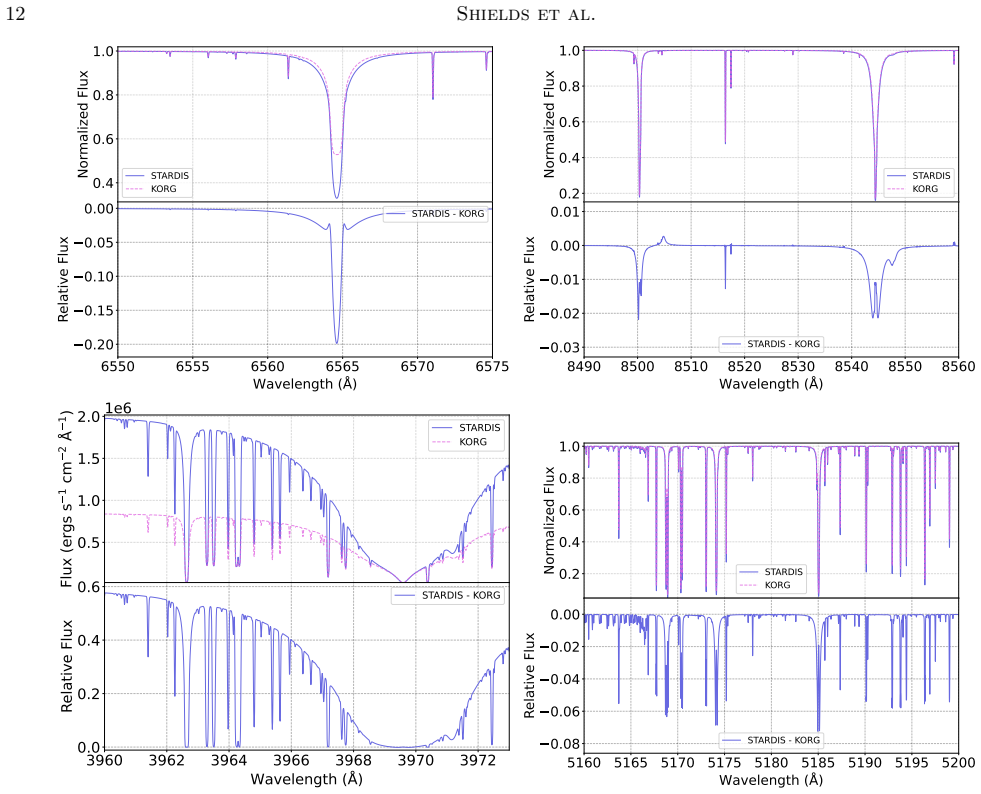
On the paper's own terms, the discovery is that a from-scratch Python spectral synthesis pipeline reproduces a modern reference code's spectrum for solar-type stars at the few-percent level in red-optical wavelengths, including the H-alpha line to better than four percent and the Ca II triplet to better than one percent, despite using different broadening prescriptions and different chemical-balance solvers. The same comparison shows systematic gaps: the codes diverge blueward of about 4000 angstroms because stardis lacks high-energy continuum opacities, and stardis over-predicts molecular formation in cool metal-rich stars such as Alpha Centauri B because molecules are not folded into a full equilibrium balance. The claim is therefore conditional: stardis is a working LTE synthesis instrument for FGK stars in the optical and near-IR, with known, stated deficiencies.
Load-bearing premise
The validation rests on the assumption that stardis agreeing with korg on shared inputs means stardis is physically accurate, even though the two codes share large portions of atomic data and atmosphere models, so the agreement may partly reflect shared systematics rather than independent correctness.
Editorial extensions
If this is right
- For solar-type and hotter stars, stardis spectra can be used for abundance measurements from lines redder than about 5000 angstroms at the claimed few-percent precision level.
- Below about 4000 angstroms the code should be used with caution until metal continuum opacities are implemented; ultraviolet fluxes are not yet reliable.
- Cool, metal-rich stars will have over-strong molecular bands because of the current single-molecule formation treatment.
- Because the code is modular and Python-based, new opacity sources and geometry options can be added without rewriting the radiative-transfer core.
- The H-alpha comparison shows that stardis's broadening prescription is competitive with a specialized Stark broadening treatment for solar-type stars.
Reading between the lines
- If the reported agreement is driven by shared line lists and equilibrium constants, then an independent validation against observed solar or benchmark-star spectra is needed before claiming accuracy for precision abundances; the paper itself only claims agreement with korg.
- A natural extension would be to include molecules in the full ionization and excitation equilibrium balance, which would likely remove the C2 over-prediction while slightly changing atomic number densities.
- A testable milestone is re-running the Sun at 3000 to 4000 angstroms with the missing H- and H2+ continuum opacity sources to see whether the disagreement with korg drops below a few percent.
- The benchmark table suggests the absolute runtime gap to korg is small, so for teaching and exploratory abundance work the lower Python entry cost may outweigh the slower runtime.
Signed reviews
Editorial analysis
A structured set of objections, weighed in public.
Referee Report
Summary. The paper presents stardis, a new 1D LTE stellar spectral synthesis code written in Python as part of the TARDIS ecosystem. It describes the code architecture: input handling of MARCS/MESA atmospheres and atomic/molecular data from NIST, Kurucz, VALD, and Barklem-Collet; plasma equilibrium calculations via the Saha and Boltzmann equations; molecular equilibrium via equilibrium constants; continuum and line opacities including Voigt profiles with Stark, van der Waals, and radiation broadening; and a piecewise radiative transfer solver with planar and spherical ray tracing. The validation compares stardis to korg for four stars (Sun, α Cen B, HD122563, HD499330) using the same MARCS atmospheres, with qualitative comparisons to PHOENIX and to observed solar irradiance. The central claim is that stardis agrees with korg at the few-percent level for solar models, with divergence in the ultraviolet and more extreme differences for cooler stars.
Significance. If the central claim holds, stardis is a useful open-source, modular alternative for 1D LTE stellar spectral synthesis, particularly for FGK stars in the red-optical regime. The paper's strengths include the open, documented code, the use of standardized atomic and molecular data, the direct code-to-code comparison on identical MARCS atmospheres, and the honest inventory of missing physics (UV continuum opacity sources, incomplete molecular equilibrium). The benchmarks in Appendix A are a useful practical contribution. However, the quantitative validation claim in the abstract is not backed by a defined residual metric, and the comparison is between two codes that share substantial inputs, so the evidence currently demonstrates code-to-code consistency rather than independent physical accuracy. The paper is a reasonable methods/code contribution that would benefit from tightened quantitative claims and a clearer statement of validation scope.
major comments (3)
- [Abstract; Sec. 3.1; Sec. 3.6] The abstract's claim of 'few percent level or better' agreement with korg is not supported by a defined global residual metric. The quantitative statements in Sec. 3.1 are limited to specific wavelength windows (Hα better than 4%, Ca II triplet better than 1%, Mg I about 3%) and to spectra smoothed to R≈2000, while Sec. 3.6 explicitly states that individual 0.1 Å pixels can have large residuals that vanish with convolution. As written, the headline claim is ambiguous and potentially misleading at native resolution or over the full 3000–9000 Å range. The authors should compute a well-defined statistic (e.g., median or percentile of |ΔF|/F over a stated wavelength range and binning) and rephrase the abstract to specify the resolution and wavelength range for which the few-percent statement holds.
- [Table 1; Sec. 3.1] Only a single solar model (Teff=5777, logg=4.44, [M/H]=0.0) is compared in the validation, yet the abstract states 'solar models' in the plural. If the claim is intended to generalize to multiple solar-metallicity models, the current data do not support it. The authors should either phrase the claim in the singular (e.g., 'for the solar model') or add additional solar-metallicity models to the comparison.
- [Sec. 3; Sec. 3.3; Sec. 4] The validation is a code-to-code comparison in which stardis and korg share MARCS atmospheres and largely overlapping atomic and molecular data (Kurucz, VALD, Barklem-Collet equilibrium constants). The paper itself notes in Sec. 3.3 that korg predicts a weaker Hα line than observed for HD122563. The few-percent agreement in red wavelengths may therefore partly reflect shared inputs and systematics rather than independent physical accuracy. The authors should explicitly state in Sec. 3 or Sec. 4 that the comparison demonstrates consistency between the codes, not absolute accuracy, and should discuss the implications for using stardis in abundance-measurement applications.
minor comments (5)
- [Sec. 1; Appendix A] The statement 'To date, no other stellar spectral synthesis Python code exists' (and its variant in Appendix A, 'the only other recently developed stellar spectral synthesis code') is overbroad; for example, Pyrat Bay is a Python radiative transfer code for atmospheric spectra, and pymoog provides a Python interface to MOOG. The claim should be removed or carefully qualified.
- [Sec. 2.3.2; Sec. 2.4.3] In the paragraph following Eq. (24), the symbol χ is defined twice; the second occurrence should be ϵ (the excitation energy). Also, please define Δτ1,2 and Δτ2,3 when they first appear in Eq. (29), and clarify the meaning of the subscripts 1, 2, and 3 in Eqs. (30)–(31).
- [Sec. 3.1; Fig. 2] The text 'we synthesize spectra using with as similar metallicities to korg as possible' contains a typo ('using with' should be 'using'). In addition, Figure 2's caption says 'R ≈ 2000' while the text says 'R = 2000'; please make this consistent.
- [Table 1] The column header '[ M H ]' should be '[M/H]' for readability, and the note 'nearest models available' should be clarified for the Sun, which appears to be an exact match to the listed parameters.
- [Sec. 3.6] The sentence 'A comparison between korg and phoenix shows strong agreement' is not supported by any residual plot or statistic; since the authors explicitly declined to show residuals to phoenix, this statement should be softened or substantiated.
Circularity Check
No circularity: the validation claim rests on external code-to-code and observed-spectrum comparisons, not on an assumption of the conclusion.
full rationale
The paper's central claim, that 'stardis generally agrees well with korg for solar models on the few percent level or better,' is supported by direct spectral comparisons against korg, a qualitative comparison to phoenix, and an observed solar irradiance spectrum. The physics chain in Section 2 (Saha and Boltzmann populations, molecular equilibrium constants, Voigt profiles, opacity summation, and the van Noort et al. radiative-transfer solver) is presented as standard first-principles calculation with inputs from external databases such as NIST, Kurucz, VALD, and Barklem & Collet. No fitted parameter is renamed as a prediction: the microturbulence value is a fixed, stated choice for comparison, and no quantity used in the validation is derived from korg's output. Shared MARCS atmospheres and overlapping atomic data mean part of the agreement reflects common inputs, but this is a limitation on the strength of the cross-check, not a circular reduction: stardis still performs its own plasma, opacity, and radiative-transfer calculations. The paper explicitly documents remaining disagreements (UV continuum, molecular formation in cool stars) and states that determining which code is more physically accurate is beyond scope, which is the opposite of a self-confirming argument. Self-citations to tardis and carsus concern code infrastructure and are not load-bearing evidence for the validation; the relevant equations are reproduced in the text. The overbroad sentence 'no other stellar spectral synthesis Python code exists' is not load-bearing for any derived result and would be a correctness or scope issue, not circularity.
Assumptions & free parameters
free parameters (1)
- microturbulent velocity xi =
1.0 km/s for all models
assumptions (5)
- domain assumption Local thermodynamic equilibrium holds: Saha and Boltzmann equations set populations and the source function is the blackbody function.
- domain assumption MARCS and MESA 1D atmospheric structures adequately represent the stars being modeled.
- domain assumption External atomic and molecular data from NIST, Kurucz, VALD, and Barklem and Collet are accurate enough for synthesis.
- domain assumption Neglecting the consumption of reactants when molecules form is acceptable for the modeled stars.
- standard math The van Noort formal solver and the Humlicek Voigt approximation are accurate numerical methods.
Cite this review
Pith. "Pith review of Introducing STARDIS: An Open and Modular Stellar Spectral Synthesis Code." pith.science (2026). https://pith.science/paper/J7Y74AXT
@misc{pith2026250417762,
  author       = {Pith},
  title        = {Pith review of: Introducing STARDIS: An Open and Modular Stellar Spectral Synthesis Code},
  year         = {2026},
  howpublished = {\url{https://pith.science/paper/J7Y74AXT}},
  note         = {Machine review of arXiv:2504.17762}
}
read the original abstract
We introduce a new 1D stellar spectral synthesis Python code called stardis. stardis is a modular, open-source radiative transfer code that is capable of spectral synthesis from near-UV to IR for FGK stars. We describe the structure, inputs, features, underlying physics, and assumptions of stardis as well as the radiative transfer scheme implemented. To validate our code, we show spectral comparisons between stardis and korg with the same input atmospheric structure models, and also compare qualitatively to phoenix for solar models. We find that stardis generally agrees well with korg for solar models on the few percent level or better, that the codes can diverge in the ultraviolet, with more extreme differences in cooler stars. stardis can be found at https://github.com/tardis-sn/stardis, and documentation can be found at https://tardis-sn.github.io/stardis/.
Figures


Figures from the paper (4 more)



Forward citations
Cited by 1 Pith paper
-
Migration and Evolution of giant ExoPlanets (MEEP) II: Super-Jupiters and Lithium-rich Host Stars
Four new super-Jupiters are confirmed and the subgiant TOI-4138 shows a 4.5-sigma lithium excess attributed to planetary engulfment.
Reference graph
Works this paper leans on
-
[1]
, " * write output.state after.block = add.period write newline
ENTRY address archivePrefix author booktitle chapter doi edition editor eprint howpublished institution journal key month number organization pages publisher school series title misctitle type volume year version url label extra.label sort.label short.list INTEGERS output.state before.all mid.sentence after.sentence after.block FUNCTION init.state.consts ...
-
[2]
write newline
" write newline "" before.all 'output.state := FUNCTION format.url url empty "" new.block "" url * "" * if FUNCTION format.eprint eprint empty "" archivePrefix empty "" archivePrefix "arXiv" = new.block " " eprint * " " * new.block " " eprint * " " * if if if FUNCTION format.doi doi empty "" " " doi * " " * if FUNCTION format.pid doi empty eprint empty ur...
-
[3]
']r k_r ˹Je\ Y1s).ƮY.#Ҋ+ax - ,Rl;ncNW Qr ٻ|E×<bg Ngb!). > |Q ɫZ _r6Se^U[]G[[; 3b jo6
thebibliography [1] 20pt to REFERENCES 6pt =0pt -12pt 10pt plus 3pt =0pt =0pt =1pt plus 1pt =0pt =0pt -12pt =13pt plus 1pt =20pt =13pt plus 1pt \@M =10000 =-1.0em =0pt =0pt 0pt =0pt =1.0em @enumiv\@empty 10000 10000 `\.\@m \@noitemerr \@latex@warning Empty `thebibliography' environment \@ifnextchar \@reference \@latexerr Missing key on reference command E...
arXiv 2021
- [4]
-
[5]
Anstee, S. D., & O'Mara, B. J. 1995, Monthly Notices of the Royal Astronomical Society, 276, 859, 10.1093/mnras/276.3.859
-
[6]
Anusha, L. S., Nagendra, K. N., Paletou, F., & Léger, L. 2009, The Astrophysical Journal, 704, 661, 10.1088/0004-637X/704/1/661
-
[7]
2005, Annual Review of Astronomy and Astrophysics, 43, 481, 10.1146/annurev.astro.42.053102.134001
Asplund, M. 2005, Annual Review of Astronomy and Astrophysics, 43, 481, 10.1146/annurev.astro.42.053102.134001
arXiv 2005
-
[8]
Asplund, M., Amarsi, A. M., & Grevesse, N. 2021, Astronomy and Astrophysics, 653, A141, 10.1051/0004-6361/202140445
Show all 73 references
-
[9]
P., Tollerud, E
Astropy Collaboration , Robitaille, T. P., Tollerud, E. J., et al. 2013, Astronomy and Astrophysics, 558, A33, 10.1051/0004-6361/201322068
2013 doi
-
[10]
M., Sipőcz, B
Astropy Collaboration , Price-Whelan, A. M., Sipőcz, B. M., et al. 2018, The Astronomical Journal, 156, 123, 10.3847/1538-3881/aabc4f
2018 doi
-
[11]
M., Lim, P
Astropy Collaboration , Price-Whelan, A. M., Lim, P. L., et al. 2022, The Astrophysical Journal, 935, 167, 10.3847/1538-4357/ac7c74
2022 doi
-
[12]
1998, Monthly Notices of the Royal Astronomical Society, 296, 1057, 10.1046/j.1365-8711.1998.01484.x
Barklem, P., O'Mara, B., & Ross, J. 1998, Monthly Notices of the Royal Astronomical Society, 296, 1057, 10.1046/j.1365-8711.1998.01484.x
1998
-
[13]
S., & Collet, R
Barklem, P. S., & Collet, R. 2016, Astronomy and Astrophysics, 588, A96, 10.1051/0004-6361/201526961
2016 doi
-
[14]
S., & Piskunov, N
Barklem, P. S., & Piskunov, N. 2003, 210, E28. https://ui.adsabs.harvard.edu/abs/2003IAUS..210P.E28B
2003
-
[15]
Baron, E., Chen, B., & Hauschildt, P. H. 2010, Astrophysics Source Code Library, ascl:1010.056. https://ui.adsabs.harvard.edu/abs/2010ascl.soft10056B
2010
-
[16]
L., & Berrington, K
Bell, K. L., & Berrington, K. A. 1987, Journal of Physics B Atomic Molecular Physics, 20, 801, 10.1088/0022-3700/20/4/019
1987 doi
-
[17]
2014, Astronomy & Astrophysics, 569, A111, 10.1051/0004-6361/201423945
Blanco-Cuaresma, S., Soubiran, C., Heiter, U., & Jofré, P. 2014, Astronomy & Astrophysics, 569, A111, 10.1051/0004-6361/201423945
2014 doi
-
[18]
P., Magee, N
Colgan, J., Kilcrease, D. P., Magee, N. H., et al. 2016, The Astrophysical Journal, 817, 116, 10.3847/0004-637X/817/2/116
2016 doi
-
[19]
1954, Nature, 173, 680, 10.1038/173680b0
de Jager, C. 1954, Nature, 173, 680, 10.1038/173680b0
1954 doi
-
[20]
P., Landi, E., Mason, H
Dere, K. P., Landi, E., Mason, H. E., Fossi, B. C. M., & Young, P. R. 1997, Astronomy and Astrophysics Supplement Series, 125, 149, 10.1051/aas:1997368
1997 doi
-
[21]
P., Zanna, G
Dere, K. P., Zanna, G. D., Young, P. R., Landi, E., & Sutherland, R. S. 2019, The Astrophysical Journal Supplement Series, 241, 22, 10.3847/1538-4365/ab05cf
2019 doi
-
[22]
2018, The Astrophysical Journal, 855, L5, 10.3847/2041-8213/aaaec3
Do, T., Kerzendorf, W., Konopacky, Q., et al. 2018, The Astrophysical Journal, 855, L5, 10.3847/2041-8213/aaaec3
2018 doi
-
[23]
Gray, D. F. 2005, The Observation and Analysis of Stellar Photospheres , 3rd edn. (Cambridge: Cambridge University Press), 10.1017/CBO9781316036570
2005 doi
-
[24]
O., & Corbally, C
Gray, R. O., & Corbally, C. J. 1994, The Astronomical Journal, 107, 742, 10.1086/116893
1994 doi
-
[25]
2011, 442, 425
Greenfield, P. 2011, 442, 425. https://ui.adsabs.harvard.edu/abs/2011ASPC..442..425G
2011
-
[26]
Gueymard, C. A. 2018, Solar Energy, 169, 434, 10.1016/j.solener.2018.04.067
2018 doi
-
[27]
2008, Astronomy and Astrophysics, 486, 951, 10.1051/0004-6361:200809724
Gustafsson, B., Edvardsson, B., Eriksson, K., et al. 2008, Astronomy and Astrophysics, 486, 951, 10.1051/0004-6361:200809724
2008 doi
-
[28]
R., Millman, K
Harris, C. R., Millman, K. J., van der Walt, S. J., et al. 2020, Nature, 585, 357, 10.1038/s41586-020-2649-2
2020 doi
-
[29]
Hauschildt, P. H. 1992, Journal of Quantitative Spectroscopy and Radiative Transfer, 47, 433, 10.1016/0022-4073(92)90105-D
1992 doi
-
[30]
J., & Miller, D
Hillier, D. J., & Miller, D. L. 1998, The Astrophysical Journal, 496, 407, 10.1086/305350
1998 doi
-
[31]
2011, Astrophysics Source Code Library, ascl:1109.022
Hubeny, I., & Lanz, T. 2011, Astrophysics Source Code Library, ascl:1109.022. https://ui.adsabs.harvard.edu/abs/2011ascl.soft09022H
2011
-
[32]
2014, Theory of Stellar Atmospheres
Hubeny, I., & Mihalas, D. 2014, Theory of Stellar Atmospheres . https://ui.adsabs.harvard.edu/abs/2014tsa..book.....H
2014
-
[33]
1982, Journal of Quantitative Spectroscopy and Radiative Transfer, 27, 437, 10.1016/0022-4073(82)90078-4
Humlíček, J. 1982, Journal of Quantitative Spectroscopy and Radiative Transfer, 27, 437, 10.1016/0022-4073(82)90078-4
1982 doi
-
[34]
2013, Astronomy & Astrophysics, 553, A6, 10.1051/0004-6361/201219058
Husser, T.-O., Wende-von Berg, S., Dreizler, S., et al. 2013, Astronomy & Astrophysics, 553, A6, 10.1051/0004-6361/201219058
2013 doi
-
[35]
S., Bauer, E
Jermyn, A. S., Bauer, E. B., Schwab, J., et al. 2023, 265, 15, 10.3847/1538-4365/acae8d
2023 doi
-
[36]
2024, tardis-sn/tardis: TARDIS v2024.08.25, Zenodo, 10.5281/zenodo.13370472
Kerzendorf, W., Sim, S., Vogl, C., et al. 2024, tardis-sn/tardis: TARDIS v2024.08.25, Zenodo, 10.5281/zenodo.13370472
2024 doi
-
[37]
E., & Sim, S
Kerzendorf, W. E., & Sim, S. A. 2014, Monthly Notices of the Royal Astronomical Society, 440, 387, 10.1093/mnras/stu055
2014 doi
-
[38]
A., Stempels, H
Kupka, F., Piskunov, N., Ryabchikova, T. A., Stempels, H. C., & Weiss, W. W. 1999, Astronomy and Astrophysics Supplement Series, 138, 119, 10.1051/aas:1999267
1999 doi
-
[39]
G., Ryabchikova, T
Kupka, F. G., Ryabchikova, T. A., Piskunov, N. E., Stempels, H. C., & Weiss, W. W. 2000, Baltic Astronomy, 9, 590, 10.1515/astro-2000-0420
2000 doi
-
[40]
1993, Robert Kurucz CD-ROM, 18
Kurucz, R. 1993, Robert Kurucz CD-ROM, 18. https://ui.adsabs.harvard.edu/abs/1993KurCD..18.....K
1993
-
[41]
1995, Robert Kurucz CD-ROM, 23
Kurucz, R., & Bell, B. 1995, Robert Kurucz CD-ROM, 23. https://ui.adsabs.harvard.edu/abs/1995KurCD..23.....K
1995
-
[42]
Kurucz, R. L. 2017, Canadian Journal of Physics, 95, 825, 10.1139/cjp-2016-0794
2017 doi
-
[43]
K., Pitrou, A., & Seibert, S
Lam, S. K., Pitrou, A., & Seibert, S. 2015, in Proceedings of the Second Workshop on the LLVM Compiler Infrastructure in HPC , LLVM '15 (New York, NY, USA: Association for Computing Machinery), 1--6, 10.1145/2833157.2833162
2015
-
[44]
2011, Astronomy & Astrophysics, 528, A44, 10.1051/0004-6361/201015814
Mucciarelli, A. 2011, Astronomy & Astrophysics, 528, A44, 10.1051/0004-6361/201015814
2011 doi
- [45]
-
[46]
V., & Ryabchikova, T
Pakhomov, Y. V., & Ryabchikova, T. A. 2019, INASAN Science Reports, 4, 79, 10.26087/INASAN.2019.4.2.014
2019 doi
-
[47]
2011, 192, 3, 10.1088/0067-0049/192/1/3
Paxton, B., Bildsten, L., Dotter, A., et al. 2011, 192, 3, 10.1088/0067-0049/192/1/3
2011 doi
-
[48]
2013, 208, 4, 10.1088/0067-0049/208/1/4
Paxton, B., Cantiello, M., Arras, P., et al. 2013, 208, 4, 10.1088/0067-0049/208/1/4
2013 doi
-
[49]
2015, 220, 15, 10.1088/0067-0049/220/1/15
Paxton, B., Marchant, P., Schwab, J., et al. 2015, 220, 15, 10.1088/0067-0049/220/1/15
2015 doi
-
[50]
B., et al
Paxton, B., Schwab, J., Bauer, E. B., et al. 2018, 234, 34, 10.3847/1538-4365/aaa5a8
2018 doi
-
[51]
2019, 243, 10, 10.3847/1538-4365/ab2241
Paxton, B., Smolec, R., Schwab, J., et al. 2019, 243, 10, 10.3847/1538-4365/ab2241
2019 doi
-
[52]
E., Kupka, F., Ryabchikova, T
Piskunov, N. E., Kupka, F., Ryabchikova, T. A., Weiss, W. W., & Jeffery, C. S. 1995, Astronomy and Astrophysics Supplement Series, 112, 525. https://ui.adsabs.harvard.edu/abs/1995A&AS..112..525P
1995
-
[53]
2012, Astrophysics Source Code Library, ascl:1205.004
Plez, B. 2012, Astrophysics Source Code Library, ascl:1205.004. https://ui.adsabs.harvard.edu/abs/2012ascl.soft05004P
2012
-
[54]
A., E., K
Pássaro, E. A., E., K. W., A., F., & C., V. 2020, An open source framework for atomic data, Zenodo, 10.5281/zenodo.4062427
2020 doi
-
[55]
L., et al
Ryabchikova, T., Piskunov, N., Kurucz, R. L., et al. 2015, Physica Scripta, 90, 054005, 10.1088/0031-8949/90/5/054005
2015 doi
-
[56]
A., Piskunov, N
Ryabchikova, T. A., Piskunov, N. E., Kupka, F., & Weiss, W. W. 1997, Baltic Astronomy, 6, 244, 10.1515/astro-1997-0216
1997 doi
-
[57]
B., & Lightman, A
Rybicki, G. B., & Lightman, A. P. 1986, Radiative Processes in Astrophysics . https://ui.adsabs.harvard.edu/abs/1986rpa..book.....R
1986
- [58]
-
[59]
2021, Numerical Python in Astronomy and Astrophysics ; A Practical Guide to Astrophysical Problem Solving , 10.1007/978-3-030-70347-9
Schmidt, W., & Völschow, M. 2021, Numerical Python in Astronomy and Astrophysics ; A Practical Guide to Astrophysical Problem Solving , 10.1007/978-3-030-70347-9
2021 doi
-
[60]
1973, The Astrophysical Journal, 184, 839, 10.1086/152374
Sneden, C. 1973, The Astrophysical Journal, 184, 839, 10.1086/152374
1973 doi
-
[61]
2012, Astrophysics Source Code Library, ascl:1202.009
Sneden, C., Bean, J., Ivans, I., Lucatello, S., & Sobeck, J. 2012, Astrophysics Source Code Library, ascl:1202.009. https://ui.adsabs.harvard.edu/abs/2012ascl.soft02009S
2012
-
[62]
Stancil, P. C. 1994, The Astrophysical Journal, 430, 360, 10.1086/174411
1994 doi
-
[63]
1978, Journal of Quantitative Spectroscopy and Radiative Transfer, 20, 333, 10.1016/0022-4073(78)90102-4
Sutton, K. 1978, Journal of Quantitative Spectroscopy and Radiative Transfer, 20, 333, 10.1016/0022-4073(78)90102-4
1978 doi
-
[64]
team, T. p. d. 2020, pandas-dev/pandas: Pandas , Zenodo, 10.5281/zenodo.3509134
2020 doi
-
[65]
1960, Zeitschrift fur Astrophysik, 49, 231
Traving, G. 1960, Zeitschrift fur Astrophysik, 49, 231. https://ui.adsabs.harvard.edu/abs/1960ZA.....49..231T
1960
-
[66]
A., & Piskunov, N
Valenti, J. A., & Piskunov, N. 1996, Astronomy and Astrophysics Supplement Series, 118, 595. https://ui.adsabs.harvard.edu/abs/1996A&AS..118..595V
1996
-
[67]
2002, The Astrophysical Journal, 568, 1066, 10.1086/338949
van Noort, M., Hubeny, I., & Lanz, T. 2002, The Astrophysical Journal, 568, 1066, 10.1086/338949
2002 doi
-
[68]
E., et al
Virtanen, P., Gommers, R., Oliphant, T. E., et al. 2020, Nature Methods, 17, 261, 10.1038/s41592-019-0686-2
2020 doi
-
[69]
1912, Sitzungsberichte, Vol
Voigt, W. 1912, Sitzungsberichte, Vol. 1912,25, Über das Gesetz der Intensitätsverteilung innerhalb der Linien eines Gasspektrums (München). https://publikationen.badw.de/de/003395768
1912
-
[70]
1967, Monthly Notices of the Royal Astronomical Society, 136, 381, 10.1093/mnras/136.4.381
Warner, B. 1967, Monthly Notices of the Royal Astronomical Society, 136, 381, 10.1093/mnras/136.4.381
1967 doi
-
[71]
2010, in Proceedings of the 9th Python in Science Conference , ed
Wes, M. 2010, in Proceedings of the 9th Python in Science Conference , ed. S. van der Walt & J. Millman, 56 -- 61, 10.25080/Majora-92bf1922-00a
2010 doi
-
[72]
J., Abruzzo, M
Wheeler, A. J., Abruzzo, M. W., Casey, A. R., & Ness, M. K. 2023, The Astronomical Journal, 165, 68, 10.3847/1538-3881/acaaad
2023 doi
-
[73]
Wishart, A. W. 1979, Journal of Physics B: Atomic and Molecular Physics, 12, 3511, 10.1088/0022-3700/12/21/009
1979 doi
Reviewed August 16, 2026 · model on record in the stance chip above.
Discussion (0). Continue with ORCID to comment.