REVIEW 3 major objections 6 minor 1 cited by
VideoVista-CulturalLingo: 360$^\circ$ Horizons-Bridging Cultures, Languages, and Domains in Video Comprehension
T0 review · 3 major / 6 minor · reviewed 2026-08-16 · deepseek-v4-flash
Pith's one-line read A new benchmark shows AI video models underperform on Chinese-centric questions.
desk verdict A genuinely reusable bilingual/tricultural video benchmark, but the headline model comparisons rest on an acknowledged protocol confound that needs a control experiment. read the letter →
The pith
A machine-rendered reading of the paper's core claim, the machinery that carries it, and where it could break.
The reading
What carries the argument
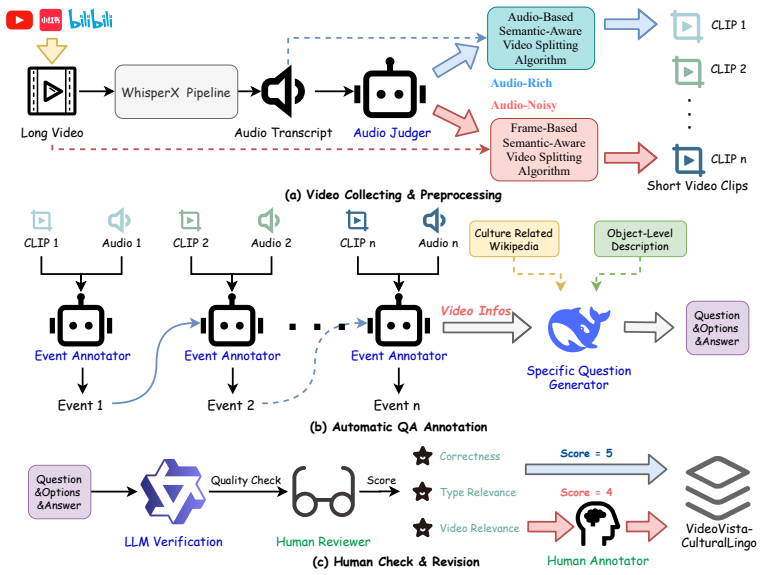
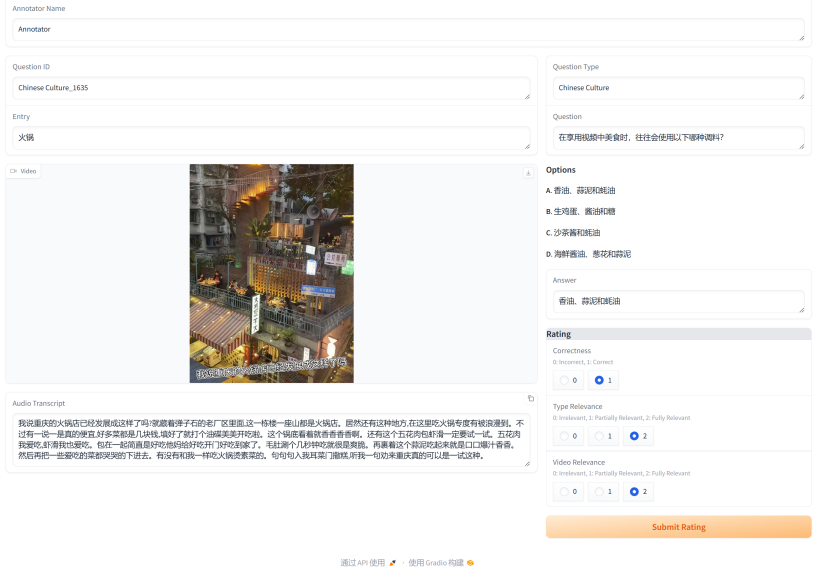
The load-bearing object is the benchmark itself, organized as 3,134 multiple-choice QA pairs over 2,052 clips from 1,389 videos, grouped into four task families, Event, Object, Culture, and Science, with fourteen subtasks. The mechanism that carries the argument is the three-stage annotation pipeline: video preprocessing segments clips and cleans transcripts; automatic annotation uses a vision-language model for event and object labeling, text language models for question generation, and retrieval of Wikipedia background for cultural questions; and a human-check stage scores each item for correctness, task-type relevance, and video relevance, keeping only top-scoring items and manually correcting borderline ones. Culture questions are independently checked by two annotators, one native to the relevant culture. This pipeline is what converts raw videos into gold-standard QA pairs, so the entire evaluation rests on it.
What would settle it
Run all evaluated models on the same 3,134 questions with no video input, only the question text and possibly transcripts; if text-only accuracy approaches the reported video-input accuracy, the benchmark would not be measuring video comprehension, while a small gap would show many questions are answerable without watching the video.
Extended reading notes
Core claim
The paper's central claim is that current video models carry a measurable cultural and linguistic bias, and that a benchmark built from Western- and Chinese-sourced videos can expose it. On its 3,134 bilingual QA pairs, the strongest proprietary model reaches 76.3 percent overall accuracy while the strongest open-source video model reaches 61.3 percent. The gap is not uniform: on Chinese-culture questions the best open-source video model scores 65.8 percent, below its performance on European and American culture, and performance falls further on questions tied to Chinese history and cuisine. Across all models, event localization, locating when an event happens in a video, is the weakest task, with the best open-source score at 45.2 percent, while in science the leading open-source models come within a few points of proprietary models on physics, chemistry, and computer science but trail by about ten points on mathematics. The paper reads these results as evidence that training-data and benchmark-coverage biases still shape what video models can understand.
Load-bearing premise
The benchmark assumes that its machine-generated, human-refined questions are correct gold standards that genuinely require watching the video to answer, and that videos collected from the chosen platforms fairly represent the cultures they stand for.
Editorial extensions
If this is right
- Model rankings on this benchmark split by culture, so the Chinese-English divide and the Chinese-culture deficit should be reported as a standard evaluation axis in future video-model comparisons.
- Event localization is the clearest unsolved capability for open-source video models; the 45.2 percent ceiling means claims of open-source parity with proprietary systems should be conditioned on the task.
- Mathematics, not general science, is where open-source video models fall furthest behind, pointing to video math reasoning as a distinct weakness.
- All tested models, including the strongest proprietary one, lose accuracy as videos get longer, so long-video understanding remains a shared limitation.
- Because the dataset and annotation pipeline are released, other labs can rerun the 24-model comparison and use it as a baseline for future video models.
Reading between the lines
- A direct testable extension is to apply the same question-generation and human-check protocol to other languages, such as Spanish, German, or Japanese; if models again score higher on Western content in those languages, the bias is cultural rather than merely English-centric.
- One could separate platform effects from cultural effects by re-sampling Chinese-culture videos from additional sources or regions; if scores shift, part of the reported gap is about video style and source distribution, not cultural knowledge as such.
- If the Western-centric advantage is driven by training-data exposure, then fine-tuning or continued pretraining on Chinese cultural video should raise Chinese-culture accuracy without much changing Western-culture accuracy; this prediction is checkable.
- The benchmark's science questions are deliberately general rather than deep, as the paper's limitation section states, so the reported math gap is best read as a lower bound on the true gap for specialized mathematical video reasoning.
Signed reviews
Editorial analysis
A structured set of objections, weighed in public.
Referee Report
Summary. The paper introduces VideoVista-CulturalLingo, a video question-answering benchmark containing 1,389 videos, 2,052 clips, and 3,134 QA pairs, designed to span Chinese/English languages, Chinese/American/European cultures, and a broad range of domains. The annotation pipeline is hybrid: Qwen2-VL-72B and DeepSeek-V3/R1 generate candidate questions, which are then filtered and refined by human annotators, with two independent cultural annotators for cultural items. The paper evaluates 24 open-source and proprietary LMMs and reports three main findings: models score lower on Chinese-centric than Western-centric questions, open-source models are markedly weak at Event Localization (best 45.2%), and open-source models trail proprietary models in mathematics. The dataset, code, and project pages are publicly released.
Significance. If the evaluation protocol is matched across model families, the benchmark addresses a genuine gap: most video benchmarks are English-only and Western-centric, while VideoVista-CulturalLingo explicitly targets cultural, linguistic, and domain diversity with 14 subtasks and public release. The paper also ships useful auxiliary analyses, including frame-sampling upper bounds, audio-transcript impact, and temporal-position effects, which are cheap to reproduce given the released data. However, the central comparative claims are currently undermined by a protocol confound in the proprietary-model evaluation, and the ground-truth quality is not quantitatively audited. With those issues resolved, the benchmark could be a reusable measurement instrument.
major comments (3)
- [Appendix B.3] The evaluation protocol is not matched across model families: proprietary LMMs (GPT-4o, Gemini-1.5-Flash, Gemini-2.0-Flash-Lite, Gemini-2.0-Flash) receive multiple questions for each video in a single API call and return a dictionary of predictions, while open-source models are evaluated one question per call with re-ingestion of the video frames. This confound directly affects the headline comparisons in the abstract and Section 4.2, such as Gemini-2.0-Flash surpassing Qwen2.5-VL-72B by 15.0%, the Event Localization maximum of 45.2% for open-source models, and the mathematics gap. The paper acknowledges that this 'may introduce some evaluation bias' but provides no control experiment. To support the paper's comparative claims, the authors should re-run at least one open-source model under the batched protocol, or one proprietary model under the single-question protocol, and report whether the performance gaps persist; alternatively, the claims should be explicitly scoped as protocol-dependent.
- [Section 3.3] The benchmark's value as a measurement instrument depends on the correctness and video-dependence of the 3,134 gold QA pairs, but the manuscript reports no inter-annotator agreement statistics, no quantitative human-error audit, and no data on how often the two independent cultural annotators disagreed. The pipeline states that questions with score 4 are manually corrected or refined, and that roughly 60% of low-quality questions are eliminated, but there is no reliability metric for the human checks or a sample of cases where the annotators overturned or corrected model-generated answers. The authors should provide a small-scale audit (e.g., re-answer rates by an external annotator, disagreement rates on cultural items, and a breakdown of corrections by task) to substantiate the claim that the benchmark is gold-standard.
- [Section 3.1 and Section 3.4] The paper equates video source with cultural content: English videos from YouTube are treated as American/European cultural material, and Chinese videos from Xiaohongshu and BiliBili are treated as Chinese cultural material. Since the central finding is that models perform worse on 'Chinese-centric' questions, the validity of that comparison rests on the assumption that platform provenance and search-keyword domains reliably indicate the intended culture. The paper does not report any validation that the collected videos are in fact about Chinese, American, or European culture (e.g., a human cultural-tagging subset, or an analysis of the retrieved Wikipedia entries' relevance). Without such evidence, the culture-based performance gaps could partly reflect video-content selection rather than cultural comprehension. A validation strategy—such as having annotators label a random subset of videos by culture and reporting agreement—should be added.
minor comments (6)
- [Appendix E] The descriptions of Event Sequence and Event Localization are duplicated: the Event Localization paragraph repeats the definition of Event Sequence almost verbatim. The intended distinction between ordering events and locating a specific event should be stated clearly.
- [Section 1 and Conclusion] The claim of being 'the first video evaluation benchmark' to bridge culture, language, and domain would be more precise as 'the first to combine all three dimensions', since multi-domain and multi-duration benchmarks such as Video-MME precede this work.
- [Section 1] In the contribution list, 'autonomic video annotation framework' should be 'automatic video annotation framework'.
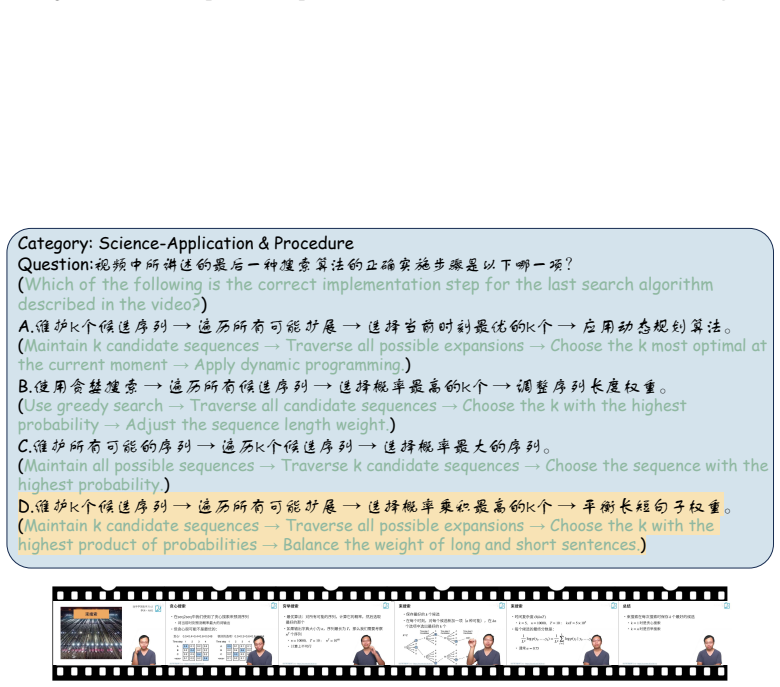
- [Section 4.3 and Figure 9] The sentence in the Science task description says 'the questions are relatively simple and can be answered with one or two-hop reasoning', but the subsequently reported mathematics gap is asserted without a difficulty calibration. A brief justification for why the math questions are not simply harder than the other science questions would strengthen the claim.
- [Appendix B.2] The description of the Molmo evaluation is clear about the horizontal concatenation of eight frames, but the potential effect of this unusual input format on Molmo's scores is not discussed in Section 4.2 when interpreting the image-LMM results.
- [Appendix D.5] The phrase 'backup-index-bydb.html' appears to be a leftover fragment of a URL or filename, not a proper reference. It should be removed or replaced with a correct citation for the Wikipedia extraction tool.
Circularity Check
The benchmark construction and evaluation results are self-contained; no circular derivation is present.
full rationale
The paper constructs a new video QA benchmark and reports model evaluations; it does not derive a scientific constant from an assumed premise. The central claims are empirical measurements on a new dataset, and the annotation pipeline (LLM generation with human verification) does not define the reported results into existence. The use of Qwen2-VL as an annotator and the later evaluation of Qwen2.5-VL is a possible lineage-related bias, but it is not a circular reduction: the benchmark answers were human-checked and the reported scores are external model outputs, not re-statements of the annotation model's own predictions. The self-citation to VideoVista (Li et al., 2024b) is contextual and not load-bearing for the main contributions. The admitted evaluation-bias passage in Appendix B.3 ('Although this may introduce some evaluation bias') concerns protocol confounds between proprietary and open-source models, which is a validity threat rather than a circularity of derivation. No fitted parameter is relabeled as a prediction, and no uniqueness theorem or ansatz is imported from the authors' prior work. Therefore, the derivation chain is independent of its inputs, and the score is 0.
Assumptions & free parameters
free parameters (3)
- Annotation score cutoffs =
score=5 selected, score=4 manually revised
- Frame sampling upper bounds =
max frames 300 (Qwen2-VL/Qwen2.5-VL), 1 fps (Gemini, GPT-4o), 8 frames (image LMMs)
- Culture QA count limits =
Chinese Culture 231, American Culture 200, European Culture 200
assumptions (4)
- domain assumption The chosen LLM question generators (Qwen2-VL, DeepSeek-V3/R1) and human annotators produce factually correct gold answers, especially for cultural facts.
- domain assumption WhisperX transcription is accurate enough, after homophone correction, for science and event questions to be answerable from the transcript.
- domain assumption Videos collected from BiliBili and Xiaohongshu are representative of Chinese culture, and YouTube videos are representative of American and European cultures.
- domain assumption The LLM-based human-check filtering (CircularEval with Qwen2.5-7B) successfully removes video-agnostic questions.
Cite this review
Pith. "Pith review of VideoVista-CulturalLingo: 360$^\circ$ Horizons-Bridging Cultures, Languages, and Domains in Video Comprehension." pith.science (2026). https://pith.science/paper/N7U6OH3X
@misc{pith2026250417821,
  author       = {Pith},
  title        = {Pith review of: VideoVista-CulturalLingo: 360$^\circ$ Horizons-Bridging Cultures, Languages, and Domains in Video Comprehension},
  year         = {2026},
  howpublished = {\url{https://pith.science/paper/N7U6OH3X}},
  note         = {Machine review of arXiv:2504.17821}
}
read the original abstract
Assessing the video comprehension capabilities of multimodal AI systems can effectively measure their understanding and reasoning abilities. Most video evaluation benchmarks are limited to a single language, typically English, and predominantly feature videos rooted in Western cultural contexts. In this paper, we present VideoVista-CulturalLingo, the first video evaluation benchmark designed to bridge cultural, linguistic, and domain divide in video comprehension. Our work differs from existing benchmarks in the following ways: 1) Cultural diversity, incorporating cultures from China, North America, and Europe; 2) Multi-linguistics, with questions presented in Chinese and English-two of the most widely spoken languages; and 3) Broad domain, featuring videos sourced from hundreds of human-created domains. VideoVista-CulturalLingo contains 1,389 videos and 3,134 QA pairs, and we have evaluated 24 recent open-source or proprietary video large models. From the experiment results, we observe that: 1) Existing models perform worse on Chinese-centric questions than Western-centric ones, particularly those related to Chinese history; 2) Current open-source models still exhibit limitations in temporal understanding, especially in the Event Localization task, achieving a maximum score of only 45.2%; 3) Mainstream models demonstrate strong performance in general scientific questions, while open-source models demonstrate weak performance in mathematics.
Figures


Figures from the paper (28 more)





Forward citations
Cited by 1 Pith paper
-
Perception, Reason, Think, and Plan: A Survey on Large Multimodal Reasoning Models
A survey organizes multimodal reasoning research into a staged roadmap and proposes native large multimodal reasoning models that unify perception, generation, and agentic planning.
Reference graph
Works this paper leans on
-
[1]
Lin Chen, Xilin Wei, Jinsong Li, Xiaoyi Dong, Pan Zhang, Yuhang Zang, Zehui Chen, Haodong Duan, Bin Lin, Zhenyu Tang, et al. 2024 a . Sharegpt4video: Improving video understanding and generation with better captions. arXiv preprint arXiv:2406.04325
arXiv 2024
-
[2]
Tsai-Shien Chen, Aliaksandr Siarohin, Willi Menapace, Ekaterina Deyneka, Hsiang-wei Chao, Byung Eun Jeon, Yuwei Fang, Hsin-Ying Lee, Jian Ren, Ming-Hsuan Yang, and Sergey Tulyakov. 2024 b . Panda-70m: Captioning 70m videos with multiple cross-modality teachers. arXiv preprint arXiv:2402.19479
arXiv 2024
-
[3]
Zhe Chen, Weiyun Wang, Yue Cao, Yangzhou Liu, Zhangwei Gao, Erfei Cui, Jinguo Zhu, Shenglong Ye, Hao Tian, Zhaoyang Liu, et al. 2024 c . Expanding performance boundaries of open-source multimodal models with model, data, and test-time scaling. arXiv preprint arXiv:2412.05271
arXiv 2024
-
[4]
Zesen Cheng, Sicong Leng, Hang Zhang, Yifei Xin, Xin Li, Guanzheng Chen, Yongxin Zhu, Wenqi Zhang, Ziyang Luo, Deli Zhao, and Lidong Bing. 2024. https://arxiv.org/abs/2406.07476 Videollama 2: Advancing spatial-temporal modeling and audio understanding in video-llms . arXiv preprint arXiv:2406.07476
arXiv 2024
-
[5]
DeepSeek-AI, Daya Guo, Dejian Yang, Haowei Zhang, Junxiao Song, Ruoyu Zhang, Runxin Xu, Qihao Zhu, Shirong Ma, Peiyi Wang, Xiao Bi, Xiaokang Zhang, Xingkai Yu, Yu Wu, Z. F. Wu, Zhibin Gou, Zhihong Shao, Zhuoshu Li, Ziyi Gao, Aixin Liu, Bing Xue, Bingxuan Wang, Bochao Wu, Bei Feng, Chengda Lu, Chenggang Zhao, Chengqi Deng, Chenyu Zhang, Chong Ruan, Damai D...
arXiv 2025
-
[6]
DeepSeek-AI, Aixin Liu, Bei Feng, Bing Xue, Bingxuan Wang, Bochao Wu, Chengda Lu, Chenggang Zhao, Chengqi Deng, Chenyu Zhang, Chong Ruan, Damai Dai, Daya Guo, Dejian Yang, Deli Chen, Dongjie Ji, Erhang Li, Fangyun Lin, Fucong Dai, Fuli Luo, Guangbo Hao, Guanting Chen, Guowei Li, H. Zhang, Han Bao, Hanwei Xu, Haocheng Wang, Haowei Zhang, Honghui Ding, Huaj...
arXiv 2024
-
[7]
Smith, Hannaneh Hajishirzi, Ross Girshick, Ali Farhadi, and Aniruddha Kembhavi
Matt Deitke, Christopher Clark, Sangho Lee, Rohun Tripathi, Yue Yang, Jae Sung Park, Mohammadreza Salehi, Niklas Muennighoff, Kyle Lo, Luca Soldaini, Jiasen Lu, Taira Anderson, Erin Bransom, Kiana Ehsani, Huong Ngo, YenSung Chen, Ajay Patel, Mark Yatskar, Chris Callison-Burch, Andrew Head, Rose Hendrix, Favyen Bastani, Eli VanderBilt, Nathan Lambert, Yvon...
arXiv 2024
-
[8]
Xinyu Fang, Kangrui Mao, Haodong Duan, Xiangyu Zhao, Yining Li, Dahua Lin, and Kai Chen. 2024. Mmbench-video: A long-form multi-shot benchmark for holistic video understanding. arXiv preprint arXiv:2406.14515
arXiv 2024
Show all 46 references
-
[9]
Chaoyou Fu, Yuhan Dai, Yondong Luo, Lei Li, Shuhuai Ren, Renrui Zhang, Zihan Wang, Chenyu Zhou, Yunhang Shen, Mengdan Zhang, et al. 2024. Video-mme: The first-ever comprehensive evaluation benchmark of multi-modal llms in video analysis. arXiv preprint arXiv:2405.21075
2024 arXiv
-
[10]
Kristen Grauman, Andrew Westbury, Eugene Byrne, Zachary Chavis, Antonino Furnari, Rohit Girdhar, Jackson Hamburger, Hao Jiang, Miao Liu, Xingyu Liu, Miguel Martin, Tushar Nagarajan, Ilija Radosavovic, Santhosh Kumar Ramakrishnan, Fiona Ryan, Jayant Sharma, Michael Wray, Mengme...
2022
-
[11]
Li KunChang, Yinan He, Yi Wang, Yizhuo Li, Wenhai Wang, Ping Luo, Yali Wang, Limin Wang, and Yu Qiao. 2023. Videochat: Chat-centric video understanding. arXiv preprint arXiv:2305.06355
2023 arXiv
-
[12]
Jie Lei, Licheng Yu, Mohit Bansal, and Tamara L Berg. 2018. Tvqa: Localized, compositional video question answering. In EMNLP
2018
-
[13]
Bo Li, Yuanhan Zhang, Dong Guo, Renrui Zhang, Feng Li, Hao Zhang, Kaichen Zhang, Yanwei Li, Ziwei Liu, and Chunyuan Li. 2024 a . Llava-onevision: Easy visual task transfer. arXiv preprint arXiv:2408.03326
2024 arXiv
-
[14]
Kunchang Li, Yali Wang, Yinan He, Yizhuo Li, Yi Wang, Yi Liu, Zun Wang, Jilan Xu, Guo Chen, Ping Luo, et al. 2023. Mvbench: A comprehensive multi-modal video understanding benchmark. arXiv preprint arXiv:2311.17005
2023 arXiv
-
[15]
Rui Li, Xiaohan Wang, Yuhui Zhang, Zeyu Wang, and Serena Yeung-Levy. 2025 a . https://arxiv.org/abs/2501.13919 Temporal preference optimization for long-form video understanding . Preprint, arXiv:2501.13919
2025 arXiv
-
[16]
Yuncheng Li, Yale Song, Liangliang Cao, Joel Tetreault, Larry Goldberg, Alejandro Jaimes, and Jiebo Luo. 2016. Tgif: A new dataset and benchmark on animated gif description. In Proceedings of the IEEE Conference on Computer Vision and Pattern Recognition, pages 4641--4650
2016
-
[17]
Yunxin Li, Xinyu Chen, Baotian Hu, Longyue Wang, Haoyuan Shi, and Min Zhang. 2024 b . https://arxiv.org/abs/2406.11303 Videovista: A versatile benchmark for video understanding and reasoning . Preprint, arXiv:2406.11303
2024 arXiv
-
[18]
Yunxin Li, Baotian Hu, Xinyu Chen, Lin Ma, Yong Xu, and Min Zhang. 2024 c . https://doi.org/10.1109/TMM.2024.3428317 Lmeye: An interactive perception network for large language models . IEEE Transactions on Multimedia, 26:10952--10964
2024
-
[19]
Yunxin Li, Shenyuan Jiang, Baotian Hu, Longyue Wang, Wanqi Zhong, Wenhan Luo, Lin Ma, and Min Zhang. 2025 b . https://doi.org/10.1109/TPAMI.2025.3532688 Uni-moe: Scaling unified multimodal llms with mixture of experts . IEEE Transactions on Pattern Analysis and Machine Intelli...
2025
-
[20]
Bin Lin, Bin Zhu, Yang Ye, Munan Ning, Peng Jin, and Li Yuan. 2023 a . Video-llava: Learning united visual representation by alignment before projection. arXiv preprint arXiv:2311.10122
2023 arXiv
-
[21]
Ji Lin, Hongxu Yin, Wei Ping, Yao Lu, Pavlo Molchanov, Andrew Tao, Huizi Mao, Jan Kautz, Mohammad Shoeybi, and Song Han. 2023 b . https://arxiv.org/abs/2312.07533 Vila: On pre-training for visual language models . Preprint, arXiv:2312.07533
2023 arXiv
-
[22]
Shilong Liu, Zhaoyang Zeng, Tianhe Ren, Feng Li, Hao Zhang, Jie Yang, Chunyuan Li, Jianwei Yang, Hang Su, Jun Zhu, et al. 2023 a . Grounding dino: Marrying dino with grounded pre-training for open-set object detection. arXiv preprint arXiv:2303.05499
2023 arXiv
-
[23]
Yuan Liu, Haodong Duan, Yuanhan Zhang, Bo Li, Songyang Zhang, Wangbo Zhao, Yike Yuan, Jiaqi Wang, Conghui He, Ziwei Liu, Kai Chen, and Dahua Lin. 2023 b . Mmbench: Is your multi-modal model an all-around player? arXiv:2307.06281
2023 arXiv
-
[24]
Yuanxin Liu, Shicheng Li, Yi Liu, Yuxiang Wang, Shuhuai Ren, Lei Li, Sishuo Chen, Xu Sun, and Lu Hou. 2024 a . Tempcompass: Do video llms really understand videos? arXiv preprint arXiv: 2403.00476
2024 arXiv
-
[25]
Zuyan Liu, Yuhao Dong, Ziwei Liu, Winston Hu, Jiwen Lu, and Yongming Rao. 2024 b . Oryx mllm: On-demand spatial-temporal understanding at arbitrary resolution. arXiv preprint arXiv:2409.12961
2024 arXiv
-
[26]
Muhammad Maaz, Hanoona Rasheed, Salman Khan, and Fahad Shahbaz Khan. 2024. Video-chatgpt: Towards detailed video understanding via large vision and language models. In Proceedings of the 62nd Annual Meeting of the Association for Computational Linguistics (ACL 2024)
2024
-
[27]
Karttikeya Mangalam, Raiymbek Akshulakov, and Jitendra Malik. 2024. Egoschema: A diagnostic benchmark for very long-form video language understanding. In NeurIPS
2024
-
[28]
Nikhila Ravi, Valentin Gabeur, Yuan-Ting Hu, Ronghang Hu, Chaitanya Ryali, Tengyu Ma, Haitham Khedr, Roman Rädle, Chloe Rolland, Laura Gustafson, Eric Mintun, Junting Pan, Kalyan Vasudev Alwala, Nicolas Carion, Chao-Yuan Wu, Ross Girshick, Piotr Dollár, and Christoph Feichtenh...
2024 arXiv
-
[29]
Qwen Team. 2025. https://qwenlm.github.io/blog/qwen2.5-vl/ Qwen2.5-vl
2025
-
[30]
Peng Wang, Shuai Bai, Sinan Tan, Shijie Wang, Zhihao Fan, Jinze Bai, Keqin Chen, Xuejing Liu, Jialin Wang, Wenbin Ge, Yang Fan, Kai Dang, Mengfei Du, Xuancheng Ren, Rui Men, Dayiheng Liu, Chang Zhou, Jingren Zhou, and Junyang Lin. 2024 a . Qwen2-vl: Enhancing vision-language m...
2024 arXiv
-
[31]
Weihan Wang, Zehai He, Wenyi Hong, Yean Cheng, Xiaohan Zhang, Ji Qi, Shiyu Huang, Bin Xu, Yuxiao Dong, Ming Ding, and Jie Tang. 2024 b . https://arxiv.org/abs/2406.08035 Lvbench: An extreme long video understanding benchmark . Preprint, arXiv:2406.08035
2024 arXiv
-
[32]
Yi Wang, Xinhao Li, Ziang Yan, Yinan He, Jiashuo Yu, Xiangyu Zeng, Chenting Wang, Changlian Ma, Haian Huang, Jianfei Gao, Min Dou, Kai Chen, Wenhai Wang, Yu Qiao, Yali Wang, and Limin Wang. 2025. Internvideo2.5: Empowering video mllms with long and rich context modeling. arXiv...
2025 arXiv
-
[33]
Zhiyu Wu, Xiaokang Chen, Zizheng Pan, Xingchao Liu, Wen Liu, Damai Dai, Huazuo Gao, Yiyang Ma, Chengyue Wu, Bingxuan Wang, Zhenda Xie, Yu Wu, Kai Hu, Jiawei Wang, Yaofeng Sun, Yukun Li, Yishi Piao, Kang Guan, Aixin Liu, Xin Xie, Yuxiang You, Kai Dong, Xingkai Yu, Haowei Zhang,...
2024 arXiv
-
[34]
Junbin Xiao, Xindi Shang, Angela Yao, and Tat-Seng Chua. 2021. Next-qa: Next phase of question-answering to explaining temporal actions. In Proceedings of the IEEE/CVF Conference on Computer Vision and Pattern Recognition (CVPR), pages 9777--9786
2021
-
[35]
Dejing Xu, Zhou Zhao, Jun Xiao, Fei Wu, Hanwang Zhang, Xiangnan He, and Yueting Zhuang. 2017. Video question answering via gradually refined attention over appearance and motion. In ACM Multimedia
2017
-
[36]
An Yang, Baosong Yang, Beichen Zhang, Binyuan Hui, Bo Zheng, Bowen Yu, Chengyuan Li, Dayiheng Liu, Fei Huang, Haoran Wei, Huan Lin, Jian Yang, Jianhong Tu, Jianwei Zhang, Jianxin Yang, Jiaxi Yang, Jingren Zhou, Junyang Lin, Kai Dang, Keming Lu, Keqin Bao, Kexin Yang, Le Yu, Me...
2024 arXiv
-
[37]
Yuan Yao, Tianyu Yu, Ao Zhang, Chongyi Wang, Junbo Cui, Hongji Zhu, Tianchi Cai, Haoyu Li, Weilin Zhao, Zhihui He, et al. 2024. Minicpm-v: A gpt-4v level mllm on your phone. arXiv preprint arXiv:2408.01800
2024 arXiv
-
[38]
Jiabo Ye, Haiyang Xu, Haowei Liu, Anwen Hu, Ming Yan, Qi Qian, Ji Zhang, Fei Huang, and Jingren Zhou. 2024. https://arxiv.org/abs/2408.04840 mplug-owl3: Towards long image-sequence understanding in multi-modal large language models . Preprint, arXiv:2408.04840
2024 arXiv
-
[39]
Zhou Yu, Dejing Xu, Jun Yu, Ting Yu, Zhou Zhao, Yueting Zhuang, and Dacheng Tao. 2019. Activitynet-qa: A dataset for understanding complex web videos via question answering. In AAAI, pages 9127--9134
2019
-
[40]
Zihao Yue, Qi Zhang, Anwen Hu, Liang Zhang, Ziheng Wang, and Qin Jin. 2023. https://doi.org/10.18653/v1/2023.acl-long.257 Movie101: A new movie understanding benchmark . In Proceedings of the 61st Annual Meeting of the Association for Computational Linguistics (Volume 1: Long ...
2023 doi
-
[41]
Boqiang Zhang, Kehan Li, Zesen Cheng, Zhiqiang Hu, Yuqian Yuan, Guanzheng Chen, Sicong Leng, Yuming Jiang, Hang Zhang, Xin Li, Peng Jin, Wenqi Zhang, Fan Wang, Lidong Bing, and Deli Zhao. 2025. https://arxiv.org/abs/2501.13106 Videollama 3: Frontier multimodal foundation model...
2025 arXiv
-
[42]
Peiyuan Zhang, Kaichen Zhang, Bo Li, Guangtao Zeng, Jingkang Yang, Yuanhan Zhang, Ziyue Wang, Haoran Tan, Chunyuan Li, and Ziwei Liu. 2024 a . https://arxiv.org/abs/2406.16852 Long context transfer from language to vision . arXiv preprint arXiv:2406.16852
2024 arXiv
-
[43]
Yuanhan Zhang, Jinming Wu, Wei Li, Bo Li, Zejun Ma, Ziwei Liu, and Chunyuan Li. 2024 b . https://arxiv.org/abs/2410.02713 Video instruction tuning with synthetic data . Preprint, arXiv:2410.02713
2024 arXiv
-
[44]
Junjie Zhou, Yan Shu, Bo Zhao, Boya Wu, Shitao Xiao, Xi Yang, Yongping Xiong, Bo Zhang, Tiejun Huang, and Zheng Liu. 2024. Mlvu: A comprehensive benchmark for multi-task long video understanding. arXiv preprint arXiv:2406.04264
2024 arXiv
-
[45]
online" 'onlinestring :=
ENTRY address archivePrefix author booktitle chapter edition editor eid eprint eprinttype howpublished institution journal key month note number organization pages publisher school series title type volume year doi pubmed url lastchecked label extra.label sort.label short.list...
-
[46]
write newline
" write newline "" before.all 'output.state := FUNCTION n.dashify 't := "" t empty not t #1 #1 substring "-" = t #1 #2 substring "--" = not "--" * t #2 global.max substring 't := t #1 #1 substring "-" = "-" * t #2 global.max substring 't := while if t #1 #1 substring * t #2 gl...
Reviewed August 16, 2026 · model on record in the stance chip above.
Discussion (0). Continue with ORCID to comment.