REVIEW 5 major objections 6 minor 51 references
Fishing for Phishers: Learning-Based Phishing Detection in Ethereum Transactions
T0 review · 5 major / 6 minor · reviewed 2026-08-16 · deepseek-v4-flash
Pith's one-line read The paper argues that a small set of implicit behavioral and graph features outperforms raw transactional fields for graph-convolutional phishing detection in Ethereum, lifting overall accuracy from 0.79 to 0.95 while per-class phishing…
desk verdict The comparison is unsupported as reported: the split looks transaction-level, and the headline F1 is the weighted average, not phishing-class performance. read the letter →
The pith
A machine-rendered reading of the paper's core claim, the machinery that carries it, and where it could break.
The reading
What carries the argument
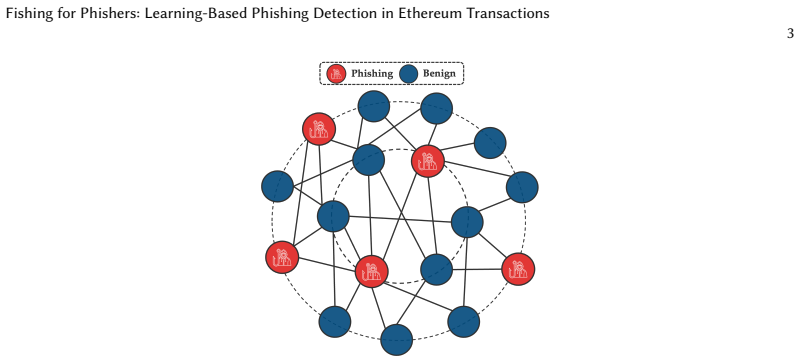
The machinery is a directed transaction graph $G=(V,E)$ whose nodes are Ethereum addresses and whose edges are transactions, combined with a GCN whose propagation rule is $H^{(l+1)} = \sigma(D^{-1/2} A D^{-1/2} H^{(l)} W^{(l)})$, where $A$ is the adjacency matrix, $D$ the degree matrix, and $W^{(l)}$ the learned weights. The node feature matrix is built from the 16 implicit behavioral features, including total value sent and received, average gas for sends and receives, mean and standard deviation of transaction hour, average, minimum, and maximum time between transactions, transaction duration, and weekend-activity ratios. A weighted cross-entropy loss $L = -\sum_i w_{y_i} \log p(y_i)$ counteracts the class imbalance (phishing is about 7.6% of transactions). Random Forest feature-importance ranking and statistical comparisons justify which implicit features are kept. The GCN's neighborhood aggregation lets an address's classification depend on the behavior of the addresses it transacts with.
What would settle it
Count unique Ethereum addresses in the graph and retrain the implicit-feature GCN under a strict address-level 80/20 split. The paper's own data table reports 'phishing nodes' and 'benign nodes' equal to the transaction counts, so the graph may treat transactions as nodes; if a correct address-level split leaves phishing-class recall near 0.33 rather than near the reported F1, the current result is partly label leakage.
Extended reading notes
Core claim
The paper's central discovery, stated on its own terms, is that implicit graph-derived features are the primary carriers of phishing signal for a GCN on Ethereum's transaction network. In the explicit-feature experiment (value, gas used, gas price, timestamp), the model collapses to essentially always predicting benign, with phishing recall of 0.00 and F1 of 0.01. In the implicit-feature experiment (16 handcrafted temporal and behavioral statistics per address), the same architecture reaches accuracy 0.95 and weighted F1 0.95, with per-class phishing precision 0.25, recall 0.33, and F1 0.28. Feature-importance analysis ranks total value sent, average gas used when sending, and inter-transaction timing as the strongest signals. The paper interprets this as evidence that relational and temporal behavior, not raw transaction values, distinguishes phishers, and that a small focused feature set can outperform a larger set of basic features—an advantage it attributes to adversarial settings where attackers can mimic obvious transaction attributes but not statistical behavioral patterns.
Load-bearing premise
The load-bearing premise is that the 80/20 split separates whole Ethereum addresses, so no address's transactions appear in both training and testing sets; if the split is actually at transaction level, the GCN can silently transfer labels between an address's training and test transactions, inflating the reported performance.
Editorial extensions
If this is right
- Feature design should be studied separately for each feature class; the paper shows that a 16-feature implicit set outperforms raw explicit fields for a GCN on the same data.
- Detection systems should favor temporal statistics such as inter-transaction intervals, hour-of-day variability, and weekend ratios over raw value and gas fields when constructing node features.
- The weighted loss function is a low-cost way to recover minority-class recall without extra hyperparameter tuning, which matters in networks where phishing is under 10% of activity.
- Graph-based models that propagate labels through address connectivity can surface suspicious addresses that explicit, per-transaction classifiers miss.
Reading between the lines
- An implication the paper leaves implicit is that the same behavioral features could transfer to other automated Ethereum fraud, such as token spamming or Ponzi-style payout patterns, which also produce burst activity and irregular inter-transaction timing.
- The reported weighted-average F1 of 0.95 is carried almost entirely by the benign majority class; a deployable system would need a cost-sensitive threshold tuned on per-class phishing precision-recall, which the paper itself flags as future work.
- Because the implicit features are computed from address histories, they could be updated incrementally as new blocks arrive, offering a streaming detection path that avoids re-training the full graph each time.
Signed reviews
Editorial analysis
A structured set of objections, weighed in public.
Referee Report
Summary. The paper proposes a GCN-based phishing detection system for Ethereum transactions, comparing two feature sets: explicit transactional features (value, gas, timestamp) and implicit graph/behavioral features (transaction counts, inter-transaction timing, weekend ratios, etc.). The authors report that implicit features substantially outperform explicit features, with accuracy rising from 0.79 to 0.95 and phishing recall from 0.00 to 0.33, and they further claim an F1-score of 0.95 for their approach. The paper also includes a Random Forest feature-importance analysis, a weighted loss for class imbalance, and a qualitative comparison with prior work.
Significance. If the empirical claims were supported, the paper would make a moderate contribution: a systematic per-feature-type comparison on a large Ethereum dataset, a compact set of temporal/behavioral implicit features, and a weighted-loss treatment of class imbalance. However, the evaluation as presented contains load-bearing inconsistencies: the reported split appears to be at the transaction level rather than the address level, which can leak test information into training; the explicit-feature metrics in Table 5 are arithmetically impossible; and the headline F1 of 0.95 in Table 1 and Section 5.4 is a weighted average that hides the much lower phishing-class scores. The paper does not provide code, full hyperparameters, or exact class weights, so the experiments are not reproducible as described. The central claim that implicit features outperform explicit features is therefore not established by the current evidence.
major comments (5)
- [4.1 and Table 3] The reported data split appears to be transaction-level rather than address-level, which leaks test information into training. Section 3.4 defines nodes as Ethereum addresses, and Section 3.1 states the dataset contains 7,915 unique phishing addresses, yet Table 3's 'Phishing Nodes' and 'Benign Nodes' totals (671,865 and 2,687,460) exactly match the phishing and benign transaction counts given in Section 4.1. If the 80/20 split was applied to transactions, the same address appears as a node in both training and test data; because the GCN is transductive and the implicit features in Section 3.3 are aggregated over each address's full transaction history, the reported implicit-feature gains in Section 5.3 can be inflated by label propagation and by features that already contain test-period information. The central comparison between implicit and explicit features is therefore unsupported by the evaluation as described.
- [5.2, Table 5] The phishing row of Table 5 reports precision 0.76, recall 0.00, and F1 0.01. With zero true positives, precision is 0 or undefined rather than 0.76, and the F1-score would be 0 rather than 0.01. These internally inconsistent numbers mean the explicit-feature baseline is not reliably characterized, which directly undermines the comparison in Section 5.4 and the claim that implicit features outperform explicit features.
- [5.4 and Table 1] Table 1 and Section 5.4 report F1 0.95, precision 0.96, and recall 0.95 for 'Our work,' but the phishing-class results in Table 6 are precision 0.25, recall 0.33, and F1 0.28. The high reported numbers are weighted averages dominated by the benign class. Presenting them as phishing detection performance overstates the method's ability to detect phishing addresses and makes the comparison with prior work in Table 1 misleading, since the prior rows report per-class metrics.
- [4.2 and 5.1] The Random Forest feature-importance analysis is described without any mention of a train/test split, and Section 3.3 applies Min-Max scaling using dataset-wide minima and maxima. If feature selection and scaling use the full dataset, then test-period information contributes to the construction of the training features. Combined with the transaction-level split identified above, this is an additional channel through which the reported improvement of implicit features could be inflated.
- [5.1, Table 4] The benign-node 'Avg time between tx' value of -5.16×10^4 seconds is impossible for a time interval. This indicates a computation or reporting error in the feature statistics used to justify the proposed feature set, and it reduces confidence in the surrounding statistical analysis.
minor comments (6)
- [Abstract] The phrase 'how feature affect model resilience' should read 'how features affect model resilience.'
- [3.1] The dataset composition is described as 'around 2M benign and around 600K phishing transactions'; exact counts are given later in Section 4.1, so the approximate language should be replaced with precise numbers throughout.
- [References] Reference [20] lists 'Author Name Kimber' as the author, which is a placeholder that should be corrected before submission.
- [3.4] The 'Edge Attributes' item says edges carry a phishing/benign label, but the task is node classification; this ambiguity should be clarified, since it is unclear whether the graph edges are labeled separately from node labels.
- [4.2] The GCN hyperparameters (number of layers, hidden dimensions, dropout rate, learning rate, epochs) and the exact class weights and decision threshold are not reported. Without these details the experiments are not reproducible.
- [3.3] Min-Max scaling should be fitted on the training set only and then applied to the test set; using dataset-wide minima and maxima as described leaks test-set statistics into training.
Circularity Check
Transaction-level split and full-data RF feature selection make the implicit-features 'prediction' partly a re-fit of training labels; the central comparison is not independently supported as reported.
-
fitted input called prediction
[Section 4.1 Data Splitting and Table 3, versus Section 3.4 Graph Construction]
"Ethereum transaction data was collected using the Etherscan API, comprising 671,865 phishing transactions from 7,915 phishing addresses and 2,687,460 benign transactions. ... The dataset, consisting of phishing and benign addresses, was divided into training and testing using an 80/20 split ... Table 3: Training Set 537,492 ... Testing Set 134,373 ... Total 671,865. ... each node represents an Ethereum address and each edge represents a transaction between two addresses."
The 'Phishing Nodes' column in Table 3 totals 671,865, exactly the number of phishing transactions, not the 7,915 phishing addresses; the benign column likewise totals 2,687,460, the number of benign transactions. Thus the 80/20 split is over transactions/rows, while the graph model defines nodes as addresses. A single address therefore appears in both training and testing, and the implicit features of Section 3.3 aggregate over the address's full transaction history (including test-period transactions). The GCN's reported test performance is partly a re-fit of labels already seen during training, not a prediction on unseen phishing addresses. The headline claim that selected implicit features outperform explicit features is not supported as an independent evaluation.
-
fitted input called prediction
[Section 3.3 Feature Analysis and Selection; Section 5.1 Distinguishing Features; Section 5.4 Comparative Evaluation]
"The RF classifier was then applied to rank the importance of the extracted features. This dual approach ensures a comprehensive understanding of feature relevance, enhancing the model's accuracy by focusing on the most predictive attributes. ... RF classifier was applied to accurately quantify the most important features for distinguishing phishing from benign nodes. ... Importantly, we combined this with statistical validation and feature importance ranking using Random Forests to systematically identify and prioritize the most predictive attributes."
The RF importance ranking is presented as the basis for the 'refined implicit features' used by the GCN, but the paper does not restrict the RF analysis to the training split; it is described in the Results as quantifying features 'distinguishing phishing from benign nodes' on the dataset as a whole. Because the same full dataset is then used to report the GCN's implicit-feature performance, the feature choice is fitted to the test labels. The conclusion that a small set of carefully selected features outperforms larger explicit sets therefore partially re-states the feature-selection signal instead of independently predicting it.
full rationale
The paper is an empirical comparison, not a derivation, so there is no equation-level equivalence between inputs and outputs. However, two reported design choices undermine the independence of the central 'implicit features outperform explicit features' claim. First, Table 3's node counts exactly equal transaction counts, while Section 3.4 defines nodes as addresses; this makes the 80/20 split transaction-level. With graph edges being transactions, the same address can appear in both training and testing, and the aggregate implicit features and GCN message passing let training labels leak into the reported test numbers. Second, the Random Forest feature-importance analysis is presented as the basis for the 'refined implicit features' used by the GCN, with no statement that it was restricted to the training split; if it used the full dataset, the feature selection was fit to the same labels later used for evaluation. Together these make several reported 'predictions' partly re-statements of the fitting input. Separate correctness issues, such as the impossible explicit-feature phishing precision of 0.76 with recall 0.00 in Table 5, are noted but are not circularity. No load-bearing self-citation was found; the phishing-address list is from an external GitHub dataset, and comparisons are against external baselines.
Assumptions & free parameters
free parameters (3)
- Phishing class weight in weighted loss =
not reported
- Classification threshold =
not reported
- GCN hyperparameters =
not reported
assumptions (6)
- domain assumption The public GitHub phishing address list is accurate and complete enough to label transactions.
- domain assumption Etherscan API transaction records are complete and correctly parsed.
- domain assumption Benign addresses selected from historical records have no undisclosed phishing involvement.
- domain assumption A transaction is phishing whenever a party is a known phishing address, and node labels are derived consistently from transaction labels.
- domain assumption GCN message passing is an appropriate model for Ethereum transaction networks.
- standard math Standard matrix operations and the GCN propagation rule (Equation 2) are valid.
Cite this review
Pith. "Pith review of Fishing for Phishers: Learning-Based Phishing Detection in Ethereum Transactions." pith.science (2026). https://pith.science/paper/IN6PXYIK
@misc{pith2026250417953,
  author       = {Pith},
  title        = {Pith review of: Fishing for Phishers: Learning-Based Phishing Detection in Ethereum Transactions},
  year         = {2026},
  howpublished = {\url{https://pith.science/paper/IN6PXYIK}},
  note         = {Machine review of arXiv:2504.17953}
}
read the original abstract
Phishing detection on Ethereum has increasingly leveraged advanced machine learning techniques to identify fraudulent transactions. However, limited attention has been given to understanding the effectiveness of feature selection strategies and the role of graph-based models in enhancing detection accuracy. In this paper, we systematically examine these issues by analyzing and contrasting explicit transactional features and implicit graph-based features, both experimentally and analytically. We explore how different feature sets impact the performance of phishing detection models, particularly in the context of Ethereum's transactional network. Additionally, we address key challenges such as class imbalance and dataset composition and their influence on the robustness and precision of detection methods. Our findings demonstrate the advantages and limitations of each feature type, while also providing a clearer understanding of how feature affect model resilience and generalization in adversarial environments.
Figures


Figures from the paper (1 more)

Reference graph
Works this paper leans on
-
[1]
Ayodeji Adeniran, Kieran Human, and David Mohaisen. 2024. Dissecting the Infrastructure Used in Web-based Cryptojacking: A Measurement Perspective. CoRR abs/2408.03426 (2024). https://doi.org/10.48550/ARXIV.2408.03426
work page Pith review arXiv doi:10.48550/arxiv.2408.03426 2024
-
[2]
Ashar Ahmad, Muhammad Saad, Mostafa A. Bassiouni, and Aziz Mohaisen. 2018. Towards Blockchain-Driven, Secure and Transparent Audit Logs. In Proceedings of the 15th EAI International Conference on Mobile and Ubiquitous Systems: Computing, Networking and Services, MobiQuitous 2018, 5-7 November 2018, New York City, NY, USA . ACM, 443–448. https://doi.org/10...
-
[3]
Ahod Alghuried and David Mohaisen. 2024. Simple Perturbations Subvert Ethereum Phishing Transactions Detection: An Empirical Analysis. In The 25th International Conference Information Security Applications, WISA . 1–12
work page 2024
-
[4]
Massimo Bartoletti, Stefano Lande, Andrea Loddo, Livio Pompianu, and Sergio Serusi. 2021. Cryptocurrency Scams: Analysis and Perspectives. IEEE Access 9 (2021), 148353–148373. https://doi.org/10.1109/ACCESS.2021.3123894
arXiv 2021
-
[5]
Shaista Bibi. 2019. Cryptocurrency world identification and public concerns detection via social media: student research abstract. In Proceedings of the 34th ACM/SIGAPP Symposium on Applied Computing, SAC . ACM, 550–552
work page 2019
-
[6]
Federico Cernera, Massimo La Morgia, Alessandro Mei, and Francesco Sassi. 2023. Token Spammers, Rug Pulls, and Sniper Bots: An Analysis of the Ecosystem of Tokens in Ethereum and in the Binance Smart Chain (BNB). In 32nd USENIX Security Symposium. USENIX Association, 3349–3366
work page 2023
-
[7]
Huashan Chen, Marcus Pendleton, Laurent Njilla, and Shouhuai Xu. 2021. A Survey on Ethereum Systems Security: Vulnerabilities, Attacks, and Defenses. ACM Comput. Surv. 53, 3 (2021), 67:1–67:43
work page 2021
-
[8]
Liang Chen, Jiaying Peng, Yang Liu, Jintang Li, Fenfang Xie, and Zibin Zheng. 2021. Phishing Scams Detection in Ethereum Transaction Network. ACM Trans. Internet Techn. 21, 1 (2021), 10:1–10:16
work page 2021
Show all 51 references
-
[9]
Weili Chen, Xiongfeng Guo, Zhiguang Chen, Zibin Zheng, and Yutong Lu. 2020. Phishing Scam Detection on Ethereum: Towards Financial Security for Blockchain Ecosystem. InProceedings of the Twenty-Ninth International Joint Conference on Artificial Intelligence, IJCAI. ijcai.org, ...
2020
-
[10]
Ling Cheng, Feida Zhu, Yong Wang, Ruicheng Liang, and Huiwen Liu. 2023. Evolve Path Tracer: Early Detection of Malicious Addresses in Cryptocurrency. In Proceedings of the 29th ACM SIGKDD Conference on Knowledge Discovery and Data Mining, KDD . ACM, 3889–3900
2023
-
[11]
Ling Cheng, Feida Zhu, Yong Wang, Ruicheng Liang, and Huiwen Liu. 2024. From Asset Flow to Status, Action, and Intention Discovery: Early Malice Detection in Cryptocurrency. ACM Trans. Knowl. Discov. Data 18, 3 (2024), 50:1–50:27
2024
-
[12]
Bingxue Fu, Xing Yu, and Tao Feng. 2022. CT-GCN: a phishing identification model for blockchain cryptocurrency transactions. Int. J. Inf. Sec. 21, 6 (2022), 1223–1232
2022
-
[13]
Letterio Galletta and Fabio Pinelli. 2024. Explainable Ponzi Schemes Detection on Ethereum. In Proceedings of the 39th ACM/SIGAPP Symposium on Applied Computing, SAC , Jiman Hong and Juw Won Park (Eds.). ACM, 1014–1023
2024
-
[14]
Bowen He, Yuan Chen, Zhuo Chen, Xiaohui Hu, Yufeng Hu, Lei Wu, Rui Chang, Haoyu Wang, and Yajin Zhou. 2023. TxPhishScope: Towards Detecting and Understanding Transaction-based Phishing on Ethereum. In Proceedings of the 2023 ACM SIGSAC Conference on Computer and Communications...
2023
-
[15]
Hwanjo Heo, Seungwon Woo, Taeung Yoon, Min Suk Kang, and Seungwon Shin. 2023. Partitioning Ethereum without Eclipsing It. In 30th Annual Network and Distributed System Security Symposium, NDSS . The Internet Society
2023
-
[16]
Lars Hornuf, Paul P Momtaz, Rachel J Nam, and Ye Yuan. 2023. Cybercrime on the ethereum blockchain. (2023)
2023
-
[17]
Jones, Miriam E
Keith S. Jones, Miriam E. Armstrong, McKenna K. Tornblad, and Akbar Siami Namin. 2021. How social engineers use persuasion principles during vishing attacks. Inf. Comput. Secur. 29, 2 (2021), 314–331. https://doi.org/10.1108/ICS-07- 2020-0113
2021 doi
-
[18]
Arkan Hammoodi Hasan Kabla, Mohammed Anbar, Selvakumar Manickam, and Shankar Karuppayah. 2022. Eth-PSD: A Machine Learning-Based Phishing Scam Detection Approach in Ethereum. IEEE Access 10 (2022), 118043–118057. , Vol. 1, No. 1, Article . Publication date: April 2025. 22 Ahod...
2022
-
[19]
Olaf Kampers, Abdulhakim Ali Qahtan, Swati Mathur, and Yannis Velegrakis. 2022. Manipulation detection in cryptocurrency markets: an anomaly and change detection based approach. In SAC ’22: The 37th ACM/SIGAPP Symposium on Applied Computing. ACM, 326–329
2022
-
[20]
Author Name Kimber. 2023. Scams on Ethereum. (2023). https://github.com/YNclusk/scamsonethereum
2023
-
[21]
Sijia Li, Gaopeng Gou, Chang Liu, Chengshang Hou, Zhenzhen Li, and Gang Xiong. 2022. TTAGN: Temporal Transaction Aggregation Graph Network for Ethereum Phishing Scams Detection. In WWW ’22: The ACM Web Conference 2022. ACM, 661–669
2022
-
[22]
Sijia Li, Gaopeng Gou, Chang Liu, Gang Xiong, Zhen Li, Junchao Xiao, and Xinyu Xing. 2023. TGC: Transaction Graph Contrast Network for Ethereum Phishing Scam Detection. In Annual Computer Security Applications Conference, ACSAC. ACM, 352–365
2023
-
[23]
Shucheng Li, Runchuan Wang, Hao Wu, Sheng Zhong, and Fengyuan Xu. 2023. SIEGE: Self-Supervised Incremental Deep Graph Learning for Ethereum Phishing Scam Detection. In Proceedings of the 31st ACM International Conference on Multimedia, MM. ACM, 8881–8890
2023
-
[24]
Zhutian Lin, Xi Xiao, Guangwu Hu, Bin Zhang, Qixu Liu, and Xiapu Luo. 2023. Phish2vec: A Temporal and Heteroge- neous Network Embedding Approach for Detecting Phishing Scams on Ethereum. In 20th Annual IEEE International Conference on Sensing, Communication, and Networking, SE...
2023
-
[25]
Jieli Liu, Jinze Chen, Jiajing Wu, Zhiying Wu, Junyuan Fang, and Zibin Zheng. 2024. Fishing for Fraudsters: Uncovering Ethereum Phishing Gangs With Blockchain Data. IEEE Trans. Inf. Forensics Secur. 19 (2024), 3038–3050
2024
-
[26]
NetworkX. 2024. NetworkX. https://networkx.org/. (2024). Accessed: 2024-11
2024
-
[27]
Cuong Phuc Ngo, Amadeus Aristo Winarto, Connie Khor Li Kou, Sojeong Park, Farhan Akram, and Hwee Kuan Lee
-
[28]
Pawel Pinio, Roman Batko, and Dagmara Lewicka. 2024. Between Theory and Value Transactions: A Multifaceted Exploration of Relevance and Resilience of Decentralised Autonomous Organisations. In Proceedings of the 2024 7th International Conference on Software Engineering and Inf...
2024
-
[29]
Muhammad Saad, Ashar Ahmad, and Aziz Mohaisen. 2019. Fighting Fake News Propagation with Blockchains. In 7th IEEE Conference on Communications and Network Security, CNS 2019, Washington, DC, USA, June 10-12, 2019 . IEEE, 1–4. https://doi.org/10.1109/CNS.2019.8802670
2019
-
[30]
2022.RouteChain: Towards Blockchain-based secure and efficient BGP routing
Muhammad Saad, Afsah Anwar, Ashar Ahmad, Hisham Alasmary, Murat Yuksel, and David Mohaisen. 2022.RouteChain: Towards Blockchain-based secure and efficient BGP routing. Comput. Networks 217 (2022), 109362. https://doi.org/10. 1016/J.COMNET.2022.109362
2022
-
[31]
Muhammad Saad, Songqing Chen, and David Mohaisen. 2021. SyncAttack: Double-spending in Bitcoin Without Mining Power. In CCS ’21: 2021 ACM SIGSAC Conference on Computer and Communications Security, Virtual Event, Republic of Korea, November 15 - 19, 2021 . ACM, 1668–1685. https...
2021
-
[32]
Muhammad Saad, Jinchun Choi, DaeHun Nyang, Joongheon Kim, and Aziz Mohaisen. 2020. Toward Characterizing Blockchain-Based Cryptocurrencies for Highly Accurate Predictions. IEEE Syst. J. 14, 1 (2020), 321–332. https: //doi.org/10.1109/JSYST.2019.2927707
2020
-
[33]
Muhammad Saad, Joongheon Kim, DaeHun Nyang, and David Mohaisen. 2021. Contra-∗: Mechanisms for countering spam attacks on blockchain’s memory pools. J. Netw. Comput. Appl. 179 (2021), 102971. https://doi.org/10.1016/J.JNCA. 2020.102971
2021
-
[34]
Muhammad Saad and David Mohaisen. 2023. Three Birds with One Stone: Efficient Partitioning Attacks on Interde- pendent Cryptocurrency Networks. In 44th IEEE Symposium on Security and Privacy, SP . IEEE, 111–125
2023
-
[35]
Kamhoua, Joongheon Kim, DaeHun Nyang, and Aziz Mohaisen
Muhammad Saad, Laurent Njilla, Charles A. Kamhoua, Joongheon Kim, DaeHun Nyang, and Aziz Mohaisen. 2019. Mempool optimization for Defending Against DDoS Attacks in PoW-based Blockchain Systems. In IEEE International Conference on Blockchain and Cryptocurrency, ICBC 2019, Seoul...
2019
-
[36]
Kamhoua, and Aziz Mohaisen
Muhammad Saad, Laurent Njilla, Charles A. Kamhoua, and Aziz Mohaisen. 2019. Countering Selfish Mining in Blockchains. In International Conference on Computing, Networking and Communications, ICNC 2019, Honolulu, HI, USA, February 18-21, 2019 . IEEE, 360–364. https://doi.org/10...
2019
-
[37]
Kamhoua, Sachin Shetty, DaeHun Nyang, and David Mohaisen
Muhammad Saad, Jeffrey Spaulding, Laurent Njilla, Charles A. Kamhoua, Sachin Shetty, DaeHun Nyang, and David Mohaisen. 2020. Exploring the Attack Surface of Blockchain: A Comprehensive Survey. IEEE Commun. Surv. Tutorials 22, 3 (2020), 1977–2008
2020
-
[38]
Marie Vasek and Tyler Moore. 2015. There’s No Free Lunch, Even Using Bitcoin: Tracking the Popularity and Profits of Virtual Currency Scams. In Financial Cryptography and Data Security - 19th International Conference, FC (Lecture Notes in Computer Science) , Vol. 8975. Springer, 44–61
2015
-
[39]
Yun Wan, Feng Xiao, and Dapeng Zhang. 2023. Early-stage phishing detection on the Ethereum transaction network. Soft Comput. 27, 7 (2023), 3707–3719. https://doi.org/10.1007/S00500-022-07661-0 , Vol. 1, No. 1, Article . Publication date: April 2025. Fishing for Phishers: Learn...
2023 doi
-
[40]
Jinhuan Wang, Pengtao Chen, Xinyao Xu, Jiajing Wu, Meng Shen, Qi Xuan, and Xiaoniu Yang. 2022. TSGN: Transaction Subgraph Networks Assisting Phishing Detection in Ethereum. CoRR abs/2208.12938 (2022)
2022 arXiv
-
[41]
Kai Wang, Michael Tong, Jun Pang, Jitao Wang, and Weili Han. 2024. XRAD: Ransomware Address Detection Method based on Bitcoin Transaction Relationships. ACM Trans. Web (2024)
2024
-
[42]
Tingke Wen, Yuanxing Xiao, Anqi Wang, and Haizhou Wang. 2023. A novel hybrid feature fusion model for detecting phishing scam on Ethereum using deep neural network. Expert Syst. Appl. 211 (2023), 118463
2023
-
[43]
Jiajing Wu, Qi Yuan, Dan Lin, Wei You, Weili Chen, Chuan Chen, and Zibin Zheng. 2022. Who Are the Phishers? Phishing Scam Detection on Ethereum via Network Embedding. IEEE Trans. Syst. Man Cybern. Syst. 52, 2 (2022), 1156–1166
2022
-
[44]
Yijun Xia, Jieli Liu, and Jiajing Wu. 2022. Phishing Detection on Ethereum via Attributed Ego-Graph Embedding. IEEE Trans. Circuits Syst. II Express Briefs 69, 5 (2022), 2538–2542
2022
-
[45]
Yufeng Xu, Lun Zhang, Turan Vural, Peng Qian, Yanbin Wang, Yuqing Fan, Ming Li, Xueyan Tang, and Zheng Cao
-
[46]
Mingxuan Yao, Runze Zhang, Haichuan Xu, Shih-Huan Chou, Varun Chowdhary Paturi, Amit Kumar Sikder, and Brendan Saltaformaggio. 2024. Pulling Off The Mask: Forensic Analysis of the Deceptive Creator Wallets Behind Smart Contract Fraud. In IEEE Symposium on Security and Privacy,...
2024
-
[47]
Parizi, Mohammad Hammoudeh, Hadis Karimipour, and Gautam Srivastava
Abbas Yazdinejad, Ali Dehghantanha, Reza M. Parizi, Mohammad Hammoudeh, Hadis Karimipour, and Gautam Srivastava. 2022. Block Hunter: Federated Learning for Cyber Threat Hunting in Blockchain-Based IIoT Networks. IEEE Trans. Ind. Informatics 18, 11 (2022), 8356–8366
2022
-
[48]
Qi Yuan, Baoying Huang, Jie Zhang, Jiajing Wu, Haonan Zhang, and Xi Zhang. 2020. Detecting Phishing Scams on Ethereum Based on Transaction Records. In IEEE International Symposium on Circuits and Systems, ISCAS . IEEE, 1–5
2020
-
[49]
Xuanchen Zhou, Wenzhong Yang, and Xiaodan Tian. 2023. Detecting Phishing Accounts on Ethereum Based on Transaction Records and EGAT. Electronics 12, 4 (2023). , Vol. 1, No. 1, Article . Publication date: April 2025
2023
-
[2019]
In 31st IEEE International Conference on Tools with Artificial Intelligence, ICTAI
Fence GAN: Towards Better Anomaly Detection. In 31st IEEE International Conference on Tools with Artificial Intelligence, ICTAI. IEEE, 141–148
-
[2023]
In Proceedings of the 2023 7th International Conference on Electronic Information Technology and Computer Engineering, EITCE
STFN: Spatio-Temporal Fusion Network to Detect Ethereum Phishing Scams. In Proceedings of the 2023 7th International Conference on Electronic Information Technology and Computer Engineering, EITCE . ACM, 599–605
2023
Reviewed August 16, 2026 · model on record in the stance chip above.
Discussion (0). Continue with ORCID to comment.