REVIEW 5 major objections 6 minor 69 references
Flow Along the K-Amplitude for Generative Modeling
T0 review · 5 major / 6 minor · reviewed 2026-08-16 · deepseek-v4-flash
Pith's one-line read K-Flow replaces the flow-matching clock with a scale axis, letting generation be steered by frequency band while matching competitive image and molecule quality.
desk verdict Scale-as-time flow matching is a genuinely fresh idea, but Eq. (10) as written never produces the claimed noise-to-data path, so the central derivation needs a corrected version before the paper can be trusted. read the letter →
The pith
A machine-rendered reading of the paper's core claim, the machinery that carries it, and where it could break.
The reading
What carries the argument
The central object is the K-amplitude interpolant, Eq. (10): an invertible transform $\mathcal{F}$ maps the signal into scale-indexed bands, and $\Psi_k$ combines already-filled low bands of data, noise-padded high bands, and a single active band interpolated by the bump function $\mu(t)$ with $t = k - \lfloor k \rfloor$. The bump's derivative antisymmetry makes the path differentiable in $k$, and for linear transforms its conditional derivative, Eq. (11), is nonzero only inside the active band. This localization is what limits the network's velocity field to one band per step and what lets the frozen noise in inactive bands act as a controllable condition during generation.
What would settle it
Evaluate Eq. (10) at an integer k, say k = 1, for a one-dimensional two-band signal and compare it with the discrete sample $\varphi_k$ defined in Eq. (9); for a valid interpolant the two must agree at every integer k, and a finite-difference derivative of Eq. (10) across a fractional interval must equal Eq. (11). Because the second noise term in Eq. (10) is written as $\left(1 - I_{r\ge \lfloor k\rfloor+1}\right)\epsilon$, this equality can fail on the already-filled low bands; correcting that term to $I_{r\ge \lfloor k\rfloor+1}\epsilon$ and rerunning the check would settle whether the localized vector field and the training loss describe the same path.
Extended reading notes
Core claim
The paper's central claim is that the flow-matching clock can be identified with a scale index. For an invertible transform that groups a signal's coefficients by a one-dimensional scaling parameter $k$, K-Flow defines an interpolant $\Psi_k$ in the K-amplitude space: coefficients with scale below $\lfloor k \rfloor$ are set to the data's coefficients, coefficients beyond the next integer band are seeded with independent noise, and the one active band in between is driven from noise to data by a bump function $\mu(t)$ with $\mu(0)=\mu(1)=1$ and $\mu'(0)=-\mu'(1)$. For linear transforms the conditional derivative $d\Psi_k/dk$ is nonzero only on that active band, so the learned velocity field is localized and learns the transport of one band at a time. Training with the conditional flow-matching loss over uniformly sampled $k$ therefore learns the unconditional transport from pure noise to data, and because inactive bands are frozen during each stage, their noise seeds act as conditions that allow scale-wise steering of generated content.
Load-bearing premise
The load-bearing premise is that Eq. (10) defines a genuine stochastic interpolant: at each integer k it equals the discrete construction with low bands filled with data and higher bands pure noise, and at fractional k its derivative is Eq. (11); if the second noise term in Eq. (10) also touches bands that already carry data or the active interpolated band, the path and the learned velocity field describe different processes.
Editorial extensions
If this is right
- Because the construction is independent of the specific invertible transform, any one-dimensional scale ordering of a complete basis, such as Fourier, wavelet, or PCA, yields a valid flow-matching generative model, and the paper demonstrates all three.
- The flow path is scale-localized, so at each step only one frequency band contributes to the velocity; this allows computational effort to be concentrated on active bands and more steps to be spent on low scales, where image energy concentrates.
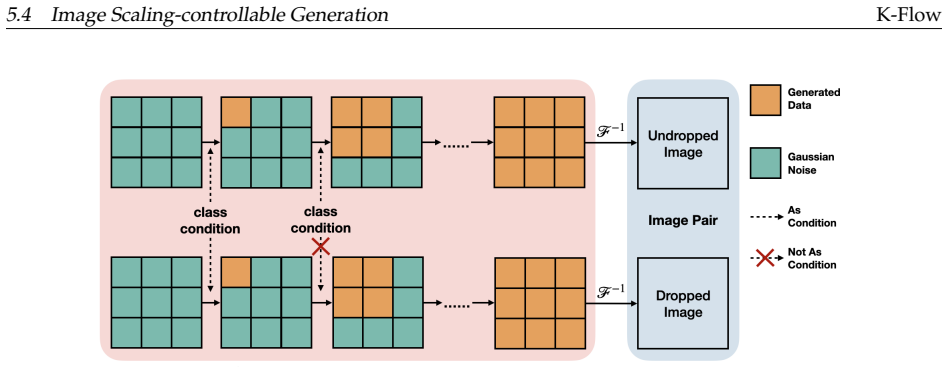
- Inactive bands' noise stays fixed during each stage, so generation becomes steerable without fine-tuning: fixing high-scale noise edits low-scale content, and fixing low-scale noise edits high-scale details.
- Class-conditional generation inherits the same localization: the reported class-dropping behavior indicates that class information mainly steers early, low-scale stages, so later stages can run with the condition removed.
- In molecular assembly, combining K-Flow with spectral decomposition of pairwise distances on top of rigid-frame flow matching improves packing matching relative to the compared crystal flow and diffusion baselines.
Reading between the lines
- One extension the paper does not pursue is to exploit the localization of Eq. (11) architecturally: because the velocity is nonzero only on the active band, a conditional computation model could evaluate the network on that band alone and keep the remaining coefficients frozen, cutting per-step cost.
- The paper's observation that low scales carry most of the energy invites an explicit scheduling rule it stops short of deriving: sample discrete scale steps proportionally to band energy, or choose the bump function per band, so compute follows energy.
- Since the paper reports both low-to-high and reversed high-to-low flows, a natural generalization is choosing flow direction per task; high-frequency-first generation would be a testable target in medical or scientific imaging where fine detail is primary.
- The reported failure of PCA-based K-Flow to give human-interpretable edits suggests scale ordering, not just invertibility, determines steerability; learning the band ordering itself from data would be a concrete next step that this paper leaves open.
Signed reviews
Editorial analysis
A structured set of objections, weighed in public.
Referee Report
Summary. The paper proposes K-Flow, a flow-matching generative framework in which the usual generative time variable is replaced by a scaling parameter k indexing frequency-like bands of an invertible K-amplitude transform (Fourier, wavelet, or data-dependent PCA). Section 3.1 defines a continuous interpolant Ψ_k between noise and data, derives a localized conditional vector field dΨ_k/dk, and trains a velocity network with a conditional flow-matching loss. The paper reports FID and Recall results on CelebA-HQ, LSUN Church, and ImageNet, three controllability ablations, and molecular assembly results on COD-Cluster17, concluding that K-Flow achieves competitive or better performance and enables explicit scale-wise steering of generation.
Significance. At a high level, the central idea is attractive and potentially broader than one more diffusion variant: organizing the generation path by the scale index of an invertible transform is a clean conceptual contribution, and the proposed plug-in replacement of the time embedding by a scale embedding is plausible. If the construction in Section 3.1 is corrected, the paper would supply a general recipe for scale-parametrized interpolants, and the qualitative steerability experiments, especially the shared-noise manipulations in Section 5.4, are useful demonstrations. The paper also states its own limitations and mitigation arguments in Section 5.4, which is to its credit. The main difficulty is that the written derivation does not support the method as presented: Equations (10)-(12) contain load-bearing errors, and the empirical tables cannot substitute for a correct central derivation.
major comments (5)
- [Section 3.1, Eq. (10)] The K-amplitude interpolant as written double-counts noise. The second term (1 − I_{r≥⌊k⌋+1})ε is active for every coefficient with r < ⌊k⌋+1, which includes the low band r < ⌊k⌋ that is already set to Fφ in the first term and the active band r∈[⌊k⌋,⌊k⌋+1) that is interpolated in the third term. The bullet list immediately below Eq. (10) describes the intended term as noise padding for r ≥ ⌊k⌋+1, so the displayed equation and its own explanation disagree. Consequently Ψ_k does not equal the discrete flow φ_k of Eq. (9) at integer k, and the stated endpoint property is false. Since Eq. (11) and the loss Eq. (12) are derived from this path, the central derivation is not currently valid.
- [Section 3.1, Eq. (11)] Eq. (11) is not the derivative of Eq. (10). Within the active band, differentiating the third term of Eq. (10) with respect to k gives μ′(t)(Fφ − ε), not μ′(t)(ε − Fφ); the printed expression has the opposite sign. In addition, if the noise-padding term were corrected to I_{r≥⌊k⌋+1}ε as the surrounding text suggests, its derivative with respect to k is not included, and the localized vector field shown in Eq. (11) is not a complete derivative of any version of Eq. (10) printed in the paper.
- [Section 3.1, bump-function conditions] The stated conditions μ(0)=μ(1)=1 make the active band equal to Fφ at both endpoints of every interval, so at integer k the active band contains data rather than noise. A noise-to-data interpolant over the active band requires μ(0)=0 and μ(1)=1, with endpoint derivative compatibility conditions chosen so that the interpolant matches the discrete flow at integer k and is differentiable in k. The printed condition μ′(0)=−μ′(1) does not provide this, and the sentence below Eq. (10) claiming that the antisymmetric derivative makes Ψ_k differentiable is therefore not justified.
- [Section 3.1, Eq. (12)] The training objective in Eq. (12) is not the conditional flow-matching objective introduced in Eq. (8). It is written as an expectation over φ0 of an integral with an unexplained factor dφ0 dk, and it does not explicitly average over the noise ε that conditions the vector field in Eq. (11). The correct conditional flow-matching loss should be an expectation over joint pairs (φ, ε), or a factorization with a conditional noise distribution, followed by an integral over k of ‖v_k(Ψ_k;θ) − dΨ_k/dk‖². As printed, the conditioning structure that defines K-Flow disappears from the loss.
- [Section 4.1, Eq. (15)] The factorization in Eq. (15) is asserted without derivation and is not a consequence of Eq. (10) as printed. For a general invertible transform F, conditional independence of the high-band noise from the low-band data is not automatic and must follow from the exact structure of the interpolant; with the noise term in Eq. (10) double-counting low and active bands, the claimed product form is not verifiable. This matters because the steerability experiments in Section 5.4 are motivated by this factorization, so the theoretical support for those experiments is currently missing.
minor comments (6)
- [Section 5.1, Tables 2 and 3] The sentence 'Table 2 summarizes the results on LSUN Church' appears to refer to Table 3, since the LSUN Church results are reported in Table 3.
- [Section 2.3, Eq. (8)] In Eq. (8), the integration bound is the same letter t as the dummy time variable, and the integral should run over the full interval [0,1]; as written the expression is not well formed.
- [Section 3.1 and Algorithm 1] The main derivation uses k∈[0,K], but Algorithm 1 normalizes k←k/kmax and samples k∼U(0,1); the normalization should be stated in the derivation because it rescales the vector field and affects the strength of the loss.
- [Section 3.3 and Algorithm 1] The bump function μ(t) is never specified in the experiments; the authors should report the explicit form used to produce Tables 2-5, since the paper emphasizes the role of μ in differentiability and localization.
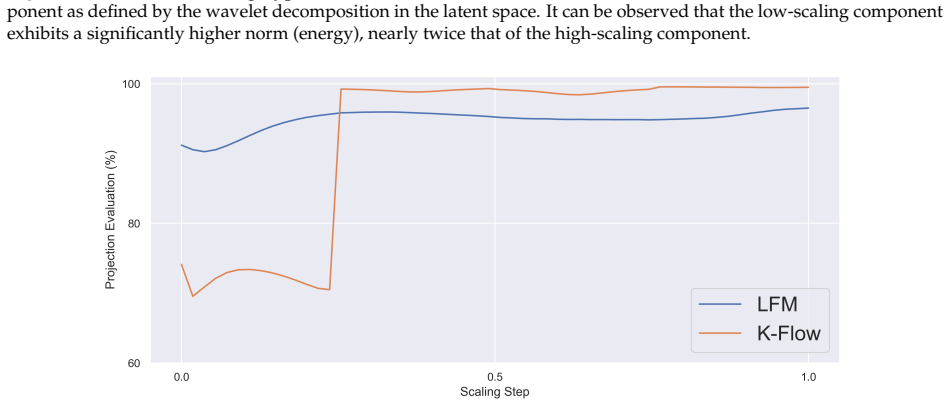
- [Figure 3] Figure 3 does not label its axes and does not state the normalization of the 'relative norm distribution', which makes the low-scaling hypothesis difficult to verify from the figure.
- [Section 3.2] The heading 'Date-dependent PCA Transform' should read 'Data-dependent PCA Transform'.
Circularity Check
K-Flow is a construction-plus-benchmark paper; no load-bearing circularity, only a non-load-bearing self-citation and an internal Eq. (10)/(11) consistency issue that is a correctness matter, not circularity.
full rationale
The central derivation is a direct construction: Eq. (10) defines a K-amplitude interpolant, Eq. (11) is stated as its conditional derivative, and Eq. (12) is the standard conditional flow-matching objective applied to that derivative. The vector field is not fit to a subset of outputs and then used to predict the same outputs; instead, the learned field is trained against an explicitly defined path, and performance is judged against independent baselines with standard metrics (FID, Recall, PM). The paper does cite prior work by overlapping authors, notably AssembleFlow [61] in the molecular experiments and the PCA-denoising remark citing [47] in Sec. 4.4, but these citations are not load-bearing for the central claim: AssembleFlow is used as an external baseline and as an incremental starting point, not as a uniqueness theorem or a justification that forbids alternatives, and the [47] remark is peripheral. The alleged inconsistency between Eq. (10) and Eq. (11) — the printed indicator in the noise padding term appears to double-count noise at low bands, so Eq. (11) may not be the true derivative — is an internal mathematical or typographical defect, not circular reasoning: the claimed reduction is from a stated definition to a consequence of that definition, and the derivation would be self-contained once the interpolant is corrected. The explicit caveats in the paper, such as PCA editing not being interpretable and unexpected high-scaling changes in reversed flow, further indicate that the claims are empirically checked rather than forced by construction. I therefore find no significant circularity.
Assumptions & free parameters
free parameters (3)
- bump function mu(t)
- number of K-amplitude scaling groups =
two or three
- class-condition drop fraction for CDR =
30%
assumptions (4)
- domain assumption The K-amplitude transform F is invertible and linear, so F^{-1} maps coefficient-space noise to a tractable prior and reconstructs signals.
- standard math Conditional flow matching is equivalent to unconditional flow matching at the loss level.
- domain assumption The data distribution factorizes across scales as p(k0)p(k1|k0)...p(kmax|...).
- domain assumption Natural images and latent codes concentrate energy in low scaling components.
Cite this review
Pith. "Pith review of Flow Along the K-Amplitude for Generative Modeling." pith.science (2026). https://pith.science/paper/2QPDSNZG
@misc{pith2026250419353,
  author       = {Pith},
  title        = {Pith review of: Flow Along the K-Amplitude for Generative Modeling},
  year         = {2026},
  howpublished = {\url{https://pith.science/paper/2QPDSNZG}},
  note         = {Machine review of arXiv:2504.19353}
}
abstract
In this work, we propose a novel generative learning paradigm, K-Flow, an algorithm that flows along the $K$-amplitude. Here, $k$ is a scaling parameter that organizes frequency bands (or projected coefficients), and amplitude describes the norm of such projected coefficients. By incorporating the $K$-amplitude decomposition, K-Flow enables flow matching across the scaling parameter as time. We discuss three venues and six properties of K-Flow, from theoretical foundations, energy and temporal dynamics, and practical applications, respectively. Specifically, from the practical usage perspective, K-Flow allows steerable generation by controlling the information at different scales. To demonstrate the effectiveness of K-Flow, we conduct experiments on unconditional image generation, class-conditional image generation, and molecule assembly generation. Additionally, we conduct three ablation studies to demonstrate how K-Flow steers scaling parameter to effectively control the resolution of image generation.
Figures


Figures from the paper (9 more)



Reference graph
Works this paper leans on
-
[1]
Improving language understanding by generative pre-training in (2018)
Radford, A. Improving language understanding by generative pre-training in (2018)
work page 2018
-
[2]
Hinton, G. E. Training products of experts by minimizing contrastive divergence. Neural computation 14, 1771– 1800 (2002)
work page 2002
-
[3]
Carreira-Perpinan, M. A. & Hinton, G. On contrastive divergence learning in International workshop on artificial intel- ligence and statistics (2005), 33–40
work page 2005
-
[4]
A tutorial on energy-based learning
LeCun, Y., Chopra, S., Hadsell, R., Ranzato, M., Huang, F., et al. A tutorial on energy-based learning. Predicting structured data 1 (2006)
work page 2006
-
[5]
Gutmann, M. & Hyvärinen, A. Noise-contrastive estimation: A new estimation principle for unnormalized statistical models in Proceedings of the thirteenth international conference on artificial intelligence and statistics (2010), 297–304
work page 2010
-
[6]
Song, Y. & Kingma, D. P . How to train your energy-based models. arXiv preprint arXiv:2101.03288 (2021)
arXiv 2021
-
[7]
Kingma, D. P . Auto-encoding variational bayes. arXiv preprint arXiv:1312.6114 (2013)
arXiv 2013
-
[8]
Goodfellow, I., Pouget-Abadie, J., Mirza, M., Xu, B., Warde-Farley, D., Ozair, S., Courville, A. & Bengio, Y. Gener- ative adversarial nets. Advances in neural information processing systems 27 (2014)
work page 2014
Show all 69 references
-
[9]
T., Ben-Hamu, H., Nickel, M
Lipman, Y., Chen, R. T., Ben-Hamu, H., Nickel, M. & Le, M. Flow matching for generative modeling. arXiv preprint arXiv:2210.02747 (2022)
2022 arXiv
-
[10]
& Liu, Q
Liu, X., Gong, C. & Liu, Q. Flow straight and fast: Learning to generate and transfer data with rectified flow. arXiv preprint arXiv:2209.03003 (2022)
2022 arXiv
-
[11]
Albergo, M. S. & Vanden-Eijnden, E. Building normalizing flows with stochastic interpolants. arXiv preprint arXiv:2209.15571 (2022)
2022 arXiv
-
[12]
A connection between score matching and denoising autoencoders
Vincent, P . A connection between score matching and denoising autoencoders. Neural computation 23, 1661–1674 (2011)
2011
-
[13]
& Ermon, S
Song, Y. & Ermon, S. Generative modeling by estimating gradients of the data distribution. Advances in neural information processing systems 32 (2019)
2019
-
[14]
& Abbeel, P
Ho, J., Jain, A. & Abbeel, P . Denoising diffusion probabilistic models. Advances in neural information processing systems 33, 6840–6851 (2020)
2020
-
[15]
& Siarohin, A
Skorokhodov, I., Girish, S., Hu, B., Menapace, W., Li, Y., Abdal, R., Tulyakov, S. & Siarohin, A. Improving the Diffusability of Autoencoders. arXiv preprint arXiv:2502.14831 (2025)
2025 arXiv
-
[16]
Scaling and renormalization in statistical physics (Cambridge university press, 1996)
Cardy, J. Scaling and renormalization in statistical physics (Cambridge university press, 1996)
1996
-
[17]
& Blöte, H
Luijten, E. & Blöte, H. W. Finite-size scaling and universality above the upper critical dimensionality. Physical review letters 76, 1557 (1996)
1996
-
[18]
& Zan, B
Behan, C., Rastelli, L., Rychkov, S. & Zan, B. A scaling theory for the long-range to short-range crossover and an infrared duality. Journal of Physics A: Mathematical and Theoretical 50, 354002 (2017)
2017
-
[19]
& Defenu, N
Bighin, G., Enss, T. & Defenu, N. Universal scaling in real dimension. Nature Communications 15, 4207 (2024)
2024
-
[20]
& Flandrin, P
Abry, P ., Gonçalvès, P . & Flandrin, P . in Wavelets and Statistics (eds Antoniadis, A. & Oppenheim, G.) 15–29 (Springer New York, New York, NY, 1995). ISBN : 978-1-4612-2544-7. https://doi.org/10.1007/978- 1- 4612- 2544-7_2
1995 doi
-
[21]
Kingma, D., Salimans, T., Poole, B. & Ho, J. Variational diffusion models. Advances in neural information processing systems 34, 21696–21707 (2021)
2021
-
[22]
Burt, P . J. & Adelson, E. H. in Readings in computer vision 671–679 (Elsevier, 1987)
1987
-
[23]
& Wang, L
Tian, K., Jiang, Y., Yuan, Z., Peng, B. & Wang, L. Visual autoregressive modeling: Scalable image generation via next-scale prediction. arXiv preprint arXiv:2404.02905 (2024)
2024 arXiv
-
[24]
Edify Image: High-Quality Image Generation with Pixel Space Laplacian Diffusion Models
Atzmon, Y., Bala, M., Balaji, Y., Cai, T., Cui, Y., Fan, J., Ge, Y., Gururani, S., Huffman, J., Isaac, R.,et al. Edify Image: High-Quality Image Generation with Pixel Space Laplacian Diffusion Models. arXiv preprint arXiv:2411.07126 (2024)
2024 arXiv
-
[25]
Field, D. J. Relations between the statistics of natural images and the response properties of cortical cells. J. Opt. Soc. Am. A 4, 2379–2394. https://opg.optica.org/josaa/abstract.cfm?URI=josaa-4-12-2379 (Dec. 1987)
1987
-
[26]
S., Boffi, N
Albergo, M. S., Boffi, N. M. & Vanden-Eijnden, E. Stochastic interpolants: A unifying framework for flows and diffusions. arXiv preprint arXiv:2303.08797 (2023). 21 REFERENCES K-Flow
2023 arXiv
-
[27]
& Freeman, W
Weiss, Y. & Freeman, W. T. What makes a good model of natural images? in 2007 IEEE conference on computer vision and pattern recognition (2007), 1–8
2007
-
[28]
Mallat, S. G. Multiresolution approximations and wavelet orthonormal bases of L2(R). Transactions of the American Mathematical Society 315, 69–87 (1989)
1989
-
[29]
Izenman, A. J. Introduction to manifold learning. Wiley Interdisciplinary Reviews: Computational Statistics4, 439–446 (2012)
2012
-
[30]
& Gao, X
Chu, Y., Zhang, Y., Han, Z., Yang, C., Zhou, L., Luo, G. & Gao, X. Improving Representation of High-frequency Components for Medical Foundation Models. arXiv preprint arXiv:2407.14651 (2024)
2024 arXiv
-
[31]
P ., Kumar, A., Ermon, S
Song, Y., Sohl-Dickstein, J., Kingma, D. P ., Kumar, A., Ermon, S. & Poole, B. Score-based generative modeling through stochastic differential equations. arXiv preprint arXiv:2011.13456 (2020)
2020 arXiv
-
[32]
& Xie, S
Peebles, W. & Xie, S. Scalable diffusion models with transformersin Proceedings of the IEEE/CVF International Conference on Computer Vision (2023), 4195–4205
2023
-
[33]
& Chen, R
Zheng, Q., Le, M., Shaul, N., Lipman, Y., Grover, A. & Chen, R. T. Guided flows for generative modeling and decision making. arXiv preprint arXiv:2311.13443 (2023)
2023 arXiv
-
[34]
& Chen, C
Zhou, Z., Chen, D., Wang, C. & Chen, C. Fast ode-based sampling for diffusion models in around 5 steps in Proceedings of the IEEE/CVF Conference on Computer Vision and Pattern Recognition (2024), 7777–7786
2024
-
[35]
J., Mohamed, S
Papamakarios, G., Nalisnick, E., Rezende, D. J., Mohamed, S. & Lakshminarayanan, B. Normalizing flows for probabilistic modeling and inference. Journal of Machine Learning Research 22, 1–64 (2021)
2021
-
[36]
T., Rubanova, Y., Bettencourt, J
Chen, R. T., Rubanova, Y., Bettencourt, J. & Duvenaud, D. K. Neural ordinary differential equations. Advances in neural information processing systems 31 (2018)
2018
-
[37]
& Santambrogio, F
Lavenant, H. & Santambrogio, F. The flow map of the fokker–planck equation does not provide optimal transport. Applied Mathematics Letters 133, 108225 (2022)
2022
-
[38]
& Holynski, A
Li, Z., Tucker, R., Snavely, N. & Holynski, A. Generative image dynamics in Proceedings of the IEEE/CVF Conference on Computer Vision and Pattern Recognition (2024), 24142–24153
2024
-
[39]
& Liu, D
Lei, J., Hu, X., Wang, Y. & Liu, D. Pyramidflow: High-resolution defect contrastive localization using pyramid normalizing flow in Proceedings of the IEEE/CVF conference on computer vision and pattern recognition (2023), 14143–14152
2023
-
[40]
& Lin, Z
Jin, Y., Sun, Z., Li, N., Xu, K., Jiang, H., Zhuang, N., Huang, Q., Song, Y., Mu, Y. & Lin, Z. Pyramidal flow matching for efficient video generative modeling. arXiv preprint arXiv:2410.05954 (2024)
2024
-
[41]
& Dekel, S
Mattar, W., Levy, I., Sharon, N. & Dekel, S. Wavelets are all you need for autoregressive image generation. arXiv preprint arXiv:2406.19997 (2024)
2024 arXiv
-
[42]
& Tran, A
Phung, H., Dao, Q. & Tran, A. Wavelet diffusion models are fast and scalable image generators in Proceedings of the IEEE/CVF conference on computer vision and pattern recognition (2023), 10199–10208
2023
-
[43]
& Kautz, J
Liu, S., De Mello, S. & Kautz, J. CosAE: Learnable Fourier Series for Image Restoration in The Thirty-eighth Annual Conference on Neural Information Processing Systems ()
-
[44]
& Tang, J
Liu, S., Guo, H. & Tang, J. Molecular geometry pretraining with se (3)-invariant denoising distance matching. arXiv preprint arXiv:2206.13602 (2022)
2022 arXiv
-
[45]
Symmetry-informed geometric representation for molecules, proteins, and crystalline materials
Liu, S., Li, Y., Li, Z., Zheng, Z., Duan, C., Ma, Z.-M., Yaghi, O., Anandkumar, A., Borgs, C., Chayes, J., et al. Symmetry-informed geometric representation for molecules, proteins, and crystalline materials. Advances in neu- ral information processing systems 36 (2024)
2024
-
[46]
Chen, X., Liu, Z., Xie, S. & He, K. Deconstructing denoising diffusion models for self-supervised learning. arXiv preprint arXiv:2401.14404 (2024)
2024 arXiv
-
[47]
Du, W., Zhang, H., Yang, T. & Du, Y. A flexible diffusion model in International Conference on Machine Learning (2023), 8678–8696
2023
-
[48]
A Proposal on Machine Learning via Dynamical Systems
Ee, W. A Proposal on Machine Learning via Dynamical Systems. Communications in Mathematics and Statistics 5, 1–11 (Feb. 2017)
2017
-
[49]
Progressive Growing of GANs for Improved Quality, Stability, and Variation.arXiv preprint arXiv:1710.10196 (2017)
Karras, T. Progressive Growing of GANs for Improved Quality, Stability, and Variation.arXiv preprint arXiv:1710.10196 (2017)
2017 arXiv
-
[50]
& Xiao, J
Yu, F., Seff, A., Zhang, Y., Song, S., Funkhouser, T. & Xiao, J. Lsun: Construction of a large-scale image dataset using deep learning with humans in the loop. arXiv preprint arXiv:1506.03365 (2015)
2015 arXiv
-
[51]
& Hochreiter, S
Heusel, M., Ramsauer, H., Unterthiner, T., Nessler, B. & Hochreiter, S. Gans trained by a two time-scale update rule converge to a local nash equilibrium. Advances in neural information processing systems 30 (2017). 22 REFERENCES K-Flow
2017
-
[52]
& Aila, T
Kynkäänniemi, T., Karras, T., Laine, S., Lehtinen, J. & Aila, T. Improved precision and recall metric for assessing generative models. Advances in neural information processing systems 32 (2019)
2019
-
[53]
& Tran, A
Dao, Q., Phung, H., Nguyen, B. & Tran, A. Flow matching in latent space. arXiv preprint arXiv:2307.08698 (2023)
2023 arXiv
-
[54]
& Ommer, B
Rombach, R., Blattmann, A., Lorenz, D., Esser, P . & Ommer, B. High-resolution image synthesis with latent diffusion models in Proceedings of the IEEE/CVF conference on computer vision and pattern recognition (2022), 10684–10695
2022
-
[55]
& Kautz, J
Vahdat, A., Kreis, K. & Kautz, J. Score-based Generative Modeling in Latent Space in Neural Information Processing Systems (NeurIPS) (2021)
2021
-
[56]
& Vahdat, A
Xiao, Z., Kreis, K. & Vahdat, A. Tackling the generative learning trilemma with denoising diffusion gans. arXiv preprint arXiv:2112.07804 (2021)
2021 arXiv
-
[57]
& Fei-Fei, L
Deng, J., Dong, W., Socher, R., Li, L.-J., Li, K. & Fei-Fei, L. Imagenet: A large-scale hierarchical image database in 2009 IEEE conference on computer vision and pattern recognition (2009), 248–255
2009
-
[58]
& Anandkumar, A
Liu, S., Yan, D., Guo, H. & Anandkumar, A. Equivariant Flow Matching Framework for Learning Molecular Cluster Crystallization in ICML 2024 Workshop on Geometry-grounded Representation Learning and Generative Modeling(2024). https://openreview.net/forum?id=lCVqpQvr4l
2024
-
[59]
T., Yokochi, A
Grazulis, S., Chateigner, D., Downs, R. T., Yokochi, A. F. T., Quirós, M., Lutterotti, L., Manakova, E., Butkus, J., Moeck, P . & Le Bail, A. Crystallography Open Database – an open-access collection of crystal structures. Journal of Applied Crystallography 42, 726–729 (2009)
2009
-
[60]
Chisholm, J. A. & Motherwell, S. COMPACK: a program for identifying crystal structure similarity using dis- tances. Journal of applied crystallography 38, 228–231 (2005)
2005
-
[61]
& Liu, S
Guo, H., Bengio, Y. & Liu, S. AssembleFlow: Rigid Flow Matching with Inertial Frames for Molecular Assembly in The Thirteenth International Conference on Learning Representations (2025). https://openreview.net/forum?id= jckKNzYYA6
2025
-
[62]
L., Chintala, S., Fergus, R., et al
Denton, E. L., Chintala, S., Fergus, R., et al. Deep generative image models using a laplacian pyramid of adversarial networks. Advances in neural information processing systems 28 (2015)
2015
-
[63]
Saharia, C., Ho, J., Chan, W., Salimans, T., Fleet, D. J. & Norouzi, M. Image super-resolution via iterative refine- ment. IEEE transactions on pattern analysis and machine intelligence 45, 4713–4726 (2022)
2022
-
[64]
Ryu, D. & Ye, J. C. Pyramidal denoising diffusion probabilistic models. arXiv preprint arXiv:2208.01864 (2022)
2022 arXiv
-
[65]
Gu, J., Zhai, S., Zhang, Y., Bautista, M. A. & Susskind, J. f-dm: A multi-stage diffusion model via progressive signal transformation. arXiv preprint arXiv:2210.04955 (2022)
2022 arXiv
-
[66]
& Vinyals, O
Razavi, A., Van den Oord, A. & Vinyals, O. Generating diverse high-fidelity images with vq-vae-2. Advances in neural information processing systems 32 (2019)
2019
-
[67]
& Han, W.-S
Lee, D., Kim, C., Kim, S., Cho, M. & Han, W.-S. Autoregressive image generation using residual quantization in Pro- ceedings of the IEEE/CVF Conference on Computer Vision and Pattern Recognition (2022), 11523–11532
2022
-
[68]
M., Nguyen, D
Tran, H.-C., Nguyen, D. M., Nguyen, D. M., Nguyen, T.-T., Le, N., Xie, P ., Sonntag, D., Zou, J. Y., Nguyen, B. T. & Niepert, M. Accelerating Transformers with Spectrum-Preserving Token Merging.arXiv preprint arXiv:2405.16148 (2024)
2024 arXiv
-
[69]
& Makadia, A
Esteves, C., Suhail, M. & Makadia, A. Spectral Image Tokenizer. arXiv preprint arXiv:2412.09607 (2024). 23 K-Flow A Related Work There have been multiple research lines on studying generative modeling, especially in terms of multi-scale modeling. In this work, we would like to...
2024 arXiv
Reviewed August 16, 2026 · model on record in the stance chip above.
Discussion (0). Continue with ORCID to comment.