REVIEW 3 major objections 3 minor 60 references
Different scenarios of dynamical chiral symmetry breaking in the interacting instanton liquid model via flavor symmetry breaking
T0 review · 3 major / 3 minor · reviewed 2026-08-16 · deepseek-v4-flash
Pith's one-line read The strange-to-light quark mass ratio decides which microscopic mechanism breaks chiral symmetry in the QCD vacuum.
desk verdict New and internally consistent IILM scan, but the central classifier C2 is a parametric fit coefficient, not the effective-potential curvature, so the anomaly-driven conclusion is not established. read the letter →
The pith
A machine-rendered reading of the paper's core claim, the machinery that carries it, and where it could break.
The reading
What carries the argument
The central object is the curvature $C_2$, the coefficient of $\frac{1}{2}\langle \bar q q\rangle^2$ in a polynomial fit of the free energy density as a function of the light quark condensate, evaluated at the origin. The sign of $C_2$ is the classification criterion: positive means anomaly-driven chiral symmetry breaking, negative means ordinary. The calculation machinery is the interacting instanton liquid model, a Monte Carlo simulation of an ensemble of 16 instantons and 16 anti-instantons interacting through streamline two-body forces, with quark effects included through the exact low-mode determinant of the zero-mode overlap matrix $T$; the quark condensate is computed from the zero-mode propagator. The load-bearing interpretive link is the 't Hooft vertex, which connects the number of active flavors to the order of the instanton-induced multi-quark interaction (six-quark for $N_f=3$, four-quark for $N_f=2$).
What would settle it
Run the same IILM simulation at $m_s/m_q \approx 3$ with the strange quark's determinant treated as a passive spectator so that no six-quark 't Hooft vertex can act on it: if $C_2$ stays positive, the anomaly attribution for the sign change is wrong. Conversely, a lattice-QCD computation of the curvature of the effective potential as a function of $m_s/m_q$ that does not show a sign change near ratio 3 would refute the result.
Extended reading notes
Core claim
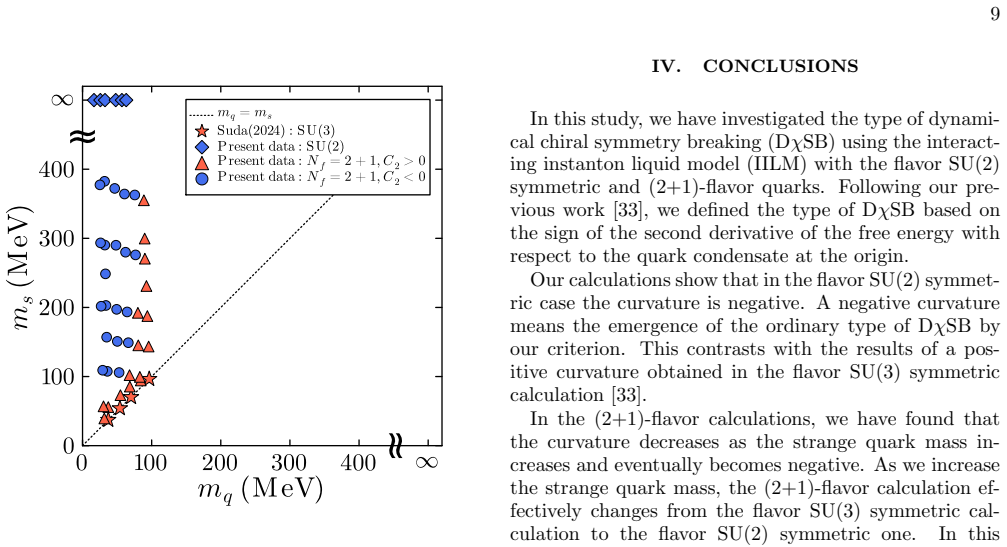
The central discovery is a sign change in $C_2$, the second derivative of the free energy density with respect to the light quark condensate at the origin, driven by the ratio $m_s/m_q$. In the flavor SU(2)-symmetric instanton liquid (only $u$ and $d$ quarks), $C_2$ is negative for all quark masses studied, indicating ordinary dynamical chiral symmetry breaking. In the $(2+1)$-flavor liquid ($u$, $d$, and a heavier $s$), $C_2$ is positive when $m_s$ is close to $m_q$, indicating anomaly-driven symmetry breaking, and decreases smoothly as $m_s$ grows, crossing zero near $m_s/m_q \approx 3$. Since the physical ratio is 27.3, the authors conclude that the real QCD vacuum exhibits the ordinary type of D$\chi$SB. They interpret the difference through the 't Hooft vertex: with three degenerate flavors the instanton-induced interaction is a six-quark vertex carrying the axial anomaly, while with only two light flavors the effective interaction is a four-quark vertex, so the anomaly plays a different role.
Load-bearing premise
The results stand or fall on the assumption that a positive $C_2$, the second derivative of the free energy with respect to the quark condensate at the origin, really identifies anomaly-driven chiral symmetry breaking in the instanton liquid, an identification imported from NJL and earlier IILM work rather than proven inside this calculation.
Editorial extensions
If this is right
- If the sign of $C_2$ is the right classifier, the physical vacuum at $m_s/m_q = 27.3$ is of the ordinary type: chiral symmetry is broken mainly by the four-quark interaction, not by the $U(1)_A$ anomaly.
- Anomaly-driven symmetry breaking is confined to a narrow window near flavor SU(3) symmetry, roughly $m_s/m_q \lesssim 3$ in this model.
- The strange-to-light mass ratio, not the absolute quark masses, is the control parameter that sets the mechanism; results at different $m_q$ collapse onto a common curve in $m_s/m_q$.
- As the strange quark decouples, the instanton-induced interaction effectively reduces from a six-quark to a four-quark vertex, which explains the earlier contrast between the SU(3)-symmetric and quenched results.
- The sign change near $m_s/m_q \approx 3$ gives a concrete target that other approaches to the QCD vacuum, such as lattice or functional methods, could try to reproduce.
Reading between the lines
- Because the sign of $C_2$ is defined at zero condensate, the classification concerns the shape of the effective potential near the origin; a direct lattice-QCD measurement of this curvature as a function of $m_s/m_q$ could test whether the sign flip near ratio 3 is a property of QCD itself or an artifact of the instanton-liquid approximation.
- The same ratio-controlled switch may influence the order of the finite-temperature chiral transition: if the anomaly's role weakens as $m_s/m_q$ grows, the Columbia-plot boundary between first-order and crossover regions could shift accordingly.
- Enlarging the instanton ensemble beyond the 32 objects used here and going to lighter $m_q$ would show whether the $m_s/m_q \approx 3$ crossing survives finite-size effects; the authors note this requires more computational resources.
- If the ordinary type at the physical point is correct, the $\sigma$ meson mass should fall in the heavier regime predicted by the authors' earlier NJL-based classification, giving an experimental handle on the underlying mechanism.
Signed reviews
Editorial analysis
A structured set of objections, weighed in public.
Referee Report
Summary. This paper uses the interacting instanton liquid model (IILM) to study how the type of dynamical chiral symmetry breaking (DχSB) depends on the number of flavors and on the strange-to-light quark mass ratio. For flavor SU(2) and (2+1)-flavor ensembles, the authors compute the free energy density F and the light quark condensate ⟨qq⟩ as functions of the instanton density n, then fit F as a polynomial in ⟨qq⟩ and denote the quadratic coefficient as C2, which they call the curvature of the free energy density with respect to the quark condensate at the origin. The sign of C2 is used to classify DχSB as ordinary (negative) or anomaly-driven (positive). The main numerical finding is that C2 is negative in the SU(2) case, positive near the flavor SU(3) limit, and becomes negative at larger ms/mq, with a suggested crossing near ms/mq ≈ 3 and hence a prediction of ordinary DχSB at the physical quark mass ratio.
Significance. If the identification of C2 with the second derivative of the effective potential at the origin were correct, the paper would provide a nontrivial, model-based statement about how the axial anomaly affects the mechanism of DχSB as flavor symmetry is broken. The systematic scan (6 SU(2) sets and 37 (2+1)-flavor sets), the consistency check between fit orders k=2 and k=3, and the fact that the sign change is a new simulation output rather than a restatement of model input are genuine strengths. However, the central physical interpretation currently rests on an unverified and, as written, unjustified identification between a fit coefficient of a parametric curve and the curvature of the true effective potential. The numerical results themselves may be sound, but the paper's central claim does not yet follow from them.
major comments (3)
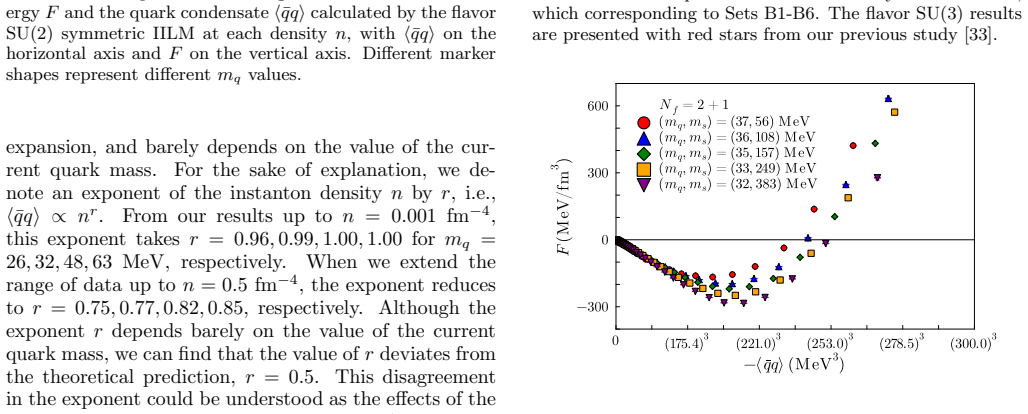
- [Sec. II C, Eq. (9)] The coefficient C2 obtained by polynomial regression on the dataset (F_j, ⟨qq⟩_j) is not the second derivative of the free energy density with respect to the quark condensate at the origin. The partition function in Eq. (2) contains no external source coupled to the quark condensate, and no Legendre transform is performed. Instead, both F and ⟨qq⟩ are computed at fixed instanton density n, and n is varied to trace out a one-parameter curve in the (⟨qq⟩, F) plane. The fitted quadratic coefficient depends on the shape of this parametric path, not on the intrinsic stiffness of the order parameter. To illustrate, if at small n one has F(n) = c n + d n² and ⟨qq⟩(n) = a n + b n², then eliminating n gives a quadratic coefficient proportional to 2(d/a² − c b/a³), which mixes the linear and quadratic responses of F and ⟨qq⟩ to n. This is not U''(0) of the effective potential. The authors must either prove that varying n is equivalent to varying a thermodynamic source conjugate to ⟨qq⟩, or recompute the effective potential curvature with an explicit source term and a Legendre transform. Without such a justification, the sign of C2 cannot be used to classify the mechanism of DχSB as stated in Sec. II C and Sec. IV.
- [Sec. II B and Fig. 6] In all (2+1)-flavor runs, the semiclassical instanton amplitude f(ρ) is computed with Nf = 3, even when the strange quark mass is large, whereas the SU(2) symmetric runs use Nf = 2. Consequently, the large-ms limit of the (2+1)-flavor calculation does not continuously approach the SU(2) calculation: the β-function and the instanton size distribution remain those of a three-flavor theory. The statement in Sec. III C that increasing ms makes the (2+1)-flavor calculation 'effectively change' from the SU(3) to the SU(2) case is therefore not a controlled limit. The mismatch may contribute to the difference between the SU(2) points (shown at ms = ∞ in Fig. 6) and the heavy-ms (2+1)-flavor points. The authors should quantify this effect, for example by repeating a large-ms (2+1)-flavor point with Nf = 2 in f(ρ), or by implementing a mass-dependent decoupling of the strange quark in the instanton amplitude.
- [Sec. III C, Fig. 7] The claim that the curvature changes sign at approximately ms/mq ≈ 3 is not universal across the scanned light quark masses. Figure 6(f) shows that for mq = 0.30Λ the curvature remains positive up to ms/mq = 4, and Fig. 7 itself shows a spread of crossing points that depends on mq. The abstract's statement that the curvature 'becomes negative when the strange quark mass is approximately three times larger than those of the light quarks' is at best valid only for the lighter mq values, and the extrapolation to the physical point ms/mq = 27.3 rests on that subset. The authors should either restrict the claim to the light-mq regime or provide an argument for why the crossing ratio is expected to be universal.
minor comments (3)
- [Tables and text] Several tables and passages contain formatting artifacts such as '0 .05', 'm q', and 's quark' with stray spaces; these should be cleaned up for publication.
- [Fig. 7] Figure 7 would be much more informative if explicit error bars were shown for each point, since the text refers to results being 'positive within error' and 'negative within error' but no uncertainties are visible in the figure.
- [Appendix A] There is a typo in Appendix A: 'scala parameter' should be 'scale parameter'.
Circularity Check
No significant circularity: C2 sign results are independent IILM simulation outputs; the interpretive criterion from prior work is a definition, not a fitted prediction.
full rationale
The central numerical quantity C2 is computed by Monte Carlo simulation of the IILM as a polynomial-regression coefficient of F versus <qq> along the instanton-density scan (Eq. (9)); it is not obtained by fitting any parameter to the sign or to the ms/mq dependence that the paper reports. The SU(2) negative curvature and the (2+1)-flavor sign crossover near ms/mq approximately 3 are outputs of the simulations and are not encoded in the model inputs. The only self-referential element is the classification 'positive C2 = anomaly-driven, negative C2 = ordinary', taken from the authors' Refs. [26,33]; that is a definition or criterion rather than a derived prediction, and the numerical C2 results would stand independently even if that interpretive mapping were disputed. The possible objection that the polynomial coefficient C2 is not literally the second derivative of the effective potential at zero condensate, because no external source or Legendre transform is used, is a question of physical identification and correctness, not a circular reduction of a predicted result to its input. Hence no circular step is exhibited.
Assumptions & free parameters
free parameters (3)
- Scale parameter Λ =
331 to 296 MeV depending on the mass set (Tables I and II)
- Repulsive core strength A =
128
- Polynomial order k of the C2 regression =
3 (with k = 2 checked)
assumptions (4)
- domain assumption The type of DχSB is classified by the sign of the second derivative of the free energy density with respect to the quark condensate at the origin: negative means ordinary type, positive means anomaly-driven type.
- domain assumption The quark determinant and the quark propagator are evaluated in the instanton zero-mode subspace; the full propagator is approximated by the zero-mode propagator in Eq. (8), and the condensate is computed with that propagator in Eq. (7).
- domain assumption The free energy density computed at fixed instanton density is used as a proxy for the effective potential as a function of the quark condensate, and C2 is extracted by polynomial regression over points obtained at different densities (Eq. 9).
- ad hoc to paper In the (2+1)-flavor runs, the semiclassical instanton amplitude f(ρ) is computed with Nf = 3 even when ms is large.
Cite this review
Pith. "Pith review of Different scenarios of dynamical chiral symmetry breaking in the interacting instanton liquid model via flavor symmetry breaking." pith.science (2026). https://pith.science/paper/LCJJRLRU
@misc{pith2026250419469,
  author       = {Pith},
  title        = {Pith review of: Different scenarios of dynamical chiral symmetry breaking in the interacting instanton liquid model via flavor symmetry breaking},
  year         = {2026},
  howpublished = {\url{https://pith.science/paper/LCJJRLRU}},
  note         = {Machine review of arXiv:2504.19469}
}
abstract
We investigate a type of dynamical chiral symmetry breaking (D$\chi$SB) for various current quark masses using the interacting instanton liquid model. The type of D$\chi$SB is classified based on the sign of the second derivative of the free energy density with respect to the quark condensate at the origin. We perform numerical simulations of the interacting instanton liquid model with the flavor SU(2) symmetric and (2+1)-flavor quarks. We find that the curvature is negative in the SU(2) case. This means the ordinary type of D$\chi$SB. In contrast, in the (2+1)-flavor case, a positive curvature is observed when the strange quark mass is as small as those of the up and down quarks. This suggests that the anomaly-driven type of D$\chi$SB can occur under the approximate flavor SU(3) symmetry. As the strange quark mass increases, the curvature gradually decreases and becomes negative when the strange quark mass is approximately three times larger than those of the light quarks. This difference can be understood in terms of the 't Hooft vertex which induces a six-quark interaction in the $N_f=3$ case and does a four-quark interaction in the $N_f=2$ case. Our results might indicate that the ratio between the strange and light quark masses plays a crucial role in understanding the microscopic relationship between D$\chi$SB and the anomaly effect.
Figures


Figures from the paper (3 more)


Reference graph
Works this paper leans on
-
[1]
E. V. Shuryak, Nonperturbative topological phenomena in QCD and related theories, Lect. Notes Phys. 977, 1 (2021)
work page 2021
-
[2]
Adler, Axial-vector vertex in spinor electrodynamics, Phys
S. Adler, Axial-vector vertex in spinor electrodynamics, Phys. Rev. 177, 2426 (1969)
work page 1969
-
[3]
J. S. Bell and R. Jackiw, PCAC puzzle: π0→ γγ in σ model, Nuovo Cimento A 60, 47 (1969)
work page 1969
-
[4]
K. Kawarabayashi and N. Ohta, The Problem of η in the LargeN Limit: Effective Lagrangian approach, Nucl. Phys. B175, 477 (1980)
work page 1980
-
[5]
K. Kawarabayashi and N. Ohta, On the partial conser- vation of the U(1) current, Prog. Theor. Phys. 66, 1789 (1981)
work page 1981
-
[6]
S. D. Bass and P. Moskal, η′ and η mesons with con- nection to anomalous glue, Rev. Mod. Phys. 91, 015003 (2019)
work page 2019
-
[7]
T. Sch¨ afer and E. V. Shuryak, Instantons in QCD, Rev. Mod. Phys. 70, 323 (1998)
work page 1998
-
[8]
E. V. Shuryak and I. Zahed, Hadronic structure on the light front. I. Instanton effects and quark-antiquark ef- fective potentials, Phys. Rev. D 107, 034023 (2023)
work page 2023
Show all 60 references
-
[9]
F. L. Braghin, U(1)A symmetry-breaking quark interac- tions from vacuum polarization, Eur. Phys. J. A 60, 178 (2024)
2024
-
[10]
E. V. Shuryak, The role of instantons in quantum chro- modynamics: (I). Physical vacuum, Nucl. Phys. B203, 93 (1982)
1982
-
[11]
E. V. Shuryak, The role of instantons in quantum chromodynamics: (II). Hadronic structure, Nucl. Phys. B203, 116 (1982)
1982
-
[12]
’t Hooft, Computation of the quantum effects due to four-dimensional pseudoparticle, Phys
G. ’t Hooft, Computation of the quantum effects due to four-dimensional pseudoparticle, Phys. Rev. D 14, 3432 (1976)
1976
-
[13]
E. V. Shuryak, Toward the quantitative theory of the in- stanton liquid (III). Instantons and light fermions, Nucl. Phys. B302, 599 (1988)
1988
-
[14]
M. A. Nowak, J. J. M. Verbaarschot, and I. Zahed, In- stantons and chiral dynamics, Phys. Lett. B 228, 251 (1989)
1989
-
[15]
M. A. Nowak, J. J. M. Verbaarschot, and I. Zahed, Flavor mixing in the instanton vacuum, Phys. Lett. B 324, 1 (1989)
1989
-
[16]
Jurkiewicz, M
J. Jurkiewicz, M. A. Nowak, and I. Zahed, Dirac spec- trum in QCD and quark masses, Nucl. Phys. B478, 605 (1996)
1996
-
[17]
Leutwyler and A
H. Leutwyler and A. V. Smilga, Spectrum of Dirac oper- ator and role of winding number in QCD, Phys. Rev. D 46, 5607 (1992)
1992
-
[18]
Banks and A
T. Banks and A. Casher, Chiral symmetry breaking in confining theories, Nucl. Phys. B169, 103 (1980)
1980
-
[19]
A. V. Smilga and J. Stern, On the spectral density of the Euclidean Dirac operator in QCD, Phys. Lett. B 318, 531 (1993)
1993
-
[20]
J. J. M. Verbaarschot and I. Zahed, Spectral density of the QCD Dirac operator near zero virtuality, Phys. Rev. Lett. 70, 3852 (1993)
1993
-
[21]
Spitzenberg, K
T. Spitzenberg, K. Schwenzer and H . J. Pirner, Spec- trum of the Dirac operator in the linear σ model with quarks, Phys. Rev. D 65, 074017 (2002)
2002
-
[22]
Weinberg, Phenomenological Lagrangians, Physica (Amsterdam) 96A, 327 (1979)
S. Weinberg, Phenomenological Lagrangians, Physica (Amsterdam) 96A, 327 (1979)
1979
-
[23]
Gasser, H
J. Gasser, H. Leutwyler, Chiral perturbation theory: ex- pansions in the mass of the strange quark, Nucl. Phys. B250, 465 (1985)
1985
-
[24]
Nambu, G
Y. Nambu, G. Jona-Lasinio, Dynamical Model of Ele- mentary Particles Based on an Analogy with Supercon- ductivity. I, Phys. Rev. 122, 345 (1961)
1961
-
[25]
Gell-Mann, M
M. Gell-Mann, M. L´ evy, The axial vector current in beta decay, Nuovo. Cim. 16, 705 (1960)
1960
-
[26]
S. Kono, D. Jido, Y. Kuroda, and M. Harada, The role of U A(1) breaking term in dynamical chiral symmetry breaking of chiral effective theories, PTEP2021, 093D02 (2021)
2021
-
[27]
Kobayashi and T
M. Kobayashi and T. Maskawa, Chiral symmetry and η-X mixing, Prog. Theor. Phys. 44, 1422 (1970)
1970
-
[28]
Kobayashi, H
M. Kobayashi, H. Kondo, and T. Maskawa, Symmetry breaking of the chiral U(3)⊗U(3) and the quark model, Prog. Theor. Phys. 45, 1955 (1971)
1971
-
[29]
’t Hooft, Symmetry breaking through Bell–Jackiw anomalies, Phys
G. ’t Hooft, Symmetry breaking through Bell–Jackiw anomalies, Phys. Rev. Lett. 37 (1976) 8
1976
-
[30]
Rosenzweig, J
C. Rosenzweig, J. Schechter, and C. G. Trahern, Is the effective Lagrangian for quantum chromodynamics a σ model?, Phys. Rev. D 21, 3388 (1980)
1980
-
[31]
Di Vecchia and G
P. Di Vecchia and G. Veneziano, Chiral dynamics in the large N limit, Nucl. Phys. B171, 253 (1980)
1980
-
[32]
Witten, Large N chiral dynamics, Ann
E. Witten, Large N chiral dynamics, Ann. Phys. (N.Y.) 128, 363 (1980)
1980
-
[33]
Suda and D
Y. Suda and D. Jido, Possible scenario of dynamical chi- ral symmetry breaking in the interacting instanton liquid model, Phys. Rev. D 110, 014037 (2024)
2024
-
[34]
C. G. Callan, R. Dashen, and D. J. Gross, Toward a theory of the strong interactions, Phys. Rev. D 17, 2717 (1978)
1978
-
[35]
C. G. Callan, R. Dashen, and D. J. Gross, A theory of hadronic structure, Phys. Rev. D 19, 1826 (1979)
1979
-
[36]
M. A. Shifman, A.I. Vainshtein, V.I. Zakharov, Instanton density in a theory with massless quarks, Nucl. Phys. B163, 46 (1980)
1980
-
[37]
Navas, et al
S. Navas, et al. , (Particle Data Group), Review of Parti- cle Physics, Phys. Rev. D 110, 030001 (2024)
2024
-
[38]
Sch¨ afer and E
T. Sch¨ afer and E. V. Shuryak, Interacting instanton liq- uid model in QCD at zero and finite temperature, Phys. Rev. D 53, 6522 (1996)
1996
-
[39]
Bernard, Gauge zero modes, instanton determinants, and quantum-chromodynamic calculations, Phys
C. Bernard, Gauge zero modes, instanton determinants, and quantum-chromodynamic calculations, Phys. Rev. D 19, 3013 (1979)
1979
-
[40]
D. I. Dyakonov, and V. Yu. Petrov, A theory of light quarks in the instanton vacuum, Nucl. Phys. B272, 457 (1986)
1986
-
[41]
Metropolis, A
N. Metropolis, A. W. Rosenbluth, M. N. Rosenbluth, A. H. Teller, E. Teller, Equation of state calculations by fast computing machines J. Chem. Phys.21, 1087 (1953)
1953
-
[42]
Duane, A
S. Duane, A. D. Kennedy, B. J. Pendleton, D. Roweth, Hybrid Monte Carlo Phys. Lett. B 195, 2 (1975)
1975
-
[43]
J. J. M. Verbaarschot, Streamlines and conformal invari- ance in Yang-Mills theories, Nucl. Phys.B362, 33 (1991)
1991
-
[44]
Binder and D
K. Binder and D. Herrmann, Monte Carlo Simulations in Statistical Physics An Introduction, 6th ed. (Springer, Berlin, Heidelberg, 2010)
2010
-
[45]
Randau and K Binder, A Guide to Monte Carlo Simulations in Statistical Physics (Cambridge University Press, Cambridge, England, 2014)
D. Randau and K Binder, A Guide to Monte Carlo Simulations in Statistical Physics (Cambridge University Press, Cambridge, England, 2014). 12
2014
-
[46]
Hanada, Markov Chain Monte Carlo for Dummies, arXiv:1808.08490
M. Hanada, Markov Chain Monte Carlo for Dummies, arXiv:1808.08490
-
[47]
Gubler and D
P. Gubler and D. Satow, Recent progress in QCD conden- sate evaluations and sum rules, Prog. Part. Nucl. Phys. 106, 1 (2019)
2019
-
[48]
Pobylitsa, The quark propagator and correlation functions in the instanton vacuum, Phys
P V. Pobylitsa, The quark propagator and correlation functions in the instanton vacuum, Phys. Lett. B 226, 387 (1989)
1989
-
[49]
Wei-Yang Liu, Generic framework for non-perturbative QCD in light hadrons, arXiv:2501.07776
-
[50]
Bentz, T
W. Bentz, T. Hama, T. Matsuki, and K. Yazaki, NJL model on the light cone and pion structure function, Nucl. Phys. A651, 143 (1999)
1999
-
[51]
Itakura and S
K. Itakura and S. Maedan, Dynamical chiral symmetry breaking on the light front. II. The Nambu–Jona-Lasinio model, Phys. Rev. D 62, 105016 (2000)
2000
-
[52]
Wei-Yang Liu, E. V. Shuryak, and I. Zahed, Hadronic structure on the light front. VII. Pions and kaons and their partonic distributions, Phys. Rev. D 107, 094024 (2023)
2023
-
[53]
Wei-Yang Liu, E. V. Shuryak, and I. Zahed, Hadronic structure on the light front. VIII. Light scalar and vector mesons, Phys. Rev. D 109, 074029 (2024)
2024
-
[54]
Kuroda, M
Y. Kuroda, M. Harada, S. Matsuzaki, and D. Jido, Inverse mass hierarchy of light scalar mesons driven by anomaly-induced flavor breaking, Prog. Theor. Exp. Phys. 2020, 053D02 (2020)
2020
-
[55]
Saionji, D
T. Saionji, D. Jido, and M. Harada, Inverse mass ordering of lihgt scalar mesons in the Nambu–Jona-Lasinio model, Prog. Theor. Exp. Phys. 2023, 033D01 (2023)
2023
-
[56]
R. D. Pisarski and F. Rennecke, Conjectures about the chiral phase transition in QCD from anomalous multi- instanton interactions, Phys. Rev. Lett. 132, 251903 (2024)
2024
-
[57]
Fejos and T
G. Fejos and T. Hatsuda, Order of the SU (Nf)× SU (Nf) chiral transition via the functional renormaliza- tion group, Phys. Rev. D 110, 016021 (2024)
2024
-
[58]
Giacosa, G
F. Giacosa, G. Kov´ acs, P. Kov´ acs, R. D. Pisarski, and F. Rennecke, Anomalous U(1)A couplings and the Columbia plot, Phys. Rev. D 111, 016014 (2025)
2025
-
[59]
A. V. Yung, Instanton vacuum in supersymmetric QCD, Nucl. Phys. B297, 47 (1988)
1988
-
[60]
E. V. Shuryak and J. J. M. Verbaarschot, Baryon number violation and nonperturbative weak processes at super- conducting super collider energies, Phys. Rev. Lett. 68, 2576 (1992)
1992
Reviewed August 16, 2026 · model on record in the stance chip above.
Discussion (0). Continue with ORCID to comment.