REVIEW 5 major objections 4 minor 93 references
Observational constraints in late time for an axially symmetric transitioning model with bulk viscous fluid
T0 review · 5 major / 4 minor · reviewed 2026-08-16 · deepseek-v4-flash
Pith's one-line read This paper claims that an axially symmetric Bianchi type-I universe with pressureless dust and bulk viscous pressure −3ζH² fits the observed late-time acceleration, giving H0 = 66.9 km/s/Mpc and 74.2 km/s/Mpc from two combined data sets.
desk verdict A standard Bianchi-I viscous model with a consistent Hubble solution, but the data analysis is internally inconsistent and the headline H0 constraints are not supported as presented. read the letter →
The pith
A machine-rendered reading of the paper's core claim, the machinery that carries it, and where it could break.
The reading
What carries the argument
The load-bearing object is the effective pressure $p_{\rm eff} = p - 3\zeta H^2$, with dust pressure $p=0$ and a constant viscosity coefficient $\zeta$. Because $H^2$ is always positive, the viscous term is always a negative pressure whose magnitude grows with the expansion rate; that is what drives the acceleration. The second ingredient is the anisotropy parameter $l = c_1/(H_0 a_0^3)$, which encodes the shear between the axial and transverse scale factors of the LRS Bianchi type-I metric. Together they reduce the field equations to a single ordinary differential equation for $H(z)$, whose closed-form solution is the function fitted to all data sets. The machinery converts a transport coefficient into a geometric expansion history.
What would settle it
Use the best-fit Hubble law with, say, $H_0 = 74.216$, $l = 0.276$, $\zeta = 0.661$ to predict distance moduli over $0<z<2.3$, and compare them with a supernova sample not used in the fit; a systematic deviation beyond the reported uncertainties would show that the viscous law cannot alone carry the acceleration. Alternatively, measure the deceleration-to-acceleration transition redshift from an independent cosmic-chronometer sample: the model predicts $z_t \approx 1.17$ for the $H_0 = 74.216$ fit and $z_t \approx 2.10$ for the $H_0 = 66.912$ fit, so a measured transition outside both ranges would contradict the constant-$\zeta$ picture.
Extended reading notes
Core claim
Within Einstein's field equations, the paper derives an exact Hubble parameter of the form $H(z) = H_0 (1+z)^{3/2} (1+z)^{-3\zeta/2} \sqrt{l^2((1+z)^{3\zeta+3}-1)+9(\zeta+1)}/(3\sqrt{\zeta+1})$. Fitting this law to the four data sets---46 Hubble parameter measurements, the Union 2.1 supernova compilation, the 1048-point Pantheon apparent-magnitude sample, and six BAO distance-ratio points---the paper reports best-fit parameters for $H_0$, $l$, and $\zeta$ from each set and from two combined sets. It then computes the deceleration parameter $q(z)$, finds the sign change from deceleration to acceleration, and uses the statefinder pair $(r,s)$, the jerk parameter, the Om diagnostic, and the $\omega$--$\omega'$ plane to classify the dark-energy behavior. The central discovery claim is that the viscous term $-3\zeta H^2$ with constant $\zeta$ is sufficient to make the model transition from deceleration to acceleration and to approach $\Lambda$CDM at late times, with fitted $H_0$ values that lie on both sides of the current Hubble tension.
Load-bearing premise
The entire late-time acceleration rests on the assumed viscous pressure law $p_{\rm eff} = -3\zeta H^2$ with $p=0$ and a constant viscosity coefficient $\zeta$; if that negative-pressure form is wrong, or if $\zeta$ varies with time or density, the reported $H_0$ values, transition redshifts, and the approach to $\Lambda$CDM inherit the error rather than following from independent physics.
Editorial extensions
If this is right
- Late-time acceleration can be obtained with no cosmological constant: a single constant bulk-viscosity coefficient suffices.
- The fitted values give $H_0 \approx 66.9$ km/s/Mpc from OHD+BAO and $H_0 \approx 74.2$ km/s/Mpc from OHD+Pan+BAO+Union, so the model can be tuned toward either side of the Hubble-tension range.
- The predicted transition redshift $z_t \approx 1.17$ or $2.10$ and present deceleration parameter $q_0 \approx -0.48$ or $-0.39$ are direct observational targets for cosmic-chronometer and redshift-drift surveys.
- The statefinder trajectory ending near $(r,s)=(1,0)$ and the Om slope classify the model as quintessence-like at late times, so data requiring a phantom crossing would falsify this viscosity mechanism.
Reading between the lines
- Because $-3\zeta H^2$ is assumed rather than derived, the same expansion history could be reinterpreted as an effective dark-energy equation of state; deriving $\zeta$ from kinetic theory or from an underlying field would turn the fit into a prediction.
- The two combined-data $H_0$ values differ by roughly 7 km/s/Mpc, so a single viscosity law may not resolve the Hubble tension by itself; fitting all four data sets simultaneously with the full covariance matrix would show whether one parameter set can satisfy everything.
- A natural extension is to use the fitted $H(z)$ to compute the sound-horizon scale or CMB distance priors, which the paper fixes rather than fits; those would be independent cross-checks of the viscosity parameters.
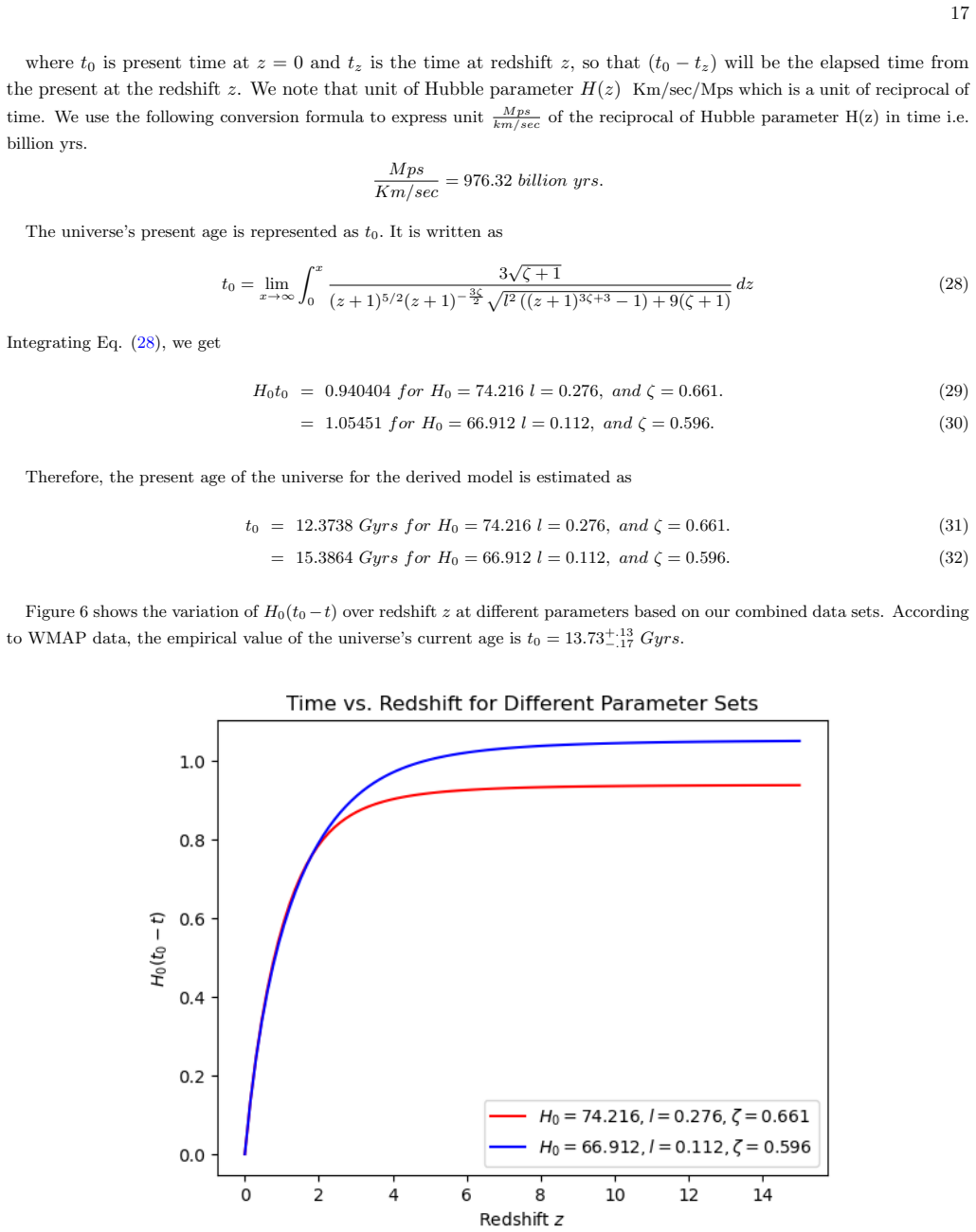
- The age estimates (12.4 and 15.4 Gyr) straddle the usually quoted 13.7 Gyr; comparing the predicted age-redshift relation with the oldest observed objects would be a direct test.
Signed reviews
Editorial analysis
A structured set of objections, weighed in public.
Referee Report
Summary. The paper constructs an LRS Bianchi type-I cosmological model with a bulk viscous fluid whose effective pressure is p_eff = -3ζH^2 and p = 0 for dust, solves the field equations to obtain H(z) in Eq. (14), and fits the three free parameters H0, l, ζ to OHD, Union 2.1, Pantheon, and BAO data, individually and in combinations. The headline results are H0 = 66.912^{+0.497}_{-0.501} and 74.216^{+0.150}_{-0.148} km/s/Mpc for the combined fits, together with derived ages, transition redshifts, statefinder, Om, and ω-ω' diagnostics, leading to the claim that the model behaves like quintessence and approaches ΛCDM.
Significance. The paper's strength is an exact anisotropic solution with a simple viscous-pressure ansatz and an explicit MCMC/χ² estimation procedure. If the statistical analysis were valid, the model would be a useful worked example of a bulk-viscous mechanism for late-time acceleration with a deceleration-to-acceleration transition. However, the statistical basis for the central claims is internally inconsistent: the BAO likelihood is not reproducible from the stated equations, the Union 2.1 sample size changes across sections, and the combined likelihood does not match the data sets named in Table 5. The late-time diagnostics are also functions of the same fitted parameters rather than independent tests. The headline H0 constraints and the quintessence/ΛCDM conclusion are therefore unsupported as presented.
major comments (5)
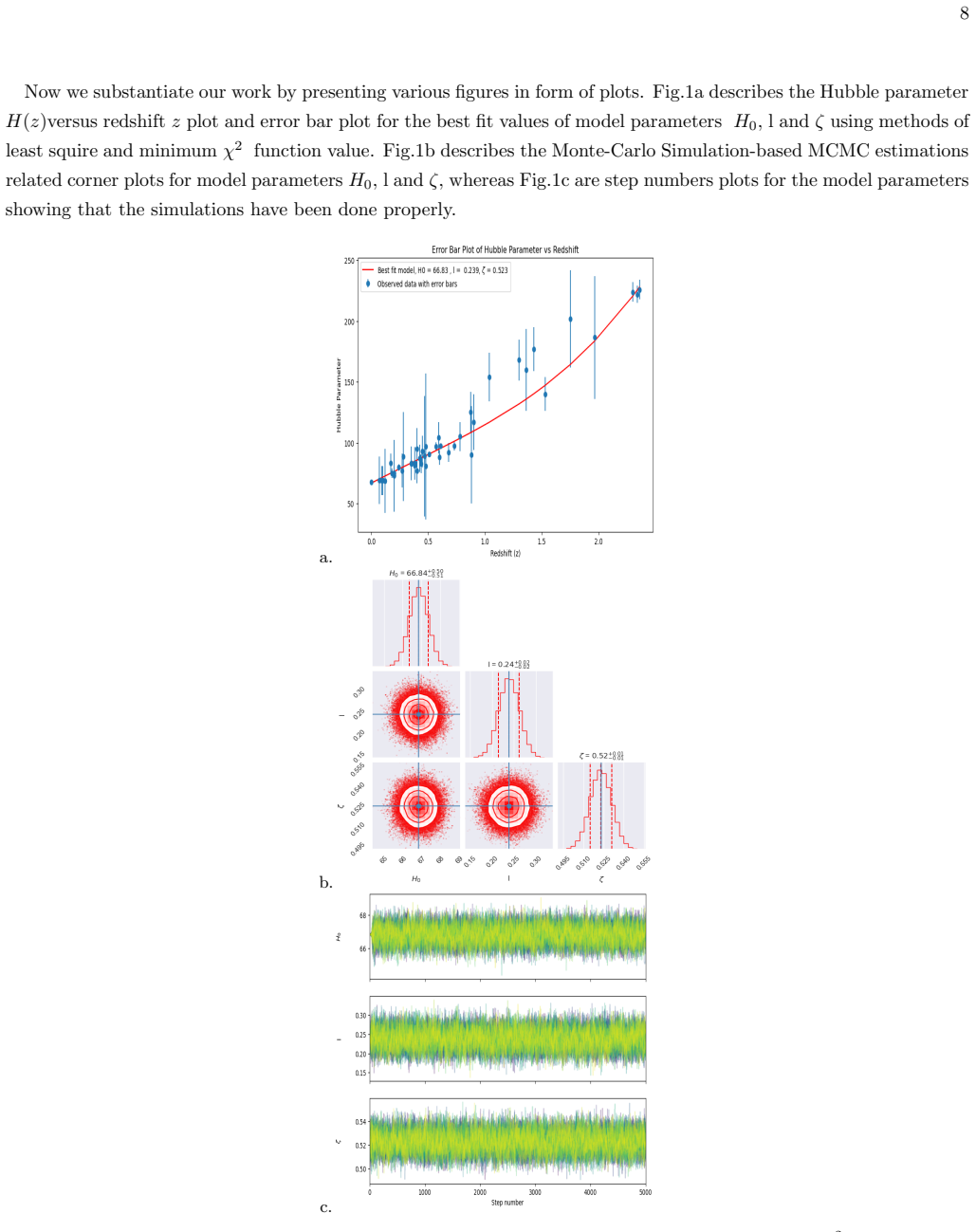
- [§III.D, Eqs. (22)–(25)] The BAO likelihood used for Table 4 and for the combined fits is not consistently defined. The text lists a six-point sample with zBAO = [0.106, 0.2, 0.35, 0.44, 0.6, 0.73] and dz = [30.95, 17.55, 10.11, 8.44, 6.69, 5.45], but Eq. (24) evaluates X at the redshifts [0.106, 0.35, 0.57, 0.44, 0.60, 0.73] against the reference values [30.84, 10.33, 6.72, 8.41, 6.66, 5.43]; neither the points nor the values match those in §III.D. In addition, Eq. (22) defines the distance ratio as dz(z) = rs(z*)/Dv(z), while Eq. (24) uses dA(z*)/Dv(z), which is a different quantity. Because Eq. (23) defines χ²_BAO = X^T C^{-1} X with this X, the BAO constraints in Tables 4 and 5 are not reproducible from the stated ingredients.
- [§III.B and §III.D] The sample sizes used in the fits are mutually inconsistent. The Union 2.1 compilation is described as 650 data sets in §III.B, as 580 in Eq. (19) and the abstract, and as 518 in the caption of Fig. 2b and in the corner-plot text. For BAO, the abstract and conclusion say '5 redshifts', while §III.D and Eqs. (23)–(25) use six points with a 6×6 covariance matrix. These discrepancies change the χ² normalization and degrees of freedom and therefore affect the parameter values and uncertainties reported in Tables 1–5.
- [§III.E, Eq. (26)] The combined likelihood in Eq. (26), labeled χ²_OHD+BAO, is defined as χ²_OHD + χ²_PAN + χ²_BAO, so it silently adds the Pantheon sample to a fit that Table 5 and the abstract call OHD+BAO. The 'OHD+Pan+BAO+Union' fit stacks Union 2.1 and Pantheon without accounting for the overlap between SNIa compilations or for the size contradictions noted above. Since the headline values H0 = 66.912 and H0 = 74.216 in Table 5, and all derived quantities evaluated at those parameters in Sections IV–X, are direct outputs of these likelihoods, the central quantitative claims are unsupported by the analysis as written.
- [§VI–§X, Eqs. (36)–(46)] The late-time diagnostics are not independent checks of the model. The quantities q0, zt, t0, the statefinder pair (r,s), Om(z), and the ω-ω' trajectory are all evaluated at the fitted H0, l, and ζ through Eq. (14), so the statement in the abstract and conclusion that the model 'behaves like quintessence and approaches ΛCDM' is a restatement of the fitted viscosity parameter rather than a falsifiable prediction. No comparison with a ΛCDM fit to the same data or model-selection statistics (Δχ², AIC, or BIC) is provided, so the claim of good agreement with observations in Sec. XI is not quantitatively supported.
- [§V, Eqs. (33)–(35)] Equation (34) reports the present density for the H0 = 74.216 fit as ρ0 = 4.06629×10^{-31} g/cm^3. Evaluating Eq. (33) at z = 0 gives ρ0/ρc = 1 - l^2/9 ≈ 0.99, which with H0 = 74.216 km/s/Mpc yields ρ0 ≈ 1.03×10^{-29} g/cm^3; the reported value is too small by a factor of about 25. The corresponding value for the H0 = 66.912 fit in Eq. (35) is consistent with the formula, so this appears to be a numerical error in one of the two reported densities.
minor comments (4)
- [Data Availability] The Data Availability statement, 'No data was used for the research described in the article,' is inconsistent with the extensive use of the OHD, Union 2.1, Pantheon, and BAO data sets in Sec. III.
- [Abstract and Sec. XI] The abstract and conclusion contain a stray closing parenthesis in '66.912^{+0.497}_{-0.501}) Km/s/Mpc', and the same H0 expression appears without consistent units in Table 5.
- [Figs. 5, 8–14] The caption of Fig. 5 and the legends of Figs. 8–14 use different names for the same combined fits ('OHD+BAO', 'OHD+BAO+Union2.1', 'Pantheon+OHD+BAO+UNION2.1'), making it hard to associate the curves with Table 5.
- [§III.A] The paragraph in Sec. III.A describing the least-squares, χ², and MCMC procedure is repeated verbatim a few lines later in the same subsection; one copy should be deleted.
Circularity Check
Late-time quintessence/ΛCDM behavior is built into the assumed −3ζH^2 viscous-pressure ansatz; the late-time diagnostics simply replay the fitted H0, l, ζ.
-
self definitional
[Sec. II, Eqs. (3), (16); Sec. XI (Conclusion)]
"Tij = (peff + ρ)uiuj + peffgij, (3) where, the effective pressure peff = p − 3ζH 2 consists of proper pressure p and barotropic bulk viscous pressure 3ζH 2. ... At present, matter is dust-dominated, so we take proper pressure p = 0. ... The equation of state parameter(EOS) is given as: ω(z) = peff/ρ = −1 + (z+1)H˙(z)/3H(z) (16) ... The study reveals that the model behaves like a quintessence in late time and approaches the ΛCDM model."
With p = 0, Eq. (3) gives peff = −3ζH^2, so the EOS in Eq. (16) reduces identically to ω(z) = −3ζH^2/ρ. For any positive fitted ζ, this is a negative-pressure, quintessence-like fluid by construction. The advertised late-time conclusion is therefore not a derived first-principles result but a restatement of the assumed stress-energy tensor: the negative pressure that produces acceleration was put into Eq. (3) by hand. The observational fits only set the numerical values of H0, l, and ζ; the qualitative 'quintessence' behavior is guaranteed by the ansatz.
-
fitted input called prediction
[Sec. IV, Eqs. (28)–(32); Sec. VI, Eqs. (36)–(40)]
"We recall that these parameter values were obtained based on Combined Hubble plus BAO plus Union 2.1 and combined Hubble plus Union 2.1 plus BAO plus Pantheon data sets. We obtain the present values of the deceleration parameter q0 as q0 = −0.478804 for H0 = 74.216, l = 0.276, and ζ = 0.661. ... The above obtained results are in good agreement with those reported in [65–67]."
The quoted q0, and similarly zt, t0, statefinder, jerk, Om, and ω−ω′, are not independent observables added to the fit. They are deterministic functions of the same H0, l, and ζ that were obtained by minimizing χ^2 on the OHD, Union, Pantheon, and BAO data: Eq. (36) is just Eq. (14) inserted into Eq. (15), and Eq. (28) contains only ζ and l, with H0 serving as a unit conversion factor. Calling these 'results in good agreement' with external values presents algebraic consequences of the best-fit parameters as independent predictions, when the agreement is forced once the parameters are chosen.
full rationale
The paper contains two related circular reductions, but not full circularity. First, the central advertised finding that the model 'behaves like a quintessence in late time and approaches the ΛCDM model' is inherited from the assumed barotropic bulk viscous pressure peff = −3ζH^2 with p = 0. Since ω = peff/ρ, the negative-pressure behavior is present by definition in Eq. (3) and is not derived from the data or from independent physics. Second, the late-time diagnostics (q0, zt, t0, statefinder, jerk, Om, ω−ω′) are presented as validating the model, but they are computed from the same fitted H0, l, ζ via Eq. (14); they are not independent measurements, so their 'agreement' with literature values is a restatement of the fit rather than an independent test. The H0 constraints in Table 5 are genuine fits to the named data, and the Bianchi-I solution of the Einstein equations is a legitimate model construction, which prevents this from being a score of 8 or 10. No load-bearing self-citation chain was found: the cited works by the authors are used mainly as data sources and consistency references, not to force the model choice. Separately, the BAO likelihood in Eq. (24) and the combined-χ^2 label in Eq. (26) contain internal inconsistencies (dA(z*) vs rs(z*), inclusion of Pantheon in 'OHD+BAO'); these are correctness concerns, not circularity, so they do not enter the score directly.
Assumptions & free parameters
free parameters (3)
- H0 =
66.912 (OHD+BAO), 74.216 (OHD+Pan+BAO+Union), 60-79 depending on dataset
- l =
0.033 (BAO) to 0.276 (OHD+Pan+BAO+Union)
- ζ =
0.523 (OHD) to 0.964 (BAO)
assumptions (6)
- standard math Einstein field equations and the LRS Bianchi type-I metric
- ad hoc to paper Bulk viscous pressure takes the barotropic form peff = p - 3ζH^2 with constant ζ and p=0 for dust
- domain assumption The anisotropy parameter c1 is constant, so l = c1/(H0 a0^3) is constant during late times
- domain assumption The four public datasets and their published errors and covariances are valid and treated as mutually independent in combined fits
- domain assumption The SNe Ia absolute magnitude is fixed at M=-19.09 in the Pantheon fit
- domain assumption The BAO sound-horizon scale and decoupling redshift z*=1090 are fixed to the values in Ref. [70]
Cite this review
Pith. "Pith review of Observational constraints in late time for an axially symmetric transitioning model with bulk viscous fluid." pith.science (2026). https://pith.science/paper/2UQ3BNO5
@misc{pith2026250419523,
  author       = {Pith},
  title        = {Pith review of: Observational constraints in late time for an axially symmetric transitioning model with bulk viscous fluid},
  year         = {2026},
  howpublished = {\url{https://pith.science/paper/2UQ3BNO5}},
  note         = {Machine review of arXiv:2504.19523}
}
abstract
In this paper, we explore an axially symmetric Bianchi type-I model of the universe with bulk viscous fluid as a source of gravitational field under the framework of Einstein's field equations by assuming barotropic bulk viscous pressure as $-3\zeta H^2$. The model parameters have been estimated with the help of four data sets: The Hubble 46 data set describes Hubble parameter values at various redshifts, Union 2.1 compilation data sets comprise a distance modulus of 580 SNIa supernovae at different redshifts, the Pantheon data set contains Apparent magnitudes of 1048 SNIa supernovae at various redshifts and finally BAO data set of volume averaged distances at 5 redshifts. The observational data is analyzed using the traditional Bayesian methodology, and the posterior distributions of the parameters are obtained using the Markov Chain Monte Carlo (MCMC) technique. To get the best-fit values for the model parameters for MCMC analysis, we use the $ emcee $ package. For parameter estimation, we have also employed the minimizing $\chi^{2}$ function. We also tried to achieve these values statistically using combined data sets from the four described earlier. The OHD+BAO~and~OHD+Pan+BAO+Union combined data sets provide the best fit Hubble parameter value $H_0$ as $66.912 ^{+0.497}_{-0.501})$ Km/s/Mpc and $74.216 ^{+0.150}_{-0.148}$ Km/s/Mpc respectively. We have performed state finder diagnostics to discuss the nature of dark energy. Some other geometrical parameters like the Jerk parameter and the Om diagnostic are also being discussed to clarify the nature of the dark energy model. The study reveals that the model behaves like a quintessence in late time and approaches the $\Lambda$ CDM model.
Figures


Figures from the paper (11 more)




Reference graph
Works this paper leans on
-
[1]
Hubble tension,
Key Parameters in BAO Analysis Sound Horizon ( rs(z)): The distance that sound waves could travel in the early universe before recombination. This serves as the standard ruler for BAO measurements.It is defined as rs(a) = Z a 0 csda a2H(a). 13 It’s typically about 150 megaparsecs (Mpc). Angular Diameter Distance ( dA(z)): The distance derived from the ang...
-
[2]
Perlmutter, et al., Nature 391 (1998) 51
S. Perlmutter, et al., Nature 391 (1998) 51
1998
-
[3]
Perlmutter, et al., Astrophys
S. Perlmutter, et al., Astrophys. J. 517 (1999) 565
1999
-
[4]
A. G. Riess, A. V. Filippenko, P. Challis, A. Clocchiatti, A. Diercks, P. M. Garnavich and B. R. U. N. O. Leibundgut, et al., Astron. J. 116, 1009 (1998)
1998
-
[5]
A. G. Riess, et al., APJ 607, 665 (2004)
2004
-
[6]
S. Jha, A. G. Riess and R. P. Krishner, Astrophys. J. 659, 122 (2007)
2007
-
[7]
Clocchiatti, B
A. Clocchiatti, B. P. Schmidt, A. V. Filippenko, P. Challis and A. L. Coil, et al., Astrophys. J. 642, 1 (2006)
2006
-
[8]
De Bernardis, P
P. De Bernardis, P. A. Ade, J. J. Bock, J. R. Bond and J. Borrill, et al., Nature 404, 955 (2000)
2000
Show all 93 references
-
[9]
Hanany, P
S. Hanany, P. Ade, A. Balbi, J. Bock and J. Borrill, et al., Astrophys. J. Lett. 545, L5 (2000)
2000
-
[10]
D. N. Spergel, L. Verde, H. V. Peiris, E. Komatsu and C. L. Bennett, et al., Astrophys. J. Suppl. 148, 175 (2003)
2003
-
[11]
Komatsu, J
E. Komatsu, J. Dunkley, M. R. Nolta, C. L. Bennett and B. Gold, et al., The Astrophys. Jour. Suppl. Ser. 180, 330 (2009)
2009
-
[12]
Hinsaw, D
G. Hinsaw, D. Larson, E. Komastsu, D. N. Spergel and C. Bennett, et al., The Astrophys. Jour. Suppl. Ser. 208, 19 (2013)
2013
-
[13]
D. N. Spergel, R. Bean, O. Dore, M. R. Nolta and C. Bennett, et al., The Astrophys. Jour. Suppl. Ser. 170, 377 (2007)
2007
-
[14]
Herrera, N
L. Herrera, N. O. Santos andA. F. Teixeira, Gen. Relativ. Gravit. 32(3), 389 (2000)
2000
-
[15]
Stephani, D
H. Stephani, D. Kramer, M. MacCallum, C. Hoenselaers and E. Herlt, Exact solutions of Einstein’s field equations, Cambridge University Press (2003)
2003
-
[16]
A. A. Coley and S. Hervik, Class. Quant. Grav. 22(16), 3591 (2005)
2005
-
[17]
Carmeli and S
M. Carmeli and S. Malin, Phys. Rep. 39(3), 169 (1977)
1977
-
[18]
P. S. Joshi and D. Malafarina, Int. J. Mod. Phys. D 20(14), 2641 (2011)
2011
-
[19]
Nojiri and S
S. Nojiri and S. D. Odintsov, Phys. Rev. D 72, 023003 (2005)
2005
-
[20]
Nojiri and S
S. Nojiri and S. D. Odintsov, Phys. Lett. B 639, 144 (2006)
2006
-
[21]
Brevik, S
I. Brevik, S. Nojiri, S. D. Odintsov and L. Vanzo, Phys. Rev. D 70, 043520 (2004)
2004
-
[22]
Brevik, S
I. Brevik, S. Nojiri, S. D. Odintsov and D. Saez-Gomez, Eur. Phys. J. C 69, 563 (2010)
2010
-
[23]
Brevik, V
I. Brevik, V. V. Obukhov and A. V. Timoshkin, Astrophys. Space Sci. 355, 399 (2015)
2015
-
[24]
C. S. J. Pun, L. A. Gergely, M. K. Mak, Z. Kovacs, G. M. Szabo and T. Harko, Phys. Rep. D 77, 063528 (2008)
2008
-
[25]
L. P. Chimento, A. S. Jakubi and D. Pavon, Phys. Rev. D 62, 063508 (2000)
2000
-
[26]
Eckart, Phys
C. Eckart, Phys. Rev. 58, 267 (1940)
1940
-
[27]
L. D. Landau and E. M. Lipshitz, Fluid Mechanics, Second Edition (Pergamon Press, Oxford, 1987)
1987
-
[28]
Brevik, O
I. Brevik, O. Gron, J. de Haro, S. D. Odintsov and E. N. Saridakis, Int. J. Mod. Phys. D 27, 1730024 (2017)
2017
-
[29]
W. J. C. da Silva, H.S. Gimenes and R. Silva, J. Cosmol. Astropart. Phys. 105, 37 (2019)
2019
-
[30]
Brevik, E
I. Brevik, E. Elizalde, S. D. Odintsov and A. V. Timoshkin, Int. J. Geom. Methods Mod. Phys. 14, 1750185 (2017)
2017
-
[31]
S. D. Odintsov, V. K. Oikonomou, A. V. Timoshkin, E. N. Saridakis and R. Myrzakulov, Ann. Phys. 398, 238 (2018)
2018
-
[32]
Dixit, S
A. Dixit, S. Gupta, A. Pradhan, S. Krishnannair, Astron. and Comput. 49, 100885 (2024)
2024
-
[33]
Dixit, A
A. Dixit, A. Pradhan, V. K. Bhardwaj, A. Beesham, Astron. and Comput. 45, 100768 (2023)
2023
-
[34]
Dixit, C
A. Dixit, C. Chawla and A. Pradhan, Can. J. Phys. 101, 378 (2023)
2023
-
[35]
Pradhan, A
A. Pradhan, A. Dixit and D. C. Maurya, Symmetry, 14 (12) , 2630 (2022)
2022
-
[36]
Dixit and A
A. Dixit and A. Pradhan, Universe, 8(12), 650 (2022)
2022
-
[37]
Dixit, D
A. Dixit, D. C. Maurya and A. Pradhan, Int. J. Geom. Methods Mod. Phys. 19 (12) , 2250198 (2022)
2022
-
[38]
Shasidharan and T
A. Shasidharan and T. Mathew, Eur. Phys. J. C 75, 348 (2015)
2015
-
[39]
Kousour, S
M. Kousour, S. H. Shekh, M. Bennai and N. Myrzakulov, Mod. Phys. Lett. A 39, 2450023 (2024)
2024
-
[40]
G. N. gadbail, S. Arora and P. K. Sahoo, Eur. Phys. J. C 81, 1088 (2021)
2021
-
[41]
Ren and X.-H
J. Ren and X.-H. Meng, Phys. Lett. B 633, 1 (2006)
2006
-
[42]
V. K. Bhardwaj, A. Dixit, R. Rani, G.K. Goswami, and A. Pradhan, Chin. J. Phys. 80, 261–274 (2022). 28
2022
-
[43]
Sharma, P
S. Sharma, P. V. Lepse and M. R. Sharma, Astrophys. Space Sci. 369, 120 (2024)
2024
-
[44]
V. A. Pai, N. Sarath and T. K. Mathew, arXiv:2409.10919[astro-ph.CO] (2024)
2024 arXiv
-
[45]
Myrzakulov, O
K. Myrzakulov, O. Donmez, M. Koussour, S. Muminov, E. Davletov and J. Rayimbaev, Phys. Lett. A 534, 130232 (2025)
2025
-
[46]
Myrzakulov, O
Y. Myrzakulov, O. Donmez, M. Koussour, S. Muminov, I. Y. Davletov and J. Rayimbaev, Phys. Darl Univ. 48, 101829 (2025)
2025
-
[47]
Koussour, Abdelghani Errehymy, O
M. Koussour, Abdelghani Errehymy, O. Donmez, K. Myrzakulov, M. A. Khan, B. Cil and E. G¨ udekli, Phys. Darl Univ. 45, 101527 (2025)
2025
-
[48]
Suzuki, et al., Astrophy
N. Suzuki, et al., Astrophy. J. 746 (2012) 85
2012
-
[49]
D. M. Scolnic, et al., Astrophys. J. 859 (2018) 101
2018
-
[50]
Padmanabhan, X
N. Padmanabhan, X. Xu, D. J. Eisenstein, R. Scalzo, A. J. Cuesta, K. T. Mehta, E. Kazin, Mon. Not. Roy. Astron. Soc. 427 (2012) 2132-2145, [arXiv:1202.0090 [astro-ph.CO]]
2012 arXiv
-
[51]
Beutler, C
F. Beutler, C. Blake, M. Colless, D. H. Jones, L. Staveley-Smith, L. Campbell, Q. Parker, W. Saunders, F. Watson, Mon. Not. Roy. Astron. Soc. 416 (2011) 3017-3032, arXiv:1106.3366 [astro-ph.CO]
2011 arXiv
-
[52]
Anderson et al.[BOSS], Mon
L. Anderson et al.[BOSS], Mon. Not. Roy. Astron. Soc. 441 (2014) 24-62 (2014), arXiv:1312.4877 [astro-ph.CO]
2014 arXiv
-
[53]
Blake, S
C. Blake, S. Brough, M. Colless, C. Contreras, W. Couch, S. Croom, D. Croton, T. Davis, M. J. Drinkwater, K. Forster et al., Mon. Not. Roy. Astron. Soc. 425 (2012) 405-414 (2012), arXiv:1204.3674 [astro-ph.CO]
2012 arXiv
-
[54]
Blake, E
C. Blake, E. Kazin, F. Beutler, T. Davis, D. Parkinson, S. Brough, M. Colless, C. Contreras, W. Couch, S. Croom et al., Mon. Not. Roy. Astron. Soc. 418 (2011) 1707-1724, arXiv:1108.2635 [astro-ph.CO]
2011 arXiv
-
[55]
W. J. Percival et al. [SDSS], Mon. Not. Roy. Astron. Soc. 401 (2010) 2148-2168, arXiv:0907.1660 [astro-ph.CO]
2010 arXiv
-
[56]
D. J. Eisenstein et al. [SDSS], Astrophys. J. 633 (2005) 560-574, arXiv:astro-ph/0501171
2005 arXiv
-
[57]
W. L. Freedman, B. F. Madore, B. K. Gibson, L. Ferrarese, D. D. Kelson, S. Sakai et al., ApJ 553 (2001) 47, [astro- ph/0012376]
2001
-
[58]
Di Valentino, O
E. Di Valentino, O. Mena, S. Pan, L. Visinelli, W. Yang, A. Melchiorri et al., arXiv:2103.01183 (2021)
2021 arXiv
-
[59]
W. L. Freedman, B. F. Madore, T. Hoyt, I. S. Jang, R. Beaton, M. G. Lee et al., ApJ 891 (2020) 57, (F20) [2002.01550]
2020 arXiv
-
[60]
Dhawan, S
S. Dhawan, S. Thorp, K. S. Mandel, S. M. Ward, G. Narayan, S. W. Jha et al., MNRAS 524 (2023) 235 [2211.07657]
2023 arXiv
-
[61]
W. L. Freedman, B. F. Madore, V. Scowcroft, C. Burns, A. Monson, S. E. Persson et al., ApJ 758 (2012) 24 [1208.3281]
2012 arXiv
-
[62]
A. G. Riess, W. Yuan, L. M. Macri, D. Scolnic, D. Brout, S. Casertano et al., ApJ 934 (2022) L7 [2112.04510]
2022 arXiv
-
[63]
Aghanim, Y
Planck Collaboration, N. Aghanim, Y. Akrami, M. Ashdown, J. Aumont, C. Baccigalupi et al., A&A 641 (2020) A6 [1807.06209]
2020 arXiv
-
[64]
D. W. Pesce, J. A. Braatz, M. J. Reid, A. G. Riess, D. Scolnic, J. J. Condon, F. Gao, C. Henkel, C. M. V. Impellizzeri, C. Y. Kuo, and K. Y. Lo, ApJL 891 (2020) L1, arXiv:2001.09213 [astro-ph.CO] (2020)
2020 arXiv
-
[65]
K. C. Wong, S. H. Suyu, G. C.-F. Chen, C. E. Rusu, et al. MNRAS 498 (20200) 1420-1439, arXiv:1907.04869 [astro-ph.CO] (2019)
2019 arXiv
-
[66]
Amirhashchi, S
H. Amirhashchi, S. Amirhashchi, Phys. Dark Univ. 29 (2020) 100557, arXiv:1802.04251[astro-ph.CO]
2020 arXiv
-
[67]
Amirhashchi, Phys
H. Amirhashchi, Phys. Rev. D 97 (2018) 063515
2018
-
[68]
N. G. Busca et al., A & A 552 (2013) A96, arXiv:1211.2616 [astro-ph.CO]
2013 arXiv
-
[69]
V. K. Bhardwaj, P. Garg, A. Pradhan, and S. Krishnannair, Chin. J. Phys. 79 (2022) 471-480
2022
-
[70]
G. K. Goswami, M. Mishra, A. K. Yadav, and A. Pradhan, Mod. Phys. Lett. A 35 (2020) 2050086
2020
-
[71]
Giostri, M
R. Giostri, M. V. dSantos, I. Waga, R. R. R. Reis, M. O. Calvao, B. L. Lago, J. Cosmol. Astropart. Phys, 1203 027 (2012)
2012
-
[72]
W. L. Freedman, B. F. Madore, J. Cosmol. Astropart. Phys, 2023 (11) 050 (2023), arXiv:2309.05618 [astro-ph.CO] (2023)
2023 arXiv
-
[73]
U. Alam, V. Sahni, T.D. Saini, A.A. Starobinsky, Mon. Not. Roy. Astron. Soc. 344 (2003) 1057
2003
-
[74]
Zhang, Int
X. Zhang, Int. J. Mod. Phys. D 14 (2005) 1597
2005
-
[75]
M. R. Setare, J. Zhang, X. Zhang, JCAP, 3 (2007) 007
2007
-
[76]
U. K. Sharma, A. Pradhan, Mod. Phys. Lett. A 34 (20019) 1950101
-
[77]
Sahni, T
V. Sahni, T. D Saini, A. A. Starobinsky, U. Alam, J. Exp. Theor. Phys. Lett. 77 (2003) 201
2003
-
[78]
V. K. Bhardwaj, A. Dixit, A. Pradhan, New Astron. 88 (2021) 101623
2021
-
[79]
M. P. Dabrowski and T. Stachowiak, Annals Phys. 321 (2006), 771-812 29
2006
-
[80]
Nagpal, et al., Ann
R. Nagpal, et al., Ann. Phys. 405 (2019) 234
2019
-
[81]
Shahalam, S
M. Shahalam, S. Sami, A. Agarwal, Mon. Not. Roy. Astron. Soc. 448 (2015) 2948
2015
-
[82]
R. D. Blandford et al., ASP Conf. Ser. 339 (2004) 27
2004
-
[83]
R. G. Cai and Z. L. Tuo, Phys. Lett. B 706 (2011), 116-122
2011
-
[84]
A. R. Neben and M. S. Turner, Astrophys. J. 769 (2013), 133
2013
-
[85]
Gaztanaga, A
E. Gaztanaga, A. Cabre and L. Hui, Mon. Not. Roy. Astron. Soc. 399 (2009), 1663-1680
2009
-
[86]
Sahni, A
V. Sahni, A. Shafieloo, A.A. Starobinsky, Phys. Rev. D 78 (2008) 103502
2008
-
[87]
Jamil, D
M. Jamil, D. Momeni, R. Myrzakulov, Eur. Phys. J. C 73 (2013) 2347
2013
-
[88]
R. R. Caldwell and E. V. Linder, Phys. Rev. Lett. 95, 141301(2005)
2005
-
[89]
Zong-Kuan et al., Phys
G. Zong-Kuan et al., Phys. Rev. D 74, 127304(2006)
2006
-
[90]
Chiba, Phys
T. Chiba, Phys. Rev. D 73, 063501(2006)
2006
-
[91]
R. J. Scherrer, Phys. Rev. D 73, 043502(2006)
2006
-
[92]
Calabrese et al., Phys
E. Calabrese et al., Phys. Rev. D83, 023011(2011)
2011
-
[93]
Vagnozzi et al
S. Vagnozzi et al. , Mon. Not. Roy. Astron. Soc. 493 (2020) 1139
2020
Reviewed August 16, 2026 · model on record in the stance chip above.
Discussion (0). Continue with ORCID to comment.