REVIEW 4 major objections 4 minor 2 cited by
Regular black hole solutions in $(2 + 1)$-dimensional $f(R,T)$ gravity coupled to nonlinear electrodynamics
T0 review · 4 major / 4 minor · reviewed 2026-08-16 · deepseek-v4-flash
Pith's one-line read The paper constructs the first centrally regular black hole metrics in (2+1)-dimensional f(R,T) gravity, using a tunable electric-field ansatz that reduces to Maxwell at infinity.
desk verdict A genuinely constructive derivation of new 2+1 black hole solutions in f(R,T)+NED, but the abstract's 'regular' label overstates the λ≠0 case, where curvature diverges at infinity. read the letter →
The pith
A machine-rendered reading of the paper's core claim, the machinery that carries it, and where it could break.
The reading
What carries the argument
The load-bearing object is the generalized electric field $E(r)=q r^{\alpha} (r^{\beta}+a^{\beta})^{-(\alpha+1)/\beta}$, proposed in analogy with an earlier (2+1)-dimensional regular solution; it is chosen so that $E\to q/r$ at infinity while remaining finite at $r=0$. This ansatz converts the coupled gravity-matter equations into a linear differential equation for the NED Lagrangian $L(r)$ (Eq. 23) and a single integral for the metric function $b(r)$ (Eq. 21), which is what makes analytical solutions possible. The hypergeometric functions ${}_{2}F_{1}$ that appear are the mechanism by which the infinite family of GR solutions is organized, and the $\alpha=\beta+1$ subfamily selects Lagrangians that recover Maxwell's theory in the asymptotic limit. In the $f(R,T)$ case, restricting $\lambda$ to special negative values turns those hypergeometric functions into polynomials, which is the technical condition that allows $b(r)$ to be integrated explicitly.
What would settle it
Compute the metric and curvature invariants for a value of $\lambda$ outside the special discrete set, for example $\lambda=-\kappa^{2}/3$ in the $\beta=1$ case, by evaluating the hypergeometric integrals numerically; if the Ricci or Kretschmann scalar diverges at $r=0$, or if $b(r)$ develops more than one zero (or none), then the claim of regular single-horizon black holes holds only for the special polynomial cases, not for the general $f(R,T)$ model.
Extended reading notes
Core claim
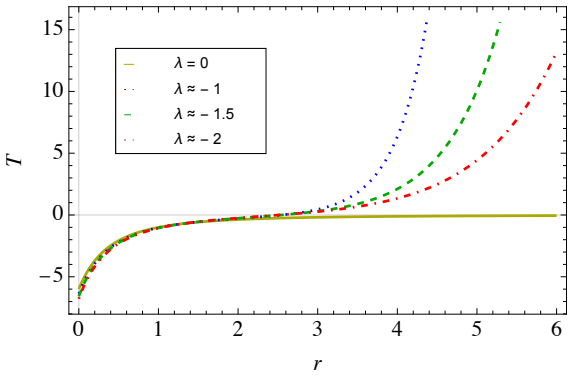
Starting from the field equations of $f(R,T)$ gravity with $f(R,T)=R-2\Lambda+\lambda T$ coupled to nonlinear electrodynamics, the paper constructs static, circularly symmetric solutions of the form $ds^{2}=-b(r)dt^{2}+b(r)^{-1}dr^{2}+r^{2}d\theta^{2}$. With the electric field $E(r)=q r^{\alpha} (r^{\beta}+a^{\beta})^{-(\alpha+1)/\beta}$, the independent equations reduce to a linear differential equation for the NED Lagrangian $L(r)$ and an integral for $b(r)$. For $\lambda=0$ this yields an infinite family of regular black holes that contains the known (2+1)-dimensional regular solutions of earlier studies as special cases, plus genuinely new solutions, in particular the $\alpha=\beta=2$ model whose Ricci and Kretschmann scalars are smooth everywhere. For $\lambda\neq 0$ the same ansatz produces, for $\beta=1$ and $\beta=2$ with special discrete negative values of $\lambda$, the first regular black hole solutions in (2+1)-dimensional $f(R,T)$ gravity, each with a single event horizon whose position depends on $\lambda$. The paper further shows that the $\lambda T$ term makes $\nabla_{\mu} T^{\mu\nu}$ nonzero and that both the trace $T$ and the curvature scalars grow without bound at large $r$ in the $f(R,T)$ cases, so the regularity is central rather than asymptotic; the deviation from energy-momentum conservation is quantified explicitly.
Load-bearing premise
The construction rests on the hand-picked electric field $E(r)=q r^{\alpha} (r^{\beta}+a^{\beta})^{-(\alpha+1)/\beta}$, proposed by analogy with an earlier solution rather than derived from a Lagrangian; the $f(R,T)$ analysis further restricts $\lambda$ to special discrete negative values that make hypergeometric functions polynomial.
Editorial extensions
If this is right
- If the construction is correct, modified gravity in 2+1 dimensions can host horizon-having black holes with finite curvature at the origin, so regularity does not require going to higher dimensions or to full quantum gravity.
- The $\alpha=\beta+1$ family supplies a catalog of nonlinear electrodynamics models with the correct Maxwell limit, reproducing earlier models at $\beta=1,2,4$ and adding new ones that can be studied for geodesics, quasinormal modes, and thermodynamics.
- Because the $\lambda T$ term breaks energy-momentum conservation by a computable amount that grows with $|\lambda|$, these solutions give a concrete arena to test whether matter creation or energy-exchange effects are compatible with horizon physics.
- The explicit divergence of curvature and of the trace $T$ at large $r$ for $\lambda\neq 0$ implies that the 'regular' label applies only to the center; any physical application of these $f(R,T)$ solutions must account for the strong-gravity behavior at infinity.
- The paper's results point to the possibility that analogous regular solutions exist in (3+1)-dimensional $f(R,T)$ gravity, a direction the authors explicitly flag as worthy of future investigation.
Reading between the lines
- Editorial extension: If the $\lambda T$ term generically drives curvature to diverge at infinity, then the class of 'regular' $f(R,T)$ black holes may be better described as singularity-free at the horizon and center but asymptotically singular; a natural next test is whether any special $\lambda$ (or a different $f(R,T)$ form) restores asymptotically anti-de Sitter behavior.
- Editorial extension: Since the electric-field profile is assumed rather than derived, one could try to construct the underlying NED Lagrangian $L(F)$ by eliminating $r$ from Eq. (24) and the associated $L(r)$; if no closed-form $L(F)$ exists, the ansatz may be a coordinate artifact rather than a physical matter model.
- Editorial extension: The discrete-$\lambda$ restriction is a technical convenience, not a physical principle; using numerical continuation for continuous $\lambda$ (including $\lambda>0$) would show whether the single-horizon and central-regularity properties persist or are an artifact of polynomial hypergeometrics.
- Editorial extension: The same two-step procedure, prescribe a regular electric field and then solve for $L(r)$ and $b(r)$, could be repeated in 3+1 dimensions with a magnetic charge, which would test whether the central regularity and the far-region curvature growth are robust across dimensions.
Signed reviews
Editorial analysis
A structured set of objections, weighed in public.
Referee Report
Summary. The paper studies static, circularly symmetric geometries in (2+1)-dimensional General Relativity and in f(R,T) gravity with f(R,T)=R-2Λ+λT, both minimally coupled to nonlinear electrodynamics. The authors derive the field equations and a first integral of the gauge equation, then propose the electric-field profile E(r)=q r^α (r^β+a^β)^{-(α+1)/β} (Eq. 24), which has the Maxwell limit q/r at large r. For λ=0 they obtain the NED Lagrangian and metric function, recovering known solutions for α=3, β=2 and α=2, β=1, presenting a new solution for α=β=2 with explicitly smooth Ricci and Kretschmann scalars, and giving a general α=β+1 family. For λ≠0 they construct solutions for β=1 and β=2, selecting discrete negative values of λ to make hypergeometric functions polynomial, and analyze horizons, curvature scalars, the trace of the energy-momentum tensor, and the non-conservation of T_{μν}. The paper claims the first regular black hole solutions in (2+1)-dimensional f(R,T) gravity, but the body shows that for every λ≠0 considered the curvature scalars diverge as r→∞, so the regularity is only at the center. The central construction is explicit and reproduces known GR limits, but the headline claim and the generality of the f(R,T) solutions need to be qualified.
Significance. If the results are taken with the necessary qualifications, the paper provides a useful explicit family of (2+1)-dimensional regular-at-the-center black hole solutions in GR, including a genuinely new α=β=2 solution, and the first concrete f(R,T) examples of this type. The derivation is constructive: the electric-field ansatz is an input, and the NED Lagrangian and metric are solved from the field equations, with the known solutions recovered as limiting cases. The explicit curvature invariants for the new GR solution and the analysis of the non-conservation of the energy-momentum tensor are valuable and checkable. However, the significance is diminished because the abstract's unqualified 'regular black hole' claim is stronger than what the body demonstrates: for λ≠0 the curvature diverges at infinity, and the f(R,T) construction is restricted to a sparse set of discrete negative λ values. These are correctness-of-claim issues rather than flaws in the individual derivations, and they can be addressed by careful rewriting.
major comments (4)
- [Abstract and Section III.C, Figs. 3 and 6] The central claim of 'regular black hole solutions' is stronger than the body supports. For every λ≠0 considered, the Ricci and Kretschmann scalars diverge as r→∞ (Figs. 3 and 6), and the conclusion states that 'the general trend is to intensify the strength of gravity at far distances despite describing regular black holes.' In the standard nomenclature, a regular black hole is a globally nonsingular spacetime, not merely one with finite curvature at r=0. Please qualify the abstract and conclusion accordingly (e.g., 'regular at the center' or 'finite curvature at r=0'), or provide an argument that the asymptotic divergence is an artifact that can be removed by a physical renormalization.
- [Section III.A, Eq. (24)] The entire construction, including the regularity at r=0 and the existence of a single event horizon, rests on the ad hoc electric-field profile (24), which is chosen 'inspired by' Ref. [38] without derivation from a NED Lagrangian or a gauge principle. The paper should state explicitly that the regularity is a consequence of this ansatz and discuss what general conditions on E(r) near r=0 (e.g., a power-law falloff) would guarantee center regularity, so that the robustness of the result with respect to other profiles can be assessed.
- [Section III.C, Eqs. (44)-(48)] The f(R,T) solutions are constructed only for discrete negative values of λ chosen to terminate the hypergeometric functions: λ=-κ²/(n+1/2) for β=1 and λ=-κ²/(2n-1/2) for β=2, with the additional bound -6<λ/κ²<0 for β=2. Therefore the phrase 'first regular black hole solutions in (2+1)-dimensional f(R,T) gravity' is demonstrated for a sparse set of parameter values, not for generic nonzero λ. The paper should clearly frame these as particular solutions rather than a general class, which is especially important because the abstract and introduction do not mention this restriction.
- [Section III.C and Section IV] The Maxwell-limit condition is applied to the electric field profile rather than to the full matter Lagrangian. For λ≠0 the NED Lagrangian does not approach the Maxwell Lagrangian at infinity; instead, the curvature scalars and the trace T grow with r. This distinction should be made explicit in the abstract and in the discussion of the asymptotic behavior, since it directly bears on whether the solutions can be considered asymptotically AdS or asymptotically Maxwell in the usual sense.
minor comments (4)
- [Figures 3 and 6] The label 'Kretchmann scalar' should be corrected to 'Kretschmann scalar' in both figure panels and in the surrounding text.
- [Eq. (29) and surrounding text] The condition α>1 and β>0 is stated only after Eq. (32), but the expression for L(r) in Eq. (29) contains factors like (α-1) in denominators; the domain of validity should be stated together with the formula.
- [Section II.B] The discussion of the Maxwell case around Eq. (14) would benefit from an explicit statement that the normalization of the integration constant e is chosen to reproduce E=q/r for all λ, since this choice is central to the subsequent ansatz.
- [Section III.A] The parameter list for the ansatz (24) is given as α, β, and a, but the abstract and introduction refer to the 'Maxwell limit condition'; a very short explanation of why the chosen form preserves the q/r falloff would improve readability.
Circularity Check
No circularity: the solution family is obtained by solving the field equations from an explicitly proposed electric-field ansatz, not by assuming the conclusion.
full rationale
The paper's derivation is constructive and self-contained. The authors explicitly propose the electric field profile (Eq. 24) as an input ansatz, stating it is 'inspired by' an external reference (Ref. [38]), and then solve the gauge-field equation (23) for the NED Lagrangian L(r) and the modified Einstein equations (21) for the metric function b(r). The regularity of the resulting metrics is a computed consequence of the solved metric functions and curvature scalars, not an assumption fed back into the derivation. The known solutions (BTZ, Cataldo-Garcia, He-Ma) are reproduced as cross-checks against external literature, which is independent support rather than circularity. The self-citations that appear (Refs. [59-61]) are used only in the introduction to motivate the non-conservation of the energy-momentum tensor in f(R,T) gravity; they are not load-bearing for the new solutions. The restriction to discrete negative values of lambda and the asymptotic divergence of curvature for lambda != 0 are acknowledged limitations of the construction and weaken the strength of the 'regular black hole' claim, but they are correctness or novelty concerns, not circular reductions. No equation is equivalent to its input by construction, and no fitted parameter is renamed as a prediction.
Assumptions & free parameters
free parameters (4)
- α =
e.g., 3, 2, β+1 (chosen by hand)
- β =
e.g., 1, 2, 4, 1/2, 2n-1
- a =
figures use a=0.5,1,1.5
- λ =
negative values: λ≈-1,-1.4,-1.5,-1.9,-2; constraints λ=-κ²/(n+1/2) or -κ²/(2n-1/2)
assumptions (4)
- domain assumption f(R,T)=R-2Λ+λT with λ constant
- domain assumption The metric is static and circularly symmetric (Eq. 15), with only a radial electric field (Eq. 16), no magnetic charge
- ad hoc to paper The electric field ansatz Eq. (24) with the Maxwell limit E→q/r at infinity
- domain assumption Maxwell limit condition: L(F) must reduce to -F for large r
Cite this review
Pith. "Pith review of Regular black hole solutions in $(2 + 1)$-dimensional $f(R,T)$ gravity coupled to nonlinear electrodynamics." pith.science (2026). https://pith.science/paper/RV4OJD4F
@misc{pith2026250419700,
  author       = {Pith},
  title        = {Pith review of: Regular black hole solutions in $(2 + 1)$-dimensional $f(R,T)$ gravity coupled to nonlinear electrodynamics},
  year         = {2026},
  howpublished = {\url{https://pith.science/paper/RV4OJD4F}},
  note         = {Machine review of arXiv:2504.19700}
}
abstract
In this paper, we investigate regular black hole solutions in the (2+1)-dimensional versions of General Relativity and $f(R, T)$ gravity, both coupled to nonlinear electrodynamics. By admitting that the matter content that generates such geometries satisfies the Maxwell limit condition, we obtain a class of regular black holes that give rise to new solutions and successfully reproduce particular cases found in earlier studies of (2+1)-dimensional General Relativity. Moreover, we discover the first regular black hole solutions in (2+1)-dimensional $f(R, T)$ gravity and explore both qualitatively and quantitatively the non-conservation of the energy-momentum tensor present in those solutions.
Figures


Figures from the paper (5 more)


Forward citations
Cited by 2 Pith papers
-
Evaporating cosmologically coupled black holes
If a black hole's mass grows with cosmic expansion, Hawking evaporation is slowed or reversed, weakening gamma-ray bounds on primordial black holes.
-
Joule-Thomson Effect and Geodesic Structure of Charged AdS Black Holes in f(R,T) Coupled with Nonlinear Electrodynamics
Charge most strongly controls JT inversion and cooling domains of the f(R,T)-NLED AdS black hole; NLED and modified-gravity parameters supply only sub-leading corrections that leave exterior geodesics close to RN-AdS.
Reference graph
Works this paper leans on
-
[38]
M. E. Rodrigues and M. V. de Sousa Silva, JCAP 06 (2018), 025 doi:10.1088/1475- 7516/2018/06/025 [arXiv:1802.05095 [gr-qc]]
arXiv 2018
-
[1]
Non-conservation of energy-momentum Finally, we discuss the (non) energy-momentum conservation forf(R,T ) gravity in the present context. To evaluate the deviation from the energy-momentum conservation equa- 18 0 1 2 3 4 -20 000 -15 000 -10 000 -5000 0 r Ricci Scalar λ ≈-1.9 λ ≈-1.4 λ ≈-1 λ=0 0 1 2 3 4 0 1 × 10⁶ 2 × 10⁶ 3 × 10⁶ 4 × 10⁶ r Kretchmann Scalar...
work page 2021
-
[2]
First M87 Event Horizon Telescope Re- sults. I. The Shadow of the Supermassive Black Hole,
K. Akiyama et al. [Event Horizon Telescope], “First M87 Event Horizon Telescope Re- sults. I. The Shadow of the Supermassive Black Hole,” Astrophys. J. Lett.875 (2019), L1 doi:10.3847/2041-8213/ab0ec7 [arXiv:1906.11238 [astro-ph.GA]]
arXiv 2019
-
[3]
First M87 Event Horizon Telescope Results. II. Array and Instrumentation,
K. Akiyama et al. [Event Horizon Telescope], “First M87 Event Horizon Telescope Results. II. Array and Instrumentation,” Astrophys. J. Lett.875 (2019) no.1, L2 doi:10.3847/2041- 8213/ab0c96 [arXiv:1906.11239 [astro-ph.IM]]
arXiv 2019
-
[4]
First M87 Event Horizon Telescope Results. III. Data Processing and Calibration,
K. Akiyamaet al. [Event Horizon Telescope], “First M87 Event Horizon Telescope Results. III. Data Processing and Calibration,” Astrophys. J. Lett.875 (2019) no.1, L3 doi:10.3847/2041- 8213/ab0c57 [arXiv:1906.11240 [astro-ph.GA]]
arXiv 2019
-
[5]
First M87 Event Horizon Telescope Results. IV. Imaging the Central Supermassive Black Hole,
K. Akiyama et al. [Event Horizon Telescope], “First M87 Event Horizon Telescope Results. IV. Imaging the Central Supermassive Black Hole,” Astrophys. J. Lett.875 (2019) no.1, L4 doi:10.3847/2041-8213/ab0e85 [arXiv:1906.11241 [astro-ph.GA]]
arXiv 2019
-
[6]
First M87 Event Horizon Telescope Re- sults. V. Physical Origin of the Asymmetric Ring,
K. Akiyama et al. [Event Horizon Telescope], “First M87 Event Horizon Telescope Re- sults. V. Physical Origin of the Asymmetric Ring,” Astrophys. J. Lett. 875 (2019) no.1, L5 doi:10.3847/2041-8213/ab0f43 [arXiv:1906.11242 [astro-ph.GA]]
arXiv 2019
-
[7]
First M87 Event Horizon Telescope Results. VI. The Shadow and Mass of the Central Black Hole,
K. Akiyama et al. [Event Horizon Telescope], “First M87 Event Horizon Telescope Results. VI. The Shadow and Mass of the Central Black Hole,” Astrophys. J. Lett.875 (2019) no.1, L6 doi:10.3847/2041-8213/ab1141 [arXiv:1906.11243 [astro-ph.GA]]
arXiv 2019
Show all 64 references
-
[8]
First Sagittarius A* Event Horizon Telescope Results. I. The Shadow of the Supermassive Black Hole in the Center of the Milky Way,
K. Akiyama et al. [Event Horizon Telescope], “First Sagittarius A* Event Horizon Telescope Results. I. The Shadow of the Supermassive Black Hole in the Center of the Milky Way,” Astrophys. J. Lett.930 (2022) no.2, L12 doi:10.3847/2041-8213/ac6674
2022 doi
-
[9]
First Sagittarius A* Event Horizon Telescope Results. II. EHT and Multiwavelength Observations, Data Processing, and Calibration,
K. Akiyama et al. [Event Horizon Telescope], “First Sagittarius A* Event Horizon Telescope Results. II. EHT and Multiwavelength Observations, Data Processing, and Calibration,” As- trophys. J. Lett.930 (2022) no.2, L13 doi:10.3847/2041-8213/ac6675
2022 doi
-
[10]
First Sagittarius A* Event Horizon Telescope Results. III. Imaging of the Galactic Center Supermassive Black Hole,
K. Akiyama et al. [Event Horizon Telescope], “First Sagittarius A* Event Horizon Telescope Results. III. Imaging of the Galactic Center Supermassive Black Hole,” Astrophys. J. Lett. 930 (2022) no.2, L14 doi:10.3847/2041-8213/ac6429
2022 doi
-
[11]
First Sagittarius A* Event Horizon Telescope 23 Results. IV. Variability, Morphology, and Black Hole Mass,
K. Akiyama et al. [Event Horizon Telescope], “First Sagittarius A* Event Horizon Telescope 23 Results. IV. Variability, Morphology, and Black Hole Mass,” Astrophys. J. Lett.930 (2022) no.2, L15 doi:10.3847/2041-8213/ac6736
2022 doi
-
[12]
First Sagittarius A* Event Horizon Telescope Results. V. Testing Astrophysical Models of the Galactic Center Black Hole,
K. Akiyama et al. [Event Horizon Telescope], “First Sagittarius A* Event Horizon Telescope Results. V. Testing Astrophysical Models of the Galactic Center Black Hole,” Astrophys. J. Lett. 930 (2022) no.2, L16 doi:10.3847/2041-8213/ac6672
2022 doi
-
[13]
First Sagittarius A* Event Horizon Tele- scope Results. VI. Testing the Black Hole Metric,
K. Akiyama et al. [Event Horizon Telescope], “First Sagittarius A* Event Horizon Tele- scope Results. VI. Testing the Black Hole Metric,” Astrophys. J. Lett.930 (2022) no.2, L17 doi:10.3847/2041-8213/ac6756
2022 doi
-
[14]
Akiyama et al
K. Akiyama et al. [Event Horizon Telescope], Astrophys. J. Lett. 910 (2021) no.1, L12 doi:10.3847/2041-8213/abe71d [arXiv:2105.01169 [astro-ph.HE]]
2021 arXiv
-
[15]
Akiyama et al
K. Akiyama et al. [Event Horizon Telescope], Astrophys. J. Lett. 910 (2021) no.1, L13 doi:10.3847/2041-8213/abe4de [arXiv:2105.01173 [astro-ph.HE]]
2021 arXiv
- [16]
-
[17]
S. W. Hawking, Phys. Rev. Lett.17 (1966), 444-445 doi:10.1103/PhysRevLett.17.444
1966 doi
-
[18]
S. W. Hawking and R. Penrose, Proc. Roy. Soc. Lond. A 314 (1970), 529-548 doi:10.1098/rspa.1970.0021
1970
-
[19]
S. W. Hawking, Phys. Rev. D14 (1976), 2460-2473 doi:10.1103/PhysRevD.14.2460
1976 doi
-
[20]
Calvani, F
M. Calvani, F. de Felice, B. Muchotrzeb and F. Salmistraro, Gen. Rel. Grav.9 (1978), 155-163 doi:10.1007/BF00760150
1978 doi
-
[21]
de Felice and M
F. de Felice and M. Calvani, Gen. Rel. Grav.10 (1979), 335-342 doi:10.1007/BF00759491
1979 doi
-
[22]
de Felice, L
F. de Felice, L. Nobili and M. Calvani, J. Phys. A13 (1980), 3635-3641 doi:10.1088/0305- 4470/13/12/012
1980 doi
-
[23]
Bambi and L
C. Bambi and L. Modesto, Phys. Lett. B 721 (2013), 329-334 doi:10.1016/j.physletb.2013.03.025 [arXiv:1302.6075 [gr-qc]]
2013 arXiv
-
[24]
D. J. Kaup, Phys. Rev.172 (1968), 1331-1342 doi:10.1103/PhysRev.172.1331
1968 doi
-
[25]
P. O. Mazur and E. Mottola, Universe 9 (2023) no.2, 88 doi:10.3390/universe9020088 [arXiv:gr-qc/0109035 [gr-qc]]
2023 arXiv
-
[26]
Brito, V
R. Brito, V. Cardoso, C. A. R. Herdeiro and E. Radu, Phys. Lett. B752 (2016), 291-295 doi:10.1016/j.physletb.2015.11.051 [arXiv:1508.05395 [gr-qc]]
2016 arXiv
-
[27]
C. Lan, H. Yang, Y. Guo and Y. G. Miao, Int. J. Theor. Phys. 62 (2023) no.9, 202 doi:10.1007/s10773-023-05454-1 [arXiv:2303.11696 [gr-qc]]. 24
2023 arXiv
-
[28]
J. M. Bardeen, Non-singular general relativistic gravitational collapse , in Proceedings of the International Conference GR5, Tbilisi, U.S.S.R, Georgia, p. 174-180 (1968)
1968
-
[29]
Borde, Phys
A. Borde, Phys. Rev. D 50 (1994), 3692-3702 doi:10.1103/PhysRevD.50.3692 [arXiv:gr- qc/9403049 [gr-qc]]
1994
-
[30]
Barrabes and V
C. Barrabes and V. P. Frolov, Phys. Rev. D 53 (1996), 3215-3223 doi:10.1103/PhysRevD.53.3215 [arXiv:hep-th/9511136 [hep-th]]
1996 arXiv
-
[31]
M. Mars, M. M. Martín-Prats and J. Senovilla, M.M., Class. Quant. Grav.13 (1996) no.5, L51-L58 doi:10.1088/0264-9381/13/5/003
1996 doi
-
[32]
Ayon-Beato and A
E. Ayon-Beato and A. Garcia, Phys. Lett. B 493 (2000), 149-152 doi:10.1016/S0370- 2693(00)01125-4 [arXiv:gr-qc/0009077 [gr-qc]]
2000 arXiv
-
[33]
K. A. Bronnikov, Phys. Rev. D63 (2001), 044005 doi:10.1103/PhysRevD.63.044005 [arXiv:gr- qc/0006014 [gr-qc]]
2001
-
[34]
Burinskii and S
A. Burinskii and S. R. Hildebrandt, Phys. Rev. D 65 (2002), 104017 doi:10.1103/PhysRevD.65.104017 [arXiv:hep-th/0202066 [hep-th]]
2002 arXiv
-
[35]
Balart and E
L. Balart and E. C. Vagenas, Phys. Rev. D 90 (2014) no.12, 124045 doi:10.1103/PhysRevD.90.124045 [arXiv:1408.0306 [gr-qc]]
2014 arXiv
-
[36]
M. S. Ma, Annals Phys.362 (2015), 529-537 doi:10.1016/j.aop.2015.08.028 [arXiv:1509.05580 [gr-qc]]
2015 arXiv
-
[37]
Toshmatov, Z
B. Toshmatov, Z. Stuchlík and B. Ahmedov, Phys. Rev. D 95 (2017) no.8, 084037 doi:10.1103/PhysRevD.95.084037 [arXiv:1704.07300 [gr-qc]]
2017 arXiv
-
[39]
Cataldo and A
M. Cataldo and A. Garcia, Phys. Rev. D61, 084003 (2000) doi:10.1103/PhysRevD.61.084003 [arXiv:hep-th/0004177 [hep-th]]
2000 arXiv
-
[40]
He and M
Y. He and M. S. Ma, Phys. Lett. B774, 229-234 (2017) doi:10.1016/j.physletb.2017.09.044 [arXiv:1709.09473 [gr-qc]]
2017 arXiv
-
[41]
Banados, C
M. Banados, C. Teitelboim and J. Zanelli, Phys. Rev. Lett. 69, 1849-1851 (1992) doi:10.1103/PhysRevLett.69.1849 [arXiv:hep-th/9204099 [hep-th]]
1992 arXiv
-
[42]
Banados, M
M. Banados, M. Henneaux, C. Teitelboim and J. Zanelli, Phys. Rev. D 48, 1506-1525 (1993) [erratum: Phys. Rev. D88, 069902 (2013)] doi:10.1103/PhysRevD.48.1506 [arXiv:gr- qc/9302012 [gr-qc]]. 25
1993
-
[43]
Carlip, J
S. Carlip, J. Korean Phys. Soc.28 (1995), S447-S467 [arXiv:gr-qc/9503024 [gr-qc]]
1995 arXiv
-
[44]
Padmanabhan, Cambridge University Press, 2014, ISBN 978-7-301-22787-9
T. Padmanabhan, Cambridge University Press, 2014, ISBN 978-7-301-22787-9
2014
- [45]
-
[46]
Bueno, P
P. Bueno, P. A. Cano, J. Moreno and G. van der Velde, Phys. Rev. D104(2021) no.2, L021501 doi:10.1103/PhysRevD.104.L021501 [arXiv:2104.10172 [gr-qc]]
2021 arXiv
-
[47]
Bueno, P
P. Bueno, P. A. Cano, J. Moreno and G. van der Velde, Phys. Rev. D107 (2023) no.6, 064050 doi:10.1103/PhysRevD.107.064050 [arXiv:2212.00637 [gr-qc]]
2023 arXiv
-
[48]
Bueno, O
P. Bueno, O. Lasso Andino, J. Moreno and G. van der Velde, [arXiv:2503.02930 [gr-qc]]
-
[49]
Harko, F
T. Harko, F. S. N. Lobo, S. Nojiri and S. D. Odintsov, Phys. Rev. D84 (2011), 024020 doi:10.1103/PhysRevD.84.024020 [arXiv:1104.2669 [gr-qc]]
2011 arXiv
-
[50]
Dzhunushaliev, V
V. Dzhunushaliev, V. Folomeev, B. Kleihaus and J. Kunz, Eur. Phys. J. C74 (2014), 2743 doi:10.1140/epjc/s10052-014-2743-4 [arXiv:1312.0225 [gr-qc]]
2014 arXiv
-
[51]
Yang, Phys
R. Yang, Phys. Dark Univ.13 (2016), 87-91 doi:10.1016/j.dark.2016.04.007 [arXiv:1506.02889 [gr-qc]]
2016 arXiv
-
[52]
Harko and F
T. Harko and F. S. N. Lobo, Cambridge University Press, 2018, ISBN 978-1-108-42874-3, 978-1-108-58457-9
2018
-
[53]
G. J. Olmo, Phys. Rev. Lett.98(2007), 061101 doi:10.1103/PhysRevLett.98.061101 [arXiv:gr- qc/0612002 [gr-qc]]
2007
-
[54]
Barrientos, F
E. Barrientos, F. S. N. Lobo, S. Mendoza, G. J. Olmo and D. Rubiera-Garcia, Phys. Rev. D 97 (2018) no.10, 104041 doi:10.1103/PhysRevD.97.104041 [arXiv:1803.05525 [gr-qc]]
2018 arXiv
-
[55]
Bertolami, J
O. Bertolami, J. Paramos and S. G. Turyshev, Astrophys. Space Sci. Libr.349 (2008), 27-74 doi:10.1007/978-3-540-34377-6_2 [arXiv:gr-qc/0602016 [gr-qc]]
2008 arXiv
-
[56]
Damour, Class
T. Damour, Class. Quant. Grav. 13 (1996), A33-A42 doi:10.1088/0264-9381/13/11A/005 [arXiv:gr-qc/9606080 [gr-qc]]
1996 arXiv
-
[57]
Damour and A
T. Damour and A. M. Polyakov, Nucl. Phys. B 423 (1994), 532-558 doi:10.1016/0550- 3213(94)90143-0 [arXiv:hep-th/9401069 [hep-th]]
1994 arXiv
-
[58]
Damour and J
T. Damour and J. F. Donoghue, Phys. Rev. D 82 (2010), 084033 doi:10.1103/PhysRevD.82.084033 [arXiv:1007.2792 [gr-qc]]
2010 arXiv
-
[59]
Harko, Phys
T. Harko, Phys. Rev. D 90 (2014) no.4, 044067 doi:10.1103/PhysRevD.90.044067 [arXiv:1408.3465 [gr-qc]]
2014 arXiv
-
[60]
M. A. S. Pinto, T. Harko and F. S. N. Lobo, Phys. Rev. D 106 (2022) no.4, 044043 26 doi:10.1103/PhysRevD.106.044043 [arXiv:2205.12545 [gr-qc]]
2022 arXiv
-
[61]
R. A. C. Cipriano, T. Harko, F. S. N. Lobo, M. A. S. Pinto and J. L. Rosa, Phys. Dark Univ. 44 (2024), 101463 doi:10.1016/j.dark.2024.101463 [arXiv:2310.15018 [gr-qc]]
2024
-
[62]
M. A. S. Pinto, T. Harko and F. S. N. Lobo, Entropy 25 (2023) no.6, 944 doi:10.3390/e25060944 [arXiv:2306.13912 [gr-qc]]
2023 arXiv
-
[63]
D 109 (2024) no.10, 104055 doi:10.1103/PhysRevD.109.104055 [arXiv:2306.11717 [gr-qc]]
Ö.Akarsu, M.Bouhmadi-López, N.Katırcı, E.Nazari, M.RoshanandN.M.Uzun, Phys.Rev. D 109 (2024) no.10, 104055 doi:10.1103/PhysRevD.109.104055 [arXiv:2306.11717 [gr-qc]]
2024 arXiv
-
[64]
Hypergeometric Function
Eric W. Weisstein, “Hypergeometric Function”, From MathWorld–A Wolfram Web Resource. https://mathworld.wolfram.com/HypergeometricFunction.html. 27
Reviewed August 16, 2026 · model on record in the stance chip above.
Discussion (0). Continue with ORCID to comment.