REVIEW 3 major objections 6 minor 129 references
Black hole charge dominates Joule-Thomson cooling in f(R,T)+NLED AdS black holes; modified-gravity and nonlinear-electrodynamics corrections stay weak outside the near-horizon region.
Reviewed by Pith at T0; open to challenge. T0 means a machine referee read the full paper against a public rubric. the ladder, T0–T4 →
T0 review · grok-4.5
2026-07-10 23:02 UTC pith:XGCVLN64
load-bearing objection Competent incremental JT + geodesic calculation on a published f(R,T)+NLED metric; charge ranking is real within their window but not scale-invariant. the 3 major comments →
Joule-Thomson Effect and Geodesic Structure of Charged AdS Black Holes in f(R,T) Coupled with Nonlinear Electrodynamics
The pith
A machine-rendered reading of the paper's core claim, the machinery that carries it, and where it could break.
Core claim
In the extended phase space of a charged AdS black hole obtained from linear f(R,T)=R+βT gravity plus a p=6 nonlinear electrodynamics source, the electric charge produces the largest shifts in inversion temperature, cooling-region size, and isenthalpic peaks; the NLED and f(R,T) parameters supply only secondary corrections, and the exterior geodesic structure (stable circular orbits, precessing bound orbits, unstable photon sphere) reproduces the Reissner-Nordström-AdS pattern at astrophysically relevant radii.
What carries the argument
The explicit metric function A(r) that encodes mass, charge, effective cosmological constant, and the O(r^{-22}) NLED/f(R,T) correction terms; every thermodynamic response function (temperature, heat capacity, JT coefficient, inversion curve) and every geodesic effective potential is obtained by differentiating this single function.
Load-bearing premise
All conclusions rest on the specific metric that follows from fixing the gravity model to the linear form f(R,T)=R+βT and the nonlinear-electrodynamics power to p=6; if that functional choice does not faithfully represent the underlying theory, the thermodynamic and orbital results do not apply.
What would settle it
Compute or measure the inversion temperature versus pressure for a sequence of increasing charges while holding the NLED and f(R,T) couplings fixed; if the cooling domain does not enlarge systematically with charge, or if exterior photon-sphere and precession observables deviate strongly from the Reissner-Nordström-AdS prediction once the higher-order terms are included, the central claim is false.
Editorial analysis
A structured set of objections, weighed in public.
Referee Report
Summary. The manuscript studies the extended-phase-space thermodynamics, Joule–Thomson expansion, and equatorial geodesic structure of a static charged AdS black hole in linear f(R,T)=R+βT gravity coupled to a p=6 power-law NLED source, taking the metric of Róis et al. as given. After deriving mass, Hawking temperature, entropy (area law), Gibbs free energy, heat capacity, and verifying the first law and Smarr relation, the authors analyse global/local stability via G(T) swallowtails and the Hessian of M(S,Q). They then compute the JT coefficient, inversion curves Ti(Pi), and isenthalpic trajectories, concluding that charge Q most strongly enlarges the cooling domain while α and β supply milder corrections. The geodesic section constructs the effective potential for timelike and null motion, identifies ISCOs, precessing bound orbits, and the photon sphere, and argues that at astrophysically relevant distances the geometry and orbits closely reproduce RN-AdS behaviour because the NLED/f(R,T) corrections fall as r^{-22}.
Significance. The work supplies a systematic JT and geodesic analysis for a relatively recent regular charged AdS solution in f(R,T)–NLED gravity, filling a documented gap. The algebraic consistency of the thermodynamic identities (first law, Smarr, µ_JT from CP and the equation of state) and of the effective-potential formulae is a clear strength, as is the explicit correlation drawn between horizon thermodynamics (A, A') and exterior orbital conditions. The finding that short-scale regularisation terms decouple from large-scale kinematics and thermodynamics is useful for observational tests. The contribution remains incremental: the metric is imported, the methods are standard, and the strongest ranking claim (dominance of Q) is not yet placed on a scale-invariant footing. If that claim is properly qualified or re-established with dimensionless measures, the paper will be a solid, citable addition to black-hole chemistry in modified gravity.
major comments (3)
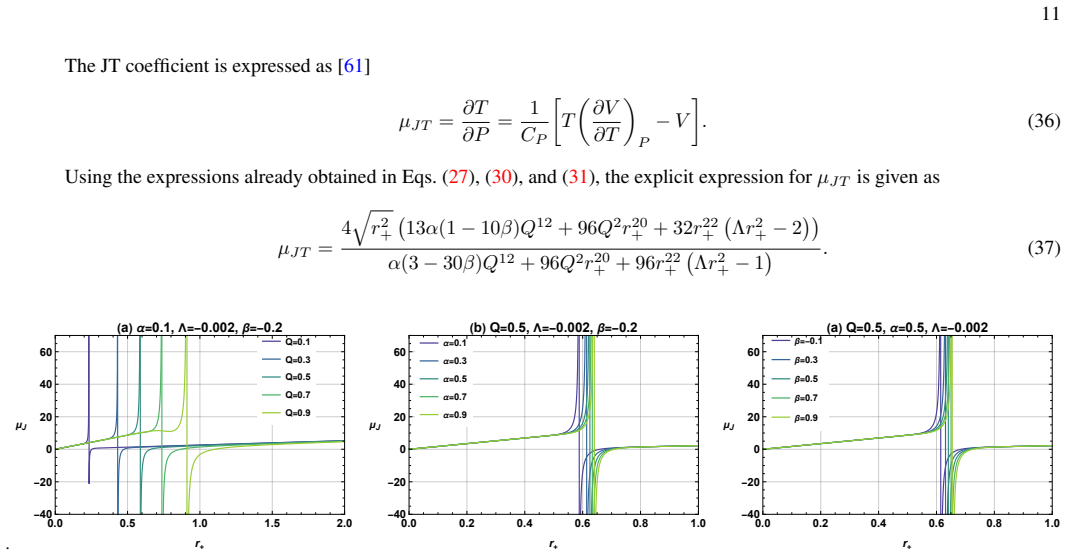
- Abstract and §V (Figs. 3–5, inversion and isenthalpic discussion): the central claim that “the black hole charge has the most pronounced impact on the JT behaviour” rests on visual comparison of curves obtained by varying Q, α and β over comparable O(0.1–0.9) intervals. For p=6 the NLED coupling α multiplies a Q^{12}/r^{22} term and therefore carries dimensions of length^{10} (or equivalent), while β is dimensionless only after the linear f(R,T) model is fixed; the chosen numerical windows are therefore not scale-invariant. A different choice of units or of the natural NLED/matter-curvature scale can reverse the apparent hierarchy of shifts in Ti(Pi) and in the isenthalpic peaks. The ranking should be re-established with dimensionless combinations (e.g. αQ^{10}/r_+^{10}, β relative to a fixed curvature scale) or explicitly qualified as holding only inside the plotted window; otherwise th
- §I and §VI: the introduction correctly notes that non-minimal matter–curvature coupling in f(R,T) implies ∇_µT^{µν}≠0 and an extra force, so that test-particle motion “deviates from geodesic trajectories.” Section VI nevertheless adopts the standard geodesic Lagrangian (Eq. 43) and the usual effective-potential formalism without the extra force. Because the geodesic conclusions (stable circular orbits, precession rates, photon-sphere location, and the claim of RN-AdS recovery at large r) are load-bearing for the second half of the paper, either (i) the extra-force term must be shown to be negligible for the adopted linear model and parameter ranges, or (ii) the orbital equations must be recomputed with the non-geodesic force. Leaving the tension unaddressed undermines the kinematic half of the central narrative.
- §II, Eq. (20) and subsequent thermodynamics: all results are obtained for the single power p=6 and the linear model f(R,T)=R+βT taken from Róis et al. The abstract and conclusions present the JT and geodesic findings as characteristic of “f(R,T) coupled with nonlinear electrodynamics.” At minimum the text should state clearly that the hierarchy of parameter influence and the r^{-22} decoupling are specific to this functional choice, and indicate whether the qualitative picture (single inversion branch, RN-AdS recovery) is expected to survive for the other powers (p=2,4) already examined in the source paper.
minor comments (6)
- Several figure panels reuse the same subplot label “(a)” (e.g. Fig. 3 has two panels labelled (a); Fig. 1 insets are hard to read). Renumber consistently and enlarge insets or move them to separate panels.
- Notation: the charge is written both q and Q; the cosmological constant appears as Λ, Λ_eff and f_0. Unify symbols after Eq. (18).
- Eq. (24) for TH still contains an unsimplified mix of αβ and α terms; a single factor α(10β−1) would match the metric and improve readability.
- Metric signature is stated as (+,−,−,−) while the geodesic normalisation uses g_µνẋ^µẋ^ν=−ϵ with ϵ=1 for massive particles; a one-sentence clarification of the sign convention for ϵ would avoid confusion.
- Typos: “inf(R, T)” spacing in the title and several headings; “R’oiset al.” / “Róis et al.” inconsistent; “Mod(A)Max-AdS” left unexplained on first use.
- §VII claims a “direct physical correlation” between thermodynamic phase boundaries and orbital dynamics; the shared dependence on A and A' is correctly noted, but the language could be toned down to “common geometric origin” unless a quantitative map (e.g. between Ti and r_ph) is supplied.
Circularity Check
No significant circularity: metric imported from independent prior work; thermodynamics and geodesics are standard forward calculations with no definitional loops or fitted-as-prediction steps.
full rationale
The load-bearing input is the metric function A(r) of Eq. (20), taken directly from the independent solution of Róis et al. [107] (different author set) after fixing the linear f(R,T)=R+eta T model and the p=6 NLED power. All subsequent quantities—M(r+), TH, S= ho r+^{2}, G, CP, ho JT, Ti(Pi), isenthalpic T(P)|M, Veff, circular-orbit conditions, ISCO, and photon-sphere loci—are obtained by ordinary differentiation and algebraic rearrangement of that fixed A(r) (Eqs. 21–54). No free parameter is fitted to any thermodynamic or geodesic observable and then re-used as a “prediction”; the numerical curves simply evaluate the same closed-form expressions at chosen O(1) values of Q, ho, eta. Self-citations (e.g. Gogoi et al. [63] on JT methods) appear only as comparative references and do not supply uniqueness theorems or ansatzes that force the present results. Consequently the derivation chain is self-contained and non-circular.
Axiom & Free-Parameter Ledger
free parameters (5)
- Q (electric/magnetic charge)
- α (NLED coupling)
- β (f(R,T) coupling)
- Λ_eff (or f_0)
- p=6 (NLED power)
axioms (4)
- domain assumption The metric function A(r) of Eq. (20) is an exact solution of the f(R,T)+NLED field equations for p=6.
- domain assumption Black-hole mass M is identified with enthalpy in the extended phase space, so constant-M curves are isenthalpic.
- domain assumption Entropy remains the Bekenstein-Hawking area law S=π r_+^{2} even after the f(R,T) and NLED modifications.
- ad hoc to paper Test-particle motion is governed by the standard geodesic equation of the metric (no extra force from non-conservation of T_µν).
read the original abstract
We herein study both the Joule-Thomson (JT) expansion process and the geodesic properties of a charged anti-de Sitter (AdS) black hole arising in modified gravity with nonlinear electrodynamic (NLED) sources. Our thermodynamic study reveals that the black hole charge has the most pronounced impact on the JT behaviour. The nonlinear electromagnetic sector together with the modified gravity parameters introduces further corrections to the inversion temperature and the associated cooling characteristics. At astrophysically relevant distances, the geometry closely reproduces expected outcomes.
Figures




Reference graph
Works this paper leans on
-
[1]
Einstein, The foundation of the general theory of relativity., Annalen Phys.49, 769 (1916)
A. Einstein, The foundation of the general theory of relativity., Annalen Phys.49, 769 (1916)
work page 1916
-
[2]
B. P. Abbottet al.(LIGO Scientific, Virgo), Observation of Gravitational Waves from a Binary Black Hole Merger, Phys. Rev. Lett. 116, 061102 (2016), arXiv:1602.03837 [gr-qc]
work page internal anchor Pith review Pith/arXiv arXiv 2016
-
[3]
B. P. Abbottet al.(LIGO Scientific, Virgo, Fermi GBM, INTEGRAL, IceCube, AstroSat Cadmium Zinc Telluride Imager Team, IPN, Insight-Hxmt, ANTARES, Swift, AGILE Team, 1M2H Team, Dark Energy Camera GW-EM, DES, DLT40, GRAWITA, Fermi-LAT, ATCA, ASKAP, Las Cumbres Observatory Group, OzGrav, DWF (Deeper Wider Faster Program), AST3, CAASTRO, VINROUGE, MASTER, J-G...
work page internal anchor Pith review Pith/arXiv arXiv 2017
-
[4]
First M87 Event Horizon Telescope Results. I. The Shadow of the Supermassive Black Hole
K. Akiyamaet al.(Event Horizon Telescope), First M87 Event Horizon Telescope Results. I. The Shadow of the Supermassive Black Hole, Astrophys. J. Lett.875, L1 (2019), arXiv:1906.11238 [astro-ph.GA]. 21
work page internal anchor Pith review Pith/arXiv arXiv 2019
-
[5]
K. Akiyamaet al.(Event Horizon Telescope), First Sagittarius A* Event Horizon Telescope Results. I. The Shadow of the Supermassive Black Hole in the Center of the Milky Way, Astrophys. J. Lett.930, L12 (2022), arXiv:2311.08680 [astro-ph.HE]
work page internal anchor Pith review Pith/arXiv arXiv 2022
-
[6]
Introduction to Modified Gravity and Gravitational Alternative for Dark Energy
S. Nojiri and S. D. Odintsov, Introduction to modified gravity and gravitational alternative for dark energy, eConfC0602061, 06 (2006), arXiv:hep-th/0601213
work page internal anchor Pith review Pith/arXiv arXiv 2006
-
[7]
T. P. Sotiriou and V . Faraoni, f(R) Theories Of Gravity, Rev. Mod. Phys.82, 451 (2010), arXiv:0805.1726 [gr-qc]
work page internal anchor Pith review Pith/arXiv arXiv 2010
-
[8]
A. De Felice and S. Tsujikawa, f(R) theories, Living Rev. Rel.13, 3 (2010), arXiv:1002.4928 [gr-qc]
work page internal anchor Pith review Pith/arXiv arXiv 2010
-
[9]
Modified Gravity and Cosmology
T. Clifton, P. G. Ferreira, A. Padilla, and C. Skordis, Modified Gravity and Cosmology, Phys. Rept.513, 1 (2012), arXiv:1106.2476 [astro-ph.CO]
work page internal anchor Pith review Pith/arXiv arXiv 2012
-
[10]
A. A. Starobinsky, A New Type of Isotropic Cosmological Models Without Singularity, Phys. Lett. B91, 99 (1980)
work page 1980
-
[11]
T. Harko, F. S. N. Lobo, S. Nojiri, and S. D. Odintsov,f(R, T)gravity, Phys. Rev. D84, 024020 (2011), arXiv:1104.2669 [gr-qc]
work page internal anchor Pith review Pith/arXiv arXiv 2011
-
[12]
Metric-affine f(R,T) theories of gravity and their applications
E. Barrientos, F. S. N. Lobo, S. Mendoza, G. J. Olmo, and D. Rubiera-Garcia, Metric-affine f(R,T) theories of gravity and their applica- tions, Phys. Rev. D97, 104041 (2018), arXiv:1803.05525 [gr-qc]
work page internal anchor Pith review Pith/arXiv arXiv 2018
-
[13]
H. F. M. Gonner, THEORIES OF GRA VITATION WITH NONMINIMAL COUPLING OF MATTER AND THE GRA VITATIONAL FIELD, Found. Phys.14, 865 (1984)
work page 1984
-
[14]
Extra force in $f(R)$ modified theories of gravity
O. Bertolami, C. G. Boehmer, T. Harko, and F. S. N. Lobo, Extra force in f(R) modified theories of gravity, Phys. Rev. D75, 104016 (2007), arXiv:0704.1733 [gr-qc]
work page internal anchor Pith review Pith/arXiv arXiv 2007
-
[15]
Non-minimal curvature-matter couplings in modified gravity
O. Bertolami, J. Paramos, T. Harko, and F. S. N. Lobo, Non-minimal curvature-matter couplings in modified gravity, (2008), arXiv:0811.2876 [gr-qc]
work page internal anchor Pith review Pith/arXiv arXiv 2008
-
[16]
Nonminimal coupling of perfect fluids to curvature
O. Bertolami, F. S. N. Lobo, and J. Paramos, Non-minimum coupling of perfect fluids to curvature, Phys. Rev. D78, 064036 (2008), arXiv:0806.4434 [gr-qc]
work page internal anchor Pith review Pith/arXiv arXiv 2008
-
[17]
T. Harko and F. S. N. Lobo, f(R,Lm) gravity, Eur. Phys. J. C70, 373 (2010), arXiv:1008.4193 [gr-qc]
work page internal anchor Pith review Pith/arXiv arXiv 2010
-
[18]
T. Harko and F. S. N. Lobo, Geodesic deviation, Raychaudhuri equation, and tidal forces in modified gravity with an arbitrary curvature- matter coupling, Phys. Rev. D86, 124034 (2012), arXiv:1210.8044 [gr-qc]
work page internal anchor Pith review Pith/arXiv arXiv 2012
-
[19]
Extended $f(R,L_m)$ gravity with generalized scalar field and kinetic term dependences
T. Harko, F. S. N. Lobo, and O. Minazzoli, Extendedf(R, L m)gravity with generalized scalar field and kinetic term dependences, Phys. Rev. D87, 047501 (2013), arXiv:1210.4218 [gr-qc]
work page internal anchor Pith review Pith/arXiv arXiv 2013
-
[20]
Further matters in space-time geometry: $f(R,T,R_{\mu\nu}T^{\mu\nu})$ gravity
Z. Haghani, T. Harko, F. S. N. Lobo, H. R. Sepangi, and S. Shahidi, Further matters in space-time geometry: f(R,T,RµνTµν) gravity, Phys. Rev. D88, 044023 (2013), arXiv:1304.5957 [gr-qc]
work page internal anchor Pith review Pith/arXiv arXiv 2013
-
[21]
Generalized curvature-matter couplings in modified gravity
T. Harko and F. S. N. Lobo, Generalized curvature-matter couplings in modified gravity, Galaxies2, 410 (2014), arXiv:1407.2013 [gr-qc]
work page internal anchor Pith review Pith/arXiv arXiv 2014
-
[22]
Beyond Einstein's General Relativity: Hybrid metric-Palatini gravity and curvature-matter couplings
T. Harko and F. S. N. Lobo, Beyond Einstein’s General Relativity: Hybrid metric-Palatini gravity and curvature-matter couplings, Int. J. Mod. Phys. D29, 2030008 (2020), arXiv:2007.15345 [gr-qc]
work page internal anchor Pith review Pith/arXiv arXiv 2020
-
[23]
Thermodynamics in f(R,T) Theory of Gravity
M. Sharif and M. Zubair, Thermodynamics in f(R,T) Theory of Gravity, JCAP03, 028, [Erratum: JCAP 05, E01 (2012)], arXiv:1204.0848 [gr-qc]
work page internal anchor Pith review Pith/arXiv arXiv 2012
-
[24]
Energy Conditions Constraints and Stability of Power Law Solutions in f(R,T) Gravity
M. Sharif and M. Zubair, Energy Conditions Constraints and Stability of Power Law Solutions in f(R,T) Gravity, J. Phys. Soc. Jap.82, 014002 (2013), arXiv:1210.3878 [gr-qc]
work page internal anchor Pith review Pith/arXiv arXiv 2013
-
[25]
F. G. Alvarenga, M. J. S. Houndjo, A. V . Monwanou, and J. B. C. Orou, Testing some f(R,T) gravity models from energy conditions, J. Mod. Phys.4, 130 (2013), arXiv:1205.4678 [gr-qc]
work page internal anchor Pith review Pith/arXiv arXiv 2013
-
[26]
P. H. R. S. Moraes, J. D. V . Arba˜nil, and M. Malheiro, Stellar equilibrium configurations of compact stars inf(R, T)gravity, JCAP06, 005, arXiv:1511.06282 [gr-qc]
work page internal anchor Pith review Pith/arXiv arXiv
-
[27]
A. Das, F. Rahaman, B. K. Guha, and S. Ray, Compact stars inf(R,T)gravity, Eur. Phys. J. C76, 654 (2016), arXiv:1608.00566 [gr-qc]
work page internal anchor Pith review Pith/arXiv arXiv 2016
-
[28]
S. K. Maurya and F. Tello-Ortiz, Charged anisotropic compact star inf(R, T)gravity: A minimal geometric deformation gravitational decoupling approach, Phys. Dark Univ.27, 100442 (2020), arXiv:1905.13519 [gr-qc]
work page internal anchor Pith review Pith/arXiv arXiv 2020
-
[29]
S. K. Maurya, A. Errehymy, D. Deb, F. Tello-Ortiz, and M. Daoud, Study of anisotropic strange stars inf(R, T)gravity: An embedding approach under the simplest linear functional of the matter-geometry coupling, Phys. Rev. D100, 044014 (2019), arXiv:1907.10149 [gr-qc]
work page internal anchor Pith review Pith/arXiv arXiv 2019
-
[30]
A. Das, S. Ghosh, B. K. Guha, S. Das, F. Rahaman, and S. Ray, Gravastars in f(R,T) gravity, Phys. Rev. D95, 124011 (2017), arXiv:1702.08873 [gr-qc]
work page internal anchor Pith review Pith/arXiv arXiv 2017
-
[31]
Charged Gravastars in Modified Gravity
Z. Yousaf, K. Bamba, M. Z. Bhatti, and U. Ghafoor, Charged Gravastars in Modified Gravity, Phys. Rev. D100, 024062 (2019), arXiv:1907.05233 [gr-qc]
work page internal anchor Pith review Pith/arXiv arXiv 2019
-
[32]
Reconstruction of some cosmological models in f(R,T) gravity
M. Jamil, D. Momeni, M. Raza, and R. Myrzakulov, Reconstruction of some cosmological models in f(R,T) gravity, Eur. Phys. J. C72, 1999 (2012), arXiv:1107.5807 [physics.gen-ph]
work page internal anchor Pith review Pith/arXiv arXiv 1999
-
[33]
f(R,T) Cosmological Models in Phase Space
H. Shabani and M. Farhoudi, f(R,T) Cosmological Models in Phase Space, Phys. Rev. D88, 044048 (2013), arXiv:1306.3164 [gr-qc]
work page internal anchor Pith review Pith/arXiv arXiv 2013
-
[34]
Cosmological and Solar System Consequences of f(R,T) Gravity Models
H. Shabani and M. Farhoudi, Cosmological and Solar System Consequences of f(R,T) Gravity Models, Phys. Rev. D90, 044031 (2014), arXiv:1407.6187 [gr-qc]
work page internal anchor Pith review Pith/arXiv arXiv 2014
-
[35]
Growth of cosmic perturbations in the modified $f(R,T)$ gravity
M. Asghari and A. Sheykhi, Growth of cosmic perturbations in the modified f(R,T) gravity, Phys. Dark Univ.46, 101695 (2024), arXiv:2405.11840 [gr-qc]
work page internal anchor Pith review Pith/arXiv arXiv 2024
-
[36]
Wormhole Geometries In $f(R,T)$ Gravity
T. Azizi, Wormhole Geometries Inf(R, T)Gravity, Int. J. Theor. Phys.52, 3486 (2013), arXiv:1205.6957 [gr-qc]
work page internal anchor Pith review Pith/arXiv arXiv 2013
-
[37]
Static Spherically Symmetric Wormholes in $f(R,T)$ Gravity
M. Zubair, S. Waheed, and Y . Ahmad, Static spherically symmetric wormholes in f(R, T) gravity, Eur. Phys. J. C76, 444 (2016), arXiv:1607.05998 [gr-qc]
work page internal anchor Pith review Pith/arXiv arXiv 2016
-
[38]
P. H. R. S. Moraes, R. A. C. Correa, and R. V . Lobato, Analytical general solutions for static wormholes inf(R, T)gravity, JCAP07, 029, arXiv:1701.01028 [gr-qc]
work page internal anchor Pith review Pith/arXiv arXiv
-
[39]
P. H. R. S. Moraes and P. K. Sahoo, Modelling wormholes inf(R, T)gravity, Phys. Rev. D96, 044038 (2017), arXiv:1707.06968 [gr-qc]. 22
work page internal anchor Pith review Pith/arXiv arXiv 2017
-
[40]
E. Elizalde and M. Khurshudyan, Wormhole formation inf(R, T)gravity: Varying Chaplygin gas and barotropic fluid, Phys. Rev. D 98, 123525 (2018), arXiv:1811.11499 [gr-qc]
work page internal anchor Pith review Pith/arXiv arXiv 2018
-
[41]
A. F. Zakharov, F. De Paolis, G. Ingrosso, and A. A. Nucita, Shadows as a tool to evaluate black hole parameters and a dimension of spacetime, New Astron. Rev.56, 64 (2012)
work page 2012
-
[42]
Constraining the spin and the deformation parameters from the black hole shadow
N. Tsukamoto, Z. Li, and C. Bambi, Constraining the spin and the deformation parameters from the black hole shadow, JCAP06, 043, arXiv:1403.0371 [gr-qc]
work page internal anchor Pith review Pith/arXiv arXiv
-
[43]
Black Hole Parameter Estimation from Its Shadow
R. Kumar and S. G. Ghosh, Black Hole Parameter Estimation from Its Shadow, Astrophys. J.892, 78 (2020), arXiv:1811.01260 [gr-qc]
work page internal anchor Pith review Pith/arXiv arXiv 2020
-
[44]
Black holes with scalar hair in light of the Event Horizon Telescope
M. Khodadi, A. Allahyari, S. Vagnozzi, and D. F. Mota, Black holes with scalar hair in light of the Event Horizon Telescope, JCAP09, 026, arXiv:2005.05992 [gr-qc]
work page internal anchor Pith review Pith/arXiv arXiv 2005
-
[45]
Constraints on black-hole charges with the 2017 EHT observations of M87*
P. Kocherlakotaet al.(Event Horizon Telescope), Constraints on black-hole charges with the 2017 EHT observations of M87*, Phys. Rev. D103, 104047 (2021), arXiv:2105.09343 [gr-qc]
work page internal anchor Pith review Pith/arXiv arXiv 2017
-
[46]
Quasinormal modes, thermodynamics and shadow of black holes in Hu-Sawicki f(R) gravity theory
R. Karmakar and U. D. Goswami, Quasinormal modes, thermodynamics and shadow of black holes in Hu–Sawickif(R)gravity theory, Eur. Phys. J. C84, 969 (2024), arXiv:2406.18329 [gr-qc]
work page internal anchor Pith review Pith/arXiv arXiv 2024
-
[47]
R. Karmakar, D. J. Gogoi, and U. D. Goswami, Thermodynamics and shadows of GUP-corrected black holes with topological defects in Bumblebee gravity, Phys. Dark Univ.41, 101249 (2023), arXiv:2303.00297 [gr-qc]
work page internal anchor Pith review Pith/arXiv arXiv 2023
-
[48]
Thermodynamic Properties and Shadows of Black Holes in $f(R,T)$ Gravity
B. Hazarika and P. Phukon, Thermodynamic properties and shadows of black holes inf(R, T)gravity, Front. Phys. (Beijing)20, 35201 (2025), arXiv:2410.00606 [gr-qc]
work page internal anchor Pith review Pith/arXiv arXiv 2025
-
[49]
Modified gravity from the quantum part of the metric
V . Dzhunushaliev, V . Folomeev, B. Kleihaus, and J. Kunz, Modified gravity from the quantum part of the metric, Eur. Phys. J. C74, 2743 (2014), arXiv:1312.0225 [gr-qc]
work page internal anchor Pith review Pith/arXiv arXiv 2014
-
[50]
Effects of quantum fluctuations of metric on the universe
R. Yang, Effects of quantum fluctuations of metric on the universe, Phys. Dark Univ.13, 87 (2016), arXiv:1506.02889 [gr-qc]
work page internal anchor Pith review Pith/arXiv arXiv 2016
-
[51]
J. Bardeen, Non-singular general relativistic gravitational collapse, inProceedings of the 5th International Conference on Gravitation and the Theory of Relativity(1968) p. 87
work page 1968
-
[52]
E. Ayon-Beato and A. Garcia, The Bardeen model as a nonlinear magnetic monopole, Phys. Lett. B493, 149 (2000), arXiv:gr- qc/0009077
-
[53]
K. A. Bronnikov, Regular magnetic black holes and monopoles from nonlinear electrodynamics, Phys. Rev. D63, 044005 (2001), arXiv:gr-qc/0006014
work page internal anchor Pith review Pith/arXiv arXiv 2001
-
[54]
Regular electrically charged structures in Nonlinear Electrodynamics coupled to General Relativity
I. Dymnikova, Regular electrically charged structures in nonlinear electrodynamics coupled to general relativity, Class. Quant. Grav.21, 4417 (2004), arXiv:gr-qc/0407072
work page internal anchor Pith review Pith/arXiv arXiv 2004
-
[55]
Regular black holes with a nonlinear electrodynamics source
L. Balart and E. C. Vagenas, Regular black holes with a nonlinear electrodynamics source, Phys. Rev. D90, 124045 (2014), arXiv:1408.0306 [gr-qc]
work page internal anchor Pith review Pith/arXiv arXiv 2014
-
[56]
On a regular charged black hole with a nonlinear electric source
H. Culetu, On a regular charged black hole with a nonlinear electric source, Int. J. Theor. Phys.54, 2855 (2015), arXiv:1408.3334 [gr-qc]
work page internal anchor Pith review Pith/arXiv arXiv 2015
-
[57]
M. E. Rodrigues and M. V . de Sousa Silva, Bardeen Regular Black Hole With an Electric Source, JCAP06, 025, arXiv:1802.05095 [gr-qc]
work page internal anchor Pith review Pith/arXiv arXiv
-
[58]
Non-linear electrodynamics and the acceleration of the universe
M. Novello, S. E. Perez Bergliaffa, and J. Salim, Non-linear electrodynamics and the acceleration of the universe, Phys. Rev. D69, 127301 (2004), arXiv:astro-ph/0312093
work page internal anchor Pith review Pith/arXiv arXiv 2004
-
[59]
Cosmological Effects of Nonlinear Electrodynamics
M. Novello, E. Goulart, J. M. Salim, and S. E. Perez Bergliaffa, Cosmological Effects of Nonlinear Electrodynamics, Class. Quant. Grav.24, 3021 (2007), arXiv:gr-qc/0610043
work page internal anchor Pith review Pith/arXiv arXiv 2007
-
[60]
Magnetically charged regular black holes in $f(R,T)$ gravity coupled to nonlinear electrodynamics
T. Tangphati, M. Youk, and S. Ponglertsakul, Magnetically charged regular black holes in f(R,T) gravity coupled to nonlinear electro- dynamics, JHEAp43, 66 (2024), arXiv:2312.16614 [gr-qc]
work page internal anchor Pith review Pith/arXiv arXiv 2024
- [61]
-
[62]
C. V . Johnson, Holographic Heat Engines, Class. Quant. Grav.31, 205002 (2014), arXiv:1404.5982 [hep-th]
work page internal anchor Pith review Pith/arXiv arXiv 2014
-
[63]
D. J. Gogoi, Y . Sekhmani, D. Kalita, N. J. Gogoi, and J. Bora, Joule-Thomson Expansion and Optical Behaviour of Reissner-Nordstr¨om- Anti-de Sitter Black Holes in Rastall Gravity Surrounded by a Quintessence Field, Fortsch. Phys.71, 2300010 (2023), arXiv:2306.02881 [gr-qc]
work page internal anchor Pith review Pith/arXiv arXiv 2023
-
[64]
S. I. Kruglov, Magnetic black holes within Einstein–AdS gravity coupled to nonlinear electrodynamics, extended phase space thermo- dynamics and Joule–Thomson expansion, Can. J. Phys.101, 739 (2023), arXiv:2401.15115 [physics.gen-ph]
work page internal anchor Pith review Pith/arXiv arXiv 2023
- [65]
- [66]
-
[67]
Thermodynamics and the Joule-Thomson expansion of dilaton black holes in 2+1 dimensions
L. Balart and S. Fernando, Thermodynamics and the Joule-Thomson expansion of dilaton black holes in 2+1 dimensions, Mod. Phys. Lett. A41, 12 (2026), arXiv:2308.14875 [gr-qc]
work page internal anchor Pith review Pith/arXiv arXiv 2026
-
[68]
Joule-Thomson expansion of charged Gauss-Bonnet black holes in AdS space
S.-Q. Lan, Joule-Thomson expansion of charged Gauss-Bonnet black holes in AdS space, Phys. Rev. D98, 084014 (2018), arXiv:1805.05817 [gr-qc]
work page internal anchor Pith review Pith/arXiv arXiv 2018
-
[69]
K. V . Rajani, C. L. A. Rizwan, A. Naveena Kumara, M. S. Ali, and D. Vaid, Joule–Thomson expansion of regular Bardeen AdS black hole surrounded by static anisotropic matter field, Phys. Dark Univ.32, 100825 (2021), arXiv:2002.03634 [gr-qc]
work page internal anchor Pith review Pith/arXiv arXiv 2021
-
[70]
J. D. Bekenstein, Black holes and entropy, Phys. Rev. D7, 2333 (1973)
work page 1973
-
[71]
S. W. Hawking, Black hole explosions, Nature248, 30 (1974)
work page 1974
-
[72]
S. W. Hawking, Particle Creation by Black Holes, Commun. Math. Phys.43, 199 (1975), [Erratum: Commun.Math.Phys. 46, 206 (1976)]
work page 1975
-
[73]
R. M. Wald, Entropy and black-hole thermodynamics, Phys. Rev. D20, 1271 (1979)
work page 1979
-
[74]
R. M. Wald, The thermodynamics of black holes, Living Rev. Rel.4, 6 (2001), arXiv:gr-qc/9912119. 23
work page internal anchor Pith review Pith/arXiv arXiv 2001
-
[75]
S. Carlip, Black Hole Thermodynamics, Int. J. Mod. Phys. D23, 1430023 (2014), arXiv:1410.1486 [gr-qc]
work page internal anchor Pith review Pith/arXiv arXiv 2014
-
[76]
P. Candelas and D. W. Sciama, Irreversible Thermodynamics of Black Holes, Phys. Rev. Lett.38, 1372 (1977)
work page 1977
-
[77]
On Black Hole Entropy Corrections in the Grand Canonical Ensemble
S. Mahapatra, P. Phukon, and T. Sarkar, On Black Hole Entropy Corrections in the Grand Canonical Ensemble, Phys. Rev. D84, 044041 (2011), arXiv:1103.5885 [hep-th]
work page internal anchor Pith review Pith/arXiv arXiv 2011
- [78]
-
[79]
P. C. W. Davies, Thermodynamic Phase Transitions of Kerr-Newman Black Holes in De Sitter Space, Class. Quant. Grav.6, 1909 (1989)
work page 1909
-
[80]
S. W. Hawking and D. N. Page, Thermodynamics of Black Holes in anti-De Sitter Space, Commun. Math. Phys.87, 577 (1983)
work page 1983
discussion (0)
Sign in with ORCID, Apple, or X to comment. Anyone can read and Pith papers without signing in.