REVIEW 2 major objections 6 minor 43 references
Learning Brenier Potentials with Convex Generative Adversarial Neural Networks
T0 review · 2 major / 6 minor · reviewed 2026-08-16 · deepseek-v4-flash
Pith's one-line read A GAN whose generator is the gradient of a learned convex potential is statistically consistent: with enough samples, the generated distribution converges to the target in Jensen-Shannon divergence up to the training error.
desk verdict A genuinely new convexity-penalty mechanism plus a mostly coherent GAN error decomposition, but the discriminator tube-volume estimate is asserted, not proved, and the fixed-ε theorem is oversold as full consistency. read the letter →
The pith
A machine-rendered reading of the paper's core claim, the machinery that carries it, and where it could break.
The reading
What carries the argument
The central object is the Brenier potential, the strictly convex function whose gradient is the optimal transport map. The construction rests on four interlocking pieces: (1) the identity G = \nabla\phi, which makes the pushforward density p(x) = 1 / \det[\text{Hess}\$\varphi$((\nabla\phi)^{-1}(x))] available through the change-of-variables formula; (2) the ReCU activation \max\{0,x\}^3, whose $C^{{2,1}}$ regularity allows simultaneous approximation of \phi and its first two derivatives; (3) the discriminator approximation built from a partition of unity on a grid, valid outside the tube C(N) around (\partial A) \cap [0,1]^d, with volume controlled by Weyl's tube formula; and (4) the convexity penalty $P^{{(\kappa)}}$(\phi) = \mathbb{E}\left[\text{ReLU}\left(\phi\left(\tfrac{U+U'}{2}\right) - \tfrac{\$\varphi$(U)+\$\varphi$(U')}{2} + \tfrac{\kappa}{8}\|U-U'\|^2\right)\right], which vanishes exactly on \kappa-strongly convex functions and, for large \gamma, pushes the training minimizer into the strongly convex class.
What would settle it
Construct a concrete strongly convex ReCU potential with the allowed Hessian bounds whose gradient image A has a boundary crossing [0,1]^2 at a corner, and numerically estimate the Lebesgue measure of the set of points within distance \sqrt{2}/N of the boundary of A inside [0,1]^2; if the decay is not O(1/N) with a constant that stays bounded as the network class grows, the uniform tube-volume estimate behind Proposition 11 is false.
Extended reading notes
Core claim
Under the paper's assumptions, the main theorem states that if the generator space H_gen(epsilon) consists of gradients of ReCU networks with Hessians bounded between 1/\tilde M and \tilde M and with bounded $C^{{2,1}}$ norm, and the discriminator space is a relatively compact ReLU-network class containing a nearly optimal discriminator for every such generator, then for every fixed epsilon > 0 and every random training sequence \hat G_n in H_gen(epsilon), almost surely limsup_{n \to \infty} d_{JS}(\mu_*, (\hat G_n)_\#\$\lambda$) \le \limsup_n \Delta_T(n) + 2\epsilon. Combined with Proposition 18, choosing the penalty parameter \gamma large enough makes every minimizer of the penalized objective (\$\beta$/2 - \eta)-strongly convex for any \eta \in (0, \$\beta$/2), so the strict convexity needed for the change-of-variables argument is not assumed but learned. The paper also establishes the supporting approximation results: ReCU networks simultaneously approximate a $C^{{3,\alpha}}$ Brenier potential and its derivatives, and ReLU discriminators approximate the optimal discriminator outside a small tube around the boundary of the generator's range, whose volume is controlled by Weyl's tube formula.
Load-bearing premise
The load-bearing premise is that the volume of the thin tube around the boundary of the generator's image decays like a constant over N uniformly across the whole allowed network class; if that uniform tube-volume bound fails, the discriminator approximation error bound and with it the main theorem lose their control.
Editorial extensions
If this is right
- If the training error \Delta_T(n) tends to zero, the generated distribution converges to \mu_* in Jensen-Shannon divergence almost surely; combined with the star-shaped support, this implies \nabla\hat\phi_n \to \nabla\phi_* almost everywhere, so the algorithm learns the Brenier potential itself.
- For any fixed epsilon, a sufficiently large penalty parameter \gamma makes every minimizer of the penalized objective (\beta/2 - \eta)-strongly convex, so no separate architectural convexity constraint, such as input-convex layers, is needed to guarantee injectivity and a well-defined density.
- The four-term error decomposition shows which sources of error vanish asymptotically: generator, discriminator, and sample errors can all be driven below any prescribed epsilon by enlarging networks and sample size, leaving only the training error in the limit.
- Because the density of the generated measure is controlled through the second derivative of a C^{2,1} potential, the method produces transport maps with Lipschitz-continuous densities rather than only point clouds.
- The consistency statement holds for slowly expanding network capacity, so the theory covers the common practical regime where the architecture grows as the sample size grows.
Reading between the lines
- The theorem's bound is conditional on solving the min-max training problem; it does not by itself show that gradient-based optimization reaches the training error, so the practical guarantee is one step removed from training dynamics.
- The convexity penalty is analyzed with a uniform law of large numbers but without finite-sample rates; a natural extension is a quantitative bound on how many random pairs m(n) are needed to certify Hessian lower bounds over the whole cube.
- The boundary-tube mechanism suggests the same consistency program should transfer to smooth domains or periodic boundary conditions, where the source density is continuous and the tube estimate becomes cleaner; the paper notes the cube is a convenience but does not develop this variant.
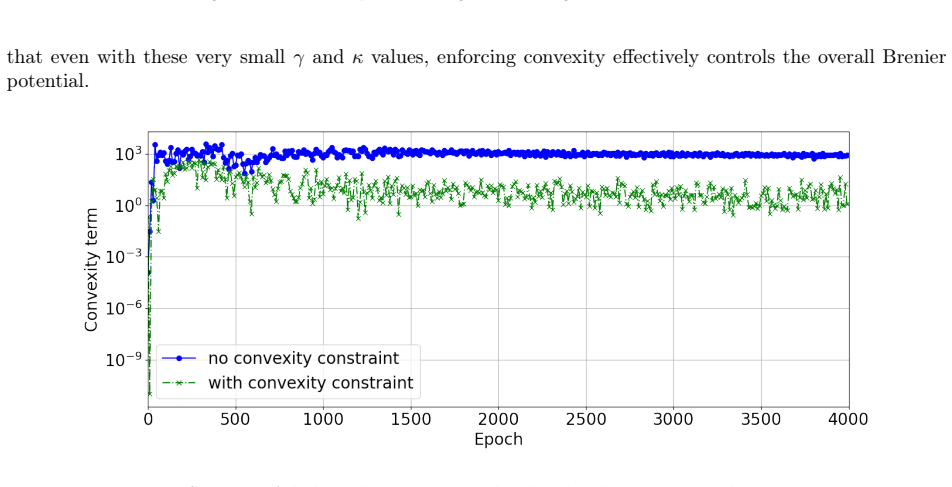
- If the theory is right, a practical diagnostic is that a sufficiently large penalty parameter makes the empirical convexity loss vanish and stay near zero after a few epochs, which the paper reports seeing in its image experiments.
Signed reviews
Editorial analysis
A structured set of objections, weighed in public.
Referee Report
Summary. The paper proposes a Brenier GAN in which the generator is the gradient of a neural-network potential, with a convexity penalty enforcing strong convexity, and develops a statistical learning theory for this construction. After decomposing the Jensen–Shannon divergence into generator, discriminator, sampling, and training errors, the paper proves (Theorem 1) that for fixed epsilon the asymptotic divergence is bounded by the limiting training error plus 2epsilon, provided the generator and discriminator hypothesis classes have sufficiently small model errors. It also proves (Proposition 18) that for a sufficiently large penalty parameter and sufficiently large sample size, global minimizers of the penalized empirical objective are strongly convex. Numerical experiments on Gaussian mixtures, MNIST, Fashion-MNIST, and NORB illustrate the method.
Significance. If the technical gaps are closed, this is a valuable contribution to the theory of GANs: it gives a clean four-term error decomposition, identifies a concrete obstruction in bounding the discriminator model error, proves an explicit strong-convexity guarantee for penalized minimizers, and provides a detailed ReCU-based construction. The proof of Proposition 4 is self-contained and transparent, and the convexity-penalty argument in Proposition 16 is elegant and quantitative. The numerical experiments are extensive enough to support the qualitative claims. However, the main theorem currently rests on an unproved uniform tube-volume estimate in Proposition 11, so the consistency result is conditional on that estimate being supplied.
major comments (2)
- [Section 3.4, Proposition 11 (paragraph after eq. (18))] The proof's only control of the tube integral is the assertion that lambda(C(N)) <= C/N, justified by Weyl's tube formula with coefficients bounded by a function of d and \tilde H. As stated, (partial A) cap [0,1]^d is not a smooth compact submanifold: A = grad phi([0,1]^d) has a boundary stratified into images of the faces, edges, and corners of the cube, and Weyl's formula applies to smooth submanifolds with tube radius below the reach. No stratification, reach estimate, or uniform coefficient bound is supplied, and the bound is required uniformly over all phi in H_gen(epsilon). Since C(N) enters eq. (18) as the sole control of the two tube integrals, the conclusion Delta_D <= epsilon, and hence Theorem 1, depends on this unproved estimate. Please supply a proof (for example, a uniform Lipschitz stratification with controlled geometry per stratum) or replace the argument; if the true tube volume behaved only as C/N^alpha with alpha < 1, then eq. (18) would not tend to zero and the limsup inequality in Theorem 1 would lose its 2epsilon slack.
- [Section 3.3, Proposition 8] The universal approximation statement in C^{2,1} for ReCU networks is load-bearing for the generator error through Proposition 10, but the proof is only a sketch: the text gives algebraic identities for multiplication and identity and then says 'this together with ... allows to proceed as in [26, Lemma 3]' and 'yields the claim.' For a formal journal proof, please state explicitly how the B-spline representation of order 3 is combined with the recursive construction of [26] to control all derivatives up to order 2 and the Holder modulus of the second derivatives, or state Proposition 8 as a theorem with a complete proof in an appendix.
minor comments (6)
- [Section 3.5, eq. (20)] The supremum in eq. (20) is written over H_gen(epsilon) x H_gen(epsilon) but should be over H_gen(epsilon) x H_dis(epsilon).
- [Introduction, Section 1] The sentence 'Nevertheless, as this discontinuity only occurs at the said manifold, we can we can adopt the approach of [27]' contains a duplicated 'we can'.
- [Section 4.2, Remark 15] The statement that H_pot^{beta/2}(epsilon) 'exactly corresponds' to the generator class of Assumption 2 is only true after also enlarging \tilde M so that \tilde M >= \tilde H; please clarify how \tilde M and \tilde H are chosen.
- [Section 4.3, Proposition 18 and abstract] The abstract's phrase 'all networks chosen in the adversarial min-max optimization problem are strictly convex' overstates Proposition 18, which establishes that global minimizers of the penalized empirical objective are strongly convex but says nothing about networks visited by a particular optimization algorithm.
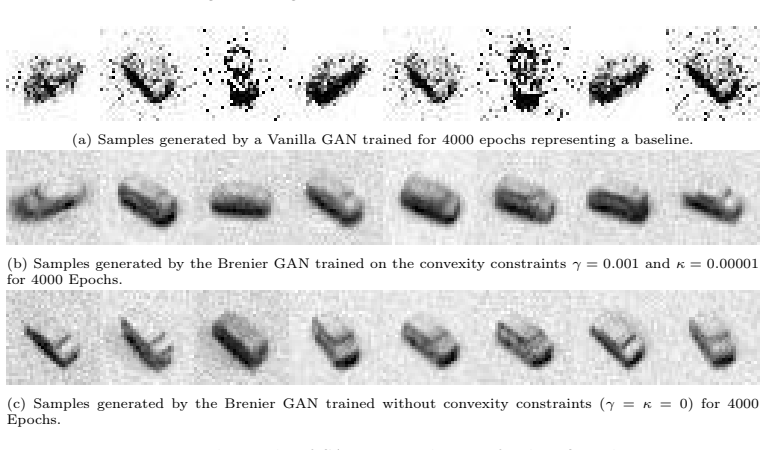
- [Section 5.3] The NORB experiments use the ReQU activation in the generator, while the theoretical results in Sections 3 and 4 are developed for ReCU; please comment on this deviation or explain why it is harmless.
- [Section 3.6] The abstract promises consistency for 'slowly expanding network capacity,' but Theorem 1 is stated only for fixed epsilon; please add a corollary showing how epsilon = epsilon_n -> 0 can be chosen as n grows in the consistency statement.
Circularity Check
No circular derivation: the error decomposition is proved in the text, approximation and regularity inputs are external, and the convexity penalty result is a genuine consequence of the penalty size.
full rationale
Walking the derivation chain, I find no step in which a claimed output is identical to an input by construction or is forced by a self-citation chain. Proposition 4's four-term decomposition is proved in the text (lines (5)-(6)) and does not depend on [23] except as a pointer to the standard variational identity in Lemma 3, which is an elementary calculation; the proof of the decomposition is self-contained. The generator error bound (Prop. 10) uses the external ReCU UAP result [26] and Caffarelli's regularity theory [36], together with Lemmas 5-7 whose proofs are given or cited to non-author work [34]; the hypothesis class Hgen(epsilon) is then deliberately built around the constructed network, so Δ_G≤ε is an approximation-theoretic input, not a fitted parameter renamed as a prediction. The discriminator bound (Prop. 11) imports the ReLU UAP construction [27] and Weyl's tube formula [38]; whether the uniform tube-volume bound is fully justified is a correctness gap, not a circularity, because it does not assume the conclusion it feeds. The consistency theorem (Theorem 1) is then an oracle inequality assembled from these independent estimates. Section 4 is likewise non-circular: Prop. 16 derives a positive penalty from a Hessian-eigenvalue violation via Taylor expansion, and Prop. 18 shows that for large γ any minimizer must lie in the strongly convex subclass, which is a consequence of the penalty size rather than an assumption. The numerical claim that the convexity loss becomes inactive is an empirical observation consistent with, but not used to prove, the theory. The only self-citations ([23], [9]) are non-load-bearing pointers or architectural examples and, under the stated rules, do not raise the circularity score.
Assumptions & free parameters
free parameters (3)
- kappa (strong convexity parameter) =
0.1 (GMM); 1e-6 (MNIST); 1e-4 (Fashion-MNIST); 1e-5 (NORB)
- gamma (convexity penalty weight) =
0.1 (GMM); 1 (MNIST/Fashion-MNIST); 0.001 (NORB)
- m(n): number of samples for the empirical convexity penalty =
10 or 20, fixed per experiment
assumptions (5)
- domain assumption Assumption 1: the target density p_* is in C^{1,alpha}([0,1]^d, R) and p_* > 0 on [0,1]^d
- domain assumption Caffarelli regularity (Remark 9): C^{1,alpha} positive source and target densities imply the Brenier potential is C^{3,alpha} and strongly convex with M^{-1} I <= Hess phi_* <= M I
- ad hoc to paper Weyl tube volume bound asserted in Prop 11: lambda(C(N)) <= C/N with coefficients bounded by a function of d and H tilde
- domain assumption Assumptions 2, 3 and 5: hypothesis classes H_gen(epsilon) and H_dis(epsilon) contain the constructed approximating networks and are relatively compact
- standard math Uniform law of large numbers (Ferguson [40, Thm 16]) applies to the empirical GAN loss and to the empirical convexity penalty
Cite this review
Pith. "Pith review of Learning Brenier Potentials with Convex Generative Adversarial Neural Networks." pith.science (2026). https://pith.science/paper/GDK4QHLF
@misc{pith2026250419779,
  author       = {Pith},
  title        = {Pith review of: Learning Brenier Potentials with Convex Generative Adversarial Neural Networks},
  year         = {2026},
  howpublished = {\url{https://pith.science/paper/GDK4QHLF}},
  note         = {Machine review of arXiv:2504.19779}
}
abstract
Brenier proved that under certain conditions on a source and a target probability measure there exists a strictly convex function such that its gradient is a transport map from the source to the target distribution. This function is called the Brenier potential. Furthermore, detailed information on the H\"older regularity of the Brenier potential is available. In this work we develop the statistical learning theory of generative adversarial neural networks that learn the Brenier potential. As by the transformation of densities formula, the density of the generated measure depends on the second derivative of the Brenier potential, we develop the universal approximation theory of ReCU networks with cubic activation $\mathtt{ReCU}(x)=\max\{0,x\}^3$ that combines the favorable approximation properties of H\"older functions with a Lipschitz continuous density. In order to assure the convexity of such general networks, we introduce an adversarial training procedure for a potential function represented by the ReCU networks that combines the classical discriminator cross entropy loss with a penalty term that enforces (strict) convexity. We give a detailed decomposition of learning errors and show that for a suitable high penalty parameter all networks chosen in the adversarial min-max optimization problem are strictly convex. This is further exploited to prove the consistency of the learning procedure for (slowly) expanding network capacity. We also implement the described learning algorithm and apply it to a number of standard test cases from Gaussian mixture to image data as target distributions. As predicted in theory, we observe that the convexity loss becomes inactive during the training process and the potentials represented by the neural networks have learned convexity.
Figures


Figures from the paper (4 more)


Reference graph
Works this paper leans on
-
[26]
D. Belomestny, A. Naumov, N. Puchkin, and S. Samsonov, “Simultaneous approximation of a smooth function and its derivatives by deep neural networks with piecewise-polynomial activations,”Neural Networks, vol. 161, pp. 242–253, 2023
work page 2023
-
[1]
S. Bond-Taylor, A. Leach, Y. Long, and C. G. Willcocks, “Deep generative modelling: A comparative review of VAEs, GANs, normalizing flows, energy-based and autoregressive models,”IEEE Transactions on Pattern Analysis and Machine Intelligence, vol. 44, no. 11, pp. 7327–7347, 2021
work page 2021
-
[2]
A comprehensive survey and analysis of generative models in machine learning,
G. Harshvardhan, M. K. Gourisaria, M. Pandey, and S. S. Rautaray, “A comprehensive survey and analysis of generative models in machine learning,”Computer Science Review, vol. 38, p. 100285, 2020
work page 2020
-
[3]
G. Montufar and N. Ay, “Refinements of universal approximation results for deep belief networks and restricted boltzmann machines,”Neural Computation, vol. 23, no. 5, pp. 1306–1319, 2011
work page 2011
-
[4]
R. Salakhutdinov and G. Hinton, “Deep Boltzmann machines,” inArtificial Intelligence and Statistics Conference, pp. 448–455, PMLR, 2009
work page 2009
-
[5]
Implicit generation and modeling with energy based models,
Y. Du and I. Mordatch, “Implicit generation and modeling with energy based models,”Advances in Neural Information Processing Systems, vol. 32, 2019
work page 2019
-
[6]
Density estimation using Real NVP,
L. Dinh, J. Sohl-Dickstein, and S. Bengio, “Density estimation using Real NVP,” inInternational Con- ference on Learning Representations, 2022
work page 2022
-
[7]
Normalizing flows for probabilistic modeling and inference,
G. Papamakarios, E. Nalisnick, D. J. Rezende, S. Mohamed, and B. Lakshminarayanan, “Normalizing flows for probabilistic modeling and inference,”Journal of Machine Learning Research, vol. 22, no. 57, pp. 1–64, 2021
2021
Show all 43 references
-
[8]
Coupling-based invertible neu- ral networks are universal diffeomorphism approximators,
T. Teshima, I. Ishikawa, K. Tojo, K. Oono, M. Ikeda, and M. Sugiyama, “Coupling-based invertible neu- ral networks are universal diffeomorphism approximators,”Advances in Neural Information Processing Systems, vol. 33, pp. 3362–3373, 2020
2020
-
[9]
LU-Net: Invertible neural networks based on matrix factor- ization,
R. Chan, S. Penquitt, and H. Gottschalk, “LU-Net: Invertible neural networks based on matrix factor- ization,” in International Joint Conference on Neural Networks, pp. 1–10, IEEE, 2023
2023
-
[10]
Generative adversarial networks,
I. Goodfellow, J. Pouget-Abadie, M. Mirza, B. Xu, D. Warde-Farley, S. Ozair, A. Courville, and Y. Ben- gio, “Generative adversarial networks,”Advances in Neural Information Processing Systems, vol. 3, 06 2014. 23
2014
-
[11]
f-gan: Training generative neural samplers using variational divergence minimization,
S. Nowozin, B. Cseke, and R. Tomioka, “f-gan: Training generative neural samplers using variational divergence minimization,”Advances in Neural Information Processing Systems, vol. 29, 2016
2016
-
[12]
Temporal shift GAN for large scale video generation,
A. Munoz, M. Zolfaghari, M. Argus, and T. Brox, “Temporal shift GAN for large scale video generation,” in IEEE/CVF Winter Conference on Applications of Computer Vision, pp. 3179–3188, 2021
2021
-
[13]
ESRGAN: Enhanced super-resolution generative adversarial networks,
X. Wang, K. Yu, S. Wu, J. Gu, Y. Liu, C. Dong, Y. Qiao, and C. Change Loy, “ESRGAN: Enhanced super-resolution generative adversarial networks,” inProceedings of the IEEE/CVF European Conference on Computer Vision workshops, 2018
2018
-
[14]
Neural ordinary differential equations,
R. T. Chen, Y. Rubanova, J. Bettencourt, and D. K. Duvenaud, “Neural ordinary differential equations,” Advances in Neural Information Processing Systems, vol. 31, 2018
2018
-
[15]
Flow matching for generative modeling,
Y. Lipman, R. T. Chen, H. Ben-Hamu, M. Nickel, and M. Le, “Flow matching for generative modeling,” in International Conference on Learning Representations, 2023
2023
-
[16]
Flow straight and fast: Learning to generate and transfer data with rectified flow,
X. Liu, C. Gong, and Q. Liu, “Flow straight and fast: Learning to generate and transfer data with rectified flow,” inInternational Conference on Learning Representations, 2023
2023
-
[17]
Deep unsupervised learning using nonequilibrium thermodynamics,
J. Sohl-Dickstein, E. Weiss, N. Maheswaranathan, and S. Ganguli, “Deep unsupervised learning using nonequilibrium thermodynamics,” in International Conference on Machine Learning, pp. 2256–2265, PMLR, 2015
2015
-
[18]
Bayesian learning via stochastic gradient Langevin dynamics,
M. Welling and Y. W. Teh, “Bayesian learning via stochastic gradient Langevin dynamics,” inInterna- tional Conference on Machine Learning, pp. 681–688, Citeseer, 2011
2011
-
[19]
High-resolution image synthesis with latent diffusion models,
R. Rombach, A. Blattmann, D. Lorenz, P. Esser, and B. Ommer, “High-resolution image synthesis with latent diffusion models,” inIEEE/CVF Conference on Computer Vision and Pattern Recognition, pp. 10684–10695, 2022
2022
-
[20]
Polar factorization and monotone rearrangement of vector-valued functions,
Y. Brenier, “Polar factorization and monotone rearrangement of vector-valued functions,”Communica- tions on Pure and Applied Mathematics, vol. 44, no. 4, pp. 375–417, 1991
1991
-
[21]
Regularity as regularization: Smooth and strongly con- vex Brenier potentials in optimal transport,
F.-P. Paty, A. d’Aspremont, and M. Cuturi, “Regularity as regularization: Smooth and strongly con- vex Brenier potentials in optimal transport,” inInternational Conference on Artificial Intelligence and Statistics, pp. 1222–1232, PMLR, 2020
2020
-
[22]
Santambrogio,Optimal Transport for Applied Mathematicians, vol
F. Santambrogio,Optimal Transport for Applied Mathematicians, vol. 55. Springer, 2015
2015
-
[23]
Aconvenientinfinitedimensionalframework for generative adversarial learning,
H.Asatryan, H.Gottschalk, M.Lippert, andM.Rottmann, “Aconvenientinfinitedimensionalframework for generative adversarial learning,”arXiv preprint arXiv:2011.12087, 2020
2011 arXiv
-
[24]
Some theoretical properties of GANs,
G. Biau, B. Cadre, M. Sangnier, and U. Tanielian, “Some theoretical properties of GANs,”The Annals of Statistics, vol. 48, no. 3, pp. 1539–1566, 2020
2020
-
[25]
Rates of convergence for density estimation with generative adversarial networks,
N. Puchkin, S. Samsonov, D. Belomestny, E. Moulines, and A. Naumov, “Rates of convergence for density estimation with generative adversarial networks,”Journal of Machine Learning Research, vol. 25, no. 29, pp. 1–47, 2024
2024
-
[27]
Error bounds for approximations with deep relu networks,
D. Yarotsky, “Error bounds for approximations with deep relu networks,”Neural Networks, vol. 94, pp. 103–114, 2017
2017
-
[28]
Input convex neural networks,
B. Amos, L. Xu, and J. Z. Kolter, “Input convex neural networks,” inInternational Conference on Machine Learning, pp. 146–155, PMLR, 2017. 24
2017
-
[29]
Convex potential flows: Universal probability distributions with optimal transport and convex optimization,
C.-W. Huang, R. T. Chen, C. Tsirigotis, and A. Courville, “Convex potential flows: Universal probability distributions with optimal transport and convex optimization,” inInternational Conference on Learning Representations, 2021
2021
-
[30]
Wasserstein2 generative networks,
A. Korotin, V. Egiazarian, A. Asadulaev, A. Safin, and E. Burnaev, “Wasserstein2 generative networks,” in International Conference on Machine Learning, 2021
2021
-
[31]
Optimal control via neural networks: A convex approach,
Y. Chen, Y. Shi, and B. Zhang, “Optimal control via neural networks: A convex approach,” inInterna- tional Conference on Learning Representations, 2019
2019
-
[32]
Input convex gradient networks,
J. Richter-Powell, J. Lorraine, and B. Amos, “Input convex gradient networks,” arXiv preprint arXiv:2111.12187, 2021
2021 arXiv
-
[33]
Gradient networks,
S. Chaudhari, S. Pranav, and J. M. Moura, “Gradient networks,”arXiv preprint arXiv:2404.07361, 2024
2024 arXiv
-
[34]
Rates of convergence for density estimation with generative adversarial networks,
D. Belomestny, E. Moulines, A. Naumov, N. Puchkin, and S. Samsonov, “Rates of convergence for density estimation with generative adversarial networks,”arXiv:2102.00199, 2023
2023 arXiv
-
[35]
Schumaker,Spline Functions: Basic Theory
L. Schumaker,Spline Functions: Basic Theory. Cambridge University Press, 2007
2007
-
[36]
Villaniet al., Optimal Transport: Old and New, vol
C. Villaniet al., Optimal Transport: Old and New, vol. 338. Springer, 2008
2008
-
[37]
Boundary regularity of maps with convex potentials – II,
L. A. Caffarelli, “Boundary regularity of maps with convex potentials – II,”Annals of Mathematics, vol. 144, no. 3, pp. 453–496, 1996
1996
-
[38]
On the volume of tubes,
H. Weyl, “On the volume of tubes,”American Journal of Mathematics, vol. 61, no. 2, pp. 461–472, 1939
1939
-
[39]
Gray,Tubes, vol
A. Gray,Tubes, vol. 221. Springer Science & Business Media, 2003
2003
-
[40]
T. S. Ferguson,A course in large sample theory. Routledge, 2017
2017
-
[41]
The MNIST database of handwritten digits,
Y. LeCun, “The MNIST database of handwritten digits,”http://yann.lecun.com/exdb/mnist/, 1998
1998
-
[42]
Fashion-MNIST: a novel image dataset for benchmarking machine learning algorithms,
H. Xiao, K. Rasul, and R. Vollgraf, “Fashion-MNIST: a novel image dataset for benchmarking machine learning algorithms,” arXiv:1708.07747, 2017
2017 arXiv
-
[43]
Learning methods for generic object recognition with invariance to pose and lighting,
Y. LeCun, F. J. Huang, and L. Bottou, “Learning methods for generic object recognition with invariance to pose and lighting,” inIEEE/CVF Conference on Computer Vision and Pattern Recognition, vol. 2, pp. II–104, IEEE, 2004. 25
2004
Reviewed August 16, 2026 · model on record in the stance chip above.
Discussion (0). Continue with ORCID to comment.