REVIEW 4 major objections 5 minor 171 references
Contextures: The Mechanism of Representation Learning
T0 review · 4 major / 5 minor · reviewed 2026-08-16 · deepseek-v4-flash
Pith's one-line read Representation learning has one mathematical target: the span of the top singular functions of the conditional expectation operator, and learning it is optimal for every compatible downstream task.
desk verdict A genuinely unifying spectral framework that mostly delivers on its mathematical claims, but the explanation of transfer rests on an unmeasured premise about which tasks are compatible with the context. read the letter →
The pith
A machine-rendered reading of the paper's core claim, the machinery that carries it, and where it could break.
The reading
What carries the argument
The central object is the conditional expectation operator $T_{P^+}: L^2(P_A)\to L^2(P_X)$ defined by $(T_{P^+}g)(x) = E[g(A)\mid X=x]$, together with the positive-pair kernel $k_X^+(x,x') = \int \frac{P^+(a|x)P^+(a|x')}{P_A(a)}\,da$. The integral operator of this kernel is self-adjoint and Hilbert–Schmidt, and its top-$d$ eigenfunctions are the contexture. The argument runs through the spectral decomposition of this operator: the singular value spectrum encodes the strength of the $X$–$A$ association, task compatibility is defined by projection onto the singular functions, and each variational objective is shown to be a spectral objective whose minimizers extract the top eigenspace. The spectrum also drives the paper's quantitative context-usefulness metric and its generalization bounds through the context complexity $\kappa$.
What would settle it
Fix a context $P^+$ and a downstream task $f^*$ with measured compatibility $\rho(f^*,P^+) \ge 1-\epsilon$. Compute the exact top-$d$ left singular functions of $T_{P^+}$ by kernel PCA on a finite approximation and train an independent encoder $\Phi$ that does not span them. If, with a linear probe and enough labeled data to make estimation error negligible, the non-contexture encoder achieves lower error on $f^*$ than the contexture encoder, Theorem 3.4 is contradicted. Alternatively, on any finite space where $T_{P^+}$ is a matrix, one can enumerate all $d$-dimensional subspaces: if any subspace outside the top-$d$ left singular span is closer to a compatible $f^*$ than the contexture span, the claimed uniqueness of the optimum fails.
Extended reading notes
Core claim
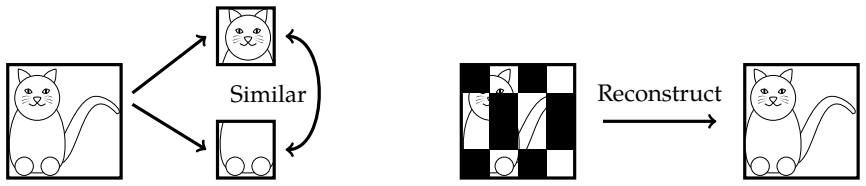
On the paper's own terms, the central claim is that the mechanism of representation learning is spectral: an encoder $\Phi = [\varphi_1,\dots,\varphi_d]$ learns the contexture of $P^+$ exactly when $\operatorname{span}\{\varphi_1,\dots,\varphi_d\} = \operatorname{span}\{\mu_1,\dots,\mu_d\}$, where $\mu_i$ are the top-$d$ left singular functions of $T_{P^+}$ (equivalently, the top eigenfunctions of the positive-pair kernel integral operator). Theorems 2.2–2.14 show that supervised MSE, balanced classification, graph embedding, contrastive and non-contrastive SSL, reconstruction, generative multi-step models, knowledge distillation, and RLHF are optimized if and only if the encoder learns the contexture (possibly with a loss kernel that reweights classes). Theorem 3.4 is the optimality result: among all $d$-dimensional encoders, the contexture uniquely minimizes the worst-case approximation error on the class of tasks with compatibility at least $1-\epsilon$, with error $\frac{s_1^2-(1-\epsilon)^2}{s_1^2-s_{d+1}^2}$, and every non-contexture encoder has a compatible task on which it does no better than this worst case. Section 2.6 draws the scaling-law consequence: once the model is large enough to express the contexture, further scaling is redundant and only a better context helps.
Load-bearing premise
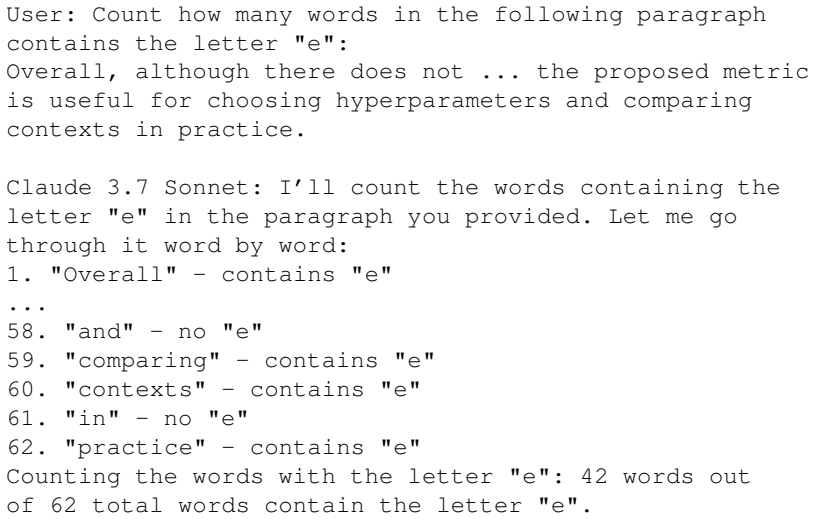
The theory assumes that the tasks that matter can be solved by a linear probe on functions lying in the range of the conditional expectation operator—tasks whose compatibility is defined through the very singular functions that make up the contexture. If real downstream tasks are solved by non-linear fine-tuning or fall outside this function class, the optimality and transfer claims do not apply; the paper itself gives the example of letter counting as a useful-sounding task that is not compatible.
Editorial extensions
If this is right
- For any task known to be compatible with the pretraining context, the best possible $d$-dimensional representation is the contexture; no other encoder can beat its worst-case approximation error on that task class.
- Because the contexture is independent of architecture, different sufficiently large models trained on the same context should converge to aligned representations, and objectives as different as masked prediction and contrastive learning are interchangeable if they share the same context.
- Scaling up model size only helps until the contexture is expressible; after that, performance gains require changing the context or mixing existing ones.
- Mixing contexts by convolution, convex combination, or concatenation can convert too-strong or too-weak associations into moderate ones, improving downstream performance; experiments on tabular benchmarks support this.
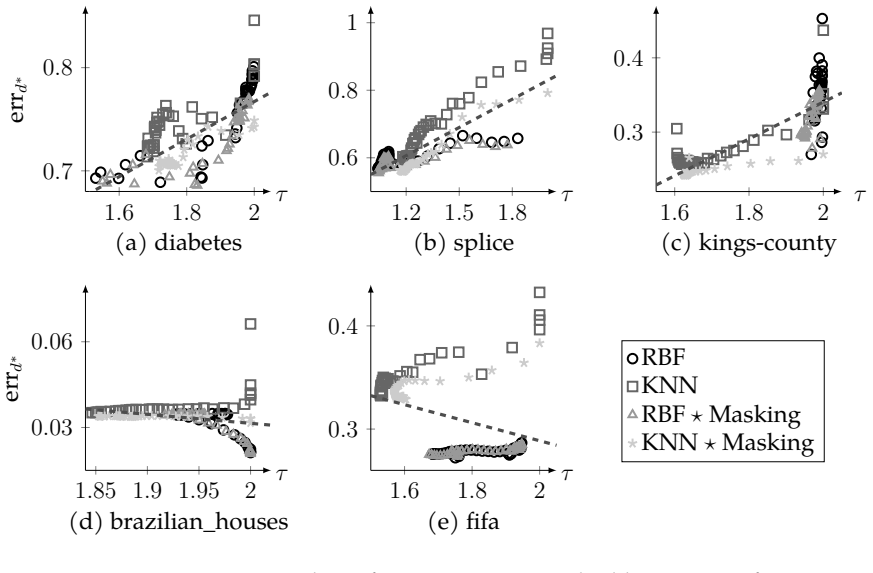
- A context's usefulness can be scored from its singular value spectrum alone, so practitioners can choose pretraining hyperparameters such as mask ratios and augmentation strengths without running full downstream evaluations.
Reading between the lines
- Beyond the paper: the same spectral argument predicts that representational convergence should occur for any sufficiently expressive function class, not only neural networks, so the convergence phenomenon is a property of the context's operator, not of deep learning itself.
- The optimality theorem is proven for linear probes and approximation error; if downstream tasks are solved by non-linear fine-tuning, the contexture may be sufficient but not necessary, and a non-contexture encoder could win on specific tasks. Testing this boundary would require extending the compatibility definition beyond the range of $T_{P^+}$.
- A testable engineering consequence the paper leaves implicit: new pretraining methods should be evaluated first by estimating the spectrum of their induced context and only second by end-task accuracy, since the spectrum determines both transfer and sample complexity.
- The theory suggests an information-theoretic account of alignment and distillation: RLHF and knowledge distillation are context-mixing operations, so safety-relevant training modifies the target contexture rather than creating a wholly new representation space.
Signed reviews
Editorial analysis
A structured set of objections, weighed in public.
Referee Report
Summary. The manuscript (a CMU PhD thesis posted on arXiv) develops the 'contexture theory' of representation learning. A context is a joint distribution P+(X,A); its contexture is the top-d eigenspace of the conditional-expectation operator T_{P+}. The thesis claims: (i) a broad family of objectives—supervised MSE, graph embedding, contrastive/non-contrastive SSL, generative modeling, RLHF—are optimized if and only if the encoder learns the contexture; (ii) learning the contexture minimizes worst-case linear-probe approximation error over the class of (1-epsilon)-compatible tasks, with an explicit error formula; (iii) better contexts, not larger models, are the path to further progress; and (iv) finite-sample bounds follow from a context-complexity assumption. The paper also introduces SVME/KISE objectives, three context-mixing operations, a spectrum-based context-usefulness metric, and a tabular-data evaluation.
Significance. The spectral formalism is clean and genuinely unifying; the minimax formula in Theorem 3.4 is a coherent spectral statement; the paper gives proof sketches for many implications and carefully distinguishes exact eigenfunction extraction from eigenspace extraction. The empirical correlation of the tau metric on 28 OpenML datasets and the tabular-data gains over XGBoost are useful contributions in their own right. The main weakness is that the bridge from the formal class F_epsilon(P+) to tasks practitioners care about is asserted, not measured; all optimality statements are for linear probes; and Theorem 3.2 as stated is internally inconsistent with Definition 3.1. If the compatibility premise can be justified, the framework is a substantial contribution; as it stands, the headline transfer and scaling claims outrun the evidence.
major comments (4)
- [Sec. 3.1, Theorem 3.2 and Eq. (3.2)] Theorem 3.2 is false as stated. Since rho(f,P+) = ||T*_{P+} tilde f|| / ||tilde f||, membership in F_epsilon(P+) only forces the majority of L2 mass of tilde f to lie on large singular components; it does not force tilde f to lie in the range of T_{P+}. For a finite-rank context such as deterministic labels (Example 1.12), take f* = a mu_1 + b mu_C with a^2+b^2=1 and a >= 1-epsilon, where mu_C is a zero-singular-value eigenfunction. Then f* is in F_epsilon(P+) but no g* in L2(P_A) satisfies f* = E[g*(A)|X]. The same issue arises for infinite-rank operators because range membership requires sum u_i^2/s_i^2 < infinity, which is strictly stronger than the spectral-energy condition in Eq. (3.2). Consequently, the two 'necessary conditions' of Section 3.1 are not equivalent to Definition 3.1, and the interpretation of F_epsilon as the class of tasks for which the context is helpful is not supported as written. The minimax computation in Theorem 3.4 may still be valid over the stated F_epsilon, but the bridge between compatibility and the range of T_{P+} needs to be repaired (for example, by defining F_epsilon via projection onto the range).
- [Sec. 3.1, Definition 3.1/Eq. (3.2) and Fig. 3.1] The central transfer explanation rests on the identification of F_epsilon(P+) with the tasks for which pretrained representations are useful. This identification is not tested. The paper never estimates rho(f,P+) for a real downstream task; it gives intuitive examples and a counterexample (letter counting, Figure 3.1) showing that a useful-sounding task can lie outside F_epsilon. Because F_epsilon is defined by correlation with the same operator T_{P+} whose top singular functions are the contexture, Theorem 3.4 is a spectral minimax statement about a class of functions chosen by the theory, not an explanation of transfer to sentiment analysis, QA, or translation unless those tasks are shown to be in F_epsilon. Please provide direct measurements of rho for representative tasks with standard contexts, or a formal argument (not just examples) that the relevant task families are contained in F_epsilon for practical epsilon. Without this, the paper's headline explanation of why pretraining transfers is an untested empirical premise.
- [Sec. 1.2 and Sec. 2.4] All formal guarantees in the paper are for linear probes, as explicitly stated in Section 1.2, yet the motivation and several applications involve nonlinear adaptation: supervised fine-tuning (SFT) and RLHF are discussed in Section 2.4, and the scaling-law discussion in Section 2.6 concerns foundation models used by fine-tuning. Theorem 3.4's worst-case approximation error is defined for a linear predictor W Phi(x) + b on the span of Phi; it does not cover nonlinear fine-tuning. If downstream tasks are solved by nonlinear adaptation, the theoretical optimality of the contexture has not been established for that setting. The manuscript should either restrict its claims to linear probing or extend the analysis to a nonlinear-probe setting.
- [Sec. 2.6, Figure 2.4] The empirical basis for the diminishing-returns claim is a single tabular dataset (abalone, 4,177 samples). The alignment metrics peak near 0.9 CCA and are non-monotone in both width and depth; the authors attribute the non-monotonicity to optimization difficulty. That attribution means the experiment does not isolate the proposed mechanism (saturation of expressivity relative to the contexture) from optimization effects. The conclusion that 'increasing model size alone will achieve diminishing returns' is substantially stronger than what this experiment can support. A more direct test would vary model size while controlling optimization effort and measuring alignment to the top-d eigenspace.
minor comments (5)
- [Theorem 3.10 proof] The expression Tr(C^{-1}_F B^{-1}_F) appears to be a typo for Tr(C^{-1}_F B_F); the notation in that paragraph should be corrected.
- [Eq. (3.5)] The metric tau_d depends on free parameters beta and d_0; the experiments fix beta=1, d_0=512, but no sensitivity analysis is reported despite the paper acknowledging failure cases.
- [Sec. 2.6] The description of depth as the number of hidden layers, with 'a 2-layer neural network has depth 1', is confusing; the figure axis labeled 'Depth' should match the definition given in the text.
- [Code availability] Several code URLs are truncated (for example, in Section 2.6 and Section 3.3); please provide complete and stable links.
- [Sec. 5.1] The 99th-percentile threshold for estimating kappa^2 is a heuristic; the paper should state how sensitive the downstream conclusions are to this threshold.
Circularity Check
Optimality over F_epsilon(P+) reduces to the definition of compatibility: the task class is the spectral subspace of the same operator whose top eigenspace is called the contexture.
-
self definitional
[Definition 3.1 / Eq. (3.2), Definition 1.7, Theorem 3.4]
"ρ(f,P+) = max_{g∈L2(PA),g≠0} ⟨f˜, T_{P+}g⟩_{PX} / (||f˜||_{PX} ||g||_{PA}) ... Fǫ(P+) = { f∈L2(PX) : ρ(f,P+) ≥ 1−ǫ } ... span{φ1,...,φd} = span{µ1,...,µd} ... Φ minimizes err(Φ;Fǫ(P+)) if and only if it learns the contexture of T_{P+}."
The class of tasks on which the contexture is declared optimal is defined by ρ, which equals ||T*_{P+}f˜||/||f˜||, i.e. the fraction of f's centered L2 energy lying in the spectral subspace of the same positive-pair operator whose top-d eigenfunctions are named the contexture in Definition 1.7. Theorem 3.4 is therefore a spectral projection statement: the top-d singular subspace is the best d-dimensional subspace for approximating functions that mostly live in that same top spectral subspace.
full rationale
The paper is internally rigorous: Theorems 2.2-2.14, 4.4, and 5.11-5.12 are proved from the stated definitions, and no load-bearing result is imported solely from the author's prior work; [167,168] are cited for definitions and bounds that the thesis itself re-proves or extends. The alignment experiments (Section 2.6) and tabular experiments (Section 4.4) are genuine empirical checks. The central non-empirical reduction is the bridge from the spectral minimax theorem to the claim that contexture explains representation transfer. Compatibility (Definition 3.1) is defined through the same conditional-expectation operator whose top singular functions constitute the contexture, so Theorem 3.4's optimality over F_epsilon(P+) is true by construction of the task class. The paper acknowledges the resulting limitation in places: it restricts evaluation to linear probes (Section 1.2), states that bounds do not cover all of F_epsilon (Section 5.2), leaves pair-access generalization bounds open, and calls the Section 3.3 metric heuristic. These concessions do not convert the spectral theorem into an empirical prediction; they underscore that the theory's applicability to real tasks rests on an unmeasured compatibility premise. On balance, this is partial definitional circularity in the central transfer claim, not a fully circular derivation: the variational equivalences and generalization bounds retain independent mathematical content, so the score is 6 rather than higher.
Assumptions & free parameters
free parameters (5)
- beta (context metric weight) =
1
- d0 (max embedding dimension in metric) =
512
- STK threshold c =
0.1
- 99th percentile for context complexity =
99th percentile
- convex combination weights w in Eqn (4.1) =
learned by Hedge (Algorithm 2)
assumptions (6)
- domain assumption T_{k+_A} and T_{k+_X} are Hilbert-Schmidt operators, so the spectral theorem gives an ordered eigenbasis with lambda_0 = 1.
- domain assumption The probability spaces of P_X and P_A are compact Hausdorff, and P_X is fixed until Chapter 6.
- domain assumption The encoder class is expressive enough and the optimizer reaches the global minimizer of each variational objective.
- domain assumption The positive-pair kernel k+_X (or its centered version) is computable or estimable for the generalization bounds.
- standard math Moment, eigenvalue-decay, embedding, and source conditions hold for the ridge regression bound.
- domain assumption For T-access contexts, a heuristic inverse Q+ exists and is available; for pair access, P_A is bounded away from zero.
invented entities (1)
-
contexture (the top-d eigenspace of the conditional expectation operator)
independent evidence
Cite this review
Pith. "Pith review of Contextures: The Mechanism of Representation Learning." pith.science (2026). https://pith.science/paper/BPPUKMRT
@misc{pith2026250419792,
  author       = {Pith},
  title        = {Pith review of: Contextures: The Mechanism of Representation Learning},
  year         = {2026},
  howpublished = {\url{https://pith.science/paper/BPPUKMRT}},
  note         = {Machine review of arXiv:2504.19792}
}
read the original abstract
This dissertation establishes the contexture theory to mathematically characterize the mechanism of representation learning, or pretraining. Despite the remarkable empirical success of foundation models, it is not very clear what representations they learn, and why these representations are useful for various downstream tasks. A scientific understanding of representation learning is critical, especially at this point when scaling up the model size is producing diminishing returns, and designing new pretraining methods is imperative for further progress. Prior work treated different representation learning methods quite differently, whereas the contexture theory provides a unified framework for analyzing these methods. The central argument is that a representation is learned from the association between the input X and a context variable A. We prove that if an encoder captures the maximum information of this association, in which case we say that the encoder learns the contexture, then it will be optimal on the class of tasks that are compatible with the context. We also show that a context is the most useful when the association between X and A is neither too strong nor too weak. The important implication of the contexture theory is that increasing the model size alone will achieve diminishing returns, and further advancements require better contexts. We demonstrate that many pretraining objectives can learn the contexture, including supervised learning, self-supervised learning, generative models, etc. Then, we introduce two general objectives -- SVME and KISE, for learning the contexture. We also show how to mix multiple contexts together, an effortless way to create better contexts from existing ones. Then, we prove statistical learning bounds for representation learning. Finally, we discuss the effect of the data distribution shift from pretraining to the downstream task.
Figures


Figures from the paper (23 more)






Reference graph
Works this paper leans on
-
[1]
Gpt- 4 technical report
Josh Achiam, Steven Adler, Sandhini Agarwal, et al. Gpt- 4 technical report. Ope- nAI Blog, 2023. 1
2023
-
[2]
Emergence of inv ariance and disentangle- ment in deep representations
Alessandro Achille and Stefano Soatto. Emergence of inv ariance and disentangle- ment in deep representations. Journal of Machine Learning Research , 19(50):1–34,
-
[3]
\alpha-req : Assessing representation quality in self-sup ervised learning by mea- suring eigenspectrum decay
Kumar K Agrawal, Arnab Kumar Mondal, Arna Ghosh, and Blak e Richards. \alpha-req : Assessing representation quality in self-sup ervised learning by mea- suring eigenspectrum decay. In S. Koyejo, S. Mohamed, A. Aga rwal, D. Belgrave, K. Cho, and A. Oh, editors, Advances in Neural Information Processing Systems, vol- ume 35, pages 17626–17638. Curran Associ...
2022
-
[4]
S carf: Self-supervised contrastive learning using random feature corruption
Dara Bahri, Heinrich Jiang, Yi Tay , and Donald Metzler. S carf: Self-supervised contrastive learning using random feature corruption. In International Conference on Learning Representations, 2022. (iii)
2022
-
[5]
Contrastive and non -contrastive self- supervised learning recover global and local spectral embe dding methods
Randall Balestriero and Yann LeCun. Contrastive and non -contrastive self- supervised learning recover global and local spectral embe dding methods. Ad- vances in Neural Information Processing Systems , 35:26671–26685, 2022. 1.5
2022
-
[6]
VICReg: Varia nce-invariance- covariance regularization for self-supervised learning
Adrien Bardes, Jean Ponce, and Yann LeCun. VICReg: Varia nce-invariance- covariance regularization for self-supervised learning. In International Conference on Learning Representations, 2022. 2.1, 2.1, 2.2
2022
-
[7]
Generalized discrimin ant analysis using a ker- nel approach
Gaston Baudat and Fatiha Anouar. Generalized discrimin ant analysis using a ker- nel approach. Neural computation, 12(10):2385–2404, 2000. 3.2
2000
-
[8]
Laplacian eigenmaps f or dimensionality re- duction and data representation
Mikhail Belkin and Partha Niyogi. Laplacian eigenmaps f or dimensionality re- duction and data representation. Neural computation, 15(6):1373–1396, 2003. 1.2, 1.5
2003
Show all 171 references
-
[9]
Rep resentation learning: A review and new perspectives
Yoshua Bengio, Aaron Courville, and Pascal Vincent. Rep resentation learning: A review and new perspectives. IEEE transactions on pattern analysis and machine intelligence, 35(8):1798–1828, 2013. 1
2013
-
[10]
Learning eigenfunctions links spectral embedding and kernel pca
Yoshua Bengio, Olivier Delalleau, Nicolas Le Roux, Jea n-François Paiement, Pas- cal Vincent, and Marie Ouimet. Learning eigenfunctions links spectral embedding and kernel pca. Neural computation, 16(10):2197–2219, 2004. 1.5
2004
-
[11]
Mixmatch: A holistic approach to s emi-supervised learning
David Berthelot, Nicholas Carlini, Ian Goodfellow , Ni colas Papernot, Avital Oliver, and Colin A Raffel. Mixmatch: A holistic approach to s emi-supervised learning. Advances in neural information processing systems , 32, 2019. 1.5
2019
-
[12]
D iscriminative learning for differing training and test distributions
Steffen Bickel, Michael Brückner, and T obias Scheffer. D iscriminative learning for differing training and test distributions. In Proceedings of the 24th international conference on Machine learning, pages 81–88, 2007. 6 140
2007
-
[13]
Statistical properties of kernel principal component analysis
Gilles Blanchard, Olivier Bousquet, and Laurent Zwald . Statistical properties of kernel principal component analysis. Machine Learning, 66:259–294, 2007. 5.2
2007
-
[14]
Demo graphic dialectal vari- ation in social media: A case study of African-American Engl ish
Su Lin Blodgett, Lisa Green, and Brendan O’Connor. Demo graphic dialectal vari- ation in social media: A case study of African-American Engl ish. In Proceedings of the 2016 Conference on Empirical Methods in Natural Language Processing, pages 1119– 1130, Austin, Texas, Novembe...
2016
-
[15]
On the opportunities and risks of foundati on models
Rishi Bommasani, Drew A Hudson, Ehsan Adeli, Russ Altma n, Simran Arora, Sydney von Arx, Michael S Bernstein, Jeannette Bohg, Antoin e Bosselut, Emma Brunskill, et al. On the opportunities and risks of foundati on models. arXiv preprint arXiv:2108.07258, 2021. 1, 3
2021 arXiv
-
[16]
Nuanced metrics for measuring unintended bias with rea l data for text clas- sification
Daniel Borkan, Lucas Dixon, Jeffrey Sorensen, Nithum Th ain, and Lucy Vasser- man. Nuanced metrics for measuring unintended bias with rea l data for text clas- sification. In Companion Proceedings of The 2019 World Wide Web Conference , pages 491–500, 2019. 6.4
2019
-
[17]
Richard P . Brent. An algorithm with guaranteed convergence for finding a zero of a function. The Computer Journal, 14(4):422–425, 1971. 6.4
1971
-
[18]
Functional analysis, Sobolev spaces and partial differenti al equations
Haim Brezis. Functional analysis, Sobolev spaces and partial differenti al equations . Springer, 2011. D.5
2011
-
[19]
Jonathon Byrd and Zachary Lipton. What is the effect of im portance weighting in deep learning? In Kamalika Chaudhuri and Ruslan Salakhut dinov , editors, Proceedings of the 36th International Conference on Machin e Learning , volume 97 of Proceedings of Machine Learning Resear...
2019
-
[20]
The SSL interplay: Augmentations, inductive bias, an d generalization
Vivien Cabannes, Bobak Kiani, Randall Balestriero, Ya nn Lecun, and Alberto Bi- etti. The SSL interplay: Augmentations, inductive bias, an d generalization. In Andreas Krause, Emma Brunskill, Kyunghyun Cho, Barbara Eng elhardt, Sivan Sabato, and Jonathan Scarlett, editors, Pro...
2023
-
[21]
Lee, Deming Chen, and Tri Dao
Tianle Cai, Yuhong Li, Zhengyang Geng, Hongwu Peng, Jas on D. Lee, Deming Chen, and Tri Dao. Medusa: Simple llm inference acceleratio n framework with multiple decoding heads. arXiv preprint arXiv: 2401.10774 , 2024. 4
2024 arXiv
-
[22]
Xgboost: A scalable tr ee boosting system
Tianqi Chen and Carlos Guestrin. Xgboost: A scalable tr ee boosting system. In Proceedings of the 22nd acm sigkdd international conferenc e on knowledge discovery and data mining, pages 785–794, 2016. 1.1, 2, 4, (ii)
2016
-
[23]
A sim- ple framework for contrastive learning of visual represent ations
Ting Chen, Simon Kornblith, Mohammad Norouzi, and Geoff rey Hinton. A sim- ple framework for contrastive learning of visual represent ations. In International conference on machine learning, pages 1597–1607. PMLR, 2020. 1, 1.4, 4.1
2020
-
[24]
Exploring simple siamese re presentation learning
Xinlei Chen and Kaiming He. Exploring simple siamese re presentation learning. In Proceedings of the IEEE/CVF Conference on Computer Vision and Pattern Recognition (CVPR), pages 15750–15758, June 2021. 2.1
2021
-
[25]
De constructing denois- ing diffusion models for self-supervised learning
Xinlei Chen, Zhuang Liu, Saining Xie, and Kaiming He. De constructing denois- ing diffusion models for self-supervised learning. In The Thirteenth International Conference on Learning Representations, 2025. 2.4 141
2025
-
[26]
Spectral graph theory , volume 92
Fan RK Chung. Spectral graph theory , volume 92. American Mathematical Soc.,
-
[27]
Le, and Christopher D
Kevin Clark, Minh-Thang Luong, Quoc V . Le, and Christopher D. Manning. Elec- tra: Pre-training text encoders as discriminators rather t han generators. In Inter- national Conference on Learning Representations , 2020. 4
2020
-
[28]
Gra- dient descent on neural networks typically occurs at the edg e of stability
Jeremy Cohen, Simran Kaur, Yuanzhi Li, J Zico Kolter, and Ameet Talwalkar. Gra- dient descent on neural networks typically occurs at the edg e of stability. In Inter- national Conference on Learning Representations , 2021. 2, 7
2021
-
[29]
Diffusion maps
Ronald R Coifman and Stéphane Lafon. Diffusion maps. Applied and computational harmonic analysis, 21(1):5–30, 2006. 1.2, 5.3
2006
-
[30]
Multinomial goodness -of-fit tests
Noel Cressie and Timothy RC Read. Multinomial goodness -of-fit tests. Journal of the Royal Statistical Society Series B: Statistical Methodology, 46(3):440–464, 1984. 6.4
1984
-
[31]
A kernel theory of modern data augmentation
Tri Dao, Albert Gu, Alexander Ratner, Virginia Smith, C hris De Sa, and Christo- pher Ré. A kernel theory of modern data augmentation. In International conference on machine learning, pages 1528–1537. PMLR, 2019. 1.5
2019
-
[32]
Fast line ar algebra is stable
James Demmel, Ioana Dumitriu, and Olga Holtz. Fast line ar algebra is stable. Numerische Mathematik, 108(1):59–91, 2007. 2
2007
-
[33]
Neuralef: Deconst ructing kernels by deep neural networks
Zhijie Deng, Jiaxin Shi, and Jun Zhu. Neuralef: Deconst ructing kernels by deep neural networks. In Kamalika Chaudhuri, Stefanie Jegelka, Le Song, Csaba Szepesvari, Gang Niu, and Sivan Sabato, editors, Proceedings of the 39th Interna- tional Conference on Machine Learning, vol...
2022
-
[34]
BERT: Pre- training of deep bidirectional transformers for language u nderstanding
Jacob Devlin, Ming-Wei Chang, Kenton Lee, and Kristina T outanova. BERT: Pre- training of deep bidirectional transformers for language u nderstanding. In Pro- ceedings of the 2019 Conference of the North American Chapter of the Association for Com- putational Linguistics: Huma...
2019
-
[35]
Improved regularization of convolutional neural networks with cutout
Terrance DeVries and Graham W Taylor. Improved regularization of convolutional neural networks with cutout. arXiv preprint arXiv:1708.04552, 2017. 1.2, 5.1
2017 arXiv
-
[36]
An image is worth 16x16 words: Transformers for image recognition at scale
Alexey Dosovitskiy , Lucas Beyer, Alexander Kolesniko v , Dirk Weissenborn, Xi- aohua Zhai, Thomas Unterthiner, Mostafa Dehghani, Matthia s Minderer, Georg Heigold, Sylvain Gelly , Jakob Uszkoreit, and Neil Houlsby. An image is worth 16x16 words: Transformers for image recogni...
2021
-
[37]
The llama 3 herd of models
Abhimanyu Dubey , Abhinav Jauhri, Abhinav Pandey , et al . The llama 3 herd of models. ArXiv, abs/2407.21783, 2024. 1
2024 arXiv
-
[38]
Learning models with uniform perfor- mance via distributionally robust optimization
John Duchi and Hongseok Namkoong. Learning models with uniform perfor- mance via distributionally robust optimization. arXiv preprint arXiv:1810.08750 ,
-
[39]
T owards revealing the mystery behind chain of thought: A theoretical perspective
Guhao Feng, Bohang Zhang, Yuntian Gu, Haotian Ye, Di He, and Liwei Wang. T owards revealing the mystery behind chain of thought: A theoretical perspective. In Thirty-seventh Conference on Neural Information Processi ng Systems, 2023. 7
2023
-
[40]
Matthias Fey and Jan E. Lenssen. Fast graph representat ion learning with PyT orch Geometric. In ICLR Workshop on Representation Learning on Graphs and Mani folds, 142
-
[41]
Sobolev norm learnin g rates for regularized least-squares algorithms
Simon Fischer and Ingo Steinwart. Sobolev norm learnin g rates for regularized least-squares algorithms. The Journal of Machine Learning Research , 21(1):8464– 8501, 2020. 5.2, 5.2, 5.4, 5.27, D.7
2020
-
[42]
A decision-theoreti c generalization of on-line learning and an application to boosting
Yoav Freund and Robert E Schapire. A decision-theoreti c generalization of on-line learning and an application to boosting. Journal of computer and system sciences , 55(1):119–139, 1997. 4.2
1997
-
[43]
Latent functional maps: a spectral framew ork for represen- tation alignment
Marco Fumero, Marco Pegoraro, Valentino Maiorca, Fran cesco Locatello, and Emanuele Rodolà. Latent functional maps: a spectral framew ork for represen- tation alignment. In A. Globerson, L. Mackey , D. Belgrave, A . Fan, U. Paquet, J. T omczak, and C. Zhang, editors, Advances ...
-
[44]
Scaling laws for reward model overop- timization
Leo Gao, John Schulman, and Jacob Hilton. Scaling laws for reward model overop- timization. In International Conference on Machine Learning , pages 10835–10866. PMLR, 2023. 2.4
2023
-
[45]
Gemini: A Family of Highly Capable Multimo dal Models
Gemini Team. Gemini: A Family of Highly Capable Multimo dal Models. arXiv e-prints, page arXiv:2312.11805, December 2023. 1
2023 arXiv
-
[46]
Un supervised representa- tion learning by predicting image rotations
Spyros Gidaris, Praveer Singh, and Nikos Komodakis. Un supervised representa- tion learning by predicting image rotations. In International Conference on Learning Representations, 2018. 1.2
2018
-
[47]
Multiple kernel learn ing algorithms
Mehmet Gönen and Ethem Alpaydin. Multiple kernel learn ing algorithms. Jour- nal of Machine Learning Research , 12(64):2211–2268, 2011. 4.2
2011
-
[48]
Generat ive adversarial nets
Ian Goodfellow , Jean Pouget-Abadie, Mehdi Mirza, Bing Xu, David Warde-Farley , Sherjil Ozair, Aaron Courville, and Yoshua Bengio. Generat ive adversarial nets. Advances in neural information processing systems , 27, 2014. 2.4
2014
-
[49]
Revisit- ing deep learning models for tabular data
Yury Gorishniy , Ivan Rubachev , Valentin Khrulkov , andArtem Babenko. Revisit- ing deep learning models for tabular data. In A. Beygelzimer, Y . Dauphin, P . Liang, and J. Wortman Vaughan, editors, Advances in Neural Information Processing Sys- tems, 2021. 4.4
2021
-
[50]
Bootstrap your own latent - a new approach t o self-supervised learning
Jean-Bastien Grill, Florian Strub, Florent Altché, Co rentin Tallec, Pierre Richemond, Elena Buchatskaya, Carl Doersch, Bernardo Avil a Pires, Zhaohan Guo, Mohammad Gheshlaghi Azar, Bilal Piot, koray kavukcuog lu, Remi Munos, and Michal Valko. Bootstrap your own latent - a new...
2020
-
[51]
In search of lost domain generalization
Ishaan Gulrajani and David Lopez-Paz. In search of lost domain generalization. In International Conference on Learning Representations , 2021. 6.1, 6.4
2021
-
[52]
Characteriz- ing implicit bias in terms of optimization geometry
Suriya Gunasekar, Jason Lee, Daniel Soudry , and Nathan Srebro. Characteriz- ing implicit bias in terms of optimization geometry. In Jenn ifer Dy and Andreas Krause, editors, Proceedings of the 35th International Conference on Machine Learning, volume 80 of Proceedings of Mach...
2018
-
[53]
Deepsee k-r1: Incen- 143 tivizing reasoning capability in llms via reinforcement le arning
Daya Guo, Dejian Yang, Haowei Zhang, Junxiao Song, Ruoy u Zhang, Runxin Xu, Qihao Zhu, Shirong Ma, Peiyi Wang, Xiao Bi, et al. Deepsee k-r1: Incen- 143 tivizing reasoning capability in llms via reinforcement le arning. arXiv preprint arXiv:2501.12948, 2025. 1.1, 2.3, 7
2025 arXiv
-
[54]
Statistical intervals: a guide for practitioners , volume 92
Gerald J Hahn and William Q Meeker. Statistical intervals: a guide for practitioners , volume 92. John Wiley & Sons, 2011. 5.1
2011
-
[55]
Graph representation learning
William L Hamilton. Graph representation learning. Morgan & Claypool Publishers,
-
[56]
A theoretical study of induc tive biases in con- trastive learning
Jeff Z HaoChen and Tengyu Ma. A theoretical study of induc tive biases in con- trastive learning. arXiv preprint arXiv:2211.14699, 2022. 1.5
2022 arXiv
-
[57]
P rovable guarantees for self-supervised deep learning with spectral contrastive loss
Jeff Z HaoChen, Colin Wei, Adrien Gaidon, and Tengyu Ma. P rovable guarantees for self-supervised deep learning with spectral contrastive loss. Advances in Neural Information Processing Systems, 34:5000–5011, 2021. 1.14, 1.5, 2, 2.1
2021
-
[58]
HaoChen, Colin Wei, Ananya Kumar, and Tengyu Ma
Jeff Z. HaoChen, Colin Wei, Ananya Kumar, and Tengyu Ma. B eyond separability: Analyzing the linear transferability of contrastive repre sentations to related sub- populations. In Alice H. Oh, Alekh Agarwal, Danielle Belgra ve, and Kyunghyun Cho, editors, Advances in Neural Inf...
2022
-
[59]
Fairness without demographics in repeated loss minimization
Tatsunori Hashimoto, Megha Srivastava, Hongseok Namk oong, and Percy Liang. Fairness without demographics in repeated loss minimization. In Jennifer Dy and Andreas Krause, editors, International Conference on Machine Learning , volume 80 of Proceedings of Machine Learning Rese...
1929
-
[60]
Masked autoencoders are scalable vision learners
Kaiming He, Xinlei Chen, Saining Xie, Yanghao Li, Piotr Dollár, and Ross Girshick. Masked autoencoders are scalable vision learners. In Proceedings of the IEEE/CVF Conference on Computer Vision and Pattern Recognition , pages 16000–16009, 2022. 1
2022
-
[61]
D eep residual learning for image recognition
Kaiming He, Xiangyu Zhang, Shaoqing Ren, and Jian Sun. D eep residual learning for image recognition. In Proceedings of the IEEE Conference on Computer Vision and Pattern Recognition (CVPR), June 2016. 2.6, 6.4
2016
-
[62]
Hearst, S.T
M.A. Hearst, S.T. Dumais, E. Osuna, J. Platt, and B. Scho lkopf. Support vector machines. IEEE Intelligent Systems and their Applications , 13(4):18–28, 1998. 1.5
1998
-
[63]
Hinton, Oriol Vinyals, and Jeffrey Dean
Geoffrey E. Hinton, Oriol Vinyals, and Jeffrey Dean. Dist illing the knowledge in a neural network. ArXiv, abs/1503.02531, 2015. 2.3
2015 arXiv
-
[64]
Denoising di ffusion probabilistic mod- els
Jonathan Ho, Ajay Jain, and Pieter Abbeel. Denoising di ffusion probabilistic mod- els. Advances in neural information processing systems , 33:6840–6851, 2020. 1, 2.4
2020
-
[65]
TabPFN: A transformer that solves small tabular classificat ion problems in a sec- ond
Noah Hollmann, Samuel Müller, Katharina Eggensperger , and Frank Hutter. TabPFN: A transformer that solves small tabular classificat ion problems in a sec- ond. In The Eleventh International Conference on Learning Represe ntations, 2023. 4.4
2023
-
[66]
Accurate pre- dictions on small data with a tabular foundation model
Noah Hollmann, Samuel Müller, Lennart Purucker, Arjun Krishnakumar, Max Körfer, Shi Bin Hoo, Robin Tibor Schirrmeister, and Frank Hu tter. Accurate pre- dictions on small data with a tabular foundation model. Nature, 637(8045):319– 326, 2025. 1
2025
-
[67]
Tagging performance corr elates with author age
Dirk Hovy and Anders Søgaard. Tagging performance corr elates with author age. In Proceedings of the 53rd annual meeting of the Association fo r Computational Linguis- tics and the 7th international joint conference on natural l anguage processing (volume 2: Short papers), pag...
2015
-
[68]
Correcting sample selection bias by unlabeled d ata
Jiayuan Huang, Arthur Gretton, Karsten Borgwardt, Ber nhard Schölkopf, and Alex Smola. Correcting sample selection bias by unlabeled d ata. Advances in 144 neural information processing systems, 19:601–608, 2006. 6
2006
-
[69]
A survey on hallucination in large language models: Principles, tax onomy , challenges, and open questions
Lei Huang, Weijiang Yu, Weitao Ma, Weihong Zhong, Zhang yin Feng, Haotian Wang, Qianglong Chen, Weihua Peng, Xiaocheng Feng, Bing Qin , et al. A survey on hallucination in large language models: Principles, tax onomy , challenges, and open questions. ACM T ransactions on Infor...
2025
-
[70]
Improving trans- former optimization through better initialization
Xiao Shi Huang, Felipe Perez, Jimmy Ba, and Maksims Volk ovs. Improving trans- former optimization through better initialization. In Hal Daumé III and Aarti Singh, editors, Proceedings of the 37th International Conference on Machin e Learning, volume 119 of Proceedings of Mach...
2020
-
[71]
Robust estimation of a location paramete r
Peter J Huber. Robust estimation of a location paramete r. In Breakthroughs in statis- tics, pages 492–518. Springer, 1992. 6.4
1992
-
[72]
What m akes imagenet good for transfer learning? arXiv:1608.08614, 2016
Minyoung Huh, Pulkit Agrawal, and Alexei A Efros. What m akes imagenet good for transfer learning? arXiv:1608.08614, 2016. 1, 1.5
2016 arXiv
-
[73]
Position: The platonic representation hypothesis
Minyoung Huh, Brian Cheung, T ongzhou Wang, and Phillip Isola. Position: The platonic representation hypothesis. In Proc. International Conference on Machine Learning, Vienna, Austria, July 2024. 1, 1.5, 2.6, 2.6, 2.6
2024
-
[74]
Estimation of non-normalized statist ical models by score match- ing
Aapo Hyvärinen. Estimation of non-normalized statist ical models by score match- ing. Journal of Machine Learning Research , 6(24):695–709, 2005. 1
2005
-
[75]
T o wards a learning theory of representation alignment
Francesco Insulla, Shuo Huang, and Lorenzo Rosasco. T o wards a learning theory of representation alignment. In The Thirteenth International Conference on Learning Representations, 2025. 1.5
2025
-
[76]
Adap- tive mixtures of local experts
Robert A Jacobs, Michael I Jordan, Steven J Nowlan, and Geoffrey E Hinton. Adap- tive mixtures of local experts. Neural computation, 3(1):79–87, 1991. 4
1991
-
[77]
Neu ral tangent kernel: Convergence and generalization in neural networks
Arthur Jacot, Franck Gabriel, and Clement Hongler. Neu ral tangent kernel: Convergence and generalization in neural networks. In S. Be ngio, H. Wallach, H. Larochelle, K. Grauman, N. Cesa-Bianchi, and R. Garnett, editors, Advances in Neural Information Processing Systems, volu...
2018
-
[78]
Ope- nai o1 system card
Aaron Jaech, Adam Kalai, Adam Lerer, Adam Richardson, A hmed El-Kishky , Aiden Low , Alec Helyar, Aleksander Madry , Alex Beutel, AlexCarney , et al. Ope- nai o1 system card. arXiv preprint arXiv:2412.16720, 2024. 1.1, 7
2024 arXiv
-
[79]
Schapire, and Matus Telgarsky
Ziwei Ji, Miroslav Dudík, Robert E. Schapire, and Matus Telgarsky. Gradient de- scent follows the regularization path for general losses. I n Jacob Abernethy and Shivani Agarwal, editors, Proceedings of Thirty Third Conference on Learning Theory , volume 125 of Proceedings of ...
2020
-
[80]
Understanding dimen- sional collapse in contrastive self-supervised learning
Li Jing, Pascal Vincent, Yann LeCun, and Yuandong Tian. Understanding dimen- sional collapse in contrastive self-supervised learning. In International Conference on Learning Representations, 2022. 1.5, 2.6
2022
-
[81]
Johnson, Ayoub El Hanchi, and Chris J
Daniel D. Johnson, Ayoub El Hanchi, and Chris J. Maddiso n. Contrastive learn- ing can find an optimal basis for approximately view-invaria nt functions. In The Eleventh International Conference on Learning Representa tions, 2023. 1.3, 1.5
2023
-
[82]
Highly accurate protein structure predic tion with alphafold
John Jumper, Richard Evans, Alexander Pritzel, Tim Gre en, Michael Figurnov , Olaf Ronneberger, Kathryn T unyasuvunakool, Russ Bates, Augustin Žídek, Anna 145 Potapenko, et al. Highly accurate protein structure predic tion with alphafold. nature, 596(7873):583–589, 2021. 7
2021
-
[83]
Thinking, fast and slow
Daniel Kahneman. Thinking, fast and slow . macmillan, 2011. 1.1
2011
-
[84]
Scaling laws for neural language models
Jared Kaplan, Sam McCandlish, T om Henighan, T om B Brown , Benjamin Chess, Rewon Child, Scott Gray , Alec Radford, Jeffrey Wu, and Dario A modei. Scaling laws for neural language models. arXiv preprint arXiv:2001.08361, 2020. 1, 2.6
2001 arXiv
-
[85]
Supervised contrastive learn- ing
Prannay Khosla, Piotr Teterwak, Chen Wang, Aaron Sarna, Yonglong Tian, Phillip Isola, Aaron Maschinot, Ce Liu, and Dilip Krishnan. Supervised contrastive learn- ing. Advances in neural information processing systems , 33:18661–18673, 2020. 4.1
2020
-
[86]
Kingma and Jimmy Ba
Diederik P . Kingma and Jimmy Ba. Adam: A method for stoch astic optimization. In International Conference on Learning Representations , 2015. 2, 2.5, 7
2015
-
[87]
Kingma and Max Welling
Diederik P . Kingma and Max Welling. Auto-Encoding Vari ational Bayes. In Inter- national Conference on Learning Representations , 2014. 2.4
2014
-
[88]
Wilds: A benchmark of in-the-wild distribution shifts
Pang Wei Koh, Shiori Sagawa, Henrik Marklund, Sang Mich ael Xie, Marvin Zhang, Akshay Balsubramani, Weihua Hu, Michihiro Yasunaga , Richard Lanas Phillips, Irena Gao, T ony Lee, Etienne David, Ian Stavness,Wei Guo, Berton Earn- shaw , Imran Haque, Sara M Beery , Jure Leskovec,...
2021
-
[89]
Sim- ilarity of neural network representations revisited
Simon Kornblith, Mohammad Norouzi, Honglak Lee, and Ge offrey Hinton. Sim- ilarity of neural network representations revisited. In Ka malika Chaudhuri and Ruslan Salakhutdinov , editors, Proceedings of the 36th International Conference on Machine Learning , volume 97 of Proceed...
2019
-
[90]
Representational similarity analysis-connecting the branches of systems ne uroscience
Nikolaus Kriegeskorte, Marieke Mur, and Peter A Bandet tini. Representational similarity analysis-connecting the branches of systems ne uroscience. Frontiers in systems neuroscience, 2:249, 2008. 1.5
2008
-
[91]
Learning multi ple layers of features from tiny images, 2009
Alex Krizhevsky , Geoffrey Hinton, et al. Learning multi ple layers of features from tiny images, 2009. 1.2
2009
-
[92]
Imagenet classification with deep convolutional neural networks
Alex Krizhevsky , Ilya Sutskever, and Geoffrey E Hinton. Imagenet classification with deep convolutional neural networks. Advances in neural information processing systems, 25, 2012. 1, 1.5
2012
-
[93]
Temporal ensembling for sem i-supervised learning
Samuli Laine and Timo Aila. Temporal ensembling for sem i-supervised learning. In International Conference on Learning Representations , 2017. 1.5
2017
-
[94]
How we analyzed the compas recidivism algorithm
Jeff Larson, Surya Mattu, Lauren Kirchner, and Julia Ang win. How we analyzed the compas recidivism algorithm. ProPublica (5 2016), 9(1):3–3, 2016. 6.3
2016
-
[95]
Gradient-based learning applied to document recognition
Yann LeCun, Léon Bottou, Yoshua Bengio, and Patrick Haff ner. Gradient-based learning applied to document recognition. Proceedings of the IEEE , 86(11):2278– 2324, 1998. 3.3
1998
-
[96]
P redicting what you already know helps: Provable self-supervised learning
Jason D Lee, Qi Lei, Nikunj Saunshi, and Jiacheng Zhuo. P redicting what you already know helps: Provable self-supervised learning. Advances in Neural Infor- mation Processing Systems, 34:309–323, 2021. 1.5
2021
-
[97]
Chain of thought empow- 146 ers transformers to solve inherently serial problems
Zhiyuan Li, Hong Liu, Denny Zhou, and Tengyu Ma. Chain of thought empow- 146 ers transformers to solve inherently serial problems. In The T welfth International Conference on Learning Representations, 2024. 7
2024
-
[98]
Foundations of multisensory artificial i ntelligence
Paul Pu Liang. Foundations of multisensory artificial i ntelligence. arXiv preprint arXiv:2404.18976, 2024. 7
2024 arXiv
-
[99]
Masked pre- diction tasks: a parameter identifiability view
Bingbin Liu, Daniel Hsu, Pradeep Ravikumar, and Andrej Risteski. Masked pre- diction tasks: a parameter identifiability view. Advances in Neural Information Pro- cessing Systems, 2022. 1.5
2022
-
[100]
HaoChen, Adrien Gaidon, and Tengyu Ma
Hong Liu, Jeff Z. HaoChen, Adrien Gaidon, and Tengyu Ma. Self-supervised learning is more robust to dataset imbalance. In NeurIPS 2021 Workshop on Distri- bution Shifts: Connecting Methods and Applications , 2021. 1.5
2021
-
[101]
Improving ker nel fisher discrimi- nant analysis for face recognition
Qingshan Liu, Hanqing Lu, and Songde Ma. Improving ker nel fisher discrimi- nant analysis for face recognition. IEEE transactions on circuits and systems for video technology, 14(1):42–49, 2004. 3.2
2004
-
[102]
Roberta: A robustly optimized bert pretraining approach
Yinhan Liu, Myle Ott, Naman Goyal, Jingfei Du, Mandar Joshi, Danqi Chen, Omer Levy , Mike Lewis, Luke Zettlemoyer, and Veselin Stoyanov. Roberta: A robustly optimized bert pretraining approach. ArXiv, abs/1907.11692, 2019. 1
1907 arXiv
-
[103]
De ep learning face at- tributes in the wild
Ziwei Liu, Ping Luo, Xiaogang Wang, and Xiaoou Tang. De ep learning face at- tributes in the wild. In Proceedings of the IEEE international conference on comput er vision, pages 3730–3738, 2015. 6.4
2015
-
[104]
Decoupled weight de cay regularization
Ilya Loshchilov and Frank Hutter. Decoupled weight de cay regularization. In International Conference on Learning Representations , 2019. 2.5
2019
-
[105]
When do neural nets outperform boosted trees on tabular data? Advances in Neural Information Process- ing Systems, 36, 2023
Duncan McElfresh, Sujay Khandagale, Jonathan Valver de, Vishak Prasad C, Ganesh Ramakrishnan, Micah Goldblum, and Colin White. When do neural nets outperform boosted trees on tabular data? Advances in Neural Information Process- ing Systems, 36, 2023. 4.2, 4.4
2023
-
[106]
Fisher discriminant analysis with kernels
Sebastian Mika, Gunnar Ratsch, Jason Weston, Bernhar d Scholkopf, and Klaus- Robert Mullers. Fisher discriminant analysis with kernels . In Neural networks for signal processing IX: Proceedings of the 1999 IEEE signal pr ocessing society workshop (cat. no. 98th8468), pages 41–...
1999
-
[107]
Virtual ad- versarial training: a regularization method for supervise d and semi-supervised learning
Takeru Miyato, Shin-ichi Maeda, Masanori Koyama, and Shin Ishii. Virtual ad- versarial training: a regularization method for supervise d and semi-supervised learning. IEEE transactions on pattern analysis and machine intellig ence, 41(8):1979– 1993, 2018. 1.5
1979
-
[108]
L earning with group invariant features: A kernel perspective
Youssef Mroueh, Stephen Voinea, and T omaso A Poggio. L earning with group invariant features: A kernel perspective. Advances in neural information processing systems, 28, 2015. 1.5
2015
-
[109]
Dinov2: Learning robust visual features witho ut supervision
Maxime Oquab, Timothée Darcet, Théo Moutakanni, Huy V o, Marc Szafraniec, Vasil Khalidov , Pierre Fernandez, Daniel Haziza, Francisco Massa, Alaaeldin El- Nouby , et al. Dinov2: Learning robust visual features witho ut supervision. arXiv preprint arXiv:2304.07193, 2023. 1
2023 arXiv
-
[110]
Train- ing language models to follow instructions with human feedb ack
Long Ouyang, Jeffrey Wu, Xu Jiang, Diogo Almeida, Carro ll Wainwright, Pamela Mishkin, Chong Zhang, Sandhini Agarwal, Katarina Slama, Alex Ray , et al. Train- ing language models to follow instructions with human feedb ack. In Proc. Ad- vances in Neural Information Processing S...
2022
-
[111]
A survey on transfer le arning
Sinno Jialin Pan and Qiang Yang. A survey on transfer le arning. IEEE T ransactions on Knowledge and Data Engineering , 22(10):1345–1359, 2010. 6
2010
-
[112]
Prevalence o f neural collapse during the terminal phase of deep learning training
Vardan Papyan, XY Han, and David L Donoho. Prevalence o f neural collapse during the terminal phase of deep learning training. Proceedings of the National Academy of Sciences, 117(40):24652–24663, 2020. 1, 2.1
2020
-
[113]
David Pfau, Stig Petersen, Ashish Agarwal, David G. T. Barrett, and Kimberly L. Stachenfeld. Spectral inference networks: Unifying deep and spectral learning. In International Conference on Learning Representations , 2019. 2.2
2019
-
[114]
Contrasting the land- scape of contrastive and non-contrastive learning
Ashwini Pokle, Jinjin Tian, Yuchen Li, and Andrej Rist eski. Contrasting the land- scape of contrastive and non-contrastive learning. In Gust au Camps-Valls, Fran- cisco J. R. Ruiz, and Isabel Valera, editors, International Conference on Artificial In- telligence and Statistics...
2022
-
[115]
Dataset shift in machine learning
Joaquin Quionero-Candela, Masashi Sugiyama, Anton S chwaighofer, and Neil D Lawrence. Dataset shift in machine learning . The MIT Press, 2009. 6
2009
-
[116]
Learning transferable visual models from natural language supervision
Alec Radford, Jong Wook Kim, Chris Hallacy , Aditya Ramesh, Gabriel Goh, Sand- hini Agarwal, Girish Sastry , Amanda Askell, Pamela Mishkin , Jack Clark, et al. Learning transferable visual models from natural language supervision. In Inter- national Conference on Machine Learn...
2021
-
[117]
Language models are unsupervised multitask lea rners
Alec Radford, Jeffrey Wu, Rewon Child, David Luan, Dari o Amodei, and Ilya Sutskever. Language models are unsupervised multitask lea rners. OpenAI blog,
-
[118]
Local group invariant representations via orbi t embeddings
Anant Raj, Abhishek Kumar, Youssef Mroueh, T om Fletch er, and Bernhard Schölkopf. Local group invariant representations via orbi t embeddings. In Ar- tificial Intelligence and Statistics, pages 1225–1235. PMLR, 2017. 1.5
2017
-
[119]
Lewis Fry Richardson. Ix. the approximate arithmetic al solution by finite differ- ences of physical problems involving differential equation s, with an application to the stresses in a masonry dam. Philosophical T ransactions of the Royal Society of London. Series A, containing ...
1911
-
[120]
Berg, and Li Fei-Fei
Olga Russakovsky , Jia Deng, Hao Su, Jonathan Krause, S anjeev Satheesh, Sean Ma, Zhiheng Huang, Andrej Karpathy , Aditya Khosla, MichaelBernstein, Alexan- der C. Berg, and Li Fei-Fei. ImageNet Large Scale Visual Reco gnition Challenge. International Journal of Computer Vision...
2015
-
[121]
Hashimoto, a nd Percy Liang
Shiori Sagawa, Pang Wei Koh, Tatsunori B. Hashimoto, a nd Percy Liang. Dis- tributionally robust neural networks for group shifts: On t he importance of reg- ularization for worst-case generalization. In International Conference on Learning Representations, 2020. 6.2, 6.1, 6.2
2020
-
[122]
Understandi ng contrastive learning requires incorporating inductive biases
Nikunj Saunshi, Jordan Ash, Surbhi Goel, Dipendra Mis ra, Cyril Zhang, Sanjeev Arora, Sham Kakade, and Akshay Krishnamurthy. Understandi ng contrastive learning requires incorporating inductive biases. In International Conference on Ma- chine Learning, pages 19250–19286. PMLR,...
2022
-
[123]
A theoretical analysis of contrastive unsupervised rep- resentation learning
Nikunj Saunshi, Orestis Plevrakis, Sanjeev Arora, Mi khail Khodak, and Hrishikesh Khandeparkar. A theoretical analysis of contrastive unsupervised rep- resentation learning. In International Conference on Machine Learning , pages 5628–
-
[124]
Learning with kernels: support vector machines, regularization, optimization, and beyond
Bernhard Schölkopf and Alexander J Smola. Learning with kernels: support vector machines, regularization, optimization, and beyond . MIT press, 2002. 1.2, 1.5, 2, 5.3, 5.3
2002
-
[125]
On the eigenspectrum of the gram matrix and the generalizati on error of kernel- pca
John Shawe-Taylor, Christopher KI Williams, Nello Cr istianini, and Jaz Kandola. On the eigenspectrum of the gram matrix and the generalizati on error of kernel- pca. IEEE T ransactions on Information Theory, 51(7):2510–2522, 2005. 2.5, 2.5, 5.29
2005
-
[126]
Connect, not collapse: Explaining con- trastive learning for unsupervised domain adaptation
Kendrick Shen, Robbie M Jones, Ananya Kumar, Sang Mich ael Xie, Jeff Z HaoChen, Tengyu Ma, and Percy Liang. Connect, not collapse: Explaining con- trastive learning for unsupervised domain adaptation. In International Conference on Machine Learning, pages 19847–19878. PMLR, 2022. 1.5
2022
-
[127]
Learning with bad trai ning data via iterative trimmed loss minimization
Yanyao Shen and Sujay Sanghavi. Learning with bad trai ning data via iterative trimmed loss minimization. In International Conference on Machine Learning, pages 5739–5748. PMLR, 2019. 6.4
2019
-
[128]
Improving predictive inferen ce under covariate shift by weighting the log-likelihood function
Hidetoshi Shimodaira. Improving predictive inferen ce under covariate shift by weighting the log-likelihood function. Journal of statistical planning and inference , 90(2):227–244, 2000. 2.1, 2.5, 6, 6.1
2000
-
[129]
An information theory perspective on varian ce-invariance- covariance regularization
Ravid Shwartz-Ziv , Randall Balestriero, Kenji Kawag uchi, Tim GJ Rudner, and Yann LeCun. An information theory perspective on varian ce-invariance- covariance regularization. Advances in Neural Information Processing Systems , 36:33965–33998, 2023. 1.5
2023
-
[130]
Manning, Andrew Ng, and Christopher Potts
Richard Socher, Alex Perelygin, Jean Wu, Jason Chuang, Christopher D. Manning, Andrew Ng, and Christopher Potts. Recursive deep models for semantic compo- sitionality over a sentiment treebank. In Proceedings of the 2013 Conference on Empir- ical Methods in Natural Language Pr...
2013
-
[131]
Fix- match: Simplifying semi-supervised learning with consist ency and confidence
Kihyuk Sohn, David Berthelot, Nicholas Carlini, Zizh ao Zhang, Han Zhang, Colin A Raffel, Ekin Dogus Cubuk, Alexey Kurakin, and Chun-Li ang Li. Fix- match: Simplifying semi-supervised learning with consist ency and confidence. Advances in neural information processing systems , ...
2020
-
[132]
Denois ing diffusion implicit models
Jiaming Song, Chenlin Meng, and Stefano Ermon. Denois ing diffusion implicit models. arXiv preprint arXiv:2010.02502, 2020. 1, 2.4
2010 arXiv
-
[133]
The implicit bias of gradient descent on separable d ata
Daniel Soudry , Elad Hoffer, Mor Shpigel Nacson, Suriya Gunasekar, and Nathan Srebro. The implicit bias of gradient descent on separable d ata. The Journal of Machine Learning Research, 19(1):2822–2878, 2018. 6.2
2018
-
[134]
Test of time award talk: Sequence to sequence learning with neural networks
Ilya Sutskever. Test of time award talk: Sequence to sequence learning with neural networks. Advances in Neural Information Processing Syste ms, 2024. 1, 1.1
2024
-
[135]
Székely , Maria L
Gábor J. Székely , Maria L. Rizzo, and Nail K. Bakirov. M easuring and testing dependence by correlation of distances. The Annals of Statistics , 35(6):2769–2794,
-
[136]
Mean teachers are b etter role models: Weight- averaged consistency targets improve semi-supervised deep learning results
Antti Tarvainen and Harri Valpola. Mean teachers are b etter role models: Weight- averaged consistency targets improve semi-supervised deep learning results. Ad- vances in neural information processing systems , 30, 2017. 1.5
2017
-
[137]
Gender and dialect bias in youtube’s a utomatic captions
Rachael Tatman. Gender and dialect bias in youtube’s a utomatic captions. In Proceedings of the First ACL Workshop on Ethics in Natural Language Processing, pages 53–59, 2017. 6.1 149
2017
-
[138]
Imbalance trouble: Revisiting neural-collapse ge ometry
Christos Thrampoulidis, Ganesh Ramachandra Kini, Va la Vakilian, and Tina Behnia. Imbalance trouble: Revisiting neural-collapse ge ometry. Advances in Neu- ral Information Processing Systems, 35:27225–27238, 2022. 2.1
2022
-
[139]
Deep contrastive learning is provably (almost) principal compo- nent analysis
Yuandong Tian. Deep contrastive learning is provably (almost) principal compo- nent analysis. Advances in Neural Information Processing Systems , 2022. 1.5
2022
-
[140]
Unders tanding self-supervised learning dynamics without contrastive pairs
Yuandong Tian, Xinlei Chen, and Surya Ganguli. Unders tanding self-supervised learning dynamics without contrastive pairs. In Marina Mei la and T ong Zhang, editors, Proceedings of the 38th International Conference on Machin e Learning, ICML 2021, 18-24 July 2021, Virtual Even...
2021
-
[141]
Gradient descent
Ryan Tibshirani. Gradient descent. Lecture Notes, 20 19. Available at: https://www.stat.cmu.edu/~ryantibs/convexopt/lectures/grad-descent.pdf. E.1
-
[142]
Contrastive estima- tion reveals topic posterior information to linear models
Christopher T osh, Akshay Krishnamurthy , and Daniel H su. Contrastive estima- tion reveals topic posterior information to linear models. J. Mach. Learn. Res. , 22:281–1, 2021. 1.5
2021
-
[143]
Contrastive learning, multi-view redundancy , and linear models
Christopher T osh, Akshay Krishnamurthy , and Daniel Hsu. Contrastive learning, multi-view redundancy , and linear models. In Algorithmic Learning Theory, pages 1179–1206. PMLR, 2021. 1.5
2021
-
[144]
Position : Why tabular foun- dation models should be a research priority
Boris Van Breugel and Mihaela Van Der Schaar. Position : Why tabular foun- dation models should be a research priority. In Ruslan Salak hutdinov , Zico Kolter, Katherine Heller, Adrian Weller, Nuria Oliver, Jon athan Scarlett, and Fe- lix Berkenkamp, editors, Proceedings of th...
2024
-
[145]
A survey on semi- supervised learning
Jesper E Van Engelen and Holger H Hoos. A survey on semi- supervised learning. Machine learning, 109(2):373–440, 2020. 1.5
2020
-
[146]
van Rijn, Bernd Bischl, and Luis T orgo
Joaquin Vanschoren, Jan N. van Rijn, Bernd Bischl, and Luis T orgo. Openml: Net- worked science in machine learning. SIGKDD Explorations, 15(2):49–60, 2013. 2.5, 4.4
2013
-
[147]
Introduction to the non-asymptotic analysis of random matri- ces
Roman Vershynin. Introduction to the non-asymptotic analysis of random matri- ces. arXiv preprint arXiv:1011.3027, 2010. E.3
2010 arXiv
-
[148]
Wainwright
Martin J. Wainwright. High-Dimensional Statistics: A Non-Asymptotic Viewpoint . Cambridge Series in Statistical and Probabilistic Mathema tics. Cambridge Uni- versity Press, 2019. 5.2, D.3
2019
-
[149]
Alex Wang, Amanpreet Singh, Julian Michael, Felix Hil l, Omer Levy , and Samuel R. Bowman. Glue: A multi-task benchmark and analysis platform for natural language understanding. BLACKBOXNLP@EMNLP, 2018. 5.1
2018
-
[150]
Is importance weighting incompatible with inte rpolating classifiers? In International Conference on Learning Representations , 2022
Ke Alexander Wang, Niladri Shekhar Chatterji, Saminu l Haque, and Tatsunori Hashimoto. Is importance weighting incompatible with inte rpolating classifiers? In International Conference on Learning Representations , 2022. 6.2
2022
-
[151]
Deep visual domain adaptati on: A survey
Mei Wang and Weihong Deng. Deep visual domain adaptati on: A survey. Neuro- computing, 312:135–153, 2018. 6
2018
-
[152]
A message passing perspective on learning dynamics of contr astive learning
Yifei Wang, Qi Zhang, Tianqi Du, Jiansheng Yang, Zhouchen Lin, and Yisen Wang. A message passing perspective on learning dynamics of contr astive learning. In 150 The Eleventh International Conference on Learning Represe ntations, 2023. 1.5
2023
-
[153]
Why do pretr ained language mod- els help in downstream tasks? an analysis of head and prompt t uning
Colin Wei, Sang Michael Xie, and Tengyu Ma. Why do pretr ained language mod- els help in downstream tasks? an analysis of head and prompt t uning. Advances in Neural Information Processing Systems, 34:16158–16170, 2021. 1.5
2021
-
[154]
Chi, Tatsunori Hashimoto, Oriol Vinyals, Percy Liang, Jeff D ean, and William Fe- dus
Jason Wei, Yi Tay , Rishi Bommasani, Colin Raffel, Barre t Zoph, Sebastian Borgeaud, Dani Yogatama, Maarten Bosma, Denny Zhou, Donald Metzler, Ed H. Chi, Tatsunori Hashimoto, Oriol Vinyals, Percy Liang, Jeff D ean, and William Fe- dus. Emergent abilities of large language models...
2022
-
[155]
Chain-of-thought prompting eli cits reasoning in large language models
Jason Wei, Xuezhi Wang, Dale Schuurmans, Maarten Bosm a, Fei Xia, Ed Chi, Quoc V Le, Denny Zhou, et al. Chain-of-thought prompting eli cits reasoning in large language models. Advances in neural information processing systems, 35:24824– 24837, 2022. 1.1, 7
2022
-
[156]
T oward understanding the feature learning process of self-supervised contrastive learning
Zixin Wen and Yuanzhi Li. T oward understanding the feature learning process of self-supervised contrastive learning. In Marina Meila and T ong Zhang, editors, Proceedings of the 38th International Conference on Machin e Learning, ICML 2021, 18- 24 July 2021, Virtual Event, vo...
2021
-
[157]
The mechanism of prediction h ead in non-contrastive self-supervised learning
Zixin Wen and Yuanzhi Li. The mechanism of prediction h ead in non-contrastive self-supervised learning. Advances in Neural Information Processing Systems , 2022. 1.5
2022
-
[158]
Should you mask 15% in masked language modeling? In Proceedings of the 17th Conference of the European Chapter of the Association for Computational L inguistics: Main V olume,
Alexander Wettig, Tianyu Gao, Zexuan Zhong, and Danqi Chen. Should you mask 15% in masked language modeling? In Proceedings of the 17th Conference of the European Chapter of the Association for Computational L inguistics: Main V olume,
-
[159]
Denoising diffusion autoencoders are unified self-supervised learners
Weilai Xiang, Hongyu Yang, Di Huang, and Yunhong Wang. Denoising diffusion autoencoders are unified self-supervised learners. In Proceedings of the IEEE/CVF International Conference on Computer Vision, pages 15802–15812, 2023. 2.4
2023
-
[160]
Self-training with noisy student improves imagenet classification
Qizhe Xie, Minh-Thang Luong, Eduard Hovy , and Quoc V Le . Self-training with noisy student improves imagenet classification. In Proceedings of the IEEE/CVF conference on computer vision and pattern recognition , pages 10687–10698, 2020. 1.5
2020
-
[161]
On la yer normaliza- tion in the transformer architecture
Ruibin Xiong, Yunchang Yang, Di He, Kai Zheng, Shuxin Z heng, Chen Xing, Huishuai Zhang, Yanyan Lan, Liwei Wang, and Tieyan Liu. On la yer normaliza- tion in the transformer architecture. InInternational Conference on Machine Learning, pages 10524–10533. PMLR, 2020. 1.5
2020
-
[162]
Understanding the role of importance weighting for deep learning
Da Xu, Yuting Ye, and Chuanwei Ruan. Understanding the role of importance weighting for deep learning. In International Conference on Learning Representations,
-
[163]
Barlow twins: Self-supervised learning via redundancy reduction
Jure Zbontar, Li Jing, Ishan Misra, Yann LeCun, and Stéphane Deny. Barlow twins: Self-supervised learning via redundancy reduction. In International Conference on Machine Learning, pages 12310–12320. PMLR, 2021. 2.1
2021
-
[164]
Un- derstanding why generalized reweighting does not improve o ver ERM
Runtian Zhai, Chen Dan, J Zico Kolter, and Pradeep Kuma r Ravikumar. Un- derstanding why generalized reweighting does not improve o ver ERM. In The Eleventh International Conference on Learning Representa tions, 2023. 6.1
2023
-
[165]
Doro: Distribu- 151 tional and outlier robust optimization
Runtian Zhai, Chen Dan, Zico Kolter, and Pradeep Ravik umar. Doro: Distribu- 151 tional and outlier robust optimization. In Marina Meila and T ong Zhang, editors, Proceedings of the 38th International Conference on Machin e Learning, volume 139 of Proceedings of Machine Learni...
2021
-
[166]
Boosted CVar classification
Runtian Zhai, Chen Dan, Arun Suggala, J Zico Kolter, and Pradeep Kumar Raviku- mar. Boosted CVar classification. In Thirty-Fifth Conference on Neural Information Processing Systems, 2021. 6.1
2021
-
[167]
Understanding augmentation-based self-supervised repre sentation learning via rkhs approximation and regression
Runtian Zhai, Bingbin Liu, Andrej Risteski, Zico Kolt er, and Pradeep Ravikumar. Understanding augmentation-based self-supervised repre sentation learning via rkhs approximation and regression. In International Conference on Learning Repre- sentations, 2024. 1.5, 5.1, 5.2
2024
-
[168]
Spectrally transformed kernel regression
Runtian Zhai, Rattana Pukdee, Roger Jin, Maria Florin a Balcan, and Pradeep Ku- mar Ravikumar. Spectrally transformed kernel regression. In The T welfth Interna- tional Conference on Learning Representations , 2024. 1.5, 5.3
2024
-
[169]
Dauphin, and Da vid Lopez-Paz
Hongyi Zhang, Moustapha Cisse, Yann N. Dauphin, and Da vid Lopez-Paz. mixup: Beyond empirical risk minimization. In International Conference on Learning Representations, 2018. 1.2, 1.5
2018
-
[170]
Learning with local and global consistency
Dengyong Zhou, Olivier Bousquet, Thomas Lal, Jason We ston, and Bernhard Schölkopf. Learning with local and global consistency. Advances in neural informa- tion processing systems, 16, 2003. 5.3, 5.5
2003
-
[171]
Learning from labe led and unlabeled data with label propagation
Xiaojin Zhu and Zoubin Ghahramani. Learning from labe led and unlabeled data with label propagation. In CMU CALD tech report CMU-CALD-02-107 , 2002. 5.3 152
2002
Reviewed August 16, 2026 · model on record in the stance chip above.
Discussion (0). Continue with ORCID to comment.