REVIEW 3 major objections 6 minor 1 cited by
AnimateAnywhere: Rouse the Background in Human Image Animation
T0 review · 3 major / 6 minor · reviewed 2026-08-16 · deepseek-v4-flash
Pith's one-line read This paper argues that in human image animation, the background should move in harmony with the person, and that the human pose sequence alone carries enough information to infer plausible camera and background motion.
desk verdict A solid, well-engineered human animation paper that tackles a real gap—dynamic backgrounds without camera trajectories—but its central causality claim needs a direct test. read the letter →
The pith
A machine-rendered reading of the paper's core claim, the machinery that carries it, and where it could break.
The reading
What carries the argument
The two load-bearing components are the Background Motion Learner (BML) and the adaptive epipolar loss. BML is a LoRA module added to each DiT block of the base video diffusion model; it receives the sum of the denoising features and the human pose features extracted by a ControlNet, so the network can shift the background according to the implied camera motion. The epipolar loss uses the fundamental matrix from labeled camera poses during training to build, for each pixel, an epipolar line in every other frame; the model suppresses attention outside that line only when the vanilla attention score is below a 30th-percentile threshold ($(1-M_{ij}(u,v)) \cap (A_{ij}(u,v) < \delta)$), penalizing geometrically unreasonable cross-frame attention without destroying learned correlations. The combined effect is that geometry is injected as a soft training signal rather than as a control input at inference.
What would settle it
Take a fixed pose sequence of a person who is stationary in world space while the camera zooms in, and the same pose sequence with the person moving forward while the camera zooms out so the on-screen pose is identical; run AnimateAnywhere on both. If the generated background motion is the same or chosen arbitrarily, or if on a held-out set with known camera trajectories the predicted background motion disagrees with the recorded camera path for these ambiguous cases, the central claim that pose sequences determine background motion fails in exactly the regime the paper concedes.
Extended reading notes
Core claim
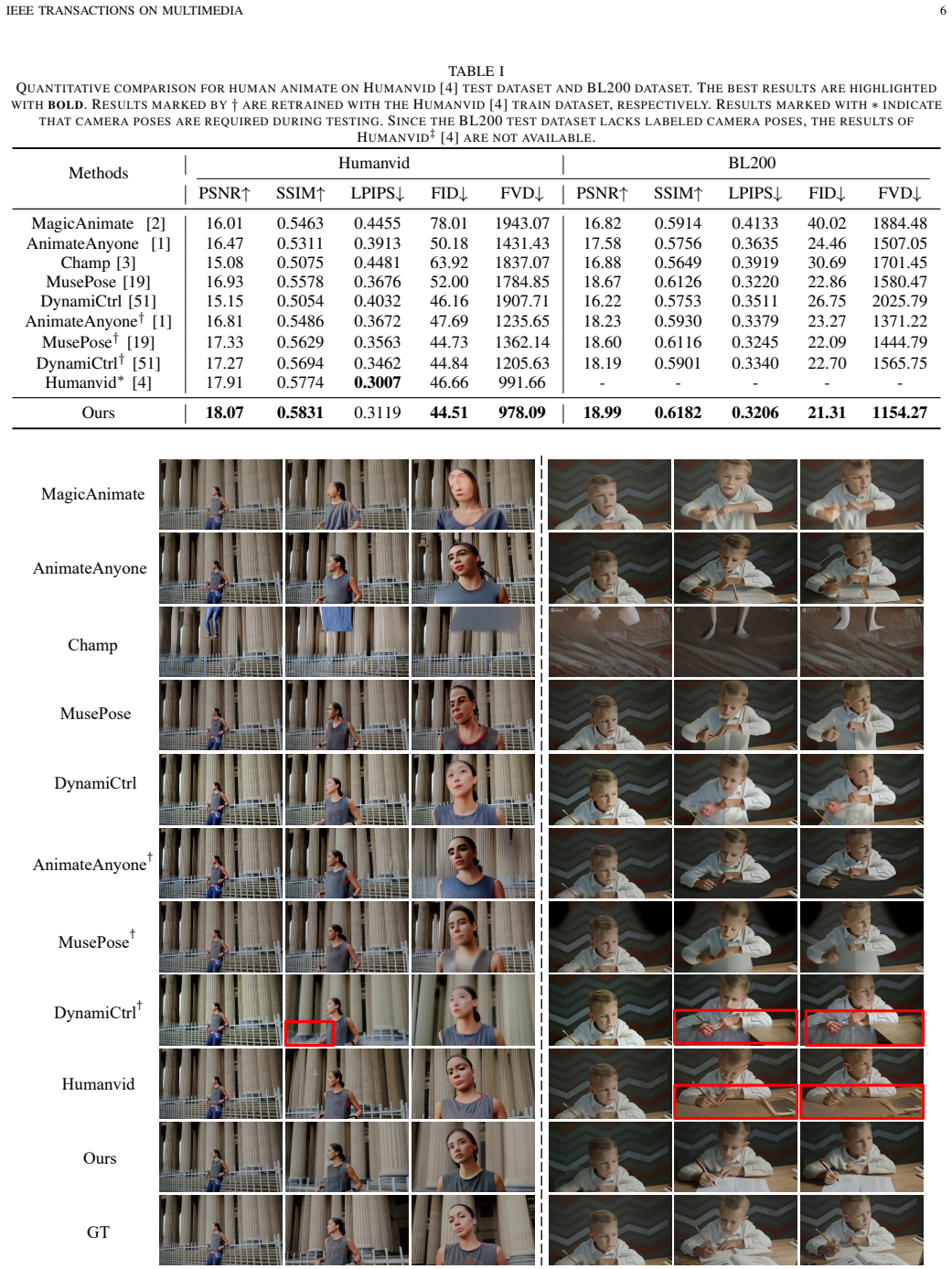
The paper claims that background motion can be learned directly from human pose sequences. Concretely, AnimateAnywhere takes a reference human image, a reference background image, and a pose sequence, and produces a video in which the background moves coherently with the human. The Background Motion Learner, a LoRA-style adapter inserted into each DiT block of the base model, reads combined pose and denoising features and predicts background motion end-to-end, avoiding the error accumulation of explicitly estimating camera trajectories. To keep that motion geometrically plausible, training applies an adaptive epipolar constraint to the 3D attention map: attention from a background pixel to another frame is suppressed only where it falls outside the epipolar line and is already low-confidence, leaving the model's own learned correlations intact. At inference no epipolar masks or camera poses are required. The paper reports that this outperforms prior human-animation methods on the Humanvid test set and a wild-collected BL200 set, including methods that use ground-truth camera poses at test time.
Load-bearing premise
The paper assumes that a human pose sequence alone reveals the background or camera motion, so that pose changes like apparent size and horizontal position translate into zoom and pan; this mapping is genuinely ambiguous in cases such as a skateboarder whose forward motion is indistinguishable from a camera zoom, and if such ambiguities dominate real usage, the learned background motion will be arbitrary or implausible.
Editorial extensions
If this is right
- Users can animate a character with a dynamic background using only a reference human, a reference background, and a pose sequence; no camera trajectory or reference video is needed at inference.
- Because the reference human and reference background are injected separately, the same pose sequence can be reused with arbitrary human and background combinations, enabling cross-character and cross-scene customization.
- Reported quantitative gains over static-background baselines and over a camera-pose-based method that needs test-time camera poses suggest the pose-to-background shortcut is learnable from camera-annotated video.
- The adaptive epipolar masking avoids the artifacts of hard suppression, making geometric consistency compatible with the free-form 3D attention of a diffusion transformer.
- When a pose sequence is ambiguous, the method still commits to a plausible background, and the paper names text descriptions as the next step for disambiguation.
Reading between the lines
- An implication the paper leaves implicit is that the BML's reliability should degrade precisely on pose sequences whose camera motion is underdetermined, such as a stationary person with a zoom; a text condition or a learned distribution over camera hypotheses would be a natural extension.
- The same 'pose implies camera' principle could transfer to non-human subjects, where object size and position changes relative to the frame are equally informative about camera motion.
- The low-confidence-gated epipolar mask is a general trick: any video-diffusion model with 3D attention could use it during training whenever camera labels are available, even for tasks outside human animation.
- A testable question is whether BML actually learns geometry or merely copies common background motions from the training distribution; ablating with a pose sequence whose implied camera motion contradicts the training prior would settle this.
Signed reviews
Editorial analysis
A structured set of objections, weighed in public.
Referee Report
Summary. The paper proposes AnimateAnywhere, a human image animation framework built on CogVideoX that generates videos with dynamic backgrounds while being controlled only by a human pose sequence and separate reference human and background images. The two main technical contributions are a Background Motion Learner (BML), a LoRA-based module that injects pose-derived features into the denoising DiT to predict background motion, and an adaptive epipolar constraint applied to the 3D attention map, which suppresses low-confidence attention that is geometrically unreasonable according to the camera motion available during training. The method is evaluated on the Humanvid test set and a new Bilibili200 (BL200) dataset, compared against MagicAnimate, AnimateAnyone, Champ, MusePose, DynamiCtrl, and Humanvid, and ablated with respect to the BML, the epipolar loss, the VGG loss, and the attention threshold. The authors report state-of-the-art quantitative results and qualitative examples showing plausible dynamic backgrounds.
Significance. If the central claim is validated, the paper makes a practical contribution by removing the need for camera trajectories or reference videos at inference, which broadens the applicability of human image animation to ordinary users. The architecture is clearly described, and the ablations do isolate the contributions of the BML and the epipolar loss, which is a genuine strength. The idea of learning background motion from pose features and of regularizing 3D attention with an adaptive epipolar mask is reasonable and worthy of publication. However, the paper's headline claim that the BML 'learns background motions from human pose sequences' is not directly supported by the reported evidence, and the paper's own Limitations section concedes a fundamental ambiguity in the pose-to-background mapping. The provided metrics are also based on single runs and a hyperparameter selected on the test set, so the strength of the empirical claims is currently not fully established.
major comments (3)
- [Section III-B, Table III] The central claim that the BML learns background motion from pose sequences is not directly supported by the reported experiments. Table III and Table I report only global frame-quality metrics (PSNR, SSIM, LPIPS, FID, FVD) aggregated over the entire video, so the gain from adding BML could come from extra model capacity, from the reference-background conditioning path, or from learning a generic camera-motion prior that is only weakly related to the specific pose content. A controlled experiment is needed: fix the reference human and reference background, vary only the pose sequence (for example, left-to-right walking versus in-place zooming, or a temporally scrambled pose sequence), and measure whether the generated background motion changes accordingly, for instance via optical-flow correlation between the background and the pose direction or via a human study. Section V's skateboard example shows that the pose-to-background mapping is ambiguous even in simple cases. Without such a test, the abstract's assertion that the method 'effectively learns the background motion from human pose sequences' remains unverified.
- [Section III-C, Eq. (4)] Equation (4) sums the epipolar loss over all pixels (u,v) without an explicit background/human mask, while the surrounding text says the constraint is applied to background pixels. Human body motion is not rigid under a global camera transformation, so applying the epipolar penalty to human-region queries would be geometrically incorrect and could distort the generated figure. The authors should state explicitly how the background region is identified in the loss, and either include the mask in Eq. (4) or define Aij(u,v) and Omega_ij(u,v) as restricted to background tokens. As written, the loss is ambiguous and cannot be reproduced from the paper.
- [Section IV-A, Table IV] The threshold delta is tuned on the Humanvid test set: Table IV reports the metrics for different percentiles and the authors then adopt the value that gives the best FVD and PSNR on that same set, and the final Table I numbers are produced with this selected value. This makes the headline comparison optimistic; a validation split or a sensitivity analysis that does not reuse the test set for model selection should be reported. Relatedly, all quantitative results are single runs without error bars or significance tests, and several differences from the nearest competitor are small (for example, PSNR 18.07 versus 17.91 in Table I), so run-to-run variance could change the ranking of methods.
minor comments (6)
- [Table II] The caption of Table II does not state that the numbers are computed on the subset of Humanvid videos with significant background motion, even though the text introduces such a subset; the table should be labeled accordingly to avoid confusion with Table I.
- [Table II] In Table II, the row 'Ours with Lepipolar((1-M) cap (A<delta))' reports SSIM = 0.5831, which is identical to the 'Ours' row in Table I while all other metrics differ; the authors should confirm whether this is a copying error and clarify the evaluation subset.
- [Section III-C and Fig. 2] The notation around the attention map is inconsistent: Aij(u,v) is sometimes a scalar and sometimes a map over the j-th frame, and the dimensions of Omega_ij(u,v) are not defined. The figures would be much easier to read if the masks and maps were defined with explicit tensor shapes.
- [Section III-D, Eq. (6)] The VGG perceptual loss in Eq. (6) uses a hand-region mask m, but the range and resolution of m and the choice of VGG features are not specified, which makes this term non-reproducible.
- [Related Work and Experiments] DynaScene [18], which is discussed in Section II-A as a method for realistic dynamic backgrounds, is not included in the quantitative or qualitative comparisons; if it requires camera poses at test time, this should be stated explicitly.
- [General] There are minor typos and formatting issues, including 'V AE' for 'VAE', inconsistent capitalization of 'AnimateAnyone', and the use of 'eq. (4)' without the equation being labeled consistently; a careful proofread would improve the presentation.
Circularity Check
No significant circularity: the paper trains a learned background-motion module against ground-truth video and camera-pose supervision, and its self-referential attention masking is a regularization mechanism, not a definitional reduction.
full rationale
The paper's central mechanism is a learned Background Motion Learner that maps human pose features to background motion signals, trained end-to-end with a latent diffusion loss (Eq. 5), a VGG perceptual loss (Eq. 6), and an epipolar loss (Eq. 4) supervised by labeled camera trajectories. The epipolar constraint is applied during training only, and the paper explicitly states that at inference 'our method no longer requires epipolar information or camera trajectories' (Section III-C). This is standard supervised learning, not a fitted parameter renamed as a prediction. The adaptive epipolar mask uses the model's own 3D attention map and a threshold delta to decide which low-confidence attention values to suppress; this is a self-regularization design, not an equivalence between the input and the claimed output. The threshold is selected via sensitivity analysis on a test set, which is a methodological concern about evaluation, not circularity. The paper's citation of DynaScene [18] is related-work context and is not load-bearing for the proposed derivation. The Limitations section (Section V) concedes that a pose sequence can correspond to multiple plausible background motions; that is an acknowledged ambiguity in the task, not a circular step. No equation or claim in the paper reduces by construction to its own inputs, and no self-citation chain is used to justify a core result. Therefore the derivation is self-contained with respect to circularity.
Assumptions & free parameters
free parameters (4)
- delta (attention threshold) =
30th percentile
- lambda_vgg =
0.2
- lambda_epipolar =
0.005
- CFG scale =
2.5
assumptions (5)
- standard math Epipolar geometry: a point in one frame must lie on the epipolar line in another frame defined by the fundamental matrix.
- domain assumption Human pose sequences carry recoverable information about camera and background motion.
- domain assumption The 3D attention map in the diffusion model encodes cross-frame correspondences that can be regularized for geometric consistency.
- domain assumption Camera poses annotated in Humanvid are accurate enough to supervise the epipolar loss.
- domain assumption Grounded-SAM human and background masks are reliable for separating foreground and background training signals.
Cite this review
Pith. "Pith review of AnimateAnywhere: Rouse the Background in Human Image Animation." pith.science (2026). https://pith.science/paper/FICWSR3E
@misc{pith2026250419834,
  author       = {Pith},
  title        = {Pith review of: AnimateAnywhere: Rouse the Background in Human Image Animation},
  year         = {2026},
  howpublished = {\url{https://pith.science/paper/FICWSR3E}},
  note         = {Machine review of arXiv:2504.19834}
}
read the original abstract
Human image animation aims to generate human videos of given characters and backgrounds that adhere to the desired pose sequence. However, existing methods focus more on human actions while neglecting the generation of background, which typically leads to static results or inharmonious movements. The community has explored camera pose-guided animation tasks, yet preparing the camera trajectory is impractical for most entertainment applications and ordinary users. As a remedy, we present an AnimateAnywhere framework, rousing the background in human image animation without requirements on camera trajectories. In particular, based on our key insight that the movement of the human body often reflects the motion of the background, we introduce a background motion learner (BML) to learn background motions from human pose sequences. To encourage the model to learn more accurate cross-frame correspondences, we further deploy an epipolar constraint on the 3D attention map. Specifically, the mask used to suppress geometrically unreasonable attention is carefully constructed by combining an epipolar mask and the current 3D attention map. Extensive experiments demonstrate that our AnimateAnywhere effectively learns the background motion from human pose sequences, achieving state-of-the-art performance in generating human animation results with vivid and realistic backgrounds. The source code and model will be available at https://github.com/liuxiaoyu1104/AnimateAnywhere.
Figures


Figures from the paper (7 more)


Forward citations
Cited by 1 Pith paper
-
AniCrafter: Customizing Realistic Human-Centric Animation via Avatar-Background Conditioning in Video Diffusion Models
A diffusion model animates a character into arbitrary dynamic backgrounds by conditioning on a rendered 3D-avatar video, reframing open-domain animation as a restoration problem.
Reference graph
Works this paper leans on
-
[1]
Animate anyone: Consistent and controllable image-to-video synthesis for character animation,
L. Hu, “Animate anyone: Consistent and controllable image-to-video synthesis for character animation,” in Proceedings of the IEEE/CVF Conference on Computer Vision and Pattern Recognition , 2024, pp. 8153–8163
2024
-
[2]
Magicanimate: Temporally consistent human image animation using diffusion model,
Z. Xu, J. Zhang, J. H. Liew, H. Yan, J.-W. Liu, C. Zhang, J. Feng, and M. Z. Shou, “Magicanimate: Temporally consistent human image animation using diffusion model,” in Proceedings of the IEEE/CVF Conference on Computer Vision and Pattern Recognition , 2024, pp. 1481–1490
work page 2024
-
[3]
Champ: Controllable and consistent human image animation with 3d parametric guidance,
S. Zhu, J. L. Chen, Z. Dai, Y . Xu, X. Cao, Y . Yao, H. Zhu, and S. Zhu, “Champ: Controllable and consistent human image animation with 3d parametric guidance,” arXiv preprint arXiv:2403.14781 , 2024
arXiv 2024
-
[4]
Humanvid: Demystifying training data for camera- controllable human image animation,
Z. Wang, Y . Li, Y . Zeng, Y . Fang, Y . Guo, W. Liu, J. Tan, K. Chen, T. Xue, B. Daiet al., “Humanvid: Demystifying training data for camera- controllable human image animation,” arXiv preprint arXiv:2407.17438, 2024
arXiv 2024
-
[5]
Disentangling foreground and background motion for enhanced realism in human video genera- tion,
J. Liu, K. Yu, M. Feng, X. Guo, and M. Cui, “Disentangling foreground and background motion for enhanced realism in human video genera- tion,” arXiv preprint arXiv:2405.16393 , 2024
arXiv 2024
-
[6]
Realisdance: Equip controllable character animation with realistic hands,
J. Zhou, B. Wang, W. Chen, J. Bai, D. Li, A. Zhang, H. Xu, M. Yang, and F. Wang, “Realisdance: Equip controllable character animation with realistic hands,” arXiv preprint arXiv:2409.06202 , 2024. IEEE TRANSACTIONS ON MULTIMEDIA 10
arXiv 2024
-
[7]
Realishuman: A two-stage approach for refining malformed human parts in generated images,
B. Wang, J. Zhou, J. Bai, Y . Yang, W. Chen, F. Wang, and Z. Lei, “Realishuman: A two-stage approach for refining malformed human parts in generated images,” arXiv preprint arXiv:2409.03644 , 2024
arXiv 2024
-
[8]
Unianimate: Taming unified video diffusion models for consistent human image animation,
X. Wang, S. Zhang, C. Gao, J. Wang, X. Zhou, Y . Zhang, L. Yan, and N. Sang, “Unianimate: Taming unified video diffusion models for consistent human image animation,” arXiv preprint arXiv:2406.01188 , 2024
arXiv 2024
Show all 51 references
-
[9]
Cogvideox: Text-to-video diffusion models with an expert transformer,
Z. Yang, J. Teng, W. Zheng, M. Ding, S. Huang, J. Xu, Y . Yang, W. Hong, X. Zhang, G. Feng et al., “Cogvideox: Text-to-video diffusion models with an expert transformer,” arXiv preprint arXiv:2408.06072 , 2024
2024 arXiv
-
[10]
Lora: Low-rank adaptation of large language models
E. J. Hu, Y . Shen, P. Wallis, Z. Allen-Zhu, Y . Li, S. Wang, L. Wang, W. Chen et al., “Lora: Low-rank adaptation of large language models.” ICLR, vol. 1, no. 2, p. 3, 2022
2022
-
[11]
First or- der motion model for image animation,
A. Siarohin, S. Lathuili `ere, S. Tulyakov, E. Ricci, and N. Sebe, “First or- der motion model for image animation,” Advances in neural information processing systems, vol. 32, 2019
2019
-
[12]
Gac-gan: A general method for appearance-controllable human video motion transfer,
D. Wei, X. Xu, H. Shen, and K. Huang, “Gac-gan: A general method for appearance-controllable human video motion transfer,” IEEE Trans- actions on Multimedia , vol. 23, pp. 2457–2470, 2020
2020
-
[13]
One-shot free-view neural talking-head synthesis for video conferencing,
T.-C. Wang, A. Mallya, and M.-Y . Liu, “One-shot free-view neural talking-head synthesis for video conferencing,” in Proceedings of the IEEE/CVF conference on computer vision and pattern recognition, 2021, pp. 10 039–10 049
2021
-
[14]
Humangan: A generative model of human images,
K. Sarkar, L. Liu, V . Golyanik, and C. Theobalt, “Humangan: A generative model of human images,” in 2021 International Conference on 3D Vision (3DV) . IEEE, 2021, pp. 258–267
2021
-
[15]
A good image generator is what you need for high- resolution video synthesis,
Y . Tian, J. Ren, M. Chai, K. Olszewski, X. Peng, D. N. Metaxas, and S. Tulyakov, “A good image generator is what you need for high- resolution video synthesis,” arXiv preprint arXiv:2104.15069 , 2021
2021 arXiv
-
[16]
Coherent image animation using spatial-temporal correspondence,
W. Wang, W. Zhou, J. Bao, and H. Li, “Coherent image animation using spatial-temporal correspondence,” IEEE Transactions on Multimedia , vol. 25, pp. 3397–3408, 2022
2022
-
[17]
One-shot human motion transfer via occlusion-robust flow prediction and neural texturing,
Y . Ji, C. Zheng, and T.-J. Cham, “One-shot human motion transfer via occlusion-robust flow prediction and neural texturing,” IEEE Transac- tions on Multimedia , 2025
2025
-
[18]
Beyond static scenes: Camera-controllable back- ground generation for human motion,
M. Yao, M. Chen, Q. Zhou, Y . Zhang, M. Liu, X. Li, S. Liu, C. Ju, S. Xiao, Q. Liu et al., “Beyond static scenes: Camera-controllable back- ground generation for human motion,” arXiv preprint arXiv:2504.02004, 2025
2025 arXiv
-
[19]
Musepose: a pose-driven image-to-video framework for virtual human generation,
Z. Tong, C. Li, Z. Chen, B. Wu, and W. Zhou, “Musepose: a pose-driven image-to-video framework for virtual human generation,” arxiv, 2024
2024
-
[20]
Animate-x: Universal character image animation with enhanced motion representation,
S. Tan, B. Gong, X. Wang, S. Zhang, D. Zheng, R. Zheng, K. Zheng, J. Chen, and M. Yang, “Animate-x: Universal character image animation with enhanced motion representation,” arXiv preprint arXiv:2410.10306, 2024
2024 arXiv
-
[21]
Mimo: Controllable character video synthesis with spatial decomposed modeling,
Y . Men, Y . Yao, M. Cui, and L. Bo, “Mimo: Controllable character video synthesis with spatial decomposed modeling,” arXiv preprint arXiv:2409.16160, 2024
2024 arXiv
-
[22]
Animate anyone 2: High-fidelity charac- ter image animation with environment affordance,
L. Hu, G. Wang, Z. Shen, X. Gao, D. Meng, L. Zhuo, P. Zhang, B. Zhang, and L. Bo, “Animate anyone 2: High-fidelity charac- ter image animation with environment affordance,” arXiv preprint arXiv:2502.06145, 2025
2025 arXiv
-
[23]
Tram: Global trajectory and motion of 3d humans from in-the-wild videos,
Y . Wang, Z. Wang, L. Liu, and K. Daniilidis, “Tram: Global trajectory and motion of 3d humans from in-the-wild videos,” arXiv preprint arXiv:2403.17346, 2024
2024 arXiv
-
[24]
Droid-slam: Deep visual slam for monocular, stereo, and rgb-d cameras,
Z. Teed and J. Deng, “Droid-slam: Deep visual slam for monocular, stereo, and rgb-d cameras,” Advances in neural information processing systems, vol. 34, pp. 16 558–16 569, 2021
2021
-
[25]
Cameractrl: Enabling camera control for text-to-video generation,
H. He, Y . Xu, Y . Guo, G. Wetzstein, B. Dai, H. Li, and C. Yang, “Cameractrl: Enabling camera control for text-to-video generation,” arXiv preprint arXiv:2404.02101 , 2024
2024 arXiv
-
[26]
Video diffusion models,
J. Ho, T. Salimans, A. Gritsenko, W. Chan, M. Norouzi, and D. J. Fleet, “Video diffusion models,” Advances in Neural Information Processing Systems, vol. 35, pp. 8633–8646, 2022
2022
-
[27]
Animatediff: Animate your personalized text- to-image diffusion models without specific tuning,
Y . Guo, C. Yang, A. Rao, Z. Liang, Y . Wang, Y . Qiao, M. Agrawala, D. Lin, and B. Dai, “Animatediff: Animate your personalized text- to-image diffusion models without specific tuning,” arXiv preprint arXiv:2307.04725, 2023
2023 arXiv
-
[28]
Stable video diffusion: Scaling latent video diffusion models to large datasets,
A. Blattmann, T. Dockhorn, S. Kulal, D. Mendelevitch, M. Kilian, D. Lorenz, Y . Levi, Z. English, V . V oleti, A. Lettset al., “Stable video diffusion: Scaling latent video diffusion models to large datasets,” arXiv preprint arXiv:2311.15127, 2023
2023 arXiv
-
[29]
Lumiere: A space-time diffusion model for video generation,
O. Bar-Tal, H. Chefer, O. Tov, C. Herrmann, R. Paiss, S. Zada, A. Ephrat, J. Hur, G. Liu, A. Raj et al. , “Lumiere: A space-time diffusion model for video generation,” arXiv preprint arXiv:2401.12945 , 2024
2024 arXiv
-
[30]
Photorealistic video generation with diffusion models,
A. Gupta, L. Yu, K. Sohn, X. Gu, M. Hahn, F.-F. Li, I. Essa, L. Jiang, and J. Lezama, “Photorealistic video generation with diffusion models,” in European Conference on Computer Vision. Springer, 2025, pp. 393– 411
2025
-
[31]
Con- trolvideo: Training-free controllable text-to-video generation,
Y . Zhang, Y . Wei, D. Jiang, X. Zhang, W. Zuo, and Q. Tian, “Con- trolvideo: Training-free controllable text-to-video generation,” arXiv preprint arXiv:2305.13077, 2023
2023 arXiv
-
[32]
Sparsectrl: Adding sparse controls to text-to-video diffusion models,
Y . Guo, C. Yang, A. Rao, M. Agrawala, D. Lin, and B. Dai, “Sparsectrl: Adding sparse controls to text-to-video diffusion models,” in European Conference on Computer Vision . Springer, 2025, pp. 330–348
2025
-
[33]
Dreamvideo: Composing your dream videos with customized subject and motion,
Y . Wei, S. Zhang, Z. Qing, H. Yuan, Z. Liu, Y . Liu, Y . Zhang, J. Zhou, and H. Shan, “Dreamvideo: Composing your dream videos with customized subject and motion,” in Proceedings of the IEEE/CVF Conference on Computer Vision and Pattern Recognition , 2024, pp. 6537–6549
2024
-
[34]
Videodreamer: Customized multi-subject text-to-video generation with disen-mix finetuning on language-video foundation models,
H. Chen, X. Wang, G. Zeng, Y . Zhang, Y . Zhou, F. Han, Y . Wu, and W. Zhu, “Videodreamer: Customized multi-subject text-to-video generation with disen-mix finetuning on language-video foundation models,” IEEE Transactions on Multimedia , 2025
2025
-
[35]
Lora: Low-rank adaptation of large language models,
E. J. Hu, Y . Shen, P. Wallis, Z. Allen-Zhu, Y . Li, S. Wang, L. Wang, and W. Chen, “Lora: Low-rank adaptation of large language models,” arXiv preprint arXiv:2106.09685 , 2021
2021 arXiv
-
[36]
Direct-a-video: Customized video generation with user- directed camera movement and object motion,
S. Yang, L. Hou, H. Huang, C. Ma, P. Wan, D. Zhang, X. Chen, and J. Liao, “Direct-a-video: Customized video generation with user- directed camera movement and object motion,” in ACM SIGGRAPH 2024 Conference Papers, 2024, pp. 1–12
2024
-
[37]
Motionctrl: A unified and flexible motion controller for video generation,
Z. Wang, Z. Yuan, X. Wang, Y . Li, T. Chen, M. Xia, P. Luo, and Y . Shan, “Motionctrl: A unified and flexible motion controller for video generation,” in ACM SIGGRAPH 2024 Conference Papers , 2024, pp. 1–11
2024
-
[38]
Camco: Camera-controllable 3d-consistent image-to-video generation,
D. Xu, W. Nie, C. Liu, S. Liu, J. Kautz, Z. Wang, and A. Vahdat, “Camco: Camera-controllable 3d-consistent image-to-video generation,” arXiv preprint arXiv:2406.02509 , 2024
2024 arXiv
-
[39]
Cami2v: Camera-controlled image-to-video diffusion model,
G. Zheng, T. Li, R. Jiang, Y . Lu, T. Wu, and X. Li, “Cami2v: Camera-controlled image-to-video diffusion model,” arXiv preprint arXiv:2410.15957, 2024
2024 arXiv
-
[40]
Training-free camera control for video generation,
C. Hou, G. Wei, Y . Zeng, and Z. Chen, “Training-free camera control for video generation,” arXiv preprint arXiv:2406.10126 , 2024
2024 arXiv
-
[41]
Adding conditional control to text-to-image diffusion models,
L. Zhang, A. Rao, and M. Agrawala, “Adding conditional control to text-to-image diffusion models,” in Proceedings of the IEEE/CVF International Conference on Computer Vision , 2023, pp. 3836–3847
2023
-
[42]
T2i- adapter: Learning adapters to dig out more controllable ability for text- to-image diffusion models,
C. Mou, X. Wang, L. Xie, Y . Wu, J. Zhang, Z. Qi, and Y . Shan, “T2i- adapter: Learning adapters to dig out more controllable ability for text- to-image diffusion models,” in Proceedings of the AAAI Conference on Artificial Intelligence, vol. 38, no. 5, 2024, pp. 4296–4304
2024
-
[43]
Scope of validity of psnr in im- age/video quality assessment,
Q. Huynh-Thu and M. Ghanbari, “Scope of validity of psnr in im- age/video quality assessment,” Electronics letters, vol. 44, no. 13, pp. 800–801, 2008
2008
-
[44]
Image quality assessment: from error visibility to structural similarity,
Z. Wang, A. C. Bovik, H. R. Sheikh, and E. P. Simoncelli, “Image quality assessment: from error visibility to structural similarity,” IEEE transactions on image processing , vol. 13, no. 4, pp. 600–612, 2004
2004
-
[45]
The unreasonable effectiveness of deep features as a perceptual metric,
R. Zhang, P. Isola, A. A. Efros, E. Shechtman, and O. Wang, “The unreasonable effectiveness of deep features as a perceptual metric,” in Proceedings of the IEEE conference on computer vision and pattern recognition, 2018, pp. 586–595
2018
-
[46]
Gans trained by a two time-scale update rule converge to a local nash equilibrium,
M. Heusel, H. Ramsauer, T. Unterthiner, B. Nessler, and S. Hochreiter, “Gans trained by a two time-scale update rule converge to a local nash equilibrium,” Advances in neural information processing systems , vol. 30, 2017
2017
-
[47]
Fvd: A new metric for video generation,
T. Unterthiner, S. van Steenkiste, K. Kurach, R. Marinier, M. Michalski, and S. Gelly, “Fvd: A new metric for video generation,” 2019
2019
-
[48]
Grounded sam: Assembling open-world models for diverse visual tasks,
T. Ren, S. Liu, A. Zeng, J. Lin, K. Li, H. Cao, J. Chen, X. Huang, Y . Chen, F. Yan, Z. Zeng, H. Zhang, F. Li, J. Yang, H. Li, Q. Jiang, and L. Zhang, “Grounded sam: Assembling open-world models for diverse visual tasks,” 2024
2024
-
[49]
ProPainter: Improving propagation and transformer for video inpainting,
S. Zhou, C. Li, K. C. Chan, and C. C. Loy, “ProPainter: Improving propagation and transformer for video inpainting,” in Proceedings of IEEE International Conference on Computer Vision (ICCV) , 2023
2023
-
[50]
Decoupled weight decay regularization,
I. Loshchilov and F. Hutter, “Decoupled weight decay regularization,” arXiv preprint arXiv:1711.05101 , 2017
2017 arXiv
-
[51]
Dynamictrl: Rethinking the basic structure and the role of text for high-quality human image animation,
H. Zhao, Z. Qi, C. Wang, Q. Zheng, G. Lu, F. Chen, H. Xu, and Z. Wu, “Dynamictrl: Rethinking the basic structure and the role of text for high-quality human image animation,” arXiv preprint arXiv:2503.21246, 2025
2025 arXiv
Reviewed August 16, 2026 · model on record in the stance chip above.
Discussion (0). Continue with ORCID to comment.