REVIEW 5 major objections 5 minor 1 cited by
DeeCLIP: A Robust and Generalizable Transformer-Based Framework for Detecting AI-Generated Images
T0 review · 5 major / 5 minor · reviewed 2026-08-16 · deepseek-v4-flash
Pith's one-line read Trained on only four ProGAN classes, DeeCLIP reports 89.00% mean accuracy across 19 AI-image generators and better robustness to blur and JPEG compression than prior CLIP detectors.
desk verdict DeeCLIP is a credible parameter-efficient CLIP detector with real generalization evidence, but the paper overclaims 'state-of-the-art' against its own Table 1 and skips ablations for its two named innovations. read the letter →
The pith
A machine-rendered reading of the paper's core claim, the machinery that carries it, and where it could break.
The reading
What carries the argument
The load-bearing object is DeeFuser, a cross-attention fusion module: the high-level feature map $F_L$ from the last selected ViT layer acts as a query, the concatenation of earlier-layer maps $F_1,\dots,F_{L-1}$ acts as the key/value source, and the attended output is refined by an MLP and a self-attention residual block before being added back to $F_L$ with a learnable scale. This lets the classifier see both semantic content and pixel-level texture artifacts. The supporting mechanisms are LoRA, which replaces each weight update by low-rank factors $\mathbf{B}\mathbf{A}$ so that $\mathbf{W}' = \mathbf{W} + \mathbf{B}\mathbf{A}$, and the combined triplet plus binary-cross-entropy loss, which separates real from fake embeddings. Together they carry the paper's claim that narrow ProGAN-only training transfers to unseen GAN and diffusion generators.
What would settle it
Re-run all detectors, including DeeCLIP, from the same 4-class ProGAN split with identical preprocessing and the same evaluation code on the 19 UniversalFakeDetect subsets and on the blur/JPEG versions, and check whether DeeCLIP's 71.91% versus 61.55% robustness margin and 89.00% mean accuracy survive; if the margin disappears, the comparative claim collapses. An even more direct check is to test DeeCLIP on generator outputs that remove low-level artifacts, such as diffusion images passed through adversarial purification; chance-level accuracy there would show the detector is keyed to shallow artifacts rather than a general synthetic-image signature.
Extended reading notes
Core claim
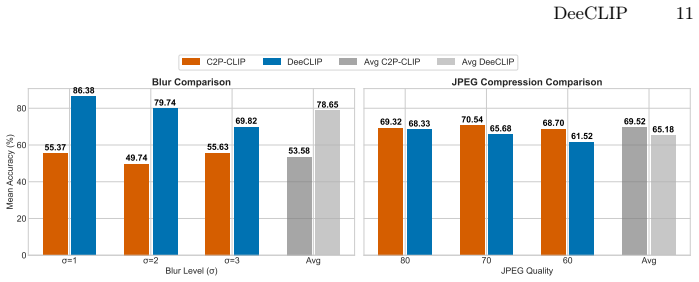
The central claim is that multi-scale feature fusion inside a frozen-but-LoRA-adapted CLIP-ViT is what makes AI-image detection both generalizable and resistant to degradation. DeeFuser uses the deepest selected ViT layer as a query in cross-attention over concatenated shallow feature maps, then passes the result through an MLP, a self-attention block with a learnable residual weight, and a second learnable residual combination with the deep feature. Triplet loss pulls embeddings of the same class together and pushes real and fake apart, while binary cross-entropy supplies the final decision; LoRA keeps the pretrained backbone intact. With this setup, images synthesized by 19 unseen generators—including diffusion models—are detected at 89.00% mean accuracy after training on four ProGAN classes, and the detector remains at 71.91% average accuracy under JPEG and Gaussian blur, a 10.36-point margin over C2P-CLIP.
Load-bearing premise
The comparison against prior detectors assumes that the accuracies taken from the original C2P-CLIP and RINE papers were produced under the same preprocessing, input sizes, class balance, and evaluation splits as DeeCLIP's, because those baselines were not re-run in this pipeline.
Editorial extensions
If this is right
- A detector trained on only four ProGAN object classes can recognize images from 19 unseen generators, including diffusion models, at 89.00% mean accuracy, so broad forensic coverage does not require training on every generator.
- Combining shallow and deep features, rather than using only the deepest CLIP layer, is sufficient to keep detection alive under Gaussian blur and JPEG compression, with an overall 71.91% versus 61.55% mean accuracy against C2P-CLIP.
- LoRA adaptation improves accuracy from 84.53% with a fixed backbone to 89.00%, so the CLIP backbone's pretrained knowledge can be adapted without full fine-tuning.
- Prompt-free detection is viable: DeeCLIP classifies without task-specific text prompts, unlike prompt-tuned detectors.
- The same 4-class-ProGAN-trained model transfers to an unrelated 12-subset benchmark at 78.99% mean accuracy, supporting deployment on data distributions not seen in training.
Reading between the lines
- An untested implication is that DeeFuser's shallow-feature path is the main source of the robustness gain; ablating it under blur and compression would show whether the 10.36-point margin over C2P-CLIP comes from fusion, triplet loss, or LoRA.
- If the detectable signature is carried by low-level artifacts, then future generators that explicitly suppress those artifacts, for example through adversarial purification or diffusion inversion, should disproportionately degrade DeeCLIP; the paper does not test such countermeasures.
- The same frozen-encoder-plus-deep-shallow-cross-attention recipe may transfer to other vision-language backbones and to video or audio deepfake detection, but that is an extrapolation beyond the paper's experiments.
Signed reviews
Editorial analysis
A structured set of objections, weighed in public.
Referee Report
Summary. The paper proposes DeeCLIP, a transformer-based framework for detecting AI-generated images. It adapts a CLIP-ViT (ViT-L/14) image encoder using LoRA, introduces a DeeFuser module that fuses shallow and deep features via cross-attention, and trains with a combination of triplet loss and binary cross-entropy. The model is trained only on 4-class ProGAN data and evaluated on the 19-subset UniversalFakeDetect benchmark, where it reports 89.00% mean accuracy, as well as on a separate 12-subset held-out benchmark where it reports 78.99% accuracy. The paper additionally evaluates robustness to Gaussian blur and JPEG compression and reports an overall average accuracy of 71.91% versus 61.55% for C2P-CLIP. The authors claim that DeeCLIP outperforms existing methods despite having fewer trainable parameters.
Significance. If the results hold after scrutiny, DeeCLIP would offer a parameter-efficient CLIP-based detector that generalizes across GAN and diffusion generators, which is a practically relevant capability for AI-generated image forensics. The paper's strengths include a held-out evaluation on unseen generators (Table 2), which is a meaningful generalization test, and the release of code. The LoRA adaptation and multi-layer fusion are reasonable ideas that could be useful to the community. However, the current manuscript's headline claims of state-of-the-art performance and robustness to compression are not supported by its own reported numbers, and several core components are not ablated. The technical approach is plausible but needs corrected claims and additional experiments to be acceptable.
major comments (5)
- [Abstract; Section 1; Section 3, Table 1] The claim that DeeCLIP "outperforms existing methods" (Abstract) and achieves "state-of-the-art (SOTA) performance" (Section 1) is contradicted by Table 1: DeeCLIP's mean accuracy of 89.00% is lower than C2P-CLIP (93.79%), RINE (91.31%), and FatFormer (90.86%). The Section 3 prose correctly downgrades the claim to "competitive" and "one of the best-performing methods," but the abstract and introduction must be revised to match the evidence, or the claim needs to be justified with a specific criterion (e.g., parameter efficiency) rather than overall accuracy.
- [Abstract; Section 3, Table 3] The robustness claim that DeeCLIP is robust to "compression and blurring" is only supported for Gaussian blur. Under JPEG compression, DeeCLIP is worse than C2P-CLIP at every reported quality level (q=80: 68.33 vs 69.32; q=70: 65.68 vs 70.54; q=60: 61.52 vs 68.70). The overall 10.36% average gain in Table 3 is driven primarily by the blur rows, where DeeCLIP is substantially better. The abstract's grouping of compression with blurring as equally supported degradations overstates the evidence.
- [Section 3, Baselines] The baseline numbers in Tables 1 and 2 are taken from the original papers ("we report the results presented in the original C2P-CLIP paper" and RINE from its paper) rather than re-run under DeeCLIP's exact preprocessing, image resolution, class balance, and split protocol. This makes all head-to-head comparisons potentially incomparable. The authors should either re-run the baselines under the same pipeline or explicitly state this limitation throughout the paper and avoid strong comparative claims such as "outperforms."
- [Section 3, Ablation study] The ablation study only compares a fixed CLIP-ViT backbone against LoRA fine-tuning (84.53% vs 89.00%). DeeFuser and the triplet loss are presented as key contributions (Section 1), but no experiment removes or varies them, so the paper does not establish that these modules contribute to the reported accuracy or robustness. Ablations for DeeFuser and for the triplet loss (and their interaction) are needed to support the causal attribution in the conclusion.
- [Abstract; Table 2] The statement in the Abstract that DeeCLIP achieves strong performance "despite having fewer trainable parameters" is contradicted by Table 2, which reports 306M parameters for DeeCLIP versus 304M for C2P-CLIP. If the intended comparison is to the number of trainable parameters under LoRA (not total parameters), this must be stated explicitly with the corresponding numbers; otherwise the claim is factually incorrect as written.
minor comments (5)
- [Section 1] There is a typo "Figue 1" in the paragraph introducing Figure 1; it should be "Figure 1."
- [Section 3, Table 1] The column header "DallemAcc" is malformed and should be split into "DALL·E" and "mAcc" for readability.
- [Section 3, Baselines] The method name "FatchFor" in the text appears to be a typo for "PatchFor," which would match the row label in Table 1.
- [Section 3, Generalization] The 12-subset held-out dataset (ControlNet, DALL·E 3, DiffusionDB, IF, LaMA, LTE, SD2Inpaint, SDXL, SGXL, SD3) is introduced without a citation or a description of how the subsets were constructed and preprocessed; adding this information would improve reproducibility.
- [Figure 5] Figure 5 is described in the text but the plot itself is not discussed in detail; the caption should indicate how to read the curves (e.g., accuracy vs. severity) for readers unfamiliar with the format.
Circularity Check
No circularity: DeeCLIP's accuracy and robustness numbers are genuine holdout evaluations; the self-cited Bi-LORA baseline is not load-bearing.
full rationale
DeeCLIP's central claims rest on a genuine holdout evaluation: the model is trained on 4-class ProGAN and tested on 19 unseen generator subsets (UniversalFakeDetect), plus a separate 12-subset generalization set and JPEG/Gaussian-blur degraded versions. None of these accuracy numbers is produced by a fitted parameter renamed as a prediction; the mAcc values are direct measurements on held-out data. The architecture borrows LoRA (Hu et al.), MMFuser (Cao et al.), triplet loss (Weinberger & Saul), and CLIP-ViT, all external components whose cited sources do not depend on DeeCLIP. The only self-citation, Bi-LORA [9], appears as a baseline in Table 1, not as support for DeeCLIP's own result, so it is not load-bearing. The claim that DeeCLIP 'outperforms existing methods' is undermined by the paper's own Table 1 (C2P-CLIP 93.79, RINE 91.31, FatFormer 90.86 vs DeeCLIP 89.00), and the robustness gain is driven by Gaussian blur while JPEG results are worse at every quality level; however, these are internal-consistency/comparability issues, not circular reductions. The baselines copied from C2P-CLIP/RINE papers may be non-comparable under DeeCLIP's preprocessing, but copying an external number is not making the prediction equal to its input. No equation or defined quantity reduces to another by construction.
Assumptions & free parameters
free parameters (5)
- LoRA rank (r) =
16
- LoRA alpha =
32
- Loss balancing factor lambda =
2.0
- Triplet loss margin alpha =
not stated
- Fusion layer set =
layers 1,3,5,8,10,13,15,17,19,21,22,23
assumptions (5)
- standard math Cross-attention, self-attention, layer norm, and MLP operations work as standard in transformer literature.
- domain assumption CLIP-ViT pre-trained features contain semantics in late layers and texture/artifact information in early layers that are complementary for synthetic image detection.
- domain assumption The 4-class ProGAN training set (horse, chair, cat, car) is representative enough to generalize to 19 unseen generators.
- domain assumption Baseline results from other papers are reproducible and directly comparable under the same evaluation protocol.
- ad hoc to paper The hand-selected fusion layer set is a valid design choice without sensitivity analysis.
invented entities (1)
-
DeeFuser module
Cite this review
Pith. "Pith review of DeeCLIP: A Robust and Generalizable Transformer-Based Framework for Detecting AI-Generated Images." pith.science (2026). https://pith.science/paper/TVIT3F7O
@misc{pith2026250419876,
  author       = {Pith},
  title        = {Pith review of: DeeCLIP: A Robust and Generalizable Transformer-Based Framework for Detecting AI-Generated Images},
  year         = {2026},
  howpublished = {\url{https://pith.science/paper/TVIT3F7O}},
  note         = {Machine review of arXiv:2504.19876}
}
read the original abstract
This paper introduces DeeCLIP, a novel framework for detecting AI-generated images using CLIP-ViT and fusion learning. Despite significant advancements in generative models capable of creating highly photorealistic images, existing detection methods often struggle to generalize across different models and are highly sensitive to minor perturbations. To address these challenges, DeeCLIP incorporates DeeFuser, a fusion module that combines high-level and low-level features, improving robustness against degradations such as compression and blurring. Additionally, we apply triplet loss to refine the embedding space, enhancing the model's ability to distinguish between real and synthetic content. To further enable lightweight adaptation while preserving pre-trained knowledge, we adopt parameter-efficient fine-tuning using low-rank adaptation (LoRA) within the CLIP-ViT backbone. This approach supports effective zero-shot learning without sacrificing generalization. Trained exclusively on 4-class ProGAN data, DeeCLIP achieves an average accuracy of 89.00% on 19 test subsets composed of generative adversarial network (GAN) and diffusion models. Despite having fewer trainable parameters, DeeCLIP outperforms existing methods, demonstrating superior robustness against various generative models and real-world distortions. The code is publicly available at https://github.com/Mamadou-Keita/DeeCLIP for research purposes.
Figures


Figures from the paper (2 more)

Forward citations
Cited by 1 Pith paper
-
AgentFoX: LLM Agent-Guided Fusion with eXplainability for AI-Generated Image Detection
An LLM agent guided by Expert and Clustering Profiles fuses heterogeneous AIGI detectors, resolves conflicts, and outputs explainable forensic reports that beat single experts and standard ensembles on high-conflict a...
Reference graph
Works this paper leans on
-
[1]
arXiv preprint arXiv:2410.11829 (2024)
Cao, Y., Liu, Y., Chen, Z., Shi, G., Wang, W., Zhao, D., Lu, T.: Mmfuser: Mul- timodal multi-layer feature fuser for fine-grained vision-language understanding. arXiv preprint arXiv:2410.11829 (2024)
arXiv 2024
-
[2]
arXiv preprint arXiv:2310.17419 (2023) 12 M
Chang, Y.M., Yeh, C., Chiu, W.C., Yu, N.: Antifakeprompt: Prompt-tuned vision- language models are fake image detectors. arXiv preprint arXiv:2310.17419 (2023) 12 M. Keita et al
arXiv 2023
-
[3]
arXiv preprint arXiv:2312.00195 (2023)
Cozzolino, D., Poggi, G., Corvi, R., Nießner, M., Verdoliva, L.: Raising the bar of ai-generated image detection with clip. arXiv preprint arXiv:2312.00195 (2023)
arXiv 2023
- [4]
-
[5]
Advances in neural information processing systems34, 8780–8794 (2021)
Dhariwal, P., Nichol, A.: Diffusion models beat gans on image synthesis. Advances in neural information processing systems34, 8780–8794 (2021)
2021
-
[6]
Advances in neural infor- mation processing systems27 (2014)
Goodfellow, I., Pouget-Abadie, J., Mirza, M., Xu, B., Warde-Farley, D., Ozair, S., Courville, A., Bengio, Y.: Generative adversarial nets. Advances in neural infor- mation processing systems27 (2014)
2014
-
[7]
arXiv preprint arXiv:2106.09685 (2021)
Hu, E.J., Shen, Y., Wallis, P., Allen-Zhu, Z., Li, Y., Wang, S., Wang, L., Chen, W.: Lora: Low-rank adaptation of large language models. arXiv preprint arXiv:2106.09685 (2021)
arXiv 2021
-
[8]
Karras, T., Laine, S., Aila, T.: A style-based generator architecture for generative adversarial networks. In: Proceedings of CVPR. pp. 4401–4410 (2019)
work page 2019
Show all 24 references
-
[9]
Expert Systems 42(1), e13829 (2025)
Keita,M.,Hamidouche,W.,BougueffaEutamene,H.,Hadid,A.,Taleb-Ahmed,A.: Bi-lora: A vision-language approach for synthetic image detection. Expert Systems 42(1), e13829 (2025)
2025
-
[10]
arXiv:2402.19091 (2024)
Koutlis, C., Papadopoulos, S.: Leveraging representations from intermediate encoder-blocks for synthetic image detection. arXiv:2402.19091 (2024)
2024 arXiv
-
[11]
In: Proceedings of CVPR
Li, K., Zhang, T., Malik, J.: Diverse image synthesis from semantic layouts via conditional imle. In: Proceedings of CVPR. pp. 4220–4229 (2019)
2019
-
[12]
In: CVPR
Lin, T.Y., Dollár, P., Girshick, R., He, K., Hariharan, B., Belongie, S.: Feature pyramid networks for object detection. In: CVPR. pp. 2117–2125 (2017)
2017
-
[13]
In: CVPR (2024)
Liu, H., Tan, Z., Tan, C., Wei, Y., Wang, J., Zhao, Y.: Forgery-aware adaptive transformer for generalizable synthetic image detection. In: CVPR (2024)
2024
-
[14]
In: CVPR
Ojha, U., Li, Y., Lee, Y.J.: Towards universal fake image detectors that generalize across generative models. In: CVPR. pp. 24480–24489 (2023)
2023
-
[15]
In: Proceedings of the IEEE/CVF conference on computer vision and pattern recognition
Rombach, R., Blattmann, A., Lorenz, D., Esser, P., Ommer, B.: High-resolution image synthesis with latent diffusion models. In: Proceedings of the IEEE/CVF conference on computer vision and pattern recognition. pp. 10684–10695 (2022)
2022
-
[16]
In: CVPR (2019)
Rossler, A., Cozzolino, D., Verdoliva, L., Riess, C., Thies, J., Nießner, M.: Face- forensics++: Learning to detect manipulated facial images. In: CVPR (2019)
2019
-
[17]
In: ICML (2015)
Sohl-Dickstein, J., Weiss, E., Maheswaranathan, N., Ganguli, S.: Deep unsuper- vised learning using nonequilibrium thermodynamics. In: ICML (2015)
2015
-
[18]
arXiv preprint arXiv:2408.09647 (2024)
Tan, C., Tao, R., Liu, H., Gu, G., Wu, B., Zhao, Y., Wei, Y.: C2p-clip: Injecting category common prompt in clip to enhance generalization in deepfake detection. arXiv preprint arXiv:2408.09647 (2024)
2024 arXiv
-
[19]
In: Proc
Tan, C., Zhao, Y., Wei, S., Gu, G., Liu, P., Wei, Y.: Frequency-aware deepfake detection: Improving generalizability through frequency space domain learning. In: Proc. of AAAI Conf. on Artificial Intelligence. vol. 38, pp. 5052–5060 (2024)
2024
-
[20]
In: Proceedings of CVPR
Tan, C., Zhao, Y., Wei, S., Gu, G., Liu, P., Wei, Y.: Rethinking the up-sampling operations in cnn-based generative network for generalizable deepfake detection. In: Proceedings of CVPR. pp. 28130–28139 (2024)
2024
-
[21]
In: CVPR (2023)
Tan, C., Zhao, Y., Wei, S., Gu, G., Wei, Y.: Learning on gradients: Generalized artifacts representation for gan-generated images detection. In: CVPR (2023)
2023
-
[22]
Wang, S.Y., Wang, O., Zhang, R., Owens, A., Efros, A.A.: Cnn-generated images are surprisingly easy to spot... for now. In: CVPR (2020)
2020
-
[23]
arXiv preprint arXiv:2303.09295 (2023)
Wang, Z., Bao, J., Zhou, W., Wang, W., Hu, H., Chen, H., Li, H.: Dire for diffusion- generated image detection. arXiv preprint arXiv:2303.09295 (2023)
2023 arXiv
-
[24]
Journal of machine learning research10(2) (2009)
Weinberger, K.Q., Saul, L.K.: Distance metric learning for large margin nearest neighbor classification. Journal of machine learning research10(2) (2009)
2009
Reviewed August 16, 2026 · model on record in the stance chip above.
Discussion (0). Continue with ORCID to comment.