REVIEW 4 major objections 3 minor 36 references
Towards Automated Scoping of AI for Social Good Projects
T0 review · 4 major / 3 minor · reviewed 2026-08-16 · deepseek-v4-flash
Pith's one-line read A retrieval-augmented LLM agent can write AI-for-social-good proposals that match expert scoping.
desk verdict Useful proof-of-concept for LLM-based AI4SG scoping, but the 'comparable to experts' claim rests on a GPT-4o-rewritten baseline and needs direct validation against the original expert text. read the letter →
The pith
A machine-rendered reading of the paper's core claim, the machinery that carries it, and where it could break.
The reading
What carries the argument
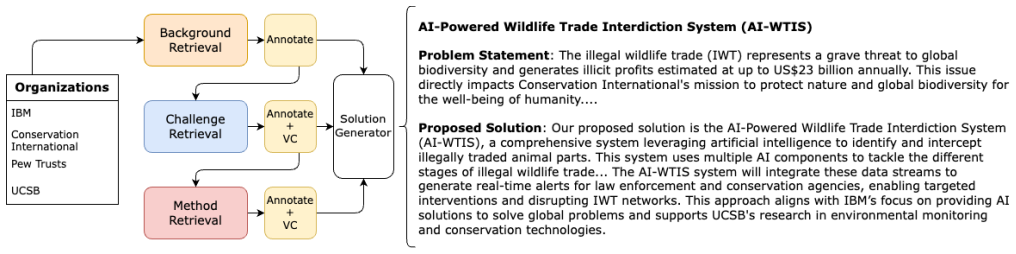
The load-bearing mechanism is the multi-stage retrieval and grounding loop of the PSA. Starting from an organization name, the agent annotates and summarizes retrieved web pages into a background statement, uses that to generate challenge-specific search queries, reranks candidate challenges by verbalized confidence and tractability, then queries a scholarly literature API for methods tied to the selected challenge. A divergent-convergent step—search broadly, prune to the five highest-confidence papers—breaks the LLM's tendency to fixate on generic problems, while confidence-weighted sampling of challenges promotes diversity. The final proposal prompt combines the background, the chosen challenge, and the pruned method set, forcing the model to justify each AI technique against the problem's constraints.
What would settle it
Have a new panel of blinded reviewers score the original, unrewritten expert summaries alongside PSA proposals with the same four-metric rubric; if the agent no longer matches the baseline, the claimed parity is an artifact of the rewriting step. A smaller test is to score original versus rewritten expert summaries directly; material score differences mean the baseline itself was moved by the rewrite.
Extended reading notes
Core claim
The central claim is that a pipeline interleaving web and scholarly retrieval with LLM summarization can turn an organization name into a full AI-for-social-good project proposal that human experts rate about as well as a proposal produced by a rigorous expert scoping process. The PSA retrieves and annotates background pages on the organization, generates and searches five candidate challenges, scores each by verbalized confidence and tractability, samples one challenge with softmax-weighted probability, retrieves up to ten scholarly papers on candidate methods, prunes to the five most applicable, and generates a solution grounded in the selected challenge and methods. On 21 expert-written fellowship project summaries, averaged human Likert scores for DS-PSA and GPT-PSA were not significantly different from the baseline, while G-PSA exceeded the baseline by 0.5476 points on average (p = 0.0058). The paper is explicit that the comparison baseline is the expert summaries after a GPT-4o formatting rewrite, and that a vanilla DeepSeek-V3 without retrieval scaffolds scores 0.619 below the baseline.
Load-bearing premise
The paper's strongest evidence for expert parity is a blind comparison against expert summaries that were first rewritten by GPT-4o for formatting; the load-bearing premise is that this rewrite preserved the quality and content of the original expert prose.
Editorial extensions
If this is right
- For a weaker base model such as DeepSeek-V3, adding PSA's retrieval scaffolding moves average human ratings from 0.619 below the expert baseline to statistically indistinguishable from it, with the paired improvement significant at p = 0.019.
- PSA roughly doubles the diversity of problem statements: GPT-4o's agent generated 57 unique problems versus 34 for the base model, and Gemini-2.0's agent generated 65 versus 31.
- Gemini-2.0-Flash, with or without the PSA pipeline, produced proposals rated above the expert baseline on average, indicating the base model's knowledge sets the quality ceiling.
- AI judges cannot replace human blind review in this setting: their scores showed very low variance across all proposals and near-zero correlation with human reviewers, so the paper's main evidence rests on the human panel.
Reading between the lines
- Placing PSA inside a human-in-the-loop workflow could yield the practical gain the paper only gestures at: the agent drafts many cheap proposals and scarce experts spend their time filtering and refining rather than writing from scratch.
- The rewrite assumption invites a direct test: scoring original, unrewritten expert summaries against PSA proposals would reveal whether the claimed parity is an artifact of GPT-4o's formatting pass.
- The same retrieve-annotate-retrieve-generate loop could transfer to other under-resourced planning tasks, such as grant writing or policy briefs, whenever an organization's public record and relevant literature are available to ground the LLM.
Signed reviews
Editorial analysis
A structured set of objections, weighed in public.
Referee Report
Summary. The paper proposes a Problem Scoping Agent (PSA) that combines retrieval-augmented LLM steps—background, challenge, method retrieval, and solution generation—to produce AI4SG project proposals. The authors evaluate PSA against 21 DSSG project summaries using blind human review and LLM-based evaluators, and report that DS-PSA and GPT-PSA are statistically indistinguishable from the GPT-4o-rewritten originals, that G-PSA outperforms them, and that PSA increases problem diversity relative to base LLMs. The paper also documents the failure of LLM evaluators and makes its prompts publicly available.
Significance. If the core claim holds, the paper makes a useful contribution to AI4SG: it formalizes a scoping pipeline and demonstrates a path toward automating a labor-intensive task. The paper is transparent about the failure of LLM evaluators, uses real-world DSSG projects, and reports diversity gains. However, the headline claim of 'comparable to experts' is presently conditional on an unvalidated rewriting step, and the human evaluation reporting is incomplete, so the empirical support is weaker than the abstract suggests.
major comments (4)
- [Section 4.1, Table 2] The human baseline used for all comparisons is not the original DSSG expert text but a GPT-4o-rewritten version, created with the same prompt used for final proposal generation (Appendix A). That prompt imposes content constraints—title, problem statement, proposed solution, avoidance of trivial or outreach solutions—that can alter exactly the dimensions evaluated (appropriateness, thoroughness, feasibility, expected effectiveness). The manuscript provides no evidence that the rewriting is lossless, such as human ratings of original vs. rewritten text or a content-overlap measure. Every p-value in Table 2 is against this transformed baseline, so the abstract's claim of 'comparable to those written by experts' is supported only relative to GPT-4o-processed versions. This is a load-bearing issue and needs to be addressed, either by using the original summaries directly or by validating the rewrite and reporting original-vs-rewrite scores.
- [Section 4.1, 4.2] The human evaluation is under-specified: the number of evaluators, their qualifications, the rating procedure, and inter-rater reliability (e.g., Krippendorff's alpha or ICC) are not reported. With 21 proposals and Likert-scale ratings, this information is necessary to interpret the paired t-tests and Hotelling's T2 tests; if a single rater scored all proposals, the independence assumption underlying the tests is violated, and the reported p-values are not trustworthy.
- [Section 4.2, Table 2] The conclusion that DS-PSA and GPT-PSA produce proposals 'comparable' to expert-written ones is based on failure to reject the null hypothesis (p ≈ 0.66 and 0.70 for the average). With n = 21, this is not evidence of equivalence; the tests may simply lack power. The paper should either report confidence intervals on the mean differences or use an equivalence testing approach with a pre-specified boundary, and should discuss the minimum detectable effect. This directly affects the main claim.
- [Section 4.2, Table 1] The paper honestly reports that AI-based evaluation was unsatisfactory (low variance, low correlation with human evaluation). However, the abstract states the framework was validated 'through a blind review and AI evaluations.' Since the AI evaluations are shown to be unreliable and are relegated to the appendix, the abstract should be revised to attribute the main evidence to blind human review, or the AI evaluation should be omitted from the central claim.
minor comments (3)
- [Tables 2 and 3] The notation 'µ±σ2' is ambiguous; using '±' with variance is nonstandard and may mislead readers. Consider reporting standard deviations or clarifying the header.
- [Table 2 footnote] The footnote says all p-values are from Hotelling's T2 test, but the text says per-metric p-values are from paired t-tests. Align the footnote with the text to avoid confusion.
- [Figure 2] The running example is the Memphis Fire Department, but the figure lists IBM, Conservation International, Pew Trusts, and UCSB as the organizations being searched; this is confusing and should be clarified.
Circularity Check
No significant circularity: the PSA evaluation is empirical and self-contained; the GPT-4o rewrite of the human baseline is a benchmark-validity concern, not a circular derivation.
full rationale
The paper's derivation chain is empirical: the Problem Scoping Agent is a retrieval-augmented LLM pipeline, and its outputs are compared against DSSG project summaries via blind human review. No parameter is fitted to the evaluation data, no prediction is defined in terms of its own output, and no load-bearing result rests on a self-citation. The only notable issue is that the human baseline was rewritten by GPT-4o before comparison (Section 4.1, Table 2), which could bias the comparison. However, this is a benchmark-validity concern rather than a circularity: the 'Original' row is explicitly labeled as 'original, rewritten proposals,' the scores are empirical and not forced by construction, and the paper transparently reports that LLM-based evaluations underperformed and relegates them to the appendix. The central claim is therefore not equivalent to its inputs by definition, and no circular step is present.
Assumptions & free parameters
free parameters (6)
- Number of background web pages per organization =
3
- Number of challenge search queries =
5
- Number of method search queries =
5
- Number of retrieved papers per challenge =
10 (top 5 used)
- Sampling temperature for generation =
0.9
- Softmax temperature for challenge sampling =
not specified
assumptions (4)
- domain assumption DSSG project summaries represent high-quality expert scoping in AI4SG
- ad hoc to paper The GPT-4o rewriting of the original DSSG summaries preserves their quality and content
- domain assumption Verbalized confidence scores from the LLM reflect actual relevance and tractability of retrieved challenges/papers
- domain assumption The 21 DSSG projects are a representative sample of AI4SG problems
Cite this review
Pith. "Pith review of Towards Automated Scoping of AI for Social Good Projects." pith.science (2026). https://pith.science/paper/AZY2VK4I
@misc{pith2026250420010,
  author       = {Pith},
  title        = {Pith review of: Towards Automated Scoping of AI for Social Good Projects},
  year         = {2026},
  howpublished = {\url{https://pith.science/paper/AZY2VK4I}},
  note         = {Machine review of arXiv:2504.20010}
}
read the original abstract
Artificial Intelligence for Social Good (AI4SG) is an emerging effort that aims to address complex societal challenges with the powerful capabilities of AI systems. These challenges range from local issues with transit networks to global wildlife preservation. However, regardless of scale, a critical bottleneck for many AI4SG initiatives is the laborious process of problem scoping -- a complex and resource-intensive task -- due to a scarcity of professionals with both technical and domain expertise. Given the remarkable applications of large language models (LLM), we propose a Problem Scoping Agent (PSA) that uses an LLM to generate comprehensive project proposals grounded in scientific literature and real-world knowledge. We demonstrate that our PSA framework generates proposals comparable to those written by experts through a blind review and AI evaluations. Finally, we document the challenges of real-world problem scoping and note several areas for future work.
Figures


Figures from the paper (3 more)


Reference graph
Works this paper leans on
-
[1]
K.; Cucerzan, S.; and Hwang, S
Baek, J.; Jauhar, S. K.; Cucerzan, S.; and Hwang, S. J. 2024. ResearchAgent: Iterative Research Idea Generation over Scientific Literature with Large Language Models. arXiv:2404.07738
arXiv 2024
-
[2]
M.; Gebru, T.; McMillan-Major, A.; and Shmitchell, S
Bender, E. M.; Gebru, T.; McMillan-Major, A.; and Shmitchell, S. 2021. On the Dangers of Stochastic Parrots: Can Language Models Be Too Big? In Proceedings of the 2021 ACM Conference on Fairness, Accountability, and Transparency, FAccT '21, 610–623. New York, NY, USA: Association for Computing Machinery. ISBN 9781450383097
2021
-
[3]
Chen, M.; Tworek, J.; Jun, H.; Yuan, Q.; de Oliveira Pinto, H. P.; Kaplan, J.; Edwards, H.; Burda, Y.; Joseph, N.; Brockman, G.; Ray, A.; Puri, R.; Krueger, G.; Petrov, M.; Khlaaf, H.; Sastry, G.; Mishkin, P.; Chan, B.; Gray, S.; Ryder, N.; Pavlov, M.; Power, A.; Kaiser, L.; Bavarian, M.; Winter, C.; Tillet, P.; Such, F. P.; Cummings, D.; Plappert, M.; Ch...
arXiv 2021
-
[4]
Fang, F.; Stone, P.; and Tambe, M. 2015. When security games go green: designing defender strategies to prevent poaching and illegal fishing. In Proceedings of the 24th International Conference on Artificial Intelligence, IJCAI'15, 2589–2595. AAAI Press. ISBN 9781577357384
work page 2015
-
[5]
Floridi, L.; Cowls, J.; King, T. C.; and Taddeo, M. 2020. How to Design AI for Social Good: Seven Essential Factors. Science and Engineering Ethics, 26: 1771 -- 1796
work page 2020
-
[6]
Gu, K.; Shang, R.; Jiang, R.; Kuang, K.; Lin, R.-J.; Lyu, D.; Mao, Y.; Pan, Y.; Wu, T.; Yu, J.; Zhang, Y.; Zhang, T. M.; Zhu, L.; Merrill, M. A.; Heer, J.; and Althoff, T. 2024. BLADE: Benchmarking Language Model Agents for Data-Driven Science. arXiv:2408.09667
arXiv 2024
-
[7]
Han, J. M.; Rute, J. M.; Wu, Y.; Ayers, E. W.; and Polu, S. 2021. Proof Artifact Co-training for Theorem Proving with Language Models. ArXiv, abs/2102.06203
arXiv 2021
-
[8]
Hu, X.; Zhao, Z.; Wei, S.; Chai, Z.; Ma, Q.; Wang, G.; Wang, X.; Su, J.; Xu, J.; Zhu, M.; Cheng, Y.; Yuan, J.; Li, J.; Kuang, K.; Yang, Y.; Yang, H.; and Wu, F. 2024. InfiAgent-DABench: Evaluating Agents on Data Analysis Tasks. arXiv:2401.05507
arXiv 2024
Show all 36 references
-
[9]
Ifargan, T.; Hafner, L.; Kern, M.; Alcalay, O.; and Kishony, R. 2024. Autonomous LLM-driven research from data to human-verifiable research papers. arXiv:2404.17605
2024 arXiv
-
[10]
Q.; Li, W.; Tworkowski, S.; Czechowski, K.; Odrzyg'o'zd'z, T.; Milo's, P.; Wu, Y.; and Jamnik, M
Jiang, A. Q.; Li, W.; Tworkowski, S.; Czechowski, K.; Odrzyg'o'zd'z, T.; Milo's, P.; Wu, Y.; and Jamnik, M. 2022 a . Thor: Wielding Hammers to Integrate Language Models and Automated Theorem Provers. ArXiv, abs/2205.10893
2022 arXiv
-
[11]
Q.; Welleck, S.; Zhou, J
Jiang, A. Q.; Welleck, S.; Zhou, J. P.; Li, W.; Liu, J.; Jamnik, M.; Lacroix, T.; Wu, Y.; and Lample, G. 2022 b . Draft, Sketch, and Prove: Guiding Formal Theorem Provers with Informal Proofs. ArXiv, abs/2210.12283
2022 arXiv
-
[12]
E.; Yang, J.; Wettig, A.; Yao, S.; Pei, K.; Press, O.; and Narasimhan, K
Jimenez, C. E.; Yang, J.; Wettig, A.; Yao, S.; Pei, K.; Press, O.; and Narasimhan, K. 2024. SWE-bench: Can Language Models Resolve Real-World GitHub Issues? arXiv:2310.06770
2024 arXiv
-
[13]
Lee, S.; Hwang, S.; and Lee, K. 2024. Conversational Agents as Catalysts for Critical Thinking: Challenging Design Fixation in Group Design. arXiv:2406.11125
2024 arXiv
-
[14]
Li, R.; Patel, T.; Wang, Q.; and Du, X. 2024. MLR-Copilot: Autonomous Machine Learning Research based on Large Language Models Agents. arXiv:2408.14033
2024
-
[15]
Liu, Y.; Feng, X.; Zhang, L.; Hua, W.; and Li, K. 2020. A pareto artificial fish swarm algorithm for solving a multi-objective electric transit network design problem. Transportmetrica A: Transport Science, 16: 1648 -- 1670
2020
-
[16]
T.; Foerster, J.; Clune, J.; and Ha, D
Lu, C.; Lu, C.; Lange, R. T.; Foerster, J.; Clune, J.; and Ha, D. 2024. The AI Scientist: Towards Fully Automated Open-Ended Scientific Discovery. arXiv:2408.06292
2024 arXiv
-
[17]
R.; and Feng, S
Panickssery, A.; Bowman, S. R.; and Feng, S. 2024. LLM Evaluators Recognize and Favor Their Own Generations. arXiv:2404.13076
2024 arXiv
-
[18]
J.; Kang, S.; Byon, Y.-J.; and Kho, S.-Y
Park, S. J.; Kang, S.; Byon, Y.-J.; and Kho, S.-Y. 2022. Multiobjective Approach to the Transit Network Design Problem with Variable Demand considering Transit Equity. Journal of Advanced Transportation
2022
-
[19]
Pu, K.; Feng, K. J. K.; Grossman, T.; Hope, T.; Mishra, B. D.; Latzke, M.; Bragg, J.; Chang, J. C.; and Siangliulue, P. 2024. IdeaSynth: Iterative Research Idea Development Through Evolving and Composing Idea Facets with Literature-Grounded Feedback. arXiv:2410.04025
2024 arXiv
-
[20]
Radensky, M.; Shahid, S.; Fok, R.; Siangliulue, P.; Hope, T.; and Weld, D. S. 2024. Scideator: Human-LLM Scientific Idea Generation Grounded in Research-Paper Facet Recombination. arXiv:2409.14634
2024 arXiv
-
[21]
Rawat, B.; Joshi, Y.; and Kumar, A. 2023. AI in Healthcare: Opportunities and Challenges for Personalized Medicine and Disease Diagnosis. 2023 5th International Conference on Inventive Research in Computing Applications (ICIRCA), 374--379
2023
-
[22]
Sherburn, D.; Chughtai, B.; and Evans, O. 2024. Can Language Models Explain Their Own Classification Behavior? arXiv:2405.07436
2024 arXiv
-
[23]
R.; Wang, C.; and Fang, F
Shi, Z. R.; Wang, C.; and Fang, F. 2020. Artificial Intelligence for Social Good: A Survey. arXiv:2001.01818
2020 arXiv
-
[24]
Si, C.; Yang, D.; and Hashimoto, T. 2024. Can LLMs Generate Novel Research Ideas? A Large-Scale Human Study with 100+ NLP Researchers. arXiv:2409.04109
2024 arXiv
-
[25]
Sisodia, S.; Dhyani, S.; Kathuria, S.; Pandey, S.; Chhabra, G.; and Pandey, R. 2023. AI Technologies, Innovations and Possibilities in Wildlife Conservation. 2023 International Conference on Innovative Data Communication Technologies and Application (ICIDCA), 1090--1095
2023
-
[26]
Stureborg, R.; Alikaniotis, D.; and Suhara, Y. 2024. Large Language Models are Inconsistent and Biased Evaluators. arXiv:2405.01724
2024 arXiv
-
[27]
L.; Marjieh, R.; Peng, N.; Choi, Y.; Griffiths, T
Tian, Y.; Ravichander, A.; Qin, L.; Bras, R. L.; Marjieh, R.; Peng, N.; Choi, Y.; Griffiths, T. L.; and Brahman, F. 2024. MacGyver: Are Large Language Models Creative Problem Solvers? arXiv:2311.09682
2024 arXiv
-
[28]
Xin, H.; Guo, D.; Shao, Z.; Ren, Z.; Zhu, Q.; Liu), B. L. B.; Ruan, C.; Li, W.; and Liang, X. 2024. DeepSeek-Prover: Advancing Theorem Proving in LLMs through Large-Scale Synthetic Data. ArXiv, abs/2405.14333
2024 arXiv
-
[29]
Xiong, M.; Hu, Z.; Lu, X.; Li, Y.; Fu, J.; He, J.; and Hooi, B. 2024. Can LLMs Express Their Uncertainty? An Empirical Evaluation of Confidence Elicitation in LLMs. arXiv:2306.13063
2024 arXiv
-
[30]
Xu, L.; Fang, F.; Perrault, A.; Wang, K.; and Tambe, M. 2020. Dual-Mandate Patrols: Bandit-Based Learning in Green Security Domains
2020
-
[31]
H.; and Yamada, M
Yang, D.; Tsai, Y.-H. H.; and Yamada, M. 2024. On Verbalized Confidence Scores for LLMs. arXiv:2412.14737
2024 arXiv
-
[32]
Yang, Z.; Du, X.; Li, J.; Zheng, J.; Poria, S.; and Cambria, E. 2024. Large Language Models for Automated Open-domain Scientific Hypotheses Discovery. arXiv:2309.02726
2024 arXiv
-
[33]
Zhao, Y.; Boehmer, N.; Taneja, A.; and Tambe, M. 2024. Towards Foundation-model-based Multiagent System to Accelerate AI for Social Impact. arXiv:2412.07880
2024 arXiv
-
[34]
u dder, B.; Gallucci, A.; Goffi, E. R.; Haase, C. B.; Hagendorff, T.; Kringen, P.; M \
Zicari, R. V.; Brusseau, J.; Blomberg, S. N. F.; Christensen, H. C.; Coffee, M.; Ganapini, M. B.; Gerke, S.; Gilbert, T. K.; Hickman, E.; Hildt, E.; Holm, S.; K \"u hne, U.; Madai, V. I.; Osika, W.; Spezzatti, A.; Schnebel, E.; Tithi, J. J.; Vetter, D.; Westerlund, M.; Wurth, ...
2021
-
[35]
, " * write output.state after.block = add.period write newline
ENTRY address archivePrefix author booktitle chapter edition editor eid eprint howpublished institution isbn journal key month note number organization pages publisher school series title type volume year label extra.label sort.label short.list INTEGERS output.state before.all...
-
[36]
write newline
" write newline "" before.all 'output.state := FUNCTION n.dashify 't := "" t empty not t #1 #1 substring "-" = t #1 #2 substring "--" = not "--" * t #2 global.max substring 't := t #1 #1 substring "-" = "-" * t #2 global.max substring 't := while if t #1 #1 substring * t #2 gl...
Reviewed August 16, 2026 · model on record in the stance chip above.
Discussion (0). Continue with ORCID to comment.