Fractional Angular Momentum and Quasi-Probability Densities for Angular Degrees of Freedom
Pith reviewed 2026-05-22 17:18 UTC · model grok-4.3
The pith
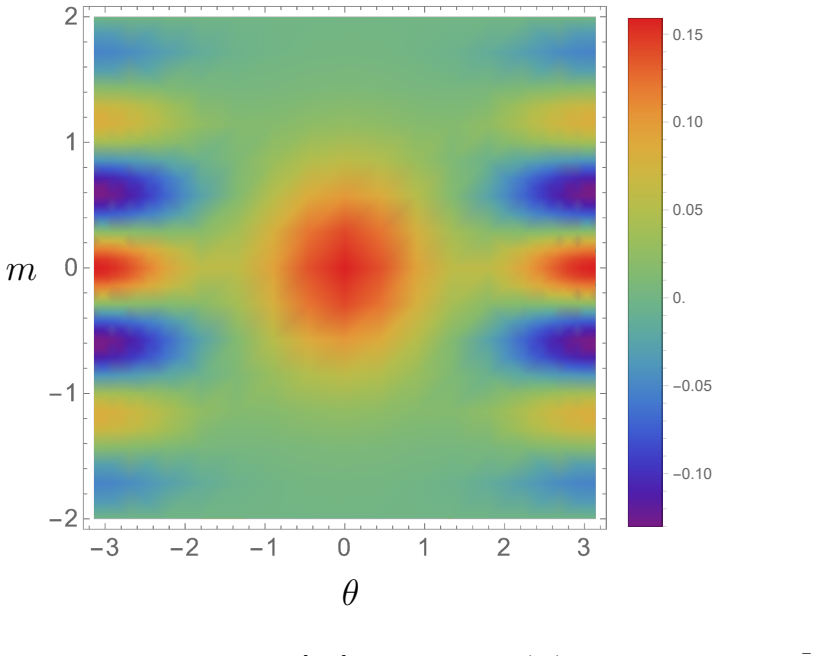
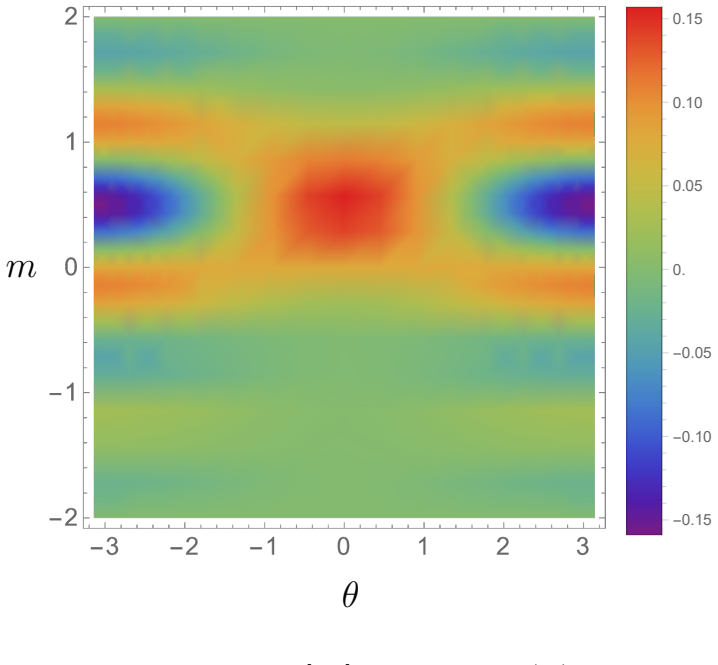
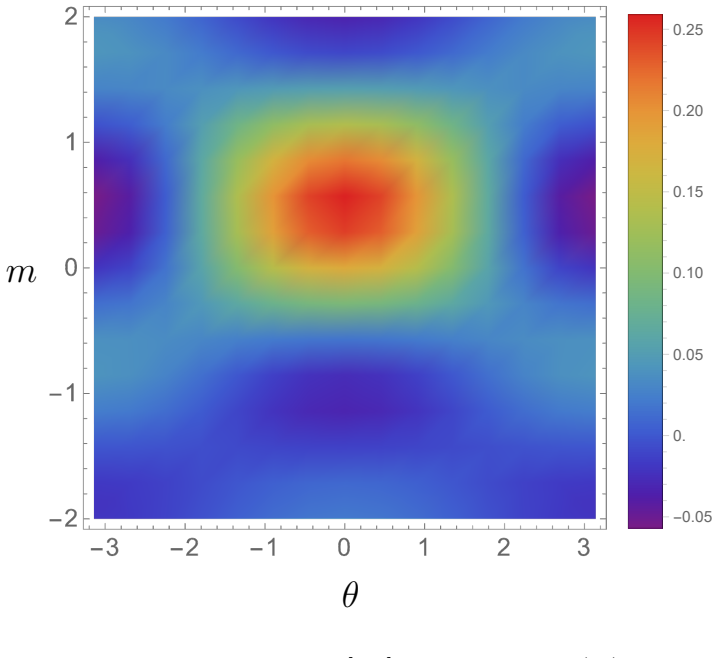
Properly defined two-parameter quasi-probability densities serve as witnesses for quantum behaviour in pure states involving angular position and angular momentum L, where negatives flag fractional mean L superpositions ambiguously.
A machine-rendered reading of the paper's core claim, the machinery that carries it, and where it could break.
Core claim
In the present update work we consider properly defined two-parameter quasi-probability densities that, e.g., can be used as witness for quantum behaviour for a class of pure states as expressed in terms of a self-adjoint observable angular position and the corresponding angular momentum operator L. It is shown that negative values of the corresponding quasi-probability densities may reveal the quantum nature of superpositions of angular momentum eigenstates with a fractional mean value of L but in an ambiguous manner. For a suitable choice of parameters these quasi-probability densities are positive and are in accordance with Borns rule in quantum mechanics. It is also shown that experiment
What carries the argument
The two-parameter quasi-probability densities for angular position and angular momentum observables that can take negative values for certain superpositions or stay positive for suitable parameters.
If this is right
- Negative values of the quasi-probability densities may reveal the quantum nature of superpositions with fractional mean angular momentum, but only in an ambiguous manner.
- A suitable choice of parameters makes the quasi-probability densities positive and consistent with Born's rule.
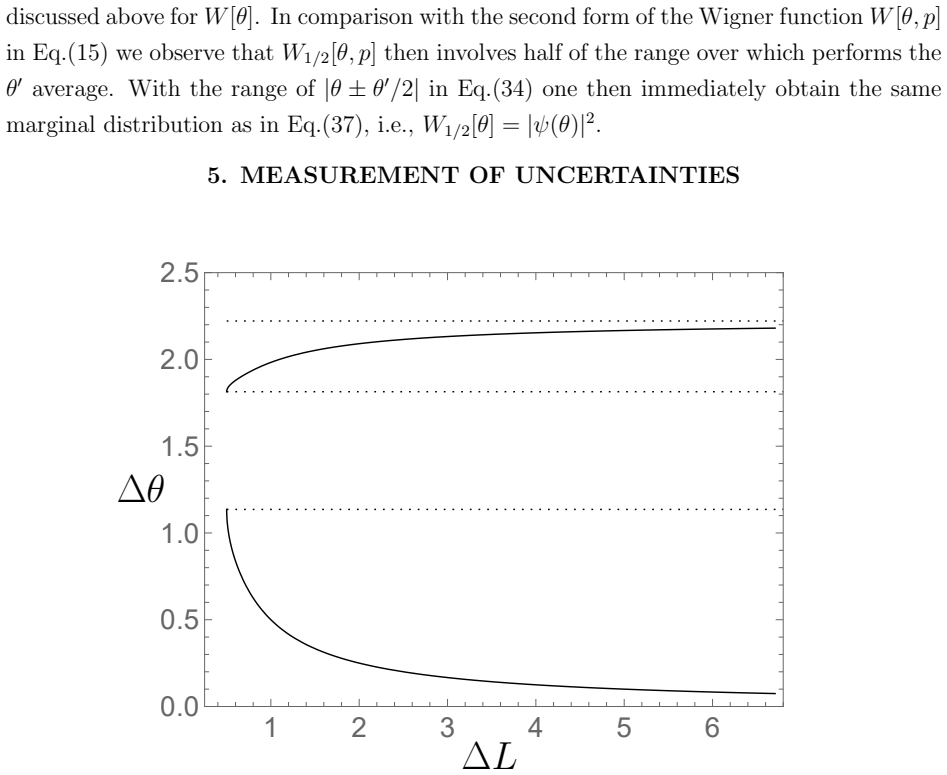
- Experimental data on the uncertainties for angular position and L observables can reveal unique quantum-mechanical features without using quasi-probability densities.
Where Pith is reading between the lines
- The ambiguity in using negative values as a quantum witness suggests that uncertainties provide a more direct experimental route for angular systems.
- These densities could be compared against other quasi-probability constructions like the Wigner function to test consistency across different parameter regimes.
- If uncertainties alone suffice, then similar uncertainty-based tests might apply to other pairs of conjugate observables with periodic boundary conditions.
Load-bearing premise
The two-parameter quasi-probability densities are properly defined such that they can serve as witnesses for quantum behaviour in the class of pure states considered.
What would settle it
Preparing a superposition state with fractional mean angular momentum, computing or measuring the two-parameter quasi-probability density, and checking whether it shows negative values or stays positive under chosen parameters while matching Born rule probabilities.
Figures
read the original abstract
In the present update work we consider properly defined two-parameter quasi-probability densities that, e.g., can be used as witness for quantum behaviour for a class of pure states as expressed in terms of a self-adjoint observable angular position and the corresponding angular momentum operator L. It is shown that negative values of the corresponding quasi-probability densities may reveal the quantum nature of superpositions of angular momentum eigenstates with a fractional mean value of L but in an ambiguous manner. For a suitable choice of parameters these quasi-probability densities are positive and are in accordance with Borns rule in quantum mechanics. It is also shown that experimental data of the uncertainties for the angular position and L observables can be sufficient to reveal some unique quantum-mechanical features of such states without necessarily making use of quasi-probability densities.
Editorial analysis
A structured set of objections, weighed in public.
Referee Report
Summary. The manuscript presents an update on two-parameter quasi-probability densities for angular degrees of freedom, specifically for a self-adjoint angular position observable and the angular momentum operator L. It claims that negative values of these densities can indicate the quantum nature of superpositions of angular momentum eigenstates with fractional mean L, albeit ambiguously. For appropriate parameter choices, the densities are positive and consistent with Born's rule. Additionally, it suggests that experimental uncertainties in angular position and L can suffice to reveal unique quantum features without relying on quasi-probability densities.
Significance. If the claims hold, this work could advance the understanding of quasi-probability representations in systems with angular degrees of freedom, particularly highlighting the role of fractional angular momentum and providing uncertainty-based methods to detect quantum features. However, the abstract-only availability limits a full assessment of the novelty and impact.
major comments (2)
- [Abstract] The central claims depend on the proper definition of the two-parameter quasi-probability densities, but without access to the full manuscript, including mathematical definitions, derivations, and any supporting evidence or examples, it is not possible to evaluate whether these densities are rigorously defined or if the negativity indeed serves as an ambiguous witness for quantum behavior in the described states.
- [Abstract] The statement that 'experimental data of the uncertainties for the angular position and L observables can be sufficient to reveal some unique quantum-mechanical features' lacks any indication of the specific features or how the data suffices, making it difficult to assess the strength of this claim without further details.
minor comments (1)
- [Abstract] The abstract mentions 'Borns rule' which should be 'Born's rule' for grammatical correctness.
Simulated Author's Rebuttal
We thank the referee for their comments on our manuscript. We address the major comments point by point below. The full manuscript on arXiv:2504.20218 contains the detailed mathematical definitions, derivations, and examples referenced in the abstract; we regret that only the abstract appears to have been available for review and are happy to expand the abstract or add clarifications as needed.
read point-by-point responses
-
Referee: [Abstract] The central claims depend on the proper definition of the two-parameter quasi-probability densities, but without access to the full manuscript, including mathematical definitions, derivations, and any supporting evidence or examples, it is not possible to evaluate whether these densities are rigorously defined or if the negativity indeed serves as an ambiguous witness for quantum behavior in the described states.
Authors: The full manuscript defines the two-parameter quasi-probability densities rigorously for the self-adjoint angular position observable and the angular momentum operator L, with explicit constructions, derivations of their properties, and concrete examples for superpositions of angular momentum eigenstates having fractional mean L. These examples illustrate how negativity can serve as an (ambiguous) witness for quantum behavior. We can revise the abstract to include a concise statement of the key definition if that addresses the concern. revision: partial
-
Referee: [Abstract] The statement that 'experimental data of the uncertainties for the angular position and L observables can be sufficient to reveal some unique quantum-mechanical features' lacks any indication of the specific features or how the data suffices, making it difficult to assess the strength of this claim without further details.
Authors: The full manuscript shows that measured uncertainties in angular position and L for the indicated states can violate classical bounds or exhibit signatures tied to the fractional mean angular momentum that are impossible for classical mixtures, thereby revealing quantum features directly from uncertainty data. We will revise the abstract to specify these features and the manner in which the data suffices. revision: yes
Circularity Check
No significant circularity detectable from abstract
full rationale
Only the abstract is provided, which states results on two-parameter quasi-probability densities for angular position and L without any equations, derivation steps, self-citations, or fitted parameters. No load-bearing claim reduces by construction to its inputs, as no specific mathematical chain or ansatz is exhibited. The assertions that negativity may reveal quantum features (ambiguously) and that suitable parameters yield positivity consistent with Born's rule are presented as demonstrated outcomes, but the absence of the underlying definitions or proofs means no circularity of any enumerated kind can be identified or quoted. The paper's claims appear self-contained within the given text.
Axiom & Free-Parameter Ledger
Reference graph
Works this paper leans on
-
[1]
Wigner, ” On the Quantum Correction for Thermodynamic Equilibrium ”, Phys
E. Wigner, ” On the Quantum Correction for Thermodynamic Equilibrium ”, Phys. Rev. 40 (1932) 749–759
work page 1932
-
[2]
Hudson, ” When is the Wigner Quasi-Probability Density Non-Negative? ”, Rep
R.L. Hudson, ” When is the Wigner Quasi-Probability Density Non-Negative? ”, Rep. Math. Phys. 6 (1974) 249-252
work page 1974
-
[3]
O’Connell, ” The Wigner Distribution Function—50th Birthday ”, Found
R.F. O’Connell, ” The Wigner Distribution Function—50th Birthday ”, Found. Phys. 13 (1983) 83–92
work page 1983
-
[4]
M. Hillery, R.F. O’Connell, M.O. Scully, and E.P. Wigner, ” Distribution functions in physics: Fundamentals ”, Phys. Rep. 106 (1984) 121–167. 15
work page 1984
-
[5]
K.Vogel and H. Risken, ” Determination of Quasiprobability Distributions in Terms of Probability Distributions for the Rotated Quadrature Phase ”, Phys. Rev. A 40 (1989) 2847-2849
work page 1989
-
[6]
V. Buˇ zek and P.L. Knight , ”I: Quantum Interference, Superposition States of Light, and Nonclassical Effects ”, in Prog. in Optics 34 (1995) 1-158
work page 1995
-
[7]
Lee, ” Theory and Application of the Quantum-Phase Distribution Functions ”, Phys
H.W. Lee, ” Theory and Application of the Quantum-Phase Distribution Functions ”, Phys. Rep. 259 (1995) 147–211
work page 1995
-
[8]
Leonhardt, ” Measuring the Quantum State of Light ”, Cambridge University Press, Cambridge (1997)
U. Leonhardt, ” Measuring the Quantum State of Light ”, Cambridge University Press, Cambridge (1997)
work page 1997
-
[9]
N. L¨ utkenhaus and S.M. Barnett, ”Nonclassical Effects in Phase Space ”, Phys. Rev. A 51 (1995) 3340-3342
work page 1995
-
[10]
W.P. Schleich, “ Quantum Optics in Phase Space ”, Wiley-VCH, Berlin (2001)
work page 2001
-
[11]
A. Kenfack and K. ˙Zyczkowski, ”Negativity of the Wigner function as an Indicator of Non-Classicality ”, J. Opt. B: Quantum Semiclass. Opt. 6 (2004) 396-404
work page 2004
-
[12]
“ Quantum State Estimation ”, Eds. M. Paris and J. ˇReh´ aˇ cek, Lecture Notes in Physics 649, Springer, Science & Business Media, Berlin Heidelberg (2004)
work page 2004
-
[13]
Exploring the Quantum - Atoms, Cavities, and Photons
S. Haroche and J.M. Raimond, “Exploring the Quantum - Atoms, Cavities, and Photons” (Oxford University Press, Oxford, 2006)
work page 2006
-
[14]
Gross, ” Hudson’s Theorem for Finite-Dimensional Quantum Systems ”, J
D. Gross, ” Hudson’s Theorem for Finite-Dimensional Quantum Systems ”, J. Math. Phys. 47 (2006) 122107-1-25
work page 2006
-
[15]
J. ˇReh´ aˇ cek, Z. Bouchal, R.ˇCelechovsk´ y, Z. Hradil, and L.L. S´ anchez-Soto, ”Experimental Test of Uncertainty Relations for Quantum Mechanics on a Circle ”, Phys. Rev. A 77 (2008) 032110-1-13
work page 2008
-
[16]
Orbital Angular Momentum in Phase Space
I. Rigas, L.L. S´ anchez-Soto, A.B. Klimov, J. ˇReh´ aˇ cek, and Z. Hradil , “Orbital Angular Momentum in Phase Space ”, Ann. Phys. 326 (2011) 426-439
work page 2011
-
[17]
Kastrup, ” Wigner Functions for the Pair Angle and Orbital Angular Momentum ”, Phys
H.A. Kastrup, ” Wigner Functions for the Pair Angle and Orbital Angular Momentum ”, Phys. Rev. A 94 (2016) 062113-1-14 and ” Wigner Functions for the Pair Angle and Orbital Angular Momentum:Operators and Dynamics ”, ibid. 95 (2017) 052111-1-13
work page 2016
-
[18]
T. Tilma, M.J. Everitt, J.H. Samson, W.J. Munro, and K. Nemoto, ” Wigner Functions for Arbitrary Quantum Systems ”, Phys. Rev. Lett. 117 (2016) 180401-1-5
work page 2016
-
[19]
From Cavity to Circuit Quantum Electro- 16 dynamics
S. Haroche, M. Brune, and J.M. Raimond, “ From Cavity to Circuit Quantum Electro- 16 dynamics ” , Nature Physics 16 (2020) 243-246
work page 2020
-
[20]
Wigner Functions and Coherent States for the Quantum Mechanics on a Circle
K. Kowalski and K. Lawniczak, “Wigner Functions and Coherent States for the Quantum Mechanics on a Circle ”, J. Phys. A: Math. Theor. 54 (2021) 275302-1-23
work page 2021
-
[21]
Feynman, ” Simulating Physics With Computers ”, Int
R.P. Feynman, ” Simulating Physics With Computers ”, Int. J. Theor. Phys. 21 (1982) 467-488
work page 1982
-
[22]
H.P. Yuen and J.H. Shapiro, ”Optical Communication with Two-Photon Coherent States - Part Ill: Quantum Measurements Realizable with Photoemissive Detectors ”, IEEE Trans. Inform. Theory IT 26 (1980) 78-92
work page 1980
- [23]
-
[24]
D. Gottesman, A. Kitaev, and J. Preskill, ” Encoding a Qubit in an Oscillator ”, Phys. Rev. A 64 (2001) 012310-1-21
work page 2001
-
[25]
On Quantum States for Angular Position and An- gular Momentum of Light
B.-S. Skagerstam and P.K. Rekdal, “ On Quantum States for Angular Position and An- gular Momentum of Light ” , (arXiv:2312.16535v1 [quant-ph] 27 Dec 2023) and in J. Opt. 26 (2024) 095201-1-6
-
[26]
Uncer- tainty Principle for Angular Position and Angular Momentum
S. Franke-Arnold, S.M. Barnett, E. Yao, J. Leach, J. Courtial, and M. Padgett, “ Uncer- tainty Principle for Angular Position and Angular Momentum ”, New J. Phys. 6 (2004) 103-1-8
work page 2004
-
[27]
Minimum Uncertainty States of Angular Momentum and Angular Position
D.T. Pegg, S.M. Barnett, R. Zambrini, S. Franke-Arnold and M.J. Padgett, “ Minimum Uncertainty States of Angular Momentum and Angular Position”, New J. Phys. 7 (2005) 62-1-21
work page 2005
-
[28]
Orbital Angular Momentum of Light
S.M. Barnett and R. Zambrini, “ Orbital Angular Momentum of Light ”, in “ Quantum Imaging ”, Ed. M.I. Kolobov, pp. 277-311, Springer, New York (2007)
work page 2007
-
[29]
Efficient Sorting of Orbital Angular Momentum States of Light
G.C.G. Berkhout, M.P.J. Lavery, J. Courtial, M.W. Beijersbergen, and M.J. Padgett, “Efficient Sorting of Orbital Angular Momentum States of Light ”, Phys. Rev. Lett. 105 (2010) 153601-1-4
work page 2010
-
[30]
Measuring the Orbital Angular Momentum of a Single Photon
J. Leach, M.J. Padgett, S.M. Barnett, S. Franke-Arnold, and J. Courtial, “ Measuring the Orbital Angular Momentum of a Single Photon ”, Phys. Rev. Lett. 88 (2002) 257901-1–4
work page 2002
-
[31]
Observation of the Vortex Structure of a Non-Integer Vortex Beam
J. Leach, E. Yao and M.J. Padgett, “Observation of the Vortex Structure of a Non-Integer Vortex Beam ”, New J. Phys. 6 (2004) 71-1-8. 17
work page 2004
-
[32]
Optical Vortices Evolving From Helicoidal Integer and Fractional Phase Steps
M.V. Berry, “ Optical Vortices Evolving From Helicoidal Integer and Fractional Phase Steps ”, J. Opt. A: Pure Appl. Opt. 6 (2004) 259-268
work page 2004
-
[33]
Experimental Demonstration of Fractional Orbital Angular Momentum En- tanglement of Two Photons
S.S.R. Oemrawsingh, X. Ma, D. Voigt, A. Aiello, E.R. Eliel, G.W. ’t Hooft, and J.P. Woerdman, “Experimental Demonstration of Fractional Orbital Angular Momentum En- tanglement of Two Photons ”, Phys. Rev. Lett. 95 (2005) 240501-1–4
work page 2005
-
[34]
Fractional Optical Vortex Beam Induced Rotation of Particles
S.H. Tao, X-C. Yuan, J. Lin, X. Peng, and H.B. Niu, “ Fractional Optical Vortex Beam Induced Rotation of Particles ”, Optics Express 13 (2005) 7726-7731
work page 2005
-
[35]
Observation of Quantum Entanglement Using Spatial Light Modulators
E. Yao, S. Franke-Arnold, J. Courtial and M.J. Padgett, and S.M. Barnett, “Observation of Quantum Entanglement Using Spatial Light Modulators ”, Optics Express 14 (2006) 13089-13094
work page 2006
-
[36]
S. Tanimura, “ Uncertainty Relation Between Angle and Orbital Angular Momentum: Interference Effect in Electron Vortex Beams ”, Nanosystems: Phys. Chem. Math. 6 (2015) 205-212
work page 2015
-
[37]
Gradual Edge Enhancement in Spiral Phase Contrast Imaging With Fractional Vortex Filters
J. Wang, W. Zhang, Q. Qi, S. Zheng, and L. Chen, “Gradual Edge Enhancement in Spiral Phase Contrast Imaging With Fractional Vortex Filters ”, Nature Scientific Reports 5 (2015) 1-6
work page 2015
-
[38]
There are Many Ways to Spin a Photon: Half-Quantization of a Total Optical Angular Momentum
K.E. Ballantine, J.F. Donegan, and P.R. Eastham, “ There are Many Ways to Spin a Photon: Half-Quantization of a Total Optical Angular Momentum ”, Sci. Adv. 2 (2016) 1-7
work page 2016
-
[39]
Negative Optical Spin Torque Wrench of a Non-Diffracting Non-Paraxial Fractional Bessel Vortex Beam
F.G. Mitri, “ Negative Optical Spin Torque Wrench of a Non-Diffracting Non-Paraxial Fractional Bessel Vortex Beam ”, J. Quantitative Spectroscopy and Radiative Transfer 182 (2016) 172-179
work page 2016
-
[40]
Arbitrarily Tunable Orbital Angular Momentum of Photons
Y. Pan, X.Z. Gao, Z.C. Ren, X.L. Wang, C. Tu, Y. Li, and H.T. Wang, “ Arbitrarily Tunable Orbital Angular Momentum of Photons ”, Nature Scientific Reports 6 (2016) 1-8
work page 2016
-
[41]
Precision Measurement of Fractional Orbital Angular Momentum
D. Deng, M. Lin, Y. Li, and H. Zhao, “ Precision Measurement of Fractional Orbital Angular Momentum ”, Phys. Rev. Applied 12 (2019) 014048–1–7
work page 2019
-
[42]
H.-C. Huang, “ Quantifiable Example of Complementarity Relation Between Optical Or- bital Angular Momentum and Angular Position ”, Opt. Commun. 446 (2019) 23-32
work page 2019
-
[43]
Bright Solid-State Sources for Single Photons with Orbital Angular Momentum
B. Chen, Y. Wei, T. Zhao, S. Liu, R. Su, B. Yao, Y. Yu, J. Liu, and X. Wang ,“ Bright Solid-State Sources for Single Photons with Orbital Angular Momentum ”, Nature Nan- otech. 16 (2021) 302-307. 18
work page 2021
-
[44]
S. Deachapunya, S. Srisuphaphon, and S. Buathong ,“ Production of Orbital Angular Momentum States of Optical Vortex Beams Using a Vortex Half-Wave Retarder With Double-Pass Configuration ”, Nature Scientific Reports 12 (2022) 6061-1–7
work page 2022
-
[45]
M. Wang, F. Zhou, X. Lu, A. McClung, M. Davanco, V.A. Aksyuk, and K. Srinivasan ,“Fractional Optical Angular Momentum and Multi-Defect-Mediated Mode Renormaliza- tion and Orientation Control in Photonic Crystal Microring Resonators ”, Phys. Rev. Lett. 129 (2022) 186101-1–6
work page 2022
-
[46]
Fractional Topological Numbers at Photonic Edges and Corners
C.P. Liang, Y. Liu, F.F. Li, S.W. Leung, Y. Poo, and J.H. Jiang, “ Fractional Topological Numbers at Photonic Edges and Corners ”, Phys. Rev. Appl. 20 (2023) 034028-1–10
work page 2023
-
[47]
D.V. Widder, “ The Convolution Transform ”, Bull. Amer. Math. Soc. 60 (1954) 444-456 and I.I. Hirschman and D.V. Widder, “ The Convolution Transform ”, Princeton University Press, Princeton (1955)
work page 1954
-
[48]
Density Operators and Quasiprobability Distributions
K.E. Cahill and R.J. Glauber,“ Density Operators and Quasiprobability Distributions ”, Phys. Rev. 177 (1969) 1882-1902
work page 1969
-
[49]
Generalized Phase-Space Representation of Opera- tors
J.R. Klauder and B.-S. Skagerstam,“ Generalized Phase-Space Representation of Opera- tors ”, J. Phys. A: Math. Theor. 40 (2007) 2093–2105
work page 2007
-
[50]
C. Itzykson, “ Fluctuating Magnetic Fields ”, Ref.TH.1703.CERN, 1973 and in Commun. Math. Phys. 36 (1974) 19-36
work page 1973
-
[51]
On Convergence and Growth of Partial Sums of Fourier Series
L. Carleson, “ On Convergence and Growth of Partial Sums of Fourier Series ”, Acta Math. 116 (1966) 135-157 and reviewed by C. Demeter, in “ A Guide to Carleson’s Theorem ”, Rocky Mountain J. of Math. 45 (2015) 169-212
work page 1966
-
[52]
Introduction to the Theory of Fourier’s Series and Integrals
H.S. Carslaw, “ Introduction to the Theory of Fourier’s Series and Integrals ”, Third Edition , Dover Publ. Inc. (N.Y., 1930) and Chapter 5 in N. Young, “ An Introduction to Hilbert Space ”, Cambridge University Press, Cambridge (1988)
work page 1930
-
[53]
B.G. Giraud and R. Peschanski, “ From “Dirac Combs” to Fourier-Positivity ”, Acta Phys. Pol. B 47 (2016) 1075-1100
work page 2016
-
[54]
On the Functions Which are Represented by the Expansions of the Interpolation Theory
E.T. Whittaker, “ On the Functions Which are Represented by the Expansions of the Interpolation Theory ”, Proc. Roy. Soc. Edinburgh 35 (1915) 181-194
work page 1915
-
[55]
Certain Topics in Telegraph Transmission Theory
H. Nyquist, “ Certain Topics in Telegraph Transmission Theory ”, Trans. Amer. Inst. Elec. Eng. 47 (1928) 617-644
work page 1928
-
[56]
A Mathematical Theory of Communication
C.E. Shannon, “ A Mathematical Theory of Communication ”, Bell System Tech. J. 27 (1948) 379-423, 623-656; C.E. Shannon and W. Weaver, “ The Mathematical Theory of 19 Communication ”, The University of Illinois Press, Urbana (1964)
work page 1948
-
[57]
Whittaker’s Cardinal Function in Retro- spect
J. McNamee, F. Stenger and E. L. Whitney, “ Whittaker’s Cardinal Function in Retro- spect ”, Mathematics of Computation 25 (1971) 141-154
work page 1971
-
[58]
Numerical Methods Based on Whittaker Cardinal, or Sinc Functions
F. Stenger, “ Numerical Methods Based on Whittaker Cardinal, or Sinc Functions ”, SIAM Review 23 (1981) 165-224
work page 1981
-
[59]
W.B. Gearhart and H.S. Shultz, “The Function sin x x ”, The College Mathematics Journal 21 (1990) 90-99
work page 1990
-
[60]
Quantum Versus Classical Phase in Optical Systems
G.S. Agarwal, “ Quantum Versus Classical Phase in Optical Systems ”, in Proceedings of the International Symposium, “Coherent States - Past, Present, and Future ”, Eds. D.H. Feng, J.R. Klauder, and M.R. Strayer, World Scientific, Singapore (1994). 20
work page 1994
discussion (0)
Sign in with ORCID, Apple, or X to comment. Anyone can read and Pith papers without signing in.