REVIEW 2 major objections 5 minor 14 references
On Stochastic Rounding with Few Random Bits
T0 review · 2 major / 5 minor · reviewed 2026-08-16 · deepseek-v4-flash
Pith's one-line read The paper shows that few-bit stochastic rounding implementations carry a systematic bias unless corrected, and that a two-step scheme—round to intermediate precision $P+N$, then apply SRFF—restores exact unbiasedness under the paper's…
desk verdict A correct and useful analysis of few-bit stochastic rounding bias, with a simple fix; the practical transfer rests on a prior the paper states clearly. read the letter →
The pith
A machine-rendered reading of the paper's core claim, the machinery that carries it, and where it could break.
The reading
What carries the argument
The load-bearing object is the rounding predicate $R(\delta,n)$, the indicator that $\delta$ plus a random noise term is at least 1; here $\delta$ is the fractional position of the input between two adjacent target floats and $n$ is a uniformly random integer with $0\le n<2^N$. SRFF uses noise $n2^{-N}$, SRF uses $(n+\tfrac12)2^{-N}$, and SRC applies SRFF after deterministically rounding the input to $P+N$ bits. The analysis reduces unbiasedness to the discrete identity that the average over $n$ of the integral of $R(\delta,n)$ over $\delta\in[0,1]$ equals $1/2$; the paper evaluates that average exactly for each scheme, producing the bias formulas and the tight bounds for $N\le D$. SRC works because rounding the input to $P+N$ bits makes the effective precision gap equal to $N$, the case in which SRFF's bias is zero.
What would settle it
Generate a large sample of inputs uniformly distributed between two adjacent floats of a target format, round them with SRFF using $N<D$ random bits, and compare the average of $x-\text{round}(x)$ with the predicted values: $-2^{-(N+1)}$ for exact real inputs, and $(2^{-D}-2^{-N})/2$ for inputs that are $P+D$-bit floats when $N\le D$. Matching those values to sampling accuracy confirms the bias calculation; a systematic mismatch would show the analysis depends on the assumed input distribution.
Extended reading notes
Core claim
Under the paper's uniform-between-floats unbiasedness criterion, the central discovery is that finite randomness, not finite input precision, is what breaks unbiasedness in natural stochastic rounding. SRFF, which rounds when $\delta + n2^{-N}\ge 1$, has non-positive pointwise bias: for every fractional position $\delta$, the expected rounded value is at most $\delta$. Integrated over a binade, this gives bias $-2^{-(N+1)}$ for infinite-precision inputs and exactly $(2^{-D}-2^{-N})/2$ for $P+D$-bit inputs when $N\le D$. SRF uses the shifted noise $(n+\tfrac12)2^{-N}$, which cancels the infinite-precision bias but leaves a finite-precision bias of $2^{-(D+1)}$. The proposed SRC scheme removes the bias structurally: deterministic rounding to $P+N$ bits reduces the problem to the $N=D$ case, for which SRFF is exactly unbiased. The paper demonstrates the practical effect in low-precision language-model training, where SRFF's bias leads to divergence while SRF and SRC converge.
Load-bearing premise
The load-bearing premise is that 'unbiased' means zero mean error under the uniform distribution between each adjacent pair of floats in the target format; if real input distributions are not uniform between adjacent floats, the numeric bias values and the exact unbiasedness of SRC do not transfer directly.
Editorial extensions
If this is right
- Designers of low-precision hardware can use the formulas as a design rule: for SRFF, setting the number of random bits equal to the precision gap $N=D$ eliminates the bias, and for $N<D$ the bias is known in advance.
- Training runs that quantize weights with biased few-bit rounding can show divergence that is a rounding artifact rather than an optimization failure; comparing SRFF against SRF or SRC in the same setup isolates the effect.
- Unbiased few-bit rounding is achievable at any $N$ by adding one deterministic rounding step to $P+N$ bits before applying SRFF, so the cost of unbiasedness is a rounding operation rather than more random bits.
- Because SRFF's bias is downward at every fractional position, its effect over a training run is a systematic drift that accumulates across billions of roundings, making it a concern in large-scale training even when the per-rounding bias is tiny.
Reading between the lines
- A consequence the authors leave implicit: because SRFF's pointwise bias is non-positive on every interval, the direction of its drift does not depend on the input distribution even though the exact magnitude does; any training setup that rounds magnitudes with SRFF should expect a systematic downward pull on weight magnitudes.
- The same interval-wise accounting could be applied to other rounding rules, such as ties-to-even stochastic rounding, block-floating-point formats, or non-uniform noise distributions, to test whether the 'round to $P+N$ first' construction remains exactly unbiased in those settings.
- A larger-scale test of the thesis would compare SRFF and SRC in a training run while logging per-step sums of weight updates; the bias should appear as a systematic difference between the two update sums that grows with the number of roundings.
Signed reviews
Editorial analysis
A structured set of objections, weighed in public.
Referee Report
Summary. The paper studies few-bit stochastic rounding (FBSR), in which N random bits are used to round a value from a source format with precision Q = P + D to a target format with precision P, with N < D. It analyzes two natural implementations: SRFF (adding n × 2^{-N}) and SRF (adding (n + 1/2) × 2^{-N}), under the interval-uniform unbiasedness criterion of Eq. (6). It derives exact bias expressions for SRFF and SRF for infinite-precision inputs and bounds for finite-precision inputs, and proposes a correction, SRC, which first rounds to precision P + N and then applies SRFF, claiming exact unbiasedness. Experiments with nanoGPT show that SRFF can diverge in quantized language-model training while SRF and SRC converge.
Significance. The derivations are correct and the experiments reproduce the predicted bias values, which gives the paper a solid core. The practical message is useful: with few random bits, natural stochastic-rounding implementations can carry a systematic bias large enough to affect low-precision training. The proposed SRC correction is simple and plausible. The code and symbolic-algebra derivations are valuable for reproducibility. However, the quantitative claims are tied to the uniform-interval prior of Eq. (6), and the paper would be substantially stronger if it clearly scoped that limitation and supplied a formal proof of SRC's unbiasedness.
major comments (2)
- [§III, Eq. (6); §IV] The unbiasedness criterion in Eq. (6) is a chosen prior (uniform between adjacent target floats), not pointwise unbiasedness. For a fixed input the paper's statements do not hold: with N = 2 and fractional position δ = 0.4, SRFF has mean error -0.15, SRF +0.10, and SRC +0.10, and only after averaging δ over [0,1) do SRF and SRC become unbiased under this criterion. The language-model experiments use non-uniform weight and gradient distributions, so the theoretical bias values do not transfer directly and the claim that SRC corrects the bias in QAT is not established by the analysis. Please either state explicitly that the bias results are prior-dependent and not worst-case, or provide pointwise worst-case bias expressions or experiments with measured input distributions to support the ML conclusions.
- [§III-F, Eq. (8); Appendix A] The exactness of SRC is asserted rather than proved, and the phrase 'Round is any unbiased rounding scheme' is too broad. For finite-precision source values on a uniform grid, round-to-nearest with ties-to-even or ties-to-odd is unbiased over the grid, but ties-away-from-zero is not. The paper should include a formal derivation of the unbiasedness of the first rounding in Eq. (8) over the discrete source grid (for example, by pairing the tie contributions in each block of 2^{D-N} source points) and restrict 'Round' to tie-breaking rules that satisfy this discrete unbiasedness.
minor comments (5)
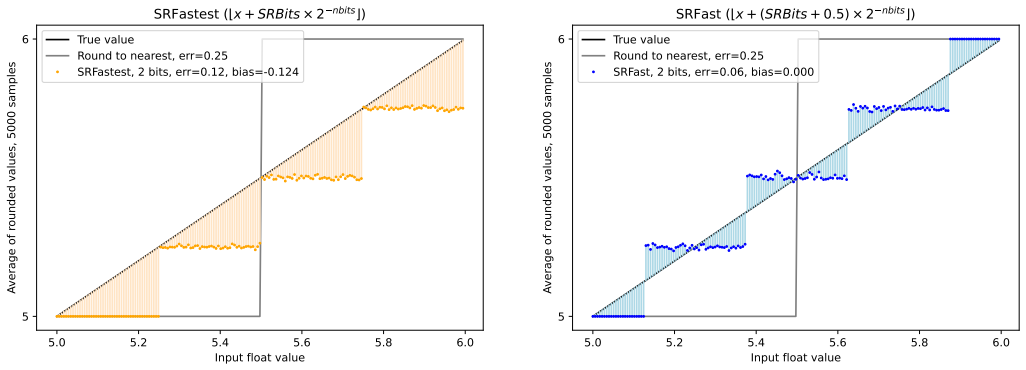
- [Figure 2 caption] The caption says '100,000 samples are rounded with 2 bits of randomness,' but the figure labels and the text use 3 bits; this is inconsistent.
- [Figure 2, right panel] The panel label 'SR' is inconsistent with the caption and the text, which call this method SRC.
- [Figure 2 caption] The caption contains the apparent debugging artifact 'P+srnumbits=6 =?= 8'; this should be removed.
- [§III-E and Appendix A-D] The SRF finite-precision bound is tight for N < D, not for N ≤ D; for N = D the bias is zero, so the parenthetical in §III-E should be corrected.
- [§III and Eq. (6)] The paper should explicitly note in the introduction or at Eq. (6) that its use of 'unbiased' differs from the common pointwise definition of unbiased stochastic rounding, in order to avoid misleading readers who may not notice the interval-uniform prior.
Circularity Check
No circularity: bias calculations and the SRC correction follow from explicit definitions with no fitted inputs or load-bearing self-citation.
full rationale
The paper's central claims are derived directly from its stated definitions. The bias of SRFF and SRF is computed by explicit summation over the uniform-interval family P defined in Eq. (6), using the formal definitions of RSRFF and RSRF; no fitted constants, empirical calibration, or external results are used to force the formulas. The finite-precision bounds are obtained by analogous discrete sums over the 2^D input grid, also from first principles, with the no-binade-wrap caveat stated explicitly. The SRC correction is constructed by first rounding to precision P+N and then applying SRFF, and its unbiasedness is a direct consequence of the same definitional calculation, reducing to the N=D case already derived. The unbiasedness criterion is an openly stated modeling choice, not a hidden assumption introduced to manufacture the conclusion; the paper explicitly acknowledges that the expectation is over a chosen prior family. The experiments are demonstrations that the predicted bias affects training and do not feed fitted parameters back into the theory. The only self-citation, the gfloat library [13], is used as an implementation tool for experiments and is not load-bearing for any analytical result. No circular step can be exhibited.
Assumptions & free parameters
assumptions (5)
- domain assumption Floating point format model of Eq. 1 (sign, exponent, significand, subnormals; NaNs, infinities, and negative values excluded from the rounding analysis).
- domain assumption Unbiasedness criterion in Eq. 6: family of test distributions P consists of uniform distributions between each adjacent pair of floats.
- domain assumption For finite-precision inputs, the 2^D fractional values in a binade are treated as equally likely (uniform) in the bias sums of Eq. 7 and Appendix A.
- domain assumption The random bits n are uniformly distributed over [0, 2^N-1] and independent of the input.
- standard math Round-to-nearest with ties to even (RTNE) is an unbiased deterministic rounding scheme for the SRC's preliminary step (Eq. 8).
Cite this review
Pith. "Pith review of On Stochastic Rounding with Few Random Bits." pith.science (2026). https://pith.science/paper/HRS325GM
@misc{pith2026250420634,
  author       = {Pith},
  title        = {Pith review of: On Stochastic Rounding with Few Random Bits},
  year         = {2026},
  howpublished = {\url{https://pith.science/paper/HRS325GM}},
  note         = {Machine review of arXiv:2504.20634}
}
read the original abstract
Large-scale numerical computations make increasing use of low-precision (LP) floating point formats and mixed precision arithmetic, which can be enhanced by the technique of stochastic rounding (SR), that is, rounding an intermediate high-precision value up or down randomly as a function of the value's distance to the two rounding candidates. Stochastic rounding requires, in addition to the high-precision input value, a source of random bits. As the provision of high-quality random bits is an additional computational cost, it is of interest to require as few bits as possible while maintaining the desirable properties of SR in a given computation, or computational domain. This paper examines a number of possible implementations of few-bit stochastic rounding (FBSR), and shows how several natural implementations can introduce sometimes significant bias into the rounding process, which are not present in the case of infinite-bit, infinite-precision examinations of these implementations. The paper explores the impact of these biases in machine learning examples, and hence opens another class of configuration parameters of which practitioners should be aware when developing or adopting low-precision floating point. Code is available at http://github.com/graphcore-research/arith25-stochastic-rounding.
Figures


Figures from the paper (1 more)

Reference graph
Works this paper leans on
-
[1]
M. Essam, T. B. Tang, E. T. W. Ho, and H. Chen, “Dynamic point stochastic rounding algorithm for limited precision arithmetic in deep belief network training,” in 2017 8th International IEEE/EMBS Confer- ence on Neural Engineering (NER) . IEEE, 2017, pp. 629–632
work page 2017
-
[2]
8-bit numeri- cal formats for deep neural networks,
B. Noune, P. Jones, D. Justus, D. Masters, and C. Luschi, “8-bit numeri- cal formats for deep neural networks,” arXiv preprint arXiv:2206.02915, 2022
arXiv 2022
-
[3]
Climate modeling in low precision: Effects of both deterministic and stochastic rounding,
E. A. Paxton, M. Chantry, M. Kl ¨ower, L. Saffin, and T. Palmer, “Climate modeling in low precision: Effects of both deterministic and stochastic rounding,” Journal of Climate , vol. 35, no. 4, pp. 1215–1229, 2022
work page 2022
-
[4]
Fast: DNN training under variable precision block floating point with stochastic rounding,
S. Q. Zhang, B. McDanel, and H. Kung, “Fast: DNN training under variable precision block floating point with stochastic rounding,” in 2022 IEEE International Symposium on High-Performance Computer Architecture (HPCA). IEEE, 2022, pp. 846–860
work page 2022
-
[5]
M. Croci and M. B. Giles, “Effects of round-to-nearest and stochastic rounding in the numerical solution of the heat equation in low precision,” IMA Journal of Numerical Analysis, vol. 43, no. 3, pp. 1358–1390, 2023
work page 2023
-
[6]
Stochastic rounding: implementation, error analysis and applications,
M. Croci, M. Fasi, N. J. Higham, T. Mary, and M. Mikaitis, “Stochastic rounding: implementation, error analysis and applications,” Royal Soci- ety Open Science , vol. 9, no. 3, p. 211631, 2022
work page 2022
-
[7]
Stochastic rounding variance and probabilistic bounds: A new approach,
E.-M. El Arar, D. Sohier, P. de Oliveira Castro, and E. Petit, “Stochastic rounding variance and probabilistic bounds: A new approach,” SIAM Journal on Scientific Computing , vol. 45, no. 5, pp. C255–C275, 2023
work page 2023
-
[8]
Probabilistic error analysis of limited-precision stochastic rounding
E.-M. El Arar, M. Fasi, S.-I. Filip, and M. Mikaitis, “Probabilistic error analysis of limited-precision stochastic rounding,” arXiv preprint arXiv:2408.03069, 2024
work page Pith review arXiv 2024
Show all 14 references
-
[9]
Improved stochastic rounding,
L. Xia, M. Anthonissen, M. Hochstenbach, and B. Koren, “Improved stochastic rounding,” arXiv preprint arXiv:2006.00489 , 2020
2006 arXiv
-
[10]
You already have it: A generator-free low- precision DNN training framework using stochastic rounding,
G. Yuan, S.-E. Chang, Q. Jin, A. Lu, Y . Li, Y . Wu, Z. Kong, Y . Xie, P. Dong, M. Qin et al. , “You already have it: A generator-free low- precision DNN training framework using stochastic rounding,” in Euro- pean Conference on Computer Vision . Springer, 2022, pp. 34–51
2022
-
[11]
Quantization-aware training for large language models with PyTorch,
A. Or, J. Zhang, E. Smothers, K. Khandelwal, and S. Rao, “Quantization-aware training for large language models with PyTorch,” The PyTorch Foundation, 2024. [Online]. Available: https://pytorch.org/ blog/quantization-aware-training
2024
-
[12]
NanoGPT,
A. Karpathy, “NanoGPT,” https://github.com/karpathy/nanoGPT, 2024
2024
-
[13]
GFloat: Generic floating point formats in Python,
A. Fitzgibbon, “GFloat: Generic floating point formats in Python,” https: //gfloat.readthedocs.io/, 2024
2024
-
[14]
Interim report on binary floating-point formats for machine learning,
IEEE SA P3109 Working Group, “Interim report on binary floating-point formats for machine learning,” The Institute of Electrical and Electronics Engineers, Inc., 2024. [Online]. Available: https://github.com/P3109/Public
2024
Reviewed August 16, 2026 · model on record in the stance chip above.
Discussion (0). Continue with ORCID to comment.