REVIEW 4 major objections 6 minor 35 references
Transcending Dimensions using Generative AI: Real-Time 3D Model Generation in Augmented Reality
T0 review · 4 major / 6 minor · reviewed 2026-08-16 · deepseek-v4-flash
Pith's one-line read The paper shows that a lasso-and-verify AR workflow can turn 2D snapshots into 3D models for non-experts.
desk verdict A plausible AR image-to-3D integration with a solid usability study, but the real-time claim is contradicted by its own 43.2s conversion and the final mesh quality is never validated. read the letter →
The pith
A machine-rendered reading of the paper's core claim, the machinery that carries it, and where it could break.
The reading
What carries the argument
The carrying mechanism is the insertion of a detection-and-verification stage between the raw camera image and the generative model. Mask R-CNN, an instance-segmentation model pre-trained on the COCO dataset with a confidence threshold of 0.5, separates objects from complex backgrounds and labels them; the user then confirms or rejects these detections in a menu before any 3D generation runs. Shap-E, a generative model that outputs a 3D mesh from an image, receives only the accepted, tightly cropped object. This arrangement is what converts Shap-E's documented failures on cluttered or screen-displayed scenes into a usable, interactive pipeline, and the reported latencies are the evidence behind the real-time claim.
What would settle it
Run the full capture-to-model workflow on a set of fifty real headset scenes covering cluttered desks, monitors displaying product photos, and objects under varied lighting, and record how often the verification menu contains the user's intended object and how often the Shap-E output is recognized as resembling it; if the menu is empty or wrong in most trials, or the meshes rarely resemble the targets, the central usability claim fails.
Extended reading notes
Core claim
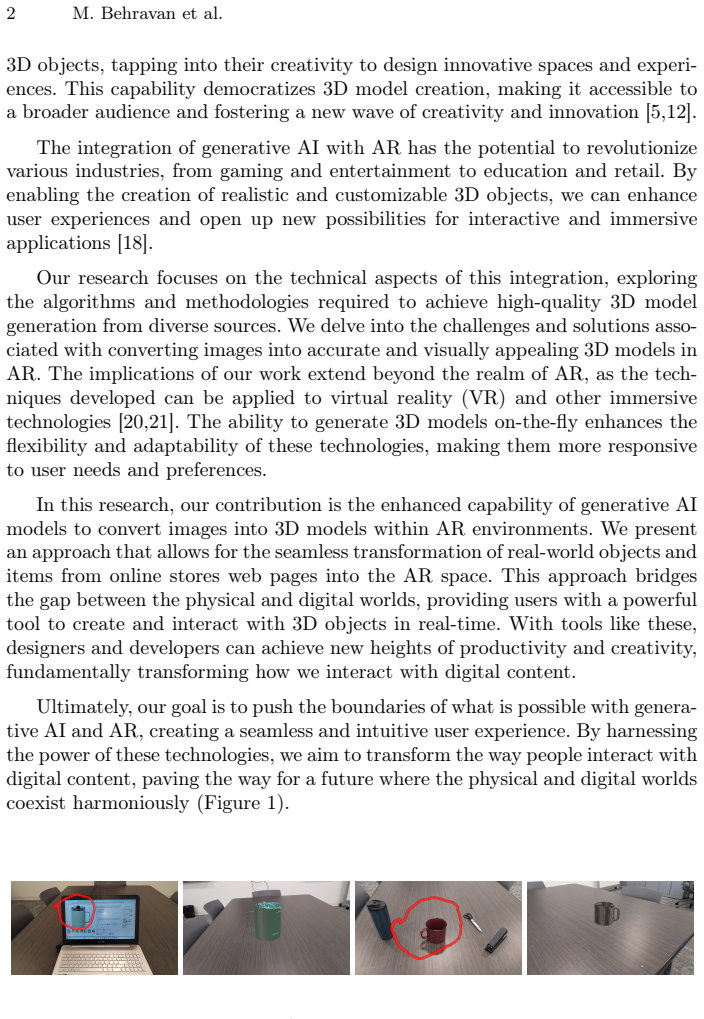
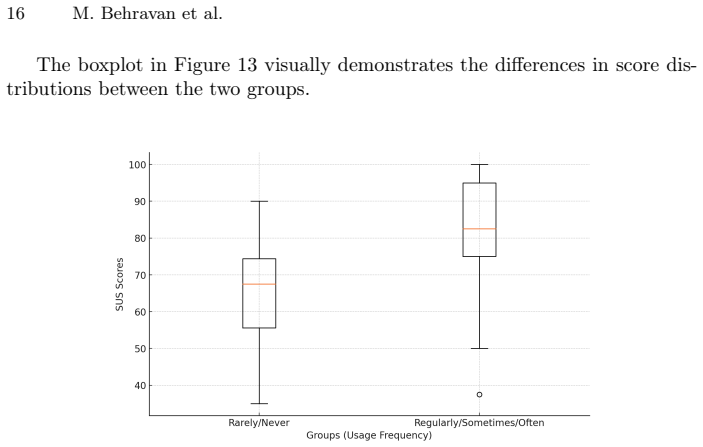
The central claim, stated as the paper's primary contribution, is a process for converting 2D images into 3D models that can be integrated into AR environments, rather than a new AI model. The paper documents two failure modes of the raw generator: a multi-object desk scene collapses into a single cube, and a mug photographed from an online store becomes a laptop. The proposed process addresses these failures by interposing object isolation and human verification: zone selection, cropping, Mask R-CNN instance segmentation, edge-based object cropping, a user menu for selecting detected objects, and finally Shap-E generation and rendering in the headset view. Measured latencies are reported for each stage: image processing 5.2 seconds, image-to-3D conversion 43.2 seconds, model simplification 9.1 seconds, load and render 10.3 seconds, with 61 percent average GPU utilization. The user study found a statistically significant difference in usability scores between infrequent and frequent AR/VR users, with means of 64.38 and 80.71 and $F = 18.21$, $p < 0.001$.
Load-bearing premise
The entire workflow assumes the pre-trained object detector will find and segment the object the user intends; the paper reports no detection accuracy or failure rate, so if the detector misses or mislabels the target, the verification menu offers no usable object and no 3D model gets generated.
Editorial extensions
If this is right
- A user without 3D modeling skill can capture a real-world object or an on-screen product photo and receive a 3D mesh placed back into the AR scene.
- The process transfers to VR and other immersive environments, because the image-to-3D conversion stage is independent of the AR front end.
- The applications named by the paper, including gaming, education, interior design, and e-commerce, become practical without dedicated modeling staff.
- The verification menu prevents the system from spending GPU time converting objects the user did not intend.
- Novice users are the group most likely to need interface simplification, since frequent AR/VR users rated usability significantly higher.
Reading between the lines
- Because the detector is COCO-trained, the object vocabulary is bounded to common classes; fine-tuning on store-specific or headset-specific objects would be an evident next step that the paper does not report.
- The conversion stage is a pluggable bottleneck: if Shap-E is replaced with a newer image-to-3D generator, the same crop-and-verify front end should transfer, suggesting that object isolation, not the generator, is the main contribution.
- The user-verification step could become a data-collection loop in which accepted crops form labeled pairs for retraining the detector under headset lighting and cluttered backgrounds.
- A natural stress test is sequential generation: with conversion taking 43.2 seconds per object, converting several objects in one scene will reveal whether the interaction remains acceptable.
Signed reviews
Editorial analysis
A structured set of objections, weighed in public.
Referee Report
Summary. The paper describes an AR system that lets a HoloLens 2 user select a region or request all objects, applies Mask R-CNN to detect and crop objects, lets the user confirm detected labels, sends the cropped image to Shap-E for 3D mesh generation, simplifies the mesh, and renders it in AR. The evaluation consists of a timing table (Table 1) and a SUS usability study of 35 participants with an ANOVA split by AR/VR familiarity. The authors claim real-time generation, seamless image-to-3D conversion, and easy 3D model creation in AR as their primary contributions.
Significance. If the claims were supported, the value would be a practical integration of well-known components into an AR workflow, with a credible usability signal: the SUS score of 69.64 and the significant familiarity effect (F=18.212, p<0.001) are analyzed and reported clearly. The paper is also honest in showing Shap-E failure modes in Figure 2, which is a strength. However, the lack of any objective fidelity metric and the direct contradiction between the 'real-time' claim and the reported timings mean the central claims are not yet established. As it stands, the contribution is an integration demo with a usability study, not a validated real-time generation system; the use of off-the-shelf components aids reproducibility in principle.
major comments (4)
- [Abstract; Section 4; Table 1] The abstract and Section 4 claim that users can generate and interact with 3D models 'in real time' and that the primary contribution is a 'seamlessly integrated' process, but Table 1 reports Image Processing for Object Detection Time of 5.2 s, Image-to-3D Conversion Time of 43.2 s, Model Simplification Time of 9.1 s, and Load and Render Time of 10.3 s, totaling approximately 67.8 s per object. This directly contradicts the real-time claim, and the table provides single measurements without variance, test conditions, or sample size. The authors should either revise the real-time/interactive wording throughout or provide evidence of a genuinely real-time configuration.
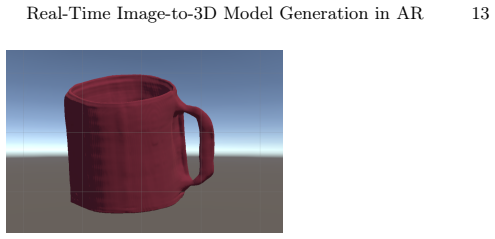
- [Section 4.5-4.6; Figure 2] The central claim that the system converts 2D images into usable 3D models is not supported by any objective evaluation of generation fidelity. Section 4.5's user verification occurs before Shap-E generation and only confirms the detected object's class label; it cannot catch a wrong or degenerate Shap-E output. Figure 2d itself shows Shap-E producing a laptop from a mug image, and Section 4.6 only displays the generated model without any accuracy check. The paper needs metrics such as reconstruction accuracy, human ratings of model-object correspondence, or a success/failure rate on a defined test set, plus a post-generation verification step, to support the 'seamless transformation' claim.
- [Section 4.3; Section 5.2] The pipeline's first AI stage, Mask R-CNN with COCO pretrained weights and a 0.5 confidence threshold, is never evaluated on AR headset imagery. Section 4.3 describes the configuration but reports no detection accuracy, precision/recall, or failure rate for the actual capture conditions, so it is unknown how often the cropped input to Shap-E contains the intended object. The performance section measures only processing time, not detection correctness. If detection fails or mislabels, the user-verification menu in Section 4.5 either shows no object or the wrong object, and no usable 3D model can be generated; the authors should quantify this failure mode.
- [Section 5.3-5.4] The SUS study is analyzed correctly, but it measures only perceived usability, not whether the generated 3D models match user intent. There are no task-success rates, model-quality ratings, or completion times, so the usability score cannot support the claim that users can 'easily generate... 3D models' of their intended objects; a system can be usable yet produce unusable output. The authors should add a task-based evaluation that records generation outcomes alongside the SUS questionnaires.
minor comments (6)
- [Section 1] The first paragraph reads 'notable advancements natural language processing' and is missing the preposition 'in'.
- [Table 1] The header 'Measured V alue' contains a spacing typo; it should read 'Measured Value'.
- [Section 5.4] The description of SUS scoring says 'subtracting 1 from score' and 'subtracting score from 5'; it should say 'subtracting 1 from the score' and 'subtracting the score from 5' for grammatical clarity.
- [Figure 13] The text references 'The boxplot in Figure 13' but no Figure 13 is included in the manuscript; all referenced figures should be present and numbered consistently.
- [References] Reference 30 has a typo: 'Porceedinsg' should be 'Proceedings'.
- [Section 6.1] The recommended hardware specifies a GPU with 16 GB of memory, while Table 1 reports 6.8 GB GPU memory consumption; please clarify whether the 16 GB recommendation is for the full system or a different hardware configuration.
Circularity Check
No circularity: the paper reports an integration of off-the-shelf components measured with an external usability instrument; no prediction is fitted to or defined by its inputs.
full rationale
The paper's central claim is the construction of a workflow (Section 4) that combines Mask R-CNN instance segmentation, cropping, base64 transfer, Shap-E generation, simplification, and AR display. There is no derivation chain in which an output quantity is defined as, or fitted to, the input quantity. The only numeric hand-set parameter is the Mask R-CNN confidence threshold of 0.5 (Section 4.3); this is a standard operating threshold, not a fitted result, and no subsequent quantity is 'predicted' from it. The evaluation uses the externally standardized SUS instrument and reports measured timings; the fact that Table 1 (5.2 + 43.2 + 9.1 + 10.3 seconds) contradicts the abstract's 'real time' wording is a correctness/evidence problem, not a circularity problem. The self-citations [2,3,4] and the phrase 'limitations identified in our previous research' (Section 4) are descriptive context; the current paper's design rationale is stated in its own Sections 3-4 and depends on external models (COCO-pretrained Mask R-CNN, OpenAI Shap-E). No load-bearing premise is justified solely by a same-author citation, and no known external result is renamed or repackaged. Therefore no circular step is exhibited.
Assumptions & free parameters
free parameters (2)
- Mask R-CNN confidence threshold =
0.5
- Post-pinch capture delay =
3 seconds
assumptions (4)
- domain assumption Shap-E can convert a cropped 2D object image into a usable 3D model.
- domain assumption Pre-trained Mask R-CNN (COCO) detects and segments the user's intended objects in real AR headset views.
- domain assumption HoloLens 2 hand tracking and spatial mapping work as expected.
- domain assumption SUS scores measure the usability construct relevant to the system's success.
Cite this review
Pith. "Pith review of Transcending Dimensions using Generative AI: Real-Time 3D Model Generation in Augmented Reality." pith.science (2026). https://pith.science/paper/RLIC3CER
@misc{pith2026250421033,
  author       = {Pith},
  title        = {Pith review of: Transcending Dimensions using Generative AI: Real-Time 3D Model Generation in Augmented Reality},
  year         = {2026},
  howpublished = {\url{https://pith.science/paper/RLIC3CER}},
  note         = {Machine review of arXiv:2504.21033}
}
read the original abstract
Traditional 3D modeling requires technical expertise, specialized software, and time-intensive processes, making it inaccessible for many users. Our research aims to lower these barriers by combining generative AI and augmented reality (AR) into a cohesive system that allows users to easily generate, manipulate, and interact with 3D models in real time, directly within AR environments. Utilizing cutting-edge AI models like Shap-E, we address the complex challenges of transforming 2D images into 3D representations in AR environments. Key challenges such as object isolation, handling intricate backgrounds, and achieving seamless user interaction are tackled through advanced object detection methods, such as Mask R-CNN. Evaluation results from 35 participants reveal an overall System Usability Scale (SUS) score of 69.64, with participants who engaged with AR/VR technologies more frequently rating the system significantly higher, at 80.71. This research is particularly relevant for applications in gaming, education, and AR-based e-commerce, offering intuitive, model creation for users without specialized skills.
Figures


Figures from the paper (10 more)


Reference graph
Works this paper leans on
-
[1]
Learn- ing representations and generative models for 3D point clouds
Panos Achlioptas, Olga Diamanti, Ioannis Mitliagkas, and Leonidas Guibas. Learn- ing representations and generative models for 3D point clouds. InProceedings of the International Conference on Machine Learning, pages 40–49. PMLR, 2018
work page 2018
-
[2]
Majid Behravan and Denis Gračanin. Generative multi-modal artificial intelligence for dynamic real-time context-aware content creation in augmented reality. InPro- ceedings of the 30th ACM Symposium on Virtual Reality Software and Technology, VRST ’24. Association for Computing Machinery, 2024
work page 2024
-
[3]
Generative AI for context-aware 3D object creation using vision-language models in augmented reality
Majid Behravan and Denis Gračanin. Generative AI for context-aware 3D object creation using vision-language models in augmented reality. In Proceedings of the 7th IEEE International Conference on Artificial Intelligence & eXtended and Virtual Reality. IEEE, 2025
work page 2025
-
[4]
Multilingual standalone trustworthy voice-based social network for disaster situ- ations
Majid Behravan, Elham Mohammadrezaei, Mohamed Azab, and Denis Gračanin. Multilingual standalone trustworthy voice-based social network for disaster situ- ations. In 2024 IEEE 15th Annual Ubiquitous Computing, Electronics & Mobile Communication Conference (UEMCON), pages 264–270, 2024. Real-Time Image-to-3D Model Generation in AR 19
work page 2024
-
[5]
Bronstein, Joan Bruna, Taco Cohen, and Petar Veličković
Michael M. Bronstein, Joan Bruna, Taco Cohen, and Petar Veličković. Geometric deep learning: Grids, groups, graphs, geodesics, and gauges. arXiv:2104.13478 [cs.LG], 2020
arXiv 2020
-
[6]
Eric R. Chan, Connor Z. Lin, Matthew A. Chan, Koki Nagano, Boxiao Pan, Shalini De Mello, Orazio Gallo, Leonidas Guibas, Jonathan Tremblay, Sameh Khamis, Tero Karras, and Gordon Wetzstein. Efficient geometry-aware 3D gen- erative adversarial networks. In Proceedings of the IEEE/CVF Conference on Computer Vision and Pattern Recognition, pages 16123–16133, 2022
work page 2022
-
[7]
Learning implicit fields for generative shape model- ing
Zhiqin Chen and Hao Zhang. Learning implicit fields for generative shape model- ing. Proceedings of the IEEE/CVF Conference on Computer Vision and Pattern Recognition, pages 5939–5948, 2019
work page 2019
-
[8]
Archi Dasgupta, Mark Manuel, Rifat Mansur, Nabil Nowak, and Denis Gračanin. Towards real time object recognition for context awareness in mixed reality: A machine learning approach. InProceedings of the 2020 IEEE Conference on Virtual Reality and 3D User Interfaces Abstracts and Workshops (VRW), pages 262–268. IEEE, 22–26 2020
work page 2020
Show all 35 references
-
[9]
GET3D: A generative model of high quality 3D textured shapes learned from images.Advances in Neural Information Processing Systems, 35:31841–31854, 2022
Jun Gao, Tianchang Shen, Zian Wang, Wenzheng Chen, Kangxue Yin, Daiqing Li, Or Litany, Zan Gojcic, and Sanja Fidler. GET3D: A generative model of high quality 3D textured shapes learned from images.Advances in Neural Information Processing Systems, 35:31841–31854, 2022
2022
-
[10]
Rich feature hierarchiesforaccurateobjectdetectionandsemanticsegmentation
Ross Girshick, Jeff Donahue, Trevor Darrell, and Jitendra Malik. Rich feature hierarchiesforaccurateobjectdetectionandsemanticsegmentation. In Proceedings of the IEEE conference on computer vision and pattern recognition, pages 580–587, 2014
2014
-
[11]
Goodfellow, Jean Pouget-Abadie, Mehdi Mirza, Bing Xu, David Warde- Farley, Sherjil Ozair, Aaron Courville, and Yoshua Bengio
Ian J. Goodfellow, Jean Pouget-Abadie, Mehdi Mirza, Bing Xu, David Warde- Farley, Sherjil Ozair, Aaron Courville, and Yoshua Bengio. Generative adversarial nets. Advances in neural information processing systems, 27:2672–2680, 2014
2014
-
[12]
MeshCNN: A network with an edge.ACM Transactions on Graphics, 38(4):1–12, 2024
Rana Hanocka, Amir Hertz, Noa Fish, Raja Giryes, Shachar Fleishman, and Daniel Cohen-Or. MeshCNN: A network with an edge.ACM Transactions on Graphics, 38(4):1–12, 2024
2024
-
[13]
Esraa Hassan, Nora El-Rashidy, and Fatma M. Talaa. Review: Mask r-cnn models. Nile Journal of Communication & Computer Science, 3(1):1–10, 2022
2022
-
[14]
Mask R-CNN
Kaiming He, Georgia Gkioxari, Piotr Dollár, and Ross Girshick. Mask R-CNN. arXiv:1703.06870 [cs.CV], 2017
2017 arXiv
-
[15]
Zixuan Huang, Varun Jampani, Anh Thai, Yuanzhen Li, Stefan Stojanov, and James M. Rehg. ShapeClipper: Scalable 3D shape learning from single-view images via geometric and CLIP-based consistency. InProceedings of the 2023 IEEE/CVF Conference on Computer Vision and Pattern Recog...
2023
-
[16]
Neural wavelet-domain diffusion for 3D shape generation.ACM SIGGRAPH Asia, 2022
Ka-Hei Hui, Ruihui Li, Jingyu Hu, and Chi-Wing Fu. Neural wavelet-domain diffusion for 3D shape generation.ACM SIGGRAPH Asia, 2022
2022
-
[17]
Diffusion probabilistic models for 3D point cloud gener- ation
Shitong Luo and Wei Hu. Diffusion probabilistic models for 3D point cloud gener- ation. Proceedings of the IEEE/CVF Conference on Computer Vision and Pattern Recognition, pages 2837–2845, 2021
2021
-
[18]
Mueller and Katja Thoring
Roland M. Mueller and Katja Thoring. Understanding artifact knowledge in design science. Proceedings of the 17th Americas Conference on Information Systems, 2011
2011
-
[19]
Object detection of aerial image using mask-region convolutional neural network (mask R-CNN).IOP Con- ference Series: Earth and Environmental Science, 500:012090, 2020
M Musyarofah, Valentina Schmidt, and Martin Kada2. Object detection of aerial image using mask-region convolutional neural network (mask R-CNN).IOP Con- ference Series: Earth and Environmental Science, 500:012090, 2020. 20 M. Behravan et al
2020
-
[20]
Transframer: Arbitrary frame prediction with generative models
Charlie Nash, João Carreira, Jacob Walker, Iain Barr, Andrew Jaegle, Mateusz Malinowski, and Peter Battaglia. Transframer: Arbitrary frame prediction with generative models. arXiv:2203.09494 [cs.CV], 2022
2022 arXiv
-
[21]
AminHeyraniNobari,MuhammadFathyRashad,andFaezAhmed. CreativeGAN: Editing generative adversarial networks for creative design synthesis.Proceedings of the ASME 2021 International Design Engineering Technical Conferences and Computers and Information in Engineering Conference, p...
2021
-
[22]
You only look once: Unified, real-time object detection
Joseph Redmon, Santosh Divvala, Ross Girshick, and Ali Farhadi. You only look once: Unified, real-time object detection. InProceedings of the 2016 IEEE Confer- ence on Computer Vision and Pattern Recognition (CVPR), pages 779–788, 2016
2016
-
[23]
YOLOv3: An incremental improvement
Joseph Redmon and Ali Farhadi. YOLOv3: An incremental improvement. arXiv:1804.02767 [cs.CV], 2018
2018 arXiv
-
[24]
Faster R-CNN: Towards real-time object detection with region proposal networks.IEEE Transactions on Pattern Analysis and Machine Intelligence, 39(6):1137–1149, 2017
Shaoqing Ren, Kaiming He, Ross Girshick, and Jian Sun. Faster R-CNN: Towards real-time object detection with region proposal networks.IEEE Transactions on Pattern Analysis and Machine Intelligence, 39(6):1137–1149, 2017
2017
-
[25]
Ryan Shue, Eric Ryan Chan, Ryan Po, Zachary Ankner, Jiajun Wu, and Gordon Wetzstein
J. Ryan Shue, Eric Ryan Chan, Ryan Po, Zachary Ankner, Jiajun Wu, and Gordon Wetzstein. 3D neural field generation using triplane diffusion. InProceedings of the IEEE/CVF Conference on Computer Vision and Pattern Recognition (CVPR), pages 20875–20886, 2023
2023
-
[26]
Sparse R-CNN: End-to-end object detection with learnable proposals
Peize Sun, Rufeng Zhang, Yi Jiang, Tao Kong, Chenfeng Xu, Masayoshi Tomizuka Wei Zhan, Lei Li, Changhu Wang Zehuan Yuan, and Ping Luo. Sparse R-CNN: End-to-end object detection with learnable proposals. arXiv:2011.12450 [cs.CV], 2020
2011 arXiv
-
[27]
Regression shrinkage and selection via the Lasso.Journal of the Royal Statistical Society: Series B (Methodological), 58(1):267–288, 1996
Robert Tibshirani. Regression shrinkage and selection via the Lasso.Journal of the Royal Statistical Society: Series B (Methodological), 58(1):267–288, 1996
1996
-
[28]
Pixelnerf: Neural radiance fields from one or few images
Alex Yu, Vickie Ye, Matthew Tancik, and Angjoo Kanazawa. Pixelnerf: Neural radiance fields from one or few images. In Proceedings of the 2020 IEEE/CVF Conference on Computer Vision and Pattern Recognition (CVPR), pages 5386– 5396, 2021
2020
-
[29]
CAST: Effective and efficient user interaction for context-aware selection in 3D particle clouds
Lingyun Yu, Konstantinos Efstathiou, Petra Isenberg, and Tobias Isenberg. CAST: Effective and efficient user interaction for context-aware selection in 3D particle clouds. IEEE Transactions on Visualization and Computer Graphics, 22(1):886– 895, January 2016
2016
-
[30]
Zamir, Alexander Sax, William Shen, Leonidas Guibas, Jitendra Ma- lik, and Silvio Savarese
Amir R. Zamir, Alexander Sax, William Shen, Leonidas Guibas, Jitendra Ma- lik, and Silvio Savarese. Taskonomy: Disentangling task transfer learning. In Porceedinsg of the 2018 IEEE/CVF Conference on Computer Vision and Pattern Recognition, pages 3712–3722, June 2018
2018
-
[31]
LION: Latent point diffusion models for 3D shape gener- ation
Xiaohui Zeng, Arash Vahdat, Francis Williams, Zan Gojcic, Or Litany, Sanja Fi- dler, and Karsten Kreis. LION: Latent point diffusion models for 3D shape gener- ation. arXiv:2210.06978 [cs.CV], 2022
2022 arXiv
-
[32]
Locally attentional SDF diffusion for controllable 3D shape genera- tion
Xin-Yang Zheng, Hao Pan, Peng-Shuai Wang, Xin Tong, Yang Liu, and Heung- Yeung Shum. Locally attentional SDF diffusion for controllable 3D shape genera- tion. arXiv:2305.04461 [cs.CV], 2023
2023 arXiv
-
[33]
Objects as points
Xingyi Zhou, Dequan Wang, and Philipp Krähenbühl. Objects as points. arXiv:1904.07850 [cs.CV], 2019
1904 arXiv
-
[34]
Sparsefusion: Distilling view-conditioned diffusion for 3D reconstruction.CVPR, 2023
Zhizhuo Zhou and Shubham Tulsiani. Sparsefusion: Distilling view-conditioned diffusion for 3D reconstruction.CVPR, 2023
2023
-
[35]
LassoNet: Deep Lasso-selection of 3D point clouds
Chen Zhu-Tian, Wei Zeng, Zhiguang Yang, Lingyun Yu, Chi-Wing Fu, and Huamin Qu. LassoNet: Deep Lasso-selection of 3D point clouds. IEEE Transactions on Visualization and Computer Graphics, 26(1):195–204, January 2020
2020
Reviewed August 16, 2026 · model on record in the stance chip above.
Discussion (0). Continue with ORCID to comment.