REVIEW 5 major objections 6 minor 34 references
Dance Style Recognition Using Laban Movement Analysis
T0 review · 5 major / 6 minor · reviewed 2026-08-16 · deepseek-v4-flash
Pith's one-line read The paper claims that adding temporal context to Laban Movement Analysis features, pulled from 3D pose and body-shape estimates, classifies ten street-dance styles at roughly 99% accuracy.
desk verdict A plausible LMA feature pipeline whose headline 99% accuracy rests on an unspecified cross-validation split unit; the paper deserves peer review but needs major revision to clarify the evaluation protocol. read the letter →
The pith
A machine-rendered reading of the paper's core claim, the machinery that carries it, and where it could break.
The reading
What carries the argument
Laban Movement Analysis — a choreological language describing movement through Body, Effort, Shape, and Space — is the organizing framework, and the load-bearing mechanism is the sliding window. Each descriptor, including a new 'initiation' detector (joint displacement over a short window exceeding a data-driven threshold), is computed over 55-frame windows, converting single-frame poses into short movement phrases. Floor-aware modeling, combining monocular scene reconstruction, quantile-regression floor fitting, SMPL mesh fitting, and pose-independent anthropometry, supplies metric body and floor references. The result is a 55-dimensional descriptor vector whose classification power is attributed to temporal context, and SHAP is applied to attribute each model decision to individual descriptors.
What would settle it
Re-run the exact 55-frame window pipeline with a leave-one-video-out or video-level 3-fold split, so no window of the same source video appears in both training and test folds; if per-class accuracy falls far below the reported 99%, particularly for freestyle genres, the headline accuracy was inflated by window overlap.
Extended reading notes
Core claim
On the paper's own terms, the central claim is that LMA's four qualitative dimensions can be quantified with temporal dynamics and that these features alone, without deep learning on raw pixels, separate dance styles nearly perfectly. Concretely, sliding-window features of 55 frames feed SVM and Random Forest classifiers: RF reaches 99.68% accuracy and 99.64% macro F1, while SVM reaches 99.07% accuracy and 99.16% macro F1 across ten AIST++ street-dance genres. The paper further claims that window size matters, with most of the gain coming between 5 and 30 frames and larger windows still helping. Out-of-distribution videos show the descriptors transfer well to structured styles such as lock (81.89% accuracy) but poorly to freestyle genres such as break (10.21%), which the authors attribute to the structured, professional nature of the training corpus.
Load-bearing premise
The near-perfect accuracy assumes that the 3-fold cross-validation splits data so that all overlapping windows from the same video stay inside a single fold; if windows from one clip appear in both training and test folds, the reported numbers could measure temporal overlap rather than generalization to unseen performances.
Editorial extensions
If this is right
- Widening the temporal context from 5 to 30 frames produces most of the accuracy gain, so short movement phrases carry the discriminative signal.
- Effort Time and Body Volume dominate SHAP attributions, suggesting that temporal energy and spatial extent are the style-separating cues.
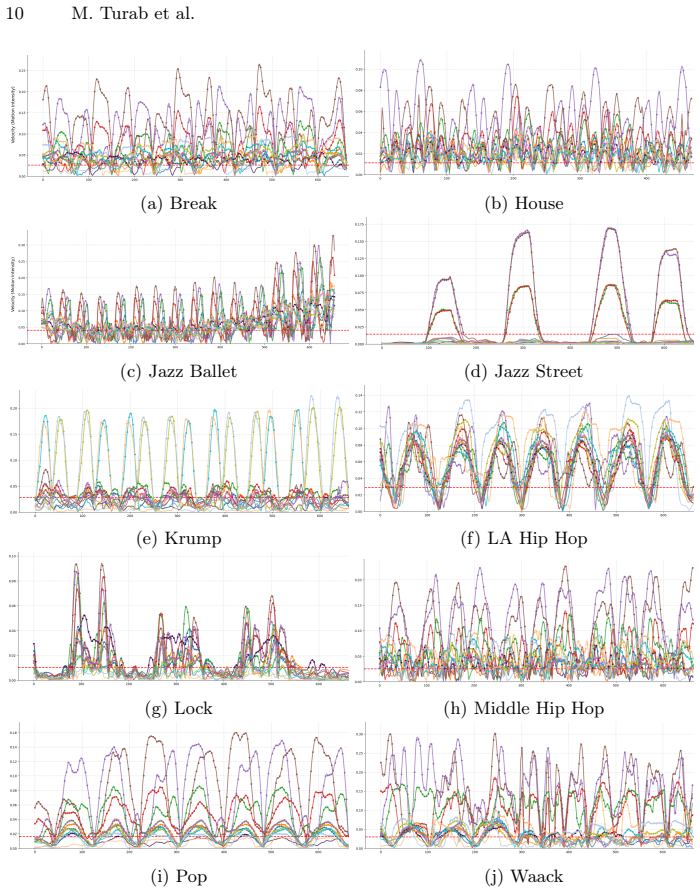
- Style-specific kinematics emerge: Krump and Pop are quick, Lock shows pause patterns, while Break, Waack, and Middle Hip Hop are less predictable.
- Out-of-distribution transfer is uneven, with lock transferring at 81.89% accuracy and break at 10.21%, so structured styles generalize better than freestyle ones.
Reading between the lines
- A video-level or dancer-level train/test split would test whether the near-perfect accuracy survives when overlapping windows from the same clip cannot leak across folds; if accuracy collapses, temporal overlap is doing the work.
- The same sliding-window LMA descriptors, with floor-aware metric scaling, could be applied to clinical gait assessment or sports technique analysis, where interpretable temporal features are valued as much as accuracy.
- The SHAP ranking suggests a compact descriptor subset (effort time, body volume, pelvis jerkiness, ankle kinetics) could reproduce most of the accuracy, reducing the 55-feature vector to a smaller explainable set.
Signed reviews
Editorial analysis
A structured set of objections, weighed in public.
Referee Report
Summary. The paper proposes a pipeline for dance style recognition on the AIST++ dataset. It combines 3D pose estimation, monocular scene reconstruction for floor estimation, SMPL mesh fitting, and Laban Movement Analysis (LMA) feature extraction with a sliding window to incorporate temporal context. A 55-feature vector is used to train support vector machines and random forests, and SHAP is applied for model interpretation. The authors report near-perfect in-distribution accuracy (the abstract states 99.18%; Section 4 reports RF 99.68% and SVM 99.07%) and also present an out-of-distribution evaluation on online videos with substantially lower per-style accuracy.
Significance. If the evaluation were sound, the paper would be a useful contribution: it offers an explicit, feature-based, explainable alternative to end-to-end deep learning for dance style classification, and it provides a practical recipe for extracting floor-aware 3D body features from monocular video. The use of SHAP to connect LMA descriptors to individual dance styles is a valuable interpretive step, and the out-of-distribution evaluation, despite its limitations, is an honest attempt to measure generalization. However, the central empirical claims are currently not verifiable because the cross-validation split is unspecified and the reported metrics are inconsistent.
major comments (5)
- [Section 3.4] The 3-fold cross-validation split is not defined at the correct unit. The paper must state whether the split is performed on the 600 source videos or on individual 55-frame sliding windows. With a 55-frame window at 60 fps, consecutive windows overlap by 54 frames, and all windows from the same video are highly correlated. If windows are randomly assigned to folds, the training and test sets will contain near-duplicate samples, allowing the classifier to memorize video-specific characteristics and inflate accuracy. This issue is load-bearing for the 99%+ accuracy claims. The experiments should use a video-level grouped split (e.g., GroupKFold), report variance across folds, and ideally report per-video majority-vote accuracy.
- [Abstract and Table 1] The headline 'highest classification accuracy of 99.18%' in the abstract does not match the accuracy values stated in Section 4 (RF 99.68%, SVM 99.07%), but it does equal the average recall for SVM in Table 1. The paper must clarify whether the abstract reports accuracy or recall, and Table 1 should include an explicit accuracy row so the reader can verify the claimed metric. This inconsistency undermines the paper's central numerical claim.
- [Section 3.3] The composition of the 55-feature vector is never specified. Equations (1)-(5) describe several quantities, but the mapping from these equations to the exact 55 input features is absent. For example, Equation (1) is a boolean inequality, not a scalar feature, and it is unclear how many joints, time offsets, and aggregations are used. Without a complete enumeration of the feature set, the method is not reproducible and the SHAP analyses cannot be interpreted. Provide the full list of the 55 features, including formulas for any remaining descriptors (spatial dispersion, volume, path, curvature, jerkiness, etc.).
- [Section 4, Fig. 2] The claim that 'the addition of temporal context significantly improves dance style recognition performance' is not supported by a non-temporal baseline. The comparison in Fig. 2 is between different sliding-window sizes; it does not compare against the same feature set extracted without a sliding window (e.g., window size 1) or against existing methods on AIST++. Add a no-temporal-context baseline and compare with published AIST++ results to substantiate the contribution.
- [Section 4.2] The out-of-distribution evaluation is described only qualitatively. The paper reports per-style accuracy values from 10.21% to 81.89% but does not state the number of test videos per style, the composition of the test set, or whether the same sliding-window protocol is used. Given the near-perfect in-distribution results, the low out-of-distribution performance for many styles suggests the model may be overfitting to AIST++ conditions. Report the evaluation protocol in sufficient detail so the robustness claims can be assessed.
minor comments (6)
- [Section 3.5] The phrase 'in the context of emotion classification for contemporary dance' appears to be a leftover from a different paper; it should read 'dance style recognition'.
- [Table 1] The typo 'A verage' should be corrected to 'Average'.
- [Section 4, Fig. 2] The figure caption and surrounding text would benefit from explicit axis labels and a description of the baseline to which the windowed results are compared.
- [Section 3.3, Ref [12]] The joint weights α_j are attributed to the OpenMMLab repository [12]; this is not a standard citable source for domain-specific joint importance. Please cite the original literature that defines these weights.
- [Section 3.1] The dataset is described as the AIST Dance Video Database, but the paper consistently refers to AIST++. These are different resources (AIST++ provides 3D motion annotations); please clarify which dataset version is used and cite the corresponding paper.
- [Equation (4)] The kinetic-energy formula lacks a mass term; if the intended quantity is scaled kinetic energy (with mass absorbed into α_j), this should be stated explicitly.
Circularity Check
No circular derivation found: LMA features are computed from pose data independently of style labels, and the accuracy claims are empirical benchmarks on an external dataset.
full rationale
The paper's pipeline computes LMA descriptors from 3D pose estimates, floor-plane fits, and SMPL meshes (Sections 3.2-3.3); none of the feature equations (1)-(5) or the 55-feature descriptor vector is defined in terms of the dance-style label or the classifier output. The threshold tau in Eq. (1) is computed from sequence statistics, the joint weights come from an external open-source implementation [12], and the window size and SVM/RF hyperparameters are selected by validation accuracy, so no fitted quantity is renamed as a prediction. The central claim (99.18% / RF 99.68% / SVM 99.07% in Table 1 and Section 4) is an empirical result on the external AIST++ benchmark, not a derivation from an input premise. No load-bearing self-citation or imported uniqueness theorem appears; the cited prior work on LMA features is background and is not used to force the present pipeline. The main weaknesses are evaluation-protocol omissions: Section 3.4 does not state whether 3-fold CV splits at video or window level, and the abstract's 99.18% does not match the stated accuracy values in Section 4 but equals the SVM average recall in Table 1. These are soundness/reporting concerns, not circularity, because even if overlapping windows leak across folds, the features remain label-independent and the classification is not equivalent to its inputs by construction. The out-of-distribution results in Section 4.2 (10-82% per style) further confirm the model is not tautologically correct. Accordingly, no circular step can be exhibited under the required standard.
Assumptions & free parameters
free parameters (3)
- Sliding window size w =
55 frames
- Initiation threshold tau =
Per-sequence standard deviation
- Joint weights alpha_j =
From MMPose [12]
assumptions (3)
- domain assumption AIST++ ground-truth style labels are correct and the 600 selected single-dancer frontal-view videos are representative of each style.
- domain assumption NLF and MoGe provide sufficiently accurate 3D pose and floor geometry for dance videos.
- domain assumption Dancers are standing so SMPL fitting and pose-independent anthropometry are valid.
Cite this review
Pith. "Pith review of Dance Style Recognition Using Laban Movement Analysis." pith.science (2026). https://pith.science/paper/3FFT5UEP
@misc{pith2026250421166,
  author       = {Pith},
  title        = {Pith review of: Dance Style Recognition Using Laban Movement Analysis},
  year         = {2026},
  howpublished = {\url{https://pith.science/paper/3FFT5UEP}},
  note         = {Machine review of arXiv:2504.21166}
}
read the original abstract
The growing interest in automated movement analysis has presented new challenges in recognition of complex human activities including dance. This study focuses on dance style recognition using features extracted using Laban Movement Analysis. Previous studies for dance style recognition often focus on cross-frame movement analysis, which limits the ability to capture temporal context and dynamic transitions between movements. This gap highlights the need for a method that can add temporal context to LMA features. For this, we introduce a novel pipeline which combines 3D pose estimation, 3D human mesh reconstruction, and floor aware body modeling to effectively extract LMA features. To address the temporal limitation, we propose a sliding window approach that captures movement evolution across time in features. These features are then used to train various machine learning methods for classification, and their explainability explainable AI methods to evaluate the contribution of each feature to classification performance. Our proposed method achieves a highest classification accuracy of 99.18\% which shows that the addition of temporal context significantly improves dance style recognition performance.
Figures


Figures from the paper (3 more)


Reference graph
Works this paper leans on
-
[1]
Grounding image matching in 3d with mast3r (2024)
work page 2024
-
[2]
Procedia computer science112, 554–563 (2017)
Ajili, I., Mallem, M., Didier, J.Y.: Robust human action recognition system using laban movement analysis. Procedia computer science112, 554–563 (2017)
work page 2017
-
[3]
Ajili, I., Ramezanpanah, Z., Mallem, M., Didier, J.Y.: Expressive motions recog- nition and analysis with learning and statistical methods (2019)
work page 2019
-
[4]
In: Computer Graphics Forum
Aristidou, A., Charalambous, P., Chrysanthou, Y.: Emotion analysis and classifica- tion: understanding the performers’ emotions using the lma entities. In: Computer Graphics Forum. vol. 34, pp. 262–276. Wiley Online Library (2015)
2015
-
[5]
In: 2014 International Conference on Computer Graph- ics Theory and Applications (GRAPP)
Aristidou, A., Chrysanthou, Y.: Feature extraction for human motion indexing of acted dance performances. In: 2014 International Conference on Computer Graph- ics Theory and Applications (GRAPP). pp. 1–11. IEEE (2014)
2014
-
[6]
Frontiers in Robotics and AI11, 1295308 (2024)
Baker, B., Liu, T., Matelsky, J., Parodi, F., Mensh, B., Krakauer, J.W., Kording, K.: Computational kinematics of dance: distinguishing hip hop genres. Frontiers in Robotics and AI11, 1295308 (2024)
work page 2024
-
[7]
The journal of machine learning research13(1), 281–305 (2012)
Bergstra, J., Bengio, Y.: Random search for hyper-parameter optimization. The journal of machine learning research13(1), 281–305 (2012)
2012
-
[8]
https://github.com/DavidBoja/ SMPL-Anthropometry (2024)
Bojanić, D.: Smpl-anthropometry. https://github.com/DavidBoja/ SMPL-Anthropometry (2024)
work page 2024
Show all 34 references
-
[9]
Machine learning45, 5–32 (2001)
Breiman, L.: Random forests. Machine learning45, 5–32 (2001)
2001
-
[10]
Advances in Neural Information Processing Systems36 (2024)
Cai, Z., Yin, W., Zeng, A., Wei, C., Sun, Q., Yanjun, W., Pang, H.E., Mei, H., Zhang, M., Zhang, L., et al.: Smpler-x: Scaling up expressive human pose and shape estimation. Advances in Neural Information Processing Systems36 (2024)
2024
-
[11]
IEEE transactions on pattern analysis and machine intelligence43(1), 172–186 (2019)
Cao, Z., Hidalgo, G., Simon, T., Wei, S.E., Sheikh, Y.: Openpose: Realtime multi- person 2d pose estimation using part affinity fields. IEEE transactions on pattern analysis and machine intelligence43(1), 172–186 (2019)
2019
-
[12]
https: //github.com/open-mmlab/mmpose (2020)
Contributors, M.: Openmmlab pose estimation toolbox and benchmark. https: //github.com/open-mmlab/mmpose (2020)
2020
-
[13]
Machine learning20 (1995)
Cortes, C., Vapnik, V.: Support-vector networks. Machine learning20 (1995)
1995
-
[14]
Dewan, S., Agarwal, S., Singh, N.: Spatio-temporal laban features for dance style recognition. pp. 2911–2916. IEEE (2018)
2018
-
[15]
In: Proceedings of the IEEE/CVF Conference on Computer Vision and Pattern Recognition (2024)
Dwivedi, S.K., Sun, Y., Patel, P., Feng, Y., Black, M.J.: Tokenhmr: Advancing human mesh recovery with a tokenized pose representation. In: Proceedings of the IEEE/CVF Conference on Computer Vision and Pattern Recognition (2024)
2024
-
[16]
In: Proceedings of the IEEE/CVF International Conference on Computer Vision (2023)
Goel, S., Pavlakos, G., Rajasegaran, J., Kanazawa, A., Malik, J.: Humans in 4d: Reconstructing and tracking humans with transformers. In: Proceedings of the IEEE/CVF International Conference on Computer Vision (2023)
2023
-
[17]
In: International Conference on Human-Computer Interaction
Guo, W., Craig, O., Difato, T., Oliverio, J., Santoso, M., Sonke, J., Barmpoutis, A.: Ai-driven human motion classification and analysis using laban movement sys- tem. In: International Conference on Human-Computer Interaction. pp. 201–210. Springer (2022) 12 M. Turab et al
2022
-
[18]
MacDonald & Evans (1950)
von Laban, R.: The mastery of movement on the stage. MacDonald & Evans (1950)
1950
-
[19]
In: Proceedings of the IEEE/CVF Conference on Computer Vision and Pattern Recognition (2023)
Lin, J., Zeng, A., Wang, H., Zhang, L., Li, Y.: One-stage 3d whole-body mesh recovery with component aware transformer. In: Proceedings of the IEEE/CVF Conference on Computer Vision and Pattern Recognition (2023)
2023
-
[20]
In: Seminal Graphics Papers: Pushing the Boundaries, Volume 2, pp
Loper, M., Mahmood, N., Romero, J., Pons-Moll, G., Black, M.J.: Smpl: A skinned multi-person linear model. In: Seminal Graphics Papers: Pushing the Boundaries, Volume 2, pp. 851–866 (2023)
2023
-
[21]
arXiv preprint arXiv:1906.08172 (2019)
Lugaresi, C., Tang, J., Nash, H., McClanahan, C., Uboweja, E., Hays, M., Zhang, F., Chang, C.L., Yong, M.G., Lee, J., et al.: Mediapipe: A framework for building perception pipelines. arXiv preprint arXiv:1906.08172 (2019)
2019 arXiv
-
[22]
Nature Machine Intelligence2(1) (2020)
Lundberg, S.M., Erion, G., Chen, H., DeGrave, A., Prutkin, J.M., Nair, B., Katz, R., Himmelfarb, J., Bansal, N., Lee, S.I.: From local explanations to global under- standing with explainable ai for trees. Nature Machine Intelligence2(1) (2020)
2020
-
[23]
In: Guyon, I., Luxburg, U.V., Bengio, S., Wallach, H., Fergus, R., Vishwanathan, S., Garnett, R
Lundberg, S.M., Lee, S.I.: A unified approach to interpreting model predictions. In: Guyon, I., Luxburg, U.V., Bengio, S., Wallach, H., Fergus, R., Vishwanathan, S., Garnett, R. (eds.) Advances in Neural Information Processing Systems 30, pp. 4765–4774. Curran Associates, Inc....
2017
-
[24]
Procedia Computer Science (2020)
Ramezanpanah, Z., Mallem, M., Davesne, F.: Human action recognition using la- ban movement analysis and dynamic time warping. Procedia Computer Science (2020)
2020
-
[25]
dos Santos, L.C.G.F.: Laban movement analysis: A Bayesian computational ap- proach to hierarchical motion analysis and learning. Ph.D. thesis, Universidade de Coimbra (Portugal) (2013)
2013
-
[26]
arXiv preprint arXiv:2407.07532 (2024)
Sárándi, I., Pons-Moll, G.: Neural localizer fields for continuous 3d human pose and shape estimation. arXiv preprint arXiv:2407.07532 (2024)
2024 arXiv
-
[27]
In: Proceedings of the IEEE/CVF Conference on Computer Vision and Pattern Recognition
Stathopoulos, A., Han, L., Metaxas, D.: Score-guided diffusion for 3d human re- covery. In: Proceedings of the IEEE/CVF Conference on Computer Vision and Pattern Recognition. pp. 906–915 (2024)
2024
-
[28]
Indone- sian Journal of Electrical Engineering and Informatics (IJEEI)11(2) (2023)
Sutopo, J., Abd Ghani, M.K., Burhanuddin, M., Septiani, A.N., Tundo, T.: Dance gesture recognition using laban movement analysis with j48 classification. Indone- sian Journal of Electrical Engineering and Informatics (IJEEI)11(2) (2023)
2023
-
[29]
In: Proceedings of the 20th International Society for Music Information Retrieval Conference, ISMIR 2019
Tsuchida, S., Fukayama, S., Hamasaki, M., Goto, M.: Aist dance video database: Multi-genre, multi-dancer, and multi-camera database for dance information pro- cessing. In: Proceedings of the 20th International Society for Music Information Retrieval Conference, ISMIR 2019. Del...
2019
-
[30]
Nature methods (2020)
Virtanen, P., Gommers, R., Oliphant, T.E., Haberland, M., Reddy, T., Courna- peau, D., Burovski, E., Peterson, P., Weckesser, W., Bright, J., et al.: Scipy 1.0: fundamental algorithms for scientific computing in python. Nature methods (2020)
2020
-
[31]
In: Proceedings of the IEEE/CVF Confer- ence on Computer Vision and Pattern Recognition (2025)
Wang, J., Chen, M., Karaev, N., Vedaldi, A., Rupprecht, C., Novotny, D.: Vggt: Visual geometry grounded transformer. In: Proceedings of the IEEE/CVF Confer- ence on Computer Vision and Pattern Recognition (2025)
2025
-
[32]
Wang, R., Xu, S., Dai, C., Xiang, J., Deng, Y., Tong, X., Yang, J.: Moge: Unlocking accurate monocular geometry estimation for open-domain images with optimal training supervision (2024),https://arxiv.org/abs/2410.19115
2024 arXiv
-
[33]
In: CVPR (2024)
Wang, S., Leroy, V., Cabon, Y., Chidlovskii, B., Revaud, J.: Dust3r: Geometric 3d vision made easy. In: CVPR (2024)
2024
-
[34]
IEEE Access8, 124928–124938 (2020)
Wang, S., Li, J., Cao, T., Wang, H., Tu, P., Li, Y.: Dance emotion recognition based on laban motion analysis using convolutional neural network and long short-term memory. IEEE Access8, 124928–124938 (2020)
2020
Reviewed August 16, 2026 · model on record in the stance chip above.
Discussion (0). Continue with ORCID to comment.