REVIEW 3 major objections 4 minor 1 cited by
Memorization and Knowledge Injection in Gated LLMs
T0 review · 3 major / 4 minor · reviewed 2026-08-16 · deepseek-v4-flash
Pith's one-line read MEGa stores each new memory in dedicated gated low-rank weights, letting an LLM recall and answer questions about sequentially injected events while largely avoiding catastrophic forgetting.
desk verdict A solid empirical paper on gated per-memory LoRA adapters; the residual forgetting is plausibly gating-limited, but the authors need to separate argmax errors from softmax dilution with an oracle-gating control. read the letter →
The pith
A machine-rendered reading of the paper's core claim, the machinery that carries it, and where it could break.
The reading
What carries the argument
The load-bearing mechanism is a per-memory gated LoRA module. A rank-128 LoRA adapter is trained for each sample on the MLP layers, and each sample is associated with a context key $K_i=f(D_i)$, the average of the model's internal activations at the input to the final MLP layer. During inference the model applies global gating weights $g_i=\mathrm{softmax}(\beta f(q)^\top K)_i$ to the sum of adapters, so the effective weight matrix in each layer is the pretrained weight plus a weighted combination of memory adapters. The same embedding function $f$ is used both to store memory keys and to embed user queries, which keeps key generation and retrieval inside one model and makes the gate the sole routing decision. Because the gate is computed once per query and shared across all layers, it selects one dominant memory per question while still allowing a soft mixture of two memories for compositional questions.
What would settle it
To test whether gating or adapter interference is the real limit, construct 50 memories with the same protagonist, location, and date that differ only in the event described, train MEGa on all 50, and ask a question about one specific event. If correct-gate rate collapses toward chance while recall with the correct gate forced stays near the paper's reported ~0.9 cosine similarity, the embedding is the bottleneck and the central claim stands as stated; if recall degrades even with the correct gate forced, the adapters themselves interfere and the no-catastrophic-forgetting claim fails.
Extended reading notes
Core claim
MEGa's discovery is that catastrophic forgetting in LLM knowledge injection can be avoided by dedicating a separate low-rank weight adapter to each memory and routing each query to the right adapter through a semantic similarity computed inside the model itself. Each memory's key is $K_i = f(D_i)$, where $f$ averages the base model's internal activations at the input to the final MLP layer; each adapter $\{A_i^\ell, B_i^\ell\}$ is fine-tuned on that memory's paragraph with an instruction-style prompt, and inference uses the merged weights $\Theta^\ell_{\mathrm{infer}} = W^\ell_{\mathrm{PT}} + \sum_i g_i A_i^\ell B_i^\ell$ with $g_i = \mathrm{softmax}(\beta f(q)^\top K)_i$. The stored memories are not merged into the shared weights, so later injections cannot overwrite earlier ones, yet the model can still reconstruct a full paragraph from a question cue, answer fresh questions about it, and even mix two adapters to answer questions that require information from two memories. The paper reports correct gate selection of 85.0% and 87.8% on its two datasets and attributes the remaining performance decline to softmax gating failures, not to interference between the adapters.
Load-bearing premise
The load-bearing premise is that the embedding function $f$, defined as the average of the base model's internal activations at the input to the final MLP layer, ranks the correct memory's stored key above all other keys for an arbitrary user question; if the ranking fails, the gate activates the wrong adapter and the memory is not retrieved even though its stored weights remain intact.
Editorial extensions
If this is right
- Sequential one-by-one injection of 50 event memories into Llama-3.1-8B-Instruct yields QA accuracy of 72.5% (fictional stories) and 78.0% (2024 Wikipedia events), within roughly ten points of RAG using the same embedding model and top-1 retrieval.
- Earlier memories survive later ones: recall of the first stored sample stays near its initial quality as the memory sequence grows, and MEGa's forgetting curves are nearly flat, whereas un-gated fine-tuning quickly defaults to reciting only the most recent memory.
- General knowledge is preserved: MMLU accuracy after injection stays at 61.75% and 61.99%, compared with 62.56% for the base model, while the continual fine-tuning baselines fall to the mid-40s to mid-50s range.
- Because gates are soft, mixing two adapters in one forward pass answers compositional questions requiring two separate memories at 49.6% and 70.4%, far above other continual baselines and comparable to full-parameter batch learning.
- A two-stage internal-RAG variant, in which the model first recalls the relevant story and then answers from that recalled text, reaches 80.7% and 84.7% QA accuracy, nearly matching external RAG while keeping all memory inside the weights.
Reading between the lines
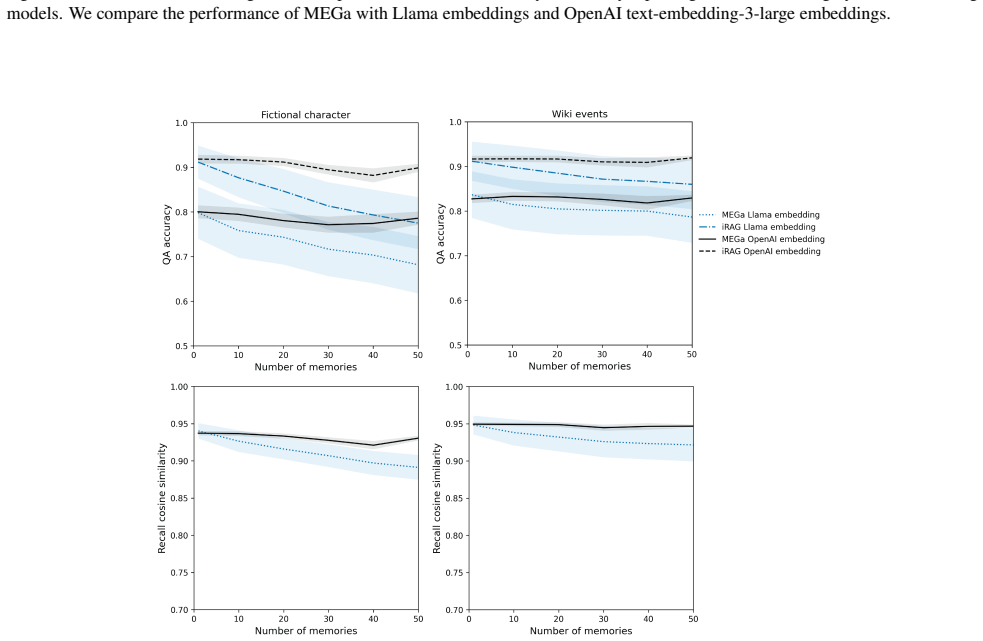
- The authors' own diagnostic—that gating failures, not adapter interference, drive the residual forgetting—suggests a cheap scaling path they did not pursue: replace the average-activation key with a contrastively trained or multi-vector retriever, which would raise the correct-gate rate without retraining any LoRA adapter. Their Figure 8 already shows a stronger embedding model cuts forgetting, so
- A stress test the paper does not run: store two memories that share the same protagonist, place, and date but differ in the outcome, then ask about the differing fact. Softmax gating cannot return two keys, so the model would either blend the adapters and hallucinate a mixture or choose only one memory; a winner-take-all or hierarchical gate would be needed for this kind of same-context, different
- If the gating analysis generalizes beyond 50 memories, MEGa's real bottleneck becomes retrieval, not storage: the adapter count and parameter count grow linearly with each memory, so at thousands of memories the softmax over all keys becomes a nearest-neighbor search problem. Treating the context keys as an index and the adapters as a separate engram store would make MEGa a hybrid of RAG and weigh
Signed reviews
Editorial analysis
A structured set of objections, weighed in public.
Referee Report
Summary. The paper introduces MEGa (Memory Embedded in Gated LLMs), a continual learning method that stores each new episodic memory in a dedicated LoRA adapter and, at inference, mixes adapters via softmax gating computed from the similarity between the query embedding and stored memory embeddings. The embedding function f is the average of the base model's internal activations at the input to the final MLP layer. Experiments on a synthetic fictional-character dataset and on Wikipedia 2024 events use 50 memories per partition over 20 partitions, with memory recall (cosine similarity), QA accuracy (GPT judge), and MMLU retention as the main metrics. MEGa is compared to full fine-tuning, LoRA, L2 and EWC regularization, batch learning, and RAG. The central claims are that MEGa mitigates catastrophic forgetting, achieves QA accuracy close to RAG, preserves general knowledge, and can answer compositional questions requiring knowledge from two memories.
Significance. If the results hold, MEGa is a useful and conceptually clean architecture-based approach to sequential knowledge injection: it requires no external database, uses a single unified embedding function, and the gating design is biologically motivated. The paper ships code and data, uses 20 dataset partitions and standard baselines, and reports means and standard deviations, which is good experimental practice. The strongest empirical results are the large gaps between MEGa and the regularization-based CL baselines on recall and QA, and the preservation of MMLU accuracy. However, the central mechanistic claim about gating is not backed by the measurements reported, and two design choices—hyperparameter selection for baselines and the construction of evaluation questions—require scrutiny before the comparison is fully convincing.
major comments (3)
- [Section 4.2, Eq. (3)-(4)] The paper attributes the residual decline in performance with an increasing number of stored memories to 'failures in the softmax-based gating selection mechanism' (Section 4.2) and supports this with correct-gate rates of 85.0% and 87.8% (Section 4.1). However, the correct-gate rate is defined only as argmax correctness; because inference weights in Eq. (3) are a softmax-weighted sum over all 50 adapters, even when the argmax is correct the other adapters contribute nonzero updates. The paper does not report QA accuracy or recall cosine conditioned on the top-1 gate being correct, nor the average probability mass assigned to the correct gate as the number of memories grows. Without such conditioning, the residual decline could be caused by softmax dilution or adapter interference, and the attribution to the gating selection mechanism is not established. I recommend an oracle-gating experiment that hard-selects the ground-truth adapter to separate these causes.
- [Appendix C (Table 4, Figure 6)] The main experiments choose L2 coefficient 0.1 even though the hyperparameter search in Table 4 shows that L2 coefficient 1.0 yields substantially better continual learning performance at the end of 50 samples (e.g., FULL L2 QA accuracy of 29.50% vs 27.73% on Fictional Character and 45.43% vs 33.20% on Wiki Events). The stated reason is that L2=1 fails to inject a single fictional character story due to refusal behavior. This means the baseline numbers in Table 1 are not the best achievable for L2-regularized baselines on the reported final metric, and the main comparison may overstate MEGa's advantage. Please either report the L2=1 results in Table 1 or justify why single-story refusal should exclude that hyperparameter while MEGa's own hyperparameters (beta, rank, alpha) are selected for best final performance.
- [Appendix E.1.3 and E.2] The evaluation questions are generated with an explicit instruction to 'provide AMPLE context in the question, including information from the original passage as context' (Appendix E.1.3), and compositional questions are similarly required to 'provide ample context from the content of the passages' (Appendix E.2). Since gating in Eq. (4) is based on the similarity between the query embedding and stored memory embeddings, this question construction likely inflates the reported correct-gate rates (85.0%/87.8%) relative to what a user would naturally ask. Please report retrieval accuracy and QA accuracy on questions that do not recapitulate the passage content, or at least quantify how gate accuracy depends on the amount of context in the question.
minor comments (4)
- [Table 1 caption] The RAG recall metric is defined as 'hit rate · 1 + (1 − hit rate) · c' without defining c in the caption; the text later defines c as the average cosine similarity between randomly selected training samples, but this should appear at the first use, and the hit rate should be reported separately.
- [Section 2.2 / References] One reference, 'Wang, Y., Liu, X., Chen, X., O'Brien, S., Wu, J., and McAuley, J. Self-updatable large language models by integrating context into model parameters. In The Thirteenth International Conference on Learning Representations.', lacks a year, unlike all other entries in the reference list.
- [Section 3.4.2] The GPT judge is run with temperature 1.0, which introduces stochasticity into the reported QA accuracies; the paper should either run the judge multiple times and report the variance, or use a lower temperature to make the evaluation deterministic.
- [Section 5 (Discussion)] The text contains a typo: 'Our preesent ''autobiographic'' stories' should be 'Our present ''autobiographic'' stories'.
Circularity Check
No significant circularity: MEGa is evaluated against external baselines and MMLU; Eq. (4) is a design choice, not a fitted derivation, and the self-citations are motivational rather than load-bearing.
full rationale
The paper's only formal relation, Eq. (4) (g = softmax(β f(q)^T K)), is a proposed inference mechanism rather than a derived prediction; MEGa's claims are evaluated against external baselines (RAG, full/LoRA continual fine-tuning, batch learning) and an external benchmark (MMLU) in Table 1. The paper does not fit a parameter and then present a closely related quantity as a prediction: β is stated as a design choice (β = 1 for main experiments, β = 0.1 for compositional questions), and L2/EWC coefficients are swept and reported as hyperparameters in Appendix C. The embedding f is used both for stored keys and query gating, but key-query similarity is an empirical property tested by the reported correct-gate rates (85.0% and 87.8%); it is not guaranteed by construction, so this is a potential weakness (gating errors limit scaling) rather than circularity. Self-citations (Shan et al. 2024; Li & Sompolinsky 2022; Kanter & Sompolinsky 1987) provide background motivation or prior theory and are not used to force the MEGa design or its evaluation. The manuscript also flags its own limitations (linear parameter growth, small memory scale, need for better embeddings), and none of those limitations amounts to a self-referential derivation. Overall, no load-bearing step reduces to its inputs.
Assumptions & free parameters
free parameters (4)
- gating softmax temperature beta =
1 for main experiments, 0.1 for compositional questions
- LoRA rank r and scaling factor alpha =
r=128, alpha=128
- L2 regularization coefficient lambda_L2 =
0.1
- EWC coefficient lambda_EWC =
1.0
assumptions (4)
- domain assumption The average of the base model's internal activations at the input to the final MLP layer is a reliable semantic embedding for matching user queries to stored memory paragraphs.
- domain assumption Independently fine-tuned per-sample LoRA adapters, when combined by softmax gating, produce minimal interference with each other and with the base model's general knowledge.
- domain assumption The GPT-4.5-generated paraphrases and QA pairs, and the GPT-o3-mini judge, accurately reflect memory content and answer correctness.
- domain assumption The softmax gating in Eq. (4) with temperature beta can be set to allow compositional mixing of two memories.
Cite this review
Pith. "Pith review of Memorization and Knowledge Injection in Gated LLMs." pith.science (2026). https://pith.science/paper/DONZPDT3
@misc{pith2026250421239,
  author       = {Pith},
  title        = {Pith review of: Memorization and Knowledge Injection in Gated LLMs},
  year         = {2026},
  howpublished = {\url{https://pith.science/paper/DONZPDT3}},
  note         = {Machine review of arXiv:2504.21239}
}
read the original abstract
Large Language Models (LLMs) currently struggle to sequentially add new memories and integrate new knowledge. These limitations contrast with the human ability to continuously learn from new experiences and acquire knowledge throughout life. Most existing approaches add memories either through large context windows or external memory buffers (e.g., Retrieval-Augmented Generation), and studies on knowledge injection rarely test scenarios resembling everyday life events. In this work, we introduce a continual learning framework, Memory Embedded in Gated LLMs (MEGa), which injects event memories directly into the weights of LLMs. Each memory is stored in a dedicated set of gated low-rank weights. During inference, a gating mechanism activates relevant memory weights by matching query embeddings to stored memory embeddings. This enables the model to both recall entire memories and answer related questions. On two datasets - fictional characters and Wikipedia events - MEGa outperforms baseline approaches in mitigating catastrophic forgetting. Our model draws inspiration from the complementary memory system of the human brain.
Figures


Figures from the paper (6 more)


Forward citations
Cited by 1 Pith paper
-
Diffusion-Inspired Masked Fine-Tuning for Knowledge Injection in Autoregressive LLMs
Masked fine-tuning enables autoregressive LLMs to inject new factual knowledge without paraphrases and with reversal-curse resistance, matching diffusion LLM advantages on QA tasks.
Reference graph
Works this paper leans on
-
[1]
write newline
" write newline "" before.all 'output.state := FUNCTION n.dashify 't := "" t empty not t #1 #1 substring "-" = t #1 #2 substring "--" = not "--" * t #2 global.max substring 't := t #1 #1 substring "-" = "-" * t #2 global.max substring 't := while if t #1 #1 substring * t #2 global.max substring 't := if while FUNCTION format.date year duplicate empty "emp...
-
[2]
Longbench: A bilingual, multitask benchmark for long context understanding
Bai, Y., Lv, X., Zhang, J., Lyu, H., Tang, J., Huang, Z., Du, Z., Liu, X., Zeng, A., Hou, L., et al. Longbench: A bilingual, multitask benchmark for long context understanding. arXiv preprint arXiv:2308.14508, 2023
arXiv 2023
-
[3]
Berglund, L., Tong, M., Kaufmann, M., Balesni, M., Stickland, A. C., Korbak, T., and Evans, O. The reversal curse: Llms trained on" a is b" fail to learn" b is a". arXiv preprint arXiv:2309.12288, 2023
arXiv 2023
-
[4]
Biderman, D., Portes, J., Ortiz, J. J. G., Paul, M., Greengard, P., Jennings, C., King, D., Havens, S., Chiley, V., Frankle, J., et al. Lora learns less and forgets less. arXiv preprint arXiv:2405.09673, 2024
arXiv 2024
-
[5]
and Schulz, E
Binz, M. and Schulz, E. Turning large language models into cognitive models. In The Twelfth International Conference on Learning Representations, 2024. URL https://openreview.net/forum?id=eiC4BKypf1
2024
-
[6]
Concepts as semantic pointers: A framework and computational model
Blouw, P., Solodkin, E., Thagard, P., and Eliasmith, C. Concepts as semantic pointers: A framework and computational model. Cognitive science, 40 0 (5): 0 1128--1162, 2016
2016
-
[7]
D., Dhariwal, P., Neelakantan, A., Shyam, P., Sastry, G., Askell, A., et al
Brown, T., Mann, B., Ryder, N., Subbiah, M., Kaplan, J. D., Dhariwal, P., Neelakantan, A., Shyam, P., Sastry, G., Askell, A., et al. Language models are few-shot learners. Advances in neural information processing systems, 33: 0 1877--1901, 2020
1901
-
[8]
Buehler, E. L. and Buehler, M. J. X-lora: Mixture of low-rank adapter experts, a flexible framework for large language models with applications in protein mechanics and molecular design. APL Machine Learning, 2 0 (2), 2024
2024
Show all 97 references
-
[9]
J., Chen, C.-T., Cheng, J.-H., and Huang, H.-H
Chan, B. J., Chen, C.-T., Cheng, J.-H., and Huang, H.-H. Don't do rag: When cache-augmented generation is all you need for knowledge tasks. arXiv preprint arXiv:2412.15605, 2024
2024 arXiv
-
[10]
How is chatgpt's behavior changing over time? arXiv preprint arXiv:2307.09009, 2023
Chen, L., Zaharia, M., and Zou, J. How is chatgpt's behavior changing over time? arXiv preprint arXiv:2307.09009, 2023
2023 arXiv
-
[11]
Recall and learn: Fine-tuning deep pretrained language models with less forgetting
Chen, S., Hou, Y., Cui, Y., Che, W., Liu, T., and Yu, X. Recall and learn: Fine-tuning deep pretrained language models with less forgetting. arXiv preprint arXiv:2004.12651, 2020
2004 arXiv
-
[12]
Empirical evaluation of gated recurrent neural networks on sequence modeling
Chung, J., Gulcehre, C., Cho, K., and Bengio, Y. Empirical evaluation of gated recurrent neural networks on sequence modeling. arXiv preprint arXiv:1412.3555, 2014
2014 arXiv
-
[13]
X., and Schulz, E
Coda-Forno, J., Binz, M., Wang, J. X., and Schulz, E. Cogbench: a large language model walks into a psychology lab. In Forty-first International Conference on Machine Learning, 2024. URL https://openreview.net/forum?id=Q3104y8djk
2024
-
[14]
Larimar: Large language models with episodic memory control
Das, P., Chaudhury, S., Nelson, E., Melnyk, I., Swaminathan, S., Dai, S., Lozano, A., Kollias, G., Chenthamarakshan, V., Dan, S., et al. Larimar: Large language models with episodic memory control. arXiv preprint arXiv:2403.11901, 2024
2024 arXiv
-
[15]
Research on the online update method for retrieval-augmented generation (rag) model with incremental learning
Fan, Y., Wang, Y., Liu, L., Tang, X., Sun, N., and Yu, Z. Research on the online update method for retrieval-augmented generation (rag) model with incremental learning. arXiv preprint arXiv:2501.07063, 2025
2025 arXiv
-
[16]
Switch transformers: Scaling to trillion parameter models with simple and efficient sparsity.(2021)
Fedus, W., Zoph, B., and Shazeer, N. Switch transformers: Scaling to trillion parameter models with simple and efficient sparsity.(2021). arXiv preprint cs.LG/2101.03961, 2021
2021 arXiv
-
[17]
A., Oomerjee, A., Christopoulou, F., Lampouras, G., Bou-Ammar, H., and Wang, J
Fountas, Z., Benfeghoul, M. A., Oomerjee, A., Christopoulou, F., Lampouras, G., Bou-Ammar, H., and Wang, J. Human-like episodic memory for infinite context llms. arXiv preprint arXiv:2407.09450, 2024
2024
-
[18]
French, R. M. Catastrophic forgetting in connectionist networks. Trends in cognitive sciences, 3 0 (4): 0 128--135, 1999
1999
-
[19]
and Stratos, K
Gangadhar, G. and Stratos, K. Model editing by standard fine-tuning. arXiv preprint arXiv:2402.11078, 2024
2024 arXiv
-
[20]
and Derrida, B
Gardner, E. and Derrida, B. Optimal storage properties of neural network models. Journal of Physics A: Mathematical and general, 21 0 (1): 0 271, 1988
1988
-
[21]
Does fine-tuning llms on new knowledge encourage hallucinations? arXiv preprint arXiv:2405.05904, 2024
Gekhman, Z., Yona, G., Aharoni, R., Eyal, M., Feder, A., Reichart, R., and Herzig, J. Does fine-tuning llms on new knowledge encourage hallucinations? arXiv preprint arXiv:2405.05904, 2024
2024 arXiv
-
[22]
J., Fiete, I., and Irie, K
Gershman, S. J., Fiete, I., and Irie, K. Key-value memory in the brain. arXiv preprint arXiv:2501.02950, 2025
2025 arXiv
-
[23]
Model editing at scale leads to gradual and catastrophic forgetting
Gupta, A., Rao, A., and Anumanchipalli, G. Model editing at scale leads to gradual and catastrophic forgetting. arXiv preprint arXiv:2401.07453, 2024 a
2024 arXiv
-
[24]
K., and Soares, G
Gupta, N., Kirtania, S., Gupta, P., Kariya, K., Gulwani, S., Iyer, A., Parthasarathy, S., Radhakrishna, A., Rajamani, S. K., and Soares, G. Stackfeed: Structured textual actor-critic knowledge base editing with feedback. arXiv preprint arXiv:2410.10584, 2024 b
-
[25]
J., Shu, Y., Gu, Y., Yasunaga, M., and Su, Y
Guti \'e rrez, B. J., Shu, Y., Gu, Y., Yasunaga, M., and Su, Y. Hipporag: Neurobiologically inspired long-term memory for large language models. In The Thirty-eighth Annual Conference on Neural Information Processing Systems, 2024
2024
-
[26]
Machine psychology: Investigating emergent capabilities and behavior in large language models using psychological methods
Hagendorff, T. Machine psychology: Investigating emergent capabilities and behavior in large language models using psychological methods. arXiv preprint arXiv:2303.13988, 1, 2023
2023 arXiv
-
[27]
A., Mukherjee, S., Tang, X., et al
Han, H., Wang, Y., Shomer, H., Guo, K., Ding, J., Lei, Y., Halappanavar, M., Rossi, R. A., Mukherjee, S., Tang, X., et al. Retrieval-augmented generation with graphs (graphrag). arXiv preprint arXiv:2501.00309, 2024
2024 arXiv
-
[28]
Aging with grace: Lifelong model editing with discrete key-value adaptors
Hartvigsen, T., Sankaranarayanan, S., Palangi, H., Kim, Y., and Ghassemi, M. Aging with grace: Lifelong model editing with discrete key-value adaptors. Advances in Neural Information Processing Systems, 36, 2024
2024
-
[29]
and Schmidhuber, J
Hochreiter, S. and Schmidhuber, J. Long short-term memory. Neural computation, 9 0 (8): 0 1735--1780, 1997
1997
-
[30]
Hopfield, J. J. Neural networks and physical systems with emergent collective computational abilities. Proceedings of the national academy of sciences, 79 0 (8): 0 2554--2558, 1982
1982
-
[31]
K.-M., Lin, T.-H., Liao, C.-W., Fang, H.-C., Huang, C.-W., and Chen, Y.-N
Hsueh, C.-H., Huang, P. K.-M., Lin, T.-H., Liao, C.-W., Fang, H.-C., Huang, C.-W., and Chen, Y.-N. Editing the mind of giants: An in-depth exploration of pitfalls of knowledge editing in large language models. arXiv preprint arXiv:2406.01436, 2024
2024 arXiv
-
[32]
J., Shen, Y., Wallis, P., Allen-Zhu, Z., Li, Y., Wang, S., Wang, L., and Chen, W
Hu, E. J., Shen, Y., Wallis, P., Allen-Zhu, Z., Li, Y., Wang, S., Wang, L., and Chen, W. Lora: Low-rank adaptation of large language models. arXiv preprint arXiv:2106.09685, 2021
2021 arXiv
-
[33]
Mitigating catastrophic forgetting in large language models with self-synthesized rehearsal
Huang, J., Cui, L., Wang, A., Yang, C., Liao, X., Song, L., Yao, J., and Su, J. Mitigating catastrophic forgetting in large language models with self-synthesized rehearsal. arXiv preprint arXiv:2403.01244, 2024
2024 arXiv
-
[34]
Janik, R. A. Aspects of human memory and large language models. arXiv preprint arXiv:2311.03839, 2023
2023 arXiv
-
[35]
Q., Sablayrolles, A., Roux, A., Mensch, A., Savary, B., Bamford, C., Chaplot, D
Jiang, A. Q., Sablayrolles, A., Roux, A., Mensch, A., Savary, B., Bamford, C., Chaplot, D. S., Casas, D. d. l., Hanna, E. B., Bressand, F., et al. Mixtral of experts. arXiv preprint arXiv:2401.04088, 2024
2024 arXiv
-
[36]
Jung, M. J. and Kim, J. Pmoe: Progressive mixture of experts with asymmetric transformer for continual learning. arXiv preprint arXiv:2407.21571, 2024
2024 arXiv
-
[37]
A rank stabilization scaling factor for fine-tuning with lora
Kalajdzievski, D. A rank stabilization scaling factor for fine-tuning with lora. arXiv preprint arXiv:2312.03732, 2023
2023 arXiv
-
[38]
Unfamiliar finetuning examples control how language models hallucinate
Kang, K., Wallace, E., Tomlin, C., Kumar, A., and Levine, S. Unfamiliar finetuning examples control how language models hallucinate. arXiv preprint arXiv:2403.05612, 2024
2024 arXiv
-
[39]
and Sompolinsky, H
Kanter, I. and Sompolinsky, H. Associative recall of memory without errors. Physical Review A, 35 0 (1): 0 380, 1987
1987
-
[40]
A., Milan, K., Quan, J., Ramalho, T., Grabska-Barwinska, A., et al
Kirkpatrick, J., Pascanu, R., Rabinowitz, N., Veness, J., Desjardins, G., Rusu, A. A., Milan, K., Quan, J., Ramalho, T., Grabska-Barwinska, A., et al. Overcoming catastrophic forgetting in neural networks. Proceedings of the national academy of sciences, 114 0 (13): 0 3521--3526, 2017
2017
-
[41]
and Sompolinsky, H
Kleinfeld, D. and Sompolinsky, H. Associative neural network model for the generation of temporal patterns. theory and application to central pattern generators. Biophysical journal, 54 0 (6): 0 1039--1051, 1988
1988
-
[42]
M., and Raghunathan, A
Kotha, S., Springer, J. M., and Raghunathan, A. Understanding catastrophic forgetting in language models via implicit inference. arXiv preprint arXiv:2309.10105, 2023
2023 arXiv
-
[43]
Knowledge injection via prompt distillation
Kujanp \"a \"a , K., Valpola, H., and Ilin, A. Knowledge injection via prompt distillation. arXiv preprint arXiv:2412.14964, 2024
2024 arXiv
-
[44]
Mixout: Effective regularization to finetune large-scale pretrained language models
Lee, C., Cho, K., and Kang, W. Mixout: Effective regularization to finetune large-scale pretrained language models. arXiv preprint arXiv:1909.11299, 2019
1909 arXiv
-
[45]
Zero-shot relation extraction via reading comprehension
Levy, O., Seo, M., Choi, E., and Zettlemoyer, L. Zero-shot relation extraction via reading comprehension. arXiv preprint arXiv:1706.04115, 2017
2017 arXiv
-
[46]
u ttler, H., Lewis, M., Yih, W.-t., Rockt \
Lewis, P., Perez, E., Piktus, A., Petroni, F., Karpukhin, V., Goyal, N., K \"u ttler, H., Lewis, M., Yih, W.-t., Rockt \"a schel, T., et al. Retrieval-augmented generation for knowledge-intensive nlp tasks. Advances in Neural Information Processing Systems, 33: 0 9459--9474, 2020
2020
-
[47]
Z., Liu, E., Ross, A., Zeitoun, A., Neubig, G., and Andreas, J
Li, B. Z., Liu, E., Ross, A., Zeitoun, A., Neubig, G., and Andreas, J. Language modeling with editable external knowledge. arXiv preprint arXiv:2406.11830, 2024
2024 arXiv
-
[48]
and Sompolinsky, H
Li, Q. and Sompolinsky, H. Globally gated deep linear networks. Advances in Neural Information Processing Systems, 35: 0 34789--34801, 2022
2022
-
[49]
On the storage capacity of hopfield models with correlated patterns
L \"o we, M. On the storage capacity of hopfield models with correlated patterns. The Annals of Applied Probability, 8 0 (4): 0 1216--1250, 1998
1998
-
[50]
Moelora: Contrastive learning guided mixture of experts on parameter-efficient fine-tuning for large language models
Luo, T., Lei, J., Lei, F., Liu, W., He, S., Zhao, J., and Liu, K. Moelora: Contrastive learning guided mixture of experts on parameter-efficient fine-tuning for large language models. arXiv preprint arXiv:2402.12851, 2024
2024 arXiv
-
[51]
An empirical study of catastrophic forgetting in large language models during continual fine-tuning
Luo, Y., Yang, Z., Meng, F., Li, Y., Zhou, J., and Zhang, Y. An empirical study of catastrophic forgetting in large language models during continual fine-tuning. arXiv preprint arXiv:2308.08747, 2023
2023 arXiv
-
[52]
L., McNaughton, B
McClelland, J. L., McNaughton, B. L., and Lampinen, A. K. Integration of new information in memory: new insights from a complementary learning systems perspective. Philosophical Transactions of the Royal Society B, 375 0 (1799): 0 20190637, 2020
2020
-
[53]
Mecklenburg, N., Lin, Y., Li, X., Holstein, D., Nunes, L., Malvar, S., Silva, B., Chandra, R., Aski, V., Yannam, P. K. R., et al. Injecting new knowledge into large language models via supervised fine-tuning. arXiv preprint arXiv:2404.00213, 2024
2024 arXiv
-
[54]
Locating and editing factual associations in gpt
Meng, K., Bau, D., Andonian, A., and Belinkov, Y. Locating and editing factual associations in gpt. Advances in Neural Information Processing Systems, 35: 0 17359--17372, 2022 a
2022
-
[55]
S., Andonian, A., Belinkov, Y., and Bau, D
Meng, K., Sharma, A. S., Andonian, A., Belinkov, Y., and Bau, D. Mass-editing memory in a transformer. arXiv preprint arXiv:2210.07229, 2022 b
2022 arXiv
-
[56]
Mitchell, E., Lin, C., Bosselut, A., Finn, C., and Manning, C. D. Fast model editing at scale. arXiv preprint arXiv:2110.11309, 2021
2021 arXiv
-
[57]
o ksal, A., Imani, A., Fayyaz, M., and Sch \
Modarressi, A., K \"o ksal, A., Imani, A., Fayyaz, M., and Sch \"u tze, H. Memllm: Finetuning llms to use an explicit read-write memory. arXiv preprint arXiv:2404.11672, 2024
2024 arXiv
-
[58]
Few-shot fine-tuning vs
Mosbach, M., Pimentel, T., Ravfogel, S., Klakow, D., and Elazar, Y. Few-shot fine-tuning vs. in-context learning: A fair comparison and evaluation. arXiv preprint arXiv:2305.16938, 2023
2023 arXiv
-
[59]
Sgpt: Gpt sentence embeddings for semantic search
Muennighoff, N. Sgpt: Gpt sentence embeddings for semantic search. arXiv preprint arXiv:2202.08904, 2022
2022 arXiv
-
[60]
Short-term memory and long-term memory are still different
Norris, D. Short-term memory and long-term memory are still different. Psychological bulletin, 143 0 (9): 0 992, 2017
2017
-
[61]
Fine-tuning or retrieval? comparing knowledge injection in llms
Ovadia, O., Brief, M., Mishaeli, M., and Elisha, O. Fine-tuning or retrieval? comparing knowledge injection in llms. arXiv preprint arXiv:2312.05934, 2023
2023 arXiv
-
[62]
Propagating knowledge updates to lms through distillation
Padmanabhan, S., Onoe, Y., Zhang, M., Durrett, G., and Choi, E. Propagating knowledge updates to lms through distillation. Advances in Neural Information Processing Systems, 36, 2024
2024
-
[63]
In-context editing: Learning knowledge from self-induced distributions
Qi, S., Yang, B., Jiang, K., Wang, X., Li, J., Zhong, Y., Yang, Y., and Zheng, Z. In-context editing: Learning knowledge from self-induced distributions. arXiv preprint arXiv:2406.11194, 2024
2024 arXiv
-
[64]
Memorag: Boosting long context processing with global memory-enhanced retrieval augmentation
Qian, H., Liu, Z., Zhang, P., Mao, K., Lian, D., Dou, Z., and Huang, T. Memorag: Boosting long context processing with global memory-enhanced retrieval augmentation. 2025
2025
-
[65]
L., Poeppel, D., and Vo, V
Raccah, O., Chen, P., Willke, T. L., Poeppel, D., and Vo, V. A. Memory in humans and deep language models: Linking hypotheses for model augmentation. arXiv preprint arXiv:2210.01869, 2022
2022 arXiv
-
[66]
Saxe, A., Sodhani, S., and Lewallen, S. J. The neural race reduction: Dynamics of abstraction in gated networks. In International Conference on Machine Learning, pp.\ 19287--19309. PMLR, 2022
2022
-
[67]
Efficiency of local learning rules in threshold-linear associative networks
Sch \"o nsberg, F., Roudi, Y., and Treves, A. Efficiency of local learning rules in threshold-linear associative networks. Physical Review Letters, 126 0 (1): 0 018301, 2021
2021
-
[68]
A rapid and efficient learning rule for biological neural circuits
Sezener, E., Grabska-Barwi \'n ska, A., Kostadinov, D., Beau, M., Krishnagopal, S., Budden, D., Hutter, M., Veness, J., Botvinick, M., Clopath, C., et al. A rapid and efficient learning rule for biological neural circuits. BioRxiv, pp.\ 2021--03, 2021
2021
-
[69]
Stochastic consolidation of lifelong memory
Shaham, N., Chandra, J., Kreiman, G., and Sompolinsky, H. Stochastic consolidation of lifelong memory. Scientific Reports, 12 0 (1): 0 13107, 2022
2022
-
[70]
Order parameters and phase transitions of continual learning in deep neural networks
Shan, H., Li, Q., and Sompolinsky, H. Order parameters and phase transitions of continual learning in deep neural networks. arXiv preprint arXiv:2407.10315, 2024
2024 arXiv
-
[71]
Outrageously large neural networks: The sparsely-gated mixture-of-experts layer
Shazeer, N., Mirhoseini, A., Maziarz, K., Davis, A., Le, Q., Hinton, G., and Dean, J. Outrageously large neural networks: The sparsely-gated mixture-of-experts layer. arXiv preprint arXiv:1701.06538, 2017
2017 arXiv
-
[72]
Continual learning of large language models: A comprehensive survey
Shi, H., Xu, Z., Wang, H., Qin, W., Wang, W., Wang, Y., Wang, Z., Ebrahimi, S., and Wang, H. Continual learning of large language models: A comprehensive survey. arXiv preprint arXiv:2404.16789, 2024
2024 arXiv
-
[73]
and Sutton, R
Silver, D. and Sutton, R. S. Welcome to the era of experience. Preprint of a chapter to appear in Designing an Intelligence, edited by George Konidaris, MIT Press (forthcoming)., April 2025
2025
-
[74]
How to complete domain tuning while keeping general ability in llm: Adaptive layer-wise and element-wise regularization
Song, S., Xu, H., Ma, J., Li, S., Peng, L., Wan, Q., Liu, X., and Yu, J. How to complete domain tuning while keeping general ability in llm: Adaptive layer-wise and element-wise regularization. arXiv preprint arXiv:2501.13669, 2025
2025 arXiv
-
[75]
Lamol: Language modeling for lifelong language learning
Sun, F.-K., Ho, C.-H., and Lee, H.-Y. Lamol: Language modeling for lifelong language learning. arXiv preprint arXiv:1909.03329, 2019
1909 arXiv
-
[76]
Teyler, T. J. and DiScenna, P. The hippocampal memory indexing theory. Behavioral neuroscience, 100 0 (2): 0 147, 1986
1986
-
[77]
Understanding the limits of lifelong knowledge editing in llms
Thede, L., Roth, K., Bethge, M., Akata, Z., and Hartvigsen, T. Understanding the limits of lifelong knowledge editing in llms. arXiv preprint arXiv:2503.05683, 2025
2025
-
[78]
Gated linear networks
Veness, J., Lattimore, T., Budden, D., Bhoopchand, A., Mattern, C., Grabska-Barwinska, A., Sezener, E., Wang, J., Toth, P., Schmitt, S., et al. Gated linear networks. In Proceedings of the AAAI conference on artificial intelligence, volume 35, pp.\ 10015--10023, 2021
2021
-
[79]
Wise: Rethinking the knowledge memory for lifelong model editing of large language models
Wang, P., Li, Z., Zhang, N., Xu, Z., Yao, Y., Jiang, Y., Xie, P., Huang, F., and Chen, H. Wise: Rethinking the knowledge memory for lifelong model editing of large language models. Advances in Neural Information Processing Systems, 37: 0 53764--53797, 2024 a
2024
-
[80]
Self-updatable large language models by integrating context into model parameters
Wang, Y., Liu, X., Chen, X., O'Brien, S., Wu, J., and McAuley, J. Self-updatable large language models by integrating context into model parameters. In The Thirteenth International Conference on Learning Representations
-
[81]
Towards lifespan cognitive systems
Wang, Y., Han, C., Wu, T., He, X., Zhou, W., Sadeq, N., Chen, X., He, Z., Wang, W., Haffari, G., et al. Towards lifespan cognitive systems. arXiv preprint arXiv:2409.13265, 2024 b
2024 arXiv
-
[82]
Infllm: Training-free long-context extrapolation for llms with an efficient context memory
Xiao, C., Zhang, P., Han, X., Xiao, G., Lin, Y., Zhang, Z., Liu, Z., and Sun, M. Infllm: Training-free long-context extrapolation for llms with an efficient context memory. arXiv preprint arXiv:2402.04617, 2024
2024 arXiv
-
[83]
Meteora: Multiple-tasks embedded lora for large language models
Xu, J., Lai, J., and Huang, Y. Meteora: Multiple-tasks embedded lora for large language models. arXiv preprint arXiv:2405.13053, 2024 a
2024 arXiv
-
[84]
Xu, Z., Jiang, F., Niu, L., Deng, Y., Poovendran, R., Choi, Y., and Lin, B. Y. Magpie: Alignment data synthesis from scratch by prompting aligned llms with nothing. arXiv preprint arXiv:2406.08464, 2024 b
2024 arXiv
-
[85]
Model merging in llms, mllms, and beyond: Methods, theories, applications and opportunities
Yang, E., Shen, L., Guo, G., Wang, X., Cao, X., Zhang, J., and Tao, D. Model merging in llms, mllms, and beyond: Methods, theories, applications and opportunities. arXiv preprint arXiv:2408.07666, 2024 a
2024 arXiv
-
[86]
Memory3: Language modeling with explicit memory
Yang, H., Lin, Z., Wang, W., Wu, H., Li, Z., Tang, B., Wei, W., Wang, J., Tang, Z., Song, S., et al. Memory3: Language modeling with explicit memory. arXiv preprint arXiv:2407.01178, 2024 b
2024 arXiv
-
[87]
A., and Lam, W
Yang, H., Zhang, Y., Xu, J., Lu, H., Heng, P. A., and Lam, W. Unveiling the generalization power of fine-tuned large language models. arXiv preprint arXiv:2403.09162, 2024 c
2024 arXiv
-
[88]
The butterfly effect of model editing: Few edits can trigger large language models collapse
Yang, W., Sun, F., Ma, X., Liu, X., Yin, D., and Cheng, X. The butterfly effect of model editing: Few edits can trigger large language models collapse. arXiv preprint arXiv:2402.09656, 2024 d
2024 arXiv
-
[89]
Melo: Enhancing model editing with neuron-indexed dynamic lora
Yu, L., Chen, Q., Zhou, J., and He, L. Melo: Enhancing model editing with neuron-indexed dynamic lora. In Proceedings of the AAAI Conference on Artificial Intelligence, volume 38, pp.\ 19449--19457, 2024
2024
-
[90]
J., and Ma, Y
Zhai, Y., Tong, S., Li, X., Cai, M., Qu, Q., Lee, Y. J., and Ma, Y. Investigating the catastrophic forgetting in multimodal large language model fine-tuning. In Conference on Parsimony and Learning, pp.\ 202--227. PMLR, 2024
2024
-
[91]
Dh-rag: A dynamic historical context-powered retrieval-augmented generation method for multi-turn dialogue
Zhang, F., Zhu, D., Ming, J., Jin, Y., Chai, D., Yang, L., Tian, H., Fan, Z., and Chen, K. Dh-rag: A dynamic historical context-powered retrieval-augmented generation method for multi-turn dialogue. arXiv preprint arXiv:2502.13847, 2025
2025 arXiv
-
[92]
A comprehensive study of knowledge editing for large language models
Zhang, N., Yao, Y., Tian, B., Wang, P., Deng, S., Wang, M., Xi, Z., Mao, S., Zhang, J., Ni, Y., et al. A comprehensive study of knowledge editing for large language models. arXiv preprint arXiv:2401.01286, 2024
2024 arXiv
-
[93]
Q., and Artzi, Y
Zhang, T., Wu, F., Katiyar, A., Weinberger, K. Q., and Artzi, Y. Revisiting few-sample bert fine-tuning. arXiv preprint arXiv:2006.05987, 2020
2006 arXiv
-
[94]
and Wu, J
Zhang, X. and Wu, J. Dissecting learning and forgetting in language model finetuning. In The Twelfth International Conference on Learning Representations, 2024
2024
-
[95]
Loraretriever: Input-aware lora retrieval and composition for mixed tasks in the wild
Zhao, Z., Gan, L., Wang, G., Zhou, W., Yang, H., Kuang, K., and Wu, F. Loraretriever: Input-aware lora retrieval and composition for mixed tasks in the wild. arXiv preprint arXiv:2402.09997, 2024
2024 arXiv
-
[96]
Model tailor: Mitigating catastrophic forgetting in multi-modal large language models
Zhu, D., Sun, Z., Li, Z., Shen, T., Yan, K., Ding, S., Kuang, K., and Wu, C. Model tailor: Mitigating catastrophic forgetting in multi-modal large language models. arXiv preprint arXiv:2402.12048, 2024 a
2024 arXiv
-
[97]
Initializing and retrofitting key-value adaptors for traceable model editing
Zhu, H., Lan, Y., Li, X., and Qian, W. Initializing and retrofitting key-value adaptors for traceable model editing. 2024 b
2024
Reviewed August 16, 2026 · model on record in the stance chip above.
Discussion (0). Continue with ORCID to comment.