REVIEW 4 major objections 5 minor 46 references
FAST-Q: Fast-track Exploration with Adversarially Balanced State Representations for Counterfactual Action Estimation in Offline Reinforcement Learning
T0 review · 4 major / 5 minor · reviewed 2026-08-16 · deepseek-v4-flash
Pith's one-line read FAST-Q claims that adversarially balancing state representations across policies enables offline reinforcement learning to estimate counterfactual actions reliably, and reports live-platform gains in returns, lifetime value, engagement…
desk verdict A solid engineering contribution that imports domain-adversarial training into offline recommender RL, but the 'counterfactual estimation' claim is not backed by validation; the paper deserves peer review with a request for a ground-truth check or a softened claim. read the letter →
The pith
A machine-rendered reading of the paper's core claim, the machinery that carries it, and where it could break.
The reading
What carries the argument
The Balancing Representation $\Theta(\beta(S_t))$ is the load-bearing object: each policy expert's LSTM hidden state passes through a dense layer, and the result is trained adversarially so that a softmax policy classifier cannot tell which policy produced the state while a critic still predicts outcomes from it. The Gradient Reversal Layer forces the representation to trade off policy invariance against outcome prediction. This representation feeds an actor-critic built on TD3+BC-style behavior-cloning regularization, while a complementary loss decomposes the critic output into per-reward-dimension weights for dwell time, engagement, return time, and an overflow term, which keeps Q-values bounded and makes objective priority explainable. A stepwise discount schedule and an $\epsilon$-greedy sampler of counterfactual actions complete the training loop.
What would settle it
Run a prospective experiment where players are randomly reassigned among the three policies, record the actual rewards for actions that FAST-Q would have judged counterfactual, and compare realized rewards with FAST-Q's predicted Q-values. If the prediction error is systematically larger for actions originating from non-serving policies than for actions from the serving policy, balancing has not removed the policy bias; equivalently, a held-out policy classifier that retains above-chance accuracy on the balanced representation would falsify the invariance.
Extended reading notes
Core claim
The paper's central claim is that a Balanced Representation, built by training a policy classifier with a Gradient Reversal Layer so that the representation maximizes policy-classification error while minimizing critic loss, makes the state representation invariant to which policy generated it. Under that invariance, the supervised critic estimates $E[R_t \mid \Theta(\beta(S_t)), A_t]$ as the counterfactual outcome of any policy's action, and the actor can be trained on counterfactual actions sampled from other policy experts without the Q-value overestimation that out-of-distribution clipping causes. The paper also claims that decomposing the critic's Q-value into per-objective weighted components yields both explainable objective prioritization and more reliable Q-values, and that removing any of the three components—balanced representation, offline exploration, or Q-value decomposition—measurably lowers estimated returns.
Load-bearing premise
The load-bearing premise is that after gradient-reversal balancing the representation $\Theta(\beta(S_t))$ carries no information about which policy produced the data, so the critic's estimate equals the true counterfactual outcome; the paper assumes this invariance rather than validating it against ground-truth counterfactuals.
Editorial extensions
If this is right
- Offline counterfactual exploration becomes possible: the actor can sample actions from non-serving policies during training, so learning no longer waits for online experiments on those policies.
- Recommender policies can be compared and switched on static logs; the paper reports FAST-Q favoring a new mix of the three platform policies rather than any single one.
- The balanced representation widens the spread of Q-values across counterfactual actions, which is evidence that the critic can actually distinguish alternatives instead of collapsing onto one narrow band.
- Multi-objective Q-decomposition gives per-player, per-time priority weights, making recommendations explainable while keeping Q-values bounded; the paper reports that ablating it drops maximum achievable Q-values by about 40%.
- On the live platform, the claims translate to at least 0.15% higher player returns, 2% higher lifetime value, 0.4% higher engagement, 2% higher dwell time, and at least 10% lower recommendation cost over the SOTA baselines.
Reading between the lines
- Beyond the paper, the same balancing trick should transfer to any logged recommender or decision-support setting where experimental path logic biases state coverage, such as personalized pricing, content feeds, or clinical treatment assignment.
- A direct testable extension is to train the policy classifier on a held-out set of states and measure whether its accuracy is at chance after the gradient-reversal step; residual accuracy would quantify how much policy bias survives.
- The paper's own report that training stops at a discount factor of 0.7 leaves long-horizon behavior of the decomposed Q-values uncharacterized; whether the decomposition loss permits higher discounts with a slower schedule is an open question.
- Because the platform's A/B conclusion framework uses permutation testing with support percentages rather than classical normality assumptions, the reported lifts are tied to that inferential choice; re-analyzing the same logs with different tests would show sensitivity.
Signed reviews
Editorial analysis
A structured set of objections, weighed in public.
Referee Report
Summary. The paper proposes FAST-Q, an offline reinforcement learning method for challenge recommendation on a real-money gaming platform. The architecture combines per-policy LSTM-based "policy experts," a gradient reversal layer that learns a policy-balanced state representation, a TD3-style actor-critic with behavior cloning, a Q-value decomposition into learned weights over reward components, and epsilon-greedy selection of counterfactual actions from other policies. Evaluation consists of retrospective offline analyses, a 21-day online A/B test against TD3+BC, Diffusion-QL, and two in-house policies, and D4RL Gym-MuJoCo benchmarks. The paper reports improvements in engagement, dwell time, LTV, and reduced recommendation cost, and claims that the balanced representation enables counterfactual action estimation.
Significance. If the counterfactual estimation claim were established, this would be a valuable practical advance: it directly targets multi-policy logged data with state-space shift, provides a deployed system with a real A/B test, ships code and hyperparameters, and compares against strong baselines. The D4RL experiments and ablations are also useful for the community. However, the central causal claim is not currently validated: the balancing procedure is not shown to remove confounding, and most offline evidence is based on the model's own Q-values rather than ground-truth counterfactual outcomes. The real-world A/B results are a strength, but they do not by themselves identify which component causes the observed gains.
major comments (4)
- [Section 3.4] The balancing condition in Section 3.4 asserts that after adversarial training the critic estimates E[R_t | Θ(β(S_t)), A_t] as a counterfactual outcome, but the condition only enforces invariance of the representation distribution across observed policies conditional on each policy's predicted action. It does not establish unconfoundedness (sequential ignorability), positivity, or consistency; these assumptions are never stated or verified. The text itself identifies player intent as a driver of both actions and rewards, so if intent is not fully captured in S_t, or if state support does not overlap across policies, the counterfactual Q-values remain biased. No experiment compares estimated counterfactual values against ground truth: the higher Q-spread in Figure 13 and the lower dropout variance in Figure 16 are internal consistency checks, not correctness checks. The D4RL experiments in Section 4.4 use single-policy datasets and therefore cannot test cross-policy counterfactual validity. I recommend either adding semi-synthetic validation with known counterfactual outcomes and overlap/positivity diagnostics, or explicitly reframing the contribution as robust out-of-distribution generalization rather than causal counterfactual estimation.
- [Section 3.5.2] The Q-value decomposition weights w1..w3 (and overflow w4) are optimized to minimize (R^i_t - w_i Q(s,a))^2, and Figures 10-12 then report these same weights as "objective prioritization." This interpretation is circular: the weights restate the fitted linear relationship between the scalar Q and the reward components; they are not an independent explanation of the agent's trade-offs. Furthermore, because Q is a discounted sum of future rewards rather than the instantaneous reward vector, the loss does not in general identify the contribution of each objective to Q. The paper should validate the decomposition on held-out reward-component prediction or against known objective preferences, or the explainability claim should be softened.
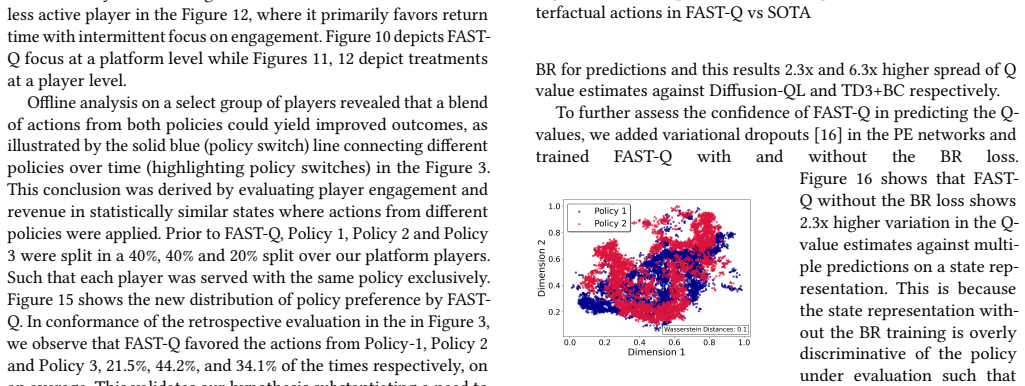
- [Sections 4.2.3 and 4.2.4] The claimed offline "time speedup" and the ablation effects are measured in terms of FAST-Q's own Q-values normalized to its own full-data or deployed model (Figures 17 and 18). Faster convergence of internal Q-values under counterfactual exploration does not establish that a better policy is learned faster; a biased critic can converge quickly. These analyses should be reported with a policy-performance measure such as normalized return on a held-out evaluation set or D4RL-style scores, or at minimum the paper should state clearly that only internal Q-value convergence is being measured.
- [Section 4.4 and Table 2] The adaptation to single-policy D4RL datasets is under-specified and internally inconsistent. Removing the PE layer and "modifying BR layer training" is not sufficient for reproducibility: gradient reversal requires a domain/policy classifier, but a single-policy medium-v0 dataset has no policy labels. The paper should specify what domains are used, how the GRL is trained, and why this still corresponds to the proposed method. In addition, the text states that FAST-Q "misses on two out of the remaining three by narrow margins," but Table 2 shows three losses, including halfcheetah-medium-expert-v0 with a severe degradation (50.9 vs 97.9). This inconsistency should be corrected and the applicability claim tempered.
minor comments (5)
- [Section 3.3] The "weighted MSE loss" for the policy experts does not specify the weights applied to the three action dimensions; please provide the exact weighting.
- [Section 3.5.2] Please clarify how the softmax over the four weights interacts with the three reward components and with the cost objective, which the text says is not controlled; the relationship between C=3 and four weights needs a precise statement.
- [Section 3.5.3] The inability to increase the discount factor beyond gamma=0.7 is a substantive limitation for long-term objectives and should be acknowledged in the conclusion as well as in the body.
- [Section 4.2.1] The retrospective analysis that led to the "policy switch" conclusion is not described: please provide the matching or confounder-adjustment procedure used to define "statistically similar states."
- [Throughout] There are typographical and consistency issues, including "Grandient" in Section 1, "Diffuion-QL" in the Conclusion, and inconsistent capitalization of "FAST-Q" versus "Fast-Q" in Table 2 and elsewhere.
Circularity Check
Q-decomposition 'explainability' and offline-exploration 'speedup' reduce to the model's own fitted weights and Q-values; central system claims retain external online/D4RL support.
-
fitted input called prediction
[Section 3.5.2 (Ldecomp) and Section 4.2.1 / Figure 10]
"Weights w1, w2, w3 are trained to estimate the following objective metrics: Ldecomp = Σ_{i=1}^C [(R_i_t − w_i ∗ Q(S^BR_t, A_t))^2]/C ... Figure 10 shows normalized distribution of the objectives for players with high organic intent to play, FAST-Q puts major focus on the return time followed by players’ engagement to keep them active on the platform."
The weights are the parameters fitted by minimizing the MSE between w_i*Q and the reward component R_i. The 'objective prioritization' insight in Section 4.2.1 is read directly off those same fitted weights. No external ground truth, human label, or held-out objective-priority measure is used; the explanation is therefore a restatement of the training fit. If the loss had been defined differently, the reported 'focus' would change by construction, so this contribution does not test any hypothesis about the model's priorities.
-
other
[Section 4.2.3 / Figure 17]
"Figure 17 shows a comparative analysis of the model’s performance, normalized with respect to the Q-values of the FAST-Q model trained on the complete dataset, highlighting the impact of exploration. The graph demonstrates that enabling the exploration component accelerates the learning process. For instance, the return for the model trained with exploration on 2 months of data is equivalent to model trained without exploration on 3 months of data."
The 'performance' and 'return' used to measure speedup are FAST-Q's own Q-values, normalized by the Q-values of the final FAST-Q model. The exploration component selects actions to maximize this same critic, so the comparison shows convergence to a self-generated target rather than to an external counterfactual return. A model with systematically biased Q-values would exhibit the same 'speedup'; the evaluation cannot distinguish correct counterfactual estimation from self-consistency. Thus the offline-exploration speedup claim is validated only on the model's own output.
full rationale
The clearest circular steps are local. The Q-decomposition 'explainable objective prioritization' is a fitted parameter reported as an insight: w1..w3 are solved to reconstruct reward components, and Section 4.2.1 then presents those weights as the model's discovered priorities. Similarly, the offline-exploration speedup (Figure 17) is measured against FAST-Q's own Q-values rather than any external benchmark, making it a self-consistency check. The paper's central counterfactual-identification claim (Section 3.4) is not an independent derivation: the balancing condition only equalizes representation distributions across policies, and the step to 'estimates the counterfactual outcomes as E[R_t|Θ,A_t]' is an asserted identification assumption, not a consequence of the equations. This is a validity gap rather than an equation-level circularity, but it means the counterfactual component is not externally falsified by Table 2 (single-policy D4RL) or by the aggregate online A/B metrics. The paper's own limitation that γ could not be raised beyond 0.7 (Section 3.5.3) further weakens long-term counterfactual claims. Offsetting these, the paper does contain independent content: the 21-day online A/B test on the real platform and the D4RL normalized scores compare against external baselines and are not forced by the fitted weights, so the system-level improvement claims are not wholly circular. Weighing the self-referential Q-decomposition explanation and the internal speedup metric against this external evidence, the appropriate score is 6: partial circularity in two load-bearing evaluation/explanation steps, while the overall paper retains independent empirical content.
Assumptions & free parameters
free parameters (6)
- critic loss mixing weight alpha =
0.75
- discount factor gamma schedule =
0.1 to 0.7
- exploration factor epsilon =
0.1 to 0.5
- Q-decomposition weights w1..w4 =
learned (values not reported)
- actor BC scaling lambda =
alpha / mean(|Q|) with alpha = 2.5
- reward normalization functions =
Engagement=(6-b)/6, Return=1-sin((6-a)/2)
assumptions (4)
- domain assumption Adversarially balanced representations remove policy-specific confounding
- ad hoc to paper The scalar Q can be decomposed as weighted reward components via learned weights
- domain assumption Behavior cloning on counterfactual actions does not induce Q overestimation
- domain assumption LSTM state history captures time-varying confounders
Cite this review
Pith. "Pith review of FAST-Q: Fast-track Exploration with Adversarially Balanced State Representations for Counterfactual Action Estimation in Offline Reinforcement Learning." pith.science (2026). https://pith.science/paper/OAGN6RIF
@misc{pith2026250421383,
  author       = {Pith},
  title        = {Pith review of: FAST-Q: Fast-track Exploration with Adversarially Balanced State Representations for Counterfactual Action Estimation in Offline Reinforcement Learning},
  year         = {2026},
  howpublished = {\url{https://pith.science/paper/OAGN6RIF}},
  note         = {Machine review of arXiv:2504.21383}
}
read the original abstract
Recent advancements in state-of-the-art (SOTA) offline reinforcement learning (RL) have primarily focused on addressing function approximation errors, which contribute to the overestimation of Q-values for out-of-distribution actions, a challenge that static datasets exacerbate. However, high stakes applications such as recommendation systems in online gaming, introduce further complexities due to player's psychology (intent) driven by gameplay experiences and the inherent volatility on the platform. These factors create highly sparse, partially overlapping state spaces across policies, further influenced by the experiment path selection logic which biases state spaces towards specific policies. Current SOTA methods constrain learning from such offline data by clipping known counterfactual actions as out-of-distribution due to poor generalization across unobserved states. Further aggravating conservative Q-learning and necessitating more online exploration. FAST-Q introduces a novel approach that (1) leverages Gradient Reversal Learning to construct balanced state representations, regularizing the policy-specific bias between the player's state and action thereby enabling counterfactual estimation; (2) supports offline counterfactual exploration in parallel with static data exploitation; and (3) proposes a Q-value decomposition strategy for multi-objective optimization, facilitating explainable recommendations over short and long-term objectives. These innovations demonstrate superiority of FAST-Q over prior SOTA approaches and demonstrates at least 0.15 percent increase in player returns, 2 percent improvement in lifetime value (LTV), 0.4 percent enhancement in the recommendation driven engagement, 2 percent improvement in the player's platform dwell time and an impressive 10 percent reduction in the costs associated with the recommendation, on our volatile gaming platform.
Figures


Figures from the paper (12 more)




Reference graph
Works this paper leans on
-
[1]
Pulkit Agrawal, Aditya Pareek, Rukma Talwadker, and Tridib Mukherjee. 2024. ARGO - An AI Based Responsible Gamification Framework for Online Skill Gaming Platform. Association for Computing Machinery, New York, NY, USA. https://doi.org/10.1145/3632410.3632455
arXiv 2024
-
[2]
Breunig, Hans-Peter Kriegel, and Jörg Sander
Mihael Ankerst, Markus M. Breunig, Hans-Peter Kriegel, and Jörg Sander. 1999. OPTICS: ordering points to identify the clustering structure. InProceedings of the 1999 ACM SIGMOD International Conference on Management of Data . Association for Computing Machinery, New York, NY, USA
work page 1999
-
[3]
Leon Barrett and Srini Narayanan. 2008. Learning all optimal policies with multiple criteria. In Proceedings of the 25th International Conference on Machine Learning (ICML ’08)
work page 2008
-
[4]
Shai Ben-David, John Blitzer, Koby Crammer, and Fernando Pereira. 2006. Anal- ysis of Representations for Domain Adaptation. In NIPS
work page 2006
-
[5]
Alaa, James Jordon, and Mihaela van der Schaar
Ioana Bica, Ahmed M. Alaa, James Jordon, and Mihaela van der Schaar. 2020. Es- timating Counterfactual Treatment Outcomes over Time Through Adversarially Balanced Representations. arXiv:2002.04083 [cs.LG] https://arxiv.org/abs/2002. 04083
arXiv 2020
-
[6]
Greg Brockman, Vicki Cheung, Ludwig Pettersson, Jonas Schneider, John Schulman, Jie Tang, and Wojciech Zaremba. 2016. OpenAI Gym. arXiv:arXiv:1606.01540
arXiv 2016
-
[7]
Hasegawa- Johnson, and Thomas S
Shiyu Chang, Yang Zhang, Jiliang Tang, Dawei Yin, Yi Chang, Mark A. Hasegawa- Johnson, and Thomas S. Huang. 2017. Streaming Recommender Systems. In WWW
work page 2017
-
[8]
Sharanya Eswaran, Mridul Sachdeva, Vikram Vimal, Deepanshi Seth, Suhaas Kalpam, Sanjay Agarwal, Tridib Mukherjee, and Samrat Dattagupta. 2020. Game Action Modeling for Fine Grained Analyses of Player Behavior in Multi-Player Card Games (Rummy as Case Study). In Proceedings of the 26th ACM SIGKDD International Conference on Knowledge Discovery & Data Mining
work page 2020
Show all 46 references
-
[9]
Sharanya Eswaran, Vikram Vimal, Deepanshi Seth, and Tridib Mukherjee. 2020. GAIM: Game Action Information Mining Framework for Multiplayer Online Card Games (Rummy as Case Study). In Advances in Knowledge Discovery and Data Mining: 24th Pacific-Asia Conference, PAKDD 2020, Sin...
2020
-
[10]
Justin Fu, Aviral Kumar, Ofir Nachum, George Tucker, and Sergey Levine
-
[11]
Scott Fujimoto. 2021. TD3+BC Repository. https://github.com/sfujim/TD3_BC
2021
-
[12]
Scott Fujimoto. 2023. Diffusion-QL git Repo. https://github.com/Zhendong- Wang/Diffusion-Policies-for-Offline-RL
2023
-
[13]
Scott Fujimoto and Shixiang Shane Gu. 2024. A minimalist approach to offline reinforcement learning. In Proceedings of the 35th International Conference on Neural Information Processing Systems (NIPS ’21) . Article 1540, 14 pages
2024
-
[14]
Scott Fujimoto, Herke Hoof, and David Meger. 2018. Addressing function ap- proximation error in actor-critic methods. In International conference on machine learning, ICML. 1587–1596
2018
-
[15]
Scott Fujimoto, David Meger, and Doina Precup. 2019. Off-Policy Deep Re- inforcement Learning without Exploration. arXiv:1812.02900 [cs.LG] https: //arxiv.org/abs/1812.02900
2019 arXiv
-
[16]
Yarin Gal and Zoubin Ghahramani. 2016. A Theoretically Grounded Application of Dropout in Recurrent Neural Networks
2016
-
[17]
Games24x7. 2024. FAST-Q GIT Repo. https://github.com/scarce-user-53/Fast-Q
2024
-
[18]
Yaroslav Ganin, Evgeniya Ustinova, Hana Ajakan, Pascal Germain, Hugo Larochelle, François Laviolette, Mario Marchand, and Victor Lempitsky. 2016. Domain-Adversarial Training of Neural Networks. arXiv:1505.07818 [stat.ML] https://arxiv.org/abs/1505.07818
2016 arXiv
-
[19]
Sepp Hochreiter and Jürgen Schmidhuber. 1997. Long short-term memory.Neural computation (1997)
1997
-
[20]
Kingma and Jimmy Ba
Diederik P. Kingma and Jimmy Ba. 2017. Adam: A Method for Stochastic Opti- mization. arXiv:1412.6980 [cs.LG] https://arxiv.org/abs/1412.6980
2017 arXiv
-
[21]
Ilya Kostrikov, Ashvin Nair, and Sergey Levine. 2021. Offline Reinforcement Learning with Implicit Q-Learning. arXiv:2110.06169 [cs.LG] https://arxiv.org/ abs/2110.06169
2021 arXiv
-
[22]
Aviral Kumar, Rishabh Agarwal, Tengyu Ma, Aaron Courville, George Tucker, and Sergey Levine. 2021. DR3: Value-Based Deep Reinforcement Learning Re- quires Explicit Regularization. arXiv:2112.04716 [cs.LG] https://arxiv.org/abs/ 2112.04716
2021 arXiv
-
[23]
Aviral Kumar, Justin Fu, George Tucker, and Sergey Levine. 2019. Stabilizing off-policy Q-learning via bootstrapping error reduction. In NIPS
2019
-
[24]
Aviral Kumar, Aurick Zhou, George Tucker, and Sergey Levine. 2020. Conserva- tive Q-Learning for Offline Reinforcement Learning. arXiv:2006.04779 [cs.LG] https://arxiv.org/abs/2006.04779
2020 arXiv
-
[25]
Riedmiller
Sascha Lange, Thomas Gabel, and Martin A. Riedmiller. 2012. Batch Reinforce- ment Learning. In Reinforcement Learning . https://api.semanticscholar.org/ CorpusID:18760634
2012
-
[26]
Jing Li, Pengjie Ren, Zhumin Chen, Zhaochun Ren, and Jun Ma. 2017. Neural Attentive Session-based Recommendation. In CIKM 2017
2017
-
[27]
Henry B Mann and Donald R Whitney. 1947. On a test of whether one of two random variables is stochastically larger than the other. The annals of mathematical statistics (1947)
1947
-
[28]
Leland McInnes, John Healy, and James Melville. 2020. UMAP: Uni- form Manifold Approximation and Projection for Dimension Reduction. arXiv:1802.03426 [stat.ML] https://arxiv.org/abs/1802.03426
2020 arXiv
-
[29]
Andriy Mnih and Russ R Salakhutdinov. 2007. Probabilistic Matrix Factorization. In NIPS
2007
-
[30]
Sriraam Natarajan and Prasad Tadepalli. 2005. Dynamic preferences in multi- criteria reinforcement learning (ICML ’05)
2005
-
[31]
Robins and Miguel A
James M. Robins and Miguel A. Hernán. 2008. Estimation of the causal effects of time-varying exposures. https://api.semanticscholar.org/CorpusID:268324361
2008
-
[32]
Wu, and Steve J
Alice Schoenauer-Sebag, Louise Heinrich, Marc Schoenauer, Michele Sebag, Lani F. Wu, and Steve J. Altschuler. 2019. Multi-Domain Adversarial Learning
2019
-
[33]
Peter Schulam and Suchi Saria. 2018. Reliable Decision Support using Counter- factual Models. arXiv:1703.10651 [stat.ML] https://arxiv.org/abs/1703.10651
2018 arXiv
-
[34]
Kihyuk Sohn, Xinchen Yan, and Honglak Lee. [n. d.]. Learning structured output representation using deep conditional generative models. In NIPS 2015
2015
-
[35]
Hossein Soleimani, Adarsh Subbaswamy, and Suchi Saria. 2017. Treatment- Response Models for Counterfactual Reasoning with Continuous-time, Continuous-valued Interventions. https://arxiv.org/abs/1704.02038
2017 arXiv
-
[36]
Richard S Sutton and Andrew G Barto. 1998. Reinforcement learning: An intro- duction, volume 1. MIT press Cambridge
1998
-
[37]
Rukma Talwadker, Surajit Chakrabarty, Aditya Pareek, Tridib Mukherjee, and Deepak Saini. 2022. CognitionNet: A Collaborative Neural Network for Play Style Discovery in Online Skill Gaming Platform. In Proceedings of the 28th ACM SIGKDD Conference on Knowledge Discovery and Data Mining
2022
-
[38]
Emanuel Todorov, Tom Erez, and Yuval Tassa. 2012. MuJoCo: A physics engine for model-based control. In 2012 IEEE/RSJ International Conference on Intelligent Robots and Systems. 5026–5033. https://doi.org/10.1109/IROS.2012.6386109
2012
-
[39]
Zhendong Wang, Jonathan J Hunt, and Mingyuan Zhou. 2023. Diffusion Policies as an Expressive Policy Class for Offline Reinforcement Learning. arXiv:2208.06193 [cs.LG] https://arxiv.org/abs/2208.06193
2023 arXiv
-
[40]
Zihan Wang, Ziheng Jiang, Zhaochun Ren, Jiliang Tang, and Dawei Yin. 2018. A Path-constrained Framework for Discriminating Substitutable and Complemen- tary Products in E-commerce. In WSDM 2018
2018
-
[41]
Wikipedia contributors. 2024. Rummy — Wikipedia, The Free Encyclopedia. https://en.wikipedia.org/w/index.php?title=Rummy&oldid=1194246527. [Online; accessed 10-November-2024]
2024
-
[42]
Runzhe Yang, Xingyuan Sun, and Karthik Narasimhan. 2019. A generalized algorithm for multi-objective reinforcement learning and policy adaptation
2019
-
[43]
Runzhe Yang, Xingyuan Sun, and Karthik Narasimhan. 2019. A Generalized Algorithm for Multi-Objective Reinforcement Learning and Policy Adaptation. In NIPS
2019
-
[44]
Lixin Zou, Long Xia, Zhuoye Ding, Jiaxing Song, Weidong Liu, and Dawei Yin
-
[2019]
arXiv:1902.05570 [cs.IR] https://arxiv.org/abs/1902
Reinforcement Learning to Optimize Long-term User Engagement in Recommender Systems. arXiv:1902.05570 [cs.IR] https://arxiv.org/abs/1902. 05570 Pulkit Agrawal, Rukma Talwadker, Aditya Pareek, and Tridib Mukherjee Appendix A ALGORITHM A.1 FAST-Q Algorithm Algorithm 1 Q-learning...
1902 arXiv
-
[2021]
arXiv:2004.07219 [cs.LG] https://arxiv.org/abs/2004.07219
D4RL: Datasets for Deep Data-Driven Reinforcement Learning. arXiv:2004.07219 [cs.LG] https://arxiv.org/abs/2004.07219
2004 arXiv
Reviewed August 16, 2026 · model on record in the stance chip above.
Discussion (0). Continue with ORCID to comment.